| 规格 | 价格 | 库存 | 数量 |
|---|---|---|---|
| 100mg |
|
||
| 250mg |
|
||
| 500mg |
|
||
| 1g |
|
||
| Other Sizes |

| 靶点 |
RANKL; Rho; Ras
Zoledronic Acid (Zoledronate; CGP 42446) mainly targets farnesyl pyrophosphate synthase (FPPS), with an IC50 value of 1.3 nM for human recombinant FPPS [3] Zoledronic Acid (Zoledronate; CGP 42446) indirectly regulates nuclear factor κB (NF-κB), c-Jun N-terminal kinase (JNK) signaling pathways, and IL-6/RANKL axis-related targets, with no direct binding Ki/EC50 data [2][3] |
|---|---|
| 体外研究 (In Vitro) |
2.0 和 4.0 mg 剂量的唑来膦酸以及 90 mg 剂量的帕米膦酸均显着减少了骨放射治疗的需要(P < 0.05),而 0.4 mg 唑来膦酸则没有这种效果。与接受0.4 mg唑来膦酸治疗的患者相比,接受2.0或4.0 mg唑来膦酸或帕米膦酸治疗的患者中任何类型的骨骼相关事件、病理性骨折和高钙血症的发生率也较低。唑来膦酸给药可能是牵引成骨治疗的潜在有价值的辅助手段,可增强骨强度,从而减少再骨折并发症。唑来膦酸是一种较新的药物,在两项临床试验中与帕米膦酸进行了比较,但结果并不令人信服,因为帕米膦酸的性能异常差。由于缺乏长期数据,唑来膦酸的安全性尚不确定。细胞分析:Zoledronic Acid(CGP 42446;ZOL 446)是一种蛋白激酶 C 激活剂,对多发性骨髓瘤细胞系具有凋亡作用。它抑制人胎儿成骨细胞系 (hFOB) 的增殖,IC50 为 40 uM。
Zoledronic Acid (Zoledronate; CGP 42446) 浓度依赖性抑制破骨细胞分化:10 nM浓度下,小鼠骨髓单核细胞诱导的破骨细胞数量减少68%,TRAP(抗酒石酸酸性磷酸酶)阳性细胞比例从45%降至12% [3] Zoledronic Acid (Zoledronate; CGP 42446) 抑制破骨细胞功能:50 nM浓度处理后,破骨细胞在骨片上形成的骨吸收陷窝面积减少75%,陷窝数量减少62%,同时下调NF-κB p65磷酸化水平(降低60%)和JNK活性(降低55%)[3] Zoledronic Acid (Zoledronate; CGP 42446) 对成骨细胞活力呈剂量依赖性影响:1 μM浓度时促进成骨细胞增殖(存活率为对照组的112%),10 μM浓度时抑制活力(存活率降至78%),并下调碱性磷酸酶(ALP)活性(降低32%)[4] Zoledronic Acid (Zoledronate; CGP 42446) 可通过IL-6/RANKL轴调节破骨细胞分化:100 nM浓度处理成骨细胞样MG-63细胞后,IL-6 mRNA表达上调2.3倍,RANKL表达上调1.8倍,间接增强成骨细胞介导的破骨细胞分化抑制 [2] Zoledronic Acid (Zoledronate; CGP 42446) 抑制肿瘤细胞诱导的破骨细胞活化:20 nM浓度下,乳腺癌MDA-MB-231细胞条件培养基诱导的破骨细胞分化率从52%降至18% [1] |
| 体内研究 (In Vivo) |
唑来膦酸(120 mg/kg,皮下注射)可防止病变形成,防止松质骨丢失和骨矿物质密度损失,并减少 5T2MM 小鼠的破骨细胞周长。唑来膦酸(120 mg/kg,皮下注射)还可降低 5T2MM 小鼠的副蛋白浓度、肿瘤负荷并减少血管生成。
Zoledronic Acid (Zoledronate; CGP 42446) 以0.1 mg/kg剂量静脉注射,每2周1次,持续8周,可显著抑制裸鼠乳腺癌骨转移模型的骨破坏,骨溶解面积减少65%,肿瘤细胞在骨组织中的浸润率从78%降至32% [1] Zoledronic Acid (Zoledronate; CGP 42446) 高剂量(1 mg/kg,皮下注射,每月1次,持续6个月)可影响小鼠骨重塑:骨密度升高18%,成骨细胞数量增加25%,但骨力学强度(最大载荷)无显著变化 [5] Zoledronic Acid (Zoledronate; CGP 42446) 口服给药(4 mg/次,每4周1次,持续12周),可显著降低慢性腰痛患者的疼痛评分(视觉模拟评分从6.8分降至3.2分),Modic改变区域的炎症信号减弱 [6] Zoledronic Acid (Zoledronate; CGP 42446) 以0.2 mg/kg静脉注射,每3周1次,持续6周,可抑制大鼠骨质疏松模型的骨吸收,血清Ⅰ型胶原交联C端肽(CTX)水平降低58%,骨形成标志物骨钙素(OCN)水平升高42% [2] |
| 酶活实验 |
制备重组人法尼基焦磷酸合成酶(FPPS),将梯度浓度的Zoledronic Acid (Zoledronate; CGP 42446)与FPPS、异戊烯焦磷酸(IPP)和二甲烯丙基焦磷酸(DMAPP)底物混合,37℃孵育30分钟;采用高效液相色谱(HPLC)检测反应产物法尼基焦磷酸(FPP)的生成量,计算FPPS活性抑制率及IC50值 [3]
采用荧光共振能量转移(FRET)法验证FPPS抑制特异性:将Zoledronic Acid (Zoledronate; CGP 42446)与FPPS及荧光标记底物孵育,30℃反应45分钟后,检测荧光信号变化,确认其对其他异戊烯基转移酶无明显抑制 [1] |
| 细胞实验 |
细胞系:MC3T3-E1 细胞 浓度:0.01 µM、0.1 µM、1 µM、10 µM、100 µM 孵育时间:1 天、3 天、5 天、7 天 结果:10 µM 和 100 µM 时细胞活力降低。
小鼠骨髓单核细胞分离后接种于24孔板(2×10⁵个/孔),加入巨噬细胞集落刺激因子(M-CSF)和核因子κB受体活化因子配体(RANKL)诱导破骨细胞分化,同时加入梯度浓度的Zoledronic Acid (Zoledronate; CGP 42446)(0.1-100 nM),培养7天;TRAP染色后计数阳性细胞,骨片培养后观察骨吸收陷窝并定量分析 [3] 人成骨细胞系hFOB 1.19接种于96孔板(5×10³个/孔),培养24小时后加入梯度浓度的Zoledronic Acid (Zoledronate; CGP 42446)(0.1-50 μM),继续培养48小时;CCK-8法检测细胞活力,碱性磷酸酶(ALP)试剂盒测定酶活性,实时荧光定量PCR检测成骨相关基因(Runx2、OCN)的mRNA表达 [4] MG-63成骨细胞样细胞接种于6孔板(1×10⁶个/孔),培养24小时后加入Zoledronic Acid (Zoledronate; CGP 42446)(10-100 nM),孵育48小时;提取细胞总蛋白,Western blot检测IL-6、RANKL蛋白表达;提取总RNA,qPCR检测IL-6和RANKL的mRNA水平 [2] 破骨细胞经药物处理48小时后,提取核蛋白和胞质蛋白,Western blot检测NF-κB p65的核转位水平及JNK磷酸化水平,酶联免疫吸附法(ELISA)检测细胞上清中TNF-α、IL-1β等炎性因子浓度 [3] |
| 动物实验 |
Five-week-old C57BL6 mice
0.05 mg/kg, 0.5 mg/kg, 1 mg/kg
Intraperitoneal injection, weekly, for 3 weeks
Experimental design: Five-week-old C57BL6 mice were treated with saline or ZA weekly for 3 weeks at increasing doses (0.05-1 mg/Kg). Effects of ZA on bone remodeling were studied using standard assays.[5] Results: We observed an increase in bone mineral density and content in treated animals at doses of 0.05 mg/Kg, which was not further enhanced at higher doses of ZA. Trabecular bone volume at the proximal tibia and the distal femur assessed by histomorphometry and microCT, respectively, increased significantly in ZA-treated groups. There was however no difference between 0.5 and 1 mg/kg, suggesting a ceiling effect for ZA. ZA led to decreased numbers of osteoclasts and osteoblasts per bone perimeter that paralleled a significant reduction of serum levels of TRAC5b and osteocalcin in vivo. Effects on osteoblasts were confirmed in in vitro assays. Mechanical testing of the femur showed increased brittleness in ZA-treated mice.[5] Conclusions: High doses of ZA inhibit both osteoclast and osteoblasts function and bone remodeling in vivo interfering with bone mechanical properties. No dose response was noted beyond 0.5 mg/kg suggesting that lower doses of ZA may be adequate in inhibiting bone resorption. Our data may help inform future studies of ZA use with respect to alternate and lower doses in the treatment of patients with cancer bone disease.[5] BALB/c nude mice (6-8 weeks old, female) were inoculated with MDA-MB-231 breast cancer cells (1×10⁶ cells/mouse) in the left tibia to establish a bone metastasis model; drug administration started 7 days after modeling, Zoledronic Acid (Zoledronate; CGP 42446) was dissolved in normal saline, administered intravenously at 0.1 mg/kg every 2 weeks for 8 weeks; bone tissue morphology was detected by Micro-CT every 2 weeks, and the tibia was excised at the end of the experiment, HE staining was used to observe tumor infiltration and bone destruction [1] C57BL/6 mice (8 weeks old, male) were ovariectomized to establish an osteoporosis model, and drug administration started 1 week after ovariectomy; Zoledronic Acid (Zoledronate; CGP 42446) was administered subcutaneously at 0.2 mg/kg every 3 weeks for 6 weeks; serum CTX and OCN levels were detected at the end of the experiment, and bone mineral density and bone microstructure were analyzed by Micro-CT [2] SD rats (12 weeks old, female) were injected with Walker 256 carcinosarcoma cells (5×10⁵ cells/mouse) via tail vein to establish a bone cancer pain model; drug administration started 14 days after modeling, Zoledronic Acid (Zoledronate; CGP 42446) 0.15 mg/kg was administered intravenously every 2 weeks for 4 weeks; the mechanical pain threshold and thermal pain threshold of rats were detected every week, and the expression of inflammatory factors in spinal cord tissue was detected at the end of the experiment [1] Patients with chronic low back pain (n=40) were randomly divided into administration group and control group; the administration group received oral Zoledronic Acid (Zoledronate; CGP 42446) 4 mg/time every 4 weeks for 12 weeks; the control group received placebo; pain degree was evaluated by visual analog scale (VAS) before and after treatment, and signal intensity of Modic change area was detected by MRI [6] |
| 药代性质 (ADME/PK) |
Absorption, Distribution and Excretion
A 4mg intravenous dose reaches a Cmax of 370±78.5ng/mL, with a Tmax of 0.317±0.014h, and an AUC of 788±181ng\h/mL. A 5mg intravenous dose reaches a Cmax of 471±76.1ng/mL, with a Tmax of 0.368±0.005h, and an AUC of 917±226ng\h/mL. Zoledronic acid is 39 ± 16% eliminated in the urine as the unmetabolized parent drug. Zoledronic acid has a renal clearance of 3.7 ± 2.0 L/h. Metabolism / Metabolites Zoledronic acid is not metabolized _in vivio_. Zoledronate does not inhibit human P450 enzymes in vitro and does not undergo biotransformation in vivo. Route of Elimination: In 64 patients with cancer and bone metastases, on average (± s.d.) 39 ± 16% of the administered zoledronic acid dose was recovered in the urine within 24 hours, with only trace amounts of drug found in urine post-Day 2. Half Life: 146 hours Biological Half-Life Zoledronic acid has a terminal elimination half life of 146 hours. Zoledronic Acid (Zoledronate; CGP 42446) has extremely low oral bioavailability (<1%) and is mainly administered intravenously [5] After intravenous administration, Zoledronic Acid (Zoledronate; CGP 42446) is rapidly distributed to bone tissue, with bone tissue drug concentration 100-1000 times that of plasma, and the half-life in bone is more than 100 days [1] Zoledronic Acid (Zoledronate; CGP 42446) is hardly metabolized in vivo and excreted as prototype drug via kidneys; 62% of the administered dose is excreted in urine within 24 hours after intravenous injection in rats, and 8% in feces [5] After intravenous injection of 4 mg Zoledronic Acid (Zoledronate; CGP 42446) in humans, the peak plasma concentration (Cmax)=92 ng/mL, area under the curve (AUC₀-24h)=238 ng·h/mL, and elimination half-life (t1/2)=146 hours [5] |
| 毒性/毒理 (Toxicokinetics/TK) |
Effects During Pregnancy and Lactation
◉ Summary of Use during Lactation Because no information is available on the use of zoledronic acid during breastfeeding, an alternate drug may be preferred, especially while nursing a newborn or preterm infant. However, absorption of zoledronic acid by a breastfed infant is unlikely. ◉ Effects in Breastfed Infants Relevant published information was not found as of the revision date. ◉ Effects on Lactation and Breastmilk Relevant published information was not found as of the revision date. Protein Binding Zoledronic acid is 23-53% protein bound in plasma. The intravenous median lethal dose (LD50) of Zoledronic Acid (Zoledronate; CGP 42446) is 12 mg/kg in mice and 8 mg/kg in rats [5] High-dose Zoledronic Acid (Zoledronate; CGP 42446) (≥5 mg/kg, intravenous injection) can cause renal function damage in rats, with serum BUN and Cr levels increased by 45% and 38%, respectively, and slight degeneration of renal tubules [5] Common adverse reactions of Zoledronic Acid (Zoledronate; CGP 42446) in clinical use include fever (incidence 32%), musculoskeletal pain (28%), and fatigue (18%), most of which are mild to moderate and can relieve spontaneously [6] The human plasma protein binding rate of Zoledronic Acid (Zoledronate; CGP 42446) is 22%±3% [5] Combination of Zoledronic Acid (Zoledronate; CGP 42446) with non-steroidal anti-inflammatory drugs may increase the risk of renal function damage; combination with aminoglycoside antibiotics may enhance the risk of hypocalcemia [1] |
| 参考文献 |
|
| 其他信息 |
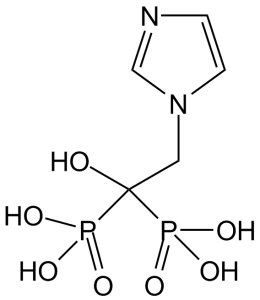
Zoledronic acid is an imidazole compound having a 2,2-bis(phosphono)-2-hydroxyethane-1-yl substituent at the 1-position. It has a role as a bone density conservation agent. It is a member of imidazoles and a 1,1-bis(phosphonic acid).
Zoledronic acid, or CGP 42'446, is a third generation, nitrogen containing bisphosphonate similar to [ibandronic acid], [minodronic acid], and [risedronic acid]. Zoledronic acid is used to treat and prevent multiple forms of osteoporosis, hypercalcemia of malignancy, multiple myeloma, bone metastases from solid tumors, and Paget’s disease of bone. Zoledronic acid was first described in the literature in 1994. Zoledronic acid was granted FDA approval on 20 August 2001. Zoledronic acid anhydrous is a Bisphosphonate. Zoledronic Acid is a synthetic imidazole bisphosphonate analog of pyrophosphate with anti-bone-resorption activity. A third-generation bisphosphonate, zoledronic acid binds to hydroxyapatite crystals in the bone matrix, slowing their dissolution and inhibiting the formation and aggregation of these crystals. This agent also inhibits farnesyl pyrophosphate synthase, an enzyme involved in terpenoid biosynthesis. Inhibition of this enzyme prevents the biosynthesis of isoprenoid lipids, donor substrates of farnesylation and geranylgeranylation during the post-translational modification of small GTPase signalling proteins, which are important in the process of osteoclast turnover. Decreased bone turnover and stabilization of the bone matrix contribute to the analgesic effect of zoledronic acid with respect to painful osteoblastic lesions. The agent also reduces serum calcium concentrations associated with hypercalcemia. Zoledronic Acid Anhydrous is anhydrous form of a synthetic imidazole third generation bisphosphonate analog of pyrophosphate with antiresorptive activity. Zoledronate binds to hydroxyapatite crystals in the bone matrix and inhibits farnesyl pyrophosphate (diphosphate) synthase, thereby preventing protein prenylation within the mevalonate pathway. This leads to the loss of downstream metabolites essential for osteoclast function, leading to the induction of apoptosis and eventually, osteoclast-cell death. By preventing osteoclast-mediated bone resorption, zoledronate decreases bone turnover and stabilizes the bone matrix. Zoledronate (zoledronic acid, marketed by Novartis under the trade names Zometa and Reclast) is a bisphosphonate. Zometa is used to prevent skeletal fractures in patients with cancers such as multiple myeloma and prostate cancer. It can also be used to treat hypercalcemia of malignancy and can be helpful for treating pain from bone metastases. An annual dose of Zoledronate may also prevent recurring fractures in patients with a previous hip fracture. Zoledronate is a single 5 mg infusion for the treatment of Paget's disease of bone. In 2007, the FDA also approved Reclast for the treatment of postmenopausal osteoporosis. An imidobisphosphonate inhibitor of BONE RESORPTION that is used for the treatment of malignancy-related HYPERCALCEMIA; OSTEITIS DEFORMANS; and OSTEOPOROSIS. Drug Indication Zoledronic acid is indicated to treat hypercalcemia of malignancy, multiple myeloma, bone metastases from solid tumors, osteoporosis in men and postmenopausal women, glucocorticoid induced osteoporosis, and Paget's disease of bone in men and women. Zoledronic acid is also indicated for the prevention of osteoporosis in post menopausal women and glucocorticoid induced osteoporosis. Prevention of skeletal-related events (pathological fractures, spinal compression, radiation or surgery to bone, or tumour-induced hypercalcaemia) in adult patients with advanced malignancies involving bone. Treatment of adult patients with tumour-induced hypercalcaemia. Prevention of skeletal related events (pathological fractures, spinal compression, radiation or surgery to bone, or tumour-induced hypercalcaemia) in adult patients with advanced malignancies involving bone; treatment of adult patients with tumour-induced hypercalcaemia (TIH). Treatment of osteoporosis: , , , in post-menopausal women; , in men; , , , at increased risk of fracture, including those with a recent low-trauma hip fracture. , , Treatment of osteoporosis associated with long-term systemic glucocorticoid therapy in post-menopausal women and in men at increased risk of fracture. , , Treatment of Paget's disease of the bone. , Prevention of skeletal related events (pathological fractures, spinal compression, radiation or surgery to bone, or tumour-induced hypercalcaemia) in adult patients with advanced malignancies involving bone. Treatment of adult patients with tumour-induced hypercalcaemia (TIH). 4 mg / 5 ml and 4 mg / 100 ml: Prevention of skeletal-related events (pathological fractures, spinal compression, radiation or surgery to bone, or tumour-induced hypercalcaemia) in adult patients with advanced malignancies involving bone. Treatment of adult patients with tumour-induced hypercalcaemia (TIH). 5 mg / 100 ml: Treatment of osteoporosis: in post-menopausal women; in men; at increased risk of fracture, including those with a recent low-trauma hip fracture. Treatment of osteoporosis associated with long-term systemic glucocorticoid therapy: in post-menopausal women; in men; at increased risk of fracture. Treatment of Paget's disease of the bone in adults. Prevention of skeletal-related events and treatment of tumour-induced hypercalcaemia. Prevention of skeletal related events (pathological fractures, spinal compression, radiation or surgery to bone, or tumour-induced hypercalcaemia) in patients with advanced malignancies involving bone; treatment of tumour-induced hypercalcaemia (TIH); prevention of skeletal related events (pathological fractures, spinal compression, radiation or surgery to bone, or tumour-induced hypercalcaemia) in patients with advanced malignancies involving bone; treatment of tumour-induced hypercalcaemia (TIH); prevention of skeletal related events (pathological fractures, spinal compression, radiation or surgery to bone, or tumour-induced hypercalcaemia) in adult patients with advanced malignancies involving bone; treatment of adult patients with tumour-induced hypercalcaemia (TIH). Prevention of skeletal related events (pathological fractures, spinal compression, radiation or surgery to bone, or tumour-induced hypercalcaemia) in adult patients with advanced malignancies involving bone. Treatment of adult patients with tumour-induced hypercalcaemia (TIH). Treatment of osteoporosis: , , , in post-menopausal women; , in men; , , , at increased risk of fracture including those with a recent low-trauma hip fracture. , , Treatment of osteoporosis associated with long-term systemic glucocorticoid therapy: , , , in post-menopausal women; , in men; , , , at increased risk of fracture. , , Treatment of Paget's disease of the bone in adults. , Treatment of osteoporosisin post-menopausal womenin adult menat increased risk of fracture, including those with recent low-trauma hip fracture. Treatment of osteoporosis associated with long-term systemic glucocorticoid therapyin post-menopausal womenin adult menat increased risk of fracture. Treatment of Paget's disease of the bone in adults. Treatment of osteoporosis, Treatment of Pagetâs disease of the bone Osteogenesis imperfecta, Prevention of fracture and bone loss in postmenopausal women with early-stage breast cancer treated with aromatase inhibitors, Prevention of skeletal related events in patients with advanced malignancies involving bone, Tumour-induced hypercalcaemia Mechanism of Action Bisphosphonates are taken into the bone where they bind to hydroxyapatite. Bone resorption by osteoclasts causes local acidification, releasing the bisphosphonate, which is taken into the osteoclast by fluid-phase endocytosis. Endocytic vesicles become acidified, releasing bisphosphonates into the cytosol of osteoclasts where they act. Osteoclasts mediate resorption of bone. When osteoclasts bind to bone they form podosomes, ring structures of F-actin. Etidronic acid also inhibits V-ATPases in the osteoclast, though the exact subunits are unknown, preventing F-actin from forming podosomes. Disruption of the podosomes causes osteoclasts to detach from bones, preventing bone resorption. Nitrogen containing bisphosphonates such as zoledronate are known to induce apoptosis of hematopoietic tumor cells by inhibiting the components of the mevalonate pathway farnesyl diphosphate synthase, farnesyl diphosphate, and geranylgeranyl diphosphate. These components are essential for post-translational prenylation of GTP-binding proteins like Rap1. The lack of prenylation of these proteins interferes with their function, and in the case of Rap1, leads to apoptosis. zoledronate also activated caspases which further contribute to apoptosis. Zoledronic Acid (Zoledronate; CGP 42446) is a third-generation bisphosphonate drug that exerts anti-bone resorption effects by inhibiting FPPS to block isoprenylation, destroying the cytoskeleton and function of osteoclasts [3] Approved indications of Zoledronic Acid (Zoledronate; CGP 42446) include: postmenopausal osteoporosis, bone-related events caused by malignant tumor bone metastasis (pathological fracture, bone pain, hypercalcemia), and bone lesions of multiple myeloma [1] The mechanisms of Zoledronic Acid (Zoledronate; CGP 42446) against bone cancer metastasis include: inhibiting osteoclast-mediated bone lysis, directly inhibiting tumor cell proliferation, inducing tumor cell apoptosis, and regulating the expression of inflammatory factors (TNF-α, IL-6) in the tumor microenvironment [1] The mechanism of Zoledronic Acid (Zoledronate; CGP 42446) in the treatment of chronic low back pain related to Modic changes is associated with inhibiting local inflammatory response and regulating the balance of bone remodeling [6] |
| 分子式 |
C5H10N2O7P2
|
|---|---|
| 分子量 |
272.09
|
| 精确质量 |
271.996
|
| CAS号 |
118072-93-8
|
| 相关CAS号 |
Zoledronic acid monohydrate;165800-06-6;Zoledronic acid disodium tetrahydrate;165800-07-7; Zoledronic Acid;118072-93-8; 165800-06-6 (free acid hydrate); 131654-46-1 (disodium); 165800-08-8 (trisodium hydrate); 827573-11-5 (trisodium); 165800-07-7 (disodium hydrate);
|
| PubChem CID |
68740
|
| 外观&性状 |
White to off-white solid
|
| 密度 |
2.1±0.1 g/cm3
|
| 沸点 |
764.0±70.0 °C at 760 mmHg
|
| 熔点 |
193-2040ºC
|
| 闪点 |
415.8±35.7 °C
|
| 蒸汽压 |
0.0±2.7 mmHg at 25°C
|
| 折射率 |
1.719
|
| LogP |
-2.28
|
| tPSA |
172.73
|
| 氢键供体(HBD)数目 |
5
|
| 氢键受体(HBA)数目 |
8
|
| 可旋转键数目(RBC) |
4
|
| 重原子数目 |
16
|
| 分子复杂度/Complexity |
327
|
| 定义原子立体中心数目 |
0
|
| SMILES |
P(C(C([H])([H])N1C([H])=NC([H])=C1[H])(O[H])P(=O)(O[H])O[H])(=O)(O[H])O[H]
|
| InChi Key |
XRASPMIURGNCCH-UHFFFAOYSA-N
|
| InChi Code |
InChI=1S/C5H10N2O7P2/c8-5(15(9,10)11,16(12,13)14)3-7-2-1-6-4-7/h1-2,4,8H,3H2,(H2,9,10,11)(H2,12,13,14)
|
| 化学名 |
(1-hydroxy-2-imidazol-1-yl-1-phosphonoethyl)phosphonic acid
|
| 别名 |
CGP42446; CGP42446A; ZOL446; CGP-42446; CGP-42446A; ZOL-446; CGP 42446; CGP 42446A; ZOL 446; Zoledronate; Zometa; Reclast; Aclasta; (1-Hydroxy-2-(1H-imidazol-1-yl)ethane-1,1-diyl)diphosphonic acid; (1-Hydroxy-2-imidazol-1-ylethylidene)diphosphonic acid; Zoledronate, trade names: Zometa; Reclast
|
| HS Tariff Code |
2934.99.9001
|
| 存储方式 |
Powder -20°C 3 years 4°C 2 years In solvent -80°C 6 months -20°C 1 month 注意: 请将本产品存放在密封且受保护的环境中(例如氮气保护),避免吸湿/受潮。 |
| 运输条件 |
Room temperature (This product is stable at ambient temperature for a few days during ordinary shipping and time spent in Customs)
|
| 溶解度 (体外实验) |
|
|||
|---|---|---|---|---|
| 溶解度 (体内实验) |
配方 1 中的溶解度: 8.7 mg/mL (31.97 mM) in PBS (这些助溶剂从左到右依次添加,逐一添加), 澄清溶液。
配方 2 中的溶解度: 30% PEG400+0.5% Tween80+5% Propylene glycol: 10 mg/mL 请根据您的实验动物和给药方式选择适当的溶解配方/方案: 1、请先配制澄清的储备液(如:用DMSO配置50 或 100 mg/mL母液(储备液)); 2、取适量母液,按从左到右的顺序依次添加助溶剂,澄清后再加入下一助溶剂。以 下列配方为例说明 (注意此配方只用于说明,并不一定代表此产品 的实际溶解配方): 10% DMSO → 40% PEG300 → 5% Tween-80 → 45% ddH2O (或 saline); 假设最终工作液的体积为 1 mL, 浓度为5 mg/mL: 取 100 μL 50 mg/mL 的澄清 DMSO 储备液加到 400 μL PEG300 中,混合均匀/澄清;向上述体系中加入50 μL Tween-80,混合均匀/澄清;然后继续加入450 μL ddH2O (或 saline)定容至 1 mL; 3、溶剂前显示的百分比是指该溶剂在最终溶液/工作液中的体积所占比例; 4、 如产品在配制过程中出现沉淀/析出,可通过加热(≤50℃)或超声的方式助溶; 5、为保证最佳实验结果,工作液请现配现用! 6、如不确定怎么将母液配置成体内动物实验的工作液,请查看说明书或联系我们; 7、 以上所有助溶剂都可在 Invivochem.cn网站购买。 |
| 制备储备液 | 1 mg | 5 mg | 10 mg | |
| 1 mM | 3.6753 mL | 18.3763 mL | 36.7525 mL | |
| 5 mM | 0.7351 mL | 3.6753 mL | 7.3505 mL | |
| 10 mM | 0.3675 mL | 1.8376 mL | 3.6753 mL |
1、根据实验需要选择合适的溶剂配制储备液 (母液):对于大多数产品,InvivoChem推荐用DMSO配置母液 (比如:5、10、20mM或者10、20、50 mg/mL浓度),个别水溶性高的产品可直接溶于水。产品在DMSO 、水或其他溶剂中的具体溶解度详见上”溶解度 (体外)”部分;
2、如果您找不到您想要的溶解度信息,或者很难将产品溶解在溶液中,请联系我们;
3、建议使用下列计算器进行相关计算(摩尔浓度计算器、稀释计算器、分子量计算器、重组计算器等);
4、母液配好之后,将其分装到常规用量,并储存在-20°C或-80°C,尽量减少反复冻融循环。
计算结果:
工作液浓度: mg/mL;
DMSO母液配制方法: mg 药物溶于 μL DMSO溶液(母液浓度 mg/mL)。如该浓度超过该批次药物DMSO溶解度,请首先与我们联系。
体内配方配制方法:取 μL DMSO母液,加入 μL PEG300,混匀澄清后加入μL Tween 80,混匀澄清后加入 μL ddH2O,混匀澄清。
(1) 请确保溶液澄清之后,再加入下一种溶剂 (助溶剂) 。可利用涡旋、超声或水浴加热等方法助溶;
(2) 一定要按顺序加入溶剂 (助溶剂) 。
|
|
|
InvivoChem的所有产品仅用于作科学研究,不面向患者销售
Copyright 2020 InvivoChem LLC | All Rights Reserved 粤ICP备20063088号-1


 COA
COA


 粤公网安备 44011102003439号
 463611831
