| 规格 | 价格 | 库存 | 数量 |
|---|---|---|---|
| 100mg |
|
||
| Other Sizes |
|

| 靶点 |
Antifungal
|
|---|---|
| 体内研究 (In Vivo) |
嘧菌酯和啶氧菌酯是全球广泛使用的两种甲氧基丙烯酸酯类杀菌剂。本研究通过斑马鱼(Danio rerio)模型评估其对胚胎发育及多种酶活性的影响。将鱼卵分别暴露于两种杀菌剂(受精后24至144小时,hpf),测定死亡率、孵化率和畸形率;同时检测96 hpf幼鱼及成年雌雄鱼肝脏中三种抗氧化酶[过氧化氢酶(CAT)、超氧化物歧化酶(SOD)和过氧化物酶(POD)]、两种解毒酶[羧酸酯酶(CarE)和谷胱甘肽S-转移酶(GST)]的活性以及丙二醛(MDA)含量以探究毒性机制。胚胎发育实验显示,嘧菌酯和啶氧菌酯处理的鱼卵死亡率、孵化率及畸形率均呈现显著剂量-时间依赖性,144小时半数致死浓度(LC50)分别为1174.9和213.8 μg·L−1。在96 hpf幼鱼实验中,与对照组相比,暴露组CAT、POD、CarE和GST活性及MDA含量均随农药浓度显著升高。进一步研究发现,两种杀菌剂均导致成年鱼肝脏显著氧化应激且存在性别差异。结果表明啶氧菌酯比嘧菌酯对斑马鱼具有更强的胚胎发育毒性和氧化应激效应,而雄性斑马鱼肝脏解毒能力优于雌性。[1]
甲氧基丙烯酸酯类是目前使用最广泛的杀菌剂,但对部分水生生物具有高毒性。本研究将斑马鱼胚胎暴露于三种杀菌剂(吡唑醚菌酯、肟菌酯和啶氧菌酯)不同浓度(受精后96小时内),评估其水生毒性。三种杀菌剂对胚胎的96小时LC50值分别为61、55和86 μg/L。急性暴露期间观察到胚胎出现心跳减缓、孵化抑制、生长迟滞及形态畸形等症状。此外,这些杀菌剂通过增加活性氧(ROS)和MDA含量、抑制SOD活性与GSH含量,并差异调节CAT活性及抗氧化系统相关基因(Mn-sod、Cu/Zn-sod、Cat、Nrf2、Ucp2和Bcl2)的mRNA水平诱导氧化应激。暴露还导致先天免疫相关因子IFN和CC-chem显著上调,并差异影响TNFa、IL-1b、C1C和IL-8的表达,表明其可引发胚胎发育期免疫毒性。三种杀菌剂引发的酶活性和基因表达差异响应可能是其毒性差异的原因。本研究通过多层面比较揭示了甲氧基丙烯酸酯类对水生生物的毒性效应。[2] |
| 酶活实验 |
成年斑马鱼肝脏酶活性研究 [1]
采用20 L玻璃烧杯(每杯盛装15 L测试溶液并放养120尾2月龄斑马鱼,雌雄比1:1)进行成年鱼实验。测试浓度与2.4节(幼鱼研究)相同。暴露实验重复三次,每24小时更换溶液以维持化学物质浓度和水质稳定。分别于7、14、21和28天每组取样30尾鱼,参照2.4节方法分离肝脏测定CAT、SOD、POD、CarE和GST酶活性及MDA含量。 化学分析 [1] 胚胎发育实验中,于每次换液前0和24小时分别采集暴露介质水样(每组10 mL),包括嘧菌酯(150、300、500、1000、1500、2000 μg·L−1)和啶氧菌酯(15、25、50、100、200、400 μg·L−1)组。采用超高效液相色谱-串联质谱(UPLC/MS/MS)测定实际浓度,以几何平均浓度计算LC50值。具体步骤:取5 mL水样加入10 mL离心管,加5 mL乙腈震荡30秒,再加入2 g NaCl和3 g MgSO4震荡1分钟,4000 rpm离心5分钟后上清液经0.22 μm微孔膜过滤,使用配备ACQUITYUPLC®BEHC181.7 μm色谱柱的Agilent 7890A UPLC/MS/MS系统,在电喷雾电离(ESI)和多反应监测(MRM)模式下进行分析。每个样品重复测定三次以验证标称浓度。 |
| 动物实验 |
胚胎发育毒性试验[1]
胚胎发育毒性试验按照OECD指南210(OECD,2013)进行,并做了一些修改。将20枚受精卵(3 hpf)置于标准24孔板中,每孔加入1枚卵和2 mL溶液,并暴露于各试验浓度下。剩余的4个孔作为对照(系统用水)。LC50试验中,胚胎暴露于标称浓度为0、150、300、500、1000、1500和2000 μg L−1的嘧菌酯或标称浓度为0、15、25、50、100、200和400 μg L−1的吡唑醚菌酯。另取20个胚胎置于单独的24孔板中,暴露于丙酮溶剂溶液中,作为溶剂对照。每个用于测试的卵批次均设置一个阳性对照,其中3,4-二氯苯胺的固定浓度为4 mg L⁻¹。暴露实验重复三次,每24小时更换一次各孔中的暴露溶液,以维持相对恒定的测试化学物质浓度。将培养板置于26 ± 1 °C的培养箱中。在受精后24、48、72、96和144小时,使用奥林巴斯BX63显微镜检查胚胎的死亡率、孵化率和致畸率。 斑马鱼幼体研究中的酶活性[1] 斑马鱼幼体研究采用标准6孔板,每孔放入3个受精卵(受精后3小时),并加入10 mL测试溶液。测试浓度基于成体急性毒性试验的初步LC50结果(数据未给出),最高剂量设定为先前LC50/6。测试溶液为一系列不同浓度的嘧菌酯(标称浓度分别为 0、0.25、2.5、25 和 250 μg L⁻¹)和吡唑醚菌酯(标称浓度分别为 0、0.02、0.2、2 和 20 μg L⁻¹)。暴露实验重复三次,每孔溶液每 24 小时更换一次,以维持相对稳定的测试化学物质浓度和水质。将培养板置于 26 ± 1 °C 的培养箱中培养 96 小时,并在暴露过程中及时移除死亡的卵或斑马鱼幼体。然后,根据制造商的建议,使用处理过的斑马鱼幼体进行酶活性(CAT、POD、CarE 和 GST)和 MDA 含量测定。CAT、POD、CarE 和 GST 的活性以基于蛋白质含量的 U mg⁻¹ 表示。 MDA 含量以 nmol mg−1 表示。 t胚胎急性毒性暴露[2] 根据 OECD 鱼类胚胎毒性 (FET) 测试草案提案 (OECD, 2013) 和先前提出的方法 (Fraysse et al., 2006) 对斑马鱼胚胎进行了急性毒性试验。将受精后2小时(2 hpf)的胚胎随机分配到24孔培养板中(每孔2 mL溶液,1个胚胎),分别暴露于不同浓度的测试溶液(吡唑醚菌酯:30.0、37.5、47.0、58.6、73.0 μg/L;三氟苯嘧菌酯:30.0、37.5、47.0、58.6、73.0 μg/L;吡唑醚菌酯:60、69、79、91、105 μg/L)中96小时。测试浓度是根据预实验数据(数据未显示)设计的。所有测试溶液均使用复水配制,复水也用作空白对照。溶剂对照组的丙酮和吐温-80含量与各杀菌剂最高浓度测试溶液中的含量相同。在每个24孔板中,20个孔装有测试溶液,4个孔装有复原水作为内对照。每个浓度和对照均重复三次(每个孔板作为一个重复),每个孔板包含60个胚胎。所有测试的24孔板均置于培养箱中(27 ± 1 °C;14:10 小时光照/黑暗周期)。孔板用透明盖覆盖以防止蒸发。每24小时更换一次暴露溶液,以保持合适的杀菌剂浓度和水质。暴露期间立即移除死亡个体。每天使用倒置显微镜检查并记录形态发育和异常情况。使用显微镜计数72小时后存活的斑马鱼胚胎/幼虫在20秒内的心跳次数来测量心率。胚胎孵化率计算为72小时后孵化卵数的百分比。使用Aigo GE-5测量96 hpf幼虫的体长。 酶活性和基因表达测试的暴露[2] 将2 hpf的胚胎随机转移至1 L烧杯中的测试溶液(吡唑醚菌酯:0、10、20、40 μg/L;三氟苯嘧菌酯:0、10、20、40 μg/L;吡唑醚菌酯:0、15、30、60 μg/L)。浓度的选择基于急性毒性试验结果和一些已报道的环境浓度。最低浓度约为96 h-LC50值的1/6,低于中国稻田水中检测到的浓度(Cao et al., 2015; Guo et al., 2016)。最高浓度约为96小时LC50值的2/3,对胚胎有不良影响。每个烧杯中盛有500 mL暴露溶液和200个胚胎,每个浓度处理组设置3个烧杯。暴露期间的外部条件,包括温度、湿度和光照周期,与急性毒性试验相同。每24小时更换一次暴露溶液,以保持适宜的杀菌剂浓度和水质。在受精后96小时(96 hpf),从每个重复组中收集胚胎(120个用于抗氧化指数测定;30个用于RNA提取),并用重构水洗涤两次。胚胎样品储存在−80 °C下以备后续研究。 |
| 毒性/毒理 (Toxicokinetics/TK) |
三种杀菌剂对斑马鱼胚胎的急性毒性[2]
胚胎急性毒性试验结果表明,三种甲氧基丙烯酸酯类杀菌剂对斑马鱼胚胎具有高毒性。根据96小时LC50值,三氟苯嘧菌酯对胚胎的毒性最大(55 μg/L),其次是吡唑醚菌酯(61 μg/L)和吡唑醚菌酯(86 μg/L)(表1)。 三种甲氧基丙烯酸酯类杀菌剂对胚胎发育的影响[2] 结果表明,在72小时后受精的胚胎中,三种杀菌剂处理均显著抑制了胚胎的心跳。在浓度为 58.6 μg/L 的吡唑醚菌酯和三氟苯嘧菌酯以及浓度为 91 μg/L 的吡唑醚菌酯处理组中,胚胎 20 秒心跳率分别降至对照组的 44.89%、41.50% 和 44.11%(图 1A)。同时,暴露于浓度高于 58.6 μg/L 的吡唑醚菌酯和三氟苯嘧菌酯以及浓度为 69 μg/L 的吡唑醚菌酯均导致 72 小时后胚胎孵化率显著降低。在浓度为 73.0 μg/L 的三氟苯嘧菌酯处理组中未观察到孵化(图 1B)。在受精后96小时(hpf),三种杀菌剂处理组中孵化幼虫的体长均呈剂量依赖性显著降低(图1C)。 三种甲氧基丙烯酸酯类杀菌剂[2]对胚胎的致畸作用 吡唑醚菌酯、三氟苯嘧菌酯和吡唑醚菌酯在胚胎发育过程中诱导形态异常,包括生长迟缓、心包水肿、卵黄囊水肿、卵黄囊畸形和色素沉着缺陷(图2A)。暴露于这三种甲氧基丙烯酸酯类杀菌剂后,累积畸形率呈剂量依赖性显著增加(图2B)。在受精后96小时(96 hpf),对照组未观察到畸形个体,而吡唑醚菌酯73.0 μg/L、三氟苯嘧菌酯58.6和73.0 μg/L、吡唑醚菌酯91和105 μg/L处理组的畸形率均达到100%。 三种杀菌剂对胚胎ROS和MDA含量的影响[2] 结果表明,三种杀菌剂的最高浓度均能显著诱导胚胎中ROS含量升高,与对照组相比,吡唑醚菌酯、三氟苯嘧菌酯和吡唑醚菌酯处理组的ROS含量分别增加了1.28倍、1.63倍和1.49倍(图3A)。与对照组相比,所有浓度的三氟苯嘧菌酯均显著诱导斑马鱼胚胎的MDA水平,分别增加了2.98倍、3.60倍和3.97倍。同时,吡唑醚菌酯20和40 μg/L、吡唑醚菌酯30和60 μg/L处理分别使胚胎的MDA水平升高了1.42倍、2.82倍、1.66倍和2.64倍,而吡唑醚菌酯10 μg/L和吡唑醚菌酯15 μg/L处理组的MDA水平未发生显著变化(图3B)。 三种杀菌剂对胚胎酶活性的影响[2] 结果表明,三种甲氧基丙烯酸酯类杀菌剂均导致胚胎中SOD活性(图4A)和GSH含量(图4C)明显降低。在40 μg/L吡唑醚菌酯和三氟苯嘧菌酯、30 μg/L吡唑醚菌酯和60 μg/L吡唑醚菌酯处理组中,胚胎的相对SOD水平显著降低,分别仅为对照组的0.77倍、0.63倍、0.69倍和0.49倍。吡唑醚菌酯处理组中GSH含量呈剂量依赖性降低,40 μg/L三氟苯嘧菌酯和60 μg/L吡唑醚菌酯处理组中也观察到GSH含量降低。 40 μg/L 吡唑醚菌酯和三氟苯嘧菌酯显著降低了 CAT 的活性,而 15、30 和 60 μg/L 的吡唑醚菌酯则明显诱导了 CAT 的活性,与对照组相比,其活性分别提高了 1.85 倍、1.96 倍和 1.48 倍(图 4B)。 三种杀菌剂对胚胎基因表达的影响[2] 氧化应激相关基因表达水平的改变[2] 所有浓度的三氟苯嘧菌酯以及 15、30 μg/L 的吡唑醚菌酯均明显诱导了 Mn-sod 的 mRNA 表达,而吡唑醚菌酯则没有诱导作用(图 5A)。吡唑醚菌酯在10 μg/L浓度下可诱导Cu/Zn-sod的转录,但在20和40 μg/L浓度下则显著抑制(图5B)。40 μg/L吡唑醚菌酯和三氟苯嘧菌酯均显著降低了Cat的mRNA水平,分别仅为对照组的0.67倍和0.57倍(图5C)。Nrf2的mRNA表达水平在所有浓度的吡唑醚菌酯和60 μg/L吡唑醚菌酯处理组中均降低,而在20和40 μg/L三氟苯嘧菌酯处理组中升高(图5D)。与对照组相比,10 μg/L 和 40 μg/L 吡唑醚菌酯以及 60 μg/L 吡唑醚菌酯均显著诱导了 Ucp2 的 mRNA 水平,分别增加了 1.46 倍、1.50 倍和 1.38 倍(图 5E)。20 μg/L 和 40 μg/L 吡唑醚菌酯以及 60 μg/L 吡唑醚菌酯明显抑制了 Bcl2 的转录,但在三氟苯嘧菌酯处理组中未观察到显著变化(图 5F)。 免疫系统相关基因表达水平的改变[2] 在所有浓度的三氟苯嘧菌酯处理组中,胚胎中 TNFα 的 mRNA 表达水平均显著降低,而在吡唑醚菌酯和吡唑醚菌酯处理组中未观察到明显变化(图 6A)。吡唑醚菌酯浓度为20和40 μg/L时,IL-1β的转录水平明显受到抑制;而40 μg/L三氟苯嘧菌酯和15 μg/L吡唑醚菌酯则显著诱导斑马鱼胚胎中IL-1β的表达,分别上调1.53倍和3.68倍(图6B)。与对照组相比,最高浓度的吡唑醚菌酯、三氟苯嘧菌酯和吡唑醚菌酯处理后,IFN的表达水平分别上调4.66倍、2.38倍和2.21倍(图6C)。 CC-chem的转录水平分别被20和40 μg/L吡唑醚菌酯、40 μg/L三氟苯嘧菌酯和60 μg/L吡唑醚菌酯诱导,分别增加了1.73倍、3.48倍、1.87倍和1.78倍(图6D)。10和20 μg/L三氟苯嘧菌酯明显抑制了C1C mRNA的表达,而40 μg/L吡唑醚菌酯使C1C mRNA水平较对照组增加了1.62倍(图6E)。在所有浓度的三氟苯嘧菌酯处理下,斑马鱼胚胎中IL-8 mRNA水平均显著降低(图6F)。 29111t吡唑醚菌酯杀菌剂t水生植物t蓝藻Anabaena flos-aquaetN.R.t96 hrtEC50t>t3000极限试验tPPB 29115t吡唑醚菌酯R403814降解剂t杀菌剂t鱼类Fathead minnowtPimephales promelast0.59 gt96 hrtLC50t>t10(极限试验)tPPM 29116t吡唑醚菌酯杀菌剂t野鸭Mallard ducktAnas platyrhynchost10 Dt8 DtLC50t>t5200tPPM 29117t吡唑醚菌酯杀菌剂tAvest白鹌鹑Colinus virginianust22周t14 DtLD50t>t2250tMGK 29118t吡唑醚菌酯R408509降解剂t杀菌剂tFishest钝吻鮈Pimephales promelast0.59 gt96 hrtLC50t>t10(极限测试)tPPM |
| 参考文献 |
[1]. Effects of two strobilurins (azoxystrobin and picoxystrobin) on embryonic development and enzyme activities in juveniles and adult fish livers of zebrafish (Danio rerio). Chemosphere. 2018 Sep;207:573-580.
[2]. Developmental toxicity, oxidative stress and immunotoxicity induced by three strobilurins (pyraclostrobin, trifloxystrobin and picoxystrobin) in zebrafish embryos . Chemosphere, 2018, 207: 781-790. |
| 其他信息 |
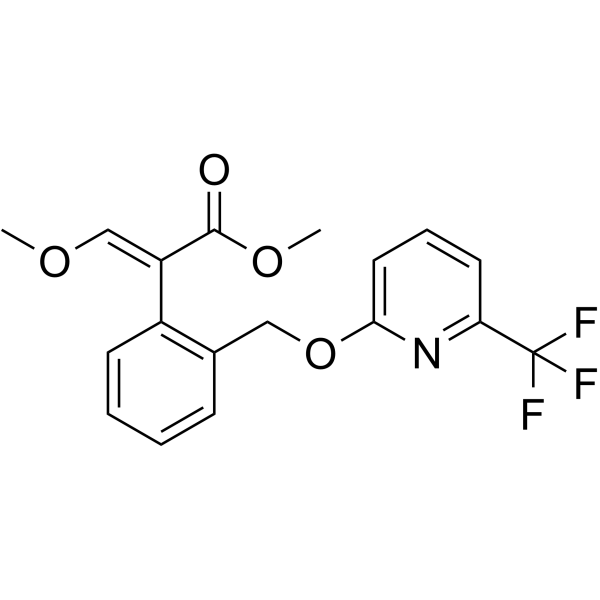
吡唑醚菌酯是一种烯酸酯,是(2E)-3-甲氧基-2-[2-({[6-(三氟甲基)吡啶-2-基]氧基}甲基)苯基]丙-2-烯酸的甲酯。它是一种谷类杀菌剂,用于防治多种病害,包括褐锈病、褐斑病、白粉病和网斑病。它是一种线粒体细胞色素bc1复合物抑制剂和抗真菌农药。它是一种芳香醚、烯酸酯、烯醇醚、有机氟化合物、吡啶类化合物,也是一种甲氧基丙烯酸酯类抗真菌剂。在对成年斑马鱼肝脏酶活性的研究中,吡唑醚菌酯处理在早期显著激活了雄性和雌性斑马鱼肝脏的谷胱甘肽S-转移酶(GST)活性,而在后期GST活性下降,这归因于反应底物减少或竞争性抑制(Egaas et al., 1999)。除0.2 μg L⁻¹处理组的雌性斑马鱼外,所有处理组的CarE酶活性在7天时均显著受到抑制(P < 0.01),但在7天后显著激活。由于早期活性氧(ROS)的过度产生,丙二醛(MDA)含量显著高于对照组,随后超氧化物歧化酶(SOD)活性显著激活。在整个试验过程中,雌性斑马鱼肝脏的超氧化物歧化酶(SOD)活性在第14天被最低剂量(0.02 μg L⁻¹)的吡唑醚菌酯显著抑制,随后恢复至对照水平,但被最高剂量(20 μg L⁻¹)的吡唑醚菌酯显著激活;而雄性斑马鱼肝脏的SOD酶活性在后期受到抑制。雄性和雌性斑马鱼肝脏中过氧化氢酶(CAT)和过氧化物酶(POD)活性在第14至28天显著激活,表明吡唑醚菌酯造成了持续的氧化损伤。结果表明,雌性斑马鱼的氧化损伤比雄性斑马鱼更为严重,因为雄性斑马鱼肝脏对吡唑醚菌酯的解毒能力强于雌性斑马鱼肝脏。
总之,嘧菌酯和吡唑醚菌酯均对斑马鱼幼体和成体肝脏产生发育毒性并诱导氧化应激。雄性斑马鱼肝脏对嘧菌酯或吡唑醚菌酯的解毒能力强于雌性斑马鱼肝脏。由于径流水中嘧菌酯的环境浓度相对较高,因此它可能对中国斑马鱼幼体构成潜在风险。尽管目前尚无关于天然水体中吡唑醚菌酯残留环境浓度的报道,但由于吡唑醚菌酯对斑马鱼胚胎发育的毒性和氧化应激作用高于嘧菌酯,因此也应更加关注吡唑醚菌酯。 [1] 总之,我们的研究结果表明,吡唑醚菌酯、三氟苯嘧菌酯和吡唑醚菌酯对斑马鱼胚胎表现出较高的急性毒性。暴露于这三种杀菌剂的胚胎均表现出心率下降、孵化抑制、生长倒退和形态畸形,且这些症状呈浓度依赖性。这种发育毒性的潜在机制可能部分与活性氧(ROS)的异常生成、丙二醛(MDA)含量的增加、抗氧化酶活性的变化以及与氧化应激和免疫系统相关的基因mRNA水平的变化有关。这些参数的不同变化可能是造成这三种杀菌剂毒性差异的原因。由于甲氧基丙烯酸酯类杀菌剂对真菌的作用靶点是线粒体复合物Ⅲ,因此未来需要研究这些杀菌剂对鱼类线粒体的影响,以充分了解甲氧基丙烯酸酯类杀菌剂对水生生物的毒性机制。[2] |
| 分子式 |
C18H16F3NO4
|
|---|---|
| 分子量 |
367.32
|
| 精确质量 |
367.103
|
| 元素分析 |
C, 58.86; H, 4.39; F, 15.52; N, 3.81; O, 17.42
|
| CAS号 |
117428-22-5
|
| 相关CAS号 |
Picoxystrobin-d3
|
| PubChem CID |
11285653
|
| 外观&性状 |
Typically exists as solid at room temperature
|
| 密度 |
1.3±0.1 g/cm3
|
| 沸点 |
453.1±45.0 °C at 760 mmHg
|
| 熔点 |
75°
|
| 闪点 |
227.9±28.7 °C
|
| 蒸汽压 |
0.0±1.1 mmHg at 25°C
|
| 折射率 |
1.522
|
| LogP |
4.48
|
| tPSA |
57.65
|
| 氢键供体(HBD)数目 |
0
|
| 氢键受体(HBA)数目 |
8
|
| 可旋转键数目(RBC) |
7
|
| 重原子数目 |
26
|
| 分子复杂度/Complexity |
495
|
| 定义原子立体中心数目 |
0
|
| SMILES |
CO/C=C(\C1=CC=CC=C1COC2=CC=CC(=N2)C(F)(F)F)/C(=O)OC
|
| InChi Key |
IBSNKSODLGJUMQ-SDNWHVSQSA-N
|
| InChi Code |
InChI=1S/C18H16F3NO4/c1-24-11-14(17(23)25-2)13-7-4-3-6-12(13)10-26-16-9-5-8-15(22-16)18(19,20)21/h3-9,11H,10H2,1-2H3/b14-11+
|
| 化学名 |
methyl (E)-3-methoxy-2-[2-[[6-(trifluoromethyl)pyridin-2-yl]oxymethyl]phenyl]prop-2-enoate
|
| 别名 |
Picoxystrobin; 117428-22-5; Picoxystrobin [ISO]; UNII-62DH7GEL1P; 62DH7GEL1P; DTXSID9047542; CHEBI:83197; PICOXYSTROBIN [MI];
|
| HS Tariff Code |
2934.99.9001
|
| 存储方式 |
Powder -20°C 3 years 4°C 2 years In solvent -80°C 6 months -20°C 1 month |
| 运输条件 |
Room temperature (This product is stable at ambient temperature for a few days during ordinary shipping and time spent in Customs)
|
| 溶解度 (体外实验) |
DMSO : 100 mg/mL (272.24 mM)
|
|---|---|
| 溶解度 (体内实验) |
配方 1 中的溶解度: ≥ 2.5 mg/mL (6.81 mM) (饱和度未知) in 10% DMSO + 40% PEG300 + 5% Tween80 + 45% Saline (这些助溶剂从左到右依次添加,逐一添加), 澄清溶液。
例如,若需制备1 mL的工作液,可将100 μL 25.0 mg/mL澄清DMSO储备液加入到400 μL PEG300中,混匀;然后向上述溶液中加入50 μL Tween-80,混匀;加入450 μL生理盐水定容至1 mL。 *生理盐水的制备:将 0.9 g 氯化钠溶解在 100 mL ddH₂O中,得到澄清溶液。 配方 2 中的溶解度: ≥ 2.5 mg/mL (6.81 mM) (饱和度未知) in 10% DMSO + 90% Corn Oil (这些助溶剂从左到右依次添加,逐一添加), 澄清溶液。 例如,若需制备1 mL的工作液,可将 100 μL 25.0 mg/mL 澄清 DMSO 储备液加入到 900 μL 玉米油中并混合均匀。 请根据您的实验动物和给药方式选择适当的溶解配方/方案: 1、请先配制澄清的储备液(如:用DMSO配置50 或 100 mg/mL母液(储备液)); 2、取适量母液,按从左到右的顺序依次添加助溶剂,澄清后再加入下一助溶剂。以 下列配方为例说明 (注意此配方只用于说明,并不一定代表此产品 的实际溶解配方): 10% DMSO → 40% PEG300 → 5% Tween-80 → 45% ddH2O (或 saline); 假设最终工作液的体积为 1 mL, 浓度为5 mg/mL: 取 100 μL 50 mg/mL 的澄清 DMSO 储备液加到 400 μL PEG300 中,混合均匀/澄清;向上述体系中加入50 μL Tween-80,混合均匀/澄清;然后继续加入450 μL ddH2O (或 saline)定容至 1 mL; 3、溶剂前显示的百分比是指该溶剂在最终溶液/工作液中的体积所占比例; 4、 如产品在配制过程中出现沉淀/析出,可通过加热(≤50℃)或超声的方式助溶; 5、为保证最佳实验结果,工作液请现配现用! 6、如不确定怎么将母液配置成体内动物实验的工作液,请查看说明书或联系我们; 7、 以上所有助溶剂都可在 Invivochem.cn网站购买。 |
| 制备储备液 | 1 mg | 5 mg | 10 mg | |
| 1 mM | 2.7224 mL | 13.6121 mL | 27.2242 mL | |
| 5 mM | 0.5445 mL | 2.7224 mL | 5.4448 mL | |
| 10 mM | 0.2722 mL | 1.3612 mL | 2.7224 mL |
1、根据实验需要选择合适的溶剂配制储备液 (母液):对于大多数产品,InvivoChem推荐用DMSO配置母液 (比如:5、10、20mM或者10、20、50 mg/mL浓度),个别水溶性高的产品可直接溶于水。产品在DMSO 、水或其他溶剂中的具体溶解度详见上”溶解度 (体外)”部分;
2、如果您找不到您想要的溶解度信息,或者很难将产品溶解在溶液中,请联系我们;
3、建议使用下列计算器进行相关计算(摩尔浓度计算器、稀释计算器、分子量计算器、重组计算器等);
4、母液配好之后,将其分装到常规用量,并储存在-20°C或-80°C,尽量减少反复冻融循环。
计算结果:
工作液浓度: mg/mL;
DMSO母液配制方法: mg 药物溶于 μL DMSO溶液(母液浓度 mg/mL)。如该浓度超过该批次药物DMSO溶解度,请首先与我们联系。
体内配方配制方法:取 μL DMSO母液,加入 μL PEG300,混匀澄清后加入μL Tween 80,混匀澄清后加入 μL ddH2O,混匀澄清。
(1) 请确保溶液澄清之后,再加入下一种溶剂 (助溶剂) 。可利用涡旋、超声或水浴加热等方法助溶;
(2) 一定要按顺序加入溶剂 (助溶剂) 。
InvivoChem的所有产品仅用于作科学研究,不面向患者销售
Copyright 2020 InvivoChem LLC | All Rights Reserved 粤ICP备20063088号-1


 粤公网安备 44011102003439号
 463611831
