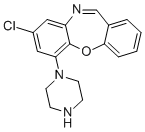
Amoxapine

别名: Asendin AmoxanAsendis AdisenDefanyl Demolox OxcapOxamine Amolife 阿莫沙平; 氯哌氧草; 氯氧平; 2-氯-11-(1-哌嗪基)二苯并[b,f][1,4]氧氮杂卓;氯哌氧卓;阿莫沙平(氯氧平); Amoxapine 阿莫沙平;阿莫沙平 USP标准品;阿莫沙平 标准品
目录号: V9835 纯度: ≥98%
阿莫沙平是二苯并氮杂卓家族的四环抗抑郁药,尽管它通常被归类为仲胺三环抗抑郁药。
Amoxapine CAS号: 14028-44-5
产品类别: New1
产品仅用于科学研究,不针对患者销售
规格 价格 库存 数量
250mg
500mg
Other Sizes

Other Forms of Amoxapine:

  • 7-Hydroxy amoxapine-d8
  • 8-Hydroxy amoxapine-d8
  • Amoxapine-d8 (CL-67772-d8)
点击了解更多
InvivoChem产品被CNS等顶刊论文引用
产品描述
阿莫沙平是二苯并氮杂卓家族的四环抗抑郁药,尽管它通常被归类为仲胺三环抗抑郁药。
生物活性&实验参考方法
药代性质 (ADME/PK)
Absorption, Distribution and Excretion
Rapidly and almost completely absorbed from the GI tract. Peak plasma concentrations occur within 1-2 hours of oral administration of a single dose.
60-69% of a single orally administered dose of amoxapine is excreted in urine, principally as conjugated metabolites. 7-18% of the dose is excrete feces mainly as unconjugated metabolites. Less than 5% of the dose is excreted as unchanged drug in urine.
Widely distributed in body tissues with highest concentrations found in lungs, spleen, kidneys, heart, and brain. Lower concentrations can be detected in testes and muscle.
Metabolism / Metabolites
Amoxapine is almost completely metabolized in the liver to its major metabolite, 8-hydroxyamoxapine, and a minor metabolite, 7-hydroxyamoxapine. Both metabolites are phamacologically inactive and have half-lives of approximately 30 and 6.5 hours, respectively.
Route of Elimination: 60-69% of a single orally administered dose of amoxapine is excreted in urine, principally as conjugated metabolites. 7-18% of the dose is excrete feces mainly as unconjugated metabolites. Less than 5% of the dose is excreted as unchanged drug in urine.
Half Life: 8 hours
Biological Half-Life
8 hours
毒性/毒理 (Toxicokinetics/TK)
Hepatotoxicity
Liver test abnormalities occur in a small proportion of patients on long term therapy with amoxapine, but elevations are usually mild, asymptomatic and transient, reversing even with continuation of medication. Instances of clinically apparent acute liver injury without jaundice have been reported due to amoxapine, but have been quite rare. Published cases have been mild, anicteric and asymptomatic. The onset of injury was within 1 to 4 weeks of starting, and the pattern of serum enzyme elevations was hepatocellular. Immunoallergic features and autoantibody formation were not present.
Likelihood score: E (unlikely cause of clinically apparent liver injury).
Effects During Pregnancy and Lactation
◉ Summary of Use during Lactation
Because there is no published experience with amoxapine during breastfeeding, other agents may be preferred, especially while nursing a newborn or preterm infant.
◉ Effects in Breastfed Infants
Relevant published information was not found as of the revision date.
◉ Effects on Lactation and Breastmilk
Two cases of galactorrhea have been reported in nonbreastfeeding women who were taking amoxapine. The clinical relevance of these findings in nursing mothers is not known. The prolactin level in a mother with established lactation may not affect her ability to breastfeed.
An observational study looked at outcomes of 2859 women who took an antidepressant during the 2 years prior to pregnancy. Compared to women who did not take an antidepressant during pregnancy, mothers who took an antidepressant during all 3 trimesters of pregnancy were 37% less likely to be breastfeeding upon hospital discharge. Mothers who took an antidepressant only during the third trimester were 75% less likely to be breastfeeding at discharge. Those who took an antidepressant only during the first and second trimesters did not have a reduced likelihood of breastfeeding at discharge. The antidepressants used by the mothers were not specified.
A retrospective cohort study of hospital electronic medical records from 2001 to 2008 compared women who had been dispensed an antidepressant during late gestation (n = 575) to those who had a psychiatric illness but did not receive an antidepressant (n = 1552) and mothers who did not have a psychiatric diagnosis (n = 30,535). Women who received an antidepressant were 37% less likely to be breastfeeding at discharge than women without a psychiatric diagnosis, but no less likely to be breastfeeding than untreated mothers with a psychiatric diagnosis. None of the mothers were taking amoxapine.
In a study of 80,882 Norwegian mother-infant pairs from 1999 to 2008, new postpartum antidepressant use was reported by 392 women and 201 reported that they continued antidepressants from pregnancy. Compared with the unexposed comparison group, late pregnancy antidepressant use was associated with a 7% reduced likelihood of breastfeeding initiation, but with no effect on breastfeeding duration or exclusivity. Compared with the unexposed comparison group, new or restarted antidepressant use was associated with a 63% reduced likelihood of predominant, and a 51% reduced likelihood of any breastfeeding at 6 months, as well as a 2.6-fold increased risk of abrupt breastfeeding discontinuation. Specific antidepressants were not mentioned.
Protein Binding
In vitro tests show that amoxapine binding to human plasma proteins is approximately 90%.
其他信息
Amoxapine can cause developmental toxicity according to state or federal government labeling requirements.
Amoxapine is a dibenzooxazepine compound having a chloro substituent at the 2-position and a piperazin-1-yl group at the 11-position. It has a role as an antidepressant, an adrenergic uptake inhibitor, a dopaminergic antagonist, a serotonin uptake inhibitor and a geroprotector.
Amoxapine, the N-demethylated derivative of the antipsychotic agent loxapine, is a dibenzoxazepine-derivative tricyclic antidepressant (TCA). TCAs are structurally similar to phenothiazines. They contain a tricyclic ring system with an alkyl amine substituent on the central ring. In non-depressed individuals, amoxapine does not affect mood or arousal, but may cause sedation. In depressed individuals, amoxapine exerts a positive effect on mood. TCAs are potent inhibitors of serotonin and norepinephrine reuptake. In addition, TCAs down-regulate cerebral cortical β-adrenergic receptors and sensitize post-synaptic serotonergic receptors with chronic use. The antidepressant effects of TCAs are thought to be due to an overall increase in serotonergic neurotransmission. TCAs also block histamine H1 receptors, α1-adrenergic receptors and muscarinic receptors, which accounts for their sedative, hypotensive and anticholinergic effects (e.g. blurred vision, dry mouth, constipation, urinary retention), respectively. See toxicity section below for a complete listing of side effects. Amoxapine may be used to treat neurotic and reactive depressive disorders, endogenous and psychotic depression, and mixed symptoms of depression and anxiety or agitation.
Amoxapine is a Tricyclic Antidepressant.
Amoxapine is a tetracyclic antidepressant used for relief of symptoms of depression caused by either reactive or psychotic depression. Amoxapine has been associated with a low rate of minor serum aminotransferase elevations during treatment and to very rare instances of clinically apparent acute liver injury.
Amoxapine is a tricyclic antidepressant of the dibenzoxazepine class. Amoxapine exerts its antidepressant effect by inhibiting the re-uptake of norepinephrine and, to a lesser degree, of serotonin, at adrenergic nerve endings and blocks the response of dopamine receptors to dopamine. This drug is used to treat symptoms of depression and may cause tardive dyskinesia. Amoxapine also binds to alpha-adrenergic, histaminergic, and cholinergic receptors which accounts for many of the side effects seen with this agent.
Amoxapine, the N-demethylated derivative of the antipsychotic agent loxapine, is a dibenzoxazepine-derivative tricyclic antidepressant (TCA). TCAs are structurally similar to phenothiazines. They contain a tricyclic ring system with an alkyl amine substituent on the central ring. In non-depressed individuals, amoxapine does not affect mood or arousal, but may cause sedation. In depressed individuals, amoxapine exerts a positive effect on mood. TCAs are potent inhibitors of serotonin and norepinephrine reuptake. In addition, TCAs down-regulate cerebral cortical β-adrenergic receptors and sensitize post-synaptic serotonergic receptors with chronic use. The antidepressant effects of TCAs are thought to be due to an overall increase in serotonergic neurotransmission. TCAs also block histamine H1 receptors, α1-adrenergic receptors and muscarinic receptors, which accounts for their sedative, hypotensive and anticholinergic effects (e.g. blurred vision, dry mouth, constipation, urinary retention), respectively. See toxicity section below for a complete listing of side effects. Amoxapine may be used to treat neurotic and reactive depressive disorders, endogenous and psychotic depression, and mixed symptoms of depression and anxiety or agitation.
The N-demethylated derivative of the antipsychotic agent LOXAPINE that works by blocking the reuptake of norepinephrine, serotonin, or both; it also blocks dopamine receptors. Amoxapine is used for the treatment of depression.
Drug Indication
For the relief of symptoms of depression in patients with neurotic or reactive depressive disorders as well as endogenous and psychotic depressions. May also be used to treat depression accompanied by anxiety or agitation.
Mechanism of Action
Amoxapine acts by decreasing the reuptake of norepinephrine and serotonin (5-HT).
*注: 文献方法仅供参考, InvivoChem并未独立验证这些方法的准确性
化学信息 & 存储运输条件
分子式
C17H16CLN3O
分子量
313.78
精确质量
313.098
CAS号
14028-44-5
相关CAS号
Amoxapine-d8;1189671-27-9
PubChem CID
2170
外观&性状
White to light yellow solid powder
密度
1.37g/cm3
沸点
469.9ºC at 760mmHg
熔点
175-1760C
闪点
238ºC
蒸汽压
5.32E-09mmHg at 25°C
折射率
1.685
LogP
3.131
tPSA
36.86
氢键供体(HBD)数目
1
氢键受体(HBA)数目
3
可旋转键数目(RBC)
1
重原子数目
22
分子复杂度/Complexity
424
定义原子立体中心数目
0
SMILES
ClC1C([H])=C([H])C2=C(C=1[H])C(=NC1=C([H])C([H])=C([H])C([H])=C1O2)N1C([H])([H])C([H])([H])N([H])C([H])([H])C1([H])[H]
InChi Key
QWGDMFLQWFTERH-UHFFFAOYSA-N
InChi Code
InChI=1S/C17H16ClN3O/c18-12-5-6-15-13(11-12)17(21-9-7-19-8-10-21)20-14-3-1-2-4-16(14)22-15/h1-6,11,19H,7-10H2
化学名
8-chloro-6-piperazin-1-ylbenzo[b][1,4]benzoxazepine
别名
Asendin AmoxanAsendis AdisenDefanyl Demolox OxcapOxamine Amolife
HS Tariff Code
2934.99.9001
存储方式

Powder      -20°C    3 years

                     4°C     2 years

In solvent   -80°C    6 months

                  -20°C    1 month

运输条件
Room temperature (This product is stable at ambient temperature for a few days during ordinary shipping and time spent in Customs)
溶解度数据
溶解度 (体外实验)
DMSO : ~8.33 mg/mL (~26.55 mM)
溶解度 (体内实验)
配方 1 中的溶解度: ≥ 1.56 mg/mL (4.97 mM) (饱和度未知) in 10% DMSO + 40% PEG300 + 5% Tween80 + 45% Saline (这些助溶剂从左到右依次添加,逐一添加), 澄清溶液。
例如,若需制备1 mL的工作液,可将100 μL 15.6 mg/mL澄清DMSO储备液加入400 μL PEG300中,混匀;然后向上述溶液中加入50 μL Tween-80,混匀;加入450 μL生理盐水定容至1 mL。
*生理盐水的制备:将 0.9 g 氯化钠溶解在 100 mL ddH₂O中,得到澄清溶液。

配方 2 中的溶解度: ≥ 1.56 mg/mL (4.97 mM) (饱和度未知) in 10% DMSO + 90% (20% SBE-β-CD in Saline) (这些助溶剂从左到右依次添加,逐一添加), 澄清溶液。
例如,若需制备1 mL的工作液,可将 100 μL 15.6 mg/mL 澄清 DMSO 储备液加入 900 μL 20% SBE-β-CD 生理盐水溶液中,混匀。
*20% SBE-β-CD 生理盐水溶液的制备(4°C,1 周):将 2 g SBE-β-CD 溶解于 10 mL 生理盐水中,得到澄清溶液。

View More

配方 3 中的溶解度: ≥ 1.56 mg/mL (4.97 mM) (饱和度未知) in 10% DMSO + 90% Corn Oil (这些助溶剂从左到右依次添加,逐一添加), 澄清溶液。
例如,若需制备1 mL的工作液,可将 100 μL 15.6 mg/mL 澄清 DMSO 储备液加入到 900 μL 玉米油中并混合均匀。


请根据您的实验动物和给药方式选择适当的溶解配方/方案:
1、请先配制澄清的储备液(如:用DMSO配置50 或 100 mg/mL母液(储备液));
2、取适量母液,按从左到右的顺序依次添加助溶剂,澄清后再加入下一助溶剂。以 下列配方为例说明 (注意此配方只用于说明,并不一定代表此产品 的实际溶解配方):
10% DMSO → 40% PEG300 → 5% Tween-80 → 45% ddH2O (或 saline);
假设最终工作液的体积为 1 mL, 浓度为5 mg/mL: 取 100 μL 50 mg/mL 的澄清 DMSO 储备液加到 400 μL PEG300 中,混合均匀/澄清;向上述体系中加入50 μL Tween-80,混合均匀/澄清;然后继续加入450 μL ddH2O (或 saline)定容至 1 mL;

3、溶剂前显示的百分比是指该溶剂在最终溶液/工作液中的体积所占比例;
4、 如产品在配制过程中出现沉淀/析出,可通过加热(≤50℃)或超声的方式助溶;
5、为保证最佳实验结果,工作液请现配现用!
6、如不确定怎么将母液配置成体内动物实验的工作液,请查看说明书或联系我们;
7、 以上所有助溶剂都可在 Invivochem.cn网站购买。
制备储备液 1 mg 5 mg 10 mg
1 mM 3.1869 mL 15.9347 mL 31.8695 mL
5 mM 0.6374 mL 3.1869 mL 6.3739 mL
10 mM 0.3187 mL 1.5935 mL 3.1869 mL

1、根据实验需要选择合适的溶剂配制储备液 (母液):对于大多数产品,InvivoChem推荐用DMSO配置母液 (比如:5、10、20mM或者10、20、50 mg/mL浓度),个别水溶性高的产品可直接溶于水。产品在DMSO 、水或其他溶剂中的具体溶解度详见上”溶解度 (体外)”部分;

2、如果您找不到您想要的溶解度信息,或者很难将产品溶解在溶液中,请联系我们;

3、建议使用下列计算器进行相关计算(摩尔浓度计算器、稀释计算器、分子量计算器、重组计算器等);

4、母液配好之后,将其分装到常规用量,并储存在-20°C或-80°C,尽量减少反复冻融循环。

计算器

摩尔浓度计算器可计算特定溶液所需的质量、体积/浓度,具体如下:

  • 计算制备已知体积和浓度的溶液所需的化合物的质量
  • 计算将已知质量的化合物溶解到所需浓度所需的溶液体积
  • 计算特定体积中已知质量的化合物产生的溶液的浓度
使用摩尔浓度计算器计算摩尔浓度的示例如下所示:
假如化合物的分子量为350.26 g/mol,在5mL DMSO中制备10mM储备液所需的化合物的质量是多少?
  • 在分子量(MW)框中输入350.26
  • 在“浓度”框中输入10,然后选择正确的单位(mM)
  • 在“体积”框中输入5,然后选择正确的单位(mL)
  • 单击“计算”按钮
  • 答案17.513 mg出现在“质量”框中。以类似的方式,您可以计算体积和浓度。

稀释计算器可计算如何稀释已知浓度的储备液。例如,可以输入C1、C2和V2来计算V1,具体如下:

制备25毫升25μM溶液需要多少体积的10 mM储备溶液?
使用方程式C1V1=C2V2,其中C1=10mM,C2=25μM,V2=25 ml,V1未知:
  • 在C1框中输入10,然后选择正确的单位(mM)
  • 在C2框中输入25,然后选择正确的单位(μM)
  • 在V2框中输入25,然后选择正确的单位(mL)
  • 单击“计算”按钮
  • 答案62.5μL(0.1 ml)出现在V1框中
g/mol

分子量计算器可计算化合物的分子量 (摩尔质量)和元素组成,具体如下:

注:化学分子式大小写敏感:C12H18N3O4  c12h18n3o4
计算化合物摩尔质量(分子量)的说明:
  • 要计算化合物的分子量 (摩尔质量),请输入化学/分子式,然后单击“计算”按钮。
分子质量、分子量、摩尔质量和摩尔量的定义:
  • 分子质量(或分子量)是一种物质的一个分子的质量,用统一的原子质量单位(u)表示。(1u等于碳-12中一个原子质量的1/12)
  • 摩尔质量(摩尔重量)是一摩尔物质的质量,以g/mol表示。
/

配液计算器可计算将特定质量的产品配成特定浓度所需的溶剂体积 (配液体积)

  • 输入试剂的质量、所需的配液浓度以及正确的单位
  • 单击“计算”按钮
  • 答案显示在体积框中
动物体内实验配方计算器(澄清溶液)
第一步:请输入基本实验信息(考虑到实验过程中的损耗,建议多配一只动物的药量)
第二步:请输入动物体内配方组成(配方适用于不溶/难溶于水的化合物),不同的产品和批次配方组成不同,如对配方有疑问,可先联系我们提供正确的体内实验配方。此外,请注意这只是一个配方计算器,而不是特定产品的确切配方。
+
+
+

计算结果:

工作液浓度 mg/mL;

DMSO母液配制方法 mg 药物溶于 μL DMSO溶液(母液浓度 mg/mL)。如该浓度超过该批次药物DMSO溶解度,请首先与我们联系。

体内配方配制方法μL DMSO母液,加入 μL PEG300,混匀澄清后加入μL Tween 80,混匀澄清后加入 μL ddH2O,混匀澄清。

(1) 请确保溶液澄清之后,再加入下一种溶剂 (助溶剂) 。可利用涡旋、超声或水浴加热等方法助溶;
            (2) 一定要按顺序加入溶剂 (助溶剂) 。

联系我们