ARCC-4

目录号: V11560 纯度: ≥98%
ARCC-4 是一种基于 PROTAC 技术的纳摩尔雄激素受体 (AR) 降解剂,D50 为 5 nM。
ARCC-4 CAS号: 1973403-00-7
产品类别: New1
产品仅用于科学研究,不针对患者销售
规格 价格 库存 数量
1mg
5mg
10mg
Other Sizes
点击了解更多
  • 与全球5000+客户建立关系
  • 覆盖全球主要大学、医院、科研院所、生物/制药公司等
  • 产品被大量CNS顶刊文章引用
InvivoChem产品被CNS等顶刊论文引用
产品描述
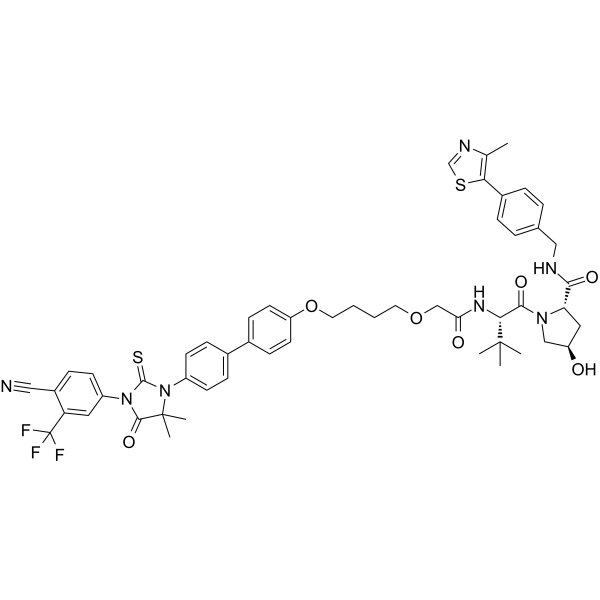
ARCC-4 是一种基于 PROTAC 技术的纳摩尔雄激素受体 (AR) 降解剂,D50 为 5 nM。 ARCC-4 是一种基于恩杂鲁胺的 von Hippel-Lindau (VHL) 招募 AR PROTAC。 ARCC-4 可有效降解与抗雄激素研究相关的 AR 突变。
生物活性&实验参考方法
体外研究 (In Vitro)
当 ARCC-4 改善 AR 和 VHL 之间的蛋白质-蛋白质反应时,三促进聚合物复合物更容易结合[1]。 AR 可有效降解 -4(0.1-10,000 nM;20 小时),D50 为 5 nM,Dmax 大于 95% [1]。含有 ARCC-4(100 nM;12 小时)的模具表现出 AR。 ARCC-4 不会阻碍 PR-A 或 PR-B,但它几乎仅通过有色体色素调节 AR [1]。 ARCC-4 可有效抑制具有临床意义的 AR 突变 [1]。 ARCC-4 在高雄激素水平下仍然发挥作用 [1]。
细胞实验
蛋白质印迹分析[1]
细胞类型: VCaP 细胞
测试浓度: 0.1 nM、1 nM、10 nM、50 nM、100 nM、0.5微米,1微米。 ,10 μM
孵育时间:20 小时
实验结果:有效降解 AR
参考文献

[1]. Androgen receptor degradation by the proteolysis-targeting chimera ARCC-4 outperforms enzalutamide in cellular models of prostate cancer drug resistance. Commun Biol. 2018 Aug 2;1:100.

*注: 文献方法仅供参考, InvivoChem并未独立验证这些方法的准确性
化学信息 & 存储运输条件
分子式
C53H58F3N7O8S2
分子量
1042.19494104385
精确质量
1023.363
CAS号
1973403-00-7
相关CAS号
1973403-00-7;ARCC-4 hydrate;
PubChem CID
122428515
外观&性状
White to off-white solid powder
LogP
8.5
tPSA
238
氢键供体(HBD)数目
3
氢键受体(HBA)数目
14
可旋转键数目(RBC)
18
重原子数目
72
分子复杂度/Complexity
1940
定义原子立体中心数目
3
SMILES
S=C1N(C2C=CC(C#N)=C(C(F)(F)F)C=2)C(C(C)(C)N1C1C=CC(C2C=CC(=CC=2)OCCCCOCC(N[C@H](C(N2C[C@@H](C[C@H]2C(NCC2C=CC(C3=C(C)N=CS3)=CC=2)=O)O)=O)C(C)(C)C)=O)=CC=1)=O.O
InChi Key
DUPAJELXESPTNF-PPZGWQTASA-N
InChi Code
InChI=1S/C53H56F3N7O7S2/c1-32-45(72-31-59-32)36-11-9-33(10-12-36)28-58-47(66)43-26-40(64)29-61(43)48(67)46(51(2,3)4)60-44(65)30-69-23-7-8-24-70-41-21-16-35(17-22-41)34-13-18-38(19-14-34)63-50(71)62(49(68)52(63,5)6)39-20-15-37(27-57)42(25-39)53(54,55)56/h9-22,25,31,40,43,46,64H,7-8,23-24,26,28-30H2,1-6H3,(H,58,66)(H,60,65)/t40-,43+,46-/m1/s1
化学名
(2S,4R)-1-[(2S)-2-[[2-[4-[4-[4-[3-[4-cyano-3-(trifluoromethyl)phenyl]-5,5-dimethyl-4-oxo-2-sulfanylideneimidazolidin-1-yl]phenyl]phenoxy]butoxy]acetyl]amino]-3,3-dimethylbutanoyl]-4-hydroxy-N-[[4-(4-methyl-1,3-thiazol-5-yl)phenyl]methyl]pyrrolidine-2-carboxamide
HS Tariff Code
2934.99.9001
存储方式

Powder      -20°C    3 years

                     4°C     2 years

In solvent   -80°C    6 months

                  -20°C    1 month

运输条件
Room temperature (This product is stable at ambient temperature for a few days during ordinary shipping and time spent in Customs)
溶解度数据
溶解度 (体外实验)
DMSO : ~200 mg/mL (~195.28 mM)
溶解度 (体内实验)
配方 1 中的溶解度: 5 mg/mL (4.88 mM) in 10% DMSO + 40% PEG300 + 5% Tween80 + 45% Saline (这些助溶剂从左到右依次添加,逐一添加), 悬浮液;超声助溶。
例如,若需制备1 mL的工作液,可将100 μL 50.0 mg/mL澄清DMSO储备液加入400 μL PEG300中,混匀;然后向上述溶液中加入50 μL Tween-80,混匀;加入450 μL生理盐水定容至1 mL。
*生理盐水的制备:将 0.9 g 氯化钠溶解在 100 mL ddH₂O中,得到澄清溶液。

配方 2 中的溶解度: 5 mg/mL (4.88 mM) in 10% DMSO + 90% (20% SBE-β-CD in Saline) (这些助溶剂从左到右依次添加,逐一添加), 悬浊液; 超声助溶。
例如,若需制备1 mL的工作液,可将 100 μL 50.0 mg/mL澄清DMSO储备液加入900 μL 20% SBE-β-CD生理盐水溶液中,混匀。
*20% SBE-β-CD 生理盐水溶液的制备(4°C,1 周):将 2 g SBE-β-CD 溶解于 10 mL 生理盐水中,得到澄清溶液。

View More

配方 3 中的溶解度: ≥ 5 mg/mL (4.88 mM) (饱和度未知) in 10% DMSO + 90% Corn Oil (这些助溶剂从左到右依次添加,逐一添加), 澄清溶液。
例如,若需制备1 mL的工作液,可将 100 μL 50.0 mg/mL 澄清 DMSO 储备液加入到 900 μL 玉米油中并混合均匀。


请根据您的实验动物和给药方式选择适当的溶解配方/方案:
1、请先配制澄清的储备液(如:用DMSO配置50 或 100 mg/mL母液(储备液));
2、取适量母液,按从左到右的顺序依次添加助溶剂,澄清后再加入下一助溶剂。以 下列配方为例说明 (注意此配方只用于说明,并不一定代表此产品 的实际溶解配方):
10% DMSO → 40% PEG300 → 5% Tween-80 → 45% ddH2O (或 saline);
假设最终工作液的体积为 1 mL, 浓度为5 mg/mL: 取 100 μL 50 mg/mL 的澄清 DMSO 储备液加到 400 μL PEG300 中,混合均匀/澄清;向上述体系中加入50 μL Tween-80,混合均匀/澄清;然后继续加入450 μL ddH2O (或 saline)定容至 1 mL;

3、溶剂前显示的百分比是指该溶剂在最终溶液/工作液中的体积所占比例;
4、 如产品在配制过程中出现沉淀/析出,可通过加热(≤50℃)或超声的方式助溶;
5、为保证最佳实验结果,工作液请现配现用!
6、如不确定怎么将母液配置成体内动物实验的工作液,请查看说明书或联系我们;
7、 以上所有助溶剂都可在 Invivochem.cn网站购买。
制备储备液 1 mg 5 mg 10 mg
1 mM 0.9595 mL 4.7975 mL 9.5951 mL
5 mM 0.1919 mL 0.9595 mL 1.9190 mL
10 mM 0.0960 mL 0.4798 mL 0.9595 mL

1、根据实验需要选择合适的溶剂配制储备液 (母液):对于大多数产品,InvivoChem推荐用DMSO配置母液 (比如:5、10、20mM或者10、20、50 mg/mL浓度),个别水溶性高的产品可直接溶于水。产品在DMSO 、水或其他溶剂中的具体溶解度详见上”溶解度 (体外)”部分;

2、如果您找不到您想要的溶解度信息,或者很难将产品溶解在溶液中,请联系我们;

3、建议使用下列计算器进行相关计算(摩尔浓度计算器、稀释计算器、分子量计算器、重组计算器等);

4、母液配好之后,将其分装到常规用量,并储存在-20°C或-80°C,尽量减少反复冻融循环。

计算器

摩尔浓度计算器可计算特定溶液所需的质量、体积/浓度,具体如下:

  • 计算制备已知体积和浓度的溶液所需的化合物的质量
  • 计算将已知质量的化合物溶解到所需浓度所需的溶液体积
  • 计算特定体积中已知质量的化合物产生的溶液的浓度
使用摩尔浓度计算器计算摩尔浓度的示例如下所示:
假如化合物的分子量为350.26 g/mol,在5mL DMSO中制备10mM储备液所需的化合物的质量是多少?
  • 在分子量(MW)框中输入350.26
  • 在“浓度”框中输入10,然后选择正确的单位(mM)
  • 在“体积”框中输入5,然后选择正确的单位(mL)
  • 单击“计算”按钮
  • 答案17.513 mg出现在“质量”框中。以类似的方式,您可以计算体积和浓度。

稀释计算器可计算如何稀释已知浓度的储备液。例如,可以输入C1、C2和V2来计算V1,具体如下:

制备25毫升25μM溶液需要多少体积的10 mM储备溶液?
使用方程式C1V1=C2V2,其中C1=10mM,C2=25μM,V2=25 ml,V1未知:
  • 在C1框中输入10,然后选择正确的单位(mM)
  • 在C2框中输入25,然后选择正确的单位(μM)
  • 在V2框中输入25,然后选择正确的单位(mL)
  • 单击“计算”按钮
  • 答案62.5μL(0.1 ml)出现在V1框中
g/mol

分子量计算器可计算化合物的分子量 (摩尔质量)和元素组成,具体如下:

注:化学分子式大小写敏感:C12H18N3O4  c12h18n3o4
计算化合物摩尔质量(分子量)的说明:
  • 要计算化合物的分子量 (摩尔质量),请输入化学/分子式,然后单击“计算”按钮。
分子质量、分子量、摩尔质量和摩尔量的定义:
  • 分子质量(或分子量)是一种物质的一个分子的质量,用统一的原子质量单位(u)表示。(1u等于碳-12中一个原子质量的1/12)
  • 摩尔质量(摩尔重量)是一摩尔物质的质量,以g/mol表示。
/

配液计算器可计算将特定质量的产品配成特定浓度所需的溶剂体积 (配液体积)

  • 输入试剂的质量、所需的配液浓度以及正确的单位
  • 单击“计算”按钮
  • 答案显示在体积框中
动物体内实验配方计算器(澄清溶液)
第一步:请输入基本实验信息(考虑到实验过程中的损耗,建议多配一只动物的药量)
第二步:请输入动物体内配方组成(配方适用于不溶/难溶于水的化合物),不同的产品和批次配方组成不同,如对配方有疑问,可先联系我们提供正确的体内实验配方。此外,请注意这只是一个配方计算器,而不是特定产品的确切配方。
+
+
+

计算结果:

工作液浓度 mg/mL;

DMSO母液配制方法 mg 药物溶于 μL DMSO溶液(母液浓度 mg/mL)。如该浓度超过该批次药物DMSO溶解度,请首先与我们联系。

体内配方配制方法μL DMSO母液,加入 μL PEG300,混匀澄清后加入μL Tween 80,混匀澄清后加入 μL ddH2O,混匀澄清。

(1) 请确保溶液澄清之后,再加入下一种溶剂 (助溶剂) 。可利用涡旋、超声或水浴加热等方法助溶;
            (2) 一定要按顺序加入溶剂 (助溶剂) 。

生物数据图片
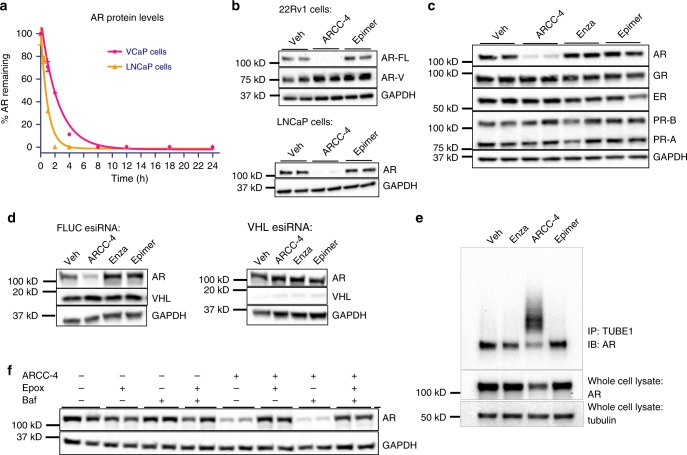
  • PROTAC ARCC-4 potently degrades AR in prostate cancer cells. a Time course serum-free treatment of VCaP and LNCaP cells with 100 nM of ARCC-4 shows over 90% AR depletion by 6 h as measured by quantified western blot. AR levels were normalized to tubulin as a loading control. See Supplementary Figures 2, 3 for western blot images. Experiment was performed in duplicate. The data represent mean values ± SEM and the plot represents two independent experiments (n = 2). b Treatment of 22Rv1 and LNCaP cells for 24 h with vehicle (Veh), ARCC-4 or epimer (100 nM) in charcoal-stripped serum (CSS) media shows AR depletion as measured by western blot. AR-FL: full length AR; AR-V: splice variants of AR. Experiments were performed in biological duplicates and the plot represents two independent experiments (n = 2). See Supplementary Figure 8 for full blot images. c Treatment of T47D breast cancer cells for 24 h with 50 nM enzalutamide (Enza) or ARCC-4 shows no loss of glucocorticoid, estrogen, and progesterone receptors. The western blot shows biological replicates and represents two independent experiments (n = 2). See Supplementary Figure 8 for full blot images. d Transfection of VCaP cells with endo-ribonuclease prepared siRNA (esiRNA) targeting Firefly Luciferase (FLUC) as a negative control, or VHL shows a loss of ARCC-4 mediated AR degradation upon VHL knockdown. VCaP cells were treated with 100 nM of the indicated compounds for 12 h after 48 h post-transfection. Data represents two independent experiments. See Supplementary Figure 9 for full blot images. e Tandem Ubiquitin Binding Elements (TUBE1) pull-down assay in VCaP cells shows enrichment of polyubiquitin chains on AR upon a 2.5-hour treatment with 1 µM ARCC-4. This polyubiquitination of AR is not seen with the other compounds tested. Data represents two independent experiments. See Supplementary Figure 9 for full blot images. f ARCC-4-mediated AR degradation (1 µM) at 4 h is blocked by 1-h pretreatment with proteasome inhibitor epoxomicin (Epox, 2 µM) and is unaffected by 1-h pretreatment with lysosomal inhibitor bafilomycin (Baf, 100 nM). The western blot shows biological replicates and represents two independent experiments (n = 2). See Supplementary Figure 9 for full blot images.[1].Androgen receptor degradation by the proteolysis-targeting chimera ARCC-4 outperforms enzalutamide in cellular models of prostate cancer drug resistance. Commun Biol. 2018 Aug 2;1:100.
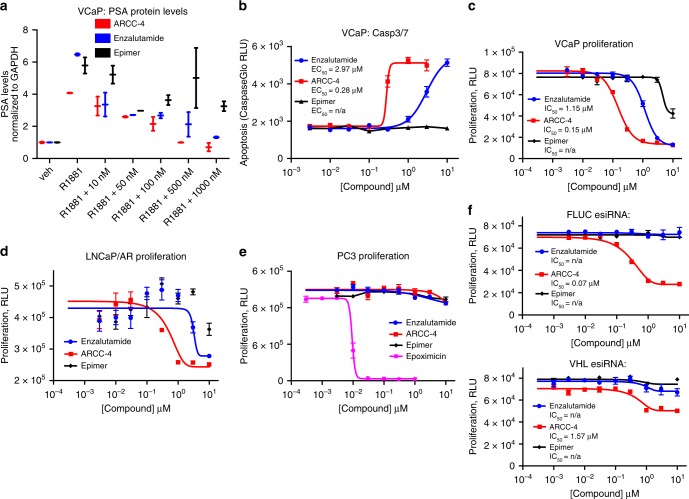
  • ARCC-4 is better than enzalutamide in inducing apoptosis and inhibiting AR signaling in prostate cancer cells overexpressing AR. a Pretreatment of VCaP cells with ARCC-4, enzalutamide or epimer for 8 h in charcoal-stripped serum (CSS) media followed by a 48-h stimulation with 0.2 nM R1881 shows blockage of PSA upregulation as measured by western blot. Experiments were performed in duplicate. The results are representative of two independent experiments (n = 2). b Treatment of VCaP cells for 48 h with enzalutamide, ARCC-4, or epimer leads to varying apoptosis induction as measured by caspase-3 and caspase-7 activation. Experiments were performed in triplicate and the plot is representative of two independent experiments (n = 2). c, d Treatment of CRPC cells (VCaP or LNCaP/AR) with enzalutamide, ARCC-4, or epimer for 6 days demonstrates antiproliferative effects. Experiments were performed in triplicate and the plot is representative of two independent experiments (n = 2). [1].Androgen receptor degradation by the proteolysis-targeting chimera ARCC-4 outperforms enzalutamide in cellular models of prostate cancer drug resistance. Commun Biol. 2018 Aug 2;1:100.
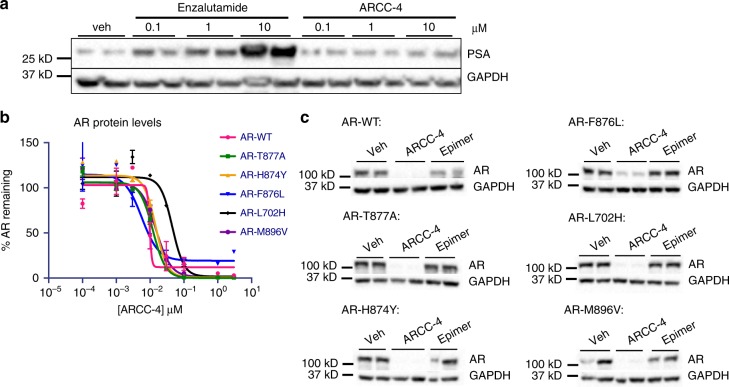
  • ARCC-4 shows efficacy against clinically relevant AR mutations. a Treatment of LNCaP/F876L AR cells with indicated concentrations of enzalutamide or ARCC-4 for 48 h shows a greater increase in PSA levels with enzalutamide as measured by western blot. Results are representative of two independent experiments (n = 2). veh refers to vehicle-treated samples. See Supplementary Figure 10 for full blot images. b Treatment of HEK293T cells overexpressing wild-type (WT) or different AR mutants for 20 h (after 50 ng per ml doxycycline induction) with ARCC-4 in charcoal-stripped serum (CSS) media shows AR depletion of WT and all mutants tested as measured by quantified western blot. AR levels were normalized to GAPDH as a loading control. See Supplementary Figure 6 for western blot images. Experiments were performed in duplicate and the plot is representative of two independent experiments (n = 2). c AR degradation in HEK293T cells overexpressing WT or different AR mutants treated for 20 h (after 50 ng per ml doxycycline induction) with vehicle, ARCC-4, or epimer (500 nM) in CSS media. Experiment was performed in biological duplicates (n = 1). See Supplementary Figure 10 for full blot images. All data represent mean values ± SEM.[1].Androgen receptor degradation by the proteolysis-targeting chimera ARCC-4 outperforms enzalutamide in cellular models of prostate cancer drug resistance. Commun Biol. 2018 Aug 2;1:100.
联系我们