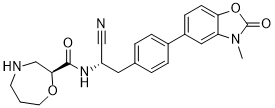
Brensocatib (AZD7986)

别名: Brensocatib; INS 1007;AZD7986;INS-1007;AZD-7986;INS1007; AZD 7986
布仁卡替
目录号: V3984 纯度: ≥98%
Brensocatib(原名 AZD-7986;INS-1007)是新的、第二代、高效、共价可逆、选择性 DPP1(二肽基肽酶 1)抑制剂,具有抗 COPD 作用。
Brensocatib (AZD7986) CAS号: 1802148-05-5
产品类别: Dipeptidyl Peptidase
产品仅用于科学研究,不针对患者销售
规格 价格 库存 数量
5mg
10mg
25mg
50mg
100mg
250mg
500mg
Other Sizes
点击了解更多
  • 与全球5000+客户建立关系
  • 覆盖全球主要大学、医院、科研院所、生物/制药公司等
  • 产品被大量CNS顶刊文章引用
InvivoChem产品被CNS等顶刊论文引用
纯度/质量控制文件

纯度: ≥98%

产品描述
Brensocatib(以前称为 AZD-7986;INS-1007)是一种新型、第二代、高效、共价可逆、选择性 DPP1(二肽基肽酶 1)抑制剂,具有抗 COPD 作用。它抑制 DPP1,在人、小鼠、大鼠、狗和兔中的 pIC50 分别为 6.85、7.6、7.7、7.8 和 7.8。它不存在早期化合物系列中发现的主动脉结合倾向,并且具有治疗 COPD(慢性阻塞性肺病)的潜力,其预测的人体 PK 特性适合每日一次的人体给药。
作用机制: 非囊性纤维化支气管扩张是一种慢性肺部疾病,其特征为感染、炎症和肺组织损伤的恶性循环。该疾病的药物治疗主要针对二肽基肽酶1,这是一种半胱氨酸蛋白酶,在骨髓中性粒细胞成熟过程中对促炎性中性粒细胞丝氨酸蛋白酶的激活起关键作用——这些蛋白酶包括组织蛋白酶G、中性粒细胞弹性蛋白酶和蛋白酶3,它们参与中性粒细胞介导的非囊性纤维化支气管扩张炎症的发病机制。Brensocatib 是二肽基肽酶1的竞争性、可逆性抑制剂。在基于细胞的实验中,Brensocatib 对DPP1的抑制降低了包括中性粒细胞弹性蛋白酶、组织蛋白酶G和蛋白酶3在内的中性粒细胞丝氨酸蛋白酶的活性。
药效学: Brensocatib 是DPP1的竞争性、可逆性抑制剂,可降低患者体内的中性粒细胞丝氨酸蛋白酶活性。探索性分析显示,在非囊性纤维化支气管扩张患者中,Brensocatib 与中性粒细胞丝氨酸蛋白酶活性的剂量依赖性降低相关。在一项1期研究中,Brensocatib 与血液中中性粒细胞弹性蛋白酶活性的剂量依赖性降低相关。群体药代动力学/药效学分析显示,达到痰中性粒细胞弹性蛋白酶水平低于定量限存在一个Brensocatib 暴露量的阈值效应,并且痰中性粒细胞弹性蛋白酶水平低于定量限与肺部急性加重减少之间存在强相关性。使用Brensocatib 治疗与皮肤不良反应和牙龈/牙周不良反应相关。应避免使用减毒活疫苗。
2025年8月12日,美国食品药品监督管理局批准了新型每日一次口服二肽基肽酶1抑制剂brensocatib(商品名Brinsupri,Insmed公司研发),用于治疗非囊性纤维化支气管扩张。Brensocatib是FDA批准的首个治疗非囊性纤维化支气管扩张的药物,该疾病是一种与持续气道炎症和感染相关的慢性病症。此前,FDA已就该适应症授予该药突破性疗法认定和优先审评资格。
生物活性&实验参考方法
靶点
Brensocatib (AZD7986), a dipeptidyl peptidase 1 (DPP1) inhibitor, has pIC50 values of 6.85, 7.6, 7.7, 7.8, and 7.8 in humans, mice, rats, dogs, and rabbits, respectively, according to the results of cell experiments. In propionaldehyde reactivity tests, brensocatib exhibits stability with a half-life of more than 50 hours. Following differentiation in the presence of 38 pM to 10 μM of Brensocatib, a concentration-dependent reduction in DPP1's and all three nsps' cytolytic enzyme activity—NE, Pr3, and CatG—was noted. With pIC50 values of roughly 7, brensocatib suppresses the activation of all three NSPs in a concentration-dependent manner. The level of activity has nearly entirely decreased. The activity of NE, Pr3, and CatG decrease to 4% to 10% of the control at 10 μM Brensocatib [1].
体外研究 (In Vitro)
根据细胞实验结果,Brensocatib (AZD7986) 是一种二肽基肽酶 1 (DPP1) 抑制剂,在人、小鼠、大鼠、狗和兔中的 pIC50 值分别为 6.85、7.6、7.7、7.8 和 7.8。在丙醛反应性测试中,brensocatib 表现出稳定性,半衰期超过 50 小时。在 38 pM 至 10 μM Brensocatib 存在下进行分化后,发现 DPP1 和所有三种 nsps 的细胞溶解酶活性(NE、Pr3 和 CatG)出现浓度依赖性降低。 brensocatib 的 pIC50 值约为 7,以浓度依赖性方式抑制所有三种 NSP 的激活。活动水平几乎完全下降。在 10 μM Brensocatib 下,NE、Pr3 和 CatG 的活性降低至对照的 4% 至 10% [1]。
Brensocatib 是 DPP1 酶和细胞活性的强效、可逆抑制剂。 [1]
在分化中的人原代骨髓来源 CD34+ 中性粒细胞祖细胞中,它能浓度依赖性地抑制中性粒细胞丝氨酸蛋白酶(NE、Pr3、CatG)的激活,对三种 NSPs 的 pIC50 值均在 7 左右,在 10 µM 浓度下将其活性降低至对照的 4-10%。 [1]
该化合物在超过 200 个体外放射性配体结合和酶测定组中显示出高选择性。 [1]
体内研究 (In Vivo)
Brensocatib (AZD7986) 的半衰期超过 10 小时,在血浆中表现出良好的稳定性。在体内,brensocatib 剂量依赖性地抑制骨髓细胞裂解物中 NE 和 Pr3 的活化,但不抑制 CatG [1]。
Brensocatib 以每日两次(0.2、2 和 20 mg/kg/天)的剂量给予初始状态大鼠,持续八天,能剂量依赖性地抑制骨髓细胞裂解物中 NE 和 Pr3 的激活,但对 CatG 无抑制。 [1]
酶活实验
使用基于 384 孔板的荧光测定法评估对分离的人重组 DPP1 酶活性的抑制。化合物在室温下与酶预孵育 30 分钟,然后加入荧光二肽底物 Gly-Arg-AMC。通过拟合数据获得效价数值。 [1]
使用表面等离子体共振直接结合实验 (SPR DBA) 表征结合动力学。相互作用符合 1:1 模型,结合速率 (kon) 为 1.5E+6 (1/Ms),解离速率 (koff) 为 4.0E-3 (1/s),pKd 为 8.6,驻留时间(半衰期)为 3 分钟,证实其为可逆抑制剂。 [1]
细胞实验
使用表达 DPP1 的单核细胞 U937 细胞系研究细胞活性。将细胞铺于 384 孔板中,与 DPP1 抑制剂在 37°C 孵育 60 分钟,然后加入底物 Gly-Phe-AFC。使用酶标仪读取荧光值,并计算 pIC50。 [1]
使用人原代骨髓来源 CD34+ 中性粒细胞祖细胞评估对 NSP 激活的影响。细胞在生长培养基中培养七天,然后在 G-CSF 和不同浓度的化合物 30 存在下再培养七天。收集并裂解细胞后,在 384 孔板中使用特异性抑制剂和合成肽底物分析细胞裂解物中的 DPP1、NE、Pr3 和 CatG 活性。 [1]
动物实验

0.2, 2, and 20 mg/kg/day; oral
Naive rats
An in vivo study was performed in naïve rats. Rats were dosed orally twice daily with Brensocatib at 0.2, 2, and 20 mg/kg/day for eight days. At termination, bone marrow was collected by femoral aspiration for NSP activity analysis using commercial synthetic peptide substrates. [1]
Rat and dog pharmacokinetic studies were conducted. For rat PK, doses were 1 mg/kg intravenous and 3 mg/kg oral. For dog PK, doses were 1 mg/kg intravenous and 2 mg/kg oral. [1]
药代性质 (ADME/PK)
Brensocatib demonstrated good metabolic stability in human liver microsomes (HLM CLint <14 µL/min/mg) and in human, rat, and dog hepatocytes (CLint <3.5 µL/min/10^6 cells). [1]
Plasma protein binding was 87% in human, 94% in rat, and 70% in dog. [1]
Kinetic solubility at pH 7.4 was 180 µM. Measured LogD at pH 7.4 was 0.8. [1]
Caco-2 apparent permeability (Papp) A to B was 9.2 x 10^-6 cm/s, B to A was 58 x 10^-6 cm/s, with an efflux ratio of 6.3. [1]
In rat PK studies, clearance (CL) was 1 mL/min/kg, volume of distribution at steady state (Vss) was 1 L/kg, terminal half-life (t1/2) was 7 hours, and oral bioavailability (F%) was 30%. [1]
In dog PK studies, CL was 8 mL/min/kg, Vss was 11 L/kg, t1/2 was 18 hours, and F% was 92%. [1]
The compound showed good stability in plasma with a half-life >10 hours. The low turnover in human hepatocytes and good in vitro-in vivo correlation predicted suitability for once-daily human dosing. [1]
Absorption
Brensocatib is rapidly absorbed following oral administration. The median time to maximum plasma concentration (Tmax) is 1.0-1.4 hours after a single dose of 10 mg or 25 mg. The absolute oral bioavailability of brensocatib has not been studied in humans, but based on mass balance studies in healthy subjects, oral absorption is greater than 80%. Following once-daily administration of brensocatib 10 mg or 25 mg, the estimated geometric mean Cmax is 85.4 ng/mL or 259 ng/mL, respectively. In healthy subjects, at steady state, Cmax increased by about 1.5-fold and AUCtau increased by about 2-fold compared to single-dose observations. The presence of food slightly delays the absorption of brensocatib, but does not result in clinically relevant differences in exposure.

Route of Elimination
Following administration of a single oral dose of radiolabeled brensocatib to healthy subjects, 54.2% of the dose was recovered in urine (22.8% as unchanged brensocatib) and 28.3% of the dose was recovered in feces (2.4% as unchanged brensocatib). Available data do not indicate a significant effect of renal impairment on brensocatib elimination and systemic exposure, suggesting that dose adjustment is not necessary in participants with renal impairment.

Volume of Distribution
Following once-daily administration of 10 mg or 25 mg brensocatib in patients with NCFB, the estimated volume of distribution at steady state ranged from 126 to 138 L.

Clearance
The apparent oral clearance of brensocatib ranged from 6.4 to 10.7 L/hour. In a study of healthy Japanese and White adults, mean steady-state CL/F was slightly higher in Japanese participants (10.1, 6.4, and 10.7 L/h for 10 mg, 25 mg, and 40 mg groups, respectively) compared with White participants (8.5, 7.0, and 6.5 L/h).

Protein Binding
The protein binding of brensocatib in human plasma was 87.2%.

Metabolism / Metabolites
Brensocatib is primarily metabolized by CYP3A and to a lesser extent by CYP2C8 and CYP2D6. One major circulating metabolite, thiocyanate, was identified in plasma and accounted for 51% of the total radioactivity following administration of a radio-labeled brensocatib dose. In vitro studies indicate that brensocatib is also a weak inducer of CYP3A.

Biological Half-Life
Following a single oral administration of brensocatib in healthy subjects, the elimination half-life ranged from 25 to 39 hours. In a study of healthy Japanese and White adults, the elimination half-life of brensocatib ranged from 22 to 28 hours.
毒性/毒理 (Toxicokinetics/TK)
Brensocatib was free from aortic binding liability, as confirmed by an in vitro competitive covalent binding assay using rat aortic tissue homogenate and a rat quantitative whole-body autoradiography study. [1]
It was stable in the propionaldehyde reactivity assay (half-life >50 hours), designed to detect reactivity with aldehyde functions. [1]
Inhibition of the hERG channel was weak, with an IC50 >33 µM. [1]
The compound showed excellent selectivity in a broad panel of over 200 in vitro assays. [1]
参考文献

[1]. Discovery of Second Generation Reversible Covalent DPP1 Inhibitors Leading to an Oxazepane Amidoacetonitrile Based Clinical Candidate (AZD7986). J Med Chem. 2016 Oct 27;59(20):9457-9472.

其他信息
Brensocatib is under investigation in clinical trial NCT03218917 (Assessment of INS1007 in Subjects With Non-cystic Fibrosis Bronchiectasis).
Brensocatib is an orally bioavailable, small molecule, reversible inhibitor of dipeptidyl peptidase 1 (DPP1), with potential anti-inflammatory activity. Upon oral administration, brensocatib reversibly binds to and inhibits the activity of DPP1, thereby inhibiting the activation of neutrophil serine proteases (NSPs), including neutrophil elastase (NE), during neutrophil maturation. This inhibits the activity of NSPs, and may prevent lung inflammation and injury and improve lung function associated with NSPs-induced respiratory diseases. NSPs, serine proteases released by neutrophils during inflammation, is upregulated in a number of respiratory diseases.
Drug Indication
Treatment of non-cystic fibrosis bronchiectasis
Brensocatib is a second-generation, reversible covalent DPP1 inhibitor discovered to be free from the aorta binding liabilities found in a first-generation candidate. [1]
It is a highly potent, selective clinical candidate for chronic obstructive pulmonary disease (COPD). [1]
Human phase 1 studies were started in the fourth quarter of 2014. [1]
The mechanism of action involves inhibition of DPP1 in the bone marrow, leading to the release of neutrophils without stored active neutrophil elastase (NE), proteinase-3 (Pr3), or cathepsin G (CatG), thereby potentially reducing inflammation and neutrophil-driven lung damage. [1]

Non-cystic fibrosis bronchiectasis (NCFB) is a chronic lung disease characterized by airway widening, mucus accumulation, and neutrophilic inflammation. Brensocatib is a first-in-class dipeptidyl peptidase 1 (DPP1) inhibitor that inhibits neutrophil serine proteases, addressing a key driver of this inflammation. It reduces exacerbations and slows lung function decline, offering a targeted approach to managing NCFB. Brensocatib was approved by the US FDA on August 12, 2025, for use in adults and pediatric patients with NCFB.
Brensocatib is an orally bioavailable, small molecule, reversible inhibitor of dipeptidyl peptidase 1 (DPP1), with potential anti-inflammatory activity. Upon oral administration, brensocatib reversibly binds to and inhibits the activity of DPP1, thereby inhibiting the activation of neutrophil serine proteases (NSPs), including neutrophil elastase (NE), during neutrophil maturation. This inhibits the activity of NSPs, and may prevent lung inflammation and injury and improve lung function associated with NSPs-induced respiratory diseases. NSPs, serine proteases released by neutrophils during inflammation, is upregulated in a number of respiratory diseases.
BRENSOCATIB is a small molecule drug with a maximum clinical trial phase of III (across all indications) and has 5 investigational indications.
a cathepsin C inhibitor; structure in first source

Bronchiectasis is a progressive inflammatory lung disease with variable clinical manifestations and causes, but most patients with the condition experience chronic cough and sputum production. Neutrophil-driven inflammation fuels persistent inflammation, impaired mucociliary clearance, airway damage, and recurrent infection. DPP-1 plays a critical role in this process, activating excess neutrophil serine proteases that contribute to worsening disease severity, more frequent exacerbations, and faster lung function decline.
The FDA based its decision on the results from the Phase 3 ASPEN clinical trial. The study enrolled 1,721 patients (1,680 adults and 41 adolescents) with bronchiectasis and randomized them to receive brensocatib 10 mg (n = 583), brensocatib 25 mg (n = 575), or placebo (n = 563) in addition to standard of care.
Both doses of brensocatib reduced the number of pulmonary exacerbations compared to placebo by about 20%. Patients on 10 mg averaged 1.02 exacerbations per year, those on 25 mg averaged 1.04, and those on placebo averaged 1.29. Brensocatib also delayed the time to the first flare-up and increased the percentage of patients who stayed flare-up-free for the whole year (48.5% with either dose vs. 40.3% with placebo). Lung function (measured by FEV₁) declined significantly less with the 25 mg dose (24 mL) than with placebo (62 mL), but the 10 mg dose did not show a meaningful difference from placebo (50 mL). Severe exacerbations were slightly less common with brensocatib, but the difference was not statistically significant.
Adverse effects were similar between groups, but mild skin thickening (hyperkeratosis) was more common with brensocatib, occurring in 1.4% of patients on 10 mg, 3.0% on 25 mg, and 0.7% on placebo.
As the first FDA-approved therapy for non-cystic fibrosis bronchiectasis, brensocatib tablets provide an option shown to reduce exacerbations and slow lung function decline. With treatment currently relying on supportive treatments (eg, airway clearance, antibiotics, mucoactive agents), its approval adds a new tool to the management of this chronic, progressive lung disease.
*注: 文献方法仅供参考, InvivoChem并未独立验证这些方法的准确性
化学信息 & 存储运输条件
分子式
C23H24N4O4
分子量
420.47
精确质量
420.18
元素分析
C, 65.70; H, 5.75; N, 13.33; O, 15.22
CAS号
1802148-05-5
相关CAS号
1802148-05-5
PubChem CID
118253852
外观&性状
Light yellow to yellow solid powder
LogP
2.447
tPSA
109.29
氢键供体(HBD)数目
2
氢键受体(HBA)数目
6
可旋转键数目(RBC)
5
重原子数目
31
分子复杂度/Complexity
699
定义原子立体中心数目
2
SMILES
CN1C2=C(C=CC(=C2)C3=CC=C(C=C3)C[C@@H](C#N)NC(=O)[C@@H]4CNCCCO4)OC1=O
InChi Key
AEXFXNFMSAAELR-RXVVDRJESA-N
InChi Code
InChI=1S/C23H24N4O4/c1-27-19-12-17(7-8-20(19)31-23(27)29)16-5-3-15(4-6-16)11-18(13-24)26-22(28)21-14-25-9-2-10-30-21/h3-8,12,18,21,25H,2,9-11,14H2,1H3,(H,26,28)/t18-,21-/m0/s1
化学名
(S)-N-((S)-1-cyano-2-(4-(3-methyl-2-oxo-2,3-dihydrobenzo[d]oxazol-5-yl)phenyl)ethyl)-1,4-oxazepane-2-carboxamide
别名
Brensocatib; INS 1007;AZD7986;INS-1007;AZD-7986;INS1007; AZD 7986
HS Tariff Code
2934.99.9001
存储方式

Powder      -20°C    3 years

                     4°C     2 years

In solvent   -80°C    6 months

                  -20°C    1 month

运输条件
Room temperature (This product is stable at ambient temperature for a few days during ordinary shipping and time spent in Customs)
溶解度数据
溶解度 (体外实验)
DMSO: >10 mM
Water:N/A
Ethanol:N/A
溶解度 (体内实验)
配方 1 中的溶解度: ≥ 2.5 mg/mL (5.95 mM) (饱和度未知) in 10% DMSO + 40% PEG300 + 5% Tween80 + 45% Saline (这些助溶剂从左到右依次添加,逐一添加), 澄清溶液。
例如,若需制备1 mL的工作液,可将100 μL 25.0 mg/mL澄清DMSO储备液加入到400 μL PEG300中,混匀;然后向上述溶液中加入50 μL Tween-80,混匀;加入450 μL生理盐水定容至1 mL。
*生理盐水的制备:将 0.9 g 氯化钠溶解在 100 mL ddH₂O中,得到澄清溶液。

配方 2 中的溶解度: ≥ 2.5 mg/mL (5.95 mM) (饱和度未知) in 10% DMSO + 90% Corn Oil (这些助溶剂从左到右依次添加,逐一添加), 澄清溶液。
例如,若需制备1 mL的工作液,可将 100 μL 25.0 mg/mL 澄清 DMSO 储备液加入到 900 μL 玉米油中并混合均匀。

请根据您的实验动物和给药方式选择适当的溶解配方/方案:
1、请先配制澄清的储备液(如:用DMSO配置50 或 100 mg/mL母液(储备液));
2、取适量母液,按从左到右的顺序依次添加助溶剂,澄清后再加入下一助溶剂。以 下列配方为例说明 (注意此配方只用于说明,并不一定代表此产品 的实际溶解配方):
10% DMSO → 40% PEG300 → 5% Tween-80 → 45% ddH2O (或 saline);
假设最终工作液的体积为 1 mL, 浓度为5 mg/mL: 取 100 μL 50 mg/mL 的澄清 DMSO 储备液加到 400 μL PEG300 中,混合均匀/澄清;向上述体系中加入50 μL Tween-80,混合均匀/澄清;然后继续加入450 μL ddH2O (或 saline)定容至 1 mL;

3、溶剂前显示的百分比是指该溶剂在最终溶液/工作液中的体积所占比例;
4、 如产品在配制过程中出现沉淀/析出,可通过加热(≤50℃)或超声的方式助溶;
5、为保证最佳实验结果,工作液请现配现用!
6、如不确定怎么将母液配置成体内动物实验的工作液,请查看说明书或联系我们;
7、 以上所有助溶剂都可在 Invivochem.cn网站购买。
制备储备液 1 mg 5 mg 10 mg
1 mM 2.3783 mL 11.8915 mL 23.7829 mL
5 mM 0.4757 mL 2.3783 mL 4.7566 mL
10 mM 0.2378 mL 1.1891 mL 2.3783 mL

1、根据实验需要选择合适的溶剂配制储备液 (母液):对于大多数产品,InvivoChem推荐用DMSO配置母液 (比如:5、10、20mM或者10、20、50 mg/mL浓度),个别水溶性高的产品可直接溶于水。产品在DMSO 、水或其他溶剂中的具体溶解度详见上”溶解度 (体外)”部分;

2、如果您找不到您想要的溶解度信息,或者很难将产品溶解在溶液中,请联系我们;

3、建议使用下列计算器进行相关计算(摩尔浓度计算器、稀释计算器、分子量计算器、重组计算器等);

4、母液配好之后,将其分装到常规用量,并储存在-20°C或-80°C,尽量减少反复冻融循环。

计算器

摩尔浓度计算器可计算特定溶液所需的质量、体积/浓度,具体如下:

  • 计算制备已知体积和浓度的溶液所需的化合物的质量
  • 计算将已知质量的化合物溶解到所需浓度所需的溶液体积
  • 计算特定体积中已知质量的化合物产生的溶液的浓度
使用摩尔浓度计算器计算摩尔浓度的示例如下所示:
假如化合物的分子量为350.26 g/mol,在5mL DMSO中制备10mM储备液所需的化合物的质量是多少?
  • 在分子量(MW)框中输入350.26
  • 在“浓度”框中输入10,然后选择正确的单位(mM)
  • 在“体积”框中输入5,然后选择正确的单位(mL)
  • 单击“计算”按钮
  • 答案17.513 mg出现在“质量”框中。以类似的方式,您可以计算体积和浓度。

稀释计算器可计算如何稀释已知浓度的储备液。例如,可以输入C1、C2和V2来计算V1,具体如下:

制备25毫升25μM溶液需要多少体积的10 mM储备溶液?
使用方程式C1V1=C2V2,其中C1=10mM,C2=25μM,V2=25 ml,V1未知:
  • 在C1框中输入10,然后选择正确的单位(mM)
  • 在C2框中输入25,然后选择正确的单位(μM)
  • 在V2框中输入25,然后选择正确的单位(mL)
  • 单击“计算”按钮
  • 答案62.5μL(0.1 ml)出现在V1框中
g/mol

分子量计算器可计算化合物的分子量 (摩尔质量)和元素组成,具体如下:

注:化学分子式大小写敏感:C12H18N3O4  c12h18n3o4
计算化合物摩尔质量(分子量)的说明:
  • 要计算化合物的分子量 (摩尔质量),请输入化学/分子式,然后单击“计算”按钮。
分子质量、分子量、摩尔质量和摩尔量的定义:
  • 分子质量(或分子量)是一种物质的一个分子的质量,用统一的原子质量单位(u)表示。(1u等于碳-12中一个原子质量的1/12)
  • 摩尔质量(摩尔重量)是一摩尔物质的质量,以g/mol表示。
/

配液计算器可计算将特定质量的产品配成特定浓度所需的溶剂体积 (配液体积)

  • 输入试剂的质量、所需的配液浓度以及正确的单位
  • 单击“计算”按钮
  • 答案显示在体积框中
动物体内实验配方计算器(澄清溶液)
第一步:请输入基本实验信息(考虑到实验过程中的损耗,建议多配一只动物的药量)
第二步:请输入动物体内配方组成(配方适用于不溶/难溶于水的化合物),不同的产品和批次配方组成不同,如对配方有疑问,可先联系我们提供正确的体内实验配方。此外,请注意这只是一个配方计算器,而不是特定产品的确切配方。
+
+
+

计算结果:

工作液浓度 mg/mL;

DMSO母液配制方法 mg 药物溶于 μL DMSO溶液(母液浓度 mg/mL)。如该浓度超过该批次药物DMSO溶解度,请首先与我们联系。

体内配方配制方法μL DMSO母液,加入 μL PEG300,混匀澄清后加入μL Tween 80,混匀澄清后加入 μL ddH2O,混匀澄清。

(1) 请确保溶液澄清之后,再加入下一种溶剂 (助溶剂) 。可利用涡旋、超声或水浴加热等方法助溶;
            (2) 一定要按顺序加入溶剂 (助溶剂) 。

临床试验信息
A Study of Brensocatib Following a Single Oral Administration in Participants With or Without Renal Impairment
CTID: NCT05673603
Phase: Phase 1
Status: Completed
Date: 2023-04-18
A Phase I Study to Assess PK of AZD7986 Alone & With Verapamil, Itraconazole or Diltiazem in Healthy Subjects
CTID: NCT02653872
Phase: Phase 1
Status: Completed
Date: 2018-02-23
A Study of the Efficacy and Safety of Brensocatib in Participants With Chronic Rhinosinusitis Without Nasal Polyps (CRSsNP)
CTID: NCT06013241
Phase: Phase 2
Status: Completed
Date: 2025-11-10
A Study to Assess the Safety, Tolerability, and Pharmacokinetics of Brensocatib Tablets in Adults With Cystic Fibrosis
CTID: NCT05090904
Phase: Phase 2
Status: Completed
Date: 2023-11-01
A Study to Investigate Effect of Clarithromycin, a Strong CYP3A4 Inhibitor, on Brensocatib Pharmacokinetics in Healthy Participants
CTID: NCT05965570
Phase: Phase 1
Status: Completed
Date: 2023-12-11
A randomised double-blind placebo-controlled trial of Brensocatib (INS1007) in patients with severe COVID-19
EudraCT: 2020-001643-13
Phase: Phase 3
Status: GB - no longer in EU/EEA
Date: 2020-05-15
A Randomized, Double-Blind, Placebo-Controlled, Parallel-Group, Multi-Center Study to Assess the Efficacy, Safety and Tolerability, and Pharmacokinetics of INS1007 Administered Once Daily for 24 Weeks in Subjects with Non-Cystic Fibrosis Bronchiectasis - The Willow Study.
EudraCT: 2017-002533-32
Phase: Phase 2
Status: Completed
Date: 2018-03-22
A Randomized, Single-Blind Study to Evaluate the Pharmacokinetics (PK), and Pharmacodynamics (PD) of INS1007 Administered for 12 Weeks in Subjects with Granulomatosis with Polyangiitis (GPA)
EudraCT: 2018-003903-21
Phase: Phase 2
Status: Prematurely Ended
Date: 2019-06-04
A Phase 3, Randomized, Double-Blind, Placebo-Controlled Study to Assess the Efficacy, Safety, and Tolerability of Brensocatib Administered Once Daily for 52 Weeks in Subjects with Non-Cystic Fibrosis Bronchiectasis – The ASPEN Study EudraCT: 2020-003688-25
Phase: Phase 3
Status: Completed, Prematurely Ended
Date: 2021-04-08
A Study to Assess the Efficacy, Safety, and Tolerability of Brensocatib in Participants With Non-Cystic Fibrosis Bronchiectasis
CTID: jRCT2031210048
Status: Not Recruiting
Date: 2021-04-22
生物数据图片
相关产品
联系我们