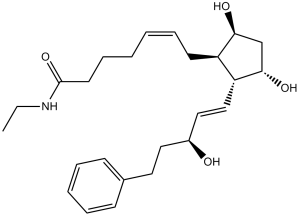
Bimatoprost (AGN 192024)

别名: AGN 192024; Bimatoprostum; AGN192024; Lumigan; AGN-192024; Latisse; AGN 192024; Prostamide; bimatoprostum; AGN-192024; Lumigan
比马前列素; (Z)-7-[(1R,2R,3R,5S)-3,5-二羟基-2-[(E,3S)-3-羟基-5-苯基戊-1-烯基]环戊基]-N-乙基庚-5-烯酰胺; 比马前列腺素; 贝美前列素; 比马前列腺; 比马前列素杂质; 比马前列素及中间体;比马前列素 API;比马前列素原药; 露泌根;贝美前列素(比马前列素);比马前列腺素/贝美前列素; 贝美前列素杂质
目录号: V2071 纯度: ≥98%
Bimatoprost (AGN-192024; Latisse; Lumigan;Bimatoprostum;AGN192024) 是一种有效的 FP(前列腺素 F)受体激动剂和前列腺素类似物,局部用作滴眼剂以控制青光眼的进展和治疗高眼压。
Bimatoprost (AGN 192024) CAS号: 155206-00-1
产品类别: Prostaglandin Receptor
产品仅用于科学研究,不针对患者销售
规格 价格 库存 数量
10 mM * 1 mL in DMSO
1mg
2mg
5mg
10mg
25mg
50mg
100mg
250mg
Other Sizes

Other Forms of Bimatoprost (AGN 192024):

  • 5,6-trans-Bimatoprost (5,6-trans-AGN 192024)
  • 15-Keto Bimatoprost-d5
  • 比马前列素酸甲基酯
  • N-去乙基比马前列素
点击了解更多
InvivoChem产品被CNS等顶刊论文引用
纯度/质量控制文件

纯度: ≥98%

产品描述
Bimatoprost (AGN-192024; Latisse; Lumigan; Bimatoprostum; AGN192024) 是一种有效的 FP(前列腺素 F)受体激动剂和前列腺素类似物,局部用作滴眼剂以控制青光眼的进展和治疗高眼压症。比马前列素在白天(13%)和夜间(14%)轻度刺激房水流动速率,其降眼压作用主要是由于眼压图对流出的阻力降低了 26%。比马前列素增强压力敏感的流出途径。 Bimatoprost 取代 FP 受体上的 [3H]前列腺素 F(2α),K(i) 为 6.31 μM。 Bimatoprost 通过在人胚胎肾细胞中表达的克隆人 FP 受体以及通过 3T3 小鼠成纤维细胞中的天然 FP 受体快速动员细胞内 Ca(2+),EC(50) 为 2.94 μM 和 2.2 μM。
生物活性&实验参考方法
靶点
FP receptor; prostaglandin analog
Prostaglandin FP receptor (Ki = 1.2 nM, determined by radioligand binding assay) [3]
- Prostaglandin E2 receptor (EP1) (Ki = 340 nM, determined by radioligand binding assay) [3]
- Prostaglandin E2 receptor (EP2) (Ki > 1000 nM, no significant binding) [3]
体外研究 (In Vitro)
比马前列素在白天(13%)和夜间(14%)轻度刺激房水流动速率,其降眼压作用主要是由于眼压图对流出的阻力降低了 26%。比马前列素增强压力敏感的流出途径。 Bimatoprost 取代 FP 受体上的 [3H]前列腺素 F(2α),K(i) 为 6.31 μM。 Bimatoprost 通过在人胚胎肾细胞中表达的克隆人 FP 受体以及通过 3T3 小鼠成纤维细胞中的天然 FP 受体快速动员细胞内 Ca(2+),EC(50) 为 2.94 μM 和 2.2 μM。 Bimatoprost 上调猫虹膜中 Cyr61 mRNA 的表达。比马前列素诱导的 Cyr61 mRNA 表达上调不是因为前列腺素 FP 受体的激活,而是因为不同的受体。比马前列素始终在同一组织制剂中的不同细胞中引起反应,而前列腺素 F(2 α) 和 17-苯基前列腺素 F(2 α) 在相同细胞中引起信号反应。比马前列素选择性刺激不同猫虹膜括约肌细胞中的细胞内钙信号传导。
以高亲和力结合人FP受体(Ki = 1.2 nM),中等亲和力结合EP1受体(Ki = 340 nM),对EP2、EP3、EP4或IP受体无显著结合活性(Ki > 1000 nM)[3]
- 浓度依赖性刺激表达FP受体的HEK293细胞中cAMP蓄积,EC50 = 2.5 nM[3]
- 诱导人睫状肌细胞钙动员,10 nM 比马前列素(AGN 192024)使细胞内钙浓度升高约2.3倍[5]
- 体外促进人真皮乳头细胞(HDPs)增殖和迁移:100 nM浓度下,HDP增殖率较对照组提高约60%,迁移率提高约45%[7]
- 增加离体猪眼眼前段房水排出量,0.1 μM浓度下使排出率提高约35%[4]
体内研究 (In Vivo)
Bimatoprost 是 17-苯基三去甲 PGF2α 的乙酰胺衍生物,是一种有效的前列腺素 FP 受体激动剂。比马前列素引起 [Ca2+] 立即、强劲的升高,并迅速衰减回到基线水平。比马前列素对大鼠、小鼠和人 FP 前列腺素受体具有直接激动剂活性。
在兔青光眼模型中,局部眼部给予比马前列素(AGN 192024)(0.03% w/v滴眼液,每日一次,持续28天),与溶媒对照组相比,显著降低眼压(IOP)约30%;给药后8-12小时眼压降低效果达峰值[1, 4]
- 在食蟹猴高眼压模型中,0.03% 比马前列素(AGN 192024)滴眼液(每日一次,持续14天)使眼压降低约25%,效果持续24小时[6]
- 在C57BL/6小鼠毛发生长模型中,局部涂抹0.1% 比马前列素(AGN 192024)凝胶(每日一次,持续21天),诱导毛囊进入生长期,毛囊密度增加约50%,毛干长度增加约35%[7]
- 对兔眼无明显炎症或角膜刺激;<5%的给药眼出现轻微结膜充血,可自行缓解[2]
酶活实验
据报道,比马前列素(17-苯基前列腺素F(2α)乙胺)不会通过前列腺素受体发挥作用。在这里,比马前列素从FP受体中置换了[3H]前列腺素F(2α)(K(i)=6310+/-1650 nM)。比马前列素通过在人胚胎肾细胞中表达的克隆人FP受体(EC(50)=2940+/-1663 nM)和3T3小鼠成纤维细胞中的天然FP受体(CE(50)=2200+/-670 nM)快速动员细胞内Ca(2+)([Ca(2+)](i))。此外,FP受体拮抗剂AL-8810((5Z,13E)-(9S,11S,15R)-9,15-二羟基-11-氟-15-(2-茚基)-16,17,18,19,20-戊-5,13-前列腺素酸)阻断了比马前列素诱导的[Ca(2+)](i)流动[2]。
前列腺素受体放射配体结合实验:将表达人FP、EP1-EP4或IP受体的细胞膜制剂,与[3H]-前列腺素F2α(针对FP受体)或[3H]-前列腺素E2(针对EP受体)及不同浓度的比马前列素(AGN 192024)在结合缓冲液中孵育。37°C孵育60分钟后,过滤去除未结合配体。测量结合部分的放射性强度,通过竞争结合分析计算Ki值[3]
- cAMP蓄积实验:表达FP受体的HEK293细胞用比马前列素(AGN 192024)(0.1-100 nM)预处理30分钟,再用IBMX(磷酸二酯酶抑制剂)孵育15分钟。裂解细胞后,酶免疫法定量cAMP浓度;根据cAMP诱导效率确定EC50值[3]
细胞实验
比马前列素是前列腺素F(2α)乙醇酰胺的合成类似物,其药理学特征与前列酰胺一致。与前列腺素F(2α)羧酸一样,比马前列素能有效降低狗、灵长类动物和人类的眼压。为了将其作用机制与前列腺素F(2α)区分开来,使用荧光共聚焦显微镜检查了比马前列素、前列腺素F(2-α)和17-苯基前列腺素F(2-α)对消化猫虹膜括约肌驻留细胞钙信号传导的影响,猫虹膜括约肌是一种对两种激动剂都有收缩反应的组织。持续的灌注条件阻碍了比马前列素的有效转化。100nM比马前列素和前列腺素F(2α)的连续挑战在同一组织制剂中的不同细胞中持续诱发反应,而前列腺素F(2-α)和17-苯基前列腺素F(2-α)在同一细胞中诱发信号反应。比马前列素敏感细胞仅用比马前列素持续再刺激,前列腺素F(2α)敏感细胞只能用前列腺素F(2-α)再刺激。比马前列素和前列腺素F(2α)对同一猫虹膜括约肌制剂中不同细胞的选择性刺激,以及完全没有观察到相同细胞对这两种激动剂都有反应的情况,强烈表明前列腺素F(2-α)和比马前列醇有不同的受体参与。此外,在用猫和人前列腺素F(2α)FP受体稳定转染的分离的人胚胎肾细胞和人皮肤成纤维细胞中,前列腺素F(2-α)而非比马前列素能有效刺激钙信号传导,只有前列腺素F(2-α)与HEK-feFP细胞中的放射配体结合竞争。这些研究为比马前列素敏感受体的存在提供了进一步的证据,该受体不同于任何已知的前列腺素受体类型[4]。
人睫状肌细胞钙动员实验:从人供体眼分离睫状肌细胞,培养至汇合。细胞加载钙敏感染料,用比马前列素(AGN 192024)(0.1-100 nM)预处理20分钟,荧光显微镜监测细胞内钙浓度变化[5]
- 人真皮乳头细胞(HDP)增殖实验:HDP接种于96孔板,用比马前列素(AGN 192024)(0.1-1000 nM)处理72小时。MTT法检测细胞活力,计算相对于对照组的增殖率[7]
- 离体猪眼前段房水排出实验:摘除猪眼,分离眼前段并以平衡盐溶液灌注。灌流液中加入比马前列素(AGN 192024)(0.01-1 μM),监测4小时内排出率;以排出率与灌注压的比值计算房水排出系数[4]
动物实验
The IOP response to a single 1.2-microg (4 microL) dose of bimatoprost was measured in the treated and untreated fellow eyes of homozygote (FP+/+, n = 9) and heterozygote (FP+/-, n = 10) FP-knockout mice, as well as in wild-type C57BL/6 mice (FP+/+, n = 20). Serial IOP measurements were also performed after topical bimatoprost in a separate generation of homozygous FP-knockout mice and wild-type littermate control animals (n = 4 per group). Aqueous humor protein concentrations were measured to establish the state of the blood-aqueous barrier. Tissue, aqueous humor and vitreous concentrations of bimatoprost, latanoprost, and their C-1 free acids were determined by liquid chromatography and tandem mass spectrometry.[6]
The study included 15 clinically healthy male rabbits. All rabbits were treated with bimatoprost 0.03% daily for 4 weeks with one drop of the topical eye drops applied to the conjunctival fornix of the right eyes; left eyes were used as controls. Eyelash lengths were measured before and after treatment. The eyelid of each animal was dissected for light and electron microscopic analysis.[7]
Treatment with Bimatoprost Bimatoprost belongs to a newer subset of PGs; prostamides which are created from anandamide that is derived from arachidonic acid.11,12 Anandamide is converted to prostamide G2 and H2 by cyclooxygenase (COX). Bimatoprost is a synthetic prostamide with a molecular formula of C25H37NO4. The unique substitution of ethyl amide instead of isopropyl ester at the C-1 carbon of the alpha chain gives different properties to bimatoprost than other PGF2α analogs (latanoprost, travoprost, and unoprostone).13 All rabbits were treated with bimatoprost 0.03% daily for 4 weeks with one drop of the topical eye drops applied to the conjunctival fornix of animals' right eye. Left eyes were used as a control group with instillation of vehicle eye drops.[7]
Rabbit glaucoma model: New Zealand White rabbits (2.5-3 kg) were induced with steroid-induced glaucoma. Bimatoprost (AGN 192024) was formulated as 0.03% w/v in phosphate-buffered saline (PBS) with 0.05% benzalkonium chloride. The was administered topically to one eye (50 μL/eye) once daily for 28 days. IOP was measured using a tonometer at baseline, 2, 4, 8, 12, and 24 hours post-administration on days 7, 14, 21, and 28 [1, 4]
- Cynomolgus monkey high IOP model: Adult cynomolgus monkeys (4-6 kg) with naturally elevated IOP were used. 0.03% Bimatoprost (AGN 192024) was administered topically (50 μL/eye) once daily for 14 days. IOP was measured at baseline and 12 hours post-administration daily; ocular tissues were examined for inflammation by slit-lamp biomicroscopy [6]
- Mouse hair growth model: C57BL/6 mice (6-8 weeks old) were depilated to induce telogen phase. Bimatoprost (AGN 192024) was formulated as 0.1% w/v gel with carbopol as the base. The gel was applied topically to the depilated area (50 μL/mouse) once daily for 21 days. Skin samples were collected at day 21 for histomorphometric analysis of hair follicles [7]
药代性质 (ADME/PK)
Absorption, Distribution and Excretion
This drug is absorbed systemically when administered to the eye. A study was performed on 15 healthy volunteers and bimatoprost ophthalmic solution 0.03% was administered once daily for 14 days. The mean Cmax was approximately 0.08 ng/mL and AUC0-24hr was approximately 0.09 on days 7 and 14 of the study. By 10 minutes, peak blood concentration was achieved. Bimatoprost was not detectable at 1.5 hours after administration in most subjects. The maximum blood concentration in a study of 6 healthy volunteers was determined to be 12.2 ng/mL. Steady state was reached in the first week of dosing. One drug label mentions that onset of decreased intraocular pressure occurs approximately 4 hours after the first administration and the peak effect occurs in the range of 8-12 hours. Bimatoprost effects may last up to 24 hours.
One pharmacokinetic study of bimatoprost in 6 healthy volunteers determined that 67% of the administered dose was found to be excreted in the urine while 25% of the dose was recovered in the feces.
The volume of distribution at steady state is 0.67 L/kg.. It penetrates the human cornea and sclera.
The clearance was measured to be 1.5 L/hr/kg in healthy subjects receiving IV administration of bimatoprost dosed at 3.12 ug/kg.
Metabolism / Metabolites
Bimatoprost is hydrolyzed to its active form, bimatoprost acid, in the eye. Bimatoprost undergoes oxidation, N-deethylation, and glucuronidation after it is systemically absorbed, and this leads to the production of various metabolites. In vitro studies show that CYP3A4 is an enzyme that participates in the metabolism of bimatoprost. Despite this, many enzymes and pathways metabolize bimatoprost, therefore, no significant drug-drug interactions are likely to occur. Glucuronidated metabolites comprise most of the excreted drug product in the blood, urine, and feces in rats.
Biological Half-Life
The elimination half-life of bimatoprost is approximately 45 minutes.
Topical ocular administration in humans: Minimal systemic absorption; plasma concentration peaks at ~0.02 ng/mL 1 hour post-administration, below detectable levels by 24 hours [1]
- Plasma half-life (t1/2) in humans is ~45 minutes; metabolized in the liver via oxidation and glucuronidation [1]
- Ocular distribution: Accumulates in ciliary body, iris, and aqueous humor; aqueous humor concentration reaches ~10 ng/mL 2 hours after topical administration of 0.03% [4]
- Excreted primarily in urine (≈60%) and feces (≈30%) as metabolites within 72 hours [1]
毒性/毒理 (Toxicokinetics/TK)
Effects During Pregnancy and Lactation
◉ Summary of Use during Lactation
No information is available on the use of bimatoprost during breastfeeding. Because of its short half-life it is not likely to reach the bloodstream of the infant or cause any adverse effects in breastfed infants. To substantially diminish the amount of drug that reaches the breastmilk after using eye drops, place pressure over the tear duct by the corner of the eye for 1 minute or more, then remove the excess solution with an absorbent tissue. With the implant, plasma levels are usually undetectable, so the amount in milk is likely to be negligible.
◉ Effects in Breastfed Infants
Relevant published information was not found as of the revision date.
◉ Effects on Lactation and Breastmilk
Relevant published information was not found as of the revision date.
Protein Binding
Bimatoprost is about 88%-90% bound to plasma proteins.
In vitro cytotoxicity: No significant toxicity to human corneal epithelial cells or retinal pigment epithelial cells at concentrations ≤1 μM [2]
- Acute ocular toxicity: Topical administration of 0.1% in rabbits did not cause corneal opacity, iritis, or conjunctival necrosis [2]
- Subchronic toxicity: Daily topical administration of 0.03% in monkeys for 90 days did not affect body weight, hematological parameters, or liver/kidney function [1]
- Plasma protein binding rate = ~88% in humans [1]
- Common adverse effects in humans: Mild conjunctival hyperemia (≈15% of patients), eyelash growth (≈80%), and ocular pruritus (≈5%) [7]
参考文献

[1]. Surv Ophthalmol . 2001 May:45 Suppl 4:S347-51.

[2]. Eur J Pharmacol . 2001 Dec 7;432(2-3):211-3.

[3]. J Biol Chem . 2003 Jul 18;278(29):27267-77.

[4]. Exp Eye Res . 2005 Jan;80(1):135-45

[5]. J Pharmacol Exp Ther . 2003 Jan;304(1):238-45.

[6]. Invest Ophthalmol Vis Sci. 2005 Dec;46(12):4571-7.
[7]. Clin Ophthalmol. 2019; 13: 2421–2426.
其他信息
Bimatoprost is a monocarboxylic acid amide. It has a role as an antiglaucoma drug and an antihypertensive agent.
Bimatoprost, also known as Latisse or Lumigan, belongs to a group of drugs called prostamides, which are synthetic structural analogs of prostaglandin. Bimatoprost, marketed by Allergan, is administered in both the ophthalmic solution and implant form. It has the ability to reduce ocular hypotension, proving effective in conditions such as ocular hypertension and glaucoma. Bimatoprost is also used to treat eyelash hypotrichosis, or sparse eyelash growth. It was initially approved by the FDA in 2001 for ocular hypertension and later approved for hypothrichosis in 2008, as eyelash growth became a desirable adverse effect for patients using this drug.
Bimatoprost is a Prostaglandin Analog.
Bimatoprost is a synthetic prostamide and structural prostaglandin analogue with ocular hypotensive activity. Bimatoprost mimics the effects of the endogenous prostamides and reduces intraocular pressure by increasing outflow of aqueous humor through both the pressure-sensitive outflow pathway (the trabecular meshwork), and the pressure-insensitive outflow pathway (the uveoscleral routes). It is not clear whether bimatoprost lowers intraocular pressure by stimulating F-Prostanoid receptors or by acting on specific prostamide receptors.
A cloprostenol-derived amide that is used as an ANTIHYPERTENSIVE AGENT in the treatment of OPEN-ANGLE GLAUCOMA and OCULAR HYPERTENSION.
Drug Indication
Bimatoprost is used for the reduction of elevated intraocular pressure in patients with open-angle glaucoma or ocular hypertension. These patients must be intolerant to other intraocular pressure lowering medications or inadequately responsive to other treatments. Bimatoprost is also indicated to treat eyelash hypotrichosis.
Reduction of elevated intraocular pressure in chronic open-angle glaucoma and ocular hypertension (as monotherapy or as adjunctive therapy to beta-blockers). ,
Treatment of glaucoma, Treatment of non-scarring hair loss
Treatment of androgenic alopecia
Mechanism of Action
Bimatoprost imitates the effects of prostamides, specifically prostaglandin F2α. Bimatoprost mildly stimulates aqueous humor outflow, relieving elevated intraocular pressure and decreasing the risk of optic nerve damage. It is thought that bimatoprost reduces intraocular pressure (IOP) in humans by causing an increase in outflow of the aqueous humor via the trabecular meshwork and uveoscleral pathways. It achieves the above effects by decreasing tonographic resistance to aqueous humor outflow. Bimatoprost does not affect aqueous humor production.
Pharmacodynamics
High intraocular pressure is a major risk factor for glaucoma-related visual field loss. A linear relationship exists between intraocular pressure and the risk of damaging the optic nerve, which can lead to considerable visual impairment. Therefore, conditions such as ocular hypertension and glaucoma can cause dangerous elevations of intraocular pressure. Bimatoprost rapidly decreases intraocular pressure and reduces the risk for visual field loss from ocular hypertension due to various causes. Other effects of this drug may include gradual changes in eyelid pigmentation, changes in iris pigmentation, changes in eyelash pigmentation, growth and thickness. Patients should be informed of these possible effects, especially if this drug is only administered to one eye, which may noticeably change in appearance with bimatoprost treatment.
Bimatoprost (AGN 192024) is a synthetic prostaglandin F2α analog with high selectivity for the FP receptor [1, 3, 7]
- Its ocular hypotensive mechanism involves increasing aqueous humor outflow through the trabecular meshwork and uveoscleral pathway by activating FP receptor-mediated signaling (cAMP and Ca2+ pathways) [3, 4, 5]
- Clinically indicated for the treatment of open-angle glaucoma and ocular hypertension to reduce IOP, and for hypotrichosis of the eyelashes to promote eyelash growth [1, 7]
- Exhibits greater IOP-lowering efficacy and longer duration of action compared to other prostaglandin analogs due to its high receptor affinity and prolonged ocular residence time [6]
*注: 文献方法仅供参考, InvivoChem并未独立验证这些方法的准确性
化学信息 & 存储运输条件
分子式
C25H37NO4
分子量
415.57
精确质量
415.272
元素分析
C, 72.26; H, 8.97; N, 3.37; O, 15.40
CAS号
155206-00-1
相关CAS号
5,6-trans-Bimatoprost; 1163135-95-2; Bimatoprost-d5; Bimatoprost methyl ester; 38315-47-8; N-Desethyl Bimatoprost; 155205-89-3; Bimatoprost-d4
PubChem CID
5311027
外观&性状
White to off-white solid powder
密度
1.1±0.1 g/cm3
沸点
629.8±55.0 °C at 760 mmHg
熔点
66-68°C
闪点
334.7±31.5 °C
蒸汽压
0.0±1.9 mmHg at 25°C
折射率
1.591
LogP
1.98
tPSA
89.79
氢键供体(HBD)数目
4
氢键受体(HBA)数目
4
可旋转键数目(RBC)
12
重原子数目
30
分子复杂度/Complexity
541
定义原子立体中心数目
5
SMILES
O([H])[C@]1([H])C([H])([H])[C@]([H])([C@@]([H])(/C(/[H])=C(\[H])/C([H])(C([H])([H])C([H])([H])C2C([H])=C([H])C([H])=C([H])C=2[H])O[H])[C@]1([H])C([H])([H])/C(/[H])=C(/[H])\C([H])([H])C([H])([H])C([H])([H])C(N([H])C([H])([H])C([H])([H])[H])=O)O[H]
InChi Key
AQOKCDNYWBIDND-FTOWTWDKSA-N
InChi Code
InChI=1S/C25H37NO4/c1-2-26-25(30)13-9-4-3-8-12-21-22(24(29)18-23(21)28)17-16-20(27)15-14-19-10-6-5-7-11-19/h3,5-8,10-11,16-17,20-24,27-29H,2,4,9,12-15,18H2,1H3,(H,26,30)/b8-3-,17-16+/t20-,21+,22+,23-,24+/m0/s1
化学名
(Z)-7-[(1R,2R,3R,5S)-3,5-dihydroxy-2-[(E,3S)-3-hydroxy-5-phenylpent-1-enyl]cyclopentyl]-N-ethylhept-5-enamide
别名
AGN 192024; Bimatoprostum; AGN192024; Lumigan; AGN-192024; Latisse; AGN 192024; Prostamide; bimatoprostum; AGN-192024; Lumigan
HS Tariff Code
2934.99.9001
存储方式

Powder      -20°C    3 years

                     4°C     2 years

In solvent   -80°C    6 months

                  -20°C    1 month

运输条件
Room temperature (This product is stable at ambient temperature for a few days during ordinary shipping and time spent in Customs)
溶解度数据
溶解度 (体外实验)
DMSO: 83~250 mg/mL (199.7~601.6 mM)
Water: <1 mg/mL
Ethanol: ~83 mg/mL (~199.7 mM)
溶解度 (体内实验)
配方 1 中的溶解度: ≥ 2.5 mg/mL (6.02 mM) (饱和度未知) in 10% DMSO + 40% PEG300 + 5% Tween80 + 45% Saline (这些助溶剂从左到右依次添加,逐一添加), 澄清溶液。
例如,若需制备1 mL的工作液,可将100 μL 25.0 mg/mL澄清DMSO储备液加入到400 μL PEG300中,混匀;然后向上述溶液中加入50 μL Tween-80,混匀;加入450 μL生理盐水定容至1 mL。
*生理盐水的制备:将 0.9 g 氯化钠溶解在 100 mL ddH₂O中,得到澄清溶液。

配方 2 中的溶解度: ≥ 2.5 mg/mL (6.02 mM) (饱和度未知) in 10% DMSO + 90% (20% SBE-β-CD in Saline) (这些助溶剂从左到右依次添加,逐一添加), 澄清溶液。
例如,若需制备1 mL的工作液,可将 100 μL 25.0 mg/mL澄清DMSO储备液加入900 μL 20% SBE-β-CD生理盐水溶液中,混匀。
*20% SBE-β-CD 生理盐水溶液的制备(4°C,1 周):将 2 g SBE-β-CD 溶解于 10 mL 生理盐水中,得到澄清溶液。

View More

配方 3 中的溶解度: ≥ 2.5 mg/mL (6.02 mM) (饱和度未知) in 10% DMSO + 90% Corn Oil (这些助溶剂从左到右依次添加,逐一添加), 澄清溶液。
例如,若需制备1 mL的工作液,可将 100 μL 25.0 mg/mL 澄清 DMSO 储备液加入到 900 μL 玉米油中并混合均匀。


请根据您的实验动物和给药方式选择适当的溶解配方/方案:
1、请先配制澄清的储备液(如:用DMSO配置50 或 100 mg/mL母液(储备液));
2、取适量母液,按从左到右的顺序依次添加助溶剂,澄清后再加入下一助溶剂。以 下列配方为例说明 (注意此配方只用于说明,并不一定代表此产品 的实际溶解配方):
10% DMSO → 40% PEG300 → 5% Tween-80 → 45% ddH2O (或 saline);
假设最终工作液的体积为 1 mL, 浓度为5 mg/mL: 取 100 μL 50 mg/mL 的澄清 DMSO 储备液加到 400 μL PEG300 中,混合均匀/澄清;向上述体系中加入50 μL Tween-80,混合均匀/澄清;然后继续加入450 μL ddH2O (或 saline)定容至 1 mL;

3、溶剂前显示的百分比是指该溶剂在最终溶液/工作液中的体积所占比例;
4、 如产品在配制过程中出现沉淀/析出,可通过加热(≤50℃)或超声的方式助溶;
5、为保证最佳实验结果,工作液请现配现用!
6、如不确定怎么将母液配置成体内动物实验的工作液,请查看说明书或联系我们;
7、 以上所有助溶剂都可在 Invivochem.cn网站购买。
制备储备液 1 mg 5 mg 10 mg
1 mM 2.4063 mL 12.0317 mL 24.0633 mL
5 mM 0.4813 mL 2.4063 mL 4.8127 mL
10 mM 0.2406 mL 1.2032 mL 2.4063 mL

1、根据实验需要选择合适的溶剂配制储备液 (母液):对于大多数产品,InvivoChem推荐用DMSO配置母液 (比如:5、10、20mM或者10、20、50 mg/mL浓度),个别水溶性高的产品可直接溶于水。产品在DMSO 、水或其他溶剂中的具体溶解度详见上”溶解度 (体外)”部分;

2、如果您找不到您想要的溶解度信息,或者很难将产品溶解在溶液中,请联系我们;

3、建议使用下列计算器进行相关计算(摩尔浓度计算器、稀释计算器、分子量计算器、重组计算器等);

4、母液配好之后,将其分装到常规用量,并储存在-20°C或-80°C,尽量减少反复冻融循环。

计算器

摩尔浓度计算器可计算特定溶液所需的质量、体积/浓度,具体如下:

  • 计算制备已知体积和浓度的溶液所需的化合物的质量
  • 计算将已知质量的化合物溶解到所需浓度所需的溶液体积
  • 计算特定体积中已知质量的化合物产生的溶液的浓度
使用摩尔浓度计算器计算摩尔浓度的示例如下所示:
假如化合物的分子量为350.26 g/mol,在5mL DMSO中制备10mM储备液所需的化合物的质量是多少?
  • 在分子量(MW)框中输入350.26
  • 在“浓度”框中输入10,然后选择正确的单位(mM)
  • 在“体积”框中输入5,然后选择正确的单位(mL)
  • 单击“计算”按钮
  • 答案17.513 mg出现在“质量”框中。以类似的方式,您可以计算体积和浓度。

稀释计算器可计算如何稀释已知浓度的储备液。例如,可以输入C1、C2和V2来计算V1,具体如下:

制备25毫升25μM溶液需要多少体积的10 mM储备溶液?
使用方程式C1V1=C2V2,其中C1=10mM,C2=25μM,V2=25 ml,V1未知:
  • 在C1框中输入10,然后选择正确的单位(mM)
  • 在C2框中输入25,然后选择正确的单位(μM)
  • 在V2框中输入25,然后选择正确的单位(mL)
  • 单击“计算”按钮
  • 答案62.5μL(0.1 ml)出现在V1框中
g/mol

分子量计算器可计算化合物的分子量 (摩尔质量)和元素组成,具体如下:

注:化学分子式大小写敏感:C12H18N3O4  c12h18n3o4
计算化合物摩尔质量(分子量)的说明:
  • 要计算化合物的分子量 (摩尔质量),请输入化学/分子式,然后单击“计算”按钮。
分子质量、分子量、摩尔质量和摩尔量的定义:
  • 分子质量(或分子量)是一种物质的一个分子的质量,用统一的原子质量单位(u)表示。(1u等于碳-12中一个原子质量的1/12)
  • 摩尔质量(摩尔重量)是一摩尔物质的质量,以g/mol表示。
/

配液计算器可计算将特定质量的产品配成特定浓度所需的溶剂体积 (配液体积)

  • 输入试剂的质量、所需的配液浓度以及正确的单位
  • 单击“计算”按钮
  • 答案显示在体积框中
动物体内实验配方计算器(澄清溶液)
第一步:请输入基本实验信息(考虑到实验过程中的损耗,建议多配一只动物的药量)
第二步:请输入动物体内配方组成(配方适用于不溶/难溶于水的化合物),不同的产品和批次配方组成不同,如对配方有疑问,可先联系我们提供正确的体内实验配方。此外,请注意这只是一个配方计算器,而不是特定产品的确切配方。
+
+
+

计算结果:

工作液浓度 mg/mL;

DMSO母液配制方法 mg 药物溶于 μL DMSO溶液(母液浓度 mg/mL)。如该浓度超过该批次药物DMSO溶解度,请首先与我们联系。

体内配方配制方法μL DMSO母液,加入 μL PEG300,混匀澄清后加入μL Tween 80,混匀澄清后加入 μL ddH2O,混匀澄清。

(1) 请确保溶液澄清之后,再加入下一种溶剂 (助溶剂) 。可利用涡旋、超声或水浴加热等方法助溶;
            (2) 一定要按顺序加入溶剂 (助溶剂) 。

临床试验信息
Stop Retinal Ganglion Cell Dysfunction Study
CTID: NCT02390284
Phase: Phase 3    Status: Completed
Date: 2024-10-10
Treatment of Hypopigmented Scars With Bimatoprost
CTID: NCT06122090
Phase: Phase 2    Status: Recruiting
Date: 2024-05-03
Evaluation of the Duration of Effect of Bimatoprost SR in Participants With Open-Angle Glaucoma or Ocular Hypertension
CTID: NCT03850782
Phase: Phase 3    Status: Active, not recruiting
Date: 2024-02-13
Efficacy and Safety Assessment of T4032 Versus Lumigan® in Ocular Hypertensive or Glaucomatous Patients
CTID: NCT03825380
Phase: Phase 3    Status: Completed
Date: 2023-11-21
A Phase 3b Study Evaluating the 24-Hour Intraocular Pressure Lowering Effect of Bimatoprost SR in Patients With Open-Angle Glaucoma or Ocular Hypertension
CTID: NCT04285580
Phase: Phase 3    Status: Completed
Date: 2023-06-08
View More

Combined CO2 Fractional Laser With Bimatoprost 0.03% Treatment of Alopecia Areata
CTID: NCT05600673
Phase: Phase 1/Phase 2    Status: Completed
Date: 2022-10-31


Effect of Microneedling, Bimatoprost and Excimer in Vitiligo Treatment
CTID: NCT04738149
PhaseEarly Phase 1    Status: Completed
Date: 2022-08-05
A Comparative Study of SPARC's SDP-133 Once Daily and Lumigan in Subjects With Open Angle Glaucoma or Ocular Hypertension
CTID: NCT03927443
Phase: Phase 3    Status: Withdrawn
Date: 2021-11-19
Dose-Ranging Study of the Bimatoprost Ocular Insert
CTID: NCT02358369
Phase: Phase 2    Status: Completed
Date: 2020-06-04
Safety and Efficacy Study of Bimatoprost in Japanese Patients With Eyelash Hypotrichosis
CTID: NCT01391273
Phase: Phase 3    Status: Completed
Date: 2019-07-08
Safety and Efficacy Study of Bimatoprost in Japanese Patients With Chemotherapy-Induced Eyelash Hypotrichosis
CTID: NCT01391286
Phase: Phase 3    Status: Completed
Date: 2019-07-08
Topical Bimatoprost in the Treatment of Migraine
CTID: NCT03419715
Phase: Phase 2    Status: Unknown status
Date: 2019-04-26
Bimatoprost 0.03% Versus Travoprost 0.004% in Patients Currently on Latanoprost 0.005%
CTID: NCT00440011
Phase: Phase 4    Status: Completed
Date: 2019-04-25
A Study of the Safety and Efficacy of Bimatoprost in Patients With Glaucoma or Ocular Hypertension
CTID: NCT00538304
Phase: Phase 2    Status: Completed
Date: 2019-04-23
Bimatoprost for the Treatment of Eyebrow Hypotrichosis
CTID: NCT01765764
Phase: Phase 3    Status: Completed
Date: 2019-04-23
An Open-label Extension Study to Evaluate the Safety of the 13 mg Bimatoprost Ocular Insert
CTID: NCT02537015
Phase: Phase 2    Status: Completed
Date: 2019-04-02
An Open-Label Extension Study to Evaluate the Safety of the ForSight VISION5 Product
CTID: NCT02143843
Phase: Phase 2    Status: Completed
Date: 2019-02-26
A Study to Evaluate Efficacy and Safety of a Fixed Combination Ocular Insert in Participants With Open-angle Glaucoma or Ocular Hypertension
CTID: NCT02742649
Phase: Phase 1/Phase 2    Status: Completed
Date: 2019-02-25
Bimatoprost Ocular Insert Compared to Topical Timolol Solution in Patients With Glaucoma or Ocular Hypertension
CTID: NCT01915940
Phase: Phase 2    Status: Completed
Date: 2018-04-20
Safety, Tolerability, and Pharmacokinetics of Bimatoprost in Men With Androgenetic Alopecia (AGA)
CTID: NCT02676310
Phase: Phase 1    Status: Terminated
Date: 2017-03-17
Prostaglandin F2-alpha Eye Drops in Thyroid Eye Disease (Bima Study)
CTID: NCT02059655
Phase: Phase 4    Status: Completed
Date: 2016-05-06
A Safety and Efficacy Study of Bimatoprost in Men With Androgenic Alopecia (AGA)
CTID: NCT01904721
Phase: Phase 2    Status: Completed
Date: 2016-03-22
The Effects of Xalatan, Travatan and Lumigan on Skin Pigmentation Near the Eye
CTID: NCT00705757
Phase: Phase 4    Status: Completed
Date: 2016-01-18
A Study of the Safety and Efficacy of Bimatoprost Ophthalmic Solution in Paediatric Patients With Glaucoma
CTID: NCT01426113
Phase: Phase 3    Status: Terminated
Date: 2015-10-02
Topical Bimatoprost Effect on Androgen Dependent Hair Follicles
CTID: NCT02170662
Phase: Phase 2    Status: Completed
Date: 2014-09-05
A Study of 0.03% Bimatoprost in the Treatment of Primary Open Angle Glaucoma and Ocular Hypertension
CTID: NCT02020512
Phase: Phase 4    Status: Completed
Date: 2014-07-21
24-hour IOP-lowering Effect of 0.01% Bimatoprost
CTID: NCT01271686
Phase: Phase 4    Status: Completed
Date: 2014-06-19
A Study Comparing IOP-Lowering Treatments to Bimatoprost in Patients With Primary Open Angle Glaucoma or Ocular Hypertension
CTID: NCT01646151
Phase:    Status: Completed
Date: 2014-06-13
Comparison of the Effects of Bimatoprost and a Fixed Combination of Latanoprost and Timolol on 24-hour Blood and Ocular Perfusion Pressures
CTID: NCT02154217
Phase: Phase 3    Status: Completed
Date: 2014-06-03
Safety and Efficacy Study of Bimatoprost in the Treatment of Men With Androgenic Alopecia
CTID: NCT01325337
Phase: Phase 2    Status: Completed
Date: 2014-04-10
Safety and Efficacy Study of Bimatoprost in the Treatment of Women With Female Pattern Hair Loss
CTID: NCT01325350
Phase: Phase 2    Status: Completed
Date: 2014-04-09
Safety and Efficacy of AGN-210669 Ophthalmic Solution Compared With Bimatoprost Ophthalmic Solution in Patients With Open-Angle Glaucoma or Ocular Hypertension
CTID: NCT01291108
Phase: Phase 2    Status: Completed
Date: 2013-11-06
Study Assessing Patient Satisfaction With LATISSE® for Increasing Eyelash Prominence
CTID: NCT01448525
Phase: Phase 4    Status: Completed
Date: 2013-05-22
Safety and Efficacy Study of Bimatoprost to Treat Hypotrichosis of the Eyelashes After Application to the Eyelid Margin
CTID: NCT00907426
Phase: Phase 3    Status: Completed
Date: 2012-09-19
24-hour Control of Intraocular Pressure (IOP) in Ocular Hypertension
CTID: NCT01655758
Phase: Phase 4    Status: Completed
Date: 2012-08-02
Latisse (Bimatoprost .03% Opthalmic Solution) for the Treatment of Hypotrichosis of the Eyebrows: Latisse Versus Placebo
CTID: NCT01387906
Phase: Phase 4    Status: Completed
Date: 2012-06-15
Safety and Efficacy of Bimatoprost Compared With Latanoprost in Patients With Glaucoma or Ocular Hypertension
CTID: NCT00541242
Phase: Phase 4    Status: Completed
Date: 2011-10-27
Efficacy Study of Latanoprost and Bimatoprost Solutions in Promoting Eyelash Growth in Patients With Alopecia Areata
CTID: NCT00187577
Phase: N/A    Status: Completed
Date: 2011-06-09
Safety and Efficacy Study of Bimatoprost in Patients With Glaucoma or Ocular Hypertension
CTID: NCT00300443
Phase: Phase 2/Phase 3    Status: Completed
Date: 2011-05-30
A Multicenter Evaluation of Methods to Reduce Hyperemia Associated With Bimatoprost Therapy for Glaucoma or Ocular Hypertension
CTID: NCT00348062
Phase: Phase 4    Status: Completed
Date: 20
A prospective, double-masked, randomized, multicenter, active-controlled, parallel-group, 6-month study assessing the safety and ocular hypotensive efficacy of PG324 Ophthalmic Solution compared to GANFORT® (bimatoprost 0.03%/timolol 0.5%) Ophthalmic Solution in subjects with elevated intraocular pressure (MERCURY 3)
CTID: null
Phase: Phase 3    Status: GB - no longer in EU/EEA, Completed
Date: 2017-06-27
A Comparison of Bimatoprost SR to Selective Laser Trabeculoplasty in Patients with Open-Angle Glaucoma or Ocular Hypertension
CTID: null
Phase: Phase 3    Status: Temporarily Halted, Completed
Date: 2017-01-12
A Comparison of Bimatoprost SR to Selective Laser Trabeculoplasty in Patients with Open-Angle Glaucoma or Ocular Hypertension
CTID: null
Phase: Phase 3    Status: GB - no longer in EU/EEA, Completed
Date: 2016-12-21
Additive Effect of Twice Daily Brinzolamide 1% /Brimonidine 0.2% Fixed Dose Combination as an Adjunctive Therapy to a Prostaglandin Analogue
CTID: null
Phase: Phase 4    Status: Completed
Date: 2015-09-14
Effectiveness, tolerability and impact in the ocular surface of Bimatoprost and Tafluprost pods in patients with glaucoma and ocular hypertension
CTID: null
Phase: Phase 4    Status: Ongoing
Date: 2015-06-10
The Efficacy and Safety of Bimatoprost SR in Patients With Open-angle Glaucoma or Ocular Hypertension
CTID: null
Phase: Phase 3    Status: GB - no longer in EU/EEA, Completed
Date: 2015-04-23
The Efficacy and Safety of Bimatoprost SR in Patients With Open-angle Glaucoma or Ocular Hypertension
CTID: null
Phase: Phase 3    Status: Completed
Date: 2015-03-16
Bimatoprost 0,3mg/ml- Eyedrops for lash-lenghtening - Pilot Study
CTID: null
Phase: Phase 3    Status: Ongoing
Date: 2014-12-05
Prostaglandin F2-alpha eye drops (Bimatoprost) in thyroid eye disease: a randomised
CTID: null
Phase: Phase 4    Status: Completed
Date: 2014-05-01
Safety and Efficacy assessment of Monoprost® (unpreserved latanoprost) in comparison with Lumigan® 0.01 % and Lumigan® 0.03% UD, in patients with open angle glaucoma or ocular hypertension, stabilized by Lumigan® 0.01 % or Xalatan® with ocular surface intolerance.
CTID: null
Phase: Phase 4    Status: Ongoing, Completed
Date: 2013-11-06
Intraocular Pressure And Tolerability Study of Preservative Free Bimatoprost 0.03% Unit Dose (BUDPF) or preservative free Latanoprost 0.005% Unit Dose (LUDPF) (Monopost)in patients with Ocular hypertension or Glaucoma: A Randomised, single masked, 3 month cross-over, Investigator led, European multicentre Trial (SPORT).
CTID: null
Phase: Phase 4    Status: Completed
Date: 2013-09-27
Evaluation of inflammatory markers in patients on topical anti-glaucoma drop therapy; a comparative trial of preserved and non-preserved primary medical treatment (eye drops) in patients with glaucoma and ocular hypertension – a pilot study.
CTID: null
Phase: Phase 4    Status: Completed
Date: 2013-07-25
Bimatoprost in the Treatment of Eyelash Hypotrichosis
CTID: null
Phase: Phase 3    Status: Completed
Date: 2013-01-14
Assessing the Efficacy and Tolerability of TRAVATAN® Solution without BAK, containing Polyquad® Preservative (travoprost 0.004%) versus LUMIGAN® 0.01% Solution with BAK (bimatoprost 0.01%) in Treatment Naïve patients with Ocular Hypertension or Open Angle Glaucoma
CTID: null
Phase: Phase 4    Status: Completed
Date: 2012-09-10
An Open Label (Stage 1) and Randomized (Stage 2), 24-Month Study of Safety and Efficacy of Bimatoprost Drug Delivery System in Patients With Open-Angle Glaucoma or Ocular Hypertension
CTID: null
Phase: Phase 1, Phase 2    Status: Completed
Date: 2012-05-08
A Multicenter, Randomized, Double-blind, Parallel-group Study to Evaluate the Safety and Efficacy of Bimatoprost Solution 0.03%, 0.1%, and 0.3% Compared with Vehicle in Women with Female Pattern Hair Loss with an Open-label Active Comparator (Minoxidil 2%) Group
CTID: null
Phase: Phase 2    Status: Completed
Date: 2011-06-21
A Multicenter, Randomized, Double-blind, Parallel-group Study to Evaluate the Safety and Efficacy of Bimatoprost Solution 0.03%, 0.1%, and 0.3% Compared with Vehicle in Men with Androgenic Alopecia with an Open-label Active Comparator (Minoxidil 5%) Group
CTID: null
Phase: Phase 2    Status: Completed
Date: 2011-06-21
A 2-year, multicenter, double-masked, randomized, parallel study of the safety of LUMIGAN® 0.1 mg/mL compared with LUMIGAN® 0.3 mg/mL in patients with glaucoma or ocular
CTID: null
Phase: Phase 4    Status: Completed
Date: 2011-06-10
Comparison of the effects of Bimatoprost 0.01% and Timolol 0.5% on circadian intraocular pressure
CTID: null
Phase: Phase 4    Status: Ongoing
Date: 2011-04-14
A Multicenter, Double-masked, Randomized, Parallel Study of the Safety and Efficacy of Bimatoprost 0.03%/Timolol 0.5% Preservative-free Ophthalmic Solution Compared with GANFORT® (bimatoprost 0.03%/timolol 0.5% ophthalmic solution) Once Daily for 12 Weeks in Patients with Glaucoma or Ocular Hypertension
CTID: null
Phase: Phase 3    Status: Completed
Date: 2011-02-23
Comparison of Incidence and Severity of conjunctival hyperemia associated with use of topical Bimatoprost 0.01% and latanoprost 0.005% in Glaucoma or Ocular Hypertensive patients
CTID: null
Phase: Phase 3    Status: Ongoing
Date: 2010-05-27
Estudio Piloto de tres meses, multicéntrico, enmascarado para el Investigador, para evaluar la eficacia y la seguridad de una combinación fija de Bimatoprost/Timolol versus Latanoprost en pacientes naïve con glaucoma de ángulo abierto con alto riesgo de progresión glaucomatosa
CTID: null
Phase: Phase 4    Status: Completed
Date: 2009-11-11
A One Year, Multicenter, Double-Masked, Randomized, Parallel-Group Study Assessing the Safety and Efficacy of Once Daily Application of Bimatoprost 0.03% Solution Compared to Vehicle to Treat Hypotrichosis of the Eyelashes from Varied Etiologies.
CTID: null
Phase: Phase 3    Status: Completed
Date: 2009-07-15
Effectiveness of GANfort® in reducing intraocular pressure in patients presenting with significantly elevated intraocular pressure
CTID: null
Phase: Phase 4    Status: GB - no longer in EU/EEA
Date: 2008-12-11
EFFECTS OF PROSTAGLANDIN COMPOUNDS ON CONJUNTIVAL MELANOGENESIS: AN IMPRESSION CITOLOGY AND TYROSINASE MARKERS STUDY
CTID: null
Phase: Phase 4    Status: Completed
Date: 2006-07-31
A Six-Week/Six-Week, Prospective, Randomised, Masked, Cross over, Primary Therapy Study comparing IOP Lowering Effects of Lumigan® and Xalatan® in Subjects with Primary Open Angle Glaucoma, Ocular Hypertension, Pseudoexfoliation glaucoma & Pigment dispersion
CTID: null
Phase: Phase 4    Status: Completed
Date: 2004-11-12
A Multicenter, Double-masked, Randomized, Active-controlled, Parallel Study of the Safety and Efficacy of Once-daily Bimatoprost Preservative-free Ophthalmic Solution Compared to Twice-daily Timolol Ophthalmic Solution in Paediatric Patients With Glaucoma
CTID: null
Phase: Phase 3    Status: Ongoing, Prematurely Ended
Date:

生物数据图片
  • Regulation of Cyr61 and CTGF mRNA expression in cat iris following PGF, Butaprost, and Bimatoprost treatment. J Biol Chem . 2003 Jul 18;278(29):27267-77.
  • Differential regulation of CTGF and Cyr61 following PGF, Bimatoprost, and Butaprost treatments. J Biol Chem . 2003 Jul 18;278(29):27267-77.
  • Effects of PGF, Butaprost, and Bimatoprost (AGN 192024) on the CTGF promoter and Cyr61 promoter luciferase reporter activity. J Biol Chem . 2003 Jul 18;278(29):27267-77.
联系我们