| 规格 | 价格 | 库存 | 数量 |
|---|---|---|---|
| 5mg |
|
||
| 10mg |
|
||
| 50mg |
|
||
| 100mg |
|
||
| 250mg |
|
||
| 500mg |
|
||
| 1g |
|
||
| 2g |
|
||
| 5g |
|
||
| 10g |
|
||
| Other Sizes |
|

| 靶点 |
COX-2 (IC50 = 3.9 μM); COX-1 (IC50 = 22.3 μM); FAAH (IC50 = 78.6 μM)
Fatty Acid Amide Hydrolase (FAAH) (Ki: 2.3 ± 0.2 μM for Carprofen, measured in recombinant human FAAH enzyme assay) [1] - Cyclooxygenase-1 (COX-1) (IC50: 0.35 ± 0.03 μM for Carprofen, measured in sheep seminal vesicle microsomes) [1] - Cyclooxygenase-2 (COX-2) (IC50: 0.18 ± 0.02 μM for Carprofen, measured in LPS-stimulated human monocytes; selectivity ratio (COX-1/COX-2) = 1.94) [1] |
|---|---|
| 体外研究 (In Vitro) |
化合物 1,或称卡洛芬,是一种非甾体类抗炎药。作为 FAAH/COX 的多靶点抑制剂,COX-2、COX 和 FAAH 的 IC50 值分别为 3.9 μM、22.3 μM 和 78.6 μM-1。在 CCL 和 CaCL 细胞中,卡洛芬 (10 μg/mL) 具有细胞保护特性并降低细胞凋亡。与相应的 CCL 或 CaCL 对照相比,卡洛芬 (10 μg/mL) 并未显着增加 PGE2 浓度 [2]。
NSAIDs的细胞保护作用取决于SNP诱导的凋亡程度,在具有中度SNP诱导的细胞毒性作用的CCL和CaCL细胞培养中最强。当CCL和CaCL细胞随后与SNP一起孵育时,用NSAID预孵育可将细胞存活率提高15%至45%。Carprofen(10μg/mL)对CCL和CaCL细胞具有最大的细胞保护作用。与非甾体抗炎药一起孵育导致SNP损伤细胞PGE(2)的产生没有显著减少。 结论和临床相关性:结果表明,卡罗芬、美洛昔康和罗布那昔布可能会减少犬交叉韧带细胞的凋亡[2] 1. 抑制FAAH与COX活性([1]): - FAAH抑制:重组人FAAH用卡洛芬(Carprofen)(0.1-10 μM)处理30分钟,随后与荧光底物(4-甲基伞形酮基花生四烯酸,AMC)孵育。2 μM时,卡洛芬 抑制FAAH活性达85±4%;10 μM时,抑制率达92±3% [1] - COX-2抑制:LPS刺激的人单核细胞(1 μg/mL LPS,16小时)用卡洛芬(0.05-1 μM)处理30分钟+花生四烯酸(100 μM)刺激15分钟。0.2 μM时,卡洛芬 使COX-2介导的PGE2生成减少85±5%;0.5 μM时,抑制率达96±2% [1] - COX-1抑制:羊精囊微粒体(COX-1来源)用卡洛芬(0.1-2 μM)+花生四烯酸(100 μM)处理。0.4 μM时,卡洛芬 使COX-1介导的TXB2生成减少82±4% [1] 2. 对犬交叉韧带细胞的细胞保护作用([2]): - 细胞模型:犬颅交叉韧带(CCL)细胞在含10%FBS的DMEM中培养,用硝普钠(SNP,1 mM)处理24小时诱导凋亡。 - 抗凋亡活性:卡洛芬(1 μM、5 μM、10 μM)在SNP处理前1小时加入。10 μM时,卡洛芬 使凋亡率从SNP单独处理组的35±3%降至12±2%(Annexin V-FITC/PI染色)[2] - 蛋白调节:Western blot显示,10 μM 卡洛芬 使抗凋亡蛋白Bcl-2上调2.1±0.2倍,促凋亡蛋白Bax下调45±5%,cleaved caspase-3较SNP组减少58±4% [2] |
| 体内研究 (In Vivo) |
第 3 天和第 10 天,卡洛芬(2.2 mg/kg,口服)显着降低了犬血液中 PGE2 的水平。第三天,卡洛芬同样减少了胃中 PGE2 的合成;然而,到了第 10 天,抑制作用就没那么大了。此外,在第3天和第10天,证明卡洛芬对狗胃内PGE1的合成没有影响[3]。
1. 调节慢性骨关节炎犬的前列腺素生成([3]): - 动物:18只客户所有的犬(体重10-15 kg,年龄4-8岁),经放射学确诊为后膝关节慢性骨关节炎,随机分为3组:对照组(溶剂)、卡洛芬(Carprofen) 4 mg/kg/天组、地拉考昔2 mg/kg/天组(每组n=6)。 - 处理:卡洛芬 每日口服1次,连续7天;对照组给予0.5%羧甲基纤维素钠(CMC-Na)。 - 前列腺素变化: - 血液TXB2(COX-1产物):卡洛芬 组较基线减少42±4%(对照组无显著变化)[3] - 滑膜液PGE2(COX-2产物):卡洛芬 组较基线减少68±5%(高于地拉考昔组的52±4%)[3] - 胃黏膜PGE2(COX-1/COX-2产物):卡洛芬 组较基线减少25±3%(低于地拉考昔组的38±4%),提示胃肠道影响更小[3] |
| 酶活实验 |
体外试验[1]
在37°C[3H]anandamide(1 uM冷AEA和0.6 nM(1 mCi/mL)[3H]-AEA(花生四烯酸-[1-3H]乙醇胺,比活度60 Ci/mmol)下孵育30分钟,在测定缓冲液(50 mM TRIS pH 7.4,0.05%无脂肪酸BSA)中存在50 ug蛋白质/总大鼠脑匀浆样品的情况下,测量FAAH活性。用冷的1:1 CHCl3/MeOH停止反应。通过液体闪烁对水相进行计数(Microbeta2-Lumijet,改编自Kathuria等人,2003)。在添加底物之前,抑制剂与适当浓度的酶制剂预孵育10分钟。 使用商业酶免疫测定试剂盒测量COX活性。除底物浓度外,遵循制造商协议。简而言之,抑制剂与绵羊COX-1或人COX-2在37°C下预孵育10分钟,反应在5μM花生四烯酸存在下在37°C下进行2分钟。用盐酸停止反应,然后用SnCl2将COX衍生的PGH2转化为PGF2α。然后使用PG特异性抗体通过酶免疫测定(EIA)定量PGF2α产物,并与PG乙酰胆碱酯酶偶联物竞争。使用帝肯Infinite M200板读数器在412 nM下测量吸光度,并根据制造商的说明处理数据[1]。 1. FAAH活性测定实验([1]): - 反应体系(100 μL):50 mM Tris-HCl(pH 7.4)、1 mM EDTA、0.1 mg/mL重组人FAAH、10 μM 4-甲基伞形酮基花生四烯酸(AMC,底物)以及系列稀释的卡洛芬(Carprofen)(0.1-10 μM)。 - 孵育:混合物在37°C孵育20分钟,加入10 μL 1 M HCl终止反应。 - 检测:用荧光计测定产物(4-甲基伞形酮)的荧光强度(激发波长360 nm,发射波长460 nm)。抑制率=(1 - 样品荧光值/对照荧光值)×100%,通过Lineweaver-Burk双倒数作图法计算Ki[1] 2. COX-1/COX-2活性测定实验([1]): - COX-1样本制备:羊精囊腺匀浆后,在4°C下以100,000×g离心60分钟分离微粒体,重悬于含2 μM血红素的50 mM Tris-HCl缓冲液(pH 8.0)中。 - COX-2样本制备:人单核细胞用LPS(1 μg/mL)刺激16小时,裂解后在4°C下以10,000×g离心10分钟,收集上清液。 - 反应体系(200 μL): - COX-1:10 μL羊微粒体+卡洛芬(0.1-2 μM)+100 μM花生四烯酸。 - COX-2:20 μL单核细胞上清液+卡洛芬(0.05-1 μM)+100 μM花生四烯酸。 - 孵育:37°C孵育15分钟,加入20 μL 1 M HCl终止反应。 - 检测:通过放射免疫测定(RIA)试剂盒检测TXB2(COX-1)和PGE2(COX-2)浓度,通过非线性回归计算IC50[1] |
| 细胞实验 |
CCL和CaCL细胞的原代培养是通过十字韧带外植体的酶解产生的。纯化的细胞培养物在没有(对照)或有3种浓度的4种非甾体抗炎药中的1种(10、100或200μg乙酰水杨酸/mL;0.1、1或10μg卡罗芬/mL;0.1,1或10μg/mL美洛昔康/mL;或0.1,1、10μg罗贝昔b/mL)的情况下孵育2小时,随后与3种浓度SNP中的1个孵育18小时,以诱导轻度、中度或重度细胞毒性作用。分别通过细胞增殖试验和流式细胞术分析细胞活力和凋亡。通过ELISA测定前列腺素E(2)浓度[2]。
1. 犬CCL细胞抗凋亡实验([2]): - 细胞分离与培养:从健康犬(因非骨科原因安乐死)体内获取颅交叉韧带,切碎后用0.1% II型胶原酶(37°C,4小时)消化。细胞经70 μm筛过滤后,在含10%FBS和1%青霉素-链霉素的DMEM中,于37°C、5% CO₂条件下培养(使用3-5代细胞)。 - 药物处理:细胞以1×10⁵个细胞/孔接种于24孔板,过夜贴壁。加入卡洛芬(Carprofen)(1 μM、5 μM、10 μM)预处理1小时,随后加入硝普钠(SNP,1 mM)处理24小时。 - 凋亡检测:收集细胞,避光条件下用Annexin V-FITC和PI染色15分钟,流式细胞术分析计算凋亡率。 - 蛋白检测:用含蛋白酶抑制剂的RIPA裂解液裂解细胞,Western blot检测Bcl-2、Bax和cleaved caspase-3,以GAPDH为内参[2] |
| 动物实验 |
每只犬分别接受卡洛芬(2.2 mg/kg,口服,每12小时一次)、德拉考昔(2 mg/kg,口服,每24小时一次)或依托度酸(10~15 mg/kg,口服,每24小时一次)治疗,疗程10天,采用交叉设计,各治疗组之间设有30~60天的洗脱期。在每个治疗周期的第0、3和10天采集血液样本,用于评估TXB2和PGE2的浓度。此外,使用丙泊酚(4 mg/kg)诱导麻醉,并使用异氟烷维持麻醉。采用标准关节穿刺术从双侧膝关节采集滑液,用于评估PGE2的浓度。在每次麻醉期间进行胃镜检查,并从胃窦采集3~6份内镜活检标本,用于评估PGE1和PGE2的合成。在第0天,对每只犬的胃活检标本进行检测,将其放入弯曲杆菌样生物检测试剂盒中,并评估长达24小时的幽门螺杆菌属(Helicobacter spp.)检测结果。同时,对胃活检标本的染色玻片(H&E染色)进行评估,以确定是否存在潜在的炎症。
犬 1. 犬慢性骨关节炎模型 ([3]): - 动物:18只患有慢性膝关节骨关节炎(病程≥3个月)的犬只(体重10-15公斤,年龄4-8岁),这些犬只均由临床症状(跛行、关节肿胀)和X光片(骨赘、关节间隙狭窄)确诊。排除患有肝肾疾病的犬只。 - 分组:随机分为对照组(0.5% CMC-Na)、卡洛芬4毫克/公斤/天组和德拉考昔2毫克/公斤/天组(每组n=6)。 - 药物制备:将卡洛芬研磨成粉末,悬浮于 0.5% CMC-Na 溶液中,浓度为 0.4 mg/mL(4 mg/kg 剂量,10 μL/g 体重)。 - 给药:每日一次灌胃,连续 7 天;对照组灌胃等体积的 0.5% CMC-Na 溶液。 - 样本采集: - 血液:分别于基线和第 7 天经头静脉采集血液,离心(3000×g,10 分钟)分离血浆,用于 TXB2 检测。 - 滑液:分别于基线和第 7 天经患侧膝关节穿刺采集滑液,储存于 -80°C,用于 PGE2 检测。 - 胃黏膜:于第 7 天处死犬只,取胃底黏膜进行活检,用于 PGE2 测定和组织学检查 [3] |
| 药代性质 (ADME/PK) |
吸收、分布和排泄
口服后迅速且几乎完全吸收(生物利用度超过90%)。 代谢/代谢物 肝脏代谢。 生物半衰期 在犬体内约为8小时(范围4.5-9.8小时)。 |
| 毒性/毒理 (Toxicokinetics/TK) |
蛋白质结合
高 (99%) 1. 犬体内安全性 ([3]): - 胃肠道安全性:卡洛芬 4 mg/kg/天(口服,7 天)使胃黏膜 PGE2 降低 25 ± 3%(与德拉考昔 38 ± 4% 相比),所有犬均未观察到肉眼可见的胃溃疡或黏膜糜烂(组织学评分:0.3 ± 0.1 vs. 对照组 0.2 ± 0.1)[3] - 肝肾安全性:卡洛芬组的血清丙氨酸氨基转移酶 (ALT:45 ± 5 U/L vs. 基线 43 ± 4 U/L) 和肌酐 (0.8 ± 0.1 mg/dL vs. 基线 0.7 ± 0.1 mg/dL) 均在犬正常范围内[3] 2. 体外细胞毒性 ([2]): - 浓度高达 10 μM 的卡洛芬在处理 24 小时后对犬 CCL 细胞无显著细胞毒性(MTT 检测:细胞活力 ≥ 90%,与未处理的对照组相比)[2] |
| 参考文献 |
|
| 其他信息 |
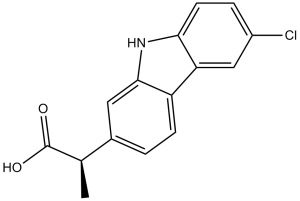
卡洛芬是一种丙酸衍生物,其中一个亚甲基氢被6-氯-9H-咔唑-2-基取代。它是一种非甾体类抗炎药,目前已不再用于人类医学,但仍用于治疗老年犬的关节炎。卡洛芬具有非甾体类抗炎药、EC 1.14.99.1(前列腺素内过氧化物合酶)抑制剂和光敏剂的双重作用。它属于咔唑类化合物,也是一种有机氯化合物。
卡洛芬是一种非甾体类抗炎药(NSAID),兽医将其用作辅助治疗,以缓解老年犬的关节炎症状。卡洛芬曾在人类医学中使用超过10年(1985-1995年)。该药总体耐受性良好,大多数不良反应较轻,例如胃肠道疼痛和恶心,与阿司匹林和其他非甾体抗炎药的不良反应相似。由于商业原因,该药已停止在人类市场销售。 卡洛芬是一种丙酸衍生物,属于非甾体抗炎药 (NSAID),具有抗炎、镇痛和解热作用,仅用于兽医学。卡洛芬抑制环氧合酶 (COX) I 和 II 的活性,从而减少前列腺素和血栓素前体的生成。这抑制了前列腺素合成酶合成前列腺素,而前列腺素参与疼痛、炎症和发热。布洛芬还能通过抑制血栓素合成酶生成血栓素A2,从而抑制血小板聚集。 药物适应症 用于治疗关节疼痛和术后疼痛。 作用机制 与其他非甾体抗炎药一样,布洛芬的作用机制被认为与环氧合酶活性的抑制有关。哺乳动物体内存在两种独特的环氧合酶。组成型环氧合酶COX-1合成维持正常胃肠道和肾脏功能所必需的前列腺素。诱导型环氧合酶COX-2生成参与炎症的前列腺素。抑制COX-1被认为与胃肠道和肾脏毒性有关,而抑制COX-2则具有抗炎作用。在一项使用犬细胞培养的体外研究中,卡洛芬表现出对 COX-2 而非 COX-1 的选择性抑制作用。 药效学 卡洛芬是一种丙酸类非甾体抗炎药 (NSAID),该类药物还包括布洛芬、萘普生和酮洛芬。它已不再用于临床,但仍获准用于犬类。卡洛芬是一种非麻醉性药物,具有与吲哚美辛在动物模型中效力大致相当的特征性镇痛和解热活性。 1. 卡洛芬是一种非甾体抗炎药 (NSAID),具有独特的多靶点活性:它既能抑制 FAAH(调节内源性大麻素信号传导),又能抑制 COX-1/COX-2(减少前列腺素合成),这使其区别于单靶点 NSAID [1] 2. 在兽医学中,卡洛芬因其强大的 COX-2 抑制作用(减少滑膜炎症)和低胃肠道毒性(对胃 PGE2 的影响极小)而被广泛用于治疗犬的慢性骨关节炎 [3] 3. 卡洛芬通过调节 Bcl-2/Bax/caspase-3 凋亡通路,对犬骨科细胞(例如 CCL 细胞)发挥细胞保护作用。提示其可能作为关节损伤的辅助治疗手段[2] |
| 分子式 |
C15H12CLNO2
|
|
|---|---|---|
| 分子量 |
273.71
|
|
| 精确质量 |
273.055
|
|
| 元素分析 |
C, 65.82; H, 4.42; Cl, 12.95; N, 5.12; O, 11.69
|
|
| CAS号 |
53716-49-7
|
|
| 相关CAS号 |
Carprofen-d3;1173019-42-5;Carprofen-13C,d3;2012598-34-2
|
|
| PubChem CID |
2581
|
|
| 外观&性状 |
Typically exists as White to off-white solids at room temperature
|
|
| 密度 |
1.4±0.1 g/cm3
|
|
| 沸点 |
509.1±35.0 °C at 760 mmHg
|
|
| 熔点 |
186-188ºC
|
|
| 闪点 |
261.7±25.9 °C
|
|
| 蒸汽压 |
0.0±1.4 mmHg at 25°C
|
|
| 折射率 |
1.732
|
|
| LogP |
4.03
|
|
| tPSA |
53.09
|
|
| 氢键供体(HBD)数目 |
2
|
|
| 氢键受体(HBA)数目 |
2
|
|
| 可旋转键数目(RBC) |
2
|
|
| 重原子数目 |
19
|
|
| 分子复杂度/Complexity |
362
|
|
| 定义原子立体中心数目 |
0
|
|
| SMILES |
ClC1C([H])=C([H])C2=C(C=1[H])C1C([H])=C([H])C(=C([H])C=1N2[H])C([H])(C(=O)O[H])C([H])([H])[H]
|
|
| InChi Key |
PUXBGTOOZJQSKH-UHFFFAOYSA-N
|
|
| InChi Code |
InChI=1S/C15H12ClNO2/c1-8(15(18)19)9-2-4-11-12-7-10(16)3-5-13(12)17-14(11)6-9/h2-8,17H,1H3,(H,18,19)
|
|
| 化学名 |
2-(6-chloro-9H-carbazol-2-yl)propanoic acid
|
|
| 别名 |
|
|
| HS Tariff Code |
2934.99.9001
|
|
| 存储方式 |
Powder -20°C 3 years 4°C 2 years In solvent -80°C 6 months -20°C 1 month |
|
| 运输条件 |
Room temperature (This product is stable at ambient temperature for a few days during ordinary shipping and time spent in Customs)
|
| 溶解度 (体外实验) |
|
|||
|---|---|---|---|---|
| 溶解度 (体内实验) |
配方 1 中的溶解度: ≥ 2.08 mg/mL (7.60 mM) (饱和度未知) in 10% DMSO + 40% PEG300 + 5% Tween80 + 45% Saline (这些助溶剂从左到右依次添加,逐一添加), 澄清溶液。
例如,若需制备1 mL的工作液,可将100 μL 20.8 mg/mL澄清DMSO储备液加入400 μL PEG300中,混匀;然后向上述溶液中加入50 μL Tween-80,混匀;加入450 μL生理盐水定容至1 mL。 *生理盐水的制备:将 0.9 g 氯化钠溶解在 100 mL ddH₂O中,得到澄清溶液。 配方 2 中的溶解度: ≥ 2.08 mg/mL (7.60 mM) (饱和度未知) in 10% DMSO + 90% (20% SBE-β-CD in Saline) (这些助溶剂从左到右依次添加,逐一添加), 澄清溶液。 例如,若需制备1 mL的工作液,可将 100 μL 20.8 mg/mL澄清DMSO储备液加入900 μL 20% SBE-β-CD生理盐水溶液中,混匀。 *20% SBE-β-CD 生理盐水溶液的制备(4°C,1 周):将 2 g SBE-β-CD 溶解于 10 mL 生理盐水中,得到澄清溶液。 View More
配方 3 中的溶解度: ≥ 2.08 mg/mL (7.60 mM) (饱和度未知) in 10% DMSO + 90% Corn Oil (这些助溶剂从左到右依次添加,逐一添加), 澄清溶液。 1、请先配制澄清的储备液(如:用DMSO配置50 或 100 mg/mL母液(储备液)); 2、取适量母液,按从左到右的顺序依次添加助溶剂,澄清后再加入下一助溶剂。以 下列配方为例说明 (注意此配方只用于说明,并不一定代表此产品 的实际溶解配方): 10% DMSO → 40% PEG300 → 5% Tween-80 → 45% ddH2O (或 saline); 假设最终工作液的体积为 1 mL, 浓度为5 mg/mL: 取 100 μL 50 mg/mL 的澄清 DMSO 储备液加到 400 μL PEG300 中,混合均匀/澄清;向上述体系中加入50 μL Tween-80,混合均匀/澄清;然后继续加入450 μL ddH2O (或 saline)定容至 1 mL; 3、溶剂前显示的百分比是指该溶剂在最终溶液/工作液中的体积所占比例; 4、 如产品在配制过程中出现沉淀/析出,可通过加热(≤50℃)或超声的方式助溶; 5、为保证最佳实验结果,工作液请现配现用! 6、如不确定怎么将母液配置成体内动物实验的工作液,请查看说明书或联系我们; 7、 以上所有助溶剂都可在 Invivochem.cn网站购买。 |
| 制备储备液 | 1 mg | 5 mg | 10 mg | |
| 1 mM | 3.6535 mL | 18.2675 mL | 36.5350 mL | |
| 5 mM | 0.7307 mL | 3.6535 mL | 7.3070 mL | |
| 10 mM | 0.3654 mL | 1.8268 mL | 3.6535 mL |
1、根据实验需要选择合适的溶剂配制储备液 (母液):对于大多数产品,InvivoChem推荐用DMSO配置母液 (比如:5、10、20mM或者10、20、50 mg/mL浓度),个别水溶性高的产品可直接溶于水。产品在DMSO 、水或其他溶剂中的具体溶解度详见上”溶解度 (体外)”部分;
2、如果您找不到您想要的溶解度信息,或者很难将产品溶解在溶液中,请联系我们;
3、建议使用下列计算器进行相关计算(摩尔浓度计算器、稀释计算器、分子量计算器、重组计算器等);
4、母液配好之后,将其分装到常规用量,并储存在-20°C或-80°C,尽量减少反复冻融循环。
计算结果:
工作液浓度: mg/mL;
DMSO母液配制方法: mg 药物溶于 μL DMSO溶液(母液浓度 mg/mL)。如该浓度超过该批次药物DMSO溶解度,请首先与我们联系。
体内配方配制方法:取 μL DMSO母液,加入 μL PEG300,混匀澄清后加入μL Tween 80,混匀澄清后加入 μL ddH2O,混匀澄清。
(1) 请确保溶液澄清之后,再加入下一种溶剂 (助溶剂) 。可利用涡旋、超声或水浴加热等方法助溶;
(2) 一定要按顺序加入溶剂 (助溶剂) 。
| NCT Number | Recruitment | interventions | Conditions | Sponsor/Collaborators | Start Date | Phases |
| NCT06420323 | Not yet recruiting | Device: Treatment with NovoX® Cup Device: Treatment with Omnistrip® |
Wound Healing Disorder Post-Surgical Complication Mammaplasty |
MOSS S.p.A. | June 2024 | |
| NCT06458478 | Recruiting | Other: Hyper-oxygenated gel Other: glycerin based gel |
Molar, Fourth Extracting Own Teeth Edema Face (and 2 more...) |
Azienda Ospedaliera di Perugia | July 1, 2024 | Not Applicable |
| NCT03911336 | Withdrawn | Drug: Group A - test:Tooth extraction and intake of NSAID and a non-NSAID Drug: Group B - Control 1: tooth extraction and intake of NSAID and a non-NSAID Drug: Group C - Control 2: tooth extraction and intake of a Non-Nsaid |
Tooth Loss | University of Iowa | January 1, 2023 | Phase 4 |
| NCT01448785 | Unknown † | Device: abiliti system implant Device: Laparoscopic adjustable gastric band (Allergan Lap Band) |
Obesity Morbid Obesity |
IntraPace, Inc | April 2011 | Not Applicable |
|
|
|
 Butanixin
 COX-2-IN-56
 COX-2-IN-57
 COX-2-IN-58
InvivoChem的所有产品仅用于作科学研究,不面向患者销售
Copyright 2020 InvivoChem LLC | All Rights Reserved 粤ICP备20063088号-1


 COA
COA


 粤公网安备 44011102003439号
 463611831
