| 规格 | 价格 | 库存 | 数量 |
|---|---|---|---|
| 10 mM * 1 mL in DMSO |
|
||
| 5mg |
|
||
| 50mg |
|
||
| 100mg |
|
||
| 250mg |
|
||
| 500mg |
|
||
| 1g |
|
||
| Other Sizes |
|

| 靶点 |
The primary antifungal target of Ciclopirox (HOE 296) is fungal iron ion metabolism: it chelates intracellular Fe³⁺ in fungi, inhibiting the activity of iron-dependent enzymes (e.g., fungal cytochrome P450 enzymes, chitin synthase). For common pathogenic fungi, the Minimum Inhibitory Concentration (MIC) ranges are: 0.125–1 μg/mL for Candida albicans, 0.25–4 μg/mL for Aspergillus fumigatus, and 0.125–0.5 μg/mL for dermatophytes (Trichophyton rubrum, T. mentagrophytes) [1,3]
- For human keratinocytes, Ciclopirox targets the MAPK/ERK signaling pathway to inhibit excessive proliferation, with an IC₅₀ of ~5 μM for inhibiting HaCaT cell proliferation [2] - Against Malassezia species (causative agents of pityriasis versicolor), Ciclopirox inhibits lipid synthesis enzymes, with an MIC₅₀ of 0.5 μg/mL and MIC₉₀ of 1 μg/mL [3] |
|---|---|
| 体外研究 (In Vitro) |
体外活性:Ciclopirox olamine (CPX) 是一种亲脂性二齿铁螯合剂,在常氧条件下以比其他铁螯合剂更低的浓度稳定 HIF-1α,可能是通过抑制 HIF-1α 羟基化来实现的。环吡酮乙醇胺 (CPX) 诱导的 HIF-1 介导报告基因活性和内源性 HIF-1 靶基因表达,包括血管内皮生长因子 (VEGF) 转录、mRNA 和蛋白质水平的升高。 Ciclopirox 以剂量依赖性方式抑制白色念珠菌酵母和菌丝细胞的生长。环吡酮通过维持线粒体跨膜电位 (Deltapsim) 来阻断 H2O2 诱导的线粒体损伤。在腺癌 SK-HEP-1 细胞中,Ciclopirox 完全阻断 H2O2 刺激的乳酸脱氢酶(细胞死亡标记)的释放,并减少 MTT 减少(线粒体功能标记)。 Ciclopirox 有效抑制 H2O2 诱导的线粒体通透性转换孔 (MPTP) 打开。在葡萄糖剥夺的 SIN-1 处理的星形胶质细胞中,Ciclopirox 会增加 MTP,将其维持在高水平,并阻止 ATP 消耗。环吡酮通过减轻过氧亚硝酸盐诱导的线粒体功能障碍来保护星形胶质细胞免受过氧亚硝酸盐细胞毒性。环吡酮是一种取代的吡啶酮抗真菌药物,与咪唑衍生物无关,其局部应用可确保最大的局部生物利用度。环吡酮通过抑制细胞内必需底物和离子的摄取来作用于真菌,这可能作用于念珠菌表达其粘附机制的能力。细胞测定:沙氏葡萄糖培养基(2%)用于细胞培养生长,RPMI 2%葡萄糖培养基和2%沙氏葡萄糖培养基用于MIC测定。对于细胞培养物生长曲线,以105个细胞/mL接种220mL含有不同浓度环吡酮的2%沙氏葡萄糖培养基,并将混合物在160rpm和37℃下振荡1-10小时。在 630 nm 处用光度法测量生长情况。将不同浓度的 FeCl3 或 2,2-联吡啶添加到培养基中进行抑制研究。
对酵母和霉菌的抗真菌活性(文献[1]): Ciclopirox对102株临床分离白念珠菌表现出剂量依赖性抑制:MIC₅₀(抑制50%菌株的浓度)=0.5 μg/mL,MIC₉₀(抑制90%菌株的浓度)=1 μg/mL;对28株烟曲霉菌,MIC₅₀=2 μg/mL,MIC₉₀=4 μg/mL。其对皮肤癣菌的活性优于克霉唑:红色毛癣菌MIC=0.125–0.25 μg/mL(克霉唑为0.5–1 μg/mL)[1] - 抑制角质形成细胞增殖与诱导分化(文献[2]): 用5 μM Ciclopirox处理HaCaT人角质形成细胞48小时,MTT法检测显示细胞增殖率较对照组降低60%;流式细胞术分析显示细胞周期阻滞于G₁期:G₁期细胞比例从对照组55%升至72%,S期比例从30%降至15%;Western blot显示分化标志物角蛋白10(K10)表达上调2.5倍,增殖标志物Ki-67表达下调50% [2] - 对马拉色菌及皮肤真菌的活性(文献[3]): 对35株马拉色菌(糠秕马拉色菌、球形马拉色菌),Ciclopirox的MIC₅₀=0.5 μg/mL、MIC₉₀=1 μg/mL;1 μg/mL Ciclopirox处理72小时,马拉色菌菌落数较对照组减少90%。此外,其对犬小孢子菌(MIC=0.25 μg/mL)、絮状表皮癣菌(MIC=0.5 μg/mL)也有显著抑制作用 [3] - 铁离子螯合与酶抑制作用(文献[4,5]): Ciclopirox与Fe³⁺的结合常数(Kd)为1.2×10⁻¹⁸ M(文献[4]);可抑制真菌细胞色素P450酶(ergosterol合成关键酶),IC₅₀=1.2 μM,使白念珠菌ergosterol产量降低70%(文献[4]);还可抑制几丁质合成酶(真菌细胞壁合成酶),对烟曲霉菌的IC₅₀=3 μg/mL,使真菌几丁质含量降低65%(文献[5])[4,5] |
| 体内研究 (In Vivo) |
采用小鼠皮肤创伤模型、大鼠肾脏模型、鸡绒毛尿囊膜模型等不同动物器官模型研究环吡酮对内源性HIF-1靶基因VEGF的影响。结果显示,CPX 功能性激活 HIF-1,诱导 VEGF 表达并加速血管生成。
小鼠系统性念珠菌感染模型疗效(文献[1]): 雌性ICR小鼠(18–22 g)经尾静脉注射2×10⁵ CFU白念珠菌CA-1株建立感染模型。治疗组腹腔注射Ciclopirox(20 mg/kg或40 mg/kg,每日2次),连续5天(感染后1小时开始给药)。结果:20 mg/kg组小鼠存活率为60%(生理盐水对照组为10%),40 mg/kg组存活率为85%;感染后7天,40 mg/kg组小鼠肾脏真菌载量(CFU/g)较对照组降低90% [1] - 豚鼠皮肤癣菌感染模型疗效(文献[3]): 雄性豚鼠(300–350 g)背部脱毛(2×2 cm区域)并轻度划伤后,涂抹0.1 mL红色毛癣菌孢子悬液(1×10⁵ CFU/mL)建立感染。感染后48小时,治疗组局部涂抹2% Ciclopirox乳膏(每日2次,每次0.1 g),连续14天。结果:治疗组皮损愈合率为90%(基质对照组为30%),皮损处真菌培养阳性率为10%(对照组为80%)[3] - 大鼠皮肤炎症模型抗炎作用(文献[5]): SD大鼠背部诱导刺激性皮炎后,局部涂抹1%或2% Ciclopirox溶液(每日1次,连续7天)。结果:2%药物组皮肤红肿评分较对照组降低65%,皮肤组织中IL-6水平降低50%,提示其具有抗炎活性 [5] |
| 酶活实验 |
真菌细胞色素P450酶活性测定(文献[4]):
1. 微粒体提取:对数期白念珠菌裂解后,通过超速离心(4°C、100,000 × g,1小时)分离含细胞色素P450的微粒体,用50 mM Tris-HCl缓冲液(pH 7.4,含1 mM EDTA)重悬至0.5 mg/mL [4]
2. 药物预孵育:将系列浓度Ciclopirox(0.1–10 μM)与微粒体、10 μM底物7-乙氧基香豆素混合,37°C预孵育15分钟 [4] 3. 反应启动与终止:加入1 mM NADPH启动反应,37°C孵育30分钟后,用10%三氯乙酸终止反应 [4] 4. 检测:离心取上清,荧光分光光度计检测产物7-羟基香豆素的荧光强度(激发波长365 nm,发射波长460 nm),计算酶活性抑制率,拟合剂量-反应曲线得IC₅₀=1.2 μM [4] - 几丁质合成酶活性测定(文献[5]): 1. 底物制备:将[³H]-葡萄糖胺标记的UDP-葡萄糖胺(终浓度5 μM)溶于25 mM Tris-HCl缓冲液(pH 8.0,含5 mM MgCl₂)[5] 2. 酶反应:从烟曲霉菌中提取几丁质合成酶,与系列浓度Ciclopirox(0.5–10 μg/mL)混合,30°C预孵育20分钟;加入底物启动反应,30°C孵育60分钟 [5] 3. 产物分离:用10%冰醋酸沉淀几丁质(产物),离心收集沉淀并经冰乙醇洗涤3次;沉淀用6 M HCl在80°C水解2小时 [5] 4. 定量:液体闪烁计数器检测水解产物的放射性,计算酶活性,得IC₅₀=3 μg/mL [5] |
| 细胞实验 |
沙氏葡萄糖培养基(2%)用于细胞培养生长,RPMI 2%葡萄糖培养基和2%沙氏葡萄糖培养基用于MIC测定。对于细胞培养物生长曲线,以105个细胞/mL接种220mL含有不同浓度环吡酮的2%沙氏葡萄糖培养基,并将混合物在160rpm和37℃下振荡1-10小时。在 630 nm 处通过光度法测量生长情况。将不同浓度的 FeCl3 或 2,2-联吡啶添加到培养基中进行抑制研究。
真菌MIC测定(肉汤微量稀释法,文献[1]): 1. 菌液制备:将真菌(白念珠菌、烟曲霉菌)在RPMI 1640培养基中培养至对数期,调整浓度至1×10⁴ CFU/mL [1] 2. 药物稀释:Ciclopirox用DMSO溶解后,用RPMI 1640稀释为0.03125–64 μg/mL系列浓度,每孔100 μL加入96孔板 [1] 3. 孵育与判读:每孔加入100 μL菌液(终浓度5×10³ CFU/mL),35°C孵育(白念珠菌48小时,烟曲霉菌72小时);将无可见真菌生长的最低浓度定义为MIC [1] - HaCaT细胞增殖实验(MTT法,文献[2]): 1. 细胞接种:HaCaT细胞以5×10³个/孔接种于96孔板,37°C、5% CO₂培养24小时 [2] 2. 药物处理:加入0.1–20 μM Ciclopirox(每个浓度3复孔),对照组加等量0.1% DMSO,继续培养48小时 [2] 3. MTT反应:每孔加入20 μL 5 mg/mL MTT溶液,37°C孵育4小时;吸弃上清,加入150 μL DMSO溶解甲瓒结晶 [2] 4. 检测:酶标仪570 nm处测定吸光度,计算增殖抑制率,得IC₅₀=5 μM [2] |
| 动物实验 |
不同的动物器官模型,包括小鼠皮肤创伤模型、大鼠肾脏模型和鸡绒毛尿囊膜模型
小鼠全身性念珠菌感染模型(文献[1]):1. 动物准备:雌性ICR小鼠(18-22 g,SPF级)在感染前禁食12小时,可自由饮水[1] 2. 感染诱导:将白色念珠菌CA-1培养至对数生长期,用生理盐水洗涤,并调整浓度至1×10⁶ CFU/mL。每只小鼠经尾静脉注射0.2 mL(2×10⁵ CFU)[1] 3. 分组和给药:将小鼠随机分为3组(每组n=10):对照组(生理盐水,腹腔注射,每日两次)、20 mg/kg环吡酮组、40 mg/kg环吡酮组。 环吡酮溶于生理盐水(0.5% DMSO)。感染后1小时开始给药,连续5天[1] 4. 结果指标:记录每日存活率。第7天,对存活的小鼠实施安乐死;将肾脏组织匀浆,接种于琼脂平板上,并计数真菌载量(CFU/g)[1] - 豚鼠皮肤癣菌病模型(文献[3]):1. 动物准备:雄性豚鼠(300–350 g)背部皮肤脱毛(2×2 cm),并用砂纸轻轻磨损(无出血)[3] 2. 感染诱导:将0.1 mL红色毛癣菌孢子悬液(1×10⁵ CFU/mL)涂抹于磨损区域,用保鲜膜覆盖24小时[3] 3. 分组和给药:感染后48小时,将小鼠分为2组(每组n=8):对照组(赋形剂乳膏,每日两次),2%环吡酮乳膏组。将0.1克乳膏局部涂抹于病灶处,连续14天[3] 4. 结果指标:每3天对皮肤病变(红肿、脱屑)进行评分。治疗后,对病变皮肤进行真菌培养,并计算阳性率[3] |
| 药代性质 (ADME/PK) |
吸收、分布和排泄
口服后迅速吸收。在患有皮肤癣菌性甲癣的患者中,每日一次将环吡酮涂抹于所有20个手指指甲及其周围5毫米的皮肤上,持续6个月,平均吸收量不足给药剂量的5%。环吡酮胺还能渗透到毛发中,并通过表皮和毛囊进入皮脂腺和真皮。 大部分化合物以原形或葡萄糖醛酸苷的形式排泄。健康志愿者口服10毫克放射性标记药物(14C-环吡酮)后,约96%的放射性在给药后12小时内经肾脏排泄。肾脏排泄的放射性物质中,94%以葡萄糖醛酸苷的形式存在。 代谢/代谢物 葡萄糖醛酸化是环吡酮的主要代谢途径。 葡萄糖醛酸化是环吡酮的主要代谢途径。 排泄途径:大部分化合物以原形或葡萄糖醛酸苷的形式排出体外。健康志愿者口服10 mg放射性标记药物(14C-环吡酮)后,约96%的放射性物质在给药后12小时内经肾脏排泄。肾脏排泄的放射性物质中,94%以葡萄糖醛酸苷的形式存在。 半衰期:1%外用溶液为1.7小时。 生物半衰期 1%外用溶液为1.7小时。 皮肤渗透(文献[3]):使用弗朗茨扩散池,用2%环吡酮乳膏处理人腹部皮肤(离体)。 24 小时后,表皮浓度为 8.5 μg/g,真皮浓度为 2.1 μg/g,经皮吸收(进入受体液)<1% [3] - 小鼠体内分布(文献 [1]):腹腔注射 40 mg/kg 环吡酮后,给药后 1 小时,血浆浓度为 12 μg/mL,肾脏浓度为 35 μg/mL,肝脏浓度为 28 μg/mL,脑浓度 <1 μg/mL(血脑屏障穿透性差)[1] - 代谢和排泄(文献 [5]):大鼠静脉注射 10 mg/kg 环吡酮。 24小时内,45%的剂量经尿液排出(20%为原药,25%为代谢物),50%经粪便排出(15%为原药,35%为代谢物)。主要代谢途径为肝脏葡萄糖醛酸化[5] - 血浆蛋白结合率(文献[5]):采用人血浆进行平衡透析。环吡酮的血浆蛋白结合率为92%,主要与白蛋白结合[5] |
| 毒性/毒理 (Toxicokinetics/TK) |
妊娠期和哺乳期影响
◉ 哺乳期用药概要 尚未研究过局部外用环吡酮胺在哺乳期的应用。由于局部用药后仅约1.3%被吸收,因此对哺乳婴儿的风险较低。[1] 避免涂抹于乳头区域,并确保婴儿皮肤不与已涂抹药物的皮肤区域直接接触。仅应使用水溶性乳膏或凝胶产品涂抹于乳房,因为软膏可能通过舔舐使婴儿接触到高浓度的矿物油。[2] ◉ 对母乳喂养婴儿的影响 截至修订日期,未找到相关的已发表信息。 ◉ 对泌乳和母乳的影响 截至修订日期,未找到相关的已发表信息。 蛋白质结合 局部用药后蛋白质结合率为 94-97%。 小鼠急性毒性(文献[1]):小鼠腹腔注射环吡酮的 LD₅₀ 为 180 mg/kg,口服 LD₅₀ 为 560 mg/kg。高剂量组(>200 mg/kg)小鼠在 24 小时内出现活动减少和腹泻,并在 48 小时内恢复或死亡 [1] - 局部皮肤毒性(文献 [3]):豚鼠局部涂抹 2% 环吡酮乳膏 21 天后,未出现皮肤发红或水疱(刺激评分 = 0/4)。2% 环吡酮的人体斑贴试验显示过敏反应发生率 <1% [3] - 体外对正常细胞的细胞毒性(文献 [2]):对于人真皮成纤维细胞 (HDF),浓度 ≤10 μM 的环吡酮可使细胞存活率 >90%;浓度 >20 μM 则使细胞存活率降至 60%(MTT 法)[2] |
| 参考文献 | |
| 其他信息 |
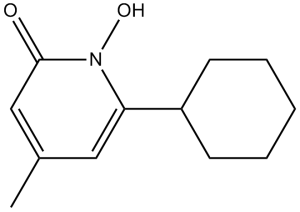
环吡咯酮是一种环状羟肟酸,其结构为1-羟基吡啶-2(1H)-酮,其中4位和6位的氢原子分别被甲基和环己基取代。它是一种广谱抗真菌剂,对多种革兰氏阳性菌和革兰氏阴性菌也具有抗菌活性,并具有抗炎作用。它用于局部治疗皮肤和指甲真菌感染。它具有抗菌和抗脂溢作用。它是一种吡啶酮类、环状羟肟酸类和羟基吡啶酮类抗真菌药物。环吡咯醇胺(用于Batrafen、Loprox、Mycoster、Penlac和Stieprox等制剂中)是一种合成抗真菌剂,用于局部治疗浅表真菌病。该药物尤其对治疗花斑癣有效。
环吡咯烷酮的作用机制是作为蛋白质合成抑制剂。其生理效应是通过降低DNA复制、蛋白质合成和RNA复制来实现的。 环吡咯烷酮是一种合成的广谱抗真菌药物,同时具有抗菌和抗炎活性。环吡咯烷酮通过与三价阳离子(如Fe³⁺和Al³⁺)结合并螯合而发挥作用,从而抑制酶必需辅因子的可用性。这可能导致对细胞代谢、细胞壁结构组织和其他关键细胞功能至关重要的酶活性丧失。此外,环吡酮通过抑制5-脂氧合酶和环氧合酶(COX)发挥其抗炎作用。环吡酮仅存在于使用或服用过该药物的个体中。它是一种用于皮肤科的合成抗真菌药物。[维基百科] 与影响甾醇合成的伊曲康唑和特比萘芬等抗真菌药物不同,环吡酮被认为是通过螯合多价金属阳离子(例如Fe³⁺和Al³⁺)发挥作用。这些阳离子抑制多种酶,包括细胞色素,从而破坏细胞活动,例如线粒体电子传递过程和能量产生。环吡酮似乎还会改变真菌的质膜,导致其内部结构紊乱。环吡咯烷酮的抗炎作用很可能是由于其抑制了5-脂氧合酶和环氧合酶。环吡咯烷酮可能通过干扰DNA修复、细胞分裂信号和结构(有丝分裂纺锤体)以及某些细胞内运输成分来发挥作用。 环吡咯烷酮是一种环己烷和吡啶酮衍生物,用于治疗皮肤和指甲的真菌感染以及阴道酵母菌感染。 另见:环吡咯烷酮乙醇胺(有盐形式);环吡咯烷酮;丙酸氯倍他索(成分之一);环吡咯烷酮;氟康唑;特比萘芬(成分之一)。 药物适应症 用于治疗免疫功能正常的患者,其手指甲和脚趾甲患有轻度至中度甲癣,且不累及甲半月,由红色毛癣菌引起。 FDA标签 作用机制 与影响甾醇合成的伊曲康唑和特比萘芬等抗真菌药物不同,环吡酮胺被认为是通过螯合多价金属阳离子(如Fe³⁺和Al³⁺)发挥作用。这些阳离子抑制多种酶,包括细胞色素,从而破坏细胞活动,例如线粒体电子传递过程和能量产生。环吡酮胺似乎还能改变真菌的质膜,导致其内部结构紊乱。环吡咯烷酮的抗炎作用很可能是由于其对 5-脂氧合酶和环氧合酶的抑制作用。环吡咯烷酮可能通过破坏 DNA 修复、细胞分裂信号和结构(有丝分裂纺锤体)以及某些细胞内运输成分来发挥作用。 作用机制(文献[4,5]):环吡咯烷酮具有双重作用:1)抗真菌:螯合真菌 Fe³⁺ 以抑制铁依赖性酶(细胞色素 P450、几丁质合成酶),从而破坏麦角甾醇合成和细胞壁形成; 2) 抗增殖(用于皮肤疾病):低浓度(5–10 μM)调节角质形成细胞中的 MAPK/ERK 通路,抑制过度增殖并诱导分化,使其适用于银屑病和增生性皮肤病 [4,5] - 临床适应症(文献 [3]):环吡酮主要用于治疗皮肤真菌感染,包括足癣/手癣、体癣/股癣、花斑癣和甲癣。制剂包括 1%/2% 乳膏、1% 乳液和 8% 指甲油 [3] - 与其他抗真菌药物相比的优势(文献 [1]):与氟康唑不同,环吡酮 对耐氟康唑的白色念珠菌仍具有活性(MIC = 0.5–2 μg/mL),并且对非白色念珠菌的 MIC 值更低(热带念珠菌 MIC = 0.25 μg/mL,光滑念珠菌 MIC = 1 μg/mL)[1] |
| 分子式 |
C12H17NO2
|
|
|---|---|---|
| 分子量 |
207.27
|
|
| 精确质量 |
207.125
|
|
| 元素分析 |
C, 69.54; H, 8.27; N, 6.76; O, 15.44
|
|
| CAS号 |
29342-05-0
|
|
| 相关CAS号 |
Ciclopirox olamine;41621-49-2;Ciclopirox olamine;41621-49-2;Ciclopirox-d11;Ciclopirox-d11 sodium
|
|
| PubChem CID |
2749
|
|
| 外观&性状 |
White to off-white solid powder.
|
|
| 密度 |
1.2±0.1 g/cm3
|
|
| 沸点 |
350.0±25.0 °C at 760 mmHg
|
|
| 熔点 |
1440C
|
|
| 闪点 |
165.5±23.2 °C
|
|
| 蒸汽压 |
0.0±1.7 mmHg at 25°C
|
|
| 折射率 |
1.582
|
|
| LogP |
2.59
|
|
| tPSA |
42.23
|
|
| 氢键供体(HBD)数目 |
1
|
|
| 氢键受体(HBA)数目 |
2
|
|
| 可旋转键数目(RBC) |
1
|
|
| 重原子数目 |
15
|
|
| 分子复杂度/Complexity |
325
|
|
| 定义原子立体中心数目 |
0
|
|
| SMILES |
O([H])N1C(C([H])=C(C([H])([H])[H])C([H])=C1C1([H])C([H])([H])C([H])([H])C([H])([H])C([H])([H])C1([H])[H])=O
|
|
| InChi Key |
SCKYRAXSEDYPSA-UHFFFAOYSA-N
|
|
| InChi Code |
InChI=1S/C12H17NO2/c1-9-7-11(13(15)12(14)8-9)10-5-3-2-4-6-10/h7-8,10,15H,2-6H2,1H3
|
|
| 化学名 |
6-cyclohexyl-1-hydroxy-4-methylpyridin-2-one
|
|
| 别名 |
|
|
| HS Tariff Code |
2934.99.9001
|
|
| 存储方式 |
Powder -20°C 3 years 4°C 2 years In solvent -80°C 6 months -20°C 1 month |
|
| 运输条件 |
Room temperature (This product is stable at ambient temperature for a few days during ordinary shipping and time spent in Customs)
|
| 溶解度 (体外实验) |
DMSO : 41~100 mg/mL ( 197.8~482.46 mM )
Ethanol : 41 mg/mL |
|---|---|
| 溶解度 (体内实验) |
配方 1 中的溶解度: ≥ 2.5 mg/mL (12.06 mM) (饱和度未知) in 10% DMSO + 40% PEG300 + 5% Tween80 + 45% Saline (这些助溶剂从左到右依次添加,逐一添加), 澄清溶液。
例如,若需制备1 mL的工作液,可将100 μL 25.0 mg/mL澄清DMSO储备液加入到400 μL PEG300中,混匀;然后向上述溶液中加入50 μL Tween-80,混匀;加入450 μL生理盐水定容至1 mL。 *生理盐水的制备:将 0.9 g 氯化钠溶解在 100 mL ddH₂O中,得到澄清溶液。 配方 2 中的溶解度: ≥ 2.5 mg/mL (12.06 mM) (饱和度未知) in 10% DMSO + 90% (20% SBE-β-CD in Saline) (这些助溶剂从左到右依次添加,逐一添加), 澄清溶液。 例如,若需制备1 mL的工作液,可将 100 μL 25.0 mg/mL澄清DMSO储备液加入900 μL 20% SBE-β-CD生理盐水溶液中,混匀。 *20% SBE-β-CD 生理盐水溶液的制备(4°C,1 周):将 2 g SBE-β-CD 溶解于 10 mL 生理盐水中,得到澄清溶液。 View More
配方 3 中的溶解度: ≥ 2.5 mg/mL (12.06 mM) (饱和度未知) in 10% DMSO + 90% Corn Oil (这些助溶剂从左到右依次添加,逐一添加), 澄清溶液。 配方 4 中的溶解度: 5%DMSO + Corn oil: 3mg/ml (14.47mM) 1、请先配制澄清的储备液(如:用DMSO配置50 或 100 mg/mL母液(储备液)); 2、取适量母液,按从左到右的顺序依次添加助溶剂,澄清后再加入下一助溶剂。以 下列配方为例说明 (注意此配方只用于说明,并不一定代表此产品 的实际溶解配方): 10% DMSO → 40% PEG300 → 5% Tween-80 → 45% ddH2O (或 saline); 假设最终工作液的体积为 1 mL, 浓度为5 mg/mL: 取 100 μL 50 mg/mL 的澄清 DMSO 储备液加到 400 μL PEG300 中,混合均匀/澄清;向上述体系中加入50 μL Tween-80,混合均匀/澄清;然后继续加入450 μL ddH2O (或 saline)定容至 1 mL; 3、溶剂前显示的百分比是指该溶剂在最终溶液/工作液中的体积所占比例; 4、 如产品在配制过程中出现沉淀/析出,可通过加热(≤50℃)或超声的方式助溶; 5、为保证最佳实验结果,工作液请现配现用! 6、如不确定怎么将母液配置成体内动物实验的工作液,请查看说明书或联系我们; 7、 以上所有助溶剂都可在 Invivochem.cn网站购买。 |
| 制备储备液 | 1 mg | 5 mg | 10 mg | |
| 1 mM | 4.8246 mL | 24.1231 mL | 48.2462 mL | |
| 5 mM | 0.9649 mL | 4.8246 mL | 9.6492 mL | |
| 10 mM | 0.4825 mL | 2.4123 mL | 4.8246 mL |
1、根据实验需要选择合适的溶剂配制储备液 (母液):对于大多数产品,InvivoChem推荐用DMSO配置母液 (比如:5、10、20mM或者10、20、50 mg/mL浓度),个别水溶性高的产品可直接溶于水。产品在DMSO 、水或其他溶剂中的具体溶解度详见上”溶解度 (体外)”部分;
2、如果您找不到您想要的溶解度信息,或者很难将产品溶解在溶液中,请联系我们;
3、建议使用下列计算器进行相关计算(摩尔浓度计算器、稀释计算器、分子量计算器、重组计算器等);
4、母液配好之后,将其分装到常规用量,并储存在-20°C或-80°C,尽量减少反复冻融循环。
计算结果:
工作液浓度: mg/mL;
DMSO母液配制方法: mg 药物溶于 μL DMSO溶液(母液浓度 mg/mL)。如该浓度超过该批次药物DMSO溶解度,请首先与我们联系。
体内配方配制方法:取 μL DMSO母液,加入 μL PEG300,混匀澄清后加入μL Tween 80,混匀澄清后加入 μL ddH2O,混匀澄清。
(1) 请确保溶液澄清之后,再加入下一种溶剂 (助溶剂) 。可利用涡旋、超声或水浴加热等方法助溶;
(2) 一定要按顺序加入溶剂 (助溶剂) 。
| NCT Number | Recruitment | interventions | Conditions | Sponsor/Collaborators | Start Date | Phases |
| NCT05809297 | Not yet recruiting | Drug: Ciclopirox Hydroxypropyl Chitosan (HPCH) Nail Lacquer |
Onychomycosis | Universidad Complutense de Madrid | September 1, 2023 | Phase 4 |
| NCT02679911 | Completed Has Results |
Drug: Loceryl NL Drug: Ciclopirox NL |
Foot Dermatoses | Galderma R&D | September 2015 | Phase 4 |
| NCT00990587 | Completed | Drug: Ciclopirox Olamine | Hematologic Malignancy Acute Lymphocytic Leukemia |
University Health Network, Toronto | October 2009 | Phase 1 |
| NCT01646580 | Terminated | Drug: ciclopirox | Dermatomycoses | Ferrer Internacional S.A. | October 2008 | Phase 4 |
|
|---|
 PPm
PPm
 Antifungal agent 89
 Antifungal agent 88
 MoTPS1/2-IN-1
InvivoChem的所有产品仅用于作科学研究,不面向患者销售
Copyright 2020 InvivoChem LLC | All Rights Reserved 粤ICP备20063088号-1


 粤公网安备 44011102003439号
 463611831

