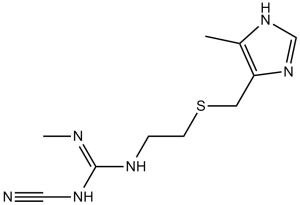
Cimetidine

别名: SKF 92334; SKF92334; Cimetidine; Tagamet; Cimetag; SKF-92334; Eureceptor; Ulcedine 西咪替丁;N'-甲基-N"-[2[[(5-甲基-1H-咪唑-4-基)甲基]硫代]乙基]-N-氰基呱;N-氰基-N’-甲基-N’’-[2-[[(5-甲基-1H-咪唑-4-基)甲基]硫基]乙基]胍;甲氰咪胺;甲氰咪胍;泰胃美;甲腈咪胺;西眯替丁;N-氰基N'-甲基-N''-[2-[[(5-甲基-1H-咪唑-4-基)甲基]硫代]乙基]-胍;4'-(4-氯苯氧基)苯乙酮;Cimetidine 西咪替丁;N-氰基-N'-甲基-N''-[2-[[(5-甲基-1H-咪唑-4-基)甲基]硫基]乙基]胍;甲腈咪胍;西咪米替丁;西咪替丁 EP标准品;西咪替丁 USP标准品;西咪替丁 标准品;西咪替丁(AB型);西咪替丁[A型];西咪替丁AB;西咪替丁AB型;西咪替丁A型;西咪替丁峰鉴别 EP标准品;西咪替丁系统适应性 EP标准品;西米替丁;西米替汀;2-氰基-1-甲基-3-[2-(5-甲基-1H-咪唑l-4-基-甲硫基)乙基]胍;AB型;N'-甲基-N;N'-甲基-N''-[2[[(5-甲基-1H-咪唑-4-基)甲基]硫代]乙基]-N-氰基胍;西咪替丁 A;西咪替汀;西米替汀 标准品;游离碱;N'-甲基-N''-[2[[(5-甲基-1H-咪唑-4-基)甲基]硫代]乙基]-N-氰基呱
目录号: V1220 纯度: ≥98%
西咪替丁(Tagamet;Cimetag;SKF-92334;Eureceptor;Ulcedine)是一种批准用于治疗胃灼热和消化性溃疡的药物,是一种有效的组胺同系物,可竞争性抑制组胺与组胺 H2 受体的结合。
Cimetidine CAS号: 51481-61-9
产品类别: Histamine Receptor
产品仅用于科学研究,不针对患者销售
规格 价格 库存 数量
1g
2g
5g
10g
25g
50g
100g
Other Sizes

Other Forms of Cimetidine:

  • 盐酸西咪替丁
  • Cimetidine-d3 (SKF-92334-d3)
点击了解更多
InvivoChem产品被CNS等顶刊论文引用
纯度/质量控制文件

纯度: ≥98%

产品描述
西咪替丁(Tagamet;Cimetag;SKF-92334;Eureceptor;Ulcedine)是一种批准用于治疗胃灼热和消化性溃疡的药物,是一种有效的组胺同源物,可竞争性抑制组胺与组胺 H2 受体的结合。具体来说,西咪替丁抑制组胺 H2 受体并防止胃酸产生。
生物活性&实验参考方法
靶点
Histamine Receptor ( Ki = 0.6 μM ); H2 Receptor
Histamine H2 receptor (H2R) (human H2R, Ki=0.5 μM; rat H2R, Ki=0.8 μM, inverse agonist) [1]
Organic cation transporter 2 (OCT2) (inhibitor) [3]
Neural Cell Adhesion Molecule (NCAM) (blocker) [5]
体外研究 (In Vitro)
西咪替丁是 H2R 的部分激动剂,其药理学特征不同于雷尼替丁和法莫替丁,这可能有助于其对胃肠道癌症的抗肿瘤活性。西咪替丁对 OCT2 mRNA 高水平的卵巢癌细胞(IGROV-1 细胞)中顺铂的摄取和细胞毒性没有影响。西咪替丁对3LL细胞的增殖、存活、迁移和侵袭没有影响。西咪替丁可逆转 MDSC 介导的 T 细胞抑制,并改善 IFN-γ 的产生。西咪替丁介导的 NCAM 下调涉及抑制 NF-κB 的核转位,NF-κB 是 NCAM 基因表达的转录激活剂。
表达人H2R的HEK293细胞经西咪替丁(Cimetidine)(0.1 μM-50 μM)处理后,作为反向激动剂,药物剂量依赖性下调自发活性H2R介导的cAMP蓄积,10 μM时抑制率达65%[1]
- 人外周血单核细胞经西咪替丁(Cimetidine)(1 μM-100 μM)处理后,通过H2激动活性,浓度依赖性诱导IL-18产生,50 μM时IL-18水平升高2.8倍(ELISA检测)[2]
- 过表达OCT2的HEK293细胞在顺铂存在下经西咪替丁(Cimetidine)(10 μM-100 μM)处理,50 μM时抑制OCT2介导的顺铂摄取达52%,降低顺铂诱导的细胞毒性(MTT法)[3]
- 小鼠髓系来源抑制细胞(MDSCs)经西咪替丁(Cimetidine)(5 μM-50 μM)处理,20 μM时诱导MDSC凋亡(Annexin V/PI染色:凋亡率从12%升至48%),caspase-3激活水平上调2.3倍[4]
- 人唾液腺肿瘤细胞(HSG)经西咪替丁(Cimetidine)(10 μM-100 μM)处理,50 μM时抑制HSG与大鼠背根神经节神经元的粘附达63%,阻断NCAM的mRNA和蛋白表达(Western blot/RT-PCR:50 μM时降低55%),并诱导细胞凋亡(100 μM时细胞活力降至45%)[5]
体内研究 (In Vivo)
顺铂对带有荧光素酶标记的 IGROV-1 异种移植物的小鼠的抗肿瘤功效不受西咪替丁影响(P = 0.39)。在 18 名患者中以随机交叉方式接受顺铂 (100 mg/m(2)) 联合或不联合西咪替丁 (800 mg × 2) 获得的数据显示,西咪替丁不会改变未结合顺铂的暴露。西咪替丁可减少荷瘤小鼠脾脏、血液和肿瘤组织中 CD11b(+)Gr-1(+) 骨髓源性抑制细胞 (MDSC) 的积累。西咪替丁对大鼠牙周病具有有益作用,可降低牙龈结缔组织中的 RANKL/OPG 比率并减少牙槽骨吸收。
顺铂处理小鼠:腹腔注射西咪替丁(Cimetidine)(50 mg/kg/天)连续5天,联合顺铂(5 mg/kg)给药,不影响顺铂的抗肿瘤疗效(肿瘤体积缩小率维持68%),但较单独顺铂组提高顺铂系统清除率35%[3]
- 肺肿瘤荷瘤小鼠:口服灌胃西咪替丁(Cimetidine)(100 mg/kg/天)连续21天,肺肿瘤重量减少52%,体积缩小48%,肿瘤组织中MDSC凋亡增加(TUNEL法:凋亡MDSCs升高3.2倍)[4]
- 大鼠牙周炎模型:磨牙结扎诱导牙周炎后,口服西咪替丁(Cimetidine)(50 mg/kg/天)连续28天,较未治疗组减少牙槽骨丢失42%(micro-CT及组织形态计量学分析)[6]
酶活实验
H2R结合及功能实验:从表达人H2R的HEK293细胞制备膜组分,将膜样品与[3H]-噻替丁(0.5 nM)及西咪替丁(Cimetidine)(0.01 nM-100 μM)在25°C孵育60分钟。真空过滤分离结合态/游离态配体,测量放射性计算Ki值。功能实验中,完整细胞与药物孵育30分钟后,提取cAMP并通过放射免疫法定量[1]
- OCT2抑制实验:培养过表达OCT2的HEK293细胞至融合,将细胞与西咪替丁(Cimetidine)(10 μM-100 μM)及[3H]-二甲双胍(OCT2底物)在37°C孵育60分钟。洗涤细胞后,测量放射性评估OCT2介导的底物摄取抑制情况[3]
细胞实验
单核细胞IL-18产生实验:密度梯度离心法分离人外周血单核细胞,接种于24孔板,与西咪替丁(Cimetidine)(1 μM-100 μM)孵育24小时。收集上清液,ELISA法量化IL-18水平[2]
- MDSC凋亡实验:从荷瘤小鼠分离MDSCs,与西咪替丁(Cimetidine)(5 μM-50 μM)孵育48小时。Annexin V-FITC和PI染色,流式细胞术分析凋亡;提取蛋白,Western blot检测caspase-3激活[4]
- HSG细胞粘附及凋亡实验:将HSG细胞接种于96孔板(活力检测)、6孔板(NCAM检测)或神经元包被的盖玻片(粘附检测),与西咪替丁(Cimetidine)(10 μM-100 μM)孵育48小时。显微镜下计数粘附细胞;RT-PCR/Western blot检测NCAM;MTT法评估细胞活力[5]
动物实验
Cisplatin combination therapy mouse model: Male C57BL/6 mice (20-25 g) were implanted with Lewis lung carcinoma cells. When tumors reached 100 mm³, mice received intraperitoneal Cimetidine (50 mg/kg/day) and cisplatin (5 mg/kg, once every 2 days) for 5 days. Measure tumor volume every 3 days; collect blood and tissues to assess cisplatin concentration and systemic clearance [3]
- Lung tumor mouse model: Female BALB/c mice (18-22 g) were intravenously injected with LLC cells to induce lung tumors. From day 7, oral gavage of Cimetidine (100 mg/kg/day) for 21 days. Euthanize mice, weigh and measure lung tumors; analyze MDSC apoptosis in tumor tissues via TUNEL assay [4]
- Rat periodontitis model: Male Wistar rats (200-250 g) were subjected to ligature placement around maxillary molars to induce periodontitis. From day 1, oral Cimetidine (50 mg/kg/day) was administered for 28 days. Harvest maxillae, perform micro-CT scanning to measure alveolar bone height; prepare histological sections for morphometric analysis [6]
药代性质 (ADME/PK)
Absorption, Distribution and Excretion
Two peak plasma concentrations are often observed after oral administration of cimetidine, likely as a result of discontinuous absorption in the gastrointestinal tract. In healthy patients, the absolute bioavailability of cimetidine is approximately 60%; however, the bioavailability can be as high as 70% in patients with peptic ulcer disease. Overall, rates of bioavailability are much more variable in patients with peptic ulcer disease.
Cimetidine is excreted primarily in the urine.
The volume of distribution of cimetidine is reported to be 1 L/kg.
Cimetidine's reported systemic clearance value is approximately 500-600 ml/min.
About 15% of cimetidine is metabolized in the liver. Seventy percent is excreted unchanged in the urine, with fecal losses accounting for approximately 10%.
Given orally, cimetidine and ranitidine are almost completely absorbed. Because of first-pass metabolism in the liver, the bioavailability is 50-60%. Both drugs are little bound to plasma proteins (10-20%).
Both drugs are mainly excreted in urine - cimetidine up to 90% within 24 hr (50-75% unchanged) and ranitidine up to 60% within 24 hr (about 40% unchanged). The apparent volume of distribution is quite large, in the range of 1.5 l/kg bw, demonstrating that nearly all drug exists outside the intravascular space.
Cimetidine is widely distributed throughout the body and is 15-20% bound to plasma proteins. Animal studies indicate that the drug crosses the placenta. Cimetidine is distributed into milk.
For more Absorption, Distribution and Excretion (Complete) data for CIMETIDINE (14 total), please visit the HSDB record page.
Metabolism / Metabolites
After intravenous administration of cimetidine, the majority of the parent drug (58-77%) is eliminated unchanged in the urine. Cimetidine’s primary metabolite is cimetidine sulfoxide and represents an estimated 10-15% of total elimination. Researchers have also identified a minor cimetidine metabolite with a hydroxylated methyl group on the imidazole ring which represents only 4% of total elimination. Both cytochrome P450 enzymes and flavin-containing monooxygenases are implicated in the metabolism of cimetidine, although it is unclear which specific enzymes are involved. Cimetidine is a well known enzyme inhibitor and may impair the metabolism of certain co-administered medications.
About 50% to 80% of an intravenous dose is excreted as unchanged drug; 40% of an oral dose is excreted unchanged in the urine in patients with peptic ulcer disease. Most of the remainder of the drug appears in the urine as 5-hydroxymethyl or sulfoxide metabolites.
Cimetidine is metabolized in the liver to sulfoxide and 5-hydroxymethyl derivatives, and possibly guanylurea, although this latter compound may result from in vitro degradation.
Hepatic
Route of Elimination: The principal route of excretion of cimetidine is the urine.
Half Life: 2 hours
Biological Half-Life
Cimetidine's half-life is estimated to be around 2 hours.
ELEVEN PATIENTS WITH ASCITIC CIRRHOSIS & ELEVEN PATIENTS WITHOUT LIVER DISEASE RECEIVED 200 MG OF CIMETIDINE ORALLY AND IV. NO DIFFERENCES WERE OBSERVED IN CIMETIDINE T/2 BETWEEN THE 2 GROUPS. CIMETIDINE CLEARANCE WAS DIMINISHED IN CIRRHOTIC PATIENTS (0.426 + OR - 0.138 VERSUS 0.649 + OR - 0.163 L/HR/KG).
The elimination half-life in man is 1.9 to 2.2 hours.
The plasma elimination half-life is about 2 hours.
The half-time for elimination of cimetidine ... is 2 to 3 hours ... .
毒性/毒理 (Toxicokinetics/TK)
Toxicity Summary
Cimetidine binds to an H2-receptor located on the basolateral membrane of the gastric parietal cell, blocking histamine effects. This competitive inhibition results in reduced gastric acid secretion and a reduction in gastric volume and acidity.
Hepatotoxicity
Chronic therapy with cimetidine has been associated with minor elevations in serum aminotransferase levels in 1% to 4% of patients, but similar rates were reported in placebo recipients. The ALT elevations were usually asymptomatic and transient and usually resolved even without dose modification. Several instances of clinically apparent liver injury have been reported in patients receiving cimetidine, but the time to onset and pattern of injury has varied greatly. Onset can be as short as a few days to as long as 7 months, and the serum enzyme pattern varies from hepatocellular to cholestatic, most cases having a “mixed” hepatocellular-cholestatic pattern of injury (Cases 1 and 2). The injury is rarely severe and resolves within 4 to 12 weeks of stopping cimetidine. Liver biopsy histology often shows prominent centrolobular necrosis. Immunoallergic features (rash, fever, eosinophilia) are uncommon, as is autoantibody formation.
Likelihood score: B (highly likely cause of clinically apparent liver injury).
Effects During Pregnancy and Lactation
◉ Summary of Use during Lactation
Maternal cimetidine doses of 1000 to 1200 mg daily result in infant dosages that are much less than reported neonatal dosages of 5 to 10 mg/kg daily. Cimetidine would not be expected to cause any adverse effects in breastfed infants, especially if the infant is older than 2 months. However, because of its potential for causing hepatic enzyme inhibition, other drugs might be preferred. Cimetidine can increase serum prolactin and it has been used, but not validated, as a galactogogue.
◉ Effects in Breastfed Infants
Relevant published information was not found as of the revision date.
◉ Effects on Lactation and Breastmilk
Histamine H2-receptor blockade is known to stimulate prolactin secretion. In addition, cimetidine may have additional, nonspecific actions that stimulate prolactin secretion. Oral cimetidine doses of 400 mg 4 times daily increased serum prolactin by 50 to 112% in 6 patients. Cimetidine has caused dose-related gynecomastia and galactorrhea in men and nonnursing women. The prolactin level in a mother with established lactation may not affect her ability to breastfeed.
One clinician reported that she used cimetidine 200 or 300 mg 4 times daily to nursing mothers with a marginal or low milk supply. Subjective reports indicated an increase in milk supply.
Protein Binding
In humans, approximately 22.5% of cimetidine is plasma protein bound.
Interactions
OUTPUT OF INTRINSIC FACTOR OF CASTLE IN RESPONSE TO BETAZOLE IS INHIBITED BY CIMETIDINE, BUT BASAL SECRETION OF THE PROTEIN IS ONLY SLIGHTLY AFFECTED AND NO EVIDENCE OF DEFICIENT ABSORPTION OF VITAMIN B12 HAS BEEN NOTED, EVEN DURING LONG-TERM TREATMENT.
Antacids reduce the oral bioavailability of concomitantly administered cimetidine or ranitidine. ... These drugs probably should be given one hour apart.
REDUCED HEPATIC BLOOD FLOW /AFTER ADMIN OF CIMETIDINE/ HAS BEEN REPORTED TO PROLONG THE CLEARANCE AND, THEREFORE, EXAGGERATE THE EFFECTS OF MORPHINE ... AND LIDOCAINE.
SIX OUT OF 8 PATIENTS TREATED WITH CARMUSTINE, 80 MG/SQ M/DAY FOR 3 DAYS, CIMETIDINE, 300 MG 6 HOURLY, AND STEROIDS DEMONSTRATED MARKED LEUCOPENIA AND THROMBOCYTOPENIA ... AFTER FIRST ADMIN. IN COMPARISON ONLY 6 OUT OF 40 PATIENTS WHO WERE SIMILARLY TREATED, BUT WITHOUT CIMETIDINE, SHOWED COMPARABLE WHITE CELL AND PLATELET DEPRESSION.
For more Interactions (Complete) data for CIMETIDINE (37 total), please visit the HSDB record page.
Drug-drug interaction: Cimetidine inhibits OCT2-mediated cisplatin uptake, increasing cisplatin systemic clearance without reducing its antitumor efficacy [3]
- Clinical side effects: Mild anti-cholinergic effects (dry mouth, constipation) in 5-8% of patients; headache and dizziness in 3-5%. High doses may cause reversible gynecomastia in men [1,2]
- Plasma protein binding: Cimetidine has a plasma protein binding rate of 15-20% in human plasma [1]
参考文献

[1]. Inverse agonism of histamine H2 antagonist accounts for upregulation of spontaneously active histamine H2 receptors. Proc Natl Acad Sci U S A. 1996 Jun 25;93(13):6802-7.

[2]. Cimetidine induces interleukin-18 production through H2-agonist activity in monocytes. Mol Pharmacol, 2006. 70(2): p. 450-3.

[3]. Conjunctive therapy of cisplatin with the OCT2 inhibitor cimetidine: influence on antitumor efficacy and systemic clearance. Clin Pharmacol Ther, 2013. 94(5): p. 585-92.

[4]. Cimetidine suppresses lung tumor growth in mice through proapoptosis of myeloid-derived suppressor cells. Mol Immunol, 2013. 54(1): p. 74-83.

[5]. Cimetidine inhibits salivary gland tumor cell adhesion to neural cells and induces apoptosis by blocking NCAM expression. BMC Cancer, 2008. 8: p. 376.

[6]. Cimetidine Reduces the Alveolar Bone Loss in Induced Periodontitis in Rat Molars. J Periodontol, 2013.

其他信息
Therapeutic Uses
Adjuvants, Immunologic; Analgesics, Non-Narcotic; Anti-Ulcer Agents; Enzyme Inhibitors; Histamine H2 Antagonists
IN MAN, A SINGLE DOSE (300 MG) WILL INHIBIT BASAL (FASTING) SECRETION AND ALSO SECRETION INDUCED BY SOLID, LIQ, OR PEPTONE MEALS, SHAM FEEDING, FUNDIC DISTENTION, PENTAGASTRIN, BETHANECHOL, INSULIN, AND CAFFEINE, AS WELL AS THE PHYSIOLOGICAL STIMULUS PROVIDED BY EATING. ... THIS SPECTRUM INCL THE CEPHALIC OR VAGAL PHASE.
CIMETIDINE IS THE PREFERRED ALTERNATIVE FOR MANY PATIENTS WHO CANNOT OR WILL NOT TOLERATE AN INTENSIVE, PROLONGED ANTACID REGIMEN.
Cimetidine is a useful alternative to antacids in preventing aspiration pneumonitis during childbirth and elective surgical procedures. It is less useful than antacids during emergency surgery because of its slow onset of action. This drug had been given to prevent alkalosis in patients subjected to prolonged nasogastric aspiration, especially those secreting large amounts of acid, and to decrease ileostomy/jejunostomy output in the short bowel syndrome.
For more Therapeutic Uses (Complete) data for CIMETIDINE (21 total), please visit the HSDB record page.
Drug Warnings
DESPITE POOR PENETRATION TO THE CNS, NEURAL DYSFUNCTION HAS BEEN ENCOUNTERED, PARTICULARLY WITH HIGH DOSES IN ELDERLY PATIENTS AND IN ASSOCIATION WITH IMPAIRED RENAL EXCRETION. THE EFFECTS INCL CONFUSION, SLURRED SPEECH, DELIRIUM, HALLUCINATIONS, AND COMA.
IN SOME INSTANCES, WITHDRAWAL OF CIMETIDINE AFTER A PERIOD OF TREATMENT HAS BEEN FOLLOWED BY RELAPSES IN THE SYMPTOMS OF ULCER AND EVEN BY PERFORATION OF DUODENAL, ESOPHAGEAL, OR GASTRIC ULCERS.
... CIMETIDINE IS INEFFECTIVE IN ACUTE OR ALCOHOLIC PANCREATITIS AND IT MAY ACTUALLY INCR AND PROLONG HYPERAMYLASEMIA.
... CLIN EXPERIENCE IN CHILDREN IS EXTREMELY LIMITED, AND THE BENEFIT/RISK RATIO SHOULD BE CONSIDERED CAREFULLY.
For more Drug Warnings (Complete) data for CIMETIDINE (15 total), please visit the HSDB record page.
Pharmacodynamics
Cimetidine is a histamine H2-receptor antagonist. It reduces basal and nocturnal gastric acid secretion and a reduction in gastric volume, acidity, and amount of gastric acid released in response to stimuli including food, caffeine, insulin, betazole, or pentagastrin. It is used to treat gastrointestinal disorders such as gastric or duodenal ulcer, gastroesophageal reflux disease, and pathological hypersecretory conditions. Cimetidine inhibits many of the isoenzymes of the hepatic CYP450 enzyme system. Other actions of Cimetidine include an increase in gastric bacterial flora such as nitrate-reducing organisms.
Cimetidine is a first-generation histamine H2 receptor antagonist with multiple pharmacological activities, including inverse agonism on H2R, OCT2 inhibition, and NCAM blocking [1,3,5]
Its core mechanism for gastric acid inhibition is inverse agonism on H2R, downregulating spontaneous H2R activity to reduce acid secretion [1]
Beyond gastric-related indications, it exhibits anti-tumor potential by inducing MDSC apoptosis and inhibiting tumor cell adhesion [4,5]
It enhances cisplatin's systemic clearance via OCT2 inhibition, reducing potential nephrotoxicity without compromising antitumor effect [3]
In periodontitis models, it reduces alveolar bone loss, suggesting potential application in oral inflammatory diseases [6]
Indications traditionally include peptic ulcer disease, GERD, and Zollinger-Ellison syndrome; off-label uses may involve tumor adjuvant therapy and inflammatory disease management [1,3,4,5,6]
*注: 文献方法仅供参考, InvivoChem并未独立验证这些方法的准确性
化学信息 & 存储运输条件
分子式
C10H16N6S
分子量
252.34
精确质量
252.115
元素分析
C, 47.60; H, 6.39; N, 33.30; S, 12.71
CAS号
51481-61-9
相关CAS号
Cimetidine hydrochloride; 70059-30-2; Cimetidine-d3; 1185237-29-9
PubChem CID
2756
外观&性状
White crystalline solid
密度
1.3±0.1 g/cm3
沸点
476.2±55.0 °C at 760 mmHg
熔点
139-144°C
闪点
241.8±31.5 °C
蒸汽压
0.0±1.2 mmHg at 25°C
折射率
1.632
LogP
0.07
tPSA
114.19
氢键供体(HBD)数目
3
氢键受体(HBA)数目
4
可旋转键数目(RBC)
7
重原子数目
17
分子复杂度/Complexity
296
定义原子立体中心数目
0
SMILES
S(C([H])([H])C([H])([H])N([H])/C(=N/C([H])([H])[H])/N([H])C#N)C([H])([H])C1=C(C([H])([H])[H])N([H])C([H])=N1
InChi Key
AQIXAKUUQRKLND-UHFFFAOYSA-N
InChi Code
InChI=1S/C10H16N6S/c1-8-9(16-7-15-8)5-17-4-3-13-10(12-2)14-6-11/h7H,3-5H2,1-2H3,(H,15,16)(H2,12,13,14)
化学名
1-cyano-2-methyl-3-[2-[(5-methyl-1H-imidazol-4-yl)methylsulfanyl]ethyl]guanidine
别名
SKF 92334; SKF92334; Cimetidine; Tagamet; Cimetag; SKF-92334; Eureceptor; Ulcedine
HS Tariff Code
2934.99.9001
存储方式

Powder      -20°C    3 years

                     4°C     2 years

In solvent   -80°C    6 months

                  -20°C    1 month

运输条件
Room temperature (This product is stable at ambient temperature for a few days during ordinary shipping and time spent in Customs)
溶解度数据
溶解度 (体外实验)
DMSO: 51~60 mg/mL (202.1~237.8 mM)
Water: <1 mg/mL
Ethanol: ~3 mg/mL (~11.9 mM)
溶解度 (体内实验)
配方 1 中的溶解度: 3 mg/mL (11.89 mM) in 10% DMSO + 40% PEG300 + 5% Tween80 + 45% Saline (这些助溶剂从左到右依次添加,逐一添加), 澄清溶液; 超声助溶。
例如,若需制备1 mL的工作液,可将100 μL 30.0 mg/mL 澄清的 DMSO 储备液加入到400 μL PEG300中,混匀;再向上述溶液中加入50 μL Tween-80,混匀;然后加入450 μL 生理盐水定容至1 mL。
*生理盐水的制备:将 0.9 g 氯化钠溶解在 100 mL ddH₂O中,得到澄清溶液。

配方 2 中的溶解度: ≥ 3 mg/mL (11.89 mM) (饱和度未知) in 10% DMSO + 90% (20% SBE-β-CD in Saline) (这些助溶剂从左到右依次添加,逐一添加), 澄清溶液。
例如,若需制备1 mL的工作液,可将 100 μL 30.0 mg/mL澄清DMSO储备液加入900 μL 20% SBE-β-CD生理盐水溶液中,混匀。
*20% SBE-β-CD 生理盐水溶液的制备(4°C,1 周):将 2 g SBE-β-CD 溶解于 10 mL 生理盐水中,得到澄清溶液。

View More

配方 3 中的溶解度: ≥ 3 mg/mL (11.89 mM) (饱和度未知) in 10% DMSO + 90% Corn Oil (这些助溶剂从左到右依次添加,逐一添加), 澄清溶液。
例如,若需制备1 mL的工作液,可将 100 μL 30.0 mg/mL 澄清 DMSO 储备液加入到 900 μL 玉米油中并混合均匀。


配方 4 中的溶解度: 3.12 mg/mL (12.36 mM) in PBS (这些助溶剂从左到右依次添加,逐一添加), 澄清溶液; 超声助溶 (<60°C).

请根据您的实验动物和给药方式选择适当的溶解配方/方案:
1、请先配制澄清的储备液(如:用DMSO配置50 或 100 mg/mL母液(储备液));
2、取适量母液,按从左到右的顺序依次添加助溶剂,澄清后再加入下一助溶剂。以 下列配方为例说明 (注意此配方只用于说明,并不一定代表此产品 的实际溶解配方):
10% DMSO → 40% PEG300 → 5% Tween-80 → 45% ddH2O (或 saline);
假设最终工作液的体积为 1 mL, 浓度为5 mg/mL: 取 100 μL 50 mg/mL 的澄清 DMSO 储备液加到 400 μL PEG300 中,混合均匀/澄清;向上述体系中加入50 μL Tween-80,混合均匀/澄清;然后继续加入450 μL ddH2O (或 saline)定容至 1 mL;

3、溶剂前显示的百分比是指该溶剂在最终溶液/工作液中的体积所占比例;
4、 如产品在配制过程中出现沉淀/析出,可通过加热(≤50℃)或超声的方式助溶;
5、为保证最佳实验结果,工作液请现配现用!
6、如不确定怎么将母液配置成体内动物实验的工作液,请查看说明书或联系我们;
7、 以上所有助溶剂都可在 Invivochem.cn网站购买。
制备储备液 1 mg 5 mg 10 mg
1 mM 3.9629 mL 19.8145 mL 39.6291 mL
5 mM 0.7926 mL 3.9629 mL 7.9258 mL
10 mM 0.3963 mL 1.9815 mL 3.9629 mL

1、根据实验需要选择合适的溶剂配制储备液 (母液):对于大多数产品,InvivoChem推荐用DMSO配置母液 (比如:5、10、20mM或者10、20、50 mg/mL浓度),个别水溶性高的产品可直接溶于水。产品在DMSO 、水或其他溶剂中的具体溶解度详见上”溶解度 (体外)”部分;

2、如果您找不到您想要的溶解度信息,或者很难将产品溶解在溶液中,请联系我们;

3、建议使用下列计算器进行相关计算(摩尔浓度计算器、稀释计算器、分子量计算器、重组计算器等);

4、母液配好之后,将其分装到常规用量,并储存在-20°C或-80°C,尽量减少反复冻融循环。

计算器

摩尔浓度计算器可计算特定溶液所需的质量、体积/浓度,具体如下:

  • 计算制备已知体积和浓度的溶液所需的化合物的质量
  • 计算将已知质量的化合物溶解到所需浓度所需的溶液体积
  • 计算特定体积中已知质量的化合物产生的溶液的浓度
使用摩尔浓度计算器计算摩尔浓度的示例如下所示:
假如化合物的分子量为350.26 g/mol,在5mL DMSO中制备10mM储备液所需的化合物的质量是多少?
  • 在分子量(MW)框中输入350.26
  • 在“浓度”框中输入10,然后选择正确的单位(mM)
  • 在“体积”框中输入5,然后选择正确的单位(mL)
  • 单击“计算”按钮
  • 答案17.513 mg出现在“质量”框中。以类似的方式,您可以计算体积和浓度。

稀释计算器可计算如何稀释已知浓度的储备液。例如,可以输入C1、C2和V2来计算V1,具体如下:

制备25毫升25μM溶液需要多少体积的10 mM储备溶液?
使用方程式C1V1=C2V2,其中C1=10mM,C2=25μM,V2=25 ml,V1未知:
  • 在C1框中输入10,然后选择正确的单位(mM)
  • 在C2框中输入25,然后选择正确的单位(μM)
  • 在V2框中输入25,然后选择正确的单位(mL)
  • 单击“计算”按钮
  • 答案62.5μL(0.1 ml)出现在V1框中
g/mol

分子量计算器可计算化合物的分子量 (摩尔质量)和元素组成,具体如下:

注:化学分子式大小写敏感:C12H18N3O4  c12h18n3o4
计算化合物摩尔质量(分子量)的说明:
  • 要计算化合物的分子量 (摩尔质量),请输入化学/分子式,然后单击“计算”按钮。
分子质量、分子量、摩尔质量和摩尔量的定义:
  • 分子质量(或分子量)是一种物质的一个分子的质量,用统一的原子质量单位(u)表示。(1u等于碳-12中一个原子质量的1/12)
  • 摩尔质量(摩尔重量)是一摩尔物质的质量,以g/mol表示。
/

配液计算器可计算将特定质量的产品配成特定浓度所需的溶剂体积 (配液体积)

  • 输入试剂的质量、所需的配液浓度以及正确的单位
  • 单击“计算”按钮
  • 答案显示在体积框中
动物体内实验配方计算器(澄清溶液)
第一步:请输入基本实验信息(考虑到实验过程中的损耗,建议多配一只动物的药量)
第二步:请输入动物体内配方组成(配方适用于不溶/难溶于水的化合物),不同的产品和批次配方组成不同,如对配方有疑问,可先联系我们提供正确的体内实验配方。此外,请注意这只是一个配方计算器,而不是特定产品的确切配方。
+
+
+

计算结果:

工作液浓度 mg/mL;

DMSO母液配制方法 mg 药物溶于 μL DMSO溶液(母液浓度 mg/mL)。如该浓度超过该批次药物DMSO溶解度,请首先与我们联系。

体内配方配制方法μL DMSO母液,加入 μL PEG300,混匀澄清后加入μL Tween 80,混匀澄清后加入 μL ddH2O,混匀澄清。

(1) 请确保溶液澄清之后,再加入下一种溶剂 (助溶剂) 。可利用涡旋、超声或水浴加热等方法助溶;
            (2) 一定要按顺序加入溶剂 (助溶剂) 。

临床试验信息
NCT Number Recruitment interventions Conditions Sponsor/Collaborators Start Date Phases
NCT05020184 Recruiting Drug: Cimetidine
Drug: Placebo
Erythropoietic Protoporphyria
X-linked Protoporphyria
Amy K. Dickey, M.D. June 14, 2022 Phase 2
NCT06056583 Recruiting Drug: Cimetidine 200 MG Lactation University of Washington January 15, 2024 Phase 4
NCT04862585 Recruiting Drug: Cimetidine
Drug: Dexamethasone
Drug: Famotidine
Drug: Paclitaxel
Breast Carcinoma
Anatomic Stage 0 Breast
Cancer AJCC v8
Ohio State University Comprehensive
Cancer Center
October 7, 2021 Phase 2
Phase 3
NCT01256879 Completed Drug: cimetidine Healthy University of Maryland, Baltimore March 2011 Phase 4
NCT03618316 Completed Drug: Imeglimin
Drug: Cimetidine
Healthy Poxel SA June 19, 2018 Phase 1
生物数据图片
  • Cimetidine
    Clin Pharmacol Ther. 2013 Nov;94(5):585-92.
  • Cimetidine
    Clin Pharmacol Ther. 2013 Nov;94(5):585-92.
  • Cimetidine
    Clin Pharmacol Ther. 2
相关产品
联系我们