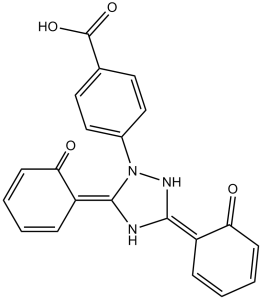
Deferasirox (ICL 670)

别名: ICL670; IC-L670; ICL 670; ICL-670A; ICL670A; IC L670A; Deferasirox. Brand name: Exjade; Desirox; Defrijet; Desifer. 地拉罗司;4-[3,5-二(2-羟基苯基)-1,2,4-三唑-1-基]苯甲酸;去铁斯若;地拉罗司-D4;拉罗司杂质; 地拉罗司标准品;拉罗司
目录号: V1877 纯度: ≥98%
Deferasirox(也称为 CGP-72670、ICL-670)是一种口服生物可利用的铁螯合剂,用于治疗铁过载疾病。
Deferasirox (ICL 670) CAS号: 201530-41-8
产品类别: Bacterial
产品仅用于科学研究,不针对患者销售
规格 价格 库存 数量
10mg
25mg
50mg
100mg
250mg
500mg
Other Sizes

Other Forms of Deferasirox (ICL 670):

  • Deferasirox-d4 (地拉罗司 d4)
点击了解更多
InvivoChem产品被CNS等顶刊论文引用
纯度/质量控制文件

纯度: ≥98%

产品描述
地拉罗司(也称为 CGP-72670、ICL-670)是一种口服生物可利用的铁螯合剂,用于治疗铁过载疾病。在 DMS-53 肺癌和 SK-N-MC 神经上皮瘤细胞系中,地拉罗司抑制细胞增殖。地拉罗司抑制人转铁蛋白的铁摄取并动员细胞 59Fe。在两种食管腺癌细胞系 OE33 和 OE19 中,地拉罗司与标准化疗剂一起抑制细胞活力和增殖。地拉罗司可有效螯合米根霉中的铁,并在体外对 29 种毛霉目临床分离株中的 28 种表现出杀灭活性,其浓度远低于临床可达到的血清水平。
生物活性&实验参考方法
靶点
Deferasirox (ICL 670) targets ferric iron (Fe³⁺) with a dissociation constant (Kd) of 10⁻²⁹ M (for Fe³⁺ chelation) [1]
Deferasirox (ICL 670) inhibits iron-dependent enzymes (e.g., ribonucleotide reductase) with an IC50 of 2.5 μM (human recombinant ribonucleotide reductase) [2]
体外研究 (In Vitro)
地拉罗司可有效螯合米根霉中的铁,并在体外对 29 种毛霉目临床分离株中的 28 种表现出杀灭活性,其浓度远低于临床可达到的血清水平。在 40 个外周血样本中,有 28 个样本中地拉罗司孵育可显着抑制 NF-κB 活性,并以非活性形式将其活性亚基 p65 隔离在细胞质中。 Deferasirox 抑制三种人骨髓细胞系(K562、U937 和 HL60),IC50 为 17-50 mM。地拉罗司在体外对烟曲霉具有杀灭作用,MIC 和 MFC 分别为 25 和 50 mg/L。细胞测定:在DMS-53肺癌和SK-N-MC神经上皮瘤细胞系中,地拉罗司抑制细胞增殖。地拉罗司抑制人转铁蛋白的铁摄取并动员细胞 59Fe。在两种食管腺癌细胞系 OE33 和 OE19 中,地拉罗司与标准化疗剂一起抑制细胞活力和增殖。
在人慢性髓系白血病K562细胞中,Deferasirox (ICL 670)(5–50 μM)以剂量依赖方式螯合细胞内铁,25 μM时使不稳定铁池(LIP)减少60%;抑制细胞增殖(IC50=18 μM),50 μM时诱导凋亡(Annexin V⁺细胞从4%升至35%),机制涉及下调Bcl-2、上调Bax [2]
在经100 μM柠檬酸铁铵预处理诱导铁过载的人肝癌HepG2细胞中,Deferasirox (ICL 670)(10–40 μM)30 μM时降低细胞内铁含量55%,抑制铁诱导的活性氧(ROS)生成(30 μM时减少45%),减轻脂质过氧化(丙二醛水平降低50%)[3]
在β-地中海贫血患者来源的原代人红系祖细胞中,Deferasirox (ICL 670)(5–20 μM)15 μM时促进红系分化(CD71⁺/GPA⁺细胞从32%升至58%),减少红系前体细胞凋亡(从28%降至12%)[4]
在人结直肠癌HCT116细胞中,Deferasirox (ICL 670)(10–50 μM)30 μM时抑制核糖核苷酸还原酶活性65%,阻断DNA合成,诱导G1/S期细胞周期阻滞(G1期细胞从40%升至62%)[5]
体内研究 (In Vivo)
地拉罗司可显着提高患有毛霉菌病的糖尿病酮症酸中毒或中性粒细胞减少小鼠的存活率并减少组织真菌负荷,其功效与脂质体两性霉素 B 相似。地拉罗司治疗还可增强宿主对毛霉菌病的炎症反应。与脂质体两性霉素 B 联合使用时,地拉罗司可协同提高存活率并减少组织真菌负荷。口服给予大鼠的地拉罗司被吸收至少 75%,生物利用度为 26%。地拉罗司主要以原形存在于血液循环中,以原形形式存在于血液循环中。其铁络合物,Fe(地拉罗克斯)2,静脉内和口服给药后。地拉罗司 99.2% 与血浆蛋白结合。地拉罗司单一疗法可适度延长 IPA 小鼠的生存期。
在铁过载小鼠模型(C57BL/6小鼠,每周腹腔注射10 mg/kg右旋糖酐铁,持续4周)中,口服 Deferasirox (ICL 670)(50 mg/kg/天,持续8周),血清铁蛋白水平降低60%,肝铁浓度降低55%,脾铁含量降低50%,对血红蛋白水平无显著影响 [1]
在荷K562慢性髓系白血病异种移植瘤裸鼠中,口服 Deferasirox (ICL 670)(80 mg/kg/天,持续21天)抑制肿瘤生长58%(肿瘤体积从1200 mm³降至500 mm³),瘤内铁含量降低45%,凋亡细胞增加3.2倍(TUNEL⁺细胞)[2]
在β-地中海贫血中间型小鼠(Hbbth3/+)中,口服 Deferasirox (ICL 670)(60 mg/kg/天,持续12周),红细胞计数从7.2×10¹²/L升至9.5×10¹²/L,网织红细胞计数从18%降至10%,肝、脾铁沉积分别减少40%和35% [4]
酶活实验
三价铁螯合实验:在醋酸缓冲液(pH 5.5)中制备含Fe³⁺(10 μM)和铁特异性显色剂菲啰嗪的溶液,加入系列浓度的 Deferasirox (ICL 670)(0.1–10 μM),37°C孵育30分钟。在562 nm处检测吸光度以量化未螯合的Fe³⁺,计算螯合效率和Kd值 [1]
核糖核苷酸还原酶(RNR)活性实验:纯化人重组RNR(α2β2复合物),悬浮于含ATP、MgCl₂和CDP的反应缓冲液中。将RNR(0.5 μg/mL)与 Deferasirox (ICL 670)(0.5–10 μM)在37°C孵育20分钟,加入[³H]-CDP作为底物,孵育60分钟后,液体闪烁计数法检测CDP向dCDP的转化,评估RNR抑制效果并计算IC50 [2]
细胞实验
在 DMS-53 肺癌和 SK-N-MC 神经上皮瘤细胞系中,地拉罗司抑制细胞增殖。地拉罗司抑制人转铁蛋白的铁摄取并动员细胞 59Fe。在两种食管腺癌细胞系 OE33 和 OE19 中,地拉罗司与标准化疗剂一起抑制细胞活力和增殖。
铁过载细胞模型实验:HepG2细胞培养于含10%胎牛血清的DMEM培养基,用100 μM柠檬酸铁铵预处理24小时诱导铁过载,再用 Deferasirox (ICL 670)(10–40 μM)处理48小时。比色法铁检测试剂盒测定细胞内铁含量,DCFH-DA染色检测ROS水平,丙二醛检测评估脂质过氧化 [3]
白血病细胞增殖与凋亡实验:K562细胞(5×10³个细胞/孔)接种到96孔板,Deferasirox (ICL 670)(5–50 μM)处理72小时,MTT法计算增殖抑制IC50。凋亡检测:50 μM Deferasirox (ICL 670)处理K562细胞48小时,Annexin V-FITC/PI染色后流式细胞术分析 [2]
红系分化实验:从β-地中海贫血患者分离原代人红系祖细胞,在红系分化培养基中培养,Deferasirox (ICL 670)(5–20 μM)处理7天,流式细胞术分析CD71/GPA表达(红系标志物)和Annexin V染色评估凋亡 [4]
细胞周期实验:HCT116细胞(2×10⁵个细胞/孔)用 Deferasirox (ICL 670)(10–30 μM)处理24小时,乙醇固定后碘化丙啶染色,流式细胞术分析细胞周期分布 [5]
动物实验
在携带DMS-53肺癌异种移植瘤的裸鼠中,地拉罗司抑制了肿瘤生长。此外,地拉罗司增加了裂解型caspase-3、裂解型聚(ADP-核糖)聚合酶1、细胞周期蛋白依赖性激酶抑制剂p21CIP1/WAF1以及转移抑制蛋白N-myc下游调控基因1的表达,同时降低了细胞周期蛋白D1的表达,这表明地拉罗司是一种有效的抗肿瘤药物。在人源异种移植瘤模型中,地拉罗司显著抑制了肿瘤生长,这与铁水平的降低有关。
铁过载小鼠模型:将6-8周龄的C57BL/6小鼠(每组n=8)每周腹腔注射一次右旋糖酐铁(10 mg/kg),持续4周,以诱导铁过载。将地拉罗司(ICL 670)悬浮于 0.5% 羧甲基纤维素溶液中,以 50 mg/kg/天的剂量灌胃给药,持续 8 周。对照组给予溶剂。治疗结束后,采集血液样本以测定血清铁蛋白和血红蛋白水平;取肝脏和脾脏组织以定量分析铁含量。[1]
白血病异种移植模型:将 K562 细胞(5×10⁶ 个细胞/只)皮下注射到 6-8 周龄的裸鼠(每组 n=7)体内。当肿瘤体积达到约 150 mm³ 时,以 80 mg/kg/天的剂量灌胃给予地拉罗司(ICL 670),持续 21 天。每 3 天测量一次肿瘤体积(体积 = 长 × 宽² × 0.5)。对小鼠实施安乐死,收集肿瘤组织进行铁含量分析和TUNEL染色[2]
β-地中海贫血小鼠模型:4周龄Hbbth3/+小鼠(每组n=6)经口灌胃给予地拉罗司(ICL 670),剂量为60 mg/kg/天,持续12周。采集血液进行全血细胞计数(红细胞、网织红细胞);取肝脏和脾脏,采用普鲁士蓝染色法进行铁沉积分析[4]
药代性质 (ADME/PK)
吸收、分布和排泄
口服混悬剂的地拉罗司片剂的绝对生物利用度(AUC)为静脉注射剂量的70%。
地拉罗司及其代谢物主要(占给药剂量的84%)经粪便排泄。地拉罗司及其代谢物的肾脏排泄量极少(占给药剂量的8%)。
14.37 ± 2.69 L
口服给药后,Exjade 被吸收,达峰时间(tmax)中位数约为1.5-4小时。单次给药后以及在稳态条件下,地拉罗司的Cmax和AUC均随剂量呈近似线性增加。多次给药后,地拉罗司的暴露量累积因子增加1.3-2.3倍。与静脉注射剂量相比,地拉罗司片剂口服混悬液的绝对生物利用度(AUC)为70%。地拉罗司的生物利用度(AUC)在与食物同服时有不同程度的增加。
……本研究评估了单次口服375 mg地拉罗司片剂与130 mg地拉罗司静脉输注的绝对生物利用度。由于这是首次使用地拉罗司静脉注射制剂进行人体研究,因此在正式研究阶段之前,先在3名受试者中进行了较低剂量(65 mg)的预试验,以评估静脉注射制剂的安全性和耐受性。正式研究阶段纳入了17名健康男性志愿者。每次给药后均测量地拉罗司的血浆浓度,并测定包括绝对口服生物利用度在内的药代动力学参数。地拉罗司片剂的绝对口服生物利用度为 70%(90% 置信区间,62%-80%)。地拉罗司的血浆清除率较低,为 3.53 (± 0.87) L/hr。地拉罗司的稳态分布容积 (V(ss)) 较小,为 14.37 (±2.69) L,表明其组织分布较少。
……本研究在健康志愿者和输血性血色素沉着症患者中考察了食物和进食时间对地拉罗司药代动力学的影响。在健康志愿者中,分别于高脂早餐或标准早餐前或与标准早餐同时服用单次口服剂量地拉罗司 (20 mg/kg) 后,评估了其生物等效性,并与空腹状态进行了比较。在患者中,分别于进食和空腹状态下,测定了单次口服剂量地拉罗司 (20 mg/kg) 后的生物利用度。这些数据表明,食物类型、膳食热量和脂肪含量会影响地拉罗司与食物同时摄入时的生物利用度。相反,如果地拉罗司在餐前至少30分钟服用,则不会出现这种情况。总之,建议地拉罗司在餐前至少30分钟服用。如果无法做到这一点,则应在餐前同一时间服用地拉罗司,以减少影响吸收的变异因素。
地拉罗司与血清白蛋白高度结合(约99%),几乎完全与血清白蛋白结合。在人体内,地拉罗司在血细胞中的分布比例为5%。地拉罗司在成人体内的稳态分布容积 (Vss) 为 14.37 ± 2.69 L。
有关地拉罗司(共 9 项)的更多吸收、分布和排泄(完整)数据,请访问 HSDB 记录页面。
代谢/代谢物
肝脏代谢。地拉罗司在人体内的 CYP450 催化(氧化)代谢似乎较少(约 8%)。葡萄糖醛酸化是地拉罗司的主要代谢途径,随后经胆汁排泄。
葡萄糖醛酸化是地拉罗司的主要代谢途径,随后经胆汁排泄。葡萄糖醛酸化产物可能在肠道内发生去结合,随后被重吸收(肠肝循环)。地拉罗司主要通过 UGT1A1 进行葡萄糖醛酸化,少量通过 UGT1A3 进行葡萄糖醛酸化。在人体内,地拉罗司的 CYP450 催化(氧化)代谢似乎较少(约 8%)。
……肾脏排泄仅占剂量的 8%,主要包括葡萄糖醛酸苷 M6。细胞色素 450 酶氧化代谢生成 M1 [5-羟基地拉罗司,推测由 CYP1A 催化] 和 M4(5'-羟基地拉罗司,由 CYP2D6 催化)的量较少(分别占剂量的 6% 和 2%)。直接和间接证据表明,地拉罗司代谢的主要途径是通过葡萄糖醛酸化生成代谢物M3(酰基葡萄糖醛酸苷)和M6(2-O-葡萄糖醛酸苷)。
...地拉罗司的代谢包括羧酸基团(酰基葡萄糖醛酸苷M3)和酚羟基的葡萄糖醛酸化,以及程度较低的细胞色素P450催化的羟基化。两种羟基化代谢物(M1 和 M2)被给予大鼠,结果表明它们对体内铁的清除没有显著贡献。
生物半衰期
口服给药后,平均消除半衰期为 8 至 16 小时。
口服给药后,平均消除半衰期 (t1/2) 为 8 至 16 小时。
在健康志愿者中,口服地拉罗司 (ICL 670) (10 mg/kg) 的口服生物利用度为 70%,给药后 4 小时血浆峰浓度 (Cmax) 为 8.5 μg/mL [1]。
地拉罗司 (ICL 670)在人体内的终末半衰期 (t1/2) 为 8 至 16 小时,在小鼠体内为 6 至 8 小时 [1]。
它广泛分布于各种组织中,在以下部位浓度最高:肝脏、脾脏和肾脏(富含铁的器官)[1]
代谢主要在肝脏进行,通过葡萄糖醛酸化(UGT1A9、UGT1A1)形成无活性的葡萄糖醛酸苷结合物[3]
约80%的剂量以葡萄糖醛酸苷代谢物的形式经粪便排出,10%经尿液排出,<5%以原药形式排出[1]
毒性/毒理 (Toxicokinetics/TK)
肝毒性
在地拉罗司的大型临床试验中,6%的患者出现血清转氨酶水平升高至正常值上限(ULN)5倍以上,其中1%至2%的患者因此停药。此外,还有数例地拉罗司治疗期间出现临床表现明显的肝损伤的个案报道,这些肝损伤通常较为严重,甚至危及生命。急性肝损伤的发生时间从开始服用地拉罗司后数天到数年不等,但大多数病例发生在1至3个月内。肝损伤的典型模式为肝细胞性或混合性,并伴有血清转氨酶水平显著升高。未见免疫过敏和自身免疫特征。停用地拉罗司后,患者通常能迅速恢复,但部分病例会出现进行性肝损伤和肝功能衰竭。由于铁过载患者通常合并基础肝病,因此叠加的急性肝细胞性损伤可能会增加急性肝功能衰竭的风险。地拉罗司的包装盒上有关于肝毒性的黑框警告,建议定期监测血清胆红素和转氨酶水平。
可能性评分:C(可能导致临床上明显的肝损伤)。
妊娠和哺乳期影响
◉ 哺乳期用药概述
地拉罗司似乎很少进入乳汁。尽管澳大利亚指南建议在服用地拉罗司期间不要进行母乳喂养,但这些指南是在一份病例报告发布之前发布的。该病例报告显示,一名患有β-地中海贫血的母亲在服用地拉罗司期间安全地进行了母乳喂养,并且未在母乳中检测到药物。然而,由于关于哺乳期使用地拉罗司的公开信息很少,因此建议监测婴儿的血清铁水平。
◉ 对母乳喂养婴儿的影响
一位患有β-地中海贫血的妇女在产后立即开始服用地拉罗司,剂量为每日2250毫克(35毫克/公斤),并纯母乳喂养她的婴儿。分别在产后第1天、第10天和第30天采集婴儿的血样。血清铁蛋白水平分别为190、218和96微克/升(正常范围22至275微克/升)。血清铁水平分别为101、77和71微克/分升(正常范围60至170微克/分升)。婴儿出生后第一个月生长发育正常,处于第41百分位。
◉ 对哺乳和母乳的影响
截至修订日期,未找到相关的已发表信息。
蛋白结合
地拉罗司的蛋白结合率很高(约99%),几乎完全与血清白蛋白结合。
药物相互作用
同时使用UGT诱导剂或考来烯胺会降低地拉罗司的全身暴露量(AUC)。避免将考来烯胺或强效UGT诱导剂(例如利福平、苯妥英钠、苯巴比妥、利托那韦)与Exjade同时使用。如果必须同时使用这些药物,请考虑将Exjade的初始剂量增加至30 mg/kg,并监测血清铁蛋白水平和临床反应,以便进一步调整剂量。
Exjade与含铝抗酸剂同时服用尚未进行正式研究。尽管地拉罗司对铝的亲和力低于对铁的亲和力,但请勿将Exjade与含铝的抗酸剂同时服用。
在为期28天的大鼠亚慢性毒性研究中,地拉罗司(ICL 670)以高达200 mg/kg/天的剂量(口服)引起轻度胃肠道毒性(腹泻、食欲减少)和血清ALT/AST短暂升高(升高1.5倍),停药后恢复正常[1]
临床试验报告的常见不良事件包括:恶心(35%)、腹泻(28%)、腹痛(22%)和皮疹(18%),大多为轻度至中度[3]
在治疗剂量(10-30 mg/kg/天)下,严重毒性(严重肝损伤、肾衰竭)罕见(<2%的患者)[4]
血浆蛋白结合率地拉罗司(ICL 670)在人体中的有效率达99%[1]
参考文献

[1]. J Clin Invest.2007 Sep;117(9):2649-57.

[2]. Haematologica.2010 Aug;95(8):1308-16.

[3]. J Gastroenterol Hepatol. 2015 Mar;30(3):638-45.

[4]. Acta Haematol. 2011;126(4):241-5.

[5]. Exp Hematol. 2013 Jun;41(6):539-46.

其他信息
治疗用途
铁螯合剂
Exjade(地拉罗司)适用于治疗2岁及以上患者因输血引起的慢性铁过载(输血性血铁沉积症)。在这些患者中,Exjade已被证实可降低肝脏铁浓度和血清铁蛋白水平。尚未完成证实其可提高生存率或确认临床获益的临床试验。/美国产品标签包含/
药物警告
/黑框警告/肾衰竭。Exjade可能导致急性肾衰竭和死亡,尤其是在合并其他疾病的患者以及处于血液系统疾病晚期的患者中。在开始治疗前,应测量血清肌酐并重复测定肌酐清除率,并在治疗后至少每月监测一次肾功能。对于基线肾功能受损或急性肾衰竭风险增加的患者,应在第一个月每周监测肌酐,之后至少每月监测一次。根据血清肌酐升高情况考虑减少剂量、暂停或停药。
/黑框警告/ 肝功能衰竭。Exjade 可导致肝损伤,包括肝功能衰竭和死亡。所有患者在开始治疗前、治疗后第一个月每 2 周以及之后至少每月均应检测血清转氨酶和胆红素水平。对于重度(Child-Pugh C 级)肝功能损害患者,应避免使用 Exjade;对于中度(Child-Pugh B 级)肝功能损害患者,应降低剂量。
/黑框警告/ 胃肠道出血。Exjade 可导致胃肠道出血,这可能致命,尤其是在患有晚期血液系统恶性肿瘤和/或血小板计数低的年长患者中。监测患者,若怀疑出现胃肠道溃疡或出血,应停止使用Exjade。
根据预期临床获益和治疗风险,并考虑患者的预期寿命和合并症等因素,个体化决定是否开始Exjade治疗。
有关地拉罗司(共26条)的更多药物警告(完整)数据,请访问HSDB记录页面。
药效学
地拉罗司是一种口服活性螯合剂,对铁(以Fe3+形式)具有选择性。它是一种三齿配体,以2:1的比例与铁高亲和力结合。尽管地拉罗司对锌和铜的亲和力很低,但在服用地拉罗司后,这些微量金属的血清浓度会出现不同程度的下降。这些下降的临床意义尚不明确。
地拉罗司 (ICL 670)是一种口服、每日一次的铁螯合剂,对 Fe³⁺ 的选择性远高于其他金属离子(例如 Zn²⁺、Cu²⁺)[1]
其核心作用机制是螯合不稳定的铁和与蛋白质(例如铁蛋白)结合的铁,形成稳定的水溶性复合物并排出体外,从而减少铁过载和铁介导的氧化应激[1]
临床上,它适用于治疗慢性输血引起的铁过载(例如地中海贫血、镰状细胞病)和非输血依赖性地中海贫血[4]
在临床前研究中,它通过消耗细胞增殖和 DNA 合成所需的铁,在铁依赖性癌症(白血病、结直肠癌)中表现出抗肿瘤活性[2][5]
已获 FDA 批准2005年,地拉罗司(ICL 670)获批用于治疗成人和2岁及以上儿童患者的慢性铁过载[3]
*注: 文献方法仅供参考, InvivoChem并未独立验证这些方法的准确性
化学信息 & 存储运输条件
分子式
C21H15N3O4
分子量
373.370
精确质量
373.106
元素分析
C, 67.56; H, 4.05; N, 11.25; O, 17.14
CAS号
201530-41-8
相关CAS号
Deferasirox-d4;1133425-75-8
PubChem CID
214348
外观&性状
White to light brown solid powder
密度
1.4±0.1 g/cm3
沸点
672.1±65.0 °C at 760 mmHg
熔点
260-262ºC
闪点
360.3±34.3 °C
蒸汽压
0.0±2.2 mmHg at 25°C
折射率
1.699
LogP
6.43
tPSA
107.95
氢键供体(HBD)数目
3
氢键受体(HBA)数目
6
可旋转键数目(RBC)
4
重原子数目
28
分子复杂度/Complexity
540
定义原子立体中心数目
0
SMILES
O([H])C1=C([H])C([H])=C([H])C([H])=C1C1=NC(C2=C([H])C([H])=C([H])C([H])=C2O[H])=NN1C1C([H])=C([H])C(C(=O)O[H])=C([H])C=1[H]
InChi Key
BOFQWVMAQOTZIW-UHFFFAOYSA-N
InChi Code
InChI=1S/C21H15N3O4/c25-17-7-3-1-5-15(17)19-22-20(16-6-2-4-8-18(16)26)24(23-19)14-11-9-13(10-12-14)21(27)28/h1-12,25-26H,(H,27,28)
化学名
4-(3,5-bis(2-hydroxyphenyl)-1H-1,2,4-triazol-1-yl)benzoic acid
别名
ICL670; IC-L670; ICL 670; ICL-670A; ICL670A; IC L670A; Deferasirox. Brand name: Exjade; Desirox; Defrijet; Desifer.
HS Tariff Code
2934.99.9001
存储方式

Powder      -20°C    3 years

                     4°C     2 years

In solvent   -80°C    6 months

                  -20°C    1 month

运输条件
Room temperature (This product is stable at ambient temperature for a few days during ordinary shipping and time spent in Customs)
溶解度数据
溶解度 (体外实验)
DMSO : 74~100 mg/mL ( 198.2~267.84 )
Ethanol : 15 mg/mL
溶解度 (体内实验)
配方 1 中的溶解度: ≥ 2.5 mg/mL (6.70 mM) (饱和度未知) in 10% DMSO + 40% PEG300 + 5% Tween80 + 45% Saline (这些助溶剂从左到右依次添加,逐一添加), 澄清溶液。
例如,若需制备1 mL的工作液,可将100 μL 25.0 mg/mL澄清DMSO储备液加入到400 μL PEG300中,混匀;然后向上述溶液中加入50 μL Tween-80,混匀;加入450 μL生理盐水定容至1 mL。
*生理盐水的制备:将 0.9 g 氯化钠溶解在 100 mL ddH₂O中,得到澄清溶液。

配方 2 中的溶解度: ≥ 2.5 mg/mL (6.70 mM) (饱和度未知) in 10% DMSO + 90% (20% SBE-β-CD in Saline) (这些助溶剂从左到右依次添加,逐一添加), 澄清溶液。
例如,若需制备1 mL的工作液,可将 100 μL 25.0 mg/mL澄清DMSO储备液加入900 μL 20% SBE-β-CD生理盐水溶液中,混匀。
*20% SBE-β-CD 生理盐水溶液的制备(4°C,1 周):将 2 g SBE-β-CD 溶解于 10 mL 生理盐水中,得到澄清溶液。

View More

配方 3 中的溶解度: ≥ 2.5 mg/mL (6.70 mM) (饱和度未知) in 10% DMSO + 90% Corn Oil (这些助溶剂从左到右依次添加,逐一添加), 澄清溶液。
例如,若需制备1 mL的工作液,可将 100 μL 25.0 mg/mL 澄清 DMSO 储备液添加到 900 μL 玉米油中并混合均匀。


配方 4 中的溶解度: 5% DMSO + 40% PEG300 + 5% Tween 80 + 50% ddH2O: 3.7mg/ml (9.91mM)

请根据您的实验动物和给药方式选择适当的溶解配方/方案:
1、请先配制澄清的储备液(如:用DMSO配置50 或 100 mg/mL母液(储备液));
2、取适量母液,按从左到右的顺序依次添加助溶剂,澄清后再加入下一助溶剂。以 下列配方为例说明 (注意此配方只用于说明,并不一定代表此产品 的实际溶解配方):
10% DMSO → 40% PEG300 → 5% Tween-80 → 45% ddH2O (或 saline);
假设最终工作液的体积为 1 mL, 浓度为5 mg/mL: 取 100 μL 50 mg/mL 的澄清 DMSO 储备液加到 400 μL PEG300 中,混合均匀/澄清;向上述体系中加入50 μL Tween-80,混合均匀/澄清;然后继续加入450 μL ddH2O (或 saline)定容至 1 mL;

3、溶剂前显示的百分比是指该溶剂在最终溶液/工作液中的体积所占比例;
4、 如产品在配制过程中出现沉淀/析出,可通过加热(≤50℃)或超声的方式助溶;
5、为保证最佳实验结果,工作液请现配现用!
6、如不确定怎么将母液配置成体内动物实验的工作液,请查看说明书或联系我们;
7、 以上所有助溶剂都可在 Invivochem.cn网站购买。
制备储备液 1 mg 5 mg 10 mg
1 mM 2.6783 mL 13.3915 mL 26.7831 mL
5 mM 0.5357 mL 2.6783 mL 5.3566 mL
10 mM 0.2678 mL 1.3392 mL 2.6783 mL

1、根据实验需要选择合适的溶剂配制储备液 (母液):对于大多数产品,InvivoChem推荐用DMSO配置母液 (比如:5、10、20mM或者10、20、50 mg/mL浓度),个别水溶性高的产品可直接溶于水。产品在DMSO 、水或其他溶剂中的具体溶解度详见上”溶解度 (体外)”部分;

2、如果您找不到您想要的溶解度信息,或者很难将产品溶解在溶液中,请联系我们;

3、建议使用下列计算器进行相关计算(摩尔浓度计算器、稀释计算器、分子量计算器、重组计算器等);

4、母液配好之后,将其分装到常规用量,并储存在-20°C或-80°C,尽量减少反复冻融循环。

计算器

摩尔浓度计算器可计算特定溶液所需的质量、体积/浓度,具体如下:

  • 计算制备已知体积和浓度的溶液所需的化合物的质量
  • 计算将已知质量的化合物溶解到所需浓度所需的溶液体积
  • 计算特定体积中已知质量的化合物产生的溶液的浓度
使用摩尔浓度计算器计算摩尔浓度的示例如下所示:
假如化合物的分子量为350.26 g/mol,在5mL DMSO中制备10mM储备液所需的化合物的质量是多少?
  • 在分子量(MW)框中输入350.26
  • 在“浓度”框中输入10,然后选择正确的单位(mM)
  • 在“体积”框中输入5,然后选择正确的单位(mL)
  • 单击“计算”按钮
  • 答案17.513 mg出现在“质量”框中。以类似的方式,您可以计算体积和浓度。

稀释计算器可计算如何稀释已知浓度的储备液。例如,可以输入C1、C2和V2来计算V1,具体如下:

制备25毫升25μM溶液需要多少体积的10 mM储备溶液?
使用方程式C1V1=C2V2,其中C1=10mM,C2=25μM,V2=25 ml,V1未知:
  • 在C1框中输入10,然后选择正确的单位(mM)
  • 在C2框中输入25,然后选择正确的单位(μM)
  • 在V2框中输入25,然后选择正确的单位(mL)
  • 单击“计算”按钮
  • 答案62.5μL(0.1 ml)出现在V1框中
g/mol

分子量计算器可计算化合物的分子量 (摩尔质量)和元素组成,具体如下:

注:化学分子式大小写敏感:C12H18N3O4  c12h18n3o4
计算化合物摩尔质量(分子量)的说明:
  • 要计算化合物的分子量 (摩尔质量),请输入化学/分子式,然后单击“计算”按钮。
分子质量、分子量、摩尔质量和摩尔量的定义:
  • 分子质量(或分子量)是一种物质的一个分子的质量,用统一的原子质量单位(u)表示。(1u等于碳-12中一个原子质量的1/12)
  • 摩尔质量(摩尔重量)是一摩尔物质的质量,以g/mol表示。
/

配液计算器可计算将特定质量的产品配成特定浓度所需的溶剂体积 (配液体积)

  • 输入试剂的质量、所需的配液浓度以及正确的单位
  • 单击“计算”按钮
  • 答案显示在体积框中
动物体内实验配方计算器(澄清溶液)
第一步:请输入基本实验信息(考虑到实验过程中的损耗,建议多配一只动物的药量)
第二步:请输入动物体内配方组成(配方适用于不溶/难溶于水的化合物),不同的产品和批次配方组成不同,如对配方有疑问,可先联系我们提供正确的体内实验配方。此外,请注意这只是一个配方计算器,而不是特定产品的确切配方。
+
+
+

计算结果:

工作液浓度 mg/mL;

DMSO母液配制方法 mg 药物溶于 μL DMSO溶液(母液浓度 mg/mL)。如该浓度超过该批次药物DMSO溶解度,请首先与我们联系。

体内配方配制方法μL DMSO母液,加入 μL PEG300,混匀澄清后加入μL Tween 80,混匀澄清后加入 μL ddH2O,混匀澄清。

(1) 请确保溶液澄清之后,再加入下一种溶剂 (助溶剂) 。可利用涡旋、超声或水浴加热等方法助溶;
            (2) 一定要按顺序加入溶剂 (助溶剂) 。

临床试验信息
Comparison of Deferasirox and Desferoxamine in Patients of β-Thalassemia Major With Iron Overload
CTID: NCT06468423
Phase: N/A    Status: Completed
Date: 2024-06-21
Treatment of Iron Overload With Deferasirox (Exjade) in Hereditary Hemochromatosis and Myelodysplastic Syndrome
CTID: NCT01892644
Phase: Phase 2    Status: Withdrawn
Date: 2024-04-03
Pilot Study for Patients With Poor Response to Deferasirox
CTID: NCT00749515
Phase: Phase 4    Status: Completed
Date: 2024-02-12
The Deferasirox-AmBisome Therapy for Mucormycosis (DEFEAT Mucor) Study
CTID: NCT00419770
Phase: Phase 2    Status: Completed
Date: 2023-10-16
Risk Factors and Measures to Prevent Liver and Pancreas Complications in Pediatric Patients After HSCT
CTID: NCT04423237
Phase:    Status: Recruiting
Date: 2023-10-10
View More

Low Dose Iron Chelation as TReatment of Oxidative Damage in Sickle Cell Disease
CTID: NCT05392101
Phase: Phase 2    Status: Completed
Date: 2023-02-13


Early and Low Dose Deferasirox (3.5 mg/kg FCT) to Suppress NTBI and LPI as Early Intervention to Prevent Tissue Iron Overload in Lower Risk MDS
CTID: NCT03920657
Phase: Phase 2    Status: Terminated
Date: 2022-11-21
Evaluating Low-dose Deferasirox (DFX) in Patients With Low-risk MDS Resistant or Relapsing After ESA Agents
CTID: NCT03387475
Phase: Phase 2    Status: Recruiting
Date: 2022-05-20
Pilot Study to Assess the Safety, PK and Iron Chelating Activity of DST-0509 (Deferasirox) in Thalassemia Patients Refractory to Chelation
CTID: NCT03637556
Phase: Phase 2    Status: Completed
Date: 2022-02-01
Open-label, Multicenter Study Assessing Preference for Deferasirox Film-coated Tablet Compared to Dispersible Tablet
CTID: NCT02993224
Phase: Phase 2    Status: Completed
Date: 2021-10-04
Study of Deferasirox for Treatment of Transfusional Iron Overload in Myelodysplastic Patients
CTID: NCT00110266
Phase: Phase 2    Status: Completed
Date: 2021-08-16
Efficacy and Safety of Deferasirox in Patients With Chronic Anemia and Transfusional Hemosiderosis
CTID: NCT00631163
Phase: Phase 2    Status: Completed
Date: 2021-06-29
Study for the Treatment of Transfusional Iron Overload in Myelodysplastic Patients
CTID: NCT00117507
Phase: Phase 4    Status: Completed
Date: 2021-06-24
Cardiac T2* in Beta-thalassemia Patients on Deferasirox Treatment
CTID: NCT00447694
Phase: Phase 2    Status: Completed
Date: 2021-06-14
Treatment of Iron Overload Requiring Chelation Therapy
CTID: NCT01927913
Phase: Phase 2    Status: Withdrawn
Date: 2021-06-02
Efficacy/Safety Study of Deferiprone Compared to Deferasirox in Paediatric Patients
CTID: NCT01825512
Phase: Phase 3    Status: Completed
Date: 2021-05-04
Phase I Study to Examine the Effect of Deferasirox on Renal Hemodynamics in β-thalassemia Patients With Transfusional Iron Overload
CTID: NCT00560820
Phase: Phase 1    Status: Completed
Date: 2020-12-09
Impact of Hepatic Impairment on the Pharmacokinetics of Deferasirox.
CTID: NCT00432627
Phase: Phase 1    Status: Completed
Date: 2020-12-09
Myelodysplastic Syndromes (MDS) Event Free Survival With Iron Chelation Therapy Study
CTID: NCT00940602
Phase: Phase 2    Status: Completed
Date: 2020-11-23
Exjade-Early-Trial
CTID: NCT01058369
Phase: Phase 2    Status: Terminated
Date: 2020-10-06
Safety Study of Crushed Deferasirox Film Coated Tablets in Pediatric Patients With Transfusional Hemosiderosis
CTID: NCT03372083
Phase: Phase 4    Status: Completed
Date: 2020-08-25
Deferasirox in Treating Patients With Very Low, Low, or Intermediate-Risk Red Blood Cell Transfusion Dependent Anemia or Myelodysplastic Syndrome
CTID: NCT02943668
Phase: Phase 2    Status: Terminated
Date: 2020-07-01
Extended Evaluation of Deferasirox Film-coated Tablet (FCT) Formulation
CTID: NCT02720536
Phase: Phase 3    Status: Completed
Date: 2020-03-03
Deferasirox, Cholecalciferol, and Azacitidine in the Treatment of Newly Diagnosed AML Patients Over 65
CTID: NCT02341495
Phase: Phase 2    Status: Terminated
Date: 2020-02-27
A Study Assessing the Efficacy and Safety of Deferasirox in Patients With Transfusion-dependent Iron Overload
CTID: NCT00171821
Phase: Phase 3    Status: Completed
Date: 2020-02-11
Safety and Efficacy of Deferasirox in Combination With Desferoxamine in β-thalassaemia Patients With Severe Cardiac Iron Overload
CTID: NCT01459718
Phase: Phase 2    Status: Terminated
Date: 2019-10-23
Efficacy and Safety Study of Deferasirox in Patients With Non-transfusion Dependent Thalassemia
CTID: NCT01709838
Phase: Phase 4    Status: Completed
Date: 2019-10-02
Safety and Efficacy of Exjade in the Treatment of Transfusion-dependent Iron Overload in Aplastic Anemia Patients
CTID: NCT01818726
Phase: Phase 4    Status: Terminated
Date: 2019-08-16
Deferasirox for Treating Patients Who Have Undergone Allogeneic Stem Cell Transplant and Have Iron Overload
CTID: NCT01159067
Phase: Phase 2    Status: Terminated
Date: 2019-06-18
Deferasirox in Treating Iron Overload Caused By Blood Transfusions in Patients With Hematologic Malignancies
CTID: NCT01273766
Phase: Phase 2    Status: Completed
Date: 2018-09-07
Study of the Outcome of Patients With Acute Myeloblastic Leukemia and Myelodysplastic Syndrome Receiving Iron Chelation Therapy After Allogeneic Hematopoietic Stem Cell Transplantation
CTID: NCT03659084
Phase:    Status: Unknown status
Date: 2018-09-06
A Phase II Pilot Study to Assess the Presence of Molecular Factors Predictive for Hematologic Response in Myelodysplastic Syndrome Patients Receiving Deferasirox Therapy.
CTID: NCT02663752
Phase: Phase 2    Status: Terminated
Date: 2018-08-23
Azacitidine Plus Deferasirox (ICL670) in Higher Risk Myelodysplastic Syndromes (MDS)
CTID: NCT02038816
Phase: Phase 2    Status: Terminated
Date: 2018-04-26
Deferasirox in Treating Patients With Iron Overload After Undergoing a Donor Stem Cell Transplant
CTID: NCT00602446
Phase: Phase 2    Status: Terminated
Date: 2017-12-28
Study of Deferasirox in Iron Overload From Beta-thalassemia Unable to be Treated With Deferoxamine or Chronic Anemias
CTID: NCT00061763
Phase: Phase 2    Status: Completed
Date: 2017-08-22
Study of The Therapeutic Benefits of Al-hijamah in Children With Beta Thalassemia Major
CTID: NCT02761395
Phase: N/A    Status: Unknown status
Date: 2017-04-25
Deferasirox BID (Twice a Day) in Transfusion Dependent Thalassemia Patients With Inadequate Response to High Doses
CTID: NCT01948817
Phase: Phase 2    Status: Withdrawn
Date: 2017-04-20
An Open Label Study to Evaluate the Pharmacokinetics, Safety, Tolerability and Efficacy of Deferasirox Administered to Chinese Patients With β-thalassemia Major Aged From 2 to Less Than 6 Years Old
CTID: NCT01724138
Phase: Phase 4    Status: Withdrawn
Date: 2017-04-20
Effect of Deferasirox on Endocrine Complications in Subjects With Transfusion Dependent Thalassemia
CTID: NCT02069886
Phase: Phase 4    Status: Withdrawn
Date: 2017-04-20
A 4-year Extension Study to Core 1-year Study of Iron Chelation Therapy With Deferasirox in β-thalassemia Major Pediatric Patients With Transfusional Iron Overload.
CTID: NCT00390858
Phase: Phase 2    Status: Completed
Date: 2017-03-20
Myelodysplastic Syndrome (MDS) Gastrointestinal (GI) Tolerability Study
CTID: NCT01326845
Phase: Phase 4    Status: Terminated
Date: 2017-03-03
A Study of Long-term Treatment With Deferasirox in Patients With Beta-thalassemia and Transfusional Hemosiderosis
CTID: NCT00171171
Phase: Phase 3    Status: Completed
Date: 2017-03-01
Evaluating the Efficacy of Deferasirox in Transfusion Dependent Chronic Anaemias (Myelodysplastic Syndrome, Beta-thalassaemia Patients) With Chronic Iron Overload
CTID: NCT00564941
Phase: Phase 4    Status: Completed
Date: 2017-02-24
Magnetic Resonance Imaging (MRI) Assessments of the Heart and Liver Iron Load in Patients With Transfusion Induced Iron Overload
CTID: NCT00673608
Phase: Phase 4    Status: Completed
Date: 2017-02-23
A Protocol to Allow Treatment With ICL670 for Patients With or at Risk of Life-threatening Complications of Transfusional Iron Overload Who Are Unable to Tolerate Other Iron Chelators Because of Documented Severe Toxicity
CTID: NCT01044186
Phase: Phase 2    Status: Completed
Date: 2017-02-23
Clinical Importance of Treating Iron Overload in Sickle Cell Disease
CTID: NCT00981370
Phase: Phase 3    Status: Terminated
Date: 2017-02-08
This Study Will Evaluate Efficacy and Safety of Deferasirox in Patients With Myelodysplastic Syndromes (MDS), Thalassemia and Rare Anemia Types Having Transfusion-induced Iron Overload.
CTID: NCT01250951
Phase: Phase 4    Status: Completed
Date: 2016-12-12
Effect of Deferasirox on Patients With Cardiac MRI T2* < 20 Msec
CTID: NCT00879242
Phase: Phase 2    Status: Completed
Date: 2016-12-12
Safety, Tolerability, and Efficacy of Deferasirox in MDS
CTID: NCT00469560
Phase: Phase 3    Status: Completed
Date: 2016-11-22
Efficacy and Safety of Oral Deferasirox (20 mg/kg/d) in Pts 3 to 6 Months After Allogeneic Hematopoietic Cell Transplantation Who Present With Iron Overload
CTID: NCT00654589
Phase: Phase 4    Status: Completed
Date: 2016-11-17
Amlodipine as Adjuvant Treatment to Iron Chelation for Prevention of Cardiac Iron Overload in Thalassemia Patients
CTID: NCT02474420
Phase: N/A    Status: Unknown status
Date: 2016-10-26
Post Hematopoietic Stem Cell Transplantation
CTID: NCT01610297
Phase: Phase 4    Status: Completed
Date: 2016-10-24
The Effect of Deferasirox on Response Rate of Acute Leukemia Patients Not Treated by Standard Chemotherapy Regimens
CTID: NCT02413021
Phase: Phase 1    Status: Unknown status
Date: 2016-02-25
Observation of Patients With Transfusional Hemosiderosis Treatment With Deferasirox
CTID: NCT01394029
Phase:    Status: Completed
Date: 2016-02-02
ENT
Essai thérapeutique de phase II évaluant le deferasirox (DFX) à faible dose chez les
CTID: null
Phase: Phase 2    Status: Completed
Date: 2017-07-11
Open-label, multicenter, single arm, phase III study to collect additional safety and efficacy data with deferasirox film-coated tablets in patients completing study CICL670F2201
CTID: null
Phase: Phase 3    Status: Completed
Date: 2016-06-21
A PHASE I/II STUDY OF THE COMBINATION OF DEFERASIROX-VITAMIN D AND AZACITIDINE IN HIGH-RISK MYELODYSPLASTIC SYNDROMES (IPSS INT-2 and HIGH).
CTID: null
Phase: Phase 1, Phase 2    Status: Ongoing
Date: 2016-02-01
A phase II pilot study to assess the presence of molecular factors predictive for hematologic response in myelodysplastic syndrome patients receiving deferasirox therapy in hematological centers in Belgium using gene expressing profiling from baseline bone marrow.
CTID: null
Phase: Phase 2    Status: Prematurely Ended
Date: 2016-01-18
A randomized, open-label, multicenter, two arm, phase II study to evaluate treatment compliance, efficacy and safety of an improved deferasirox formulation (granules) in pediatric patients with iron overload
CTID: null
Phase: Phase 2    Status: Prematurely Ended, Completed
Date: 2015-09-18
An open-label, phase II, randomized, pilot study to assess the effect in term of erythroid improvement of deferasirox combined with erythropoietin compared to erythropoietin alone in patients with low- and int-1-risk myelodysplastic syndrome.
CTID: null
Phase: Phase 2    Status: Completed, Prematurely Ended
Date: 2014-06-04
A randomized, open-label, multicenter, two arm, phase II study to investigate the benefits of an improved deferasirox formulation (film-coated tablet)
CTID: null
Phase: Phase 2    Status: Completed
Date: 2014-05-06
A 48-week, Open-label, 2-arm, Parallel-group, Randomized Exploratory Study to Assess Liver Iron Concentration Measured by FerriScan® (R2) Magnetic Resonance Imaging in β-thalassemia Subjects Administered SPD602 (SSP-004184AQ) or Exjade® (deferasirox) for Treatment of Chronic Transfusional Iron Overload
CTID: null
Phase: Phase 2    Status: Prematurely Ended, Completed
Date: 2014-01-16
Multicentre, randomised, open label, non-inferiority active-controlled trial to evaluate the efficacy and safety of deferiprone compared to deferasirox in paediatric patients aged from 1 month to less than 18 years affected by transfusion-dependent haemoglobinopathies
CTID: null
Phase: Phase 3    Status: Completed
Date: 2012-11-29
An open label, multi-center, efficacy and safety study of deferasirox in iron overloaded patients with non-transfusion dependent thalassemia (THETIS)
CTID: null
Phase: Phase 4    Status: Completed
Date: 2012-11-05
A phase IIa open-label, single arm, multi-center trial evaluating the safety of standard antiviral therapy (pegylated interferon and ribavirin) plus deferasirox in thalassemia patients with transfusion dependent iron overload and chronic hepatitis C
CTID: null
Phase: Phase 2    Status: Completed
Date: 2012-10-02
A phase 2 study of the efficacy and safety of Deferasirox administered at early iron loading in patients with transfusion-dependent Myelodysplastic Syndromes.
CTID: null
Phase: Phase 2    Status: Completed
Date: 2012-08-08
A phase IV, open-label, partial cross-over partial parallel, randomized, multi-centre study to compare the gastrointestinal tolerability of once daily oral deferasirox, when administered before or after food in patients with transfusional haemosiderosis.
CTID: null
Phase: Phase 4    Status: Prematurely Ended
Date: 2012-01-27
Estudio clínico multicéntrico, aleatorizado, comparativo, de distintos regímenes de administración de deferasirox en la tolerabilidad gastrointestinal (GI), en pacientes con síndrome mielodisplásico (SMD) de riesgo bajo o intermedio (int-1) con sobrecarga de hierro transfusional
CTID: null
Phase: Phase 4    Status: Prematurely Ended, Completed
Date: 2011-08-11
Phase II, open-label, single-arm, multicenter study to evaluate the efficacy and safety of deferasirox in combination with deferoxamine followed by deferasirox monotherapy in patients with severe cardiac iron overload due to chronic blood transfusion (HYPERION)
CTID: null
Phase: Phase 2    Status: Completed
Date: 2010-12-21
Estudio de los indicadores de eficacia y seguridad de dos quelantes del hierro en pacientes con sobrecarga férrica.
CTID: null
Phase: Phase 3    Status: Completed
Date: 2010-08-25
A multicenter open label phase II study to evaluate the safety and efficacy of deferasirox in combination with deferioxamine followed by transitioning to deferasirox monotherapy in β-thalassemia patients with severe cardiac iron overload
CTID: null
Phase: Phase 2    Status: Completed
Date: 2010-07-14
The Impact of Deferasirox on Non-Alcoholic-Steatohepatitis (NASH) - a prospective open-label phase I/II trial
CTID: null
Phase: Phase 1, Phase 2    Status: Completed
Date: 2010-01-12
SEQUENTIAL DEFERASIROX-DEFERIPRONE VERSUS DEFERASIROX OR DEFERIPRONE MULTICENTRE RANDOMIZED TRIAL
CTID: null
Phase: Phase 3    Status: Prematurely Ended
Date: 2010-01-02
A multi-centre, randomized, double-blind, placebo-controlled clinical trial of deferasirox in patients with myelodysplastic syndromes (low/int-1 risk) and transfusional iron overload (TELESTO)
CTID: null
Phase: Phase 2    Status: Prematurely Ended, Completed
Date: 2009-12-18
A randomized, open label, single center, phase IIa controlled trial to assess tolerability, safety and effect of treatment with deferasirox plus standard antiviral therapy versus standard antiviral therapy in chronic hepatitis C patients na�ve to treatment with interferon and/or ribavirin
CTID: null
Phase: Phase 2    Status: Ongoing
Date: 2009-10-13
Early treatment with deferasirox (Exjade®) in low risk MDS
CTID: null
Phase: Phase 2    Status: Prematurely Ended
Date: 2009-08-31
Whole liver iron overload measured by the biosusceptometer Magnetic Iron Detector (MID) in thalassemia and MDS patients treated with deferasirox
CTID: null
Phase: Phase 4    Status: Ongoing
Date: 2009-02-16
A randomized, double-blind, placebo-controlled, phase II study to evaluate efficacy and safety of deferasirox in nontransfusion-dependent thalassemia patients with iron overload (THALASSA)
CTID: null
Phase: Phase 2    Status: Completed
Date: 2009-01-19
Multicenter, open label, prospective study to evaluate the efficacy and safety of deferasirox 30 mg/kg/day for 52 weeks, in transfusion-dependent β-thalassemic patients with cardiac MRI T2* <20 msec
CTID: null
Phase: Phase 2    Status: Completed
Date: 2008-11-04
Ensayo abierto, no aleatorizado, multicéntrico, que evalúa la eficacia y seguridad de deferasirox (Exjade®) en pacientes con sobrecarga férrica después de un trasplante alogénico de progenitores hematopoyéticos
CTID: null
Phase: Phase 4    Status: Completed
Date: 2008-10-01
A multicenter, randomized, open-label phase II trial evaluating deferasirox compared with deferoxamine in patients with cardiac iron overload due to chronic blood transfusions
CTID: null
Phase: Phase 2    Status: Completed
Date: 2008-07-17
A one year open label, non comparative extension to a randomised, multicentre, phase II study to evaluate the asfety, tolerability, pharmacokinetics and effects on iron concentration of repeated doses of 5-10 mg/kg/day of ICL670 relative to deferoxamine in sickle cell disease patients with transfusional hemosiderosis
CTID: null
Phase: Phase 2    Status: Completed
Date: 2008-06-02
LPI-Labile Plasma Iron in Deferasirox-Treated Thalassemic Patients
CTID: null
Phase: Phase 4    Status: Completed
Date: 2008-03-26
Evaluating the efficacy of Exjade® (deferasirox) in transfusion dependent chronic anaemias ( Myelodysplasia Syndrome, Beta-thalassaemia major patients) with chronic iron overload
CTID: null
Phase: Phase 4    Status: Completed
Date: 2008-01-08
A one-year, open-label, single arm, multi-center trial evaluating the efficacy and safety of oral ICL670 (20 mg/kg/day) in patients three to six months after allogeneic hematopoietic cell transplantation in whom iron overload is present
CTID: null
Phase: Phase 4    Status: Completed
Date: 2007-12-21
Phase I study to examine the effect of deferasirox on renal hemodynamics in β-thalassemia patients with transfusional iron overload
CTID: null
Phase: Phase 2    Status: Prematurely Ended
Date: 2007-09-13
A one-year, open-label, single arm, multi-centre trial evaluating the efficacy and safety of oral ICL670 (20 mg/kg/day) in patients diagnosed with transfusion-dependent iron overload
CTID: null
Phase: Phase 3    Status: Completed
Date: 2007-05-20
An open multicenter clinical trial to evaluate the safety, tolerability and efficacy of Deferasirox (ICL670) in patients affected by Myelodysplastic syndrome and transfusional chronic hemosiderosis.
CTID: null
Phase: Phase 3    Status: Completed
Date: 2007-05-03
A one-year, open-label, single arm, multi-center trial evaluating the efficacy and safety of oral ICL670 in patients diagnosed with Low and INT-1 risk Myelodysplastic Syndrome (MDS) and transfusion-dependent iron overload
CTID: null
Phase: Phase 4    Status: Completed
Date: 2007-04-10
?Estudio Fase II, multicéntrico, abierto y no comparativo para evaluar la eficacia y la seguridad de ICL670 administrado durante 1 año ajustando la dosis en función de los niveles de ferritina en suero, en pacientes con anemia crónica y hemosiderosis transfusional?
CTID: null
Phase: Phase 2    Status: Completed
Date: 2007-03-13
A phase I/II open label, dose escalation trial to explore the safety and efficacy of ICL670 in patients with iron overload resulting from hereditary hemochromatosis
CTID: null
Phase: Phase 2    Status: Completed
Date: 2006-10-12
A study to provide expanded access of EXJADE® (deferasirox) to patients with congenital disorders of red blood cells and chronic iron overload from blood transfusions who cannot adequately be treated with other locally approved iron chelators
CTID: null
Phase: Phase 3    Status: Prematurely Ended, Completed
Date: 2006-01-30

生物数据图片
  • Deferasirox induces the expression of rFTR1.[1]. J Clin Invest.2007 Sep;117(9):2649-57.
  • Deferasirox protects diabetic ketoacidotic mice from hematogenously disseminated R. oryzae infection. [1]. J Clin Invest.2007 Sep;117(9):2649-57.
  • Deferasirox protects diabetic ketoacidotic mice infected intranasally with R. oryzae. [1]. J Clin Invest.2007 Sep;117(9):2649-57.
  • Iron chelation increases splenic Th1 and Th2 lymphocyte frequencies and increases the levels of proinflammatory cytokines compared with iron overload. [1]. J Clin Invest.2007 Sep;117(9):2649-57.
  • Deferasirox therapy acts synergistically with LAmB. [1]. J Clin Invest.2007 Sep;117(9):2649-57.
  • Deferasirox is effective in treating R. oryzae infections in neutropenic mice. [1]. J Clin Invest.2007 Sep;117(9):2649-57.
相关产品
联系我们