| 规格 | 价格 | 库存 | 数量 |
|---|---|---|---|
| 50mg |
|
||
| 100mg |
|
||
| 250mg |
|
||
| 500mg |
|
||
| Other Sizes |
|

| 靶点 |
Linker for antibody-drug conjugates (ADCs)
DSP Crosslinker itself is a chemical crosslinker and does not have traditional biological targets. Its mechanism of action is chemical, forming covalent bonds by reacting its NHS ester groups with primary amines on target molecules (typically proteins or peptides). Due to its reversibility, it is particularly valuable for studying transient or weak protein-protein interactions, chemically "freezing" and stabilizing these complexes. |
|---|---|
| 体外研究 (In Vitro) |
抗体药物偶联物(ADC)通过ADC连接子与抗体连接形成ADC。
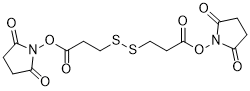
洛曼试剂(Lomant's Reagent),或称DSP(二硫代双(琥珀酰亚胺基丙酸酯)),是一种同双功能、硫醇可裂解、可透过膜的交联剂。其结构包含一个由8个原子组成的间隔臂,该间隔臂末端连接有胺反应性N-羟基琥珀酰亚胺(NHS)酯。在pH 7-9时,这些酯选择性地靶向伯胺,形成稳定的酰胺键,从而共价连接蛋白质或其他含胺分子。间隔臂内的中心二硫键可在还原条件下(例如,用DTT、TCEP或2-巯基乙醇)裂解,从而实现可逆交联,以便进行后续的分析步骤。 尽管DSP不溶于水性缓冲液,但它易溶于极性非质子溶剂,例如DMF或DMSO。该试剂能够穿透细胞膜,从而交联细胞内蛋白质,稳定瞬时或较弱的蛋白质-蛋白质相互作用,以便进行后续研究。该试剂还可用于免疫染色前固定组织样本中的蛋白质复合物、将蛋白质固定在胺功能化表面上,以及制备用于各种生化分析的生物偶联物。 一种密切相关的类似物,3,3'-二硫代双(磺基琥珀酰亚胺基丙酸酯) (DTSSP,通常称为磺基-DSP),具有相同的8原子间隔基和同双功能NHS酯反应活性。关键区别在于其磺酸基团,这使得DTSSP具有水溶性和膜不渗透性。这一特性限制了其对细胞外或细胞表面蛋白质的标记,从而阻止了其进入细胞内。 综合来看,Lomant试剂的结构设计——包括其间隔臂长度、可裂解的二硫键和膜渗透性——使其成为一种用途广泛的工具,可用于探测细胞内外蛋白质相互作用、绘制蛋白质复合物图谱以及生成可逆生物偶联物。 主要特性 NHS酯基团:这些官能团可选择性地与伯胺反应,形成稳定的酰胺键,从而促进蛋白质或其他含胺分子之间的共价交联。 二硫键间隔臂:引入二硫键使其能够在还原条件下裂解,从而使DSP能够作为可逆交联剂。这一特性对于分析后回收原始分子至关重要。 主要应用 蛋白质交联:DSP 广泛用于蛋白质或肽的共价偶联,在结构生物学、蛋白质相互作用图谱和免疫分析中发挥着关键作用。 生物偶联:该试剂是生物偶联策略的基础,支持抗体药物偶联物 (ADC) 和其他靶向治疗剂的合成。 可逆交联:由于其可裂解的二硫键,DSP 可实现暂时性交联,并可使用 DTT 或 TCEP 等还原剂精确逆转。 主要优势 可控可逆性:在需要后续去除连接子的实验流程中,能够进行交联并随后逆转交联的能力至关重要。 高效稳定的偶联:NHS 酯化学确保在生理 pH 条件下与伯胺快速、高产率地偶联,生成适用于各种生物学和免疫学应用的稳定偶联物。分析背景。 摘要 DSP 交联剂是一种用途广泛且不可或缺的试剂,在生物技术和药物研究中尤为重要,尤其适用于需要精确控制蛋白质或其他生物分子交联及后续释放的应用。 DSP 的体外活性主要体现在其作为交联剂的高效性和特异性上。它能够快速高效地将蛋白质与蛋白质交联,或将蛋白质与溶液中其他含伯胺的分子(例如抗体)交联。在抗体药物偶联物 (ADC) 的开发中,它可用作连接剂,将细胞毒性药物连接到抗体上。 |
| 体内研究 (In Vivo) |
DSP本身并非直接的治疗剂。其体内活性是通过抗体药物偶联物(ADC)间接实现的。由DSP将抗体和毒素偶联而成的ADC已显示出在动物模型中靶向并杀死肿瘤细胞的能力。此外,研究还利用DSP在体内稳定基因递送复合物,从而提高肿瘤组织中的基因转导效率。
|
| 酶活实验 |
典型的体外无细胞体系实验方案如下:将目标蛋白溶解于合适的反应缓冲液(例如,pH 7.2-7.5的PBS缓冲液)中。将DSP溶解于无水DMSO或DMF中,配制成储备液(例如,100 mM)。将DSP储备液稀释到蛋白溶液中,使其最终浓度为0.1-2 mM。室温孵育30分钟至1小时,使NHS酯与伯胺反应并发生交联。加入过量的淬灭溶液(例如,pH 7.5的1M Tris-HCl缓冲液),使其最终浓度为20-50 mM,并孵育15分钟以淬灭未反应的NHS酯。最后,通过SDS-PAGE电泳分离交联产物,然后进行Western Blot或质谱分析。
|
| 细胞实验 |
在体外细胞实验(活细胞交联)中,DSP 用于稳定细胞内蛋白质复合物。实验步骤如下:用 PBS 洗涤贴壁细胞(例如 HEK293T 或 MCF7 细胞)。将新鲜配制的 DSP 储备液(例如 100 mM DMSO 溶液)稀释到无血清细胞培养基中,配制成工作浓度(例如 0.5-2 mM)。吸出旧培养基,加入含 DSP 的培养基,并在 37°C 下孵育 10-30 分钟。移除含 DSP 的培养基,加入淬灭液(例如含 100 mM Tris-HCl,pH 8.0 的培养基),并在 37°C 下孵育 10 分钟以终止反应。移除淬灭液,并用 PBS 洗涤细胞。最后,裂解细胞并收集蛋白裂解液,用于后续的免疫沉淀 (IP) 或蛋白质印迹分析。
|
| 动物实验 |
DSP在动物实验中可作为抗体药物偶联物(ADC)的组成部分或作为独立的化学试剂使用。作为ADC的组成部分,其给药方案取决于偶联的抗体和毒素。当用作研究试剂时,一般的体内配制方案如下:首先,将DSP溶解于DMSO中配制成储备液。然后,依次加入PEG300、Tween 80和生理盐水,直至得到澄清的工作液。例如,推荐的配制方案为:10% DMSO + 40% PEG300 + 5% Tween 80 + 45% 生理盐水,可得到浓度约为3.3 mg/mL的DSP溶液。典型的给药途径为腹腔注射(ip)或静脉注射(iv)。
|
| 药代性质 (ADME/PK) |
由于DSP是一种高反应性的化学交联剂,而非典型的候选药物,因此其独立的药代动力学数据非常有限。DSP一旦进入体内,其NHS酯基团会迅速与血浆和组织中普遍存在的游离胺反应,并立即被“固定”。其体内代谢高度依赖于与其偶联的药物或蛋白质。对于以DSP为连接剂合成的抗体药物偶联物(ADC),其药代动力学性质主要由抗体组分决定。
|
| 毒性/毒理 (Toxicokinetics/TK) |
作为一种活性化学物质,DSP 具有刺激性。根据其安全数据表 (SDS),DSP 可引起皮肤刺激(2 类)和特定靶器官毒性(3 类,可能引起呼吸道刺激)。其毒性源于其与生物分子上伯胺的非特异性反应。细胞毒性是其作为抗体药物偶联物 (ADC) 连接子发挥功能的核心,它能将强效细胞毒素(有效载荷)递送至靶细胞。游离的 DSP 在体内可能具有非特异性毒性,因此必须将其稳定地连接到 ADC 中的抗体上,以确保毒素的精准递送。
|
| 参考文献 | |
| 其他信息 |
基于抗体-抗原识别事件的电化学传感器常用于快速、无标记、灵敏地检测各种分析物。然而,生物电子界面上的各种参数,特别是探针(例如抗体)组装到电极前后的参数,会显著影响分析物(例如抗原)的检测性能。本研究深入探讨了生物电子界面特性与一些尚未被充分研究的参数之间的关系:电极表面的抗体密度和抗原孵育时间。为此,我们采用了灵敏的非辐射电化学阻抗谱技术。我们发现,随着含抗原液滴孵育时间的增加,溶液电阻、反射边界元件的扩散电阻和相位常数元件的电容均呈下降趋势,其下降速率分别为 160 ± 30 kΩ/min、800 ± 100 mΩ/min 和 520 ± 80 pF × s(α-1)/min。利用原子力显微镜,我们还发现高抗体密度下的电极涂层比低抗体密度下的涂层更厚,其均方根粗糙度值分别为 2.2 ± 0.2 nm 和 1.28 ± 0.04 nm。此外,我们发现随着抗原在电极上的积累,溶液电阻在高抗体密度下增大,在低抗体密度下减小。最后,抗原检测性能测试表明,低抗体密度下的检测限更优(0.26 μM 对比 2.2 μM)。总之,本文阐明了这两个因素的重要性,以及改变其中一个参数如何显著影响预期结果。(图文摘要)
|
| 分子式 |
C14H16N2O8S2
|
|---|---|
| 分子量 |
404.415441513062
|
| 精确质量 |
404.034
|
| CAS号 |
57757-57-0
|
| PubChem CID |
93313
|
| 外观&性状 |
White to off-white solid powder
|
| 密度 |
1.6±0.1 g/cm3
|
| 沸点 |
560.1±60.0 °C at 760 mmHg
|
| 熔点 |
128-133 °C
|
| 闪点 |
292.6±32.9 °C
|
| 蒸汽压 |
0.0±1.5 mmHg at 25°C
|
| 折射率 |
1.625
|
| LogP |
-1.66
|
| tPSA |
177.96
|
| 氢键供体(HBD)数目 |
0
|
| 氢键受体(HBA)数目 |
10
|
| 可旋转键数目(RBC) |
11
|
| 重原子数目 |
26
|
| 分子复杂度/Complexity |
552
|
| 定义原子立体中心数目 |
0
|
| SMILES |
S(CCC(=O)ON1C(CCC1=O)=O)SCCC(=O)ON1C(CCC1=O)=O
|
| InChi Key |
FXYPGCIGRDZWNR-UHFFFAOYSA-N
|
| InChi Code |
InChI=1S/C14H16N2O8S2/c17-9-1-2-10(18)15(9)23-13(21)5-7-25-26-8-6-14(22)24-16-11(19)3-4-12(16)20/h1-8H2
|
| 化学名 |
Dithiobis[succinimidyl propionate]
|
| 别名 |
DTSSP CrosslinkerDSP Crosslinker
|
| HS Tariff Code |
2934.99.9001
|
| 存储方式 |
Powder -20°C 3 years 4°C 2 years In solvent -80°C 6 months -20°C 1 month 注意: (1). 本产品在运输和储存过程中需避光。 (2). 请将本产品存放在密封且受保护的环境中(例如氮气保护),避免吸湿/受潮。 |
| 运输条件 |
Room temperature (This product is stable at ambient temperature for a few days during ordinary shipping and time spent in Customs)
|
| 溶解度 (体外实验) |
DMSO : ~50 mg/mL (~123.63 mM)
H2O : < 0.1 mg/mL Prior to use in aqueous cross-linking reactions, DSP must first be dissolved in an appropriate organic solvent, such as DMSO or DMF. The crosslinker exhibits solubility in several common solvents, including DMF, DMSO, acetone, and chloroform (at concentrations up to 50 mg/mL). Its membrane-permeable nature allows it to be effectively employed for cross-linking intracellular proteins, making it a frequent choice for applications such as immunoprecipitation (IP), co-immunoprecipitation (Co-IP), and chromatin immunoprecipitation (ChIP) assays. For applications specifically targeting extracellular cross-linking, the water-soluble analog DTSSP is recommended as a suitable alternative. When preparing DSP for aqueous reactions, precipitation can sometimes occur upon dilution of the DMSO stock solution into phosphate-buffered saline (PBS). To mitigate this, it is advisable to add the DMSO stock to PBS in a dropwise manner while gently vortexing the PBS solution. Gentle warming of the final reaction mixture can also help maintain solubility. If precipitation is observed, reducing the concentrations of both the protein and DSP in the reaction may resolve the issue. Alternatively, increasing the final DMSO concentration in the reaction solution up to 20% can improve solubility and prevent precipitate formation. |
|---|---|
| 溶解度 (体内实验) |
配方 1 中的溶解度: ≥ 2.5 mg/mL (6.18 mM) (饱和度未知) in 10% DMSO + 40% PEG300 + 5% Tween80 + 45% Saline (这些助溶剂从左到右依次添加,逐一添加), 澄清溶液。
例如,若需制备1 mL的工作液,可将100 μL 25.0 mg/mL澄清DMSO储备液加入到400 μL PEG300中,混匀;然后向上述溶液中加入50 μL Tween-80,混匀;加入450 μL生理盐水定容至1 mL。 *生理盐水的制备:将 0.9 g 氯化钠溶解在 100 mL ddH₂O中,得到澄清溶液。 配方 2 中的溶解度: ≥ 2.5 mg/mL (6.18 mM) (饱和度未知) in 10% DMSO + 90% (20% SBE-β-CD in Saline) (这些助溶剂从左到右依次添加,逐一添加), 澄清溶液。 例如,若需制备1 mL的工作液,可将 100 μL 25.0 mg/mL澄清DMSO储备液加入900 μL 20% SBE-β-CD生理盐水溶液中,混匀。 *20% SBE-β-CD 生理盐水溶液的制备(4°C,1 周):将 2 g SBE-β-CD 溶解于 10 mL 生理盐水中,得到澄清溶液。 View More
配方 3 中的溶解度: ≥ 2.5 mg/mL (6.18 mM) (饱和度未知) in 10% DMSO + 90% Corn Oil (这些助溶剂从左到右依次添加,逐一添加), 澄清溶液。 1、请先配制澄清的储备液(如:用DMSO配置50 或 100 mg/mL母液(储备液)); 2、取适量母液,按从左到右的顺序依次添加助溶剂,澄清后再加入下一助溶剂。以 下列配方为例说明 (注意此配方只用于说明,并不一定代表此产品 的实际溶解配方): 10% DMSO → 40% PEG300 → 5% Tween-80 → 45% ddH2O (或 saline); 假设最终工作液的体积为 1 mL, 浓度为5 mg/mL: 取 100 μL 50 mg/mL 的澄清 DMSO 储备液加到 400 μL PEG300 中,混合均匀/澄清;向上述体系中加入50 μL Tween-80,混合均匀/澄清;然后继续加入450 μL ddH2O (或 saline)定容至 1 mL; 3、溶剂前显示的百分比是指该溶剂在最终溶液/工作液中的体积所占比例; 4、 如产品在配制过程中出现沉淀/析出,可通过加热(≤50℃)或超声的方式助溶; 5、为保证最佳实验结果,工作液请现配现用! 6、如不确定怎么将母液配置成体内动物实验的工作液,请查看说明书或联系我们; 7、 以上所有助溶剂都可在 Invivochem.cn网站购买。 |
| 制备储备液 | 1 mg | 5 mg | 10 mg | |
| 1 mM | 2.4727 mL | 12.3634 mL | 24.7268 mL | |
| 5 mM | 0.4945 mL | 2.4727 mL | 4.9454 mL | |
| 10 mM | 0.2473 mL | 1.2363 mL | 2.4727 mL |
1、根据实验需要选择合适的溶剂配制储备液 (母液):对于大多数产品,InvivoChem推荐用DMSO配置母液 (比如:5、10、20mM或者10、20、50 mg/mL浓度),个别水溶性高的产品可直接溶于水。产品在DMSO 、水或其他溶剂中的具体溶解度详见上”溶解度 (体外)”部分;
2、如果您找不到您想要的溶解度信息,或者很难将产品溶解在溶液中,请联系我们;
3、建议使用下列计算器进行相关计算(摩尔浓度计算器、稀释计算器、分子量计算器、重组计算器等);
4、母液配好之后,将其分装到常规用量,并储存在-20°C或-80°C,尽量减少反复冻融循环。
计算结果:
工作液浓度: mg/mL;
DMSO母液配制方法: mg 药物溶于 μL DMSO溶液(母液浓度 mg/mL)。如该浓度超过该批次药物DMSO溶解度,请首先与我们联系。
体内配方配制方法:取 μL DMSO母液,加入 μL PEG300,混匀澄清后加入μL Tween 80,混匀澄清后加入 μL ddH2O,混匀澄清。
(1) 请确保溶液澄清之后,再加入下一种溶剂 (助溶剂) 。可利用涡旋、超声或水浴加热等方法助溶;
(2) 一定要按顺序加入溶剂 (助溶剂) 。
InvivoChem的所有产品仅用于作科学研究,不面向患者销售
Copyright 2020 InvivoChem LLC | All Rights Reserved 粤ICP备20063088号-1


 COA
COA
 粤公网安备 44011102003439号
 463611831
