| 规格 | 价格 | 库存 | 数量 |
|---|---|---|---|
| 5mg |
|
||
| 10mg |
|
||
| 25mg |
|
||
| 50mg |
|
||
| 100mg |
|
||
| Other Sizes |
|

| 靶点 |
TRPV1 (EC50 = 11.6 ± 2.5 μM for activating outward currents at +60 mV in mTRPV1-expressing HEK293T cells) [1]
TMEM16A [1] |
|---|---|
| 体外研究 (In Vitro) |
Eact 依赖于 TRPV1 来诱发瘙痒和相关的疼痛行为。Eact 的 EC50 为 11.6±2.5 μM,它以浓度依赖的方式刺激表达 mTRPV1 的 HEK293T 细胞的膜电流。当 TMEM16A 激活剂 Eact 激活 TRPV1 通道时,TRPV1 通道会发生损伤和重排 [1]。在表达 mTRPV1 的 HEK293T 细胞中,Eact (100 μM) 可显著增加细胞内游离 Ca2+ ([Ca2+]i),并且这些细胞对辣椒素 (500 nM) 也有反应。Eact 对表达 hTRPA1、hTRPM8 或 rTRPV4 的 HEK293T 细胞没有影响,而相应的激动剂(AITC、薄荷醇、GSK1016790A)则能激活这些细胞。 [1]
Eact 以浓度依赖的方式激活表达 mTRPV1 的 HEK293T 细胞的膜电流,EC50 为 11.6 ± 2.5 μM(Hill 系数 2.0 ± 0.4)。Eact 激活电流的电流-电压关系与辣椒素相似。100 μM Eact 诱发的最大电流密度为 404.0 ± 24.4 pA/pF,是 3 μM 辣椒素(581.8 ± 33.9 pA/pF)诱发反应的 69.4 ± 0.9%。[1] 在从表达 mTRPV1 的 HEK293T 细胞切取的膜片钳记录中,与基线相比,Eact 显著增加了单通道开放概率 (nPo) (P < 0.0001)。 [1] 在HEK293T细胞中,通过siRNA敲低内源性TMEM16A并不影响Eact对mTRPV1的激活,因为在对照siRNA组和TMEM16A siRNA组中,Eact(10 μM)激活的电流密度没有显著差异。[1] 在培养的小鼠背根神经节(DRG)神经元中,Eact(100 μM)激活了一个大的外向整流电流,该电流可被TRPV1抑制剂AMG9810(0.1 μM)或辣椒素(10 μM)共同应用而显著降低,并且在Trpv1-/- DRG神经元中消失。选择性TMEM16A抑制剂A01(10 μM)对野生型(WT)DRG神经元中Eact激活的电流没有显著影响。使用不含氯离子的移液管溶液记录时,Eact激活的电流仍然存在,表明它不是氯离子电流。 [1]在背根神经节(DRG)神经元中,单独应用Eact(100 μM)可使32.7 ± 2.2%的受试神经元产生[Ca2+]i反应,所有这些神经元均对辣椒素(500 nM)有反应。辣椒素激活的神经元数量更多(51.8 ± 5.1%)。AMG9810(0.1 μM)或TRPV1基因敲除几乎完全消除了Eact诱发的[Ca2+]i反应。[1] |
| 体内研究 (In Vivo) |
将 Eact(50 μL,4.67 mM)皮内注射到小鼠背部前部可引起强烈的抓挠反应(瘙痒相关行为)。预先注射 TRPV1 拮抗剂 AMG9810(50 mg/kg,腹腔注射)可减轻这种抓挠反应,而 Trpv1-/- 小鼠则完全没有这种反应。[1] 将 Eact(20 μL,4.67 mM)足底注射到后爪可立即引起伤害性防御反应(畏缩和舔舐)(疼痛相关行为)。在注射 Eact 前 30 分钟给予 AMG9810(50 mg/kg,腹腔注射)可显著降低这种反应,而 TRPV1 基因敲除则完全消除了这种反应。 [1]
足底注射 Eact(20 μL,4.67 mM)可诱发持续至少 60 分钟的显著且持久的热痛觉过敏,这通过 Hargreaves 装置测定的缩爪潜伏期得到证实。AMG9810(50 mg/kg,腹腔注射)显著抑制了这种效应,并且在 Trpv1-/- 小鼠中 Eact 诱发的热痛觉过敏消失。[1] 同时应用选择性 TMEM16A 抑制剂 T16Ainh-A01 (A01) 可部分逆转 Eact 诱发的瘙痒和疼痛相关行为(见补充信息图 S1)。[1] |
| 细胞实验 |
对于活细胞Ca2+成像,将培养的DRG神经元或表达TRP通道的HEK293T细胞在37°C下用4 μM Fura-2 AM培养基孵育60分钟,然后洗涤三次,并在室温下用HBSS孵育30分钟。使用配备激发滤光片轮的倒置显微镜记录340 nm和380 nm激发波长下的荧光。Fura-2比值(F340/F380)反映了[Ca2+]i的变化。激活阈值定义为高于平均值3个标准差(约高于基线20%)。[1]
对于全细胞膜片钳记录,使用Axon 700B放大器在室温(22-24°C)下进行。用于全细胞记录的电极(2-4 MΩ)内填充有含有 140 mM CsCl、2 mM EGTA 和 10 mM HEPES(pH 7.3)的溶液。无钙细胞外液含有 140 mM NaCl、5 mM KCl、0.5 mM EGTA、1 mM MgCl₂、10 mM 葡萄糖和 10 mM HEPES(pH 7.4)。全细胞电流的记录采用电压斜坡,电压从 -100 mV 升至 +100 mV,持续 500 ms,钳制电位为 0 mV。数据经 2 kHz 滤波,并以 10 kHz 采样率进行数字化。[1] 对于单通道记录,电极(8-10 MΩ)内填充有对称溶液(与电极内液相同)。切取膜片内侧朝外的膜片,并使用半振幅阈值交叉标准确定开放概率。 [1] 对于蛋白质印迹实验,HEK293T细胞用裂解缓冲液(25 mM Tris-HCl pH 7.6、150 mM NaCl、0.1% SDS、1 mM PMSF、NaF、NaVO3、亮抑蛋白酶肽、胃蛋白酶抑制剂、抑蛋白酶)裂解。蛋白质浓度采用BCA法测定。取120 μg蛋白质与SDS-PAGE上样缓冲液混合煮沸,经12% SDS-PAGE凝胶电泳分离后,转移至膜上,用5% BSA封闭,与兔抗TMEM16A抗体(1:1000)和HRP标记的抗兔二抗(1:1000)孵育,最后用ECL显色。以小鼠HRP标记的抗β-肌动蛋白抗体(1:5000)作为上样对照。使用 Image J 软件进行密度分析。[1] 对于 siRNA 敲低实验,将 HEK293T 细胞用 Lipofectamine 2000 转染 200 nM TMEM16A siRNA 或对照 siRNA(20:2 pmol siRNA:μL Lipofectamine 2000),并共转染 mTRPV1。48 小时后,将细胞接种到盖玻片上,继续培养 24 小时后进行实验。通过 Western blot 验证敲低效果。[1] |
| 动物实验 |
本研究使用了C57BL/6J背景的野生型(WT)和同源Trpv1-/-小鼠。所有小鼠均饲养于12小时光照/12小时黑暗循环条件下,并可自由摄取食物和水。所有实验均已获得华盛顿大学医学院动物研究委员会的批准。[1]
为研究抓挠行为,在实验前将小鼠单独置于透明笼中至少30分钟。将Eact(4.67 mM,50 μL)或溶剂(0.9%生理盐水+1% DMSO+0.1% Tween 80)皮内注射(id)至小鼠背部前部。记录30分钟内小鼠后肢抓挠注射部位的次数。[1] 为研究伤害性防御反应,将Eact(4.67 mM,20 μL)足底注射(i.pl.)至小鼠后爪。注射后立即将小鼠放入有机玻璃箱中,通过5分钟的视频记录测量小鼠舔舐和抬起注射爪的总时间。在注射Eact前30分钟,腹腔注射AMG9810(50 mg/kg)。对照组小鼠注射等体积的溶剂。[1] 对于热痛觉测试,使用Hargreaves装置测量小鼠对辐射热刺激的缩爪潜伏期。将小鼠单独放入透明有机玻璃箱(8×8×12 cm)中,并在测试前适应至少1小时。在小鼠右后爪足底注射20 μL溶剂,其中部分小鼠同时注射Eact。分别在注射前(0分钟)和注射后15、30、60、90和120分钟测量缩爪潜伏期。调整红外光强度以获得 10-15 秒的基础潜伏期,并设定 20 秒的截止时间以防止组织损伤。[1] |
| 参考文献 | |
| 其他信息 |
Eact 最初是通过对约 11 万种化合物进行基于细胞的高通量筛选而发现的,它是一种 TMEM16A(钙激活氯离子通道)的小分子激活剂。Eact 可以直接打开 TMEM16A 通道,而不会增加细胞内钙离子浓度,并刺激氯离子分泌。然而,这项研究意外地发现,Eact 还可以通过与辣椒素结合位点相互作用直接激活 TRPV1 通道。破坏辣椒素结合的突变(例如 S513Y、Y512A/S513Y)会显著减弱 Eact 的激活作用(EC50 值至少增加六倍)。因此,由于 Eact 在同一细胞中直接激活 TRPV1,它并非解析原代感觉神经元中 TMEM16A 功能的理想工具。Eact 引起的感官过敏可能会对其在治疗囊性纤维化及相关疾病方面的潜在应用构成不良副作用。[1]
|
| 分子式 |
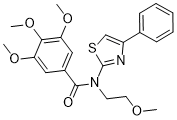
C22H24N2O5S
|
|---|---|
| 分子量 |
428.501364707947
|
| 精确质量 |
428.141
|
| CAS号 |
461000-66-8
|
| PubChem CID |
3173542
|
| 外观&性状 |
White to off-white solid powder
|
| 密度 |
1.237±0.06 g/cm3(Predicted)
|
| 沸点 |
595.9±60.0 ℃(Predicted)
|
| LogP |
4.129
|
| tPSA |
98.36
|
| 氢键供体(HBD)数目 |
0
|
| 氢键受体(HBA)数目 |
7
|
| 可旋转键数目(RBC) |
9
|
| 重原子数目 |
30
|
| 分子复杂度/Complexity |
520
|
| 定义原子立体中心数目 |
0
|
| InChi Key |
ZUXNHFFVQWADJL-UHFFFAOYSA-N
|
| InChi Code |
InChI=1S/C22H24N2O5S/c1-26-11-10-24(22-23-17(14-30-22)15-8-6-5-7-9-15)21(25)16-12-18(27-2)20(29-4)19(13-16)28-3/h5-9,12-14H,10-11H2,1-4H3
|
| 化学名 |
3,4,5-trimethoxy-N-(2-methoxyethyl)-N-(4-phenyl-1,3-thiazol-2-yl)benzamide
|
| HS Tariff Code |
2934.99.9001
|
| 存储方式 |
Powder -20°C 3 years 4°C 2 years In solvent -80°C 6 months -20°C 1 month |
| 运输条件 |
Room temperature (This product is stable at ambient temperature for a few days during ordinary shipping and time spent in Customs)
|
| 溶解度 (体外实验) |
DMSO : ~50 mg/mL (~116.69 mM)
|
|---|---|
| 溶解度 (体内实验) |
配方 1 中的溶解度: ≥ 2.5 mg/mL (5.83 mM) (饱和度未知) in 10% DMSO + 90% Corn Oil (这些助溶剂从左到右依次添加,逐一添加), 澄清溶液。
例如,若需制备1 mL的工作液,可将100 μL 25.0 mg/mL 澄清 DMSO 储备液加入900 μL 玉米油中,混合均匀。 请根据您的实验动物和给药方式选择适当的溶解配方/方案: 1、请先配制澄清的储备液(如:用DMSO配置50 或 100 mg/mL母液(储备液)); 2、取适量母液,按从左到右的顺序依次添加助溶剂,澄清后再加入下一助溶剂。以 下列配方为例说明 (注意此配方只用于说明,并不一定代表此产品 的实际溶解配方): 10% DMSO → 40% PEG300 → 5% Tween-80 → 45% ddH2O (或 saline); 假设最终工作液的体积为 1 mL, 浓度为5 mg/mL: 取 100 μL 50 mg/mL 的澄清 DMSO 储备液加到 400 μL PEG300 中,混合均匀/澄清;向上述体系中加入50 μL Tween-80,混合均匀/澄清;然后继续加入450 μL ddH2O (或 saline)定容至 1 mL; 3、溶剂前显示的百分比是指该溶剂在最终溶液/工作液中的体积所占比例; 4、 如产品在配制过程中出现沉淀/析出,可通过加热(≤50℃)或超声的方式助溶; 5、为保证最佳实验结果,工作液请现配现用! 6、如不确定怎么将母液配置成体内动物实验的工作液,请查看说明书或联系我们; 7、 以上所有助溶剂都可在 Invivochem.cn网站购买。 |
| 制备储备液 | 1 mg | 5 mg | 10 mg | |
| 1 mM | 2.3337 mL | 11.6686 mL | 23.3372 mL | |
| 5 mM | 0.4667 mL | 2.3337 mL | 4.6674 mL | |
| 10 mM | 0.2334 mL | 1.1669 mL | 2.3337 mL |
1、根据实验需要选择合适的溶剂配制储备液 (母液):对于大多数产品,InvivoChem推荐用DMSO配置母液 (比如:5、10、20mM或者10、20、50 mg/mL浓度),个别水溶性高的产品可直接溶于水。产品在DMSO 、水或其他溶剂中的具体溶解度详见上”溶解度 (体外)”部分;
2、如果您找不到您想要的溶解度信息,或者很难将产品溶解在溶液中,请联系我们;
3、建议使用下列计算器进行相关计算(摩尔浓度计算器、稀释计算器、分子量计算器、重组计算器等);
4、母液配好之后,将其分装到常规用量,并储存在-20°C或-80°C,尽量减少反复冻融循环。
计算结果:
工作液浓度: mg/mL;
DMSO母液配制方法: mg 药物溶于 μL DMSO溶液(母液浓度 mg/mL)。如该浓度超过该批次药物DMSO溶解度,请首先与我们联系。
体内配方配制方法:取 μL DMSO母液,加入 μL PEG300,混匀澄清后加入μL Tween 80,混匀澄清后加入 μL ddH2O,混匀澄清。
(1) 请确保溶液澄清之后,再加入下一种溶剂 (助溶剂) 。可利用涡旋、超声或水浴加热等方法助溶;
(2) 一定要按顺序加入溶剂 (助溶剂) 。
| NCT Number | Recruitment | interventions | Conditions | Sponsor/Collaborators | Start Date | Phases |
| NCT03817229 | COMPLETED | Behavioral: Education microlearning sessions
Behavioral: Automated digital reminders Behavioral: Problem-solving mHealth module Behavioral: Individualized Adherence Feedback Report |
Epilepsy | Children's Hospital Medical Center, Cincinnati | 2019-04-15 | Not Applicable |
|
|
|
InvivoChem的所有产品仅用于作科学研究,不面向患者销售
Copyright 2020 InvivoChem LLC | All Rights Reserved 粤ICP备20063088号-1


 粤公网安备 44011102003439号
 463611831
