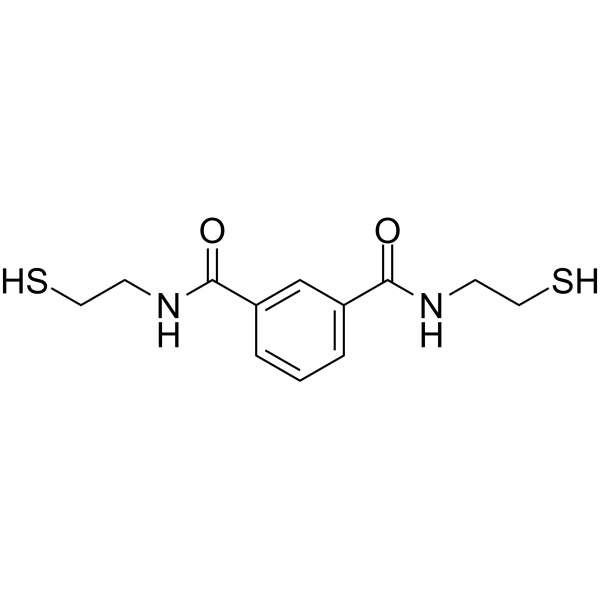
Emeramide

别名: BDETH2; BDET; BDTH2 N,N'-二(2-巯基乙基)间苯二甲酰胺;硫醇氧化还原抗氧化剂和重金属螯合剂
目录号: V19302 纯度: ≥98%
Emeramide 是一种硫醇氧化还原抗氧化剂和重金属螯合剂。
Emeramide CAS号: 351994-94-0
产品类别: New1
产品仅用于科学研究,不针对患者销售
规格 价格 库存 数量
100mg
250mg
500mg
Other Sizes
点击了解更多
  • 与全球5000+客户建立关系
  • 覆盖全球主要大学、医院、科研院所、生物/制药公司等
  • 产品被大量CNS顶刊文章引用
InvivoChem产品被CNS等顶刊论文引用
纯度/质量控制文件

纯度: ≥98%

产品描述
Emeramide 是一种硫醇氧化还原抗氧化剂和重金属螯合剂。
Emeramide(BDTH2,N,N'-双(2-巯基乙基)间苯二甲酰胺)是一种硫醇氧化还原抗氧化剂和重金属螯合剂。其分子式为 C12H16N2O2S2,分子量为 284.40。Emeramide 是一种苯甲酰胺衍生物,其分子内的酰胺基和巯基可以螯合金属。它可用于螯合铅、铜、锰、汞和其他重金属。该化合物的国际非专利名称 (INN) 为 Emeramide。
生物活性&实验参考方法
靶点
Heavy metal ions (mercury, lead, copper, manganese). Emeramide is a heavy metal chelator and thiol redox antioxidant. It binds to heavy metals through its thiol (mercaptan) groups, forming stable complexes that facilitate the excretion of these metals from the body. The compound also exhibits antioxidant properties through its thiol redox activity.
体外研究 (In Vitro)
研究表明,Emeramide能够预防甲基汞诱导的谷胱甘肽(GSH)损失和细胞毒性。作为一种硫醇氧化还原抗氧化剂,它能够清除活性氧,保护细胞免受氧化损伤。体外研究表明,Emeramide可以螯合多种重金属,包括汞、铅、铜和锰,从而降低它们的生物利用度和毒性。
体内研究 (In Vivo)
关于艾美酰胺的体内研究有限。作为一种重金属螯合剂,该化合物在治疗重金属中毒和降低体内重金属负荷方面具有潜在应用价值。其抗氧化特性也可能对氧化应激相关疾病有益。然而,目前公开文献中尚缺乏全面的体内疗效和安全性数据。
酶活实验
体外螯合试验通常包括将该化合物与各种金属离子(例如Hg²⁺、Pb²⁺、Cu²⁺、Mn²⁺)在缓冲溶液中孵育。金属-Emeramide络合物的形成可通过紫外-可见光谱、荧光光谱或质谱进行监测。竞争性结合研究可使用金属特异性指示剂或螯合剂进行。测定金属络合物的化学计量比和稳定性常数。
细胞实验
使用暴露于重金属毒性的多种细胞系进行 Emeramide 的细胞活性测定。细胞预先用 Emeramide 和重金属(例如甲基汞)处理或共同处理,并使用 MTT、LDH 释放或其他细胞活力测定方法评估细胞活力。测定细胞内谷胱甘肽水平以评估该化合物的抗氧化作用。可通过 ICP-MS 分析细胞内金属含量以评估螯合效率。
动物实验
Emeramide 的体内动物研究通常采用啮齿动物重金属中毒模型。动物将暴露于重金属(例如汞、铅)中,然后通过口服或腹腔注射途径给予 Emeramide。通过测量血液、组织和排泄物中的金属含量来评估螯合效果。同时,还将评估临床症状、体重和器官组织病理学变化,以评价其毒性和治疗效果。
药代性质 (ADME/PK)
Emeramide 的分子量为 284.40,分子式为 C12H16N2O2S2。它可溶于 DMSO(溶解度约为 100 mg/mL),水溶性较低(溶解度约为 1 mg/mL)。该化合物应以粉末形式储存于 -20°C 下 3 年,或 4°C 下 2 年。在溶剂中,它在 -80°C 下可稳定保存 6 个月,或在 -20°C 下可稳定保存 1 个月。该化合物在溶液中不稳定,应现配现用。
毒性/毒理 (Toxicokinetics/TK)
由于其作为重金属螯合剂的用途,Emeramide 通常被认为毒性较低。然而,全面的毒理学数据有限。该化合物含有巯基,可能产生生物效应。处理 Emeramide 时应遵循标准的实验室安全预防措施。与所有螯合剂一样,应考虑潜在的矿物质消耗。
参考文献

[1]. Novel lipid-soluble thiol-redox antioxidant and heavy metal chelator, N,N'-bis(2-mercaptoethyl)isophthalamide (NBMI) and phospholipase D-specific inhibitor, 5-fluoro-2-indolyl des-chlorohalopemide (FIPI) attenuate mercury-induced lipid signaling leading to protection against cytotoxicity in aortic endothelial cells. Int J Toxicol. 2011 Dec;30(6):619-38.

[2]. Thiol-redox antioxidants protect against lung vascular endothelial cytoskeletal alterations caused by pulmonary fibrosis inducer, bleomycin: comparison between classical thiol-protectant, N-acetyl-L-cysteine, and novel thiol antioxidant, N,N'-bis-2-mercaptoethyl isophthalamide. Toxicol Mech Methods. 2012 Jun;22(5):383-96.

[3]. N,N'bis-(2-mercaptoethyl) isophthalamide (NBMI) exerts neuroprotection against lead-induced toxicity in U-87 MG cells. Arch Toxicol. 2021 Aug;95(8):2643-2657.

[4]. Reversal of genetic brain iron accumulation by N,N'-bis(2-mercaptoethyl)isophthalamide, a lipophilic metal chelator, in mice. Arch Toxicol. 2022 Jul;96(7):1951-1962.

其他信息
Emeramide 已用于汞中毒治疗研究的临床试验中。
Emeramide (BDTH2) 是一种硫醇氧化还原抗氧化剂和重金属螯合剂,已被分配国际非专利名称 (INN)。它是一种苯甲酰胺衍生物,具有分子内酰胺和硫醇基团,可螯合多种重金属,包括铅、铜、锰和汞。该化合物在环境修复方面具有潜在应用,可用于螯合地下水、废水和污染土壤中的重金属,并可能用于治疗重金属中毒。Emeramide 仅供研究使用,尚未获准用于临床。
*注: 文献方法仅供参考, InvivoChem并未独立验证这些方法的准确性
化学信息 & 存储运输条件
分子式
C12H16N2O2S2
分子量
284.39
精确质量
284.065
CAS号
351994-94-0
PubChem CID
21133161
外观&性状
White to off-white solid powder
密度
1.2±0.1 g/cm3
沸点
568.9±45.0 °C at 760 mmHg
闪点
297.9±28.7 °C
蒸汽压
0.0±1.6 mmHg at 25°C
折射率
1.595
LogP
1.16
tPSA
142.78
氢键供体(HBD)数目
4
氢键受体(HBA)数目
4
可旋转键数目(RBC)
6
重原子数目
18
分子复杂度/Complexity
261
定义原子立体中心数目
0
InChi Key
JUTBAVRYDAKVGQ-UHFFFAOYSA-N
InChi Code
InChI=1S/C12H16N2O2S2/c15-11(13-4-6-17)9-2-1-3-10(8-9)12(16)14-5-7-18/h1-3,8,17-18H,4-7H2,(H,13,15)(H,14,16)
化学名
1-N,3-N-bis(2-sulfanylethyl)benzene-1,3-dicarboxamide
别名
BDETH2; BDET; BDTH2
HS Tariff Code
2934.99.9001
存储方式

Powder      -20°C    3 years

                     4°C     2 years

In solvent   -80°C    6 months

                  -20°C    1 month

注意: 该产品在溶液状态不稳定,请现配现用。
运输条件
Room temperature (This product is stable at ambient temperature for a few days during ordinary shipping and time spent in Customs)
溶解度数据
溶解度 (体外实验)
DMSO : ~100 mg/mL (~351.62 mM)
H2O : ~1 mg/mL (~3.52 mM)
溶解度 (体内实验)
配方 1 中的溶解度: ≥ 2.08 mg/mL (7.31 mM) (饱和度未知) in 10% DMSO + 40% PEG300 + 5% Tween80 + 45% Saline (这些助溶剂从左到右依次添加,逐一添加), 澄清溶液。
例如,若需制备1 mL的工作液,可将100 μL 20.8 mg/mL澄清DMSO储备液加入400 μL PEG300中,混匀;然后向上述溶液中加入50 μL Tween-80,混匀;加入450 μL生理盐水定容至1 mL。
*生理盐水的制备:将 0.9 g 氯化钠溶解在 100 mL ddH₂O中,得到澄清溶液。

配方 2 中的溶解度: ≥ 2.08 mg/mL (7.31 mM) (饱和度未知) in 10% DMSO + 90% Corn Oil (这些助溶剂从左到右依次添加,逐一添加), 澄清溶液。
例如,若需制备1 mL的工作液,可将 100 μL 20.8 mg/mL 澄清 DMSO 储备液加入到 900 μL 玉米油中并混合均匀。

请根据您的实验动物和给药方式选择适当的溶解配方/方案:
1、请先配制澄清的储备液(如:用DMSO配置50 或 100 mg/mL母液(储备液));
2、取适量母液,按从左到右的顺序依次添加助溶剂,澄清后再加入下一助溶剂。以 下列配方为例说明 (注意此配方只用于说明,并不一定代表此产品 的实际溶解配方):
10% DMSO → 40% PEG300 → 5% Tween-80 → 45% ddH2O (或 saline);
假设最终工作液的体积为 1 mL, 浓度为5 mg/mL: 取 100 μL 50 mg/mL 的澄清 DMSO 储备液加到 400 μL PEG300 中,混合均匀/澄清;向上述体系中加入50 μL Tween-80,混合均匀/澄清;然后继续加入450 μL ddH2O (或 saline)定容至 1 mL;

3、溶剂前显示的百分比是指该溶剂在最终溶液/工作液中的体积所占比例;
4、 如产品在配制过程中出现沉淀/析出,可通过加热(≤50℃)或超声的方式助溶;
5、为保证最佳实验结果,工作液请现配现用!
6、如不确定怎么将母液配置成体内动物实验的工作液,请查看说明书或联系我们;
7、 以上所有助溶剂都可在 Invivochem.cn网站购买。
制备储备液 1 mg 5 mg 10 mg
1 mM 3.5163 mL 17.5815 mL 35.1630 mL
5 mM 0.7033 mL 3.5163 mL 7.0326 mL
10 mM 0.3516 mL 1.7581 mL 3.5163 mL

1、根据实验需要选择合适的溶剂配制储备液 (母液):对于大多数产品,InvivoChem推荐用DMSO配置母液 (比如:5、10、20mM或者10、20、50 mg/mL浓度),个别水溶性高的产品可直接溶于水。产品在DMSO 、水或其他溶剂中的具体溶解度详见上”溶解度 (体外)”部分;

2、如果您找不到您想要的溶解度信息,或者很难将产品溶解在溶液中,请联系我们;

3、建议使用下列计算器进行相关计算(摩尔浓度计算器、稀释计算器、分子量计算器、重组计算器等);

4、母液配好之后,将其分装到常规用量,并储存在-20°C或-80°C,尽量减少反复冻融循环。

计算器

摩尔浓度计算器可计算特定溶液所需的质量、体积/浓度,具体如下:

  • 计算制备已知体积和浓度的溶液所需的化合物的质量
  • 计算将已知质量的化合物溶解到所需浓度所需的溶液体积
  • 计算特定体积中已知质量的化合物产生的溶液的浓度
使用摩尔浓度计算器计算摩尔浓度的示例如下所示:
假如化合物的分子量为350.26 g/mol,在5mL DMSO中制备10mM储备液所需的化合物的质量是多少?
  • 在分子量(MW)框中输入350.26
  • 在“浓度”框中输入10,然后选择正确的单位(mM)
  • 在“体积”框中输入5,然后选择正确的单位(mL)
  • 单击“计算”按钮
  • 答案17.513 mg出现在“质量”框中。以类似的方式,您可以计算体积和浓度。

稀释计算器可计算如何稀释已知浓度的储备液。例如,可以输入C1、C2和V2来计算V1,具体如下:

制备25毫升25μM溶液需要多少体积的10 mM储备溶液?
使用方程式C1V1=C2V2,其中C1=10mM,C2=25μM,V2=25 ml,V1未知:
  • 在C1框中输入10,然后选择正确的单位(mM)
  • 在C2框中输入25,然后选择正确的单位(μM)
  • 在V2框中输入25,然后选择正确的单位(mL)
  • 单击“计算”按钮
  • 答案62.5μL(0.1 ml)出现在V1框中
g/mol

分子量计算器可计算化合物的分子量 (摩尔质量)和元素组成,具体如下:

注:化学分子式大小写敏感:C12H18N3O4  c12h18n3o4
计算化合物摩尔质量(分子量)的说明:
  • 要计算化合物的分子量 (摩尔质量),请输入化学/分子式,然后单击“计算”按钮。
分子质量、分子量、摩尔质量和摩尔量的定义:
  • 分子质量(或分子量)是一种物质的一个分子的质量,用统一的原子质量单位(u)表示。(1u等于碳-12中一个原子质量的1/12)
  • 摩尔质量(摩尔重量)是一摩尔物质的质量,以g/mol表示。
/

配液计算器可计算将特定质量的产品配成特定浓度所需的溶剂体积 (配液体积)

  • 输入试剂的质量、所需的配液浓度以及正确的单位
  • 单击“计算”按钮
  • 答案显示在体积框中
动物体内实验配方计算器(澄清溶液)
第一步:请输入基本实验信息(考虑到实验过程中的损耗,建议多配一只动物的药量)
第二步:请输入动物体内配方组成(配方适用于不溶/难溶于水的化合物),不同的产品和批次配方组成不同,如对配方有疑问,可先联系我们提供正确的体内实验配方。此外,请注意这只是一个配方计算器,而不是特定产品的确切配方。
+
+
+

计算结果:

工作液浓度 mg/mL;

DMSO母液配制方法 mg 药物溶于 μL DMSO溶液(母液浓度 mg/mL)。如该浓度超过该批次药物DMSO溶解度,请首先与我们联系。

体内配方配制方法μL DMSO母液,加入 μL PEG300,混匀澄清后加入μL Tween 80,混匀澄清后加入 μL ddH2O,混匀澄清。

(1) 请确保溶液澄清之后,再加入下一种溶剂 (助溶剂) 。可利用涡旋、超声或水浴加热等方法助溶;
            (2) 一定要按顺序加入溶剂 (助溶剂) 。

临床试验信息
NCT Number Recruitment interventions Conditions Sponsor/Collaborators Start Date Phases
NCT04092205 COMPLETED Drug:Emeramide
Other Names:NBMI
Irminix
Beta Thalassemia Major EmeraMed 2019-11-21 Phase 2
NCT03123692 COMPLETED Drug:Emeramide
Drug:Placebo
COPD
COPD Bronchitis
EmeraMed 2017-01-01 Phase 2
NCT02486289 COMPLETED Drug:Emeramide
Drug:Placebo
Mercury Poisoning EmeraMed 2015-08 Phase 2
生物数据图片
  • N,N′-bis(2-Mercaptoethyl)isopthalamide (NBMI) attenuates the mercury-induced phospholipase D (PLD) activation in a dose-dependent fashion in mouse aortic endothelial cells (MAECs). The MAECs (5 × 10⁵ cells/35 mm dish) were labeled with [32P]orthophosphate in phosphate-free Dulbecco-modified Eagle medium (DMEM) for 12 hours. Following [32P]orthophosphate labeling, MAECs were treated with minimal essential medium (MEM) alone or MEM containing different concentrations (5, 10, and 25 μmol/L) of mercury(II) chloride, methylmercury, and thimerosal for 1 hour (A) in the presence of 0.05% (volume/volume [vol/vol]) 1-butanol. The MAECs were also labeled with [32P]orthophosphate, then pretreated with MEM or different concentrations of MEM containing NBMI (10, 25, and 50 μmol/L) for 1 hour, then treated with mercury(II) chloride (25 μmol/L) (B); methylmercury (10 μmol/L) (C); and thimerosal (25 μmol/L); (D), for 1 hour in the presence of 0.05% (vol/vol) 1-butanol. At the end of the incubation period, [32P] PBt formed was determined. Data represent mean ± standard deviation (SD) calculated from 3 independent experiments. *Significantly different at P < .05 as compared to cells treated with MEM alone. **Significantly different at P < .05 as compared to cells treated with MEM containing mercury alone. Int J Toxicol. 2011 Dec;30(6):619-38.
  • N,N′-bis(2-Mercaptoethyl)isopthalamide (NBMI) attenuates the mercury-induced phospholipase D (PLD) activation in similar fashion to N-acetyl-l-cysteine (NAC) and meso-2,3-dimercaptosuccinic acid (DMSA) in mouse aortic endothelial cells (MAECs). The MAECs (5 × 10⁵ cells/35 mm dish) were labeled with [32P]orthophosphate in phosphate-free Dulbecco-modified Eagle medium (DMEM) for 12 hours. Following [32P]orthophosphate labeling, cells were pretreated with minimal essential medium (MEM) alone or MEM containing NBMI (50 μmol/L) and MEM containing NAC (50 μmol/L, A and 5 mmol/L, B) or DMSA (50 (C) μmol/L and 5 mmol/L (D)) for 1 hour. After pretreatment, cells were treated with MEM alone or MEM containing methylmercury (10 μmol/L) or thimerosal (25 μmol/L) for 1 hour in the presence of 0.05% (volume/volume [vol/vol]) 1-butanol. At the end of the incubation period, [32P]phosphatidylbutanol ([32P]PBt) formed was determined. Data represent mean ± standard deviation (SD) calculated from 3 independent experiments. *Significantly different at P < .05 as compared to cells treated with MEM alone. **Significantly different at P < .05 as compared to cells treated with MEM containing mercury alone. Int J Toxicol. 2011 Dec;30(6):619-38.
  • N,N′-bis(2-Mercaptoethyl)isopthalamide (NBMI) attenuates the mercury-induced phospholipase D1 (PLD1) and PLD2 in situ translocation. Mouse aortic endothelial cells (MAECs) cultured on coverslips (5 × 10⁵ cells/35 mm dish) were pretreated with minimal essential medium (MEM) alone or MEM containing NBMI (50 μmol/L) for 1 hour then treated with MEM alone or MEM containing methylmercury (5 and 10 μmol/L) and thimerosal (10 and 25 μmol/L) for 1 hour. At the end of the incubation period, the cells were fixed, stained for PLD1 (A and B) and PLD2 (C and D), and visualized using confocal fluorescent microscopy. Each digitally captured image is a representative picture obtained from 3 independent experiments conducted under identical conditions. Int J Toxicol. 2011 Dec;30(6):619-38.
联系我们