| 规格 | 价格 | 库存 | 数量 |
|---|---|---|---|
| 1mg |
|
||
| 5mg |
|
||
| 10mg |
|
||
| 100mg |
|
||
| 250mg |
|
||
| Other Sizes |
|

| 靶点 |
Natural flavone; anti-inflammatory, anti-tumor, anti-oxidant, neuroprotective, anti-fungal activities
|
|---|---|
| 体外研究 (In Vitro) |
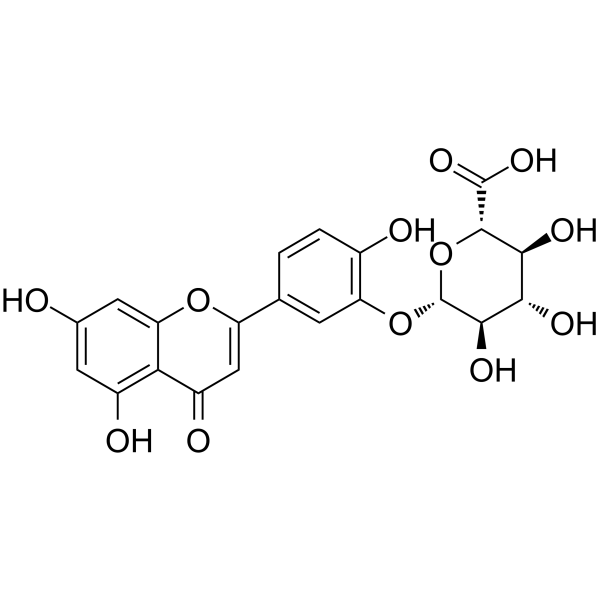
木犀草素3'-O-葡糖苷酸是一种木犀草素葡萄糖醛酸,由在3'-位置附着β-D-葡萄糖醛酸残基的木犀草素组成。它具有代谢物的作用。它是木犀草素O-葡萄糖醛酸苷和三羟基黄酮。
木犀草素3'-邻葡糖苷酸已被报道存在于鼠尾草、香蜂草和其他生物中
|
| 参考文献 | |
| 其他信息 |
木犀草素 3'-O-葡萄糖醛酸苷是一种木犀草素葡萄糖醛酸衍生物,由木犀草素分子在其 3' 位连接一个 β-D-葡萄糖醛酸残基构成。它是一种代谢产物,属于木犀草素 O-葡萄糖醛酸苷和三羟基黄酮类化合物。
据报道,木犀草素 3'-O-葡萄糖醛酸苷存在于鼠尾草、香蜂花以及其他有相关数据的生物体中。 另见:迷迭香(部分)。 |
| 分子式 |
C21H18O12
|
|---|---|
| 分子量 |
462.3604
|
| 精确质量 |
462.079
|
| 元素分析 |
Because of the widespread use of botanicals, it has become crucial for health professionals to improve their knowledge about safety problems. Several herbal medicines contain chemicals with allergenic properties responsible for contact dermatitis. Among these, one is Rosmarinus officinalis L. (rosemary), a plant used since ancient times in folk medicine; at the present time it is used worldwide as a spice and flavouring agent, as a preservative and for medicinal and cosmetic purposes. The present article aims to revise and summarise scientific literature reporting cases of contact dermatitis caused by the use of R. officinalis as a raw material or as herbal preparations. Published case reports were researched on the following databases and search engines: PUBMED, MEDLINE, EMBASE, Google Scholar, Scopus. The used keywords were: R. officinalis and rosemary each alone or combined with the words allergy, contact dermatitis, allergic contact dermatitis, sensitisation and occupational dermatitis. The published case reports show that both rosemary extracts and raw material can be responsible for allergic contact dermatitis. Two cases related to contact dermatitis caused by cross-reactivity between rosemary and thyme were also commented. The diterpene carnosol, a chemical constituent of this plant, has been imputed as a common cause for this reaction. The incidence of contact dermatitis caused by rosemary is not common, but it could be more frequent with respect to the supposed occurrence. It seems plausible that cases of contact dermatitis caused by rosemary are more frequent with respect to the supposed occurrence, because they could be misdiagnosed. For this reason, this possibility should be carefully considered in dermatitis differential diagnosis.https://pubmed.ncbi.nlm.nih.gov/23827646/
|
| CAS号 |
53527-42-7
|
| PubChem CID |
10253785
|
| 外观&性状 |
Light yellow to yellow solid powder
|
| 密度 |
1.8±0.1 g/cm3
|
| 沸点 |
865.4±65.0 °C at 760 mmHg
|
| 闪点 |
305.9±27.8 °C
|
| 蒸汽压 |
0.0±0.3 mmHg at 25°C
|
| 折射率 |
1.764
|
| LogP |
-1.16
|
| tPSA |
203
|
| 氢键供体(HBD)数目 |
7
|
| 氢键受体(HBA)数目 |
12
|
| 可旋转键数目(RBC) |
4
|
| 重原子数目 |
33
|
| 分子复杂度/Complexity |
785
|
| 定义原子立体中心数目 |
5
|
| SMILES |
C1=CC(=C(C=C1C2=CC(=O)C3=C(C=C(C=C3O2)O)O)O[C@H]4[C@@H]([C@H]([C@@H]([C@H](O4)C(=O)O)O)O)O)O
|
| InChi Key |
JDOFZOKGCYYUER-ZFORQUDYSA-N
|
| InChi Code |
InChI=1S/C21H18O12/c22-8-4-10(24)15-11(25)6-12(31-14(15)5-8)7-1-2-9(23)13(3-7)32-21-18(28)16(26)17(27)19(33-21)20(29)30/h1-6,16-19,21-24,26-28H,(H,29,30)/t16-,17-,18+,19-,21+/m0/s1
|
| 化学名 |
(2S,3S,4S,5R,6S)-6-[5-(5,7-dihydroxy-4-oxochromen-2-yl)-2-hydroxyphenoxy]-3,4,5-trihydroxyoxane-2-carboxylic acid
|
| 别名 |
Luteolin 3'-o-glucuronide; Luteolin-3-O-beta-D-glucuronide; Luteolin-3'-D-glucuronide; Luteolin 3'-glucuronide; Luteolin 3'-o-beta-D-glucuronide; UNII-1T6AU6J856; 1T6AU6J856;
|
| HS Tariff Code |
2934.99.9001
|
| 存储方式 |
Powder -20°C 3 years 4°C 2 years In solvent -80°C 6 months -20°C 1 month 注意: 本产品在运输和储存过程中需避光。 |
| 运输条件 |
Room temperature (This product is stable at ambient temperature for a few days during ordinary shipping and time spent in Customs)
|
| 溶解度 (体外实验) |
DMSO : ~100 mg/mL (~216.28 mM)
|
|---|---|
| 溶解度 (体内实验) |
配方 1 中的溶解度: ≥ 2.08 mg/mL (4.50 mM) (饱和度未知) in 10% DMSO + 40% PEG300 + 5% Tween80 + 45% Saline (这些助溶剂从左到右依次添加,逐一添加), 澄清溶液。
例如,若需制备1 mL的工作液,可将100 μL 20.8 mg/mL澄清DMSO储备液加入400 μL PEG300中,混匀;然后向上述溶液中加入50 μL Tween-80,混匀;加入450 μL生理盐水定容至1 mL。 *生理盐水的制备:将 0.9 g 氯化钠溶解在 100 mL ddH₂O中,得到澄清溶液。 配方 2 中的溶解度: ≥ 2.08 mg/mL (4.50 mM) (饱和度未知) in 10% DMSO + 90% (20% SBE-β-CD in Saline) (这些助溶剂从左到右依次添加,逐一添加), 澄清溶液。 例如,若需制备1 mL的工作液,可将 100 μL 20.8 mg/mL澄清DMSO储备液加入900 μL 20% SBE-β-CD生理盐水溶液中,混匀。 *20% SBE-β-CD 生理盐水溶液的制备(4°C,1 周):将 2 g SBE-β-CD 溶解于 10 mL 生理盐水中,得到澄清溶液。 View More
配方 3 中的溶解度: ≥ 2.08 mg/mL (4.50 mM) (饱和度未知) in 10% DMSO + 90% Corn Oil (这些助溶剂从左到右依次添加,逐一添加), 澄清溶液。 1、请先配制澄清的储备液(如:用DMSO配置50 或 100 mg/mL母液(储备液)); 2、取适量母液,按从左到右的顺序依次添加助溶剂,澄清后再加入下一助溶剂。以 下列配方为例说明 (注意此配方只用于说明,并不一定代表此产品 的实际溶解配方): 10% DMSO → 40% PEG300 → 5% Tween-80 → 45% ddH2O (或 saline); 假设最终工作液的体积为 1 mL, 浓度为5 mg/mL: 取 100 μL 50 mg/mL 的澄清 DMSO 储备液加到 400 μL PEG300 中,混合均匀/澄清;向上述体系中加入50 μL Tween-80,混合均匀/澄清;然后继续加入450 μL ddH2O (或 saline)定容至 1 mL; 3、溶剂前显示的百分比是指该溶剂在最终溶液/工作液中的体积所占比例; 4、 如产品在配制过程中出现沉淀/析出,可通过加热(≤50℃)或超声的方式助溶; 5、为保证最佳实验结果,工作液请现配现用! 6、如不确定怎么将母液配置成体内动物实验的工作液,请查看说明书或联系我们; 7、 以上所有助溶剂都可在 Invivochem.cn网站购买。 |
| 制备储备液 | 1 mg | 5 mg | 10 mg | |
| 1 mM | 2.1628 mL | 10.8141 mL | 21.6282 mL | |
| 5 mM | 0.4326 mL | 2.1628 mL | 4.3256 mL | |
| 10 mM | 0.2163 mL | 1.0814 mL | 2.1628 mL |
1、根据实验需要选择合适的溶剂配制储备液 (母液):对于大多数产品,InvivoChem推荐用DMSO配置母液 (比如:5、10、20mM或者10、20、50 mg/mL浓度),个别水溶性高的产品可直接溶于水。产品在DMSO 、水或其他溶剂中的具体溶解度详见上”溶解度 (体外)”部分;
2、如果您找不到您想要的溶解度信息,或者很难将产品溶解在溶液中,请联系我们;
3、建议使用下列计算器进行相关计算(摩尔浓度计算器、稀释计算器、分子量计算器、重组计算器等);
4、母液配好之后,将其分装到常规用量,并储存在-20°C或-80°C,尽量减少反复冻融循环。
计算结果:
工作液浓度: mg/mL;
DMSO母液配制方法: mg 药物溶于 μL DMSO溶液(母液浓度 mg/mL)。如该浓度超过该批次药物DMSO溶解度,请首先与我们联系。
体内配方配制方法:取 μL DMSO母液,加入 μL PEG300,混匀澄清后加入μL Tween 80,混匀澄清后加入 μL ddH2O,混匀澄清。
(1) 请确保溶液澄清之后,再加入下一种溶剂 (助溶剂) 。可利用涡旋、超声或水浴加热等方法助溶;
(2) 一定要按顺序加入溶剂 (助溶剂) 。
InvivoChem的所有产品仅用于作科学研究,不面向患者销售
Copyright 2020 InvivoChem LLC | All Rights Reserved 粤ICP备20063088号-1


 粤公网安备 44011102003439号
 463611831
