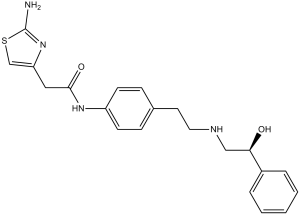
Mirabegron (YM178)

别名: YM 178; Mirabegron; Myrbetriq; YM-178; YM178; Betanis; Betmiga 米拉贝隆;2-氨基-n-[4-[2-[[(2r)-2-羟基-2-苯基乙基]氨基]乙基]苯基]-4-噻唑乙酰胺; 米拉贝隆Mirabegron;米拉贝隆标准品;米拉贝隆原药;米拉贝隆杂质
目录号: V1098 纯度: =99.39%
Mirabegron(原名 YM-178;YM178;Myrbetriq;Betanis;Betmiga)是一种有效的选择性 β3-肾上腺素受体激动剂,与抗毒蕈碱药物具有相似的作用。
Mirabegron (YM178) CAS号: 223673-61-8
产品类别: Adrenergic Receptor
产品仅用于科学研究,不针对患者销售
规格 价格 库存 数量
10 mM * 1 mL in DMSO
1mg
5mg
10mg
25mg
50mg
100mg
250mg
500mg
1g
Other Sizes

Other Forms of Mirabegron (YM178):

  • 米拉贝龙D5
点击了解更多
InvivoChem产品被CNS等顶刊论文引用
纯度/质量控制文件

纯度: ≥98%

纯度: =99.39%

产品描述
Mirabegron(以前称为 YM-178;YM178;Myrbetriq;Betanis;Betmiga)是一种有效的选择性 β3-肾上腺素受体激动剂,与抗毒蕈碱药物具有相似的作用。它激活 β3-肾上腺素受体,EC50 为 22.4 nM。米拉贝隆是一种已批准用于治疗膀胱过度活动症的药物。米拉贝隆激活膀胱逼尿肌中的 β3 肾上腺素能受体,从而导致肌肉松弛和膀胱容量增加。
生物活性&实验参考方法
靶点
β3-adrenoceptor ( EC50 = 22.4 nM )
β3-adrenoceptor (EC50 = 24 nM for cAMP accumulation; Ki = 7.4 nM for radioligand binding) [1]
体外研究 (In Vitro)
米拉贝隆浓度依赖性地增加表达人 3-肾上腺素受体 (AR) 的 CHO 细胞中 cAMP 的积累,IA 为 0.8。米拉贝隆对 1- 和 2-AR 几乎没有激动作用。 Mirabegron 浓度依赖性地松弛用 10-6 M 或 10-7 M 卡巴胆碱预收缩的大鼠和人膀胱平滑肌条,EC50 值分别为 5.1 μM 和 0.78 μM。米拉贝隆的最大松弛作用分别是卡巴胆碱的 94.0% 和 89.4%。 Mirabegron 是一种在 NADPH 存在下的 CYP2D6 时间依赖性抑制剂,预孵育 30 分钟后,人肝微粒体中的 IC50 值从 13 μM 降至 4.3 μM。米拉贝隆部分充当 CYP2D6 的不可逆或准不可逆代谢依赖性抑制剂,细胞测定:将 CHO 细胞 (105) 接种到 24 孔培养板的每个孔中并传代培养。三天后,将培养基更换为 250 μL/孔 Hanks 平衡盐溶液,其中含有 0.1 mM 3-异丁基-1-甲基黄嘌呤,pH 7.4。将细胞与每种化合物(终浓度为 10-10 至 10-4 M 的异丙肾上腺素、米拉贝隆、BRL37344 和 CL316,243)在 37°C 下孵育 10 分钟,然后添加 250 μL 停止孵育0.2 M HCl。反应混合物中的cAMP浓度通过使用γ计数器的125I-cAMP测定系统的放射免疫测定来测量。将 50 微升反应混合物与 50 μL 琥珀酰试剂在室温下孵育 10 分钟,然后通过添加 400 μL 缓冲溶液终止反应。将 50 微升琥珀酰化样品与 50 μL 125I-cAMP 和 50 μL 抗 cAMP 抗体在 4°C 下孵育 24 小时。孵育期结束时,添加 250 μL 木炭悬浮液,并在 4°C 下以 2800g 离心 10 分钟。将 250 微升上清液转移至试管中并使用伽玛计数器计数 1 分钟。使用每种化合物的最大反应计算每种 β-肾上腺素受体激动剂相对于异丙肾上腺素的内在活性 (IA)。
米拉贝隆(Mirabegron,YM178)是一种选择性β3-肾上腺素受体激动剂,对膀胱平滑肌具有强效活性。在分离的大鼠膀胱条中,它以浓度依赖方式舒张卡巴胆碱预收缩的肌肉,EC50为31 nM。1 μM时最大舒张率约为85%,该效应可被β3-肾上腺素受体拮抗剂L-748,337阻断[1]
它对β3-肾上腺素受体具有高选择性,在cAMP积累实验中对β1(EC50 > 10 μM)和β2(EC50 > 10 μM)肾上腺素受体无显著活性。放射性配体结合研究中,对β1(Ki = 1200 nM)和β2(Ki = 890 nM)受体的亲和力极低[1]
在培养的大鼠膀胱平滑肌细胞中,米拉贝隆(Mirabegron,YM178)(10-1000 nM)剂量依赖升高细胞内cAMP水平,1 μM时最大升高3.8倍,证实其介导β3-肾上腺素受体信号传导[1]
体内研究 (In Vivo)
米拉贝隆在麻醉大鼠中产生剂量依赖性的节律性膀胱收缩频率降低。 3 mg/kg iv 米拉贝隆可将频率抑制至 2 次/10 分钟。米拉贝隆不会降低膀胱节律收缩的幅度。米拉贝隆降低大鼠初级膀胱传入活动和膀胱微收缩。 Mirabegron(0.3 和 1 mg/kg)抑制 Aδ 纤维响应膀胱充盈的机械敏感单单位传入活动 (SAA)。 C 纤维的 SAA 仅在 1 mg/kg 米拉贝隆治疗时下降。米拉贝隆给药可抑制膀胱等容状态下的平均膀胱压力和微收缩次数。米拉贝隆可有效促进膀胱储存。米拉贝隆剂量依赖性地降低静息膀胱内压。米拉贝隆剂量依赖性地降低非排尿性收缩的频率,被认为是膀胱储存异常反应的指标。米拉贝隆对非排尿收缩幅度、排尿压力、阈压、排尿量、残余量或膀胱容量没有显着影响。
在麻醉大鼠中,静脉注射米拉贝隆(Mirabegron,YM178)(0.1-1 mg/kg)剂量依赖增加膀胱容量和排尿量。1 mg/kg剂量时,膀胱容量较溶媒组增加约40%,排尿量增加约45%,且对心率和血压无显著影响[1]
在部分膀胱出口梗阻(PBOO,过度活跃膀胱模型)的清醒大鼠中,口服米拉贝隆(Mirabegron,YM178)(3-30 mg/kg)改善膀胱功能。30 mg/kg剂量时,排尿频率减少约30%,平均排尿量增加约35%,逆转梗阻诱导的膀胱过度活动[1]
酶活实验
我们评价了(R)-2-(2-氨基噻唑-4-基)-4′-{2-[(2-羟基-2-苯乙基)氨基]-乙基}乙酰苯胺(YM178)的药理特性。YM178增加了表达人β3-肾上腺素受体(AR)的中国仓鼠卵巢(CHO)细胞中环状AMP的积累。半数最大有效浓度(EC50)值为22.4nM。YM178对人β1-和β2-AR的EC50值分别为10000 nM或更高。YM178的内在活性与异丙肾上腺素(非选择性β-AR激动剂)诱导的最大反应之比,对于人β3-AR为0.8,对于人α1-AR为0.1,对于人γ2-AR为0.1。[1]
β3-肾上腺素受体放射性配体结合实验:从表达人β3-肾上腺素受体的中国仓鼠卵巢(CHO)细胞制备膜匀浆,将匀浆与[3H]-CGP12177(非选择性β-肾上腺素受体配体)和不同浓度的米拉贝隆(Mirabegron,YM178)(0.1-1000 nM)在25°C孵育60分钟。通过玻璃纤维滤膜快速过滤分离结合态和游离态配体,用冰浴缓冲液洗涤滤膜后,通过闪烁计数器测定放射性强度,基于竞争结合曲线计算Ki值[1]
cAMP积累实验:将表达人β3、β1或β2肾上腺素受体的CHO细胞接种到96孔板培养至汇合,在磷酸二酯酶抑制剂存在下,用米拉贝隆(Mirabegron,YM178)(0.01-100 μM)处理细胞30分钟。裂解细胞后,采用竞争性酶免疫测定法检测cAMP水平,计算各受体亚型的EC50值[1]
细胞实验
在 24 孔培养板的每个孔中,放置 10 5 CHO 细胞并使其生长。三天后,将含有 0.1 mM 3-异丁基-1-甲基黄嘌呤的 pH 7.4 Hanks 平衡盐溶液添加到培养基的每个孔中。在 37°C 下将细胞暴露于每种化合物(异丙肾上腺素、米拉贝隆、BRL37344 和 CL316,243)10 分钟后,添加 250 μL 0.2 M HCl 以结束细胞的孵育。化合物的添加终浓度为 10 -10 至 10 - M。通过使用 125 I-cAMP 测定系统和 γ 射线进行放射免疫测定计数器,测定反应混合物中cAMP的浓度。将50微升反应混合物和50μL琥珀酰试剂在室温下孵育10分钟后,加入400μL缓冲溶液终止反应。将 50 微升琥珀酰化样品与 50 μL 125 I-cAMP 和 50 μL 抗 cAMP 抗体在 4°C 下孵育 24 小时。孵育期结束后,加入 250 μL 木炭悬浮液,并在 4°C 下以 2800g 离心 10 分钟。将 250 微升上清液转移到试管中后,使用伽马计数器计数一分钟。每种化合物的最大反应用于计算每种 β-肾上腺素受体激动剂相对于异丙肾上腺素的固有活性 (IA)。
膀胱平滑肌细胞cAMP实验:从成年大鼠分离膀胱平滑肌细胞,接种到24孔板中,用杜氏改良 Eagle 培养基培养5-7天。血清饥饿细胞24小时后,用米拉贝隆(Mirabegron,YM178)(10-1000 nM)处理20分钟。加入裂解缓冲液收集细胞,使用荧光检测试剂盒测定cAMP浓度[1]
膀胱条舒张实验:从大鼠分离膀胱组织,切成纵向肌条(2-3 mm宽),置于含含氧克雷布斯-林格溶液的器官浴中,维持37°C。用卡巴胆碱(1 μM)预收缩肌肉至稳定状态,累积加入米拉贝隆(Mirabegron,YM178)(0.1-1000 nM),通过等长换能器记录张力变化,计算相对于预收缩幅度的舒张百分比[1]
动物实验
本研究采用Wistar大鼠,包括雄性(350–400 g)和雌性(225–290 g)。研究中,米拉贝隆的游离剂量分别为0.03、0.1、0.3、1和3 mg/kg,奥昔布宁的游离剂量分别为0.0272、0.0907、0.272、0.907和2.72 mg/kg。
大鼠
麻醉大鼠膀胱功能研究:成年雄性大鼠麻醉后,植入经尿道导管用于膀胱充盈和压力记录,并植入颈静脉导管用于给药。待大鼠状态稳定后,将米拉贝隆(YM178)溶于生理盐水中,并以0.1、0.3或1 mg/kg的剂量进行静脉注射。给药后60分钟内记录膀胱容量、排尿量和排尿压力[1]
部分膀胱出口梗阻(PBOO)大鼠模型:成年雄性大鼠麻醉后,部分结扎尿道以诱导膀胱出口梗阻。术后两周,将大鼠随机分为溶剂组和治疗组。米拉贝隆(YM178)悬浮于0.5%羧甲基纤维素溶液中,每日一次口服给药,剂量分别为3、10或30 mg/kg,连续7天。将清醒的大鼠置于代谢笼中,记录24小时内的排尿频率和排尿量[1]
药代性质 (ADME/PK)
吸收、分布和排泄
口服米拉贝隆的绝对生物利用度在25 mg剂量时为29%,在50 mg剂量时为35%。缓释片和混悬剂的达峰时间(Tmax)约为3.5小时,而颗粒剂的Tmax为4-5小时。Cmax和AUC的增加幅度均大于剂量的增加幅度——剂量从50 mg增加到100 mg,Cmax和AUC分别增加2.9倍和2.6倍;而剂量从50 mg增加到200 mg,Cmax和AUC分别增加8.4倍和6.5倍。每日一次给药约7天后,米拉贝隆可达到稳态血药浓度。
健康志愿者服用160毫克放射性标记米拉贝隆后,约55%的放射性物质从尿液中回收,34%从粪便中回收。约25%的未代谢米拉贝隆从尿液中回收,而粪便中未回收。米拉贝隆主要通过肾小管主动分泌清除,肾小球滤过也起到一定作用。
静脉给药后,米拉贝隆的表观稳态分布容积 (Vd) 为 1670 L,表明其分布广泛。
静脉给药后的总血浆清除率约为 57 L/h,其中肾脏清除率约占 25%,约为 13 L/h。
代谢/代谢物
米拉贝隆可通过多种机制广泛代谢,但口服给药后,原药仍是主要的循环成分。推测的代谢途径及其代谢产物包括酰胺水解(M5、M16、M17)、葡萄糖醛酸化(米拉贝隆 O-葡萄糖醛酸苷、N-葡萄糖醛酸苷、N-氨甲酰葡萄糖醛酸苷、M12)以及仲胺氧化或脱烷基化(M8、M9、M15)等。负责米拉贝隆氧化代谢的酶被认为是CYP3A4和CYP2D6,而负责结合反应的UDP-葡萄糖醛酸转移酶已被鉴定为UGT2B7、UGT1A3和UGT1A8。其他可能参与米拉贝隆代谢的酶包括丁基胆碱酯酶和可能的醇脱氢酶。
生物半衰期
成人患者接受米拉贝隆治疗膀胱过度活动症的平均终末消除半衰期约为50小时。儿童患者接受颗粒剂治疗神经源性逼尿肌过度活动症时,平均终末消除半衰期约为26-31小时。
毒性/毒理 (Toxicokinetics/TK)
肝毒性
在预注册临床试验中,接受米拉贝隆治疗的患者血清转氨酶升高并不常见且程度较轻,血清酶升高的发生率与安慰剂组相似。在数千名接受治疗的患者中,未发生临床上明显的肝损伤。自米拉贝隆获批并广泛应用以来,尚未有已发表的关于其引起肝毒性的报告。然而,米拉贝隆的产品说明书中提到,治疗过程中偶有ALT和AST升高,以及一例伴有转氨酶升高的Stevens-Johnson综合征病例。因此,米拉贝隆可能作为全身性超敏反应的一部分引起肝损伤。
可能性评分:E(未经证实但怀疑是临床上明显的肝损伤的罕见原因)。
妊娠和哺乳期影响
◉ 哺乳期用药概述
目前尚无米拉贝隆在哺乳期使用的信息。由于其蛋白结合率中等偏高且生物利用度相对较低,母乳喂养的婴儿接触到的药物量可能较低。如果母亲需要服用米拉贝隆,这并非停止母乳喂养的理由,但在获得更多数据之前,尤其是在哺乳新生儿或早产儿期间,可能更倾向于选择其他药物。
◉ 对母乳喂养婴儿的影响
截至修订日期,未找到相关的已发表信息。
◉ 对泌乳和母乳的影响
截至修订日期,未找到相关的已发表信息。
蛋白结合
米拉贝隆在血浆中的蛋白结合率约为71%,主要与白蛋白和α-1-酸性糖蛋白结合。
大鼠急性静脉毒性研究显示,剂量高达10 mg/kg时未出现死亡[1]。
在麻醉状态下,治疗剂量(0.1-1 mg/kg,静脉注射)下未观察到心率、收缩压/舒张压或心电图参数的显著变化。大鼠[1]
米拉贝隆(YM178)在大鼠体内的血浆蛋白结合率约为71%[1]
参考文献

[1]. Effect of (R)-2-(2-aminothiazol-4-yl)-4'-{2-[(2-hydroxy-2-phenylethyl)amino]ethyl} acetanilide (YM178), a novel selective beta3-adrenoceptor agonist, on bladder function. J Pharmacol Exp Ther. 2007 May;321(2):642-7.

其他信息
米拉贝隆是一种单羧酸酰胺,由2-氨基-1,3-噻唑-4-基乙酸的羧基与(1R)-2-{[2-(4-氨基苯基)乙基]氨基}-1-苯基乙醇的苯胺基缩合而成。用于治疗膀胱过度活动症。它是一种β-肾上腺素能激动剂。它属于1,3-噻唑类化合物、芳香酰胺类化合物、乙醇胺类化合物和单羧酸酰胺类化合物。
米拉贝隆是一种拟交感神经β3肾上腺素能受体激动剂,用于松弛膀胱平滑肌,治疗尿频和尿失禁。米拉贝隆在治疗膀胱过度活动症的众多药物中独树一帜,与其他药物(如索利那新和达非那新)不同,它缺乏显著的抗胆碱能活性。抗胆碱能活性既是这些药物发挥疗效的原因,也是其产生广泛不良反应的原因。与其他现有治疗方案相比,米拉贝隆的不良反应谱相对较好,并且其作用机制与之前的抗胆碱能药物互补,因此可以与索利那新联合用于难治性病例。米拉贝隆于2012年首次获得美国食品药品监督管理局(FDA)批准,商品名为Myrbetriq,用于治疗成人膀胱过度活动症。随后,其缓释颗粒剂型于2021年3月获批,用于治疗儿童神经源性逼尿肌过度活动症。米拉贝隆也在全球其他地区使用,包括加拿大、欧盟和日本。米拉贝隆是一种β3-肾上腺素能激动剂。米拉贝隆的作用机制是作为β3肾上腺素能受体激动剂、细胞色素P450 2D6抑制剂、细胞色素P450 3A抑制剂和P-糖蛋白抑制剂。
米拉贝隆是一种β3肾上腺素能受体激动剂,用于治疗膀胱过度活动症。米拉贝隆不会引起肝酶升高或临床上明显的急性肝损伤。
米拉贝隆是一种口服生物利用度高的β3肾上腺素能受体(ADRB3)激动剂,具有肌肉松弛、神经保护和潜在的抗肿瘤活性。口服后,米拉贝隆与ADRB3结合并激活它,从而导致平滑肌松弛。米拉贝隆还能恢复间充质干细胞 (MSC) 微环境中的交感神经刺激,抑制 JAK2 突变的造血干细胞 (HSC) 的扩增,并阻断骨髓增生性肿瘤 (MPN) 的进展。MSC 和 HSC 微环境交感神经刺激的缺乏与 MPN 的发生发展密切相关。
药物适应症
米拉贝隆适用于治疗膀胱过度活动症 (OAB),其症状包括尿急、尿频和急迫性尿失禁,可单独使用或与索利那新联合使用。它也适用于治疗 3 岁及以上、体重 35 公斤及以上的儿童患者的神经源性逼尿肌过度活动症 (NDO)。
缓解尿急症状。成人膀胱过度活动症患者可能出现排尿次数增多和/或急迫性尿失禁。
治疗神经源性逼尿肌过度活动症
治疗特发性膀胱过度活动症
作用机制
米拉贝隆是一种强效且选择性的β3肾上腺素能受体激动剂。β3受体的激活可使膀胱充盈-排尿周期储尿期逼尿肌平滑肌松弛,从而增加膀胱容量,缓解尿急和尿频。
药效学
米拉贝隆通过促使膀胱平滑肌松弛发挥药理作用,从而扩大膀胱容量并缓解尿急。米拉贝隆似乎不会对下尿路症状和膀胱出口梗阻 (BOO) 患者的平均最大尿流率或最大尿流率时的平均逼尿肌压力产生不利影响,但由于有报道称其会导致明显的尿潴留,因此应谨慎用于 BOO 患者。此外,米拉贝隆会以剂量依赖的方式升高血压和心率,因此对于严重未控制的高血压患者或其他可能因血压和心率升高而面临危险的患者,应谨慎使用。
米拉贝隆 (YM178)是一种新型选择性β3-肾上腺素受体激动剂,用于治疗膀胱过度活动症[1]。
其作用机制是激活膀胱平滑肌中的β3-肾上腺素受体,从而提高细胞内cAMP水平,导致肌肉松弛、膀胱容量增加和排尿功能改善[1]。
它对β3-肾上腺素受体的选择性高于β1和β2亚型,从而最大限度地减少了与非选择性β-肾上腺素受体激动剂相关的心血管副作用(例如,心动过速、高血压)[1]。
在PBOO诱导的膀胱过度活动症模型中的临床前疗效支持其治疗膀胱功能障碍的潜力。由尿道梗阻或特发性膀胱过度活动症引起[1]
*注: 文献方法仅供参考, InvivoChem并未独立验证这些方法的准确性
化学信息 & 存储运输条件
分子式
C21H24N4O2S
分子量
396.51
精确质量
396.161
元素分析
C, 63.61; H, 6.10; N, 14.13; O, 8.07; S, 8.09
CAS号
223673-61-8
相关CAS号
(Rac)-Mirabegron-d5; 1215807-38-7
PubChem CID
9865528
外观&性状
White to light yellow solid powder
密度
1.3±0.1 g/cm3
沸点
690.0±55.0 °C at 760 mmHg
熔点
138-140°C
闪点
371.1±31.5 °C
蒸汽压
0.0±2.3 mmHg at 25°C
折射率
1.681
LogP
1.29
tPSA
128.51
氢键供体(HBD)数目
4
氢键受体(HBA)数目
6
可旋转键数目(RBC)
9
重原子数目
28
分子复杂度/Complexity
467
定义原子立体中心数目
1
SMILES
S1C(N([H])[H])=NC(=C1[H])C([H])([H])C(N([H])C1C([H])=C([H])C(=C([H])C=1[H])C([H])([H])C([H])([H])N([H])C([H])([H])[C@@]([H])(C1C([H])=C([H])C([H])=C([H])C=1[H])O[H])=O
InChi Key
PBAPPPCECJKMCM-IBGZPJMESA-N
InChi Code
InChI=1S/C21H24N4O2S/c22-21-25-18(14-28-21)12-20(27)24-17-8-6-15(7-9-17)10-11-23-13-19(26)16-4-2-1-3-5-16/h1-9,14,19,23,26H,10-13H2,(H2,22,25)(H,24,27)/t19-/m0/s1
化学名
2-(2-amino-1,3-thiazol-4-yl)-N-[4-[2-[[(2R)-2-hydroxy-2-phenylethyl]amino]ethyl]phenyl]acetamide
别名
YM 178; Mirabegron; Myrbetriq; YM-178; YM178; Betanis; Betmiga
HS Tariff Code
2934.99.9001
存储方式

Powder      -20°C    3 years

                     4°C     2 years

In solvent   -80°C    6 months

                  -20°C    1 month

运输条件
Room temperature (This product is stable at ambient temperature for a few days during ordinary shipping and time spent in Customs)
溶解度数据
溶解度 (体外实验)
DMSO: 79~100 mg/mL (199.2~252.2 mM)
Water: <1 mg/mL
Ethanol: ~8 mg/mL (~20.2 mM)
溶解度 (体内实验)
配方 1 中的溶解度: ≥ 2.08 mg/mL (5.25 mM) (饱和度未知) in 10% DMSO + 40% PEG300 + 5% Tween80 + 45% Saline (这些助溶剂从左到右依次添加,逐一添加), 澄清溶液。
例如,若需制备1 mL的工作液,可将100 μL 20.8 mg/mL澄清DMSO储备液加入400 μL PEG300中,混匀;然后向上述溶液中加入50 μL Tween-80,混匀;加入450 μL生理盐水定容至1 mL。
*生理盐水的制备:将 0.9 g 氯化钠溶解在 100 mL ddH₂O中,得到澄清溶液。

配方 2 中的溶解度: ≥ 2.08 mg/mL (5.25 mM) (饱和度未知) in 10% DMSO + 90% (20% SBE-β-CD in Saline) (这些助溶剂从左到右依次添加,逐一添加), 澄清溶液。
例如,若需制备1 mL的工作液,可将 100 μL 20.8 mg/mL澄清DMSO储备液加入900 μL 20% SBE-β-CD生理盐水溶液中,混匀。
*20% SBE-β-CD 生理盐水溶液的制备(4°C,1 周):将 2 g SBE-β-CD 溶解于 10 mL 生理盐水中,得到澄清溶液。

View More

配方 3 中的溶解度: ≥ 2.08 mg/mL (5.25 mM) (饱和度未知) in 10% DMSO + 90% Corn Oil (这些助溶剂从左到右依次添加,逐一添加), 澄清溶液。
例如,若需制备1 mL的工作液,可将 100 μL 20.8 mg/mL 澄清 DMSO 储备液添加到 900 μL 玉米油中并混合均匀。


配方 4 中的溶解度:

Mirabegron (10 mg/ml) dissolved in DMSO (50%, vol%) and polyethylene glycol (50%, vol%)


请根据您的实验动物和给药方式选择适当的溶解配方/方案:
1、请先配制澄清的储备液(如:用DMSO配置50 或 100 mg/mL母液(储备液));
2、取适量母液,按从左到右的顺序依次添加助溶剂,澄清后再加入下一助溶剂。以 下列配方为例说明 (注意此配方只用于说明,并不一定代表此产品 的实际溶解配方):
10% DMSO → 40% PEG300 → 5% Tween-80 → 45% ddH2O (或 saline);
假设最终工作液的体积为 1 mL, 浓度为5 mg/mL: 取 100 μL 50 mg/mL 的澄清 DMSO 储备液加到 400 μL PEG300 中,混合均匀/澄清;向上述体系中加入50 μL Tween-80,混合均匀/澄清;然后继续加入450 μL ddH2O (或 saline)定容至 1 mL;

3、溶剂前显示的百分比是指该溶剂在最终溶液/工作液中的体积所占比例;
4、 如产品在配制过程中出现沉淀/析出,可通过加热(≤50℃)或超声的方式助溶;
5、为保证最佳实验结果,工作液请现配现用!
6、如不确定怎么将母液配置成体内动物实验的工作液,请查看说明书或联系我们;
7、 以上所有助溶剂都可在 Invivochem.cn网站购买。
制备储备液 1 mg 5 mg 10 mg
1 mM 2.5220 mL 12.6100 mL 25.2200 mL
5 mM 0.5044 mL 2.5220 mL 5.0440 mL
10 mM 0.2522 mL 1.2610 mL 2.5220 mL

1、根据实验需要选择合适的溶剂配制储备液 (母液):对于大多数产品,InvivoChem推荐用DMSO配置母液 (比如:5、10、20mM或者10、20、50 mg/mL浓度),个别水溶性高的产品可直接溶于水。产品在DMSO 、水或其他溶剂中的具体溶解度详见上”溶解度 (体外)”部分;

2、如果您找不到您想要的溶解度信息,或者很难将产品溶解在溶液中,请联系我们;

3、建议使用下列计算器进行相关计算(摩尔浓度计算器、稀释计算器、分子量计算器、重组计算器等);

4、母液配好之后,将其分装到常规用量,并储存在-20°C或-80°C,尽量减少反复冻融循环。

计算器

摩尔浓度计算器可计算特定溶液所需的质量、体积/浓度,具体如下:

  • 计算制备已知体积和浓度的溶液所需的化合物的质量
  • 计算将已知质量的化合物溶解到所需浓度所需的溶液体积
  • 计算特定体积中已知质量的化合物产生的溶液的浓度
使用摩尔浓度计算器计算摩尔浓度的示例如下所示:
假如化合物的分子量为350.26 g/mol,在5mL DMSO中制备10mM储备液所需的化合物的质量是多少?
  • 在分子量(MW)框中输入350.26
  • 在“浓度”框中输入10,然后选择正确的单位(mM)
  • 在“体积”框中输入5,然后选择正确的单位(mL)
  • 单击“计算”按钮
  • 答案17.513 mg出现在“质量”框中。以类似的方式,您可以计算体积和浓度。

稀释计算器可计算如何稀释已知浓度的储备液。例如,可以输入C1、C2和V2来计算V1,具体如下:

制备25毫升25μM溶液需要多少体积的10 mM储备溶液?
使用方程式C1V1=C2V2,其中C1=10mM,C2=25μM,V2=25 ml,V1未知:
  • 在C1框中输入10,然后选择正确的单位(mM)
  • 在C2框中输入25,然后选择正确的单位(μM)
  • 在V2框中输入25,然后选择正确的单位(mL)
  • 单击“计算”按钮
  • 答案62.5μL(0.1 ml)出现在V1框中
g/mol

分子量计算器可计算化合物的分子量 (摩尔质量)和元素组成,具体如下:

注:化学分子式大小写敏感:C12H18N3O4  c12h18n3o4
计算化合物摩尔质量(分子量)的说明:
  • 要计算化合物的分子量 (摩尔质量),请输入化学/分子式,然后单击“计算”按钮。
分子质量、分子量、摩尔质量和摩尔量的定义:
  • 分子质量(或分子量)是一种物质的一个分子的质量,用统一的原子质量单位(u)表示。(1u等于碳-12中一个原子质量的1/12)
  • 摩尔质量(摩尔重量)是一摩尔物质的质量,以g/mol表示。
/

配液计算器可计算将特定质量的产品配成特定浓度所需的溶剂体积 (配液体积)

  • 输入试剂的质量、所需的配液浓度以及正确的单位
  • 单击“计算”按钮
  • 答案显示在体积框中
动物体内实验配方计算器(澄清溶液)
第一步:请输入基本实验信息(考虑到实验过程中的损耗,建议多配一只动物的药量)
第二步:请输入动物体内配方组成(配方适用于不溶/难溶于水的化合物),不同的产品和批次配方组成不同,如对配方有疑问,可先联系我们提供正确的体内实验配方。此外,请注意这只是一个配方计算器,而不是特定产品的确切配方。
+
+
+

计算结果:

工作液浓度 mg/mL;

DMSO母液配制方法 mg 药物溶于 μL DMSO溶液(母液浓度 mg/mL)。如该浓度超过该批次药物DMSO溶解度,请首先与我们联系。

体内配方配制方法μL DMSO母液,加入 μL PEG300,混匀澄清后加入μL Tween 80,混匀澄清后加入 μL ddH2O,混匀澄清。

(1) 请确保溶液澄清之后,再加入下一种溶剂 (助溶剂) 。可利用涡旋、超声或水浴加热等方法助溶;
            (2) 一定要按顺序加入溶剂 (助溶剂) 。

临床试验信息
The Physiological Responses and Adaptation of Brown Adipose Tissue to Chronic Treatment With Beta3-Adrenergic Receptor Agonists
CTID: NCT03049462
Phase: Phase 1    Status: Recruiting
Date: 2024-12-02
Trial of the Combination of Alpha-Lipoic Acid and Mirabegron in Women and in Men With Obesity
CTID: NCT05713799
Phase: Phase 2    Status: Not yet recruiting
Date: 2024-12-02
Study to Evaluate the Efficacy, Safety, and Tolerability of Mirabegron in Older Adult Subjects With Overactive Bladder (OAB)
CTID: NCT02216214
Phase: Phase 4    Status: Completed
Date: 2024-11-22
A Study to Evaluate the Efficacy and Safety of Mirabegron Compared to Solifenacin in Patients With Overactive Bladder Who Were Previously Treated With Another Medicine But Were Not Satisfied With That Treatment.
CTID: NCT01638000
Phase: Phase 3    Status: Completed
Date: 2024-11-21
A Study to Test the Efficacy and Safety of the Beta-3 Agonist Mirabegron (YM178) in Patients With Symptoms of Overactive Bladder
CTID: NCT00912964
Phase: Phase 3    Status: Completed
Date: 2024-11-21
View More

Study to Test the Long Term Safety and Efficacy of the Beta-3 Agonist Mirabegron (YM178) in Patients With Symptoms of Overactive Bladder
CTID: NCT00688688
Phase: Phase 3    Status: Completed
Date: 2024-11-20


Study to Assess the Efficacy and Safety of the Beta-3 Agonist Mirabegron (YM178) in Patients With Symptoms of Overactive Bladder
CTID: NCT00689104
Phase: Phase 3    Status: Completed
Date: 2024-11-20
A Study to Assess Efficacy and Safety of the Beta-3 Agonist Mirabegron (YM178) in Patients With Symptoms of Overactive Bladder
CTID: NCT00662909
Phase: Phase 3    Status: Completed
Date: 2024-11-20
A Study With Mirabegron 50 mg and 25 mg in Chinese Participants With Overactive Bladder
CTID: NCT04562090
Phase: Phase 4    Status: Completed
Date: 2024-11-15
A Study to Evaluate Mirabegron in Pediatric Participants From 5 to Less Than 18 Years of Age With Overactive Bladder (OAB)
CTID: NCT04641975
Phase: Phase 3    Status: Terminated
Date: 2024-11-14
A Study to Evaluate the Efficacy, Safety, and Tolerability of Mirabegron in Men With OAB Symptoms While Taking Tamsulosin Hydrochloride for Lower Urinary Tract Symptoms (LUTS) Due to Benign Prostatic Hyperplasia (BPH)
CTID: NCT02757768
Phase: Phase 4    Status: Completed
Date: 2024-11-12
A Study to Investigate the Effect of Food With Mirabegron in Healthy Chinese Participants
CTID: NCT04501640
Phase: Phase 4    Status: Completed
Date: 2024-11-12
A Phase 4 Study to Evaluate the Efficacy, Safety, and Tolerability of Mirabegron in Male Subjects With Overactive Bladder (OAB) Symptoms, While Taking the Alpha Blocker for Benign Prostatic Hypertrophy (BPH)
CTID: NCT02656173
Phase: Phase 4    Status: Completed
Date: 2024-11-12
Open-label Phase 3 Study With Mirabegron in Children From 3 to Less Than 18 Years of Age With Neurogenic Detrusor Overactivity
CTID: NCT02751931
Phase: Phase 3    Status: Completed
Date: 2024-11-12
A Study to Learn How Effective and Safe the Drug 'Mirabegron' is and How Long it Stays in the Body of Children Aged 6 Months to Less Than 3 Years of Age With Neurogenic Detrusor Overactivity
CTID: NCT05621616
Phase: Phase 3    Status: Recruiting
Date: 2024-11-08
The Effects of Mirabegron and Tadalafil on Glucose Tolerance in Prediabetics
CTID: NCT05051436
Phase: Phase 4    Status: Recruiting
Date: 2024-11-04
A Study to Evaluate the Pharmacokinetics, Safety and Tolerability of Mirabegron Oral Suspension in Pediatric Subjects From 3 to Less Than 12 Years of Age With Neurogenic Detrusor Overactivity (NDO) or Overactive Bladder (OAB)
CTID: NCT02526979
Phase: Phase 1    Status: Completed
Date: 2024-10-31
A Study to Evaluate Safety and Efficacy of YM178 in Patients With Overactive Bladder
CTID: NCT00966004
Phase: Phase 3    Status: Completed
Date: 2024-10-31
A Trial Comparing Combination Treatment (Solifenacin Plus Mirabegron) With One Treatment Alone (Solifenacin)
CTID: NCT01908829
Phase: Phase 3    Status: Completed
Date: 2024-10-31
A Study of YM178 in Subjects With Symptoms of Overactive Bladder
CTID: NCT01043666
Phase: Phase 3    Status: Completed
Date: 2024-10-31
Postmarketing Study to Evaluate add-on Therapy With Anticholinergics in Patients With Overactive Bladder (OAB) on Mirabegron.
CTID: NCT02294396
Phase: Phase 4    Status: Completed
Date: 2024-10-31
A Study of YM178 in Patients With Symptomatic Overactive Bladder
CTID: NCT00527033
Phase: Phase 2    Status: Completed
Date: 2024-10-31
A Multinational Study Comparing the Long-term Efficacy and Safety of Two Medicines, Solifenacin Succinate and Mirabegron Taken Together, or Separately, in Subjects With Symptoms of Overactive Bladder
CTID: NCT02045862
Phase: Phase 3    Status: Completed
Date: 2024-10-31
A Study to Evaluate the Efficacy, Safety and Tolerability of Mirabegron and Solifenacin Succinate Alone and in Combination for the Treatment of Overactive Bladder
CTID: NCT01340027
Phase: Phase 2    Status: Completed
Date: 2024-10-31
This Was a Multinational Study Comparing the Efficacy and Safety of Two Medicines , Solifenacin Succinate and Mirabegron Taken Together, or Separately, or a Mock Treatment (Placebo) in Subjects With S
The effect of Mirabegron on brown adipose tissue in healthy young white Caucasian and South Asian men
CTID: null
Phase: Phase 4    Status: Completed
Date: 2016-04-20
An Open-label, Baseline-controlled, Multicenter, Phase 3 Dose-titration Study Followed by a Fixed-dose Observation Period to Evaluate Efficacy, Safety and Pharmacokinetics of Mirabegron in Children and Adolescents From 3 to Less Than 18 Years of Age With Neurogenic Detrusor Overactivity (NDO) on Clean Intermittent Catheterization (CIC)
CTID: null
Phase: Phase 3    Status: Completed
Date: 2016-03-30
A multi-centre randomized, placebo-controlled trial of mirabegron, a new beta3-adrenergic receptor agonist on the progression of left ventricular mass and diastolic function in patients with structural heart disease.
CTID: null
Phase: Phase 2    Status: Completed
Date: 2016-03-14
A multicentre, open-label, single dose, phase 1 study to evaluate the pharmacokinetics, safety and tolerability of mirabegron oral suspension in pediatric subjects from 3 to less than 12 years of age with neurogenic detrusor overactivity (NDO) or overactive bladder (OAB)
CTID: null
Phase: Phase 1    Status: Completed
Date: 2015-09-23
A randomized, double blind, placebo controlled study to evaluate the efficacy and safety of mirabegron 50 mg versus placebo in patients with neurogenic detrusor overactivity
CTID: null
Phase: Phase 3    Status: Completed
Date: 2015-04-17
A Phase 1, Single Dose, 4-Period Crossover Study to Assess the Bioavailability of an Mirabegron Oral Suspension Relative to the Mirabegron Prolonged Release Tablet and to Assess the Effect of Food on the Pharmacokinetics of Mirabegron Oral Suspension in Healthy Young Male and Female Subjects
CTID: null
Phase: Phase 1    Status: Completed
Date: 2014-10-09
A multicentre, open-label, single ascending dose Phase 1 study to evaluate the pharmacokinetics, safety and tolerability of mirabegron OCAS tablets in pediatric subjects from 5 to less than 18 years of age with neurogenic detrusor overactivity (NDO) or overactive bladder (OAB)
CTID: null
Phase: Phase 1    Status: Completed
Date: 2014-07-11
A Randomized, Double-Blind, Parallel-Group, Active-Controlled, Multi-center Study to Evaluate the Long-Term Safety and Efficacy of Combination of Solifenacin Succinate with Mirabegron Compared to Solifenacin Succinate and Mirabegron Monotherapy in Subjects with Overactive Bladder
CTID: null
Phase: Phase 3    Status: Completed
Date: 2014-07-08
A Randomized, Double-Blind, Parallel-Group, Placebo- and Active-Controlled, Multi-center Study to Evaluate the Efficacy, Safety and Tolerability of Combinations of Solifenacin Succinate and Mirabegron Compared to Solifenacin Succinate and Mirabegron Monotherapy in the Treatment of Overactive Bladder
CTID: null
Phase: Phase 3    Status: Completed
Date: 2013-11-12
A Randomized, Double-Blind, Multi-Centre Study to Evaluate the Efficacy and Safety of Adding Mirabegron to Solifenacin in Incontinent OAB Subjects who have Received Solifenacin for 4 Weeks and Warrant Additional Relief for their OAB Symptoms.
CTID: null
Phase: Phase 3    Status: Completed
Date: 2013-07-03
Beta 3 agonist treatment in heart failure
CTID: null
Phase: Phase 2    Status: Completed
Date: 2013-06-04
A Double-Blind, Randomized, Parallel Group, Multi-Centre Study to Evaluate the Efficacy and Safety of Mirabegron Compared to Solifenacin in Subjects with Overactive Bladder (OAB) Treated with Antimuscarinics and Dissatisfied due to Lack of Efficacy
CTID: null
Phase: Phase 3    Status: Completed
Date: 2012-04-05
A Randomized, Double-Blind, Factorial, Parallel-Group, Active and Placebo-Controlled, Multicenter Dose-Ranging Study to Evaluate the Efficacy, Safety and Tolerability of Six Dose Combinations of Solifenacin Succinate and Mirabegron Compared to Mirabegron and Solifenacin Succinate Monotherapies in the Treatment of Overactive Bladder.
CTID: null
Phase: Phase 2    Status: Completed
Date: 2011-03-23
A Phase III, Randomized, Double-Blind, Parallel Group, Placebo Controlled, Multicenter Study to Assess the Efficacy and Safety
CTID: null
Phase: Phase 3    Status: Completed
Date: 2009-06-03
A Randomized, Double-Blind, Parallel Group, Active Controlled, Multicenter Long-term Study to Assess the Safety and Efficacy of the Beta-3 Agonist YM178 (50 mg qd and 100 mg qd) in Subjects with Symptoms of Overactive Bladder
CTID: null
Phase: Phase 3    Status: Completed
Date: 2008-06-05
A Randomized, Double-blind, Parallel Group, Placebo and Active Controlled, Multicenter Study to Assess the Efficacy and Safety of the Beta-3 Agonist YM178 (50 mg qd and 100 mg qd) in Subjects with Symptoms of Overactive Bladder
CTID: null
Phase: Phase 3    Status: Completed
Date: 2008-06-05
A Randomized, Double-blind, Parallel Group, Placebo and Active Controlled, Multi-Center Dose Ranging Study with the Beta-3 AGONist YM178 in Patients with Symptomatic Overactive Bladder (DRAGON)
CTID: null
Phase: Phase 2    Status: Completed
Date: 2006-01-19
A Phase 3, Double blind, Randomized, Multicenter, Parallel Group, Placebo controlled Sequential Dose Titration Study to Evaluate Efficacy, Safety and Pharmacokinetics of Mirabegron in Pediatric Subjects from 5 to < 18 Years of Age with Overactive Bladder
CTID: null
Phase: Phase 3    Status: Completed
Date:
ONO-8577-02 Phase2a
CTID: jRCT2080223480
Phase:    Status:
Date: 2017-03-15
Comparison in the efficacy of the two add on therapies with an anticholinergic agent versus a beta3-adrenoceptor agonist for patients with benign prostatic enlargement complicated by overactive bladder after alpha1-blocker administration, A randomized, prospective trial using a urodynamic study
CTID: UMIN000026394
Phase: Phase IV    Status: Complete: follow-up complete
Date: 2017-03-10
A randomized controlled study of the efficacy of Tadalafil monotherapy versus combination of Tadalafil and mirabegron for the treatment of overactive bladder (OAB) associated with benign prostatic hyperplasia (BPH)
CTID: UMIN000025282
Phase:    Status: Complete: follow-up complete
Date: 2016-12-15
Comparison of fesoterodine and mirabegron in the treatment of female overactive baldder patients with urgency incontinence: A randomized, prospective study (Feminine study)
CTID: UMIN000024442
Phase: Phase IV    Status:
Date: 2016-11-01
Nocturia QOL evaluation in OAB patients treated with Oxybutinin & Mirabegron study
CTID: UMIN000024234
Phase:    Status: Recruiting
Date: 2016-10-01
The Efficacy of Mirabegron on Sleep Quality in Japanese patients with nocturia associated overactive bladder
CTID: UMIN000021297
PhaseNot applicable    Status: Complete: follow-up complete
Date: 2016-03-02
Examination the efficacy of Mirabegron on patient with overactive bladder after treatment with a1 blocker for benign prostatic hyperplasia
CTID: UMIN000019735
Phase:    Status: Complete: follow-up continuing
Date: 2015-11-10
The examination of the efficacy by adverse reaction changing the treatment with Oxybutynin or Mirabegron on the patient who cannot go on treatment with anticholinergic agent
CTID: UMIN000019736
Phase:    Status: Complete: follow-up continuing
Date: 2015-11-10
Efficacy and safety of Mirabegron for treatment OAB in the postmenopausal female patients -Evaluation using Pressure Flow Study
CTID: UMIN000019272
Phase: Phase IV    Status: Complete: follow-up complete
Date: 2015-10-08
Investigation on efficacy and safety of combination treatment with imidafenacin and mirabegron in patients with overactive bladder.
CTID: UMIN000016236
Phase:    Status: Complete: follow-up complete
Date: 2015-01-16
Effect of Mirabegron (beta 3-adrenergic receptor agonist) on overactive bladder patients : a functional brain imaging study
CTID: UMIN000014150
Phase:    Status: Complete: follow-up complete
Date: 2014-06-16
Safety and efficacy of mirabegron on nocturia and quality of sleep in Japanese patients with overactive bladder.
CTID: UMIN000012869
Phase: Phase IV    Status: Recruiting
Date: 2014-01-16
Comparison of efficacy and safety of the secondary treatment with increased fesoterodine and with mirabegron combination with 4mg fesoterodine for those who still have moderate or more overactive bladder symptoms after the initial treatment with 4mg fesoterodine: preliminary study
CTID: UMIN000011677
PhaseNot applicable    Status: Pending
Date: 2013-09-17
Comparison of efficacy and safety of the secondary treatment with increased fesoterodine and with mirabegron combination with 4mg fesoterodine for those who still have moderate or more overactive bladder symptoms after the initial treatment with 4mg fesoterodine: preliminary study
CTID: UMIN000011677
PhaseNot applicable    Status: Pending
Date: 2013-09-17
Investigation of availability of solifenacin succinate on effect insufficiency cases by b3 receptor agonist -Switching study from mirabegron to solifenacin-
CTID: UMIN000011620
Phase:    Status: Complete: follow-up complete
Date: 2013-09-02
Investigation of availability of solifenacin succinate on effect insufficiency cases by b3 receptor agonist -Switching study from mirabegron to solifenacin-
CTID: UMIN000011620
Phase:    Status: Complete: follow-up complete
Date: 2013-09-02
A randomized controlled trial for beta agonist on ulolithiasis patients associated with overactive bladder.
CTID: UMIN000010553
Phase: Phase II    Status: Pending
Date: 2013-05-01
Good combination therapy with alpha-blocker plus imidafenacin or mirabegron for nocturia in overactive bladder with benign prostatic hyperplasia; prospective randomized trial
CTID: UMIN000010327
PhaseNot applicable    Status: Recruiting
Date: 2013-03-27
Comparison of Mirabegron and Imidafenacin for efficacy and safety in Japanese female patients with overactive bladder: A randomized controlled trial (COMFORT Study).
CTID: UMIN000010321
Phase:    Status: Complete: follow-up complete
Date: 2013-03-26
Clinical efficacy and safety of a beta3-adrenoceptor agonist and an antimuscarinic agent in female patients with overactive overactive bladder: a randomized crossover study
CTID: UMIN000010060
PhaseNot applicable    Status: Complete: follow-up complete
Date: 2013-02-18
Evaluation of the usefulness of anti-cholinergic and B(Beta)3 agonist in patients with OAB.
CTID: UMIN000008863
Phase:    Status: Complete: follow-up complete
Date: 2012-10-01
a
CTID: UMIN000008484
Phase:    Status: Pending
Date: 2012-07-20

生物数据图片
  • Mirabegron
    cAMP accumulation in CHO cells expressing human β1-AR (A), β2-AR (B), and β3-AR (C).J Pharmacol Exp Ther.2007 May;321(2):642-7.
  • Mirabegron
    Relaxing effect of isoproterenol, YM178, and CGP-12177A in rat bladder strips precontracted with carbachol.J Pharmacol Exp Ther.2007 May;321(2):642-7.
  • Mirabegron
    Relaxing effect of isoproterenol, YM178, and CGP-12177A in human bladder strips precontracted with carbachol.J Pharmacol Exp Ther.2007 May;321(2):642-7.
相关产品
联系我们