| 规格 | 价格 | 库存 | 数量 |
|---|---|---|---|
| 50mg |
|
||
| 100mg |
|
||
| 250mg |
|
||
| 500mg |
|
||
| Other Sizes |
|

| 体外研究 (In Vitro) |
那他霉素是一种大环内酯类抗生素,对纳他链球菌、金孢链球菌、利迪链球菌和查塔诺链球菌有效。它通过抑制调节以及可能跨质膜的运输来抑制真菌生长。纳他霉素广泛应用于食品领域和作为局部用药的药物。纳他霉素的作用机制与其他多烯抗生素的不同之处在于它不依赖麦角醇来透化质膜。游霉素处理后酵母生长突然停止表明游霉素具有短暂的作用,最有可能在质膜水平上[1][2]。
|
|---|---|
| 药代性质 (ADME/PK) |
吸收、分布和排泄
局部用药后不应期望全身吸收,与其他多烯类抗生素一样,胃肠道的吸收非常差。 |
| 毒性/毒理 (Toxicokinetics/TK) |
妊娠和哺乳期的影响
◉ 哺乳期用药概述 目前尚无关于哺乳期使用那他霉素的临床信息。然而,其他多烯类抗生素很少分泌到母乳中,且婴儿吸收率低。虽然可能性不大,但眼部使用那他霉素可能会扰乱母乳喂养婴儿的胃肠道菌群。应监测婴儿胃肠道菌群可能受到的影响,例如腹泻。为了显著减少使用眼药水后进入母乳的药物量,可在眼角泪管处按压2至5分钟,然后用吸水纸巾吸去多余的药液。如果母亲需要使用那他霉素,这并非停止母乳喂养的理由。 ◉ 对母乳喂养婴儿的影响 截至修订日期,未找到相关的已发表信息。 ◉ 对哺乳和母乳的影响 截至修订日期,未找到相关的已发表信息。 |
| 参考文献 | |
| 其他信息 |
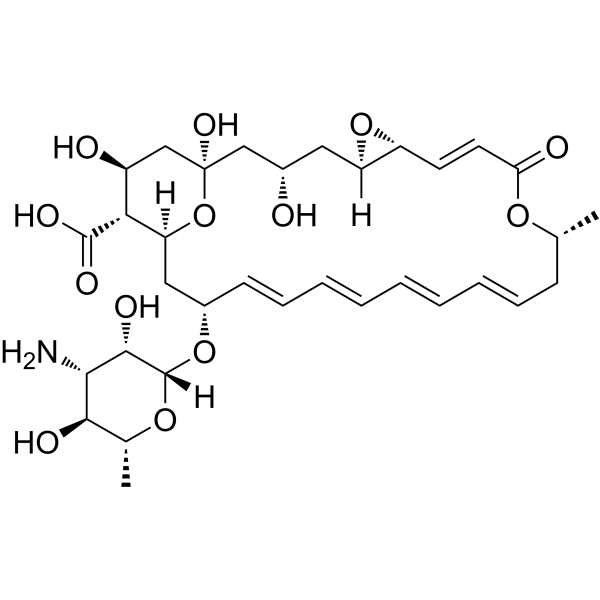
那他霉素是一种多烯类抗菌药物。
据报道,那他霉素存在于吉尔沃斯孢链霉菌(Streptomyces gilvosporeus)、链霉菌属(Streptomyces)以及其他有相关数据的微生物中。 那他霉素是一种具有抗真菌特性的多烯类两性大环内酯抗生素。那他霉素通过与真菌细胞膜中的甾醇结合,增加细胞膜的通透性,从而发挥其抗真菌作用。这会导致细胞必需成分的泄漏和丢失。眼用后,那他霉素滞留在结膜穹窿部,并在角膜基质中达到有效浓度,从而发挥作用。 那他霉素是一种来源于纳塔尔链霉菌(Streptomyces natalensis)或查塔努加链霉菌(S. chattanoogensis)的两性大环内酯类抗真菌抗生素。它用于治疗多种真菌感染,主要局部用药。 药物适应症 用于治疗由敏感菌(包括茄病镰刀菌)引起的真菌性睑缘炎、结膜炎和角膜炎。 作用机制 与其他多烯类抗生素一样,那他霉素通过与甾醇结合来抑制真菌生长。具体而言,那他霉素与质膜中的麦角甾醇结合,阻止麦角甾醇依赖的液泡融合以及膜融合和分裂。这与其他大多数多烯类抗生素的作用机制不同,后者通常通过改变真菌膜的通透性发挥作用。 药效学 那他霉素是一种用于眼部局部给药的抗真菌药物。它是一种四烯多烯类抗生素,来源于纳塔尔链霉菌。纳他霉素对多种酵母菌和丝状真菌具有体外活性,包括念珠菌属、曲霉属、头孢菌属、镰刀菌属和青霉属。虽然其抗真菌活性与剂量相关,但纳他霉素主要表现为杀菌作用。纳他霉素对革兰氏阳性菌或革兰氏阴性菌体外无效。局部用药似乎可在角膜基质内产生有效浓度的纳他霉素,但无法在眼内液中达到有效浓度。 |
| 分子式 |
C33H47NO13
|
|---|---|
| 分子量 |
665.7252
|
| 精确质量 |
665.304
|
| CAS号 |
7681-93-8
|
| PubChem CID |
5284447
|
| 外观&性状 |
Off-white to light yellow solid powder
|
| 密度 |
1.4±0.1 g/cm3
|
| 沸点 |
952.2±65.0 °C at 760 mmHg
|
| 熔点 |
2000ºC
|
| 闪点 |
529.7±34.3 °C
|
| 蒸汽压 |
0.0±0.6 mmHg at 25°C
|
| 折射率 |
1.620
|
| LogP |
0.74
|
| tPSA |
230.99
|
| 氢键供体(HBD)数目 |
7
|
| 氢键受体(HBA)数目 |
14
|
| 可旋转键数目(RBC) |
3
|
| 重原子数目 |
47
|
| 分子复杂度/Complexity |
1220
|
| 定义原子立体中心数目 |
14
|
| SMILES |
C[C@@H]1C/C=C/C=C/C=C/C=C/[C@@H](C[C@H]2[C@@H]([C@H](C[C@](O2)(C[C@H](C[C@@H]3[C@H](O3)/C=C/C(=O)O1)O)O)O)C(=O)O)O[C@H]4[C@H]([C@H]([C@@H]([C@H](O4)C)O)N)O
|
| InChi Key |
NCXMLFZGDNKEPB-FFPOYIOWSA-N
|
| InChi Code |
InChI=1S/C33H47NO13/c1-18-10-8-6-4-3-5-7-9-11-21(45-32-30(39)28(34)29(38)19(2)44-32)15-25-27(31(40)41)22(36)17-33(42,47-25)16-20(35)14-24-23(46-24)12-13-26(37)43-18/h3-9,11-13,18-25,27-30,32,35-36,38-39,42H,10,14-17,34H2,1-2H3,(H,40,41)/b4-3+,7-5+,8-6+,11-9+,13-12+/t18-,19-,20+,21+,22+,23-,24-,25+,27-,28+,29-,30+,32+,33-/m1/s1
|
| 化学名 |
(1R,3S,5R,7R,8E,12R,14E,16E,18E,20E,22R,24S,25R,26S)-22-[(2R,3S,4S,5S,6R)-4-amino-3,5-dihydroxy-6-methyloxan-2-yl]oxy-1,3,26-trihydroxy-12-methyl-10-oxo-6,11,28-trioxatricyclo[22.3.1.05,7]octacosa-8,14,16,18,20-pentaene-25-carboxylic acid
|
| HS Tariff Code |
2934.99.9001
|
| 存储方式 |
Powder -20°C 3 years 4°C 2 years In solvent -80°C 6 months -20°C 1 month |
| 运输条件 |
Room temperature (This product is stable at ambient temperature for a few days during ordinary shipping and time spent in Customs)
|
| 溶解度 (体外实验) |
DMSO : ~16.67 mg/mL (~25.04 mM)
H2O : ~1 mg/mL (~1.50 mM) |
|---|---|
| 溶解度 (体内实验) |
配方 1 中的溶解度: ≥ 1.67 mg/mL (2.51 mM) (饱和度未知) in 10% DMSO + 40% PEG300 + 5% Tween80 + 45% Saline (这些助溶剂从左到右依次添加,逐一添加), 澄清溶液。
例如,若需制备1 mL的工作液,可将100 μL 16.7 mg/mL澄清的DMSO储备液加入到400 μL PEG300中,混匀;再向上述溶液中加入50 μL Tween-80,混匀;然后加入450 μL生理盐水定容至1 mL。 *生理盐水的制备:将 0.9 g 氯化钠溶解在 100 mL ddH₂O中,得到澄清溶液。 配方 2 中的溶解度: ≥ 1.67 mg/mL (2.51 mM) (饱和度未知) in 10% DMSO + 90% (20% SBE-β-CD in Saline) (这些助溶剂从左到右依次添加,逐一添加), 澄清溶液。 例如,若需制备1 mL的工作液,可将 100 μL 16.7mg/mL澄清的DMSO储备液加入到900μL 20%SBE-β-CD生理盐水中,混匀。 *20% SBE-β-CD 生理盐水溶液的制备(4°C,1 周):将 2 g SBE-β-CD 溶解于 10 mL 生理盐水中,得到澄清溶液。 请根据您的实验动物和给药方式选择适当的溶解配方/方案: 1、请先配制澄清的储备液(如:用DMSO配置50 或 100 mg/mL母液(储备液)); 2、取适量母液,按从左到右的顺序依次添加助溶剂,澄清后再加入下一助溶剂。以 下列配方为例说明 (注意此配方只用于说明,并不一定代表此产品 的实际溶解配方): 10% DMSO → 40% PEG300 → 5% Tween-80 → 45% ddH2O (或 saline); 假设最终工作液的体积为 1 mL, 浓度为5 mg/mL: 取 100 μL 50 mg/mL 的澄清 DMSO 储备液加到 400 μL PEG300 中,混合均匀/澄清;向上述体系中加入50 μL Tween-80,混合均匀/澄清;然后继续加入450 μL ddH2O (或 saline)定容至 1 mL; 3、溶剂前显示的百分比是指该溶剂在最终溶液/工作液中的体积所占比例; 4、 如产品在配制过程中出现沉淀/析出,可通过加热(≤50℃)或超声的方式助溶; 5、为保证最佳实验结果,工作液请现配现用! 6、如不确定怎么将母液配置成体内动物实验的工作液,请查看说明书或联系我们; 7、 以上所有助溶剂都可在 Invivochem.cn网站购买。 |
| 制备储备液 | 1 mg | 5 mg | 10 mg | |
| 1 mM | 1.5021 mL | 7.5106 mL | 15.0211 mL | |
| 5 mM | 0.3004 mL | 1.5021 mL | 3.0042 mL | |
| 10 mM | 0.1502 mL | 0.7511 mL | 1.5021 mL |
1、根据实验需要选择合适的溶剂配制储备液 (母液):对于大多数产品,InvivoChem推荐用DMSO配置母液 (比如:5、10、20mM或者10、20、50 mg/mL浓度),个别水溶性高的产品可直接溶于水。产品在DMSO 、水或其他溶剂中的具体溶解度详见上”溶解度 (体外)”部分;
2、如果您找不到您想要的溶解度信息,或者很难将产品溶解在溶液中,请联系我们;
3、建议使用下列计算器进行相关计算(摩尔浓度计算器、稀释计算器、分子量计算器、重组计算器等);
4、母液配好之后,将其分装到常规用量,并储存在-20°C或-80°C,尽量减少反复冻融循环。
计算结果:
工作液浓度: mg/mL;
DMSO母液配制方法: mg 药物溶于 μL DMSO溶液(母液浓度 mg/mL)。如该浓度超过该批次药物DMSO溶解度,请首先与我们联系。
体内配方配制方法:取 μL DMSO母液,加入 μL PEG300,混匀澄清后加入μL Tween 80,混匀澄清后加入 μL ddH2O,混匀澄清。
(1) 请确保溶液澄清之后,再加入下一种溶剂 (助溶剂) 。可利用涡旋、超声或水浴加热等方法助溶;
(2) 一定要按顺序加入溶剂 (助溶剂) 。
Link: https://clinicaltrials.gov/ct2/show/NCT05110001
Conditions:Acanthamoeba Keratitis|Fungal KeratitisLink: https://clinicaltrials.gov/ct2/show/NCT02731638
Conditions:Corneal Ulcer|Fungal KeratitisLink: https://clinicaltrials.gov/ct2/show/NCT06411314
Conditions:Vulvovaginal Candidiasis, Genital
Title:The Antibiogram and Outcomes of Antimicrobial Regimens in Microbial Keratitis: A Prospective Cohort Study
Status:Completed
updateDate:2024-01-25
Ctid:NCT05655689
Link: https://clinicaltrials.gov/ct2/show/NCT05655689
Conditions:Bacterial Keratitis|Fungal Keratitis|Mixed Bacterial and Fungal Keratitis|Microbial KeratitisLink: https://clinicaltrials.gov/ct2/show/NCT00996736
Conditions:Corneal Ulcer|Eye Infections, Fungal
|
|
|
InvivoChem的所有产品仅用于作科学研究,不面向患者销售
Copyright 2020 InvivoChem LLC | All Rights Reserved 粤ICP备20063088号-1


 粤公网安备 44011102003439号
 463611831
