| 规格 | 价格 | 库存 | 数量 |
|---|---|---|---|
| 1mg |
|
||
| 2mg |
|
||
| 5mg |
|
||
| 10mg |
|
||
| 25mg |
|
||
| 50mg |
|
||
| Other Sizes |
|
| 靶点 |
PAC1 ( Ki = 1.1 nM ); PAC1s ( Ki = 1.7 nM ); PAC1vs ( Ki = 121 nM )
Pituitary Adenylate Cyclase-Activating Polypeptide Receptor 1 (PAC1) (Ki = 0.3 nM for human recombinant PAC1; EC50 = 0.5 nM for cAMP accumulation in PAC1-expressing cells) [1] - Vasoactive Intestinal Peptide Receptor 1 (VPAC1) (Ki = 3.2 nM for human recombinant VPAC1; EC50 = 4.8 nM for cAMP accumulation) [1] - Vasoactive Intestinal Peptide Receptor 2 (VPAC2) (Ki = 2.7 nM for human recombinant VPAC2; EC50 = 3.5 nM for cAMP accumulation) [1] |
|---|---|
| 体外研究 (In Vitro) |
体外活性:PACAP 1-38 是一种多效性神经肽,通过影响 MAPK 信号传导和激活调节,在免疫细胞中表现出多种生物学作用,包括作为神经递质、神经调节剂、神经营养因子以及免疫调节剂的活性NFκB。 PACAP 1-38 通过 PAC1 和 VPAC1 受体抑制 p38 MAPK 和 NFκB 易位,抑制促炎细胞因子的产生,从而显着预防骨髓瘤轻链引起的培养肾近曲小管细胞损伤。 PACAP38 直接抑制骨髓瘤细胞生长,也可能通过抑制骨髓基质细胞产生由骨髓瘤细胞粘附刺激的生长因子 IL-6 来间接抑制。 PACAP38 剂量依赖性地抑制 IL-6 和 TNFα 的释放。激酶测定:PACAP (1-38),人、羊、大鼠是一种具有 38 个氨基酸残基的神经肽。 PACAP (1-38) 与 PACAP I 型受体、PACAP II 型受体 VIP1 和 PACAP II 型受体 VIP2 结合,IC50 分别为 4 nM、2 nM 和 1 nM。细胞测定:铺在 6 孔组织培养板上的人肾近曲小管细胞在补充有 0.5%(体积/体积)FBS 的 DRM-23E 培养基中于 37°C 培养箱中生长 24 小时。用无血清培养基预洗后,在存在或不存在不同浓度的 PACAP38 或地塞米松以及激酶和转录因子抑制剂的情况下,将细胞与 κ-LC(1.5 mg/ml,∼ 50 μM)一起孵育 3 天。通过台盼蓝排除试验测定细胞活力;在所有实验中,至少 85% 的细胞保持活力。接触测试物质后,收集培养物上清液并储存在 –70°C 下用于细胞因子测定。除去培养基后,用冰冷的 PBS 洗涤细胞,并通过使用 Sigma 哺乳动物细胞裂解试剂裂解细胞来提取蛋白质。刮取裂解物并通过 21 号针剪切 DNA,并在 4°C 下以 12 000g 离心 10 分钟。最后,收获上清液并用于激酶研究。
PACAP 1-38(0.01-100 nM)剂量依赖性结合人重组PAC1、VPAC1和VPAC2受体,对PAC1亲和力最高(1 nM浓度下结合抑制率达95%)[1] - PACAP 1-38(0.1-50 nM)诱导PAC1表达CHO细胞中cAMP累积(EC50 = 0.5 nM),VPAC1/VPAC2表达COS细胞中cAMP累积(EC50 = 3.5-4.8 nM),激活腺苷酸环化酶信号通路 [1] - PACAP 1-38(1-10 nM)抑制人急性髓系白血病(AML)细胞系(HL-60、U937)增殖,72小时后GI50值分别为3.2 nM(HL-60)和4.5 nM(U937);10 nM时诱导HL-60细胞凋亡率达35% [2] - PACAP 1-38(0.5-20 nM)在大鼠嗜铬细胞瘤(PC12)细胞中,5 nM浓度下使ERK1/2磷酸化水平增加2.8倍,促进神经突生长 [3] - PACAP 1-38(10 nM)刺激原代大鼠垂体细胞分泌生长激素(GH)和催乳素(PRL),分别增加60%和45% [3] |
| 体内研究 (In Vivo) |
PACAP38 能够高效抑制轻链诱导的细胞因子表达,并防止由此产生的体内细胞损伤。然而,PACAP 也被认为是某些肿瘤的自动调节因子,以自分泌方式刺激其生长。
荷HL-60 AML异种移植瘤的裸鼠(BALB/c-nu)接受PACAP 1-38(5 μg/kg,静脉注射,每日1次,连续14天)处理。肿瘤生长抑制率达58%,中位生存期从25天延长至38天 [2] - PACAP 1-38(5 μg/kg,静脉注射,每日1次×14天)使HL-60异种移植瘤中凋亡指数(TUNEL阳性细胞)增加3.1倍,Ki-67阳性细胞减少50% [2] - 雄性Wistar大鼠静脉注射PACAP 1-38(1 μg/kg)后30分钟,血浆GH水平增加70%,PRL水平增加55% [3] - 大鼠局灶性脑缺血模型中,PACAP 1-38(2 μg/kg,脑室内注射,缺血后30分钟)使梗死体积减少42%,神经功能评分改善35% [1] |
| 酶活实验 |
PAC1/VPAC受体放射性配体结合实验:人重组PAC1/VPAC1/VPAC2表达细胞制备的膜制剂,与[125I]-PACAP 1-38(0.1 nM)及系列浓度未标记PACAP 1-38(0.001-100 nM)在25°C孵育120分钟。过滤法分离结合态与游离态配体,量化放射性强度计算Ki值 [1]
- cAMP累积实验:PAC1/VPAC1/VPAC2表达细胞血清饥饿24小时,用PACAP 1-38(0.01-50 nM)处理30分钟后裂解。竞争性放射免疫分析法试剂盒定量细胞内cAMP,确定EC50值 [1] |
| 细胞实验 |
将人肾近曲小管细胞接种到 6 孔组织培养板上后,在含有 0.5%(体积/体积)FBS 的 DRM-23E 培养基中于 37°C 培养 24 小时。用无血清培养基预洗后,在存在和不存在不同浓度的转录因子和激酶抑制剂以及PACAP38 或地塞米松。台盼蓝排除试验用于确定细胞的活力;在所有实验中,至少 85% 的细胞仍然存活。对于细胞因子测定,培养物上清液在暴露于测试物质后被去除并保存在-70°C。除去培养基后,使用 Sigma 哺乳动物细胞裂解试剂裂解细胞以提取蛋白质,然后用冰冷的 PBS 冲洗细胞。刮擦后,裂解物在 4°C 下以 12,000 g 离心 10 分钟,并使用 21 号针剪切 DNA。随后收集培养基并用于激酶研究。
AML细胞增殖与凋亡实验:HL-60和U937细胞在添加胎牛血清的RPMI 1640培养基中培养,用PACAP 1-38(0.1-50 nM)处理72小时。MTT法检测细胞活力(计算GI50);Annexin V-FITC/PI染色流式细胞术检测凋亡 [2] - 神经突生长与ERK磷酸化实验:PC12细胞在含1%胎牛血清的DMEM培养基中培养,用PACAP 1-38(0.5-20 nM)处理48小时。相差显微镜观察并量化神经突生长;提取总蛋白,Western blot检测磷酸化ERK1/2 [3] - 垂体激素分泌实验:分离原代大鼠垂体细胞,在DMEM/F12培养基中培养。用PACAP 1-38(1-10 nM)处理24小时,放射免疫分析法定量培养上清液中GH/PRL水平 [3] |
| 动物实验 |
生理盐水;2 nmol/10 mL;静脉注射
雄性Sprague-Dawley大鼠 AML异种移植模型:将6-8周龄的BALB/c-nu裸鼠皮下注射HL-60细胞(5×10⁶个细胞/只)。当肿瘤体积达到100-150 mm³时,将小鼠随机分为对照组(生理盐水)和PACAP 1-38组(5 μg/kg)。将药物溶于生理盐水中,每日静脉注射一次,连续14天。每3天测量一次肿瘤体积;于第15天处死小鼠,收集肿瘤组织进行TUNEL和Ki-67染色[2] -激素分泌模型:雄性Wistar大鼠(200-250 g)禁食过夜,然后静脉注射PACAP 1-38(1 μg/kg)或生理盐水。分别于给药后0、15、30和60分钟采集血样,并采用放射免疫分析法测定血浆GH/PRL水平[3] - 脑缺血模型:雄性Sprague-Dawley大鼠接受大脑中动脉闭塞(MCAO)以诱导局灶性脑缺血。缺血30分钟后,脑室内注射PACAP 1-38(2 μg/kg)或载体。于第3天评估神经功能,并采用TTC染色法测量梗死体积[1] |
| 药代性质 (ADME/PK) |
在静脉注射(1 μg/kg)后,大鼠体内 PACAP 1-38 的血浆半衰期 (t1/2) 为 12 分钟 [1]
- 该药物在小鼠体内的口服生物利用度较低 (<5%),且在胃肠道液中降解显著 [1] - 在大鼠体内,静脉注射后 5 分钟,PACAP 1-38 广泛分布于组织中,垂体 (120 pg/g)、脑 (85 pg/g) 和脾脏 (60 pg/g) 中的浓度最高 [3] - 在大鼠体内,约 70% 的剂量在 2 小时内以降解肽的形式经尿液排出 [1] |
| 毒性/毒理 (Toxicokinetics/TK) |
PACAP 1-38 (≤100 nM) 对正常人外周血单核细胞 (PBMC) 和星形胶质细胞无细胞毒性,72 小时后细胞存活率 >90% [2]
- 小鼠急性毒性:单次静脉注射高达 50 μg/kg 的 PACAP 1-38 未引起死亡或显著体重减轻 (<5%) [1] - 大鼠亚慢性毒性研究 (14 天) 中,给予 PACAP 1-38 (5 μg/kg/天,静脉注射) 后,血清 ALT、AST、肌酐或血尿素氮水平无显著变化;肝脏、肾脏、心脏或肺脏未见病理损伤 [2] - PACAP 1-38 (2 μg/kg,脑室内注射) 未诱导大鼠脑组织神经炎症或水肿 [1] |
| 参考文献 | |
| 其他信息 |
PACAP 1-38 是一种内源性神经肽(38 个氨基酸),是 G 蛋白偶联受体 (GPCR) PAC1、VPAC1 和 VPAC2 受体的激动剂 [1][3]。其作用机制包括激活 Gαs 蛋白偶联受体,刺激腺苷酸环化酶以提高细胞内 cAMP 水平,并激活下游信号通路(PKA、ERK1/2)[1]。PACAP 1-38 具有多种生物活性,包括对脑缺血的神经保护作用、通过诱导细胞凋亡抑制 AML 细胞增殖以及调节垂体激素(GH、PRL)的分泌 [1][2][3]。作为一种内源性肽,它具有低毒性和高生物相容性,支持其在神经保护疗法和 AML 治疗中的潜在应用 [2]。其血浆半衰期短且口服生物利用度低是其主要限制因素,因此治疗应用需要通过肠外途径(静脉注射、脑室内注射)给药[1]
|
| 分子式 |
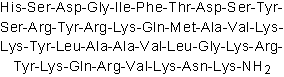
C203H331N63O53S
|
|
|---|---|---|
| 分子量 |
4534.25553999996
|
|
| CAS号 |
137061-48-4
|
|
| 相关CAS号 |
PACAP (1-38), human, ovine, rat TFA; PACAP (1-38) free acid TFA; PACAP (1-38) free acid; 129405-61-4
|
|
| PubChem CID |
133082079
|
|
| 外观&性状 |
White to off-white solid powder
|
|
| 氢键供体(HBD)数目 |
69
|
|
| 氢键受体(HBA)数目 |
66
|
|
| 可旋转键数目(RBC) |
158
|
|
| 重原子数目 |
313
|
|
| 分子复杂度/Complexity |
10400
|
|
| 定义原子立体中心数目 |
37
|
|
| SMILES |
[H]/N=C(/NCCC[C@@H](C(N[C@H](C(N[C@H](C(N[C@H](C(N[C@H](C(N[C@H](C(N[C@H](C(N[C@H](C(N[C@H](C(=O)N)CCCCN)=O)CC(=O)N)=O)CCCCN)=O)C(C)C)=O)CCCN/C(=N/[H])/N)=O)CCC(=O)N)=O)CCCCN)=O)CC1=CC=C(O)C=C1)=O)NC([C@@H](NC(CNC([C@@H](NC([C@H](C(C)C)NC([C@@H](NC([C@@H](NC([C@@H](NC([C@@H](NC([C@@H](NC([C@@H](NC([C@H](C(C)C)NC([C@@H](NC([C@@H](NC([C@@H](NC([C@@H](NC([C@@H](NC([C@@H](NC([C@@H](NC([C@@H](NC([C@@H](NC([C@@H](NC([C@@H](NC([C@H]([C@H](O)C)NC([C@@H](NC([C@H]([C@H](CC)C)NC(CNC([C@@H](NC([C@@H](NC([C@H](CC1N=CNC=1)N)=O)CO)=O)CC(=O)O)=O)=O)=O)CC1=CC=CC=C1)=O)=O)CC(=O)O)=O)CO)=O)CC1=CC=C(O)C=C1)=O)CO)=O)CCCN/C(=N/[H])/N)=O)CC1=CC=C(O)C=C1)=O)CCCN/C(=N/[H])/N)=O)CCCCN)=O)CCC(=O)N)=O)CCSC)=O)C)=O)=O)CCCCN)=O)CCCCN)=O)CC1=CC=C(O)C=C1)=O)CC(C)C)=O)C)=O)C)=O)=O)CC(C)C)=O)=O)CCCCN)=O)\N
|
|
| 别名 |
|
|
| HS Tariff Code |
2934.99.9001
|
|
| 存储方式 |
Powder -20°C 3 years 4°C 2 years In solvent -80°C 6 months -20°C 1 month 注意: 请将本产品存放在密封且受保护的环境中,避免吸湿/受潮。 |
|
| 运输条件 |
Room temperature (This product is stable at ambient temperature for a few days during ordinary shipping and time spent in Customs)
|
| 溶解度 (体外实验) |
|
|---|
| 制备储备液 | 1 mg | 5 mg | 10 mg | |
| 1 mM | 0.2205 mL | 1.1027 mL | 2.2054 mL | |
| 5 mM | 0.0441 mL | 0.2205 mL | 0.4411 mL | |
| 10 mM | 0.0221 mL | 0.1103 mL | 0.2205 mL |
1、根据实验需要选择合适的溶剂配制储备液 (母液):对于大多数产品,InvivoChem推荐用DMSO配置母液 (比如:5、10、20mM或者10、20、50 mg/mL浓度),个别水溶性高的产品可直接溶于水。产品在DMSO 、水或其他溶剂中的具体溶解度详见上”溶解度 (体外)”部分;
2、如果您找不到您想要的溶解度信息,或者很难将产品溶解在溶液中,请联系我们;
3、建议使用下列计算器进行相关计算(摩尔浓度计算器、稀释计算器、分子量计算器、重组计算器等);
4、母液配好之后,将其分装到常规用量,并储存在-20°C或-80°C,尽量减少反复冻融循环。
计算结果:
工作液浓度: mg/mL;
DMSO母液配制方法: mg 药物溶于 μL DMSO溶液(母液浓度 mg/mL)。如该浓度超过该批次药物DMSO溶解度,请首先与我们联系。
体内配方配制方法:取 μL DMSO母液,加入 μL PEG300,混匀澄清后加入μL Tween 80,混匀澄清后加入 μL ddH2O,混匀澄清。
(1) 请确保溶液澄清之后,再加入下一种溶剂 (助溶剂) 。可利用涡旋、超声或水浴加热等方法助溶;
(2) 一定要按顺序加入溶剂 (助溶剂) 。
 |
|---|
 |
 |
InvivoChem的所有产品仅用于作科学研究,不面向患者销售
Copyright 2020 InvivoChem LLC | All Rights Reserved 粤ICP备20063088号-1


 COA
COA
 粤公网安备 44011102003439号
 463611831
