| 规格 | 价格 | 库存 | 数量 |
|---|---|---|---|
| 10 mM * 1 mL in DMSO |
|
||
| 50mg |
|
||
| 100mg |
|
||
| 250mg |
|
||
| 500mg |
|
||
| 1g |
|
||
| 2g |
|
||
| 5g |
|
||
| Other Sizes |
|
| 靶点 |
Pyrimethamine targets the dihydrofolate reductase (DHFR) of malarial parasites (Plasmodium spp.), inhibiting the conversion of dihydrofolate to tetrahydrofolate (a critical cofactor for DNA synthesis). [1]
- Pyrimethamine exerts its anti-Toxoplasma effect by specifically inhibiting the DHFR of Toxoplasma gondii (TgDHFR), which has higher affinity for the drug than mammalian DHFR. [2] |
|---|---|
| 体外研究 (In Vitro) |
氟康唑 (FLZ) 与乙胺嘧啶(吡美西丹;4 nM–4 μM;24 小时;LLC-MK2 细胞与弓形虫)联合使用可抑制 FLZ 浓度为 0、0.05、0.1、0.5、1.0 和 3.0 的弓形虫活性μM,IC50 值分别为 0.23、0.19、0.23、0.34、0.14 和 0.19 μM[1]。
在疟原虫(种类未明确,推测为恶性疟原虫或间日疟原虫)体外培养体系中,用乙胺嘧啶(浓度范围:0.1-1 μM)处理后,寄生虫核分裂显著受阻。光镜和电镜观察显示:(1)裂殖体发育停滞,无法形成成熟裂殖子;(2)处理24小时后,60%-70%的寄生虫出现核固缩(凋亡样异常);(3)0.5 μM浓度下,寄生虫DNA合成(通过[3H]-胸腺嘧啶掺入法检测)较未处理对照组减少50%-60% [1] |
| 体内研究 (In Vivo) |
氟康唑、磺胺嘧啶与乙胺嘧啶(吡美西丹;1 mg/kg;ig;每天,持续 10 天;带有弓形虫异种移植物的雌性 CF1 小鼠)的组合可增强对死亡的保护[1]。
1968年的疟原虫核分裂体外研究未描述乙胺嘧啶的体内动物实验或药效数据 [1] - 在小鼠急性弓形虫病模型(6-8周龄Swiss Webster小鼠)中:小鼠腹腔注射1×10⁴个弓形虫RH株速殖子进行感染,乙胺嘧啶分为三组测试:(1)乙胺嘧啶单药组(10 mg/kg/天,灌胃);(2)乙胺嘧啶+磺胺嘧啶组(10 mg/kg + 100 mg/kg/天,灌胃);(3)乙胺嘧啶+磺胺嘧啶+氟康唑组(10 mg/kg + 100 mg/kg + 20 mg/kg/天,灌胃)。感染后24小时开始治疗,持续7天。结果:(1)乙胺嘧啶单药将死亡率从100%(未处理对照组)降至40%,脑速殖子载量(实时PCR检测)降低30%;(2)双药联合组(乙胺嘧啶+磺胺嘧啶)将死亡率降至20%,速殖子载量降低60%;(3)三药联合组进一步将死亡率降至10%,速殖子载量降低80%,证实协同疗效 [2] |
| 细胞实验 |
细胞活力测定[1]
细胞类型:含有弓形虫的 LLC-MK2 细胞 测试浓度: 4 nM-4 μM 孵化持续时间:24小时 实验结果:抑制弓形虫活性并降低寄生虫增殖指数。 疟原虫核分裂检测:疟原虫在含5%红细胞压积的RPMI 1640培养基中培养(补充10%人血清和25 mM HEPES)。加入浓度为0.1、0.5、1 μM的乙胺嘧啶,在37°C、5% CO₂环境中孵育。处理后12、24、48小时,收集100 μL培养物,用吉姆萨染液染色30分钟,在光镜下(1000×放大倍数)观察。每样本计数100个含虫红细胞中的正常裂殖体(核分裂完整)和异常寄生虫(核固缩)数量,通过异常寄生虫百分比评估药物作用 [1] |
| 动物实验 |
动物/疾病模型:雌性CF1小鼠(18-22克;4-6周龄)携带弓形虫异种移植[1]
剂量:口服(po);每日一次,持续10天 给药途径:1毫克/千克;10毫克/千克(氟康唑),40毫克/千克(磺胺嘧啶) 实验结果:与单独使用SDZ/PYR治疗相比,小鼠存活率提高。 急性弓形虫病小鼠模型方案:(1) 小鼠准备:雌性瑞士韦伯斯特小鼠(6-8周龄,20-25克)在感染前适应环境7天。 (2)感染:小鼠腹腔注射1×10⁴个弓形虫RH株速殖子(悬浮于0.2 mL无菌PBS中)。(3)药物配制:将乙胺嘧啶溶解于0.5%羧甲基纤维素(CMC)无菌水中;磺胺嘧啶和氟康唑溶解于相同溶剂中。(4)治疗组(每组10只小鼠):- 未治疗对照组:0.5% CMC(灌胃,每日一次);- 单独使用乙胺嘧啶:10 mg/kg(灌胃,每日一次);- 乙胺嘧啶+磺胺嘧啶:10 mg/kg + 100 mg/kg(灌胃,每日一次)。 - 乙胺嘧啶 + 磺胺嘧啶 + 氟康唑:10 mg/kg + 100 mg/kg + 20 mg/kg(灌胃,每日一次)。(5)监测:感染后21天内,每日监测小鼠的死亡率和临床症状(例如,嗜睡、体重减轻)。治疗后第7天,每组处死3只小鼠,并收集脑组织,通过实时PCR定量速殖子载量[2]。 |
| 药代性质 (ADME/PK) |
吸收、分布和排泄
吸收良好,给药后2至6小时达到血药浓度峰值。 在哺乳期妇女同时服用单剂量氯喹和马洛普林后,测定了血浆和乳汁中氯喹、氨苯砜和乙胺嘧啶的浓度。氯喹的乳汁与血浆浓度-时间曲线下面积(AUC)比值范围为1.96至4.26,氨苯砜为0.22至0.45,乙胺嘧啶为0.46至0.66。假设婴儿每日摄入1升乳汁,在9天内,乳汁中氯喹、氨苯砜和乙胺嘧啶的最大浓度百分比分别为母体剂量的4.2%、14.3%和45.6%。 乙胺嘧啶可排泄到乳汁中。据估计,母亲单次口服75毫克该药物后,哺乳婴儿在48小时内会摄入约3-4毫克该药物。 本研究探讨了乙胺嘧啶经尿液排泄的动力学。实验对象为6名年龄在23-32岁之间的健康男性志愿者。受试者单次口服(po)三种不同浓度的乙胺嘧啶,分别为50毫克、75毫克和100毫克。采用Bonini等人和Garber等人改进的方法测定尿液中药物的浓度。结果发现,经尿液排泄的药物中,有13.4±1.3%以原形排出。乙胺嘧啶的排泄过程可用开放式动力学双室模型描述:乙胺嘧啶随时间的排泄过程公式已给出。已提出多种定量暴露试验方法,这些方法可以计算药物吸收剂量,从而确定毒性程度。该试验在受控的临床环境中也很有用。 本研究对4周龄(103-115克)和12周龄(260-280克)的雄性Wistar白鼠进行了乙胺嘧啶的药代动力学研究。这些大鼠分别饲喂含24%蛋白质的标准饲料和含8%蛋白质的低蛋白饲料。大鼠经胃内灌注单剂量40毫克/公斤体重的乙胺嘧啶后,在给药后15分钟至20小时的不同时间点测定血液中乙胺嘧啶的浓度。根据所得结果,计算了表征药物从血液中吸收和消除过程的多个参数。大多数参数与年龄和饲料类型均相关。在4周龄大鼠中观察到最高的生物利用度:低蛋白饮食组的浓度-时间曲线下面积(AUC)为593.0,标准饮食组的AUC为503.1。在较大年龄的大鼠中,该参数分别为339.3和228.1。幼龄大鼠的k(e)值(分别为0.0121 hr⁻¹和0.0135 h⁻¹)低于老年大鼠(分别为0.0164 h⁻¹和0.0193 hr⁻¹)。 4周龄大鼠的消除半衰期(t1/2)高于12周龄大鼠(分别为57.1小时;8%蛋白和51.2小时;24%蛋白,而12周龄大鼠分别为42.4小时;8%蛋白和36.0小时;24%蛋白)。 有关乙胺嘧啶(共10种)的更多吸收、分布和排泄(完整)数据,请访问HSDB记录页面。 代谢/代谢物 肝脏 乙胺嘧啶代谢为几种未鉴定的代谢物。约 5% 的磺胺多辛剂量以乙酰化代谢物的形式存在于血浆中,约 2-3% 以葡萄糖醛酸苷的形式存在。 肝脏 半衰期:96 小时 生物半衰期 96 小时 据报道,乙胺嘧啶的平均血浆半衰期为 111 小时(范围:54-148 小时)。据报道,磺胺多辛的血浆半衰期平均为 169 小时(范围:100-231 小时)。 为了确定婴儿血清、脑脊液和脑室液中的乙胺嘧啶水平,研究人员检查了 37 名年龄在 10 天至 1.5 岁之间的婴儿的样本。这些婴儿接受了乙胺嘧啶治疗,剂量为每日 1 mg/kg 体重,持续 2 个月,之后每周一、周三和周五服用相同剂量,用于治疗疑似或确诊的先天性弓形虫病。从9名婴儿的血清中获得的乙胺嘧啶半衰期为64小时,与服用苯巴比妥的2名婴儿(33小时)的半衰期有显著差异。 对4周龄(103-115克)和12周龄(260-280克)的雄性Wistar白鼠进行了乙胺嘧啶的药代动力学研究,这些大鼠分别喂以含24%蛋白质的标准饲料和含8%蛋白质的低蛋白饲料。单次灌胃给予40 mg/kg体重的药物后,在给药后15分钟至20小时的不同时间点测定血液中乙胺嘧啶的浓度……4周龄大鼠的消除半衰期(t1/2)高于12周龄大鼠(分别为57.1小时;8%蛋白质和51.2小时;24%蛋白质,而12周龄大鼠分别为42.4小时;8%蛋白质和36.0小时;24%蛋白质)。 |
| 毒性/毒理 (Toxicokinetics/TK) |
毒性概述
乙胺嘧啶抑制疟原虫的二氢叶酸还原酶,从而阻断嘌呤和嘧啶的生物合成,而嘌呤和嘧啶是DNA合成和细胞增殖所必需的。这会导致红细胞和肝脏中裂殖体形成时细胞核分裂失败。 妊娠和哺乳期影响 ◉ 哺乳期用药概述 尚未有母乳喂养婴儿出现不良反应的报告,哺乳期妇女可安全使用。在HIV感染妇女中,与接受磺胺多辛和乙胺嘧啶联合治疗的妇女相比,接受氯喹治疗的妇女乳汁中HIV病毒载量下降更为显著。有研究表明,哺乳期母亲体内乙胺嘧啶的清除率可能会增加,但数据不足以得出明确结论。 ◉ 对母乳喂养婴儿的影响 对26名主要以母乳喂养的2至6个月大感染疟疾的婴儿的母亲服用乙胺嘧啶,结果婴儿痊愈。治疗方案为:首次服用75毫克,4至7天后再次服用50至75毫克。疗效显然与母乳喂养习惯有关,因为另一个母乳喂养较少的部落群体中的婴儿没有得到保护。这些婴儿未报告任何不良反应。 一例病例报告显示,母亲口服75毫克乙胺嘧啶,随后每周服用25毫克,治愈了其母乳喂养婴儿的疟疾,并使婴儿在6个月内免受疟疾感染。母亲漏服药物两周后,婴儿出现疟疾症状。 ◉ 对哺乳和母乳的影响 截至修订日期,未找到相关的已发表信息。 蛋白结合率 87% 药物相互作用 虽然临床意义尚不明确,但据报道,一些同时服用乙胺嘧啶和劳拉西泮的患者出现轻度肝毒性。 虽然临床意义尚不明确,但据报道,对氨基苯甲酸 (PABA) 会干扰乙胺嘧啶的作用,因此可能不应在服用乙胺嘧啶的患者中使用。 据报道,与单独使用磺胺多辛和乙胺嘧啶固定复方制剂相比,同时使用氯喹会增加不良反应的发生率和严重程度。磺胺多辛和乙胺嘧啶可与奎宁和其他抗感染药物合用。 不建议将乙胺嘧啶或磺胺多辛和乙胺嘧啶与其他抗叶酸药物(例如磺胺类药物、复方新诺明、甲氧苄啶)同时使用,因为这种使用可能会增加骨髓抑制的风险。如果出现叶酸缺乏的迹象,应停用乙胺嘧啶或磺胺多辛和乙胺嘧啶,并根据需要给予亚叶酸钙,直至造血功能恢复正常。 有关乙胺嘧啶(共6种)的更多相互作用(完整)数据,请访问HSDB记录页面。 非人类毒性值 大鼠腹腔注射LD50:70 mg/kg 小鼠腹腔注射LD50:74 mg/kg 小鼠口服LD50:92 mg/kg 在2013年的小鼠研究中:乙胺嘧啶(10 mg/kg/天,口服)在治疗的前3天导致小鼠出现轻微的短暂性体重下降(5%-8%),并在第7天恢复。血清丙氨酸氨基转移酶(ALT)和天冬氨酸氨基转移酶(AST)无显著变化。与未治疗的对照组相比,未观察到转氨酶(AST)或肌酐水平的变化。在治疗后第7天采集的肝脏和肾脏组织进行组织学检查时,未检测到严重的毒性反应(例如肝坏死、肾损伤)[2] |
| 参考文献 |
[1]. Aikawa M, et, al. Studies on nuclear division of a malarial parasite under pyrimethamine treatment. J Cell Biol. 1968 Dec;39(3):749-54.
[2]. Martins-Duarte ÉS, et, al. Toxoplasma gondii: the effect of fluconazole combined with sulfadiazine and pyrimethamine against acute toxoplasmosis in murine model. Exp Parasitol. 2013 Mar;133(3):294-9. |
| 其他信息 |
治疗用途
虽然乙胺嘧啶曾被单独用于抑制或预防旅行者疟疾,但美国疾病控制与预防中心 (CDC) 和其他专家已不再推荐该药用于疟疾预防。生产商声明,乙胺嘧啶仅应用于抑制或预防由已知对该药敏感的疟原虫引起的疟疾。然而,乙胺嘧啶耐药性在全球范围内普遍存在,因此对于前往世界大多数地区的旅行者而言,单独使用该药并非合适的疟疾预防方案。/美国产品标签内容/ 乙胺嘧啶可与磺胺嘧啶联合使用,或与克林霉素、阿托伐醌或阿奇霉素联合使用,用于治疗由弓形虫引起的弓形虫病。 /已包含在美国产品标签中/ 在这些治疗方案中,口服或注射用亚叶酸钙与乙胺嘧啶联合使用,以预防乙胺嘧啶引起的血液系统不良反应。/已包含在美国产品标签中/ 虽然复方新诺明通常被认为是治疗由贝氏等孢球虫引起的胃肠道感染的首选药物,但乙胺嘧啶也曾用于治疗某些患者(例如,HIV感染患者)的等孢球虫病,尤其是在复方新诺明禁忌的情况下,包括对磺胺类药物过敏的患者。/未包含在美国产品标签中/ 有关乙胺嘧啶(共16种)的更多治疗用途(完整)数据,请访问HSDB记录页面。 药物警告 高剂量乙胺嘧啶可能导致神经系统不良反应,包括共济失调、震颤、癫痫发作和呼吸衰竭。服用乙胺嘧啶后,罕见报告出现头痛、头晕、失眠、抑郁、不适、疲劳和易怒等症状。服用磺胺多辛和乙胺嘧啶后,罕见报告出现可逆性感觉过敏。磺胺类药物或乙胺嘧啶的其他不良神经系统反应包括周围神经炎、幻觉、耳鸣、眩晕、肌无力、紧张和多发性神经炎。服用乙胺嘧啶,尤其是与磺胺类药物合用时,曾有报告出现过敏反应,偶有严重反应(例如,Stevens-Johnson综合征、中毒性表皮坏死松解症、多形性红斑、过敏性休克)。磺胺多辛和乙胺嘧啶的固定复方制剂曾发生严重甚至致命的超敏反应。在大多数已报告的病例中,死亡是由严重的皮肤反应引起的,包括多形性红斑、史蒂文斯-约翰逊综合征和中毒性表皮坏死松解症。也有肺部过敏反应以及累及皮肤、肝脏和肾脏的致命反应的报道。此外,还有服用该复方制剂后发生致命性肝炎的报道。 服用磺胺多辛和乙胺嘧啶2-9剂用于疟疾预防的旅行者曾出现过严重的反应,但迄今为止,尚未有服用单剂(例如用于治疗疟疾的剂量)后出现严重反应的报道。据估计,接受磺胺多辛和乙胺嘧啶化学预防的美国旅行者中,严重皮肤不良反应的发生率在 1/8000 至 1/5000 之间,致命性皮肤反应的发生率在 1/25000 至 1/11000 之间。 大剂量乙胺嘧啶可能引起厌食、腹部绞痛、腹泻和呕吐。减少乙胺嘧啶的剂量或与食物同服可以减轻厌食和呕吐。也有报道称,大剂量乙胺嘧啶可引起萎缩性舌炎或胃炎。磺胺类药物或乙胺嘧啶的其他不良胃肠道反应包括口腔炎、恶心、腹痛和饱胀感。 有关乙胺嘧啶(共21条)的更多药物警告(完整)数据,请访问HSDB记录页面。 药效学 乙胺嘧啶是一种抗寄生虫化合物,常用于辅助治疗无并发症的、对氯喹耐药的恶性疟原虫疟疾。乙胺嘧啶是一种叶酸拮抗剂,其治疗作用的原理是基于宿主和寄生虫对生长过程中核酸前体的不同需求。这种活性对疟原虫和弓形虫具有高度选择性。乙胺嘧啶对人类疟原虫具有血液裂殖体杀灭活性和一定的组织裂殖体杀灭活性。然而,4-氨基喹啉类化合物对红细胞裂殖体更有效。它不会破坏配子体,但会抑制蚊体内的孢子生殖。当与磺胺类药物联合使用时,乙胺嘧啶对弓形虫的疗效显著增强。 1968 年的研究是早期阐明乙胺嘧啶抗疟机制的研究之一:该药物通过抑制寄生虫的二氢叶酸还原酶 (DHFR),阻断四氢叶酸依赖的 DNA 合成,导致异常的核分裂和裂殖体成熟停滞——这为其作为抗疟药的临床应用奠定了基础[1] - 在 2013 年的研究中,乙胺嘧啶 + 磺胺嘧啶 + 氟康唑的三联疗法在治疗急性弓形虫病方面显示出优于单独使用乙胺嘧啶或两种药物联合疗法的疗效。这是因为氟康唑抑制弓形虫麦角甾醇的合成(寄生虫细胞膜的关键成分),与乙胺嘧啶的抗叶酸作用协同作用,增强对寄生虫的杀灭作用[2] |
| 分子式 |
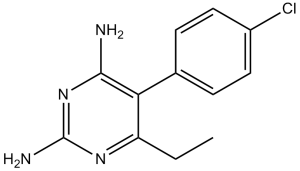
C12H13CLN4
|
|
|---|---|---|
| 分子量 |
248.71
|
|
| 精确质量 |
248.082
|
|
| CAS号 |
58-14-0
|
|
| 相关CAS号 |
Pyrimethamine-d3;1189936-99-9
|
|
| PubChem CID |
4993
|
|
| 外观&性状 |
Crystals
White scored tablets contains 25 mg pyrimethamine /Daraprim/ |
|
| 密度 |
1.4±0.1 g/cm3
|
|
| 沸点 |
368.4±52.0 °C at 760 mmHg
|
|
| 熔点 |
233-234°C
|
|
| 闪点 |
176.6±30.7 °C
|
|
| 蒸汽压 |
0.0±0.8 mmHg at 25°C
|
|
| 折射率 |
1.667
|
|
| LogP |
1.03
|
|
| tPSA |
77.82
|
|
| 氢键供体(HBD)数目 |
2
|
|
| 氢键受体(HBA)数目 |
4
|
|
| 可旋转键数目(RBC) |
2
|
|
| 重原子数目 |
17
|
|
| 分子复杂度/Complexity |
243
|
|
| 定义原子立体中心数目 |
0
|
|
| SMILES |
ClC1C([H])=C([H])C(=C([H])C=1[H])C1C(N([H])[H])=NC(N([H])[H])=NC=1C([H])([H])C([H])([H])[H]
|
|
| InChi Key |
WKSAUQYGYAYLPV-UHFFFAOYSA-N
|
|
| InChi Code |
InChI=1S/C12H13ClN4/c1-2-9-10(11(14)17-12(15)16-9)7-3-5-8(13)6-4-7/h3-6H,2H2,1H3,(H4,14,15,16,17)
|
|
| 化学名 |
5-(4-chlorophenyl)-6-ethylpyrimidine-2,4-diamine
|
|
| 别名 |
|
|
| HS Tariff Code |
2934.99.9001
|
|
| 存储方式 |
Powder -20°C 3 years 4°C 2 years In solvent -80°C 6 months -20°C 1 month |
|
| 运输条件 |
Room temperature (This product is stable at ambient temperature for a few days during ordinary shipping and time spent in Customs)
|
| 溶解度 (体外实验) |
|
|||
|---|---|---|---|---|
| 溶解度 (体内实验) |
配方 1 中的溶解度: ≥ 2.5 mg/mL (10.05 mM) (饱和度未知) in 10% DMSO + 40% PEG300 + 5% Tween80 + 45% Saline (这些助溶剂从左到右依次添加,逐一添加), 澄清溶液。
例如,若需制备1 mL的工作液,可将100 μL 25.0 mg/mL澄清DMSO储备液加入到400 μL PEG300中,混匀;然后向上述溶液中加入50 μL Tween-80,混匀;加入450 μL生理盐水定容至1 mL。 *生理盐水的制备:将 0.9 g 氯化钠溶解在 100 mL ddH₂O中,得到澄清溶液。 配方 2 中的溶解度: ≥ 2.5 mg/mL (10.05 mM) (饱和度未知) in 10% DMSO + 90% Corn Oil (这些助溶剂从左到右依次添加,逐一添加), 澄清溶液。 例如,若需制备1 mL的工作液,可将 100 μL 25.0 mg/mL 澄清 DMSO 储备液加入到 900 μL 玉米油中并混合均匀。 请根据您的实验动物和给药方式选择适当的溶解配方/方案: 1、请先配制澄清的储备液(如:用DMSO配置50 或 100 mg/mL母液(储备液)); 2、取适量母液,按从左到右的顺序依次添加助溶剂,澄清后再加入下一助溶剂。以 下列配方为例说明 (注意此配方只用于说明,并不一定代表此产品 的实际溶解配方): 10% DMSO → 40% PEG300 → 5% Tween-80 → 45% ddH2O (或 saline); 假设最终工作液的体积为 1 mL, 浓度为5 mg/mL: 取 100 μL 50 mg/mL 的澄清 DMSO 储备液加到 400 μL PEG300 中,混合均匀/澄清;向上述体系中加入50 μL Tween-80,混合均匀/澄清;然后继续加入450 μL ddH2O (或 saline)定容至 1 mL; 3、溶剂前显示的百分比是指该溶剂在最终溶液/工作液中的体积所占比例; 4、 如产品在配制过程中出现沉淀/析出,可通过加热(≤50℃)或超声的方式助溶; 5、为保证最佳实验结果,工作液请现配现用! 6、如不确定怎么将母液配置成体内动物实验的工作液,请查看说明书或联系我们; 7、 以上所有助溶剂都可在 Invivochem.cn网站购买。 |
| 制备储备液 | 1 mg | 5 mg | 10 mg | |
| 1 mM | 4.0207 mL | 20.1037 mL | 40.2075 mL | |
| 5 mM | 0.8041 mL | 4.0207 mL | 8.0415 mL | |
| 10 mM | 0.4021 mL | 2.0104 mL | 4.0207 mL |
1、根据实验需要选择合适的溶剂配制储备液 (母液):对于大多数产品,InvivoChem推荐用DMSO配置母液 (比如:5、10、20mM或者10、20、50 mg/mL浓度),个别水溶性高的产品可直接溶于水。产品在DMSO 、水或其他溶剂中的具体溶解度详见上”溶解度 (体外)”部分;
2、如果您找不到您想要的溶解度信息,或者很难将产品溶解在溶液中,请联系我们;
3、建议使用下列计算器进行相关计算(摩尔浓度计算器、稀释计算器、分子量计算器、重组计算器等);
4、母液配好之后,将其分装到常规用量,并储存在-20°C或-80°C,尽量减少反复冻融循环。
计算结果:
工作液浓度: mg/mL;
DMSO母液配制方法: mg 药物溶于 μL DMSO溶液(母液浓度 mg/mL)。如该浓度超过该批次药物DMSO溶解度,请首先与我们联系。
体内配方配制方法:取 μL DMSO母液,加入 μL PEG300,混匀澄清后加入μL Tween 80,混匀澄清后加入 μL ddH2O,混匀澄清。
(1) 请确保溶液澄清之后,再加入下一种溶剂 (助溶剂) 。可利用涡旋、超声或水浴加热等方法助溶;
(2) 一定要按顺序加入溶剂 (助溶剂) 。
| NCT Number | Recruitment | interventions | Conditions | Sponsor/Collaborators | Start Date | Phases |
| NCT05678348 | Recruiting | Drug: Pyrimethamine | Head and Neck Cancer Cancer of the Head and Neck |
Washington University School of Medicine |
August 3, 2023 | Early Phase 1 |
| NCT05497063 | Not yet recruiting | Drug: G-COSPE® tablets | Bioequivalence | Emzor Pharmaceutical Industries Limited |
December 2022 | Phase 1 |
| NCT03057990 | Withdrawn | Drug: Pyrimethamine | Myelodysplastic Syndromes | Montefiore Medical Center | September 11, 2019 | Phase 1 |
| NCT01102686 | Completed | Drug: Pyrimethamine Drug: Leucovorin |
Gangliosidoses, GM2 Sandhoff Disease |
The Hospital for Sick Children | August 2009 | Phase 1 Phase 2 |
 |
|---|
 |
InvivoChem的所有产品仅用于作科学研究,不面向患者销售
Copyright 2020 InvivoChem LLC | All Rights Reserved 粤ICP备20063088号-1


 粤公网安备 44011102003439号
 463611831
