| 规格 | 价格 | 库存 | 数量 |
|---|---|---|---|
| 1mg |
|
||
| 5mg |
|
||
| 10mg |
|
||
| 50mg |
|
||
| 100mg |
|
||
| Other Sizes |
|

| 靶点 |
Ubiquitin-activating enzyme E1 (UBA1).
IC50 for E1 enzyme inhibition = approximately 20 µM in a cell-free enzymatic assay. |
|---|---|
| 体外研究 (In Vitro) |
在8种白血病和骨髓瘤细胞系中,有5种细胞系在浓度低于10 μM的PYZD-4409(10–40 μM;72小时;骨髓瘤、白血病和实体瘤细胞系、原代急性髓系白血病细胞和正常造血细胞)作用下即可导致细胞死亡,即达到半数致死浓度(LD50)。另一方面,实体瘤细胞系的LD50约为15至20 μM,表明它们对PYZD-4409的敏感性较低。与正常造血细胞相比,PYZD-4409主要对恶性细胞产生细胞毒性[1]。PYZD-4409(50 μM;4小时;K562白血病细胞)处理可阻止泛素以E1依赖的方式与E2酶cdc34结合[1]。 PYZD-4409(0-25 μM;24 小时;K562 白血病细胞)显著增强了 Grp78 和 Hsp70 的 mRNA 和蛋白水平。此外,与内质网应激和未折叠蛋白反应相关的磷酸化 JNK 和磷酸化 p38 丝裂原活化蛋白激酶的水平也因 PYZD-4409 而升高 [1]。
E1 酶活性抑制:PYZD-4409 在凝胶电泳实验中抑制了泛素的 ATP 依赖性活化以及活化泛素从 E1 酶向 E2 酶(UBE2E2)的转移。在 K562 白血病细胞中,PYZD-4409 处理 4 小时后,也抑制了 E1 介导的泛素加载到 E2 酶 Cdc34 上的过程。在无细胞实验中,E1抑制剂的IC50估计值为20 µM。结构相关的对照化合物PYZDmut对E1活性没有抑制作用。[1] 细胞毒性:PYZD-4409在多种白血病、多发性骨髓瘤和实体瘤细胞系中诱导细胞死亡,经Alamar Blue法检测,处理72小时后细胞死亡情况。骨髓瘤细胞系(LP1、KMS11、U266)尤其敏感,LD50值≤3 µM。8个白血病和骨髓瘤细胞系中有5个的LD50<10 µM。实体瘤细胞系的敏感性较低,LD50值约为15-20 µM。对照化合物PYZDmut在浓度高达50 µM时未显示细胞毒性。细胞死亡通过台盼蓝染色证实。 [1] 对原代急性髓系白血病 (AML) 细胞与正常细胞的影响:在克隆形成生长实验中,用PYZD-4409(10 µM,24 小时)处理可抑制原代急性髓系白血病 (AML) 细胞的克隆形成。相反,在相同条件下,它并未降低来自健康供体的正常造血细胞(外周血干细胞,PBSC)的克隆形成生长。[1] 对短寿命蛋白和内质网应激的影响: 用PYZD-4409(50 µM)处理可增加受泛素化调控的短半衰期蛋白的蛋白水平,例如细胞周期蛋白 D3(在 K562 细胞中 4 小时)和 p53(在 HCT116 细胞中 2 小时)。 [1] PYZD-4409 处理(10-25 µM,24 小时)可增加 K562 细胞中内质网应激标志物 GRP78 和 HSP70 的 mRNA 水平。它还能增加内质网应激标志物的蛋白水平,包括磷酸化 JNK 和磷酸化 p38 MAPK(在 K562 细胞中,50 µM,2.5 小时),以及磷酸化 PERK、ATF4 和 CHOP(在 MDAY-D2 细胞中,10 µM,24 小时)。对照化合物 PYZDmut 未诱导这些变化。[1] 在 HT1080 细胞中过表达 BI-1(一种内质网应激保护蛋白)可显著抑制 PYZD-4409 浓度增加诱导的细胞死亡,表明内质网应激在其细胞毒性机制中起着重要的功能作用。[1] |
| 体内研究 (In Vivo) |
PYZD-4409(10 mg/kg;腹腔注射;隔日一次,连续16天;雄性重症联合免疫缺陷小鼠)可降低肿瘤重量和体积,且无不良反应[1]。
在小鼠白血病模型中的疗效:在皮下异种移植模型中,携带MDAY-D2小鼠白血病细胞的SCID小鼠接受PYZD-4409(10 mg/kg)或载体对照治疗,隔日腹腔注射,连续8天。肿瘤接种后第16天,与对照组相比,PYZD-4409治疗组显著延缓肿瘤生长并降低最终肿瘤重量,且未出现明显的毒性反应。然而,免疫印迹分析显示,治疗组小鼠肿瘤中内质网应激标志物(磷酸化PERK、Grp78、CHOP)的表达未见升高。[1] |
| 酶活实验 |
E1酶活性测定(IC50测定):为测定IC50值,将重组His标签人E1(1 µM)、His标签人E2酶UbcH5A(10 µM)、泛素(20 µM)和ATP(1 mM)在96孔板中,于反应缓冲液(50 mM Tris-HCl,pH 7,5 mM MgCl2)中,加入递增浓度的PYZD-4409进行孵育。立即加入无机焦磷酸盐检测试剂,并在30分钟内读取荧光信号(激发波长530 nm,发射波长567 nm)。通过定量E1催化泛素活化过程中ATP水解产生的无机焦磷酸盐,来评估酶活性。测得IC50值约为20 µM。 [1]
E1-泛素缀合物形成实验:将GST标记的人E1蛋白(0.5 µM)和荧光素标记的泛素(1 µM)在反应缓冲液(50 mM Tris-HCl,pH 7,5 mM MgCl2,250 µM ATP)中,加入或不加入递增浓度的PYZD-4409或对照化合物PYZDmut,于37°C孵育30分钟。然后将反应产物在非还原条件下进行SDS-PAGE电泳分离。使用凝胶成像仪观察荧光素信号,以评估E1-泛素缀合物的形成。 [1] E2 加载实验:将 GST 标签的人 E1 (1 µM)、His 标签的人 E2 (UbcH5A, 5 µM)、泛素 (20 µM) 和 ATP (1 mM) 与不同浓度的 PYZD-4409 或 PYZDmut 在 30°C 下孵育 30 分钟。反应产物经 SDS-PAGE 电泳分离,然后用抗 His 抗体和荧光染料标记的二抗进行免疫印迹分析。使用红外成像系统检测 E2-泛素缀合物的荧光信号。[1] 细胞 E1 活性测定(E2 加载):为评估细胞内 E1 的抑制情况,将 K562 细胞用 PYZD-4409 (50 µM) 处理 4 小时。随后制备细胞裂解液,并在非还原性或还原性SDS-PAGE上样缓冲液中加热。样品经SDS-PAGE分离后,用针对E2蛋白cdc34的抗体进行免疫印迹分析,以检测E2-泛素缀合物的形成,该缀合物的形成依赖于E1的活性。[1] |
| 细胞实验 |
细胞毒性试验[1]
细胞类型:骨髓瘤、白血病和实体瘤细胞系,原代急性髓系白血病(AML)细胞和正常造血细胞 测试浓度:10 μM、20 μM、30 μM、40 μM 孵育时间:72 小时 实验结果:细胞死亡诱导 8 种白血病和骨髓瘤细胞系中有 5 种的 LD50 低于 10 μM。相比之下,实体瘤细胞系的敏感性较低,LD50 约为 15 至 20 μM。 蛋白质印迹分析[1] 细胞类型: K562 白血病细胞 测试浓度: 50 μM 孵育时间: 4 小时 实验结果: 阻断 E1 依赖的泛素与 E2 酶 cdc34 的结合。 RT-PCR[1] 细胞类型: K562 细胞 测试浓度: 0 μM、10 μM、25 μM 孵育时间: 24 小时 实验结果: Grp78 和 Hsp70 的 mRNA 和蛋白水平显著升高。 细胞活力检测(Alamar Blue/MTS):将细胞接种于 96 孔板中,并用递增浓度的 PYZD-4409 处理 72 小时。孵育后,根据制造商的说明加入 Alamar Blue 或 MTS 试剂,并测量荧光或吸光度以确定相对于对照组的细胞活力。对于台盼蓝排除法,将细胞等分试样与染料混合,并计数未染色(活)细胞。对于Annexin V/PI染色,用Annexin V-FITC和PI对细胞进行染色,并通过流式细胞术进行分析。[1] 集落形成实验:将原代人AML细胞或正常PBSC用PYZD-4409(10 µM)或缓冲液对照处理24小时。处理后,洗涤细胞,并以一式两份接种于含细胞因子的甲基纤维素培养基(MethoCult GF H4434)中。AML细胞培养7天后计数集落,正常造血细胞培养2周后计数集落。[1] 蛋白质印迹分析:用PYZD-4409、对照化合物PYZDmut或DMSO处理的细胞在SDS上样缓冲液中裂解。测定蛋白质浓度后,向裂解液中加入β-巯基乙醇(用于还原条件),加热,并通过SDS-PAGE进行分离。将蛋白质转移至硝酸纤维素膜,并与针对目标蛋白(例如E1、泛素、细胞周期蛋白D3、p53、GRP78、磷酸化JNK、磷酸化p38、磷酸化PERK、ATF4、CHOP)的一抗进行杂交。使用增强型化学发光试剂盒显色。[1] 实时定量RT-PCR:用指定浓度的PYZD-4409处理K562细胞24小时后收集细胞,并提取总RNA。合成cDNA,并使用针对GRP78、HSP70和18S rRNA的引物进行实时PCR。采用ΔΔCT归一化法,以18S rRNA为内参基因,测定mRNA的相对表达量。[1] BI-1过表达保护实验:将稳定过表达BI-1的HT1080细胞(HT1080-BI-1)或含有空载体的HT1080细胞(HT1080-neo)接种于96孔板中,过夜培养。次日,用递增浓度的PYZD-4409处理细胞24小时。然后采用Alamar Blue法测定细胞活力。[1] |
| 动物实验 |
动物/疾病模型: 雄性重症联合免疫缺陷 (SCID) 小鼠,携带 MDAY-D2 鼠白血病细胞 [1]
剂量: 10 mg/kg 给药途径: 腹腔注射 (ip);每日一次,隔日一次;持续 16 天 实验结果: 肿瘤生长延迟,肿瘤重量减轻,且未见不良毒性。 鼠白血病异种移植疗效研究:** 将 1 x 10^5 个 MDAY-D2 鼠白血病细胞皮下注射到雄性 SCID 小鼠体内。次日开始治疗。小鼠接受腹腔注射 PYZD-4409(10 mg/kg,溶于生理盐水),或注射等体积的生理盐水作为对照。治疗每隔一天进行一次,共持续8天。一旦肿瘤可触及,至少每隔一天使用游标卡尺监测肿瘤生长情况。肿瘤接种16天后,用二氧化碳窒息法处死小鼠。然后切除肿瘤并称重。[1] 小鼠白血病异种移植疗效研究:将1 x 10^5个MDAY-D2小鼠白血病细胞皮下注射到雄性SCID小鼠体内。第二天开始治疗。小鼠腹腔注射PYZD-4409,剂量为10 mg/kg(溶于生理盐水),或注射等体积的生理盐水作为对照。治疗每隔一天进行一次,共持续8天。一旦肿瘤可触及,至少每隔一天使用游标卡尺监测肿瘤生长情况。肿瘤接种16天后,用二氧化碳窒息法处死小鼠。然后切除肿瘤并称重。[1] |
| 毒性/毒理 (Toxicokinetics/TK) |
体内耐受性:在小鼠疗效研究中,腹腔注射PYZD-4409,剂量为10 mg/kg,隔日一次,连续8天,未观察到不良毒性反应,因为未报告明显的毒性症状。[1]
体外选择性:PYZD-4409对恶性细胞表现出优先细胞毒性。它在10 µM浓度下抑制原代急性髓系白血病(AML)细胞的克隆形成,但不会降低健康供体正常造血细胞(PBSC)的集落形成。此外,在浓度高达100 µM时,它对α-甘露糖苷酶II或荧光素酶等无关酶没有抑制作用,并且在类似浓度下也不抑制SUMO E1酶Uba2。[1] |
| 参考文献 | |
| 其他信息 |
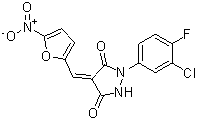
背景与机制:PYZD-4409(1-(3-氯-4-氟苯基)-4-[(5-硝基-2-呋喃基)亚甲基]-3,5-吡唑烷二酮)是一种新型小分子泛素激活酶E1 (UBA1)抑制剂。它是通过对基于吡唑烷药效团的定向化合物库进行筛选而发现的。该化合物通过抑制E1,阻断泛素化级联反应的第一步,从而阻止泛素的激活及其向E2酶的转移。这种抑制作用导致泛素化蛋白和短半衰期蛋白(如p53和细胞周期蛋白D3)的积累,最终通过涉及内质网(ER)应激和未折叠蛋白反应的机制诱导细胞死亡。该研究为以E1酶为靶点治疗白血病和多发性骨髓瘤等血液系统恶性肿瘤提供了概念验证。[1]
|
| 精确质量 |
351.006
|
|---|---|
| CAS号 |
423148-78-1
|
| PubChem CID |
60111983
|
| 外观&性状 |
Light brown to black solid powder
|
| LogP |
3.305
|
| tPSA |
111.86
|
| 氢键供体(HBD)数目 |
1
|
| 氢键受体(HBA)数目 |
6
|
| 可旋转键数目(RBC) |
2
|
| 重原子数目 |
24
|
| 分子复杂度/Complexity |
595
|
| 定义原子立体中心数目 |
0
|
| SMILES |
FC1=CC=C(N2C(/C(C(N2)=O)=C\C3=CC=C([N+]([O-])=O)O3)=O)C=C1Cl
|
| InChi Key |
MSYMKEYWUWVZQY-TWGQIWQCSA-N
|
| InChi Code |
InChI=1S/C14H7ClFN3O5/c15-10-5-7(1-3-11(10)16)18-14(21)9(13(20)17-18)6-8-2-4-12(24-8)19(22)23/h1-6H,(H,17,20)/b9-6-
|
| 化学名 |
(4Z)-1-(3-chloro-4-fluorophenyl)-4-[(5-nitrofuran-2-yl)methylidene]pyrazolidine-3,5-dione
|
| 别名 |
PYZD4409 PYZD-4409 PYZD 4409
|
| HS Tariff Code |
2934.99.9001
|
| 存储方式 |
Powder -20°C 3 years 4°C 2 years In solvent -80°C 6 months -20°C 1 month |
| 运输条件 |
Room temperature (This product is stable at ambient temperature for a few days during ordinary shipping and time spent in Customs)
|
| 溶解度 (体外实验) |
DMSO : ≥ 35 mg/mL (~99.53 mM)
|
|---|---|
| 溶解度 (体内实验) |
配方 1 中的溶解度: ≥ 2.5 mg/mL (7.11 mM) (饱和度未知) in 10% DMSO + 40% PEG300 +5% Tween-80 + 45% Saline (这些助溶剂从左到右依次添加,逐一添加), 澄清溶液。
例如,若需制备1 mL的工作液,可将100 μL 25.0 mg/mL澄清DMSO储备液加入到400 μL PEG300中,混匀;然后向上述溶液中加入50 μL Tween-80+,混匀;加入450 μL生理盐水定容至1 mL。 *生理盐水的制备:将 0.9 g 氯化钠溶解在 100 mL ddH₂O中,得到澄清溶液。 请根据您的实验动物和给药方式选择适当的溶解配方/方案: 1、请先配制澄清的储备液(如:用DMSO配置50 或 100 mg/mL母液(储备液)); 2、取适量母液,按从左到右的顺序依次添加助溶剂,澄清后再加入下一助溶剂。以 下列配方为例说明 (注意此配方只用于说明,并不一定代表此产品 的实际溶解配方): 10% DMSO → 40% PEG300 → 5% Tween-80 → 45% ddH2O (或 saline); 假设最终工作液的体积为 1 mL, 浓度为5 mg/mL: 取 100 μL 50 mg/mL 的澄清 DMSO 储备液加到 400 μL PEG300 中,混合均匀/澄清;向上述体系中加入50 μL Tween-80,混合均匀/澄清;然后继续加入450 μL ddH2O (或 saline)定容至 1 mL; 3、溶剂前显示的百分比是指该溶剂在最终溶液/工作液中的体积所占比例; 4、 如产品在配制过程中出现沉淀/析出,可通过加热(≤50℃)或超声的方式助溶; 5、为保证最佳实验结果,工作液请现配现用! 6、如不确定怎么将母液配置成体内动物实验的工作液,请查看说明书或联系我们; 7、 以上所有助溶剂都可在 Invivochem.cn网站购买。 |
计算结果:
工作液浓度: mg/mL;
DMSO母液配制方法: mg 药物溶于 μL DMSO溶液(母液浓度 mg/mL)。如该浓度超过该批次药物DMSO溶解度,请首先与我们联系。
体内配方配制方法:取 μL DMSO母液,加入 μL PEG300,混匀澄清后加入μL Tween 80,混匀澄清后加入 μL ddH2O,混匀澄清。
(1) 请确保溶液澄清之后,再加入下一种溶剂 (助溶剂) 。可利用涡旋、超声或水浴加热等方法助溶;
(2) 一定要按顺序加入溶剂 (助溶剂) 。
|
|
|
InvivoChem的所有产品仅用于作科学研究,不面向患者销售
Copyright 2020 InvivoChem LLC | All Rights Reserved 粤ICP备20063088号-1


 粤公网安备 44011102003439号
 463611831
