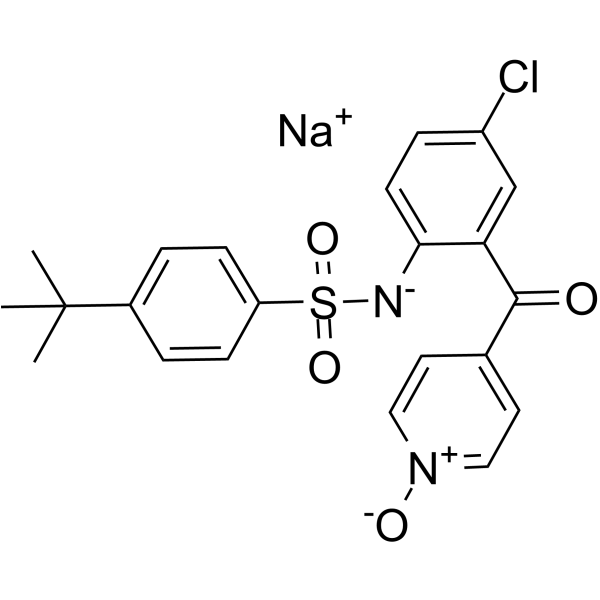
| 规格 | 价格 | |
|---|---|---|
| 500mg | ||
| 1g | ||
| Other Sizes |
| 靶点 |
CCR9B ( IC50 = 2.6 nM ); CCR9A ( IC50 = 2.8 nM )
|
|---|---|
| 体外研究 (In Vitro) |
vercirnon (GSK-1605786) 钠抑制原代 CCR9 表达细胞对 CCL25 的趋化性,IC50 为 6.8 nM。用视黄酸 (RA) 培养的人 T 细胞表现出由 CCL25 诱导的趋化性,而 CCL25 会被 vercirnonodium 抑制。 Vercirnonodium 的 IC50 为 141 nM,抑制 100% 人 AB 血清中 RA 培养细胞的 CCL25 介导的趋化性。 Vercirnonodium 的 IC50 值分别为 6.9 nM 和 1.3 nM,是 CCL25 诱导的小鼠和大鼠胸腺细胞趋化性的强抑制剂 [1]。
|
| 体内研究 (In Vivo) |
Vercirnon (GSK1605786A) 钠(10、50 mg/kg;皮下注射;每天两次;从 2 周龄开始直至 12 周龄)可降低 TNFΔARE 动物模型中肠道炎症的严重程度 [1]。
|
| 酶活实验 |
CCX282-B抑制了CCR9介导的Molt-4细胞上的钙(2+)动员和趋化性,IC(50)值分别为5.4和3.4 nM。在100%人血清存在的情况下,CCX282-B抑制了CCR9介导的趋化性,IC(50)为33 nM,添加α1-酸性糖蛋白不影响其效力。CCX282-B以6.8nM的IC(50)抑制了原代表达CCR9的细胞对CCL25的趋化性。CCX282-B是两种剪接形式的CCR9(CCR9A和CCR9B)的CCL25导向趋化性的等效抑制剂,IC(50)值分别为2.8和2.6 nM。CCX282-B还抑制了小鼠和大鼠CCR9介导的趋化性[1]。
|
| 动物实验 |
动物/疾病模型: C57BL/6 小鼠(TNFΔARE 末端回肠炎小鼠模型)[1]
剂量: 10、50 mg/kg 给药途径: 皮下注射;每日两次;从 2 周龄开始,直至 12 周龄 实验结果: 50 mg/kg 的剂量可完全抑制 TNF 过表达相关的严重炎症。较低剂量也具有类似的保护作用。 |
| 参考文献 | |
| 其他信息 |
Vercirnon 是一种新型口服抗炎药,靶向一种与克罗恩病和溃疡性结肠炎(炎症性肠病 (IBD) 的两种主要类型)均相关的趋化因子受体蛋白。目前正在进行临床试验 NCT01611805(GSK1605786 的日本 I 期临床试验)。
作用机制 Vercirnon 是一种小分子口服药物,旨在通过阻断 CCR9 趋化因子受体的活性来控制 IBD 的异常免疫反应。在成人中,CCR9 是一种高度特异性的受体,由选择性迁移至消化道的 T 细胞表达。T 细胞向小肠和大肠的迁移会导致持续性炎症,进而可能导致克罗恩病或溃疡性结肠炎——IBD 的两种主要类型。 炎症性肠病,包括克罗恩病和溃疡性结肠炎,影响着全球数百万人。 CCR9已被证实是介导胃肠道局部炎症反应的关键趋化因子受体。CCR9抑制剂Vercirnon已进入III期临床试验,但存在一些我们试图改进的缺陷。[3] 虽然人们早已认识到趋化因子受体CCR9及其配体CCL25对于白细胞进入小肠以及小肠炎症的发生至关重要,但该趋化因子-受体对在结肠炎症中的作用尚不明确。为此,我们比较了健康个体和溃疡性结肠炎患者的结肠CCL25蛋白水平。此外,我们还研究了CCR9药理学抑制在mdr1a(-/-)溃疡性结肠炎小鼠模型中的作用。与健康对照组相比,溃疡性结肠炎患者的结肠样本中CCL25蛋白水平显著升高,这一发现与mdr1a(-/-)小鼠的结果一致。在mdr1a(-/-)小鼠中,CCR9拮抗剂显著降低了结肠萎缩和重塑的程度,并降低了结肠中炎症细胞因子的水平。这些发现表明CCR9:CCL25受体对在溃疡性结肠炎的发病机制中起着关键作用,并提示CCR9拮抗剂可能对结肠炎症患者具有治疗益处。[2]趋化因子系统是一类多样化的G蛋白偶联受体,负责在稳态和炎症条件下协调细胞募集。趋化因子受体9 (CCR9) 是一种已知的趋化因子受体,在免疫细胞向肠道迁移的过程中起着核心作用。 CCR9的唯一配体CCL25表达于肠道黏膜表面,已知在肠道炎症中表达升高。迄今为止,尚无针对CCR9的小分子拮抗剂的报道。我们首次报道了一种名为CCX282-B的小分子,它是一种口服生物利用度高、选择性强、高效的CCR9拮抗剂。CCX282-B抑制Molt-4细胞中CCR9介导的Ca²⁺动员和趋化作用,IC₅₀值分别为5.4 nM和3.4 nM。在100%人血清存在下,CCX282-B抑制CCR9介导的趋化作用的IC₅₀值为33 nM,且添加α1-酸性糖蛋白不影响其效力。 CCX282-B 能以 6.8 nM 的 IC50 值抑制表达 CCR9 的原代细胞对 CCL25 的趋化作用。CCX282-B 对 CCR9 的两种剪接体(CCR9A 和 CCR9B)的 CCL25 趋化作用均具有等效的抑制作用,IC50 值分别为 2.8 nM 和 2.6 nM。CCX282-B 还能抑制小鼠和大鼠的 CCR9 介导的趋化作用。使用 CCX282-B 抑制 CCR9 可使克罗恩病(如 TNF(ΔARE) 小鼠)的组织病理学表现恢复正常。分析与此改善相关的血浆药物浓度有助于了解 CCR9 拮抗剂在治疗肠道炎症中的药代动力学/药效学关系。[1] |
| 分子式 |
C22H21CLN2NAO4S
|
|---|---|
| 分子量 |
466.913
|
| 精确质量 |
466.073
|
| 元素分析 |
C, 56.59; H, 4.32; Cl, 7.59; N, 6.00; Na, 4.92; O, 13.71; S, 6.87
|
| CAS号 |
886214-18-2
|
| 相关CAS号 |
Vercirnon;698394-73-9
|
| PubChem CID |
71300757
|
| 外观&性状 |
Light yellow to yellow solid powder
|
| LogP |
6.157
|
| tPSA |
103.4
|
| 氢键供体(HBD)数目 |
0
|
| 氢键受体(HBA)数目 |
5
|
| 可旋转键数目(RBC) |
4
|
| 重原子数目 |
31
|
| 分子复杂度/Complexity |
862
|
| 定义原子立体中心数目 |
0
|
| SMILES |
CC(C)(C)C1=CC=C(C=C1)S(=O)(=O)/N=C/2\C=CC(=C\C2=C(/C3=CC=[N+](C=C3)[O-])\[O-])Cl.[Na+]
|
| InChi Key |
NKNHYMXTVRJZBC-YBZPVFAISA-M
|
| InChi Code |
InChI=1S/C22H21ClN2O4S.Na/c1-22(2,3)16-4-7-18(8-5-16)30(28,29)24-20-9-6-17(23)14-19(20)21(26)15-10-12-25(27)13-11-15;/h4-14,26H,1-3H3;/q;+1/p-1/b21-19-,24-20+;
|
| 化学名 |
sodium;(Z)-[(6E)-6-(4-tert-butylphenyl)sulfonylimino-3-chlorocyclohexa-2,4-dien-1-ylidene]-(1-oxidopyridin-1-ium-4-yl)methanolate
|
| 别名 |
Vercirnon sodium; 886214-18-2; Vercirnon sodium [USAN]; UNII-9NQF0M8R0M; 9NQF0M8R0M; GSK1605786A; GSK-1605786A; Benzenesulfonamide, N-(4-chloro-2-((1-oxido-4-pyridinyl)carbonyl)phenyl)-4-(1,1- dimethylethyl)-, sodium salt;
|
| HS Tariff Code |
2934.99.9001
|
| 存储方式 |
Powder -20°C 3 years 4°C 2 years In solvent -80°C 6 months -20°C 1 month 注意: 请将本产品存放在密封且受保护的环境中(例如氮气保护),避免吸湿/受潮。 |
| 运输条件 |
Room temperature (This product is stable at ambient temperature for a few days during ordinary shipping and time spent in Customs)
|
| 溶解度 (体外实验) |
DMSO : ~100 mg/mL (~214.17 mM)
|
|---|---|
| 溶解度 (体内实验) |
配方 1 中的溶解度: 5 mg/mL (10.71 mM) in 10% DMSO + 40% PEG300 + 5% Tween80 + 45% Saline (这些助溶剂从左到右依次添加,逐一添加), 悬浮液;超声助溶。
例如,若需制备1 mL的工作液,可将100 μL 50.0 mg/mL澄清DMSO储备液加入400 μL PEG300中,混匀;然后向上述溶液中加入50 μL Tween-80,混匀;加入450 μL生理盐水定容至1 mL。 *生理盐水的制备:将 0.9 g 氯化钠溶解在 100 mL ddH₂O中,得到澄清溶液。 配方 2 中的溶解度: ≥ 5 mg/mL (10.71 mM) (饱和度未知) in 10% DMSO + 90% (20% SBE-β-CD in Saline) (这些助溶剂从左到右依次添加,逐一添加), 澄清溶液。 例如,若需制备1 mL的工作液,可将 100 μL 50.0 mg/mL澄清DMSO储备液加入900 μL 20% SBE-β-CD生理盐水溶液中,混匀。 *20% SBE-β-CD 生理盐水溶液的制备(4°C,1 周):将 2 g SBE-β-CD 溶解于 10 mL 生理盐水中,得到澄清溶液。 请根据您的实验动物和给药方式选择适当的溶解配方/方案: 1、请先配制澄清的储备液(如:用DMSO配置50 或 100 mg/mL母液(储备液)); 2、取适量母液,按从左到右的顺序依次添加助溶剂,澄清后再加入下一助溶剂。以 下列配方为例说明 (注意此配方只用于说明,并不一定代表此产品 的实际溶解配方): 10% DMSO → 40% PEG300 → 5% Tween-80 → 45% ddH2O (或 saline); 假设最终工作液的体积为 1 mL, 浓度为5 mg/mL: 取 100 μL 50 mg/mL 的澄清 DMSO 储备液加到 400 μL PEG300 中,混合均匀/澄清;向上述体系中加入50 μL Tween-80,混合均匀/澄清;然后继续加入450 μL ddH2O (或 saline)定容至 1 mL; 3、溶剂前显示的百分比是指该溶剂在最终溶液/工作液中的体积所占比例; 4、 如产品在配制过程中出现沉淀/析出,可通过加热(≤50℃)或超声的方式助溶; 5、为保证最佳实验结果,工作液请现配现用! 6、如不确定怎么将母液配置成体内动物实验的工作液,请查看说明书或联系我们; 7、 以上所有助溶剂都可在 Invivochem.cn网站购买。 |
| 制备储备液 | 1 mg | 5 mg | 10 mg | |
| 1 mM | 2.1417 mL | 10.7087 mL | 21.4174 mL | |
| 5 mM | 0.4283 mL | 2.1417 mL | 4.2835 mL | |
| 10 mM | 0.2142 mL | 1.0709 mL | 2.1417 mL |
1、根据实验需要选择合适的溶剂配制储备液 (母液):对于大多数产品,InvivoChem推荐用DMSO配置母液 (比如:5、10、20mM或者10、20、50 mg/mL浓度),个别水溶性高的产品可直接溶于水。产品在DMSO 、水或其他溶剂中的具体溶解度详见上”溶解度 (体外)”部分;
2、如果您找不到您想要的溶解度信息,或者很难将产品溶解在溶液中,请联系我们;
3、建议使用下列计算器进行相关计算(摩尔浓度计算器、稀释计算器、分子量计算器、重组计算器等);
4、母液配好之后,将其分装到常规用量,并储存在-20°C或-80°C,尽量减少反复冻融循环。
计算结果:
工作液浓度: mg/mL;
DMSO母液配制方法: mg 药物溶于 μL DMSO溶液(母液浓度 mg/mL)。如该浓度超过该批次药物DMSO溶解度,请首先与我们联系。
体内配方配制方法:取 μL DMSO母液,加入 μL PEG300,混匀澄清后加入μL Tween 80,混匀澄清后加入 μL ddH2O,混匀澄清。
(1) 请确保溶液澄清之后,再加入下一种溶剂 (助溶剂) 。可利用涡旋、超声或水浴加热等方法助溶;
(2) 一定要按顺序加入溶剂 (助溶剂) 。
| NCT Number | Recruitment | interventions | Conditions | Sponsor/Collaborators | Start Date | Phases |
| NCT00540657 | Completed | Drug: CCX282-B Drug: Placebo |
Celiac Disease | ChemoCentryx | October 2007 | Phase 2 |
| NCT00306215 | Completed | Drug: CCX282-B | Crohn's Disease | ChemoCentryx | March 2006 | Phase 2 |
| NCT01277666 | Completed | Drug: GSK1605786A Drug: Placebo |
Crohn's Disease | GlaxoSmithKline | December 20, 2010 | Phase 3 |
| NCT00102921 | Completed | Drug: CCX282-B | Crohn Disease | ChemoCentryx | August 2004 | Phase 2 |
InvivoChem的所有产品仅用于作科学研究,不面向患者销售
Copyright 2020 InvivoChem LLC | All Rights Reserved 粤ICP备20063088号-1


 粤公网安备 44011102003439号
 463611831
