| 规格 | 价格 | 库存 | 数量 |
|---|---|---|---|
| 10 mM * 1 mL in DMSO |
|
||
| 1mg |
|
||
| 2mg |
|
||
| 5mg |
|
||
| 10mg |
|
||
| 25mg |
|
||
| 50mg |
|
||
| 100mg |
|
||
| 250mg |
|
||
| Other Sizes |
|

| 靶点 |
The purpose of AZD3965 is to obstruct single-effector transporter-1 (MCT1), which is anticipated to impact cell entry and exit [1]. The administration of AZD3965 led to an increase in internal repletion of 3.7 times in hypoxic COR-L103 cells and 3.9 times in normoxic and hypoxic NCI-H1048 cells, respectively. A <1.9-fold rise was noted in all other cases. These results are in line with the theory that AZD3965 both decreases the number of cells and blocks leaky movement in cells. The EC50 of NCI-H1048 rises from 0.14 nM to 10.5 nM in NCI-H1048 cells when MCT1 is overexpressed, which is consistent with AZD3965's inhibitory impact via MCT1 [2].
|
|---|---|
| 体外研究 (In Vitro) |
AZD3965 的目的是阻碍单效应转运蛋白 1 (MCT1),预计该蛋白会影响细胞进入和退出 [1]。 AZD3965 的施用导致缺氧 COR-L103 细胞的内部补充增加 3.7 倍,常氧和缺氧 NCI-H1048 细胞的内部补充分别增加 3.9 倍。在所有其他情况下均出现 <1.9 倍的增长。这些结果符合 AZD3965 既减少细胞数量又阻止细胞渗漏运动的理论。当 MCT1 过表达时,NCI-H1048 细胞中 NCI-H1048 的 EC50 从 0.14 nM 上升至 10.5 nM,这与 AZD3965 通过 MCT1 产生的抑制作用一致 [2]。
AZD3965 (100 nM) 抑制乳酸的双向转运。处理 24 小时后,在常氧、缺氧和厌氧条件下,H526 (小细胞肺癌)、HGC27 (胃癌) 和 DMS114 (小细胞肺癌) 细胞内的乳酸水平升高,细胞外乳酸水平降低(或呈下降趋势)。[1] 在测定前 24 小时、4 小时或急性(同时)应用时,AZD3965 显著降低了 H526、HGC27 和 DMS114 细胞对乳酸的摄取(使用 14C-乳酸测量)。即使在缺氧模拟物氯化钴存在下,这种抑制作用仍然存在。[1] 对用 AZD3965 (10 nM 或 1 µM 处理 6 或 24 小时) 处理的 H526 细胞进行代谢组学分析 (LC-MS) 显示,早期糖酵解中间体(例如,葡萄糖-6-磷酸、果糖-1-磷酸)剂量依赖性增加,而晚期中间体(例如,丙酮酸)减少,表明糖酵解速率增加。在缺氧条件和较短 (6小时) 处理时间下观察到更大的代谢变化。[1] 酶动力学分析显示,用 100 nM AZD3965 处理 H526 细胞 24 小时,提高了己糖激酶和丙酮酸激酶的 Vmax,表明这些糖酵解酶表达上调。[1] 在常氧条件下,用 1 µM AZD3965 处理导致 H526 细胞中 ATP 水平统计学显著降低 30%。在厌氧条件下,AZD3965 处理导致 ATP 进一步降低,氧化型谷胱甘肽 (GSSG) 比例增加,以及活性氧 (ROS) 产量增加 50%。[1] |
| 体内研究 (In Vivo) |
向携带 COR-L103 肿瘤的突变体施用 AZD3965 (100 mg/kg) 或媒介物 BID 21 天,同时跟踪肿瘤体积。根据药代动力学研究,剂量为 100 mg/kg 的 AZD3965 会产生游离量的药物,预计会阻止交换转运。由于AZD3965仅抑制肿瘤的缺氧部分,因此用其治疗可显着减缓COR-L103肿瘤的生长,但不会引起任何肿瘤消退[2]。
在 CD-1 裸鼠的 H526 小细胞肺癌异种移植模型中,口服给予 AZD3965 (100 mg/kg,每日两次,连续 7 天) 显著延迟了肿瘤生长。肿瘤从 150 mm³ 生长到 1000 mm³ 的时间从 8 天(溶剂对照组)延长到 12 天(治疗组)。治疗组中有一只小鼠出现完全肿瘤消退。[1] 与对照组相比,用 AZD3965 处理的小鼠肿瘤表现出显著更高的瘤内乳酸浓度,证实了体内靶点结合和乳酸外排抑制。这不是由于血管生成改变,因为血管密度 (CD31 染色) 保持不变。[1] 免疫组织化学分析显示,AZD3965 治疗后肿瘤中 MCT4 蛋白表达显著增加,提示存在代偿性糖酵解适应。[1] 在 H526 异种移植瘤中,将 AZD3965(相同的给药方案)与分割放疗(在药物治疗的第 3-5 天给予 3 次 2 Gy 照射)联合使用,产生了比任一单独治疗显著更强的抗肿瘤效果。单独放疗组肿瘤达到 1000 mm³ 的时间为 18 天,而联合治疗组延长至 25 天。联合治疗组中有一只小鼠被治愈。[1] |
| 酶活实验 |
糖酵解酶动力学在细胞裂解物中测定。处理细胞后,洗涤并用特定缓冲液裂解。裂解物经过冻融循环并离心。酶活性(例如,己糖激酶、丙酮酸激酶)在预热的微孔板读数器中通过监测在 340 nm 处的吸光度变化(NADH/NADPH 的产生或消耗)来测量,该变化在将细胞裂解物加入补充有特定底物和辅因子的反应缓冲液后发生。计算初始反应速率 (V0),绘制与底物浓度的关系图,并使用分析软件确定 Vmax 和 Km 值。[1]
|
| 细胞实验 |
乳酸和葡萄糖摄取实验:处理后,洗涤细胞,并在含有缓冲液、100 nM AZD3965 或溶媒以及 ³H-2-脱氧葡萄糖或 ¹⁴C-乳酸的摄取混合液中于 37°C 孵育一小时。移除混合液,洗涤并裂解细胞,通过闪烁计数测量裂解液中的放射性。摄取量根据蛋白浓度和加入的总放射性代谢物进行标准化。[1]
细胞内和细胞外乳酸测量:使用比色法测定乳酸浓度。对于细胞外乳酸,分析无细胞培养基。对于细胞内乳酸,洗涤并裂解细胞后进行测定。数值与标准曲线比较。[1] ATP 测量:使用发光法测定细胞裂解物中的细胞 ATP 水平,并与未处理的对照进行比较。[1] GSH/GSSG 测量:使用发光法测定细胞裂解物中的谷胱甘肽水平。[1] 活性氧 (ROS) 测定:处理后,用荧光 ROS 指示剂染色细胞,洗涤,并通过流式细胞术分析。活细胞群的平均荧光与对照进行比较。[1] 代谢组学样品制备:细胞在含有透析血清的培养基中培养。在特定氧条件下处理后,立即加入冷的提取溶剂淬灭代谢。刮取细胞,离心沉淀蛋白质,上清液进行 LC-MS 分析。数据处理包括峰积分、标准化和统计分析。[1] |
| 动物实验 |
将H526小细胞肺癌细胞(5 x 10⁷ 个细胞/mL,溶于0.1 mL培养液)皮下植入8周龄以上的雌性CD-1裸鼠背部中段。[1]
当肿瘤体积达到约150 mm³时,将小鼠随机分配至治疗组。[1] AZD3965以100 mg/kg的剂量,每日两次(BID)灌胃给药,共7天。该化合物配制成口服制剂(具体溶剂未在正文中详细说明)。[1] 在与放射疗法联合治疗的研究中,药物在放射治疗前两天给药,放射治疗期间同时给药(第3、4、5天,每次2 Gy,共3次),并在最后一次放射治疗后继续给药两天。放射治疗采用X射线机对肿瘤进行局部照射。[1] 定期监测肿瘤大小和小鼠体重。治疗结束后或肿瘤体积达到 1000 mm³ 时,处死小鼠进行组织分析。[1] |
| 药代性质 (ADME/PK) |
AZD3965具有良好的口服生物利用度。[1]
选择的体内剂量(100 mg/kg,每日两次)是基于良好的耐受性和在7天内维持MCT1抑制作用而确定的。[1] |
| 毒性/毒理 (Toxicokinetics/TK) |
小鼠每日两次连续7天接受100 mg/kg剂量的AZD3965给药,耐受性良好,研究中未报告明显的体重减轻或明显的毒性反应。[1]
|
| 参考文献 |
|
| 其他信息 |
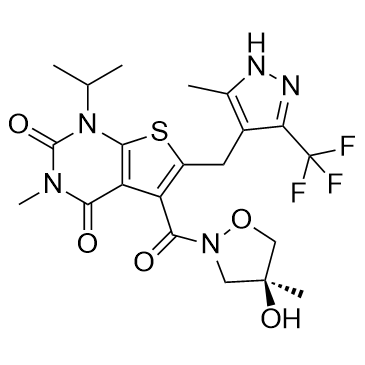
单羧酸转运蛋白1抑制剂AZD3965是一种口服的单羧酸转运蛋白1 (MCT1) 抑制剂,具有潜在的抗肿瘤活性。口服后,MCT1抑制剂AZD3965与MCT1结合,阻止乳酸进出细胞。这导致乳酸积累、细胞内酸化,最终导致癌细胞死亡。MCT1是一种在肿瘤细胞上过度表达的蛋白质,负责将单羧酸转运过细胞膜,并在细胞代谢中发挥关键作用。
AZD3965是由阿斯利康公司开发的一种特异性MCT1抑制剂,不同于非特异性抑制剂α-氰基-4-羟基肉桂酸酯(CHC)。[1] 其作用机制是通过抑制乳酸进入氧合肿瘤细胞,从而破坏肿瘤内的代谢共生,迫使肿瘤细胞依赖糖酵解,进而使缺氧细胞缺乏葡萄糖,造成代谢应激。 [1]药物诱导的糖酵解增强、氧化应激(尤其是在缺氧条件下)以及乳酸穿梭障碍被认为是其抗肿瘤活性和放射增敏作用的机制。[1]本研究为将AZD3965与放射疗法联合用于治疗小细胞肺癌等实体瘤提供了临床前依据。[1] |
| 分子式 |
C21H24F3N5O5S
|
|---|---|
| 分子量 |
515.5060
|
| 精确质量 |
515.145
|
| CAS号 |
1448671-31-5
|
| 相关CAS号 |
1448671-31-5; 733809-45-5;
|
| PubChem CID |
10369242
|
| 外观&性状 |
White to off-white solid powder
|
| 密度 |
1.5±0.1 g/cm3
|
| 沸点 |
723.1±70.0 °C at 760 mmHg
|
| 闪点 |
391.1±35.7 °C
|
| 蒸汽压 |
0.0±2.5 mmHg at 25°C
|
| 折射率 |
1.597
|
| LogP |
1.45
|
| tPSA |
147
|
| 氢键供体(HBD)数目 |
2
|
| 氢键受体(HBA)数目 |
10
|
| 可旋转键数目(RBC) |
4
|
| 重原子数目 |
35
|
| 分子复杂度/Complexity |
894
|
| 定义原子立体中心数目 |
1
|
| SMILES |
CC1=C(C(=NN1)C(F)(F)F)CC2=C(C3=C(S2)N(C(=O)N(C3=O)C)C(C)C)C(=O)N4C[C@](CO4)(C)O
|
| InChi Key |
PRNXOFBDXNTIFG-FQEVSTJZSA-N
|
| InChi Code |
InChI=1S/C21H24F3N5O5S/c1-9(2)29-18-14(16(30)27(5)19(29)32)13(17(31)28-7-20(4,33)8-34-28)12(35-18)6-11-10(3)25-26-15(11)21(22,23)24/h9,33H,6-8H2,1-5H3,(H,25,26)/t20-/m0/s1
|
| 化学名 |
(S)-5-(4-hydroxy-4-methylisoxazolidine-2-carbonyl)-1-isopropyl-3-methyl-6-((3-methyl-5-(trifluoromethyl)-1H-pyrazol-4-yl)methyl)thieno[2,3-d]pyrimidine-2,4(1H,3H)-dione
|
| 别名 |
AZD3965; AZD-3965; AZD 3965
|
| HS Tariff Code |
2934.99.9001
|
| 存储方式 |
Powder -20°C 3 years 4°C 2 years In solvent -80°C 6 months -20°C 1 month |
| 运输条件 |
Room temperature (This product is stable at ambient temperature for a few days during ordinary shipping and time spent in Customs)
|
| 溶解度 (体外实验) |
DMSO : ~100 mg/mL (~193.98 mM)
|
|---|---|
| 溶解度 (体内实验) |
配方 1 中的溶解度: ≥ 2.08 mg/mL (4.03 mM) (饱和度未知) in 10% DMSO + 40% PEG300 + 5% Tween80 + 45% Saline (这些助溶剂从左到右依次添加,逐一添加), 澄清溶液。
例如,若需制备1 mL的工作液,可将100 μL 20.8 mg/mL澄清DMSO储备液加入400 μL PEG300中,混匀;然后向上述溶液中加入50 μL Tween-80,混匀;加入450 μL生理盐水定容至1 mL。 *生理盐水的制备:将 0.9 g 氯化钠溶解在 100 mL ddH₂O中,得到澄清溶液。 配方 2 中的溶解度: ≥ 2.08 mg/mL (4.03 mM) (饱和度未知) in 10% DMSO + 90% (20% SBE-β-CD in Saline) (这些助溶剂从左到右依次添加,逐一添加), 澄清溶液。 例如,若需制备1 mL的工作液,可将 100 μL 20.8 mg/mL澄清DMSO储备液加入900 μL 20% SBE-β-CD生理盐水溶液中,混匀。 *20% SBE-β-CD 生理盐水溶液的制备(4°C,1 周):将 2 g SBE-β-CD 溶解于 10 mL 生理盐水中,得到澄清溶液。 View More
配方 3 中的溶解度: ≥ 2.08 mg/mL (4.03 mM) (饱和度未知) in 10% DMSO + 90% Corn Oil (这些助溶剂从左到右依次添加,逐一添加), 澄清溶液。 配方 4 中的溶解度: 5 mg/mL (9.70 mM) in 20% HP-β-CD in Saline (这些助溶剂从左到右依次添加,逐一添加), 悬浮液; 超声助溶 (<60°C). *生理盐水的制备:将 0.9 g 氯化钠溶解在 100 mL ddH₂O中,得到澄清溶液。 配方 5 中的溶解度: 5 mg/mL (9.70 mM) in 0.5% HPMC 0.2%Tween80 (这些助溶剂从左到右依次添加,逐一添加), 悬浊液; 超声助溶。 1、请先配制澄清的储备液(如:用DMSO配置50 或 100 mg/mL母液(储备液)); 2、取适量母液,按从左到右的顺序依次添加助溶剂,澄清后再加入下一助溶剂。以 下列配方为例说明 (注意此配方只用于说明,并不一定代表此产品 的实际溶解配方): 10% DMSO → 40% PEG300 → 5% Tween-80 → 45% ddH2O (或 saline); 假设最终工作液的体积为 1 mL, 浓度为5 mg/mL: 取 100 μL 50 mg/mL 的澄清 DMSO 储备液加到 400 μL PEG300 中,混合均匀/澄清;向上述体系中加入50 μL Tween-80,混合均匀/澄清;然后继续加入450 μL ddH2O (或 saline)定容至 1 mL; 3、溶剂前显示的百分比是指该溶剂在最终溶液/工作液中的体积所占比例; 4、 如产品在配制过程中出现沉淀/析出,可通过加热(≤50℃)或超声的方式助溶; 5、为保证最佳实验结果,工作液请现配现用! 6、如不确定怎么将母液配置成体内动物实验的工作液,请查看说明书或联系我们; 7、 以上所有助溶剂都可在 Invivochem.cn网站购买。 |
| 制备储备液 | 1 mg | 5 mg | 10 mg | |
| 1 mM | 1.9398 mL | 9.6991 mL | 19.3983 mL | |
| 5 mM | 0.3880 mL | 1.9398 mL | 3.8797 mL | |
| 10 mM | 0.1940 mL | 0.9699 mL | 1.9398 mL |
1、根据实验需要选择合适的溶剂配制储备液 (母液):对于大多数产品,InvivoChem推荐用DMSO配置母液 (比如:5、10、20mM或者10、20、50 mg/mL浓度),个别水溶性高的产品可直接溶于水。产品在DMSO 、水或其他溶剂中的具体溶解度详见上”溶解度 (体外)”部分;
2、如果您找不到您想要的溶解度信息,或者很难将产品溶解在溶液中,请联系我们;
3、建议使用下列计算器进行相关计算(摩尔浓度计算器、稀释计算器、分子量计算器、重组计算器等);
4、母液配好之后,将其分装到常规用量,并储存在-20°C或-80°C,尽量减少反复冻融循环。
计算结果:
工作液浓度: mg/mL;
DMSO母液配制方法: mg 药物溶于 μL DMSO溶液(母液浓度 mg/mL)。如该浓度超过该批次药物DMSO溶解度,请首先与我们联系。
体内配方配制方法:取 μL DMSO母液,加入 μL PEG300,混匀澄清后加入μL Tween 80,混匀澄清后加入 μL ddH2O,混匀澄清。
(1) 请确保溶液澄清之后,再加入下一种溶剂 (助溶剂) 。可利用涡旋、超声或水浴加热等方法助溶;
(2) 一定要按顺序加入溶剂 (助溶剂) 。
Effect of AZD3965 on lactate concentration, blood vessel density and MCT4 expression in H526 xenografts.Mol Cancer Ther. 2014 Dec;13(12):2805-16. |
AZD3965 increases intracellular lactate whilst decreasing the amount of extracellular lactate.Mol Cancer Ther. 2014 Dec;13(12):2805-16. |
AZD3965 significantly reduces lactate uptake.Mol Cancer Ther. 2014 Dec;13(12):2805-16. |
Inhibiting lactate transport increases glycolytic rate.Mol Cancer Ther. 2014 Dec;13(12):2805-16. |
Combining AZD3965 with radiation to treat H526 xenografts.Mol Cancer Ther. 2014 Dec;13(12):2805-16. |
AZD3965 slows H526 xenograft growthin vivo.A)In vivogrowth curves showing tumour volume (mean and SEM) in mm3post start of treatment; the growth curve finishes when the first tumour in each group reaches 1000mm3. The control group contained 5 mice the AZD3965 group contained 11 mice three of which were sacrificed for histology at the end of drug treatment (day 7).B) Days (±SEM) taken to reach 1000mm3for each treatment group
The effect of inhibiting lactate transport on metabolism.Mol Cancer Ther. 2014 Dec;13(12):2805-16. |
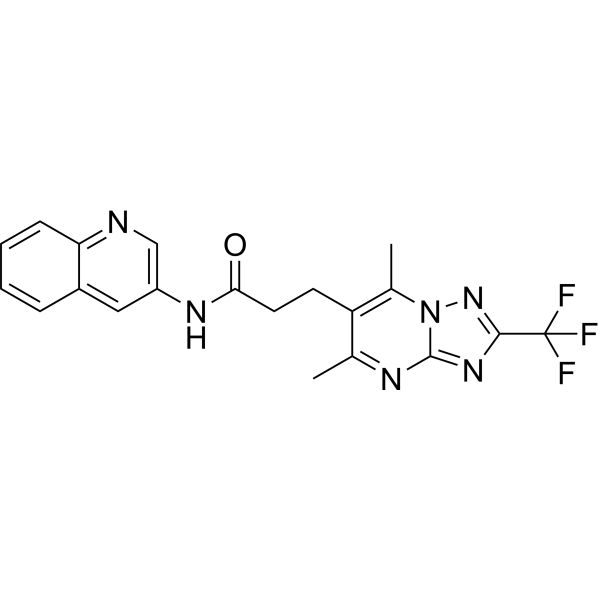 slCeMM1
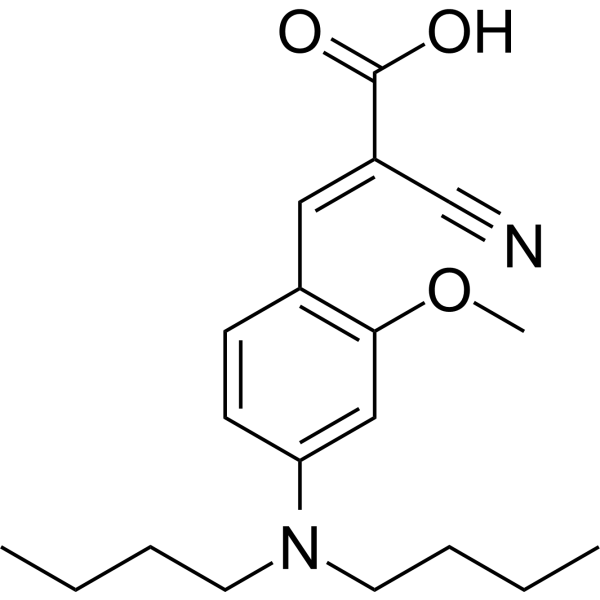 MCT-IN-1
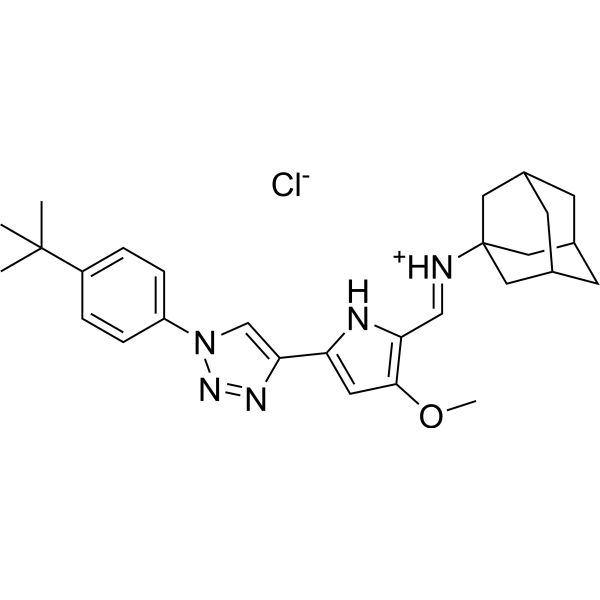 Lactate transportor 1
 MCT1-IN-3
InvivoChem的所有产品仅用于作科学研究,不面向患者销售
Copyright 2020 InvivoChem LLC | All Rights Reserved 粤ICP备20063088号-1


 COA
COA


 粤公网安备 44011102003439号
 463611831
