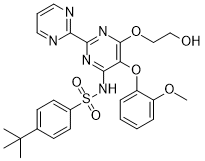
Bosentan

别名: Ro-47-0203; Ro47-0203; 147536-97-8; Tracleer; bosentan anhydrous; Actelion; Ro 47-0203; bosentanum; Bosentan [USAN:INN:BAN]; bosentan anhydrous; Ro 47-0203; bosentan monohydrate; Ro47 0203; Ro-47 0203; Tracleer 波生坦; 伯森坦; N-[6-(2-羟基乙氧基)-5-(2-甲氧基苯氧基)-2-嘧啶-2-基-嘧啶-4-基]-4-叔丁基-苯磺酰胺; 波生坦(水合物);波生坦标准品;波生坦杂质; 苯磺酰胺,4-(1,1-二甲基乙基)-N-[6-(2-羟基乙氧基)-5-(2-甲氧基苯氧基)[2,2'-联嘧啶]-4-基];柏森坦;伯森坦一水合物; 也叫波生坦一水合物; 波生坦, 一种内皮素受体拮抗剂;苯磺酰胺, 4-(1,1-二甲基乙基)-N-[6-(2-羟基乙氧基)-5-(2-甲氧基苯氧基)[2,2'-联嘧啶]-4-基]-
目录号: V1513 纯度: ≥98%
波生坦(原名 Ro 47-0203;商品名 Tracleer)是一种强效、竞争性、内皮素 (ET) 受体双重拮抗剂,具有抗高血压活性。
Bosentan CAS号: 147536-97-8
产品类别: Endothelin Receptor
产品仅用于科学研究,不针对患者销售
规格 价格 库存 数量
25mg
50mg
100mg
250mg
500mg
1g
Other Sizes

Other Forms of Bosentan:

  • Bosentan-d4
  • 波生坦一水合物
点击了解更多
InvivoChem产品被CNS等顶刊论文引用
纯度/质量控制文件

纯度: ≥98%

产品描述
波生坦(原名 Ro 47-0203;商品名 Tracleer)是一种有效的、竞争性的内皮素 (ET) 受体双重拮抗剂,具有抗高血压活性。它抑制 ET-A 和 ET-B,Ki 值分别为 4.7 nM 和 95 nM。波生坦用作治疗肺动脉高压(PAH)的血管扩张剂。
生物活性&实验参考方法
靶点
ETA receptor ( Ki = 4.7 nM ); ETA receptor ( Ki = 95 nM )
体外研究 (In Vitro)
体外活性:波生坦竞争性拮抗[125 I]标记的ET-1对人平滑肌细胞(ET-A受体)、人胎盘(ET-B受体)的特异性结合。波生坦还抑制猪气管上选择性 ET-B 配体的结合。离体大鼠主动脉 (ET-A) 中 ET-1 诱导的收缩和大鼠气管中选择性 ET-B 激动剂 sarafotoxin S6C 诱导的收缩被波生坦竞争性抑制(pA2 分别 = 7.2 和 6.0),内皮依赖性舒张也是如此。兔肠系膜上动脉中sarafotoxin S6C (pA2= 6.7)。波生坦对其他 40 种肽、前列腺素、离子和神经递质的结合没有显着影响,这显示了其对 ET 受体的特异性。细胞测定:进行了一项体外研究,测量波生坦对真皮微血管内皮细胞 (MVEC) 血管生成性能的影响,并检测波生坦抵消系统性硬化症血清抗血管生成作用的能力。研究发现,波生坦显着增加细胞活力,抵消系统性硬化症血清对真皮 MVEC 的抗血管生成作用。
波生坦/Bosentan是一种双重内皮素受体拮抗剂,通过逆转Fli1在SSc皮肤成纤维细胞中的转录活性来降低COL1A2基因的表达[2]
之前的报告表明,波生坦是一种双ET受体拮抗剂,可以逆转SSc成纤维细胞的促纤维化表型。然而,Bosentan/波生坦对SSc成纤维细胞发挥显著抗纤维化作用的详细机制仍然未知。我们之前已经证明,Fli1缺乏有助于SSc成纤维细胞中促纤维化表型的建立,而靶向c-Abl/PKC-δ/Fli1通路的甲磺酸伊马替尼逆转了这些细胞的促纤维化表型。鉴于SSc成纤维细胞被转化生长因子β(TGF-β)的自分泌刺激组成型激活,TGF-β是ET-1的强效诱导剂,并产生过量的ET-1,自分泌ET-1似乎参与了SSc成细胞的自激活系统。目前观察到ET-1使Fli1的转录活性失活,这表明波生坦阻断自分泌ET-1通过重新激活Fli1的翻译阻遏物活性逆转了SSc成纤维细胞的促纤维化表型。为了解决这个问题,我们使用培养的SSc皮肤成纤维细胞进行了一系列实验。[2]
支持自分泌ET-1对SSc皮肤成纤维细胞活化的贡献,外源性ET-1不影响I型胶原表达(图5A),而Bosentan/波生坦以剂量依赖的方式抑制I型胶原的表达,对SSc真皮成纤维细胞的细胞存活率没有任何影响(图5B和表1)。此外,在用波生坦治疗的SSc皮肤成纤维细胞中,c-Abl的总水平和磷酸化水平以及PKC-δ的总水平及核定位降低(图5C和5D)。一致地,在用波生坦治疗的SSc皮肤成纤维细胞中,苏氨酸312处的Fli1磷酸化减少(图5E),Fli1在COL1A2启动子上的占有率增加(图5F)。重要的是,波生坦不影响SSc皮肤成纤维细胞中FLI1基因的mRNA水平(图5G)。总的来说,这些结果表明,自分泌ET-1有助于激活SSc皮肤成纤维细胞,波生坦通过增加Fli1的DNA结合能力逆转了SSc皮肤成纤维细胞的促纤维化表型。[2]
体内研究 (In Vivo)
静脉注射和口服给药后,波生坦均可抑制大 ET-1 的加压反应,作用持续时间长,且无内在激动剂活性。波生坦还抑制 ET-1 和 sarafotoxin S6C 的抑制和升压作用。其药理学特征使波生坦成为治疗与血管收缩相关的临床疾病的潜在有用药物。波生坦是第一个口服非肽混合 ETA/B 受体拮抗剂。波生坦的长期治疗显着提高了慢性心力衰竭大鼠的生存率、血流动力学和心脏重塑。波生坦降低动脉血压的程度与血管紧张素转换酶 (ACE) 抑制剂相似。急性 MI 后患有 CHF 的大鼠服用波生坦可显着降低动脉血压,并且与 ACE 抑制剂具有相加效应。波生坦的急性和慢性治疗还可以通过降低外周和肺血管阻力以及增加 CHF 患者的心输出量来改善全身和肺血流动力学。
波生坦增加了BLM诱导的SSc小鼠模型皮损皮肤成纤维细胞中Fli1蛋白的表达[2]
最后,我们研究了波生坦是否会增加BLM诱导的SSc小鼠模型皮损皮肤成纤维细胞中Fli1蛋白的表达,因为之前的报告表明,波生坦可以预防该模型中皮肤纤维化的发展。由于我们可以再现波生坦对BLM治疗小鼠皮肤纤维化的预防作用(图6A),我们在这些小鼠的皮肤样本中对Fli1进行了免疫染色。如图6B所示,在没有波生坦的情况下,BLM处理的小鼠皮肤成纤维细胞中Fli1阳性皮肤成纤维纤维细胞的数量比PBS处理的小鼠减少得多。相比之下,当施用波生坦时,BLM处理的小鼠和PBS处理的小鼠之间Fli1阳性皮肤成纤维细胞的数量相当。重要的是,Fli1和肌成纤维细胞的标志物α-SMA在双重免疫荧光中的信号在大多数皮肤成纤维细胞中是互斥的(图6C),表明Fli1的表达与体内皮肤成纤维纤维细胞的失活密切相关。总的来说,这些结果表明,波生坦通过增加损伤皮肤成纤维细胞中Fli1蛋白的表达,至少部分地预防了BLM诱导的SSc小鼠模型中皮肤纤维化的发展。
DSS大鼠最大有效剂量的测定以及观察到马西坦的最大疗效大于Bosentan波生坦[3]
DSS大鼠的MAP升高至约180 mm Hg。不同实验组的MAP和HR基线值相似。急性口服后,macitentan剂量依赖性地降低了DSS大鼠的MAP。最大有效剂量为30mg/kg;该剂量使MAP降低了30±5 mm Hg(表1)。给药后约24小时达到最大效果(Tmax)。急性口服波生坦可剂量依赖性地降低DSS大鼠的MAP。在100 mg/kg的最大有效剂量下,波生坦使MAP降低了15±2 mm Hg(表1),Tmax在6小时。未观察到对HR的影响。根据这些数据,为附加研究选择了30 mg/kg的马西坦和100 mg/kg的波生坦的最大有效剂量。波生坦的Tmax为6小时,马西坦为24小时。
使用附加方案在DSS大鼠中确认选择马西坦和Bosentan/波生坦的最大有效剂量[3]
使用附加方案证实了最大有效剂量的马西坦和波生坦的使用:与马西坦上的赋形剂相比,在马西坦30 mg/kg的基础上服用马西坦30mg/kg不会导致额外的MAP降低(-29±2和-28±5 mm Hg)。当波生坦100 mg/kg达到最大效果时,与波生坦上的赋形剂相比,波生坦100mg/kg不会引起额外的MAP降低(分别为-13±2和-14±3 mm Hg;图2)。
在DSS大鼠中使用附加方案对马西坦和Bosentan波生坦进行比较[3]
当达到波生坦100 mg/kg的最大效果时,口服马西替坦30 mg/kg,与在波生坦100mg/kg的基础上服用赋形剂相比,MAP额外降低了19 mm Hg(p<0.01)。马西替丹引起的最大降低为33±4 mm Hg(图2)。相反,当达到马西坦30mg/kg的最大效果时,以100mg/kg的剂量口服波生坦,与在马西坦30 mg/kg的基础上服用的赋形剂相比,不会引起额外的MAP降低(图3)。
博莱霉素治疗大鼠的最大有效剂量测定,并观察到马西坦的最大疗效大于Bosentan/波生坦[3]
与盐水滴注的大鼠相比,博莱霉素治疗的大鼠MPAP增加了约13 mm Hg。不同实验组的MPAP和HR基线值相似。急性口服macitentan和波生坦可剂量依赖性地降低博莱霉素大鼠的MPAP(表1),而不影响HR(数据未显示)。在30 mg/kg的剂量下,MPAP的最大下降量为12±3 mm Hg,大约在给药后24小时(Tmax)。在300 mg/kg的最大有效剂量下,波生坦使MPAP降低了7±2 mm Hg(表1),Tmax约为6小时。根据这些数据,选择30 mg/kg的马西坦和300 mg/kg的波生坦进行附加研究。波生坦的Tmax为6小时,马西坦为24小时。
在博莱霉素治疗的大鼠中使用附加方案确认Bosentan波生坦最大有效剂量的选择[3]
使用附加方案证实了最大有效剂量的马西坦和波生坦的使用:与马西坦上的赋形剂相比,在马西坦30 mg/kg的基础上服用马西坦30mg/kg不会导致额外的MPAP降低(-18±2和-13±2 mm Hg,p=0.112)。同样,如图4所示,与波生坦上的赋形剂相比,当波生坦300 mg/kg达到最大效果时,服用波生坦300mg/kg不会导致额外的MPAP降低(分别为-8±1和-7±1 mm Hg)。
在博莱霉素治疗的大鼠中,使用附加方案对马西坦和Bosentan/波生坦进行比较[3]
当波生坦300 mg/kg达到最大效果时,博莱霉素大鼠口服马西坦30 mg/kg,与波生坦300mg/kg上的赋形剂相比,会导致MPAP进一步降低。马西坦在波生坦上引起的最大降低为-11±1 mm Hg(与赋形剂相比,p<0.01)(图4)。相反,当达到马西坦30mg/kg的最大效果时,以300mg/kg的剂量口服波生坦,与在马西坦30 mg/kg的基础上服用的赋形剂相比,没有引起额外的MPAP降低(图5)。
无药物相互作用[3]
如图6所示,服用波生坦不会改变马西坦及其活性代谢产物ACT-132577的血浆浓度,排除了波生坦在附加方案中对马西坦药代动力学的影响。
细胞实验
台盼蓝排除试验用于评估细胞的活力。波生坦以推荐浓度(10、20 和 40 μM)添加到人真皮成纤维细胞中。 24 小时和 48 小时后,评估细胞活力。血细胞计数器用于对染色(死)和未染色(活)细胞进行计数[2]。
细胞活力测定[2]
通过台盼蓝排斥试验评估细胞存活率。用指定浓度的Bosentan/波生坦处理细胞。在24小时和48小时检查细胞活力。用血细胞计数器计数染色(死)和未染色(活)细胞。
免疫印迹[2]
将汇合的静止成纤维细胞血清饥饿48小时并收获。在一些实验中,细胞在收获前用ET-1或Bosentan/波生坦刺激指定的时间。如前所述制备全细胞裂解物和核提取物。样品经过十二烷基硫酸钠聚丙烯酰胺凝胶电泳和用指定的一抗进行免疫印迹。使用增强的化学发光技术检测条带。根据一系列试点实验,分别使用核提取物和全细胞裂解物进行免疫印迹时,抗Fli1抗体和抗磷酸Fli1(Thr312)特异性抗体的效果要好得多。
实时荧光定量PCR评价COL1A2启动子活性[2]
正常或SSc成纤维细胞在100mm培养皿中生长至50%融合,使用FuGENE6用指定的构建体和pSV-β-半乳糖苷酶(β-GAL)转染。在37°C下孵育过夜后,一些细胞用ET-1或Bosentan/波生坦进一步刺激24小时。收集细胞,使用RT-PCR测定CAT和β-GAL mRNA水平。β-GAL mRNA水平使转染效率正常化。在某些样本中,已证实该方法再现了使用[14C]-氯霉素进行CAT报告分析的规范方法评估的相对启动子活性的结果。引物序列如下:CAT正向5′-TTCCGTCTCAGCACATCCCTGGGTGA-3′和反向5′-CCCATCGGTGAAAACGGGGGCGAA-3′;β-GAL正向5′-TCCACCTTCCCTGGTTA-3′和反向5′-AGAGTCGGGGGGGGGTTTG-3′。
动物实验
Rats: Rats that are two months old—DSS and Wistar—are employed. Doses ranging from 0.1 to 100 mg/kg (Macitentan) or 3 to 600 mg/kg (Bosentan) are used to measure the pharmacological effects on heart rate (HR), mean arterial pressure (MAP), or mean pulmonary arterial pressure (MPAP), and up to 120 hours after a single gavage. 1) Macitentan is given on top of the maximum effective dose of Bosentan determined by the dose-response curve in order to assess whether Macitentan can offer greater pharmacological activity compared to Bosentan. Secondly, the maximum effective dose of Macitentan is topped off with the same dose of Bosentan. Tmax of the first tested compound is the point at which the second compound's maximal effective dose is given.
Dose–response curves and add-on protocol [3]
First, dose–response curves of each ERA were constructed in both systemic hypertensive DSS rats and bleomycin-induced pulmonary hypertensive Wistar rats to determine the maximal effective dose and Tmax (time of observed maximal effect) of each ERA. Pharmacological effects on MAP or MPAP and HR were measured up to 120 h after a single gavage at doses ranging from 0.1 to 100 mg/kg (macitentan) or 3 to 600 mg/kg (Bosentan). To determine whether macitentan could provide superior pharmacological activity vs. bosentan, we designed a study in which: 1) macitentan was administered on top of the maximal effective dose of bosentan established by the dose–response curve as shown in Fig. 1, Fig. 2) the same dose of bosentan was administered on top of the maximal effective dose of macitentan. The maximal effective dose of the second compound was administered at Tmax of the first tested compound.
Pharmacokinetics [3]
In order to rule out any confounding drug–drug interaction on the pharmacological effect measured, the exposure of macitentan and its active metabolite ACT-132577 was measured in the presence or absence of Bosentan in similar conditions to the add-on protocol. Vehicle or bosentan 300 mg/kg was administered to Wistar rats (n = 6/group) 6 h prior to macitentan 30 mg/kg. Plasma samples were collected at 1, 2, 3, 4, 6, 8 and 24 h after oral administration of macitentan, and quantification of macitentan and ACT-132577 was determined by liquid chromatography coupled to mass spectrometry.
Test compounds [3]
Macitentan and Bosentan were supplied by Actelion Pharmaceuticals Ltd. Gelatin 7.5%, administered at 5 mL/kg, was used as vehicle for oral administration of the compounds by gavage.
药代性质 (ADME/PK)
吸收、分布和排泄
绝对生物利用度约为50%,食物不影响吸收。
波生坦经肝脏代谢后,通过胆汁排泄。
18 L
4 L/h [肺动脉高压患者]
代谢/代谢物
波生坦在肝脏中经细胞色素P450酶CYP2C9和CYP3A4(以及可能的CYP2C19)代谢,产生三种代谢物,其中一种Ro 48-5033具有药理活性,可能贡献母体化合物总活性的10%至20%。
已知的波生坦人体代谢物包括羟基波生坦和4-叔丁基-N-[6-(2-羟基乙氧基)-5-(2-羟基苯氧基)-[2,2-]联嘧啶-4-基]-苯磺酰胺。
生物半衰期
在健康成年人中,末端消除半衰期约为5小时。
毒性/毒理 (Toxicokinetics/TK)
肝毒性
波生坦可导致3%至18%的患者出现血清转氨酶水平升高,超过正常值上限(ULN)三倍,使用目前推荐剂量时平均发生率为7.6%。酶升高通常可自行缓解,且很少伴有症状,但有时升高幅度较大且持续存在,需要减少剂量或停药(3%至4%的患者)。建议每月监测血清转氨酶水平,若转氨酶水平超过ULN八倍或持续超过ULN五倍,则应停药。另有罕见病例报告显示,使用波生坦可出现临床表现明显的肝损伤,并伴有黄疸。发病通常在开始使用波生坦后1至6个月内,但也曾有长期治疗期间出现病例的报道(病例1)。酶谱通常为肝细胞型或混合型。通常不出现免疫过敏症状,自身抗体通常不存在或滴度很低。部分病例病情严重,并有死亡病例报告,但尚未有已发表的关于波生坦引起慢性肝炎或胆管消失综合征的报告。通常不出现自身免疫和免疫过敏症状。
可能性评分:C(可能是临床上明显的肝损伤的原因)。
妊娠和哺乳期影响
◉ 哺乳期用药概述
一项针对一名哺乳期服用波生坦患者的研究发现,其乳汁中药物浓度极低。另一名妇女在服用波生坦和西地那非期间哺乳早产儿,未报告不良反应。婴儿摄入的剂量远低于治疗婴儿的剂量,预计不会对母乳喂养的婴儿造成任何不良影响。
◉ 对母乳喂养婴儿的影响
一名23岁患有先天性心脏病和肺动脉高压的女性在怀孕期间接受了波生坦和西地那非治疗,剂量不详。产后继续服用这些药物和华法林。她的婴儿在妊娠30周时通过剖腹产分娩,出生体重1.41公斤。据作者所述,她在新生儿重症监护室哺乳了11周,“结果良好”,但婴儿在妊娠26周时死于呼吸道合胞病毒感染。[2]
一名正在哺乳其21个月大婴儿的女性,每天服用3次20毫克西地那非和每天2次125毫克波生坦来治疗肺动脉高压。药物在产后6个月以上开始使用。母亲未报告从出生到产后第651天期间婴儿出现任何可能的不良反应、严重健康问题或住院情况,在此期间婴儿仍接受部分母乳喂养。[1]
◉ 对哺乳和母乳的影响
截至修订日期,未找到相关的已发表信息。
蛋白结合
与血浆蛋白(主要是白蛋白)的结合率大于98%。
毒性概述
波生坦耐受性良好,在患者接受适当监测的情况下,毒性风险极低。然而,当与环孢素A合用时,波生坦的血浆浓度升高了30倍,导致严重的头痛、恶心和呕吐。但这些患者未出现严重的不良反应或毒性。在上市后监测期间,一名男性患者服用10000毫克波生坦后出现过量用药,导致恶心、呕吐、低血压、视力模糊和出汗。经充分的血压支持治疗后,患者完全康复。
参考文献

[1]. Bosentan: a review of its use in the management of mildly symptomatic pulmonary arterial hypertension. Am J Cardiovasc Drugs. 2009;9(5):331-50.

[2]. Bosentan reverses the pro-fibrotic phenotype of systemic sclerosis dermal fibroblasts via increasing DNA binding ability of transcription factor Fli1. Arthritis Res Ther. 2014 Apr 3;16(2):R86.

[3]. Comparison of pharmacological activity of macitentan and bosentan in preclinical models of systemic and pulmonary hypertension. Life Sci. 2014 Nov 24;118(2):333-9.

[4]. Endothelin Regulates Porphyromonas gingivalis-Induced Production of Inflammatory Cytokines. PLoS One. 2016 Dec 28;11(12):e0167713.

其他信息
波生坦是一种磺胺类药物,属于嘧啶类和伯醇类。它是一种抗高血压药和内皮素受体拮抗剂。
波生坦是一种双重内皮素受体拮抗剂,由Actelion Pharmaceuticals公司以商品名Tracleer上市销售。波生坦通过阻断内皮素分子的作用来治疗肺动脉高压,内皮素分子原本会促进血管收缩并导致高血压。
无水波生坦是一种内皮素受体拮抗剂。无水波生坦的作用机制是作为内皮素受体拮抗剂、细胞色素P450 3A诱导剂和细胞色素P450 2C9诱导剂。
波生坦是一种内皮素受体拮抗剂,用于治疗肺动脉高压(PAH)。波生坦治疗期间曾出现血清酶升高,并偶见临床表现明显的急性肝损伤。
波生坦是一种磺胺类药物衍生的竞争性特异性内皮素受体拮抗剂,其对内皮素A受体的亲和力略高于内皮素B受体。波生坦通过与内皮细胞和血管平滑肌中的内皮素A和内皮素B受体结合,阻断内皮素1(一种强效的内源性血管收缩剂和支气管收缩剂)的作用。波生坦可降低肺血管阻力和全身血管阻力,尤其用于治疗肺动脉高压。
一种磺胺类和嘧啶类衍生物,作为双重内皮素受体拮抗剂,用于治疗肺动脉高压和系统性硬化症。
药物适应症
用于治疗肺动脉高压 (PAH),以改善运动能力并降低临床恶化速度(适用于 WHO III 级或 IV 级症状的患者)。
FDA 标签
用于治疗 WHO 功能分级 III 级的肺动脉高压 (PAH),以改善患者的运动能力和症状。已证实对以下情况有效:,,,原发性(特发性和家族性)PAH;,继发于硬皮病且无明显间质性肺疾病的 PAH;与先天性体肺分流和艾森门格综合征相关的肺动脉高压 (PAH)。在 WHO 功能分级 II 级的 PAH 患者中也显示出一些改善。Tracleer 还适用于减少系统性硬化症合并持续性指端溃疡患者的新发指端溃疡数量。用于治疗肺动脉高压 (PAH),以改善世界卫生组织 (WHO) 功能分级 III 级患者的运动能力和症状。已证实对以下情况有效:原发性(特发性和家族性)PAH;继发于硬皮病且无明显间质性肺疾病的 PAH;与先天性体肺分流和艾森门格综合征相关的 PAH。在 WHO 功能分级 II 级的 PAH 患者中也显示出一些改善。 Stayveer 还适用于减少系统性硬化症合并持续性指端溃疡患者新发指端溃疡的数量。
治疗间质性肺纤维化、治疗肺动脉高压、治疗系统性硬化症
作用机制
内皮素-1 (ET-1) 是一种神经激素,其作用是通过与内皮细胞和血管平滑肌中的 ETA 和 ETB 受体结合介导的。它对 ETA 受体的亲和力略高于 ETB 受体。肺动脉高压患者的血浆和肺组织中 ET-1 浓度升高,提示 ET-1 在该疾病的发病机制中发挥作用。波生坦是内皮素受体ETA和ETB的特异性竞争性拮抗剂。
药效学
波生坦属于内皮素受体拮抗剂(ERA)类药物。肺动脉高压(PAH)患者的血浆和肺组织中内皮素水平升高,内皮素是一种强效的血管收缩剂。波生坦可阻断内皮素与其受体的结合,从而消除内皮素的有害作用。
波生坦(Tracleer)是一种口服的双重内皮素-1(ET-1)受体拮抗剂,获准用于治疗WHO II级(轻度症状性)肺动脉高压(PAH)患者。口服波生坦治疗对轻度症状性PAH患者有益,且通常耐受性良好。在一项设计良好的安慰剂对照试验中,研究人员对轻度症状性肺动脉高压(PAH)的青少年和成人患者进行了研究,结果显示,与安慰剂相比,波生坦显著降低了肺血管阻力,但6分钟步行距离并未显著增加。同样,在一项小型非对照试验中,波生坦也使儿童患者(其中大多数患有轻度症状性PAH)的血流动力学指标有所改善,但运动能力并未显著提高。波生坦的不良反应与其他适应症中观察到的不良反应一致,主要关注点是潜在的致畸性和肝毒性,因此建议定期监测肝功能。总体而言,考虑到PAH的进展性,波生坦为轻度症状性PAH患者提供了更多治疗选择。 [1]
引言:尽管系统性硬化症(SSc)的发病机制仍不甚明了,但近期研究表明,内皮素在SSc相关的纤维化和血管病变发展过程中发挥着重要作用,而双重内皮素受体拮抗剂波生坦有望成为该疾病的疾病修饰药物。重要的是,内皮素-1(ET-1)对正常真皮成纤维细胞具有促纤维化作用,而波生坦能够逆转SSc真皮成纤维细胞的促纤维化表型。本研究旨在阐明ET-1和波生坦对真皮成纤维细胞作用的分子机制,这些机制目前尚未得到充分研究。方法:分别采用逆转录实时PCR和免疫印迹法检测靶基因的mRNA水平以及靶蛋白的表达和磷酸化水平。采用人α2(I)型胶原(COL1A2)启动子序列缺失进行启动子分析。利用DNA亲和沉淀和染色质免疫沉淀技术评估Fli1的DNA结合能力。通过免疫染色评估小鼠皮肤中Fli1蛋白的表达水平。结果:在正常成纤维细胞中,ET-1激活c-Abl和蛋白激酶C (PKC)-δ,并诱导Fli1在苏氨酸312位点磷酸化,导致Fli1(COL1A2基因的强效抑制因子)的DNA结合能力下降,以及I型胶原表达增加。另一方面,波生坦降低了c-Abl和PKC-δ的表达、PKC-δ的核定位以及Fli1的磷酸化水平,导致Fli1的DNA结合能力增强,并抑制系统性硬化症(SSc)成纤维细胞中I型胶原的表达。在博来霉素处理的小鼠中,波生坦可预防真皮纤维化并增加病变真皮成纤维细胞中 Fli1 的表达。结论:ET-1 通过激活“c-Abl - PKC-δ - Fli1”通路,对正常成纤维细胞发挥强效的促纤维化作用。波生坦通过阻断该信号通路,逆转系统性硬化症 (SSc) 成纤维细胞的促纤维化表型,并预防博来霉素处理小鼠真皮纤维化的发生。尽管波生坦治疗 SSc 真皮和肺纤维化的疗效有限,但本研究结果无疑为我们进一步探索即将推出的新型双重内皮素受体拮抗剂作为 SSc 疾病修饰药物的潜力提供了有用的线索。[2]
目的:内皮素 (ET) 系统是一个组织系统,因为 ET 同工酶的产生主要为自分泌或旁分泌。马西替坦是一种新型的双重 ETA/ETB 受体拮抗剂,具有增强的组织分布和持续的受体结合特性,旨在实现更有效的 ET 受体阻断。为了确定这些特性是否能转化为体内疗效的提高,我们设计了一项研究,将患有全身性或肺动脉高压并佩戴遥测装置的大鼠,在给予最大有效剂量的另一种双重ETA/ETB受体拮抗剂波生坦(其不具有持续的受体占有率,且组织分布较少)的基础上,再给予马西替坦。主要方法:在清醒的、对盐敏感的Dahl高血压大鼠和经博来霉素治疗的肺动脉高压大鼠中建立两种化合物的剂量反应曲线后,在给予最大有效剂量的波生坦的基础上,再给予马西替坦。主要结果:在高血压大鼠中,在给予100 mg/kg波生坦的基础上,再给予30 mg/kg马西替坦,可使平均动脉压(MAP)进一步降低19 mmHg(n=9,与溶剂对照组相比,p<0.01)。相反,在给予马西替坦的基础上再给予波生坦,未能引起MAP的进一步降低。在肺动脉高压大鼠模型中,在波生坦的基础上加用马西替坦30 mg/kg可使平均肺动脉压(MPAP)进一步降低4 mmHg(n=8,与溶媒组相比p<0.01),而加用最大有效剂量的波生坦则未引起MPAP的进一步降低。意义:在两种病理模型中,马西替坦与波生坦联合用药的附加效应证实,这种新型化合物能够更有效地阻断内皮素受体,并为其更高的最大疗效提供了证据。[3]
*注: 文献方法仅供参考, InvivoChem并未独立验证这些方法的准确性
化学信息 & 存储运输条件
分子式
C27H29N5O6S
分子量
551.61
精确质量
551.183
元素分析
C, 58.79; H, 5.30; N, 12.70; O, 17.40; S, 5.81
CAS号
147536-97-8
相关CAS号
Bosentan-d4; 1065472-77-6; Bosentan hydrate; 157212-55-0
PubChem CID
104865
外观&性状
White to off-white solid powder
密度
1.3±0.1 g/cm3
沸点
742.3±70.0 °C at 760 mmHg
熔点
171-175 °C(lit.)
闪点
402.8±35.7 °C
蒸汽压
0.0±2.6 mmHg at 25°C
折射率
1.607
LogP
1.15
tPSA
154.03
氢键供体(HBD)数目
2
氢键受体(HBA)数目
11
可旋转键数目(RBC)
11
重原子数目
39
分子复杂度/Complexity
839
定义原子立体中心数目
0
SMILES
O=S(NC1=NC(C2=NC=CC=N2)=NC(OCCO)=C1OC3=CC=CC=C3OC)(C4=CC=C(C(C)(C)C)C=C4)=O
InChi Key
GJPICJJJRGTNOD-UHFFFAOYSA-N
InChi Code
InChI=1S/C27H29N5O6S/c1-27(2,3)18-10-12-19(13-11-18)39(34,35)32-23-22(38-21-9-6-5-8-20(21)36-4)26(37-17-16-33)31-25(30-23)24-28-14-7-15-29-24/h5-15,33H,16-17H2,1-4H3,(H,30,31,32)
化学名
4-tert-butyl-N-[6-(2-hydroxyethoxy)-5-(2-methoxyphenoxy)-2-pyrimidin-2-ylpyrimidin-4-yl]benzenesulfonamide
别名
Ro-47-0203; Ro47-0203; 147536-97-8; Tracleer; bosentan anhydrous; Actelion; Ro 47-0203; bosentanum; Bosentan [USAN:INN:BAN]; bosentan anhydrous; Ro 47-0203; bosentan monohydrate; Ro47 0203; Ro-47 0203; Tracleer
HS Tariff Code
2934.99.9001
存储方式

Powder      -20°C    3 years

                     4°C     2 years

In solvent   -80°C    6 months

                  -20°C    1 month

运输条件
Room temperature (This product is stable at ambient temperature for a few days during ordinary shipping and time spent in Customs)
溶解度数据
溶解度 (体外实验)
DMSO: ~100 mg/mL (~181.3 mM)
Water: <1 mg/mL
Ethanol: ~3 mg/mL (~5.4 mM)
溶解度 (体内实验)
配方 1 中的溶解度: ≥ 2.75 mg/mL (4.99 mM) (饱和度未知) in 5% DMSO + 40% PEG300 + 5% Tween80 + 50% Saline (这些助溶剂从左到右依次添加,逐一添加), 澄清溶液。
*生理盐水的制备:将 0.9 g 氯化钠溶解在 100 mL ddH₂O中,得到澄清溶液。

配方 2 中的溶解度: ≥ 2.75 mg/mL (4.99 mM) (饱和度未知) in 5% DMSO + 95% (20% SBE-β-CD in Saline) (这些助溶剂从左到右依次添加,逐一添加), 澄清溶液。
*20% SBE-β-CD 生理盐水溶液的制备(4°C,1 周):将 2 g SBE-β-CD 溶解于 10 mL 生理盐水中,得到澄清溶液。

View More

配方 3 中的溶解度: ≥ 2.5 mg/mL (4.53 mM) (饱和度未知) in 10% DMSO + 40% PEG300 + 5% Tween80 + 45% Saline (这些助溶剂从左到右依次添加,逐一添加), 澄清溶液。
例如,若需制备1 mL的工作液,可将 100 μL 25.0 mg/mL澄清DMSO储备液加入到400 μL PEG300中,混匀;然后向上述溶液中加入50 μL Tween-80,混匀;加入450 μL生理盐水定容至1 mL。
*生理盐水的制备:将 0.9 g 氯化钠溶解在 100 mL ddH₂O中,得到澄清溶液。


配方 4 中的溶解度: ≥ 2.5 mg/mL (4.53 mM) (饱和度未知) in 10% DMSO + 90% (20% SBE-β-CD in Saline) (这些助溶剂从左到右依次添加,逐一添加), 澄清溶液。
例如,若需制备1 mL的工作液,可将100μL 25.0mg/mL澄清的DMSO储备液加入到900μL 20%SBE-β-CD生理盐水中,混匀。
*20% SBE-β-CD 生理盐水溶液的制备(4°C,1 周):将 2 g SBE-β-CD 溶解于 10 mL 生理盐水中,得到澄清溶液。

配方 5 中的溶解度: ≥ 2.5 mg/mL (4.53 mM) (饱和度未知) in 10% DMSO + 90% Corn Oil (这些助溶剂从左到右依次添加,逐一添加), 澄清溶液。
例如,若需制备1 mL的工作液,可将100 μL 25.0 mg/mL 澄清 DMSO 储备液加入900 μL 玉米油中,混合均匀。

请根据您的实验动物和给药方式选择适当的溶解配方/方案:
1、请先配制澄清的储备液(如:用DMSO配置50 或 100 mg/mL母液(储备液));
2、取适量母液,按从左到右的顺序依次添加助溶剂,澄清后再加入下一助溶剂。以 下列配方为例说明 (注意此配方只用于说明,并不一定代表此产品 的实际溶解配方):
10% DMSO → 40% PEG300 → 5% Tween-80 → 45% ddH2O (或 saline);
假设最终工作液的体积为 1 mL, 浓度为5 mg/mL: 取 100 μL 50 mg/mL 的澄清 DMSO 储备液加到 400 μL PEG300 中,混合均匀/澄清;向上述体系中加入50 μL Tween-80,混合均匀/澄清;然后继续加入450 μL ddH2O (或 saline)定容至 1 mL;

3、溶剂前显示的百分比是指该溶剂在最终溶液/工作液中的体积所占比例;
4、 如产品在配制过程中出现沉淀/析出,可通过加热(≤50℃)或超声的方式助溶;
5、为保证最佳实验结果,工作液请现配现用!
6、如不确定怎么将母液配置成体内动物实验的工作液,请查看说明书或联系我们;
7、 以上所有助溶剂都可在 Invivochem.cn网站购买。
制备储备液 1 mg 5 mg 10 mg
1 mM 1.8129 mL 9.0644 mL 18.1288 mL
5 mM 0.3626 mL 1.8129 mL 3.6258 mL
10 mM 0.1813 mL 0.9064 mL 1.8129 mL

1、根据实验需要选择合适的溶剂配制储备液 (母液):对于大多数产品,InvivoChem推荐用DMSO配置母液 (比如:5、10、20mM或者10、20、50 mg/mL浓度),个别水溶性高的产品可直接溶于水。产品在DMSO 、水或其他溶剂中的具体溶解度详见上”溶解度 (体外)”部分;

2、如果您找不到您想要的溶解度信息,或者很难将产品溶解在溶液中,请联系我们;

3、建议使用下列计算器进行相关计算(摩尔浓度计算器、稀释计算器、分子量计算器、重组计算器等);

4、母液配好之后,将其分装到常规用量,并储存在-20°C或-80°C,尽量减少反复冻融循环。

计算器

摩尔浓度计算器可计算特定溶液所需的质量、体积/浓度,具体如下:

  • 计算制备已知体积和浓度的溶液所需的化合物的质量
  • 计算将已知质量的化合物溶解到所需浓度所需的溶液体积
  • 计算特定体积中已知质量的化合物产生的溶液的浓度
使用摩尔浓度计算器计算摩尔浓度的示例如下所示:
假如化合物的分子量为350.26 g/mol,在5mL DMSO中制备10mM储备液所需的化合物的质量是多少?
  • 在分子量(MW)框中输入350.26
  • 在“浓度”框中输入10,然后选择正确的单位(mM)
  • 在“体积”框中输入5,然后选择正确的单位(mL)
  • 单击“计算”按钮
  • 答案17.513 mg出现在“质量”框中。以类似的方式,您可以计算体积和浓度。

稀释计算器可计算如何稀释已知浓度的储备液。例如,可以输入C1、C2和V2来计算V1,具体如下:

制备25毫升25μM溶液需要多少体积的10 mM储备溶液?
使用方程式C1V1=C2V2,其中C1=10mM,C2=25μM,V2=25 ml,V1未知:
  • 在C1框中输入10,然后选择正确的单位(mM)
  • 在C2框中输入25,然后选择正确的单位(μM)
  • 在V2框中输入25,然后选择正确的单位(mL)
  • 单击“计算”按钮
  • 答案62.5μL(0.1 ml)出现在V1框中
g/mol

分子量计算器可计算化合物的分子量 (摩尔质量)和元素组成,具体如下:

注:化学分子式大小写敏感:C12H18N3O4  c12h18n3o4
计算化合物摩尔质量(分子量)的说明:
  • 要计算化合物的分子量 (摩尔质量),请输入化学/分子式,然后单击“计算”按钮。
分子质量、分子量、摩尔质量和摩尔量的定义:
  • 分子质量(或分子量)是一种物质的一个分子的质量,用统一的原子质量单位(u)表示。(1u等于碳-12中一个原子质量的1/12)
  • 摩尔质量(摩尔重量)是一摩尔物质的质量,以g/mol表示。
/

配液计算器可计算将特定质量的产品配成特定浓度所需的溶剂体积 (配液体积)

  • 输入试剂的质量、所需的配液浓度以及正确的单位
  • 单击“计算”按钮
  • 答案显示在体积框中
动物体内实验配方计算器(澄清溶液)
第一步:请输入基本实验信息(考虑到实验过程中的损耗,建议多配一只动物的药量)
第二步:请输入动物体内配方组成(配方适用于不溶/难溶于水的化合物),不同的产品和批次配方组成不同,如对配方有疑问,可先联系我们提供正确的体内实验配方。此外,请注意这只是一个配方计算器,而不是特定产品的确切配方。
+
+
+

计算结果:

工作液浓度 mg/mL;

DMSO母液配制方法 mg 药物溶于 μL DMSO溶液(母液浓度 mg/mL)。如该浓度超过该批次药物DMSO溶解度,请首先与我们联系。

体内配方配制方法μL DMSO母液,加入 μL PEG300,混匀澄清后加入μL Tween 80,混匀澄清后加入 μL ddH2O,混匀澄清。

(1) 请确保溶液澄清之后,再加入下一种溶剂 (助溶剂) 。可利用涡旋、超声或水浴加热等方法助溶;
            (2) 一定要按顺序加入溶剂 (助溶剂) 。

临床试验信息
Mono vs. Dual Therapy for Pediatric Pulmonary Arterial Hypertension
CTID: NCT04039464
Phase: Phase 3    Status: Recruiting
Date: 2024-10-15
Gemcitabine, Nab-Paclitaxel, and Bosentan for the Treatment of Unresectable Pancreatic Cancer
CTID: NCT04158635
Phase: Phase 1    Status: Recruiting
Date: 2024-08-09
Endothelin Receptor Function and Acute Stress
CTID: NCT02116335
Phase: N/A    Status: Active, not recruiting
Date: 2024-01-31
Vascular Dysfunction in Black Individuals: Roles of Nitric Oxide and Endothelin-1
CTID: NCT04770155
PhaseEarly Phase 1    Status: Terminated
Date: 2023-10-31
A Study in Healthy Men to Test Whether Bosentan Influences the Amount of BI 425809 in the Blood
CTID: NCT05723874
Phase: Phase 1    Status: Completed
Date: 2023-06-06
View More

Safety of Bosentan in Type II Diabetic Patients
CTID: NCT04068272
Phase: Phase 1    Status: Completed
Date: 2023-02-16


ENDOTHELION Study Group: Effect of Bosentan in NAION Patients
CTID: NCT02377271
Phase: Phase 3    Status: Recruiting
Date: 2022-07-07
Reflex Responses to Intermittent Hypoxia in Humans: Mechanisms and Consequences
CTID: NCT05146089
PhaseEarly Phase 1    Status: Completed
Date: 2021-12-06
Study to Evaluate the Effect of Bosentan on the Pharmacokinetics of Lurbinectedin in Patients With Advanced Solid Tumors
CTID: NCT05072106
Phase: Phase 1    Status: Unknown status
Date: 2021-10-08
Effect of BIA 5-1058 400 mg on the Steady State Pharmacokinetics of Bosentan
CTID: NCT04991207
Phase: Phase 1    Status: Completed
Date: 2021-08-05
Pharmacokinetic Effects of QTI571 on Sildenafil and Bosentan in Pulmonary Arterial Hypertension Participants
CTID: NCT01392469
Phase: Phase 3    Status: Completed
Date: 2021-06-21
FUTURE 3 Study Extension
CTID: NCT01338415
Phase: Phase 3    Status: Completed
Date: 2021-06-16
Assess the Efficacy and Safety of Sildenafil When Added to Bosentan in the Treatment of Pulmonary Arterial Hypertension
CTID: NCT00323297
Phase: Phase 4    Status: Completed
Date: 2021-02-01
Bosentan Use in Patients With Diabetic Nephropathy
CTID: NCT00638131
Phase: Phase 3    Status: Terminated
Date: 2020-07-24
VASCULAR AND RENAL IMPACT OF ENDOTHELIN-1 RECEPTOR BLOCKADE IN PATIENTS WITH RESISTANT ARTERIAL HYPERTENSION
CTID: NCT04388124
Phase: Phase 2    Status: Unknown status
Date: 2020-05-14
Population Pharmacokinetics and Dosage Individualization of Oral Pulmonary Vasodilators in PPHN
CTID: NCT04379180
Phase:    Status: Unknown status
Date: 2020-05-07
Bioequivalence Study of Bosentan 125 mg Tablets Immediate Release (IR) Versus Tracleer® 125 mg Tablets IR In Healthy Subjects
CTID: NCT04101370
Phase: Phase 1    Status: Completed
Date: 2019-09-24
Bosentan Treatment of Digital Ulcers Related to Systemic Sclerosis
CTID: NCT02798055
Phase:    Status: Completed
Date: 2019-07-05
The 'VISION' Trial: Ventavis Inhalation With Sildenafil to Improve and Optimize Pulmonary Arterial Hypertension
CTID: NCT00302211
Phase: Phase 3    Status: Terminated
Date: 2019-04-16
Bosentan in Digital Ulcers
CTID: NCT00319696
Phase: Phase 3    Status: Completed
Date: 2019-01-08
The Clinical And Subclinical Effects on Arterial Stiffness of Bosentan in Patients With Systemic Sclerosis
CTID: NCT02480335
Phase: Phase 4    Status: Completed
Date: 2018-12-13
Placebo Controlled Trial of Bosentan in Scleroderma Patients
CTID: NCT00377455
Phase: Phase 2    Status: Terminated
Date: 2018-05-24
Pulmonary Arterial Hypertension Secondary to Idiopathic Pulmonary Fibrosis and Treatment With Bosentan
CTID: NCT00625469
Phase: Phase 4    Status: Withdrawn
Date: 2018-03-06
Treatment of Resistant Port-wine Stains With Bosentan and Pulsed Dye Laser: a Pilot Study
CTID: NCT02317679
Phase: Phase 2    Status: Completed
Date: 2018-02-05
Effects of Two Dosing Regimens of Bosentan in Children With Pulmonary Arterial Hypertension
CTID: NCT01223352
Phase: Phase 3    Status: Completed
Date: 2017-12-11
Treatment of Supine Hypertension in Autonomic Failure
CTID: NCT00223717
Phase: Phase 1    Status: Completed
Date: 2017-10-13
Bosentan In Exercise Induced Pulmonary Arterial Hypertension in CongenitaL Heart diseasE
CTID: NCT01827059
Phase: Phase 2    Status: Unknown status
Date: 2017-08-16
the Effect of Tracleer on Tourniquet-associated Hypertension
CTID: NCT03229694
Phase: Phase 4    Status: Unknown status
Date: 2017-07-25
Bosentan in Children With Pulmonary Arterial Hypertension Extension Study
CTID: NCT00319020
Phase: Phase 3    Status: Completed
Date: 2017-06-14
Influence of OATP1B1 and CYP2C9 Genotypes on the Pharmacokinetics of Bosentan Before and During Clarithromycin
CTID: NCT01425229
Phase:    Status: Completed
Date: 2017-05-31
Influence of Bosentan on the Pharmacokinetics of Nintedanib
CTID: NCT02667704
Phase: Phase 1    Status: Completed
Date: 2017-04-13
Insulin Resistance in Pulmonary Arterial Hypertension
CTID: NCT00825266
Phase: Phase 2    Status: Terminated
Date: 2017-03-31
Efficacy and Safety of Oral Bosentan on Healing/Prevention of Digital (Finger) Ulcers in Patients With Scleroderma
CTID: NCT00077584
Phase: Phase 3    Status: Completed
Date: 2016-10-27
Bosentan and Pulmonary Endothelial Function
CTID: NCT01721564
Phase: N/A    Status: Completed
Date: 2016-10-19
Bosentan for Treatment of Hepatopulmonary Syndrome in Patients With Liver Cirrhosis
CTID: NCT01518595
Phase: Phase 2    Status: Terminated
Date: 2016-09-28
Safety and Efficacy Study of Bosentan in Progressive Pulmonary Sarcoidosis
CTID: NCT00926627
Phase: Phase 2    Status: Terminated
Date: 2016-09-15
Treatment of Thromboangiitis Obliterans (Buerguer's Disease) With Bosentan
CTID: NCT01447550
Phase:    Status: Completed
Date: 2016-08-16
Effect of Bosentan in Scleroderma Renal Crisis
CTID: NCT01241383
Phase: Phase 2    Status: Completed
Date: 2016-07-06
Bosentan in Children With Pulmonary Arterial Hypertension
CTID: NCT00319267
Phase: Phase 3    Status: Completed
Date: 2016-05-24
ET-blockade and Exercise-induced Vascular Adaptations in T2DM
CTID: NCT01779609
Phase: Phase 4    Status: Completed
Date: 2016-05-05
ET-blockade and Exercise Induced Blood Flow in T2DM
CTID: NCT01779596
Phase: Phase 4    Status: Completed
Date: 2016-05-04
Bosentan Improves Clinical Outcome of Adults With Congenital Heart Disease or Mitral Valve Lesions Who Undergo CArdiac Surgery
CTID: NCT01184404
Phase: N/A    Status: Unknown status
Date: 2015-12-22
Effects of the Combination of Bosentan and Sildenafil Versus Sildenafil Monotherapy on Pulmonary Arterial Hypertension (PAH)
CTID: NCT00303459
Phase: Phase 4    Status: Completed
Date: 2015-11-11
Open Label Extension Study in Patients With Idiopathic Pulmonary Fibrosis Who Completed Protocol AC-052-321/ BUILD 3 / NCT00391443
CTID: NCT00631475
Phase: Phase 3    Status: Completed
Date: 2015-09-28
BUILD 3: Bosentan Use in Interstitial Lung Disease
CTID: NCT00391443
Phase: Phase 3    Status: Completed
Date: 2015-09-28
Effects of Bosentan on Respiratory Mechanics
CTID: NCT00679068
Phase: Phase 4    Status: Terminated
Date: 2015-08-20
Role of Endothelin-A (ETA) and Endothelin-B (ETB) Receptors in the Vasodilatory Response to Endothelin-3 (ET-3)
CTID: NCT01100736
PhaseEarly Phase 1    Status: Completed
Date: 2015-07-21
Persistent Pulmonary Hypertension of the Newborn
CTID: NCT01389856
Phase: Phase 3    Status: Terminated
Date: 2015-05-01
Effect of Bosentan in Patients With Metastatic Melanoma Treated With Dacarbazine (DTIC)
CTID: NCT01009177
Phase: Phase 2    Status: Completed
Date: 2015-04-30
Pulmonary Artery Remodelling With Bosentan
CTID: NCT00595049
Phase: Phase 4    Status: Completed
Date: 2015-04-30
Open-label Study With Bosentan in Interstitial Lung Disease
CTID: NCT00319033
Phase: Phase 2/Phase 3    Status: Completed
Date: 2015-04-30
Endothelin Blockade in Patients With Single Ventricle Physiology
CTID: NCT00989911
Phase: N/A    Status: Completed
Date: 2015-02-27
Prognostic Influence of Light Rheography Measurement of Patients With Secondary Raynaud Syndrome With Ulcers on Hands
CTID: NCT01378845
Phase: N/A    Status: Unknown status
Date: 2014-12-15
Safety and Efficacy of Bosentan in Patients With Diastolic Heart Failure and Secondary Pulmonary Hypertension
CTID: NCT00820352
Phase: Phase 3    Status: Completed
Date: 2014-06-30
Preventive Effects of Bosentan on the Systemic Cardiovascular Consequence of Sleep Apnea
CTID: NCT00777985
Phase: Phase 2    Status: Completed
Date: 2014-05-21
Study of Bosentan in the Treatment of Stable Severe Chronic Obstructive Pulmonary Disease Patients
CTID: NCT02093195
Phase: Phase 2    Status: Unknown status
Date: 2014-03-20
Bosentan for Mild Pulmonary Vascular
Multicenter, double-blind, placebo-controlled, randomized, prospective study of bosentan as adjunctive therapy to inhaled nitric oxide in the management of persistent pulmonary hypertension of the newborn (PPHN)
CTID: null
Phase: Phase 3    Status: Completed, Not Authorised, Ongoing, Prematurely Ended
Date: 2011-09-06
Bosentan for treatment ofhepatopulmonary syndrome in patients with liver cirrhosis - a prospective double blind randomized controlled clinical study
CTID: null
Phase: Phase 2    Status: Prematurely Ended
Date: 2011-07-22
An open label, prospective multicenter study to assess the pharmacokinetics, tolerability, safety and efficacy of the pediatric formulation of bosentan two versus three times a day in children with pulmonary arterial hypertension
CTID: null
Phase: Phase 3    Status: Ongoing, Completed
Date: 2011-04-28
A prospective, multicenter, open-label extension of FUTURE 3 to assess the safety, tolerability and efficacy of the pediatric formulation of bosentan two versus three times a day in children with pulmonary arterial hypertension
CTID: null
Phase: Phase 3    Status: Ongoing, Completed
Date: 2011-04-04
Effects of bosentan in a HOMogenEous population of SSc subjects with a predefined restriction of blood flow in the hands (HOME)
CTID: null
Phase: Phase 4    Status: Completed
Date: 2011-03-16
A non-randomized, multiple dose, three treatment period, open-label, single sequence, single group study to evaluate the pharmacokinetic effect of two doses of QTI571 (imatinib) on the co-administered drugs sildenafil and bosentan in pulmonary arterial hypertension (PAH) patients.
CTID: null
Phase: Phase 3    Status: Completed
Date: 2011-01-28
Treatment with Endothelinantagonist to tcpc patients; a multicenter, randomized, Prospective study measuring maximal O2 uptake in ergometer bicycle test.
CTID: null
Phase: Phase 2    Status: Completed
Date: 2010-11-12
BOsentan for Mild Pulmonary vascular disease in Asd patients (the BOMPA trial): a double-blind, randomized controlled, pilot trial
CTID: null
Phase: Phase 4    Status: Completed
Date: 2010-10-12
Diabetes and vascular complications: the role of endothelin and physical inactivity’
CTID: null
Phase: Phase 4    Status: Ongoing
Date: 2010-09-21
Crise Rénale sclérodermique : amélioration du pronostic par adjonction de Bosentan au traitement de référence de la maladie
CTID: null
Phase: Phase 3    Status: Completed
Date: 2010-09-20
The role of Bosentan in fontan patients: improvement of aerobic capacity
CTID: null
Phase: Phase 4    Status: Ongoing
Date: 2010-06-25
Endothelin Receptor Blockade in Heart Failure with Diastolic Dysfunction and Pulmonary Hypertension
CTID: null
Phase: Phase 2    Status: Ongoing
Date: 2008-10-08
The effect of bosentan, a selective endothelin antagonist, on cardiovascular performance in patients with a Fontan circulation
CTID: null
Phase: Phase 4    Status: Completed
Date: 2008-07-04
Use of endothelin-1 antagonists in patients with Established Pulmonary Hypertension and Fibrotic Lung Disease.
CTID: null
Phase: Phase 4    Status: Completed
Date: 2008-06-26
Open-label extension study in patients with Idiopathic Pulmonary Fibrosis who completed protocol AC-052-321 / BUILD 3
CTID: null
Phase: Phase 3    Status: Completed
Date: 2008-06-24
Frühtherapie der pulmonal arteriellen Hypertonie (PAH)
CTID: null
Phase: Phase 2    Status: Completed
Date: 2008-04-28
Safety and efficacy study of bosentan in progressive pulmonary sarcoidosis
CTID: null
Phase: Phase 2    Status: Prematurely Ended
Date: 2008-04-03
Comparaison des effets du bosentan et de la pression positive continue sur les complications cardiovasculaires du syndrome d’apnées du sommeil
CTID: null
Phase: Phase 2    Status: Ongoing
Date: 2007-12-28
Prevention of Established Pulmonary Hypertension in High Risk patients with Fibrotic Lung Disease – a double-blinded, randomised, placebo controlled trial with endothelin-1 receptor antagonist therapy
CTID: null
Phase: Phase 4    Status: Completed
Date: 2007-12-04
Evaluation of the efficacy of the dual endothelin 1 receptor antagonist Bosentan in the treatment of Pulmonary Hypertension secondary to Chronic Obstructive Pulmonary Disease and in the treatment of Pulmonary Hypertension secondary to sarcoidosis
CTID: null
Phase: Phase 4    Status: Prematurely Ended
Date: 2007-03-09
Effects of bosentan on morbidity and mortality in patients with Idiopathic Pulmonary Fibrosis - a multicenter, double-blind, randomized, placebo-controlled, parallel group, event-driven, group sequential, phase III study
CTID: null
Phase: Phase 3    Status: Completed
Date: 2007-03-06
Long-term, open-label, multicenter extension study of bosentan in patients with pulmonary hypertension associated with sickle cell disease completing a double-blind ASSET study (AC-052-368 or AC-052-369)
CTID: null
Phase: Phase 3    Status: Completed
Date: 2007-02-05
Evaluation of tolerability and efficacy of the combination Sildenafil/Bosentan in patients with severe pulmonary hypertension.
CTID: null
Phase: Phase 3    Status: Completed
Date: 2006-11-07
Etude des effets d’un antagoniste non spécifique de l’endothéline (le bosentan) sur l’activité orthosympathique et le chémoréflexe.
CTID: null
Phase: Phase 4    Status: Completed
Date: 2006-07-14
Tracleer - Therapie bei Patienten mit Downsyndrom und Eisenmengerreaktion: Verträglichkeit und hämodynamische Wirkungen.
CTID: null
Phase: Phase 4    Status: Prematurely Ended
Date: 2006-03-13
Bosentan and Sildenfil for patients with Eisenmenger syndrome
CTID: null
Phase: Phase 3    Status: Completed
Date: 2006-03-10
An open label trial of the dual specificity endothelin receptor antagonist bosentan in established scleroderma renal crisis
CTID: null
Phase: Phase 2    Status: Completed
Date: 2005-11-29
Prospective, randomized, placebo-controlled, double-blind, multicenter, parallel group study to assess the efficacy, safety and tolerability of bosentan in patients with inoperable chronic thromboembolic pulmonary hypertension (CTEPH)
CTID: null
Phase: Phase 3    Status: Completed
Date: 2005-11-01
An open-label, long-term, safety, and tolerability extension study using the pediatric formulation of bosentan in the treatment of children with idiopathic or familial pulmonary arterial hypertension who completed FUTURE 1
CTID: null
Phase: Phase 3    Status: Completed
Date: 2005-10-13
BENEFIT-OL / Long-term open-label extension study in patients with inoperable chronic thromboembolic pulmonary hypertension (CTEPH) who completed protocol
CTID: null
Phase: Phase 3    Status: Completed
Date: 2005-08-15
An open label, multicenter study to assess the pharmacokinetics, tolerability, and safety of a pediatric formulation of bosentan in children with idiopathic or familial pulmonary arterial hypertension.
CTID: null
Phase: Phase 3    Status: Completed
Date: 2005-06-15
A multicenter, open-label, single-arm safety study to investigate the effects of chronic TRACLEER® treatment on testicular function in male patients with pulmonary arterial hypertension
CTID: null
Phase: Phase 4    Status: Completed
Date: 2005-05-23
Efficacy of Endothelin 1 receptor antagonist Bosentan in secondary Raynauds Syndrom
CTID: null
Phase: Phase 3    Status: Completed
Date: 2005-02-22
Endothelin antagonist trial in mildly symptomatic PAH patients. A randomized, double-blind, placebo-controlled, multicenter study to assess the efficacy, safety, and tolerability of bosentan in patients with mildly symptomatic pulmonary arterial hypertension.
CTID: null
Phase: Phase 3    Status: Completed
Date: 2004-10-28
Uncontrolled extension trial to protocol AC-052-406 to evaluate the long-term effects of bosentan therapy in patients with pulmonary arterial hypertension related to connective tissue disease (TRUST-Extension)
CTID: null
Phase: Phase 4    Status: Completed
Date: 2004-10-11
Long term bosentan open label extension of the RAPIDS-2 study in Systemic Sclerosis patients with ischemic digital ulcers
CTID: null
Phase: Phase 3    Status: Completed
Date: 2004-09-16
Bosentan use in interstitial lung disease (open label). Long-term open-label study in patients with interstitial lung disease associated with systemic sclerosis who completed the protocol AC-052-330/BUILD 2.
CTID: null
Phase: Phase 3    Status: Completed
Date: 2004-09-14
Effects of combination of bosentan and sildenafil versus sildenafil monotherapy on morbidity and mortality in symptomatic patients with pulmonary arterial hypertension – A multicenter, double - blind, randomized, placebo - controlled, parallel group, prospective, event driven Phase IV study
CTID: null
Phase: Phase 4    Status: Completed
Date:
A randomized, prospective, double-blind, placebo-controlled, group sequential multicenter study to assess efficacy, safety, and tolerability of the pediatric formulation of bosentan in children with pulmonary arterial hypertension
CTID: null
Phase: Phase 3    Status: Ongoing, Completed
Date:

生物数据图片
  • Bosentan reversed the pro-fibrotic phenotype of systemic sclerosis (SSc) dermal fibroblasts via increasing the DNA binding of Fli1. Arthritis Res Ther . 2014 Apr 3;16(2):R86.
  • Bosentan prevented the development of dermal fibrosis, at least partially, by increasing the expression of Fli1 protein in lesional dermal fibroblasts of bleomycin (BLM)-induced systemic sclerosis (SSc) murine model. Arthritis Res Ther . 2014 Apr 3;16(2):R86.
  • Absence of pharmacological activity of bosentan on top of macitentan in conscious Dahl-salt sensitive rats. Life Sci . 2014 Nov 24;118(2):333-9.
  • Superior pharmacological effect of macitentan on top of bosentan in conscious bleomycin-induced pulmonary hypertensive rats. Life Sci . 2014 Nov 24;118(2):333-9.
  • Experimental design and time schedule. Ligature was placed on day 0, and bosentan was treated 1 day before ligature ligation (-1 day). PLoS One . 2016 Dec 28;11(12):e0167713.
相关产品
联系我们