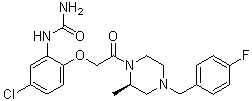
BX471

别名: ZK811752; ZK 811752; ZK-811752; BX471; [5-chloro-2-[2-[(2R)-4-[(4-fluorophenyl)methyl]-2-methylpiperazin-1-yl]-2-oxoethoxy]phenyl]urea; 76K17ZG4ZN; BX 471; BX-471 (2R)-1-[[[4-氯-2-(脲基)苯氧基]甲基]羰基]-2-甲基-4-(4-氟苄基)哌嗪; 2R)-1-[[[4-氯-2-(脲基)苯氧基]甲基]羰基]-2-甲基-4-(4-氟苄基)哌嗪; ZK811752 (BX471) ;(R)-1-[5-氯-2-[2-[4-(4-氟苄基)-2-甲基哌嗪-1-基]-2-氧代乙氧基]苯基]脲
目录号: V3022 纯度: = 99.64%
BX471(也称为ZK-811752)是一种新型口服非肽类CCR1(CC趋化因子受体-1)拮抗剂,对人CCR1的Kiof为1 nM,可能可用于治疗慢性炎症性疾病。
BX471 CAS号: 217645-70-0
产品类别: CCR
产品仅用于科学研究,不针对患者销售
规格 价格 库存 数量
10 mM * 1 mL in DMSO
1mg
5mg
10mg
25mg
50mg
100mg
250mg
Other Sizes

Other Forms of BX471:

  • BX-471 HCl
点击了解更多
InvivoChem产品被CNS等顶刊论文引用
纯度/质量控制文件

纯度: ≥98%

纯度: = 99.64%

产品描述
BX471(也称为 ZK-811752)是一种新型口服非肽 CCR1(CC 趋化因子受体-1)拮抗剂,对人 CCR1 的 Ki 为 1 nM,可用于治疗慢性炎症疾病。 BX471 对 CCR1 的选择性是 CCR2、CCR5 和 CXCR4 的 250 倍。 CCR1是治疗自身免疫性疾病的主要治疗靶点。与 28 G 蛋白偶联受体相比,BX 471 对 CCR1 的选择性高出 10,000 倍以上。竞争结合研究表明,BX 471 能够以高亲和力(K(i) 范围为 1 nm)取代 CCR1 配体巨噬细胞炎症蛋白-1α (MIP-1α)、RANTES 和单核细胞趋化蛋白-3 (MCP-3)至 5.5 nm)。 BX 471 是一种有效的功能拮抗剂,因为它能够抑制许多 CCR1 介导的效应,包括 Ca(2+) 动员、细胞外酸化率增加、CD11b 表达和白细胞迁移。此外,BX 471 能有效减少多发性硬化症大鼠实验性过敏性脑脊髓炎模型中的疾病。
生物活性&实验参考方法
靶点
MIP-1α-CCR1 ( Ki = 1 nM ); RANTES-CCR1 ( Ki = 2.8 nM ); MCP-3-CCR1 ( Ki = 5.5 nM )
CC chemokine receptor-1 (CCR1): It can displace CCR1 ligands including macrophage inflammatory protein-1α (MIP-1α), RANTES, and monocyte chemotactic protein-3 (MCP-3) with high affinity, and the Ki values range from 1 nM to 5.5 nM[1]
- Murine CCR1: The non-peptide antagonist BX471 can displace radiolabeled MIP-1α from murine CCR1[2]
- Human CCR1: BX471 can inhibit the ability of MIP-1α/CCL3 to increase Ca²⁺ transients in HEK 293 cells expressing human CCR1[2]
体外研究 (In Vitro)
体外活性:BX471(也称为 ZK-811752)是一种新型口服非肽 CCR1(CC 趋化因子受体-1)拮抗剂,对人 CCR1 的 Ki 为 1 nM,可用于治疗慢性炎症性疾病。 BX471 对 CCR1 的选择性是 CCR2、CCR5 和 CXCR4 的 250 倍。 CCR1是治疗自身免疫性疾病的主要治疗靶点。与 28 G 蛋白偶联受体相比,BX 471 对 CCR1 的选择性高出 10,000 倍以上。竞争结合研究表明,BX 471 能够以高亲和力(K(i) 范围为 1 nm)取代 CCR1 配体巨噬细胞炎症蛋白-1α (MIP-1α)、RANTES 和单核细胞趋化蛋白-3 (MCP-3)至 5.5 nm)。 BX 471 是一种有效的功能拮抗剂,因为它能够抑制许多 CCR1 介导的效应,包括 Ca(2+) 动员、细胞外酸化率增加、CD11b 表达和白细胞迁移。此外,BX 471 能有效减少多发性硬化症大鼠实验性过敏性脑脊髓炎模型中的疾病。激酶测定:BX471(也称为 ZK-811752)是一种新型口服非肽 CCR1(CC 趋化因子受体-1)拮抗剂,对人 CCR1 的 Ki 为 1 nM,可能可用于治疗慢性炎症性疾病。 BX471 对 CCR1 的选择性是 CCR2、CCR5 和 CXCR4 的 250 倍。 CCR1是治疗自身免疫性疾病的主要治疗靶点。细胞测定:BX471 (0.1-10 μM) 在分离的血液单核细胞的剪切流中显示出对 RANTES 介导的和对 IL-1β 激活的微血管内皮的抗剪切粘附的剂量依赖性抑制。 BX471 还抑制 RANTES 介导的 T 淋巴细胞与活化内皮细胞的粘附。BX471 还能够以浓度依赖性方式取代 125I-MIP-1α/CCL3 与小鼠 CCR1 的结合,Ki 为 215±46 nM。增加 BX471 浓度可抑制人和小鼠 CCR1 中 MIP-1α/CCL3 诱导的 Ca2+ 瞬变,IC50 分别为 5.8±1 nM 和 198±7 nM。BX 471 是一种有效的功能拮抗剂,因为它能够抑制CCR1 介导的效应包括 Ca2+ 动员、细胞外酸化率增加、CD11b 表达和白细胞迁移。与 28 个 G 蛋白偶联受体相比,BX 471 对 CCR1 的选择性高出 10,000 倍以上。
BX471是一种强效功能性拮抗剂,能够抑制一系列由CCR1介导的效应,具体包括细胞内Ca²⁺动员、细胞外酸化速率升高、CD11b分子表达以及白细胞迁移。此外,与28种G蛋白偶联受体相比,BX471对CCR1的选择性超过10,000倍[1]
- 在转染了小鼠CCR1的HEK细胞中,BX471可置换放射性标记的MIP-1α与小鼠CCR1的结合。当负载Fluo-3(一种钙离子荧光探针)且分别表达人CCR1和小鼠CCR1的HEK293细胞,经不同浓度BX471预处理15分钟后,再用CCR1激动剂MIP-1α/CCL3刺激,BX471可抑制MIP-1α/CCL3诱导的这些细胞内Ca²⁺瞬变升高[2]
- 在微血管内皮细胞体外流动实验中,BX471可阻断由RANTES诱导的单核细胞在炎症内皮细胞上的牢固黏附[4]
- 对于野生型小鼠,在7天的肾脏缺血再灌注损伤模型中,用特异性CCR1拮抗剂BX471预处理,可抑制中性粒细胞和巨噬细胞的浸润[3]
体内研究 (In Vivo)
BX 471在多发性硬化大鼠EAE模型中的疗效[1]
在确定BX 471在多发性硬化大鼠EAE模型中的疗效之前,我们测试了其抑制MIP-1α与大鼠CCR1受体结合的能力。对BX 471竞争结合研究的Scatchard分析表明,该化合物能够以121±60 nm的K i抑制趋化因子与大鼠CCR1的结合(数据未显示),这对大鼠CCR2的有效性比人类CCR1低约100倍。此外,BX 471不抑制趋化因子与大鼠CCR5的结合(数据未显示),因此对大鼠CCR1具有特异性。[1]
根据大鼠的药代动力学研究,我们确定每天皮下注射三次BX 471会使血液药物水平达到1至5μm(数据未显示),我们计算出这大约是大鼠CCR1受体K i的10-50倍,应该足以抑制MIP-1α的结合。不幸的是,与狗体内获得的药代动力学数据相反,BX 471在大鼠体内的口服率很低(<20%,数据未显示)。基于这些研究,建立了多发性硬化大鼠EAE模型。 动物每天皮下注射三次赋形剂或5、20和50 mg/kg的BX 471。CCR1拮抗剂BX 471剂量依赖性地降低了疾病的严重程度(图10A)。在最高剂量50mg/kg时,与赋形剂对照组相比,临床评分显著降低,在p=0.05时具有统计学意义(通过方差分析分析)。然而,即使在较低的两个剂量的BX 471,20 mg/kg和5 mg/kg,临床评分仍然明显下降。通过将数据表示为每个治疗组的平均累积临床评分,可以更容易地观察到这一点(图10B)。通过t检验对平均累积临床评分数据的统计分析显示,与赋形剂对照组相比,50和20mg/kg剂量分别为p=0.003和p=0.014,具有统计学意义。
BX471(20 mg/kg,皮下注射)在约 30 分钟内达到峰值血浆水平 9 μM,并在 2 小时后迅速下降至约 0.4 μM。 4 至 8 小时后,血浆药物水平降至 0.1 μM 或更低。用 20 mg/kg BX471 治疗 10 天的小鼠显示间质 CD45 阳性白细胞减少约 55%。 BX471 对外周血中 CCR5 阳性 CD8 细胞的数量具有临界显着影响。与载体对照相比,BX471 使 UUO 肾脏中 FSP1 阳性细胞的数量减少 65%。用 BX471 预处理可减少缺血再灌注损伤后肾脏中巨噬细胞和中性粒细胞的积累。BX 471(4 mg/kg,口服或静脉注射)是口服有效,狗体内生物利用度为 60%。此外,BX 471 能有效减少多发性硬化症大鼠实验性过敏性脑脊髓炎模型中的疾病。
在大鼠多发性硬化症的实验性变态反应性脑脊髓炎模型中,BX471能有效减轻疾病症状[1]
- 在单侧输尿管梗阻(UUO)小鼠模型中,与对照组相比,经BX471处理(处理时间为0-10天和6-10天)的小鼠,其梗阻侧肾脏的间质巨噬细胞和淋巴细胞浸润减少40%-60%。经药物处理的小鼠,CCR1和CCR5的mRNA水平也显著降低,流式细胞术分析显示CD8⁺/CCR5⁺T细胞数量相应减少。与溶媒对照组相比,肾纤维化相关标志物(包括间质成纤维细胞数量、间质容积以及I型胶原的mRNA和蛋白表达水平)在BX471处理组中均显著降低。但仅在0-5天给予药物处理时,该药物无明显疗效[2]
- 在大鼠异位心脏移植排斥模型中,当动物同时接受BX471和亚治疗剂量环孢素(2.5mg/kg,单独使用该剂量环孢素无法延缓移植排斥)处理时,其延缓移植排斥的效果远优于单独使用环孢素或BX471处理的动物[4]
- 在7天的小鼠肾脏缺血再灌注损伤模型中,到第7天时,CCR1缺陷小鼠受损肾脏中的中性粒细胞数量比野生型对照小鼠少35%,巨噬细胞数量少45%。此外,与野生型对照相比,CCR1缺陷小鼠受损肾脏中CCR1配体CCL3(MIP-1α)和CCL5(RANTES)的水平更低。损伤后可观察到局部白细胞增殖和凋亡现象,但这些过程不依赖于CCR1。而且,野生型小鼠和CCR1缺陷小鼠受损肾脏的坏死、纤维化损伤程度以及肾功能下降程度无显著差异[3]
酶活实验
趋化因子结合研究[1]
如前所述,通过过滤进行结合分析。使用终浓度约为0.1-0.2 nm的放射性标记趋化因子作为配体。使用每个测定点8000或300000个细胞表达人CCR1的HEK293细胞作为受体来源。在存在100nm未标记趋化因子的情况下测定非特异性结合。结合数据用计算机程序IGOR进行曲线拟合,以确定亲和力和位点数量。
胞浆Ca2+测量[1]
将表达人CCR1的HEK293细胞以80000个细胞/孔的速度铺在聚-d-赖氨酸涂覆的黑壁96孔板上,并培养过夜。然后,在Hanks的平衡盐溶液中,在37°C下用4μm Fluo-3(一种钙敏感的荧光染料)装载细胞60分钟,该溶液含有20 mm Hepes、3.2 mm氯化钙、1%胎牛血清、2.5 mm丙磺舒和0.04%普朗尼克酸。使用Denley洗涤器用测定缓冲液(Hanks平衡盐溶液,含有20mmHepes、2.5mm丙磺舒和0.1%牛血清白蛋白)轻轻洗涤细胞4次,去除多余的染料。在37°C下加入激动剂后,立即用FLIPR测量细胞内游离Ca2+浓度的变化。为了检测BX471的拮抗活性,在加入激动剂之前,用该化合物对细胞进行15分钟的预处理。根据方程式Ca2+=K D(F−F min)/(F max−F)计算细胞内Ca2+浓度(nm)(7)。K D是Fluo-3和Ca2+复合物的离解常数(Fluo-3为390 nm)。F是测量的荧光强度。F max是在0.1%triton X-100存在的情况下测定的最大荧光强度。F min是在0.1%曲拉通X-100加5 mmEGTA存在下测定的最小荧光强度。
BX471(也称为 ZK-811752)是一种新型口服非肽 CCR1(CC 趋化因子受体-1)拮抗剂,对人 CCR1 的 Ki 为 1 nM。它可能有助于治疗慢性炎症。与 CCR2、CCR5 和 CXCR4 相比,BX471 对 CCR1 的偏好程度高出 250 倍。在治疗自身免疫性疾病时,CCR1 是首要治疗靶点。
CCR1配体竞争结合实验:将表达CCR1的细胞与放射性标记的CCR1配体(如¹²⁵I-MIP-1α/CCL3)以及不同浓度的BX471共同孵育。孵育一段时间后,通过离心细胞终止结合反应,随后测定放射性标记配体与CCR1的特异性结合情况,并根据置换数据计算BX471置换配体的Ki值。实验中需测定非特异性结合,并从总结合量中减去非特异性结合量以获得特异性结合量[2]
- 钙离子动员实验:将表达CCR1的细胞(如HEK293细胞)负载钙离子敏感性荧光染料(如Fluo-3)。用不同浓度的BX471预处理负载染料的细胞15分钟,之后用CCR1激动剂(如MIP-1α/CCL3)刺激细胞。通过检测荧光强度的变化(荧光强度变化反映细胞内钙离子浓度变化),评估BX471对CCR1介导的钙离子动员的抑制作用[2]
细胞实验
BX471 (0.1–10 μM) 以剂量依赖性方式抑制分离血液单核细胞剪切流中 IL-1β 激活的微血管内皮的抗剪切和 RANTES 介导的粘附。此外,BX471 还可抑制 T 细胞 RANTES 介导的与活化内皮细胞的粘附。 BX471 的 Ki 为 215±46 nM,还可以以浓度依赖性方式取代 125I-MIP-1α/CCL3 与小鼠 CCR1 的结合。 BX471 在人和小鼠 CCR1 中抑制 MIP-1α/CCL3 诱导的 Ca2+ 瞬变,随着化合物浓度的增加,IC50 值分别为 5.8±1 nM 和 198±7 nM。 BX 471 能够阻断多种 CCR1 介导的过程,例如白细胞迁移、细胞外酸化率增加、Ca2+ 动员和 CD11b 表达,使其成为强大的功能拮抗剂。 BX 471 对 CCR1 的选择性比 28 G 蛋白偶联受体高 10,000 倍以上。
外周血单个核细胞CD11b的表达[1]
如上所述测量全血测定中外周血单核细胞上表达的CD11b。简而言之,通过静脉穿刺将人全血收集到含有EDTA的2.5ml Vacutainer管中。血液保持在室温下,抽血后立即使用。全血样本(200μl)在37°C下用或不用1μmBX471预处理15分钟,然后用或不用100 nm MIP-1α再处理15分钟。通过加入1 ml冷磷酸盐缓冲盐溶液洗涤液终止反应。试管离心(200×g,4°C下7分钟),通过抽吸去除上清液。将细胞沉淀重新悬浮在冷磷酸盐缓冲盐溶液中,加入10μl 1mg/ml热聚集IgG,并在4°C下孵育试管10分钟。将抗体CD11b FITC(5μl)和CD14 PE(20μl)加入每个检测管中,在4°C下孵育20分钟。最后,加入1ml冰冷的磷酸盐缓冲盐溶液,如上所述将细胞造粒,并通过FACScan进行分析。
白细胞迁移实验:采用合适的细胞迁移体系(如Transwell小室),下室中加入可通过CCR1诱导白细胞迁移的趋化因子,在上室或上下两室中加入不同浓度的BX471。将白细胞置于上室,孵育特定时间后,计数迁移至下室的白细胞数量。通过比较加入和未加入BX471时的白细胞迁移数量,评估BX471对CCR1介导的白细胞迁移的抑制作用[1]
- CD11b表达实验:在存在或不存在不同浓度BX471的条件下,用CCR1激动剂处理白细胞。孵育后,用荧光标记的CD11b抗体对细胞进行染色,通过流式细胞术检测白细胞表面CD11b的表达水平。比较处理组和对照组的荧光强度,分析BX471对CCR1介导的CD11b表达的影响[1]
- 趋化因子受体mRNA实时荧光定量PCR实验:从肾脏组织(如单侧输尿管梗阻小鼠的梗阻侧和对侧肾脏)中提取总RNA,将RNA逆转录为cDNA。使用针对CCR1、CCR2、CCR5以及内参基因(如GAPDH)的特异性引物进行实时PCR。将趋化因子受体的mRNA表达水平以GAPDH表达水平为参照进行标准化处理,比较BX471处理组和对照组中受体的相对表达水平,从而评估BX471对趋化因子受体mRNA表达的影响[2]
- 白细胞亚群流式细胞术分析实验:从肾脏组织或血液中分离细胞,用荧光标记的细胞表面标志物抗体(如识别白细胞的CD45、识别淋巴细胞的CD3、识别巨噬细胞的F4/80、识别中性粒细胞的Gr-1、识别CD8⁺T细胞的CD8以及CCR5)对细胞进行染色。通过流式细胞术分析染色细胞,比较BX471处理组和对照组中不同白细胞亚群(如CD45⁺白细胞、CD3⁺淋巴细胞、F4/80⁺巨噬细胞、Gr-1⁺中性粒细胞、CD8⁺/CCR5⁺T细胞)的百分比,评估BX471对白细胞浸润和亚群分布的影响[2, 3]
- I型胶原蛋白Western blot实验:从肾脏组织中提取蛋白质,将蛋白质样品通过SDS-PAGE(十二烷基硫酸钠-聚丙烯酰胺凝胶电泳)分离后转移到膜上。用I型胶原 primary抗体孵育膜,再用偶联酶(如辣根过氧化物酶)的secondary抗体孵育。使用化学发光底物使蛋白条带显影,对I型胶原条带的强度进行定量,比较BX471处理组和对照组中的蛋白表达水平,评估BX471对肾纤维化的影响[2]
- 免疫组化染色实验:制备肾脏组织切片,对切片进行脱蜡、水化和抗原修复处理。用针对特定标志物(如识别白细胞的CD45、识别成纤维细胞的FSP1)的primary抗体孵育切片,清洗后用偶联荧光或酶标记的secondary抗体孵育。在显微镜下观察染色切片,对阳性细胞数量或染色程度进行定量,比较BX471处理组和对照组中白细胞浸润和成纤维细胞聚集情况[2, 3]
- 中性粒细胞萘酚AS-D氯乙酸酯酶染色实验:用萘酚AS-D氯乙酸酯酶试剂对肾脏组织切片进行染色,中性粒细胞会呈现阳性染色(橙红色颗粒)。在显微镜下观察染色切片,计数阳性中性粒细胞数量,评估BX471对中性粒细胞浸润的影响[3]
- 细胞凋亡TUNEL实验:制备肾脏组织切片,使用TUNEL试剂盒进行TUNEL染色。用末端脱氧核苷酸转移酶和荧光标记的dUTP孵育切片,凋亡细胞会呈现阳性荧光。计数TUNEL阳性细胞数量,评估CCR1缺失(与BX471作用靶点相关)对肾脏细胞凋亡的影响[3]
- 细胞增殖Ki67染色实验:用针对Ki67(一种细胞增殖标志物)的primary抗体孵育肾脏组织切片,再用secondary抗体孵育。在显微镜下观察Ki67阳性细胞(处于增殖期的细胞),计数阳性细胞数量,评估CCR1缺失对肾脏细胞增殖的影响[3]
动物实验
Male beagle dogs that have been fattened (n = 3 per treatment group) are administered BX471 orally or intravenously (IV) at a dose of 4 mg/kg through the cephalic vein. 40% aqueous cyclodextrin is used as a vehicle in which to dissolve the compound. An in-dwelling catheter is used to draw blood serially from the jugular vein at predetermined intervals up to six hours after dosing. One use for EDTA is as an anticoagulant. The samples undergo a centrifugation process (1000× g for 10 min at 4°C), and the plasma is kept frozen until HPLC-MS (electrospray mode operated under a positive ion mode) is used to analyze the drug levels. Four parts ice-cold methanol containing a fixed amount of an internal standard are added to one part plasma to thaw and denature the samples. Following a centrifugation at 5000× g to remove the resultant protein precipitate, the supernatants are immediately analyzed. The BX471 plasma calibration standards are prepared across the quantification range concurrently, processed, and analyzed in the same way. Utilizing an electrospray inlet operated at 3.57 kV, a FISONS, VG Platform single quadrupole instrument is employed in these analyses. After a brief isocratic elution procedure (35% methanol, 65% water containing 0.1% trifluoroacetic acid), chromatographic separation is achieved using a YMC AQ octadecyl silane reversed phase column (4.6×250 mm). The mass spectrometer receives 50 μL/min of infusion by splitting the total column flow (1 mL/min) post-column. After injecting 50 microliters of solution onto the column, the chromatograms are obtained over a total run time of 7.5 minutes per sample. A solitary ion positive ionization mode is used to gather the ions. Ion current ratios between the internal standard peak and the analyte in the plasma standards are plotted over the quantification range to create a calibration curve for quantification. Inferred from the area under the curve measurements is the percentage of oral availability. WinNonLin version 3.0 is utilized to compute pharmacokinetic parameters. EAE Study in Lewis Rats [1]
Male Lewis rats were immunized subcutaneously into both hind footpads with 50 μl of a guinea pig spinal cord homogenate. The guinea pig spinal cord homogenate was prepared by homogenizing guinea pig (male Hartley) whole spinal cords and adjusting the concentration to 1 g/ml with 0.9% physiological saline. This homogenate was then diluted (1:1) with complete Freund's adjuvant containing 1 mg/ml Mycobacterium tuberculosis. One day after immunization the animals were injected subcutaneously 3 times/day with increasing doses of the CCR1 antagonist BX471 (5, 20, and 50 mg/kg) dissolved in 40% cyclodextrin insaline solution or with the vehicle as a control. There were 10 animals per treatment group. Rats were weighed, and clinical symptoms were evaluated on a daily basis throughout the study and scored as follows: 0, no symptoms; 1, complete tail paralysis; 2, paraparesis, abnormal gait; 3, paralysis of one hind limb; 4, paralysis of both hind limbs; 5, moribund or dead. Clinical score data were analyzed using an analysis of variance and Fisher's least significant difference.

Rat experimental allergic encephalomyelitis model: Rats are immunized with an antigen to induce experimental allergic encephalomyelitis (a model of multiple sclerosis). BX471 is administered to the rats via an appropriate route (the specific route is not detailed in the literature) at a certain dose and frequency. The severity of the disease in the rats is monitored regularly (such as by observing clinical symptoms). The effect of BX471 on reducing the disease is evaluated by comparing the disease severity between the BX471-treated group and the control group[1]
- Mouse unilateral ureter obstruction (UUO) model: Mice are subjected to unilateral ureter ligation to induce renal fibrosis. BX471 is dissolved in 40% cyclodextrin. Three treatment regimens are used: 1) Administration from day 0 to 10; 2) Administration from day 6 to 10; 3) Administration from day 0 to 5. The drug is given subcutaneously at a dose of 20 mg/kg (the frequency is not detailed in the literature). At 10 days after UUO, the mice are sacrificed, and their kidneys are collected. Various analyses (such as immunohistochemistry, real-time RT-PCR, Western blot) are performed on the renal tissues to evaluate the effect of BX471 on leukocyte infiltration and renal fibrosis[2]
- Rat heterotopic heart transplant model: Heterotopic heart transplantation is performed in rats. The rats are divided into different groups: 1) BX471 treatment alone; 2) Subtherapeutic dose of cyclosporin (2.5 mg/kg) treatment alone; 3) Combination treatment of BX471 and subtherapeutic dose of cyclosporin; 4) Control group. The drugs are administered via appropriate routes (the specific routes are not detailed in the literature) at a certain frequency. The survival time of the transplanted hearts is monitored. The effect of BX471 on prolonging transplant rejection is evaluated by comparing the survival time of the transplanted hearts between different groups[4]
- Mouse renal ischemia-reperfusion injury model: Mice are anesthetized, and the renal pedicle is clamped to induce ischemia. After a certain period of ischemia, the clamp is removed to allow reperfusion, establishing a renal ischemia-reperfusion injury model. For wild-type mice, BX471 is administered before the injury (pretreatment) via an appropriate route (the specific route and dose are not detailed in the literature). CCR1-deficient mice are also used in the experiment. At different time points after reperfusion (up to 7 days), the mice are sacrificed, and their kidneys are collected. Analyses such as immunohistochemistry, FACS, and histopathological examination are performed to evaluate the effect of BX471 (and CCR1 deficiency) on leukocyte infiltration and renal damage[3]
- Pharmacokinetic study in dogs: BX471 is administered to dogs via oral gavage at a certain dose (the specific dose is not detailed in the literature). Blood samples are collected at different time points after administration. The concentration of BX471 in the plasma is measured using an appropriate analytical method (such as HPLC). Pharmacokinetic parameters such as oral bioavailability are calculated based on the plasma concentration-time data[1]
- Pharmacokinetic study in mice: Male mice (n = 4) receive a single subcutaneous dose of 20 mg/kg BX471 dissolved in 40% cyclodextrin. Blood samples are collected at different time points after dosing. The plasma concentration of BX471 is measured using a specific method. The pharmacokinetic profile of BX471 in mice is plotted based on the plasma concentration data[2]
药代性质 (ADME/PK)
Pharmacokinetics of BX 471 in dogs [1] This study investigated the oral bioavailability of BX 471 in conscious dogs. BX 471 was dissolved in 40% cyclodextrin saline at a dose of 4 mg/kg and administered to fasting male beagle dogs via cephalic intravenous bolus or gavage. Plasma samples were prepared and the concentration of the compound in plasma was determined by high performance liquid chromatography-mass spectrometry (HPLC-MS). As shown in Figure 9, BX 471 reached peak plasma concentrations approximately 2 hours after oral administration and remained at measurable concentrations for up to 6 hours. The volume of distribution of BX 471 (0.5 L/kg) was close to that of body fluids (0.6 L/kg), indicating that the compound was mainly distributed in body fluids (Table III). The clearance rate in dogs was low, at 2 ml/min/kg (less than 10% of total hepatic blood flow), resulting in a moderate terminal half-life of 3 hours (Figure 9 and Table III). For dogs administered orally, the half-life of BX 471 is approximately 3 hours. Analysis of the area under the curve (AUC) using TOPFIT software to calculate the percentage of oral bioavailability indicates that BX 471 is an orally absorbed drug in fasting dogs with an oral bioavailability of approximately 60% (Figure 9 and Table III). In dogs, BX471 is orally active with an oral bioavailability of 60% [1]. In mice, after a single subcutaneous injection of 20 mg/kg BX471 (dissolved in 40% cyclodextrin), the plasma concentration of BX471 changed over time, showing certain pharmacokinetic characteristics (specific parameters such as half-life are not described in detail in the literature) [2].
毒性/毒理 (Toxicokinetics/TK)
Effects of BX 471 on systemic toxicity [1]
To demonstrate that the antagonistic effect of BX 471 on CCR1 was not caused by the cytotoxicity of the compound, we treated HEK293 cells transfected with THP-1 or CCR1 at a concentration of up to 10 μM of BX 471 for 24 hours and monitored cytotoxicity by WST-1 staining. No obvious toxicity was observed (data not shown). We further tested the toxicity of BX 471 in vivo by performing a series of serum diagnostic tests, including liver and kidney function tests and blood electrolyte tests, on rabbits that were given BX 471 at a dose of 20 mg/kg/day for 30 consecutive days. All test results were within the normal range (data not shown). The results indicate that the inhibition of CCR1 activation by BX 471 was not due to cytotoxicity and that long-term use of the drug had no adverse effects on the normal physiological functions of animals. Information on the median lethal dose, hepatotoxicity, nephrotoxicity, drug interactions, and plasma protein binding rate of BX471 was not provided in the literature [1, 2, 3, 4].
参考文献

[1]. Identification and characterization of a potent, selective, and orally active antagonist of the CC chemokine receptor-1. J Biol Chem. 2000 Jun 23;275(25):19000-8.

[2]. A chemokine receptor CCR-1 antagonist reduces renal fibrosis after unilateral ureter ligation. J Clin Invest. 2002 Jan;109(2):251-9.

[3]. Chemokine receptor CCR1 regulates inflammatory cell infiltration after renal ischemia-reperfusion injury. J Immunol. 2008 Dec 15;181(12):8670-6.

[4]. A non-peptide functional antagonist of the CCR1 chemokine receptor is effective in rat heart transplant rejection. J Biol Chem. 2001 Feb 9;276(6):4199-204.

其他信息
CC chemokine receptor 1 (CCR1) is a major target for the treatment of autoimmune diseases. Through high-throughput screening and chemical optimization, we identified a novel non-peptide CCR1 antagonist, RN-[5-chloro-2-[2-[4-[(4-fluorophenyl)methyl]-2-methyl-1-piperazinyl]-2-oxoethoxy]phenyl]urea hydrochloride (BX 471). Competitive binding assays showed that BX 471 can replace CCR1 ligands macrophage inflammatory protein-1α (MIP-1α), RANTES, and monocyte chemoattractant protein-3 (MCP-3) with high affinity (Ki ranging from 1 nM to 5.5 nM). BX 471 is a potent functional antagonist that inhibits multiple CCR1-mediated effects, including Ca²⁺ mobilization, increased extracellular acidification, CD11b expression, and leukocyte migration. BX 471 is more than 10,000 times more selective for CCR1 than 28 G protein-coupled receptors. Pharmacokinetic studies have shown that BX 471 is orally active with a bioavailability of 60% in dogs. In addition, BX 471 effectively alleviates disease symptoms in a rat model of experimental allergic encephalomyelitis (multiple sclerosis). This study is the first to demonstrate the efficacy of a non-peptide chemokine receptor antagonist in an animal model of an autoimmune disease. In summary, we have discovered a potent, selective and orally effective CCR1 antagonist that may help treat chronic inflammatory diseases. [1] The expression of chemokines and their receptors is thought to be associated with leukocyte infiltration and progressive renal fibrosis following unilateral ureteral obstruction (UUO). We hypothesize that blocking the chemokine receptor CCR1 with the non-peptide antagonist BX471 can reduce leukocyte infiltration and renal fibrosis following UUO. In mice with unexplained renal fibrosis (UUO) treated with BX471 (days 0-10 and 6-10), interstitial macrophage and lymphocyte infiltration was reduced by 40-60% compared to the control group. CCR1 and CCR5 mRNA levels were also significantly reduced in the treatment group, and FACS analysis showed a corresponding decrease in CD8+/CCR5+ T cell numbers. Compared to the vector control group, BX471 treatment significantly reduced renal fibrosis markers such as interstitial fibroblasts, interstitial volume, and type I collagen mRNA and protein expression. Conversely, administration only on days 0-5 was ineffective. In conclusion, blocking CCR1 significantly reduced cell infiltration and renal fibrosis following UUO. Importantly, delayed administration was also effective. Therefore, we conclude that CCR1 blockade may represent a novel therapeutic strategy for reducing cell infiltration and renal fibrosis, which are major factors contributing to the progression of end-stage renal failure. [2] Neutrophils and macrophages rapidly infiltrate the kidneys after renal ischemia-reperfusion injury, but the specific molecular recruitment mechanisms of these cell types have not been fully elucidated. This study uses genetic and pharmacological evidence to demonstrate that the chemokine receptor CCR1 plays a positive role in macrophage and neutrophil infiltration in a 7-day mouse model of renal ischemia-reperfusion injury. By day 7, the number of neutrophils and macrophages in the damaged kidneys of CCR1-deficient mice was reduced by 35% and 45%, respectively, compared to wild-type control mice. Pretreatment of wild-type mice with the specific CCR1 antagonist BX471 also inhibited neutrophil and macrophage infiltration in this model. Compared to wild-type control mice, the levels of CCR1 ligands CCL3 (MIP-1α) and CCL5 (RANTES) in the damaged kidneys of CCR1-deficient mice were also reduced, suggesting that these inflammatory chemokines originate from leukocytes and that a CCR1-dependent positive feedback loop for leukocyte infiltration exists in this model. Local leukocyte proliferation and apoptosis were detected after injury, but these processes were not dependent on CCR1. In addition, the degree of necrosis and fibrosis of the damaged kidneys and the decline in renal function were similar in wild-type mice and CCR1-deficient mice. Therefore, in a mouse model of renal ischemia-reperfusion injury, CCR1 appears to regulate the migration of macrophages and neutrophils to the kidneys, but this activity does not appear to affect tissue damage. [3]
Chemokines such as RANTES appear to play a role in organ transplant rejection. Since RANTES is a potent agonist of the chemokine receptor CCR1, we investigated the efficacy of the CCR1 receptor antagonist BX471 in a rat model of heterotopic heart transplant rejection. Animals were treated with BX471 in combination with a subtherapeutic dose of cyclosporine (2.5 mg/kg). Although treatment with cyclosporine or BX471 alone did not effectively prolong transplant rejection, its efficacy was far superior to that of treatment with cyclosporine or BX471 alone. We investigated the mechanism of action of CCR1 antagonists through in vitro microvascular endothelial cell flow experiments and found that the antagonist could block the strong adhesion of RANTES-induced monocytes to inflammatory endothelial cells. These data together indicate that CCR1 plays an important role in allogeneic transplant rejection. [4]
BX471 is a novel non-peptide CCR1 antagonist. CCR1 is a key target for the treatment of autoimmune diseases. This study is the first to demonstrate that non-peptide chemokine receptor antagonists are effective in animal models of autoimmune diseases, suggesting that BX471 may be beneficial for the treatment of chronic inflammatory diseases [1]
- The expression of chemokines and their receptors is considered to be associated with leukocyte infiltration and progressive renal fibrosis after unilateral ureteral obstruction (UUO). Using BX471 to block CCR1 can significantly reduce cell aggregation and renal fibrosis after UUO, and delayed treatment is also effective. Therefore, CCR1 blockade may be a novel therapeutic strategy to reduce cell infiltration and renal fibrosis, which are important factors leading to end-stage renal failure [2]. Neutrophils and macrophages rapidly infiltrate the kidneys after renal ischemia-reperfusion injury, but the specific molecular recruitment mechanisms of these cell types have not been fully elucidated. BX471, as a specific CCR1 antagonist, can modulate the migration of macrophages and neutrophils to the kidneys in a mouse model of renal ischemia-reperfusion injury, but this effect does not appear to affect tissue damage [3]. Chemokines such as RANTES appear to play a role in organ transplant rejection. Since RANTES is a potent agonist of the chemokine receptor CCR1, BX471, as a CCR1 antagonist, may play an important role in allogeneic transplant rejection, especially when used in combination with subtherapeutic doses of cyclosporine [4].
- Compared with the wild-type control group, the levels of CCR1 ligands CCL3 (MIP-1α) and CCL5 (RANTES) in the damaged kidneys of CCR1-deficient mice were lower, suggesting that leukocytes are the source of these inflammatory chemokines and that there is a CCR1-dependent leukocyte infiltration positive feedback loop in the renal ischemia-reperfusion injury model [3].
*注: 文献方法仅供参考, InvivoChem并未独立验证这些方法的准确性
化学信息 & 存储运输条件
分子式
C21H24CLFN4O3
分子量
434.89
精确质量
434.152
元素分析
C, 58.00; H, 5.56; Cl, 8.15; F, 4.37; N, 12.88; O, 11.04
CAS号
217645-70-0
相关CAS号
BX471 hydrochloride; 288262-96-4
PubChem CID
512282
外观&性状
White to off-white solid powder
密度
1.3±0.1 g/cm3
沸点
593.5±50.0 °C at 760 mmHg
闪点
312.8±30.1 °C
蒸汽压
0.0±1.7 mmHg at 25°C
折射率
1.617
LogP
2.77
tPSA
88.89
氢键供体(HBD)数目
2
氢键受体(HBA)数目
5
可旋转键数目(RBC)
6
重原子数目
30
分子复杂度/Complexity
591
定义原子立体中心数目
1
SMILES
O=C(N)NC1=CC(Cl)=CC=C1OCC(N2[C@H](C)CN(CC3=CC=C(F)C=C3)CC2)=O
InChi Key
XQYASZNUFDVMFH-CQSZACIVSA-N
InChi Code
InChI=1S/C21H24ClFN4O3/c1-14-11-26(12-15-2-5-17(23)6-3-15)8-9-27(14)20(28)13-30-19-7-4-16(22)10-18(19)25-21(24)29/h2-7,10,14H,8-9,11-13H2,1H3,(H3,24,25,29)/t14-/m1/s1
化学名
[5-chloro-2-[2-[(2R)-4-[(4-fluorophenyl)methyl]-2-methylpiperazin-1-yl]-2-oxoethoxy]phenyl]urea
别名
ZK811752; ZK 811752; ZK-811752; BX471; [5-chloro-2-[2-[(2R)-4-[(4-fluorophenyl)methyl]-2-methylpiperazin-1-yl]-2-oxoethoxy]phenyl]urea; 76K17ZG4ZN; BX 471; BX-471
HS Tariff Code
2934.99.9001
存储方式

Powder      -20°C    3 years

                     4°C     2 years

In solvent   -80°C    6 months

                  -20°C    1 month

运输条件
Room temperature (This product is stable at ambient temperature for a few days during ordinary shipping and time spent in Customs)
溶解度数据
溶解度 (体外实验)
DMSO: ≥ 51 mg/mL
Water: <1 mg/mL
Ethanol: <1 mg/mL
溶解度 (体内实验)
配方 1 中的溶解度: ≥ 2.5 mg/mL (5.75 mM) (饱和度未知) in 10% DMSO + 40% PEG300 + 5% Tween80 + 45% Saline (这些助溶剂从左到右依次添加,逐一添加), 澄清溶液。
例如,若需制备1 mL的工作液,可将100 μL 25.0 mg/mL澄清DMSO储备液加入到400 μL PEG300中,混匀;然后向上述溶液中加入50 μL Tween-80,混匀;加入450 μL生理盐水定容至1 mL。
*生理盐水的制备:将 0.9 g 氯化钠溶解在 100 mL ddH₂O中,得到澄清溶液。

配方 2 中的溶解度: ≥ 2.08 mg/mL (4.78 mM) (饱和度未知) in 10% DMSO + 90% (20% SBE-β-CD in Saline) (这些助溶剂从左到右依次添加,逐一添加), 澄清溶液。
例如,若需制备1 mL的工作液,可将 100 μL 20.8 mg/mL澄清DMSO储备液加入900 μL 20% SBE-β-CD生理盐水溶液中,混匀。
*20% SBE-β-CD 生理盐水溶液的制备(4°C,1 周):将 2 g SBE-β-CD 溶解于 10 mL 生理盐水中,得到澄清溶液。

View More

配方 3 中的溶解度: ≥ 2.08 mg/mL (4.78 mM) (饱和度未知) in 10% DMSO + 90% Corn Oil (这些助溶剂从左到右依次添加,逐一添加), 澄清溶液。
例如,若需制备1 mL的工作液,可将 100 μL 20.8 mg/mL 澄清 DMSO 储备液加入到 900 μL 玉米油中并混合均匀。


配方 4 中的溶解度: 5 mg/mL (11.50 mM) in 50% PEG300 50% Saline (这些助溶剂从左到右依次添加,逐一添加), 澄清溶液; 超声助溶.
*生理盐水的制备:将 0.9 g 氯化钠溶解在 100 mL ddH₂O中,得到澄清溶液。

请根据您的实验动物和给药方式选择适当的溶解配方/方案:
1、请先配制澄清的储备液(如:用DMSO配置50 或 100 mg/mL母液(储备液));
2、取适量母液,按从左到右的顺序依次添加助溶剂,澄清后再加入下一助溶剂。以 下列配方为例说明 (注意此配方只用于说明,并不一定代表此产品 的实际溶解配方):
10% DMSO → 40% PEG300 → 5% Tween-80 → 45% ddH2O (或 saline);
假设最终工作液的体积为 1 mL, 浓度为5 mg/mL: 取 100 μL 50 mg/mL 的澄清 DMSO 储备液加到 400 μL PEG300 中,混合均匀/澄清;向上述体系中加入50 μL Tween-80,混合均匀/澄清;然后继续加入450 μL ddH2O (或 saline)定容至 1 mL;

3、溶剂前显示的百分比是指该溶剂在最终溶液/工作液中的体积所占比例;
4、 如产品在配制过程中出现沉淀/析出,可通过加热(≤50℃)或超声的方式助溶;
5、为保证最佳实验结果,工作液请现配现用!
6、如不确定怎么将母液配置成体内动物实验的工作液,请查看说明书或联系我们;
7、 以上所有助溶剂都可在 Invivochem.cn网站购买。
制备储备液 1 mg 5 mg 10 mg
1 mM 2.2994 mL 11.4972 mL 22.9943 mL
5 mM 0.4599 mL 2.2994 mL 4.5989 mL
10 mM 0.2299 mL 1.1497 mL 2.2994 mL

1、根据实验需要选择合适的溶剂配制储备液 (母液):对于大多数产品,InvivoChem推荐用DMSO配置母液 (比如:5、10、20mM或者10、20、50 mg/mL浓度),个别水溶性高的产品可直接溶于水。产品在DMSO 、水或其他溶剂中的具体溶解度详见上”溶解度 (体外)”部分;

2、如果您找不到您想要的溶解度信息,或者很难将产品溶解在溶液中,请联系我们;

3、建议使用下列计算器进行相关计算(摩尔浓度计算器、稀释计算器、分子量计算器、重组计算器等);

4、母液配好之后,将其分装到常规用量,并储存在-20°C或-80°C,尽量减少反复冻融循环。

计算器

摩尔浓度计算器可计算特定溶液所需的质量、体积/浓度,具体如下:

  • 计算制备已知体积和浓度的溶液所需的化合物的质量
  • 计算将已知质量的化合物溶解到所需浓度所需的溶液体积
  • 计算特定体积中已知质量的化合物产生的溶液的浓度
使用摩尔浓度计算器计算摩尔浓度的示例如下所示:
假如化合物的分子量为350.26 g/mol,在5mL DMSO中制备10mM储备液所需的化合物的质量是多少?
  • 在分子量(MW)框中输入350.26
  • 在“浓度”框中输入10,然后选择正确的单位(mM)
  • 在“体积”框中输入5,然后选择正确的单位(mL)
  • 单击“计算”按钮
  • 答案17.513 mg出现在“质量”框中。以类似的方式,您可以计算体积和浓度。

稀释计算器可计算如何稀释已知浓度的储备液。例如,可以输入C1、C2和V2来计算V1,具体如下:

制备25毫升25μM溶液需要多少体积的10 mM储备溶液?
使用方程式C1V1=C2V2,其中C1=10mM,C2=25μM,V2=25 ml,V1未知:
  • 在C1框中输入10,然后选择正确的单位(mM)
  • 在C2框中输入25,然后选择正确的单位(μM)
  • 在V2框中输入25,然后选择正确的单位(mL)
  • 单击“计算”按钮
  • 答案62.5μL(0.1 ml)出现在V1框中
g/mol

分子量计算器可计算化合物的分子量 (摩尔质量)和元素组成,具体如下:

注:化学分子式大小写敏感:C12H18N3O4  c12h18n3o4
计算化合物摩尔质量(分子量)的说明:
  • 要计算化合物的分子量 (摩尔质量),请输入化学/分子式,然后单击“计算”按钮。
分子质量、分子量、摩尔质量和摩尔量的定义:
  • 分子质量(或分子量)是一种物质的一个分子的质量,用统一的原子质量单位(u)表示。(1u等于碳-12中一个原子质量的1/12)
  • 摩尔质量(摩尔重量)是一摩尔物质的质量,以g/mol表示。
/

配液计算器可计算将特定质量的产品配成特定浓度所需的溶剂体积 (配液体积)

  • 输入试剂的质量、所需的配液浓度以及正确的单位
  • 单击“计算”按钮
  • 答案显示在体积框中
动物体内实验配方计算器(澄清溶液)
第一步:请输入基本实验信息(考虑到实验过程中的损耗,建议多配一只动物的药量)
第二步:请输入动物体内配方组成(配方适用于不溶/难溶于水的化合物),不同的产品和批次配方组成不同,如对配方有疑问,可先联系我们提供正确的体内实验配方。此外,请注意这只是一个配方计算器,而不是特定产品的确切配方。
+
+
+

计算结果:

工作液浓度 mg/mL;

DMSO母液配制方法 mg 药物溶于 μL DMSO溶液(母液浓度 mg/mL)。如该浓度超过该批次药物DMSO溶解度,请首先与我们联系。

体内配方配制方法μL DMSO母液,加入 μL PEG300,混匀澄清后加入μL Tween 80,混匀澄清后加入 μL ddH2O,混匀澄清。

(1) 请确保溶液澄清之后,再加入下一种溶剂 (助溶剂) 。可利用涡旋、超声或水浴加热等方法助溶;
            (2) 一定要按顺序加入溶剂 (助溶剂) 。

临床试验信息
NCT Number Recruitment interventions Conditions Sponsor/Collaborators Start Date Phases
NCT00185341 Completed Drug: Placebo
Drug: CCR1-Antagonist
(BAY86-5047, ZK811752)
Endometriosis Bayer February 2005 Phase 2
生物数据图片
  • BX471

    CCR1-deficiency does not alter extent of renal dysfunction after ischemia-reperfusion injury2008 Dec 15;181(12):8670-6.

  • BX471

    CCL3 (MIP-1α) and CCL5 (RANTES) expression are upregulated after renal ischemia-reperfusion injury2008 Dec 15;181(12):8670-6.

  • BX471

    CCR1 does not regulate cell proliferation or apoptosis in the outer medulla after renal ischemia-reperfusion injury2008 Dec 15;181(12):8670-6.
相关产品
联系我们