| 规格 | 价格 | 库存 | 数量 |
|---|---|---|---|
| 10 mM * 1 mL in DMSO |
|
||
| 1mg |
|
||
| 5mg |
|
||
| 10mg |
|
||
| 25mg |
|
||
| 50mg |
|
||
| 100mg |
|
||
| 250mg |
|
||
| 500mg |
|
||
| Other Sizes |
|

| 靶点 |
BRafV600E (IC50 = 0.6 nM); CRAF (IC50 = 5 nM); B-Raf (IC50 = 5.2 nM)
|
|---|---|
| 体外研究 (In Vitro) |
在 Raf 激酶选择性方面,达拉非尼对 B-Raf 的偏好程度超过 91% 的其他测试激酶的 400 倍。 Dabrafenib 通过最初将特异性编码 B-RafV600E 突变的癌细胞的细胞周期阻滞在 G1 期,减少 ERK 磷酸化并抑制细胞增殖。 [1]
BRAF抑制剂GSK2118436(Dabrafenib)和PLX4032(vemurafenib)的临床试验结果显示了令人鼓舞的反应率;然而,响应的持续时间是有限的。为了确定对GSK2118436获得性耐药性的决定因素和克服耐药性的策略,我们从A375 BRAFV600E和YUSIT1 BRAFV600K黑色素瘤细胞系中分离出GSK2118443耐药克隆。这些克隆对变构丝裂原激活蛋白/细胞外信号调节激酶(MEK)抑制剂GSK1120212(曲美替尼)的敏感性也降低。这些克隆的遗传特征表明,在BRAFV600E背景中存在MEK1的框内缺失(MEK1K59del)或NRAS突变(NRASQ61K和/或NRASA146T),有和没有MEK1P387S,BRAFV600K背景中有NRASQ618K。用短发夹RNA稳定敲除NRAS部分恢复了突变NRAS克隆中GSK2118436的敏感性,而A375亲本细胞中NRASQ61K或NRASA146T的表达降低了对Dabrafenib/GSK2118436敏感性。同样,表达MEK1K59del而非MEK1P387S会降低A375细胞对GSK2118436的敏感性。GSK2118436和GSK1120212的组合有效地抑制了抗性克隆中的细胞生长,降低了ERK磷酸化,降低了细胞周期蛋白D1蛋白,增加了p27kip1蛋白。此外,GSK2118436或GSK1120212与磷酸肌醇3-激酶/mTOR抑制剂GSK2126458的组合增强了这些克隆中的细胞生长抑制作用,降低了S6核糖体蛋白磷酸化。我们的结果表明,NRAS和/或MEK突变在体外导致BRAF抑制剂耐药性,GSK2118436和GSK1120212的组合克服了这种耐药性。此外,这些抗性克隆对GSK2126458与GSK2118436或GSK1120212的组合有反应。临床试验正在进行或计划测试这些组合。[2] GSK2118436/Dabrafenib(12)在酶和细胞机制测定以及B-RafV600E驱动的黑色素瘤系SKMEL28和A375P F11(IC50=3和8 nM)和结直肠癌系Colo205(IC50=7 nM)的细胞增殖测定中显示出令人信服的抑制活性。令人欣慰的是,GSK2118436在体外对具有野生型B-Raf的细胞(HFF IC50=3.0μM)和不携带激活性B-RafV600E突变的肿瘤细胞的影响很小[3]。 GSK2118436/Dabrafenib针对一组61种激酶进行了筛选,这些激酶代表了激酶组的广泛覆盖范围,被发现是B-RafV600E、野生型B-Raf和c-Raf的强效生化抑制剂,显示出亚纳米或纳摩尔的效力(见支持信息)。重要的是,还发现GSK2118436具有高度选择性,与筛选的大多数激酶相比,对B-RafV600E的选择性超过500倍。11在面板中观察到单个激酶Alk5的显著活性(<100倍选择性)。通过测量HepG2细胞中SMAD2/3的下游磷酸化水平,进一步研究了Alk5酶活性对细胞信号传导的影响。12在细胞环境中,与抑制ERK磷酸化(IC50=4 nM)相比,GSK2118436在抑制SMAD2/3磷酸化方面的效果明显较差(IC50=3.7μM)。这些数据强调了这种独特有效和选择性的B-RafV600E抑制剂所实现的显著选择性。[3] |
| 体内研究 (In Vivo) |
Dabrafenib(口服)可抑制在免疫缺陷小鼠皮下生长的 B-RafV600E 突变结肠癌 (Colo205) 和黑色素瘤 (A375P) 人类肿瘤异种移植物的发育。 [1]
还对GSK2118436/Dabrafenib进行了体内研究,发现它能显著降低携带B-RafV600E人类黑色素瘤的小鼠的肿瘤生长。在该模型中,携带A375P F11(B-RafV600E)肿瘤的CD1-nu/nu小鼠口服GSK2118436,剂量为0.1、1、10和100mg/kg,每日一次,持续14天(图3)。观察到肿瘤生长的剂量成比例减少。还测量了体重,在任何测试剂量下都没有观察到显著变化。值得注意的是,在100mg/kg组中,50%的受试动物肿瘤完全消退。[3] 此外,GSK2118436/Dabrafenib在单次口服剂量后以剂量依赖的方式降低了A375P F11(B-RafV600E)肿瘤组织中pERK的水平。在给药后2、6和24小时收集肿瘤,测量每个肿瘤中的pERK水平,并将其归一化为存在的总ERK(tERK)。使用MEK抑制剂PD0325901作为对照。图4显示了pERK/tERK水平与载体处理动物的水平的比较,以及两项单独研究的药代动力学数据。给药后2小时和6小时,pERK/tERK水平显著降低,在这项单剂量研究中,当剂量≥3 mg/kg时,药效作用显著(抑制率>50%),当剂量≤30 mg/kg时,24小时后恢复到未经治疗的水平。研究过程中血液和肿瘤中测得的药物浓度与观察到的药效作用相关。这些数据表明,在测试条件下,单次口服剂量≥3 mg/kg的Dabrafenib/GSK2118436可以在至少6小时内保持≥50%的B-Raf抑制。[3] Raf激酶通过细胞外信号调节激酶1/2(ERK1/2)发出信号,以驱动细胞分裂。由于BRAF的激活突变(B-Raf原原癌基因,丝氨酸/苏氨酸激酶)是高度致癌的,因此已开发出用于癌症的BRAF抑制剂,包括Dabrafenib。用于癌症的ERK1/2信号抑制剂在一些患者中具有心脏毒性,这就提出了达巴芬尼是否具有心脏毒性的问题。在心脏中,ERK1/2信号传导不仅促进心肌细胞肥大,具有心脏保护作用,还促进纤维化。我们的假设是,ERK1/2信号传导在非应激心脏中不是必需的,但在心脏重塑中是必需的。因此,dabrafenib可能会在高血压等情况下影响心脏。在心肌细胞、心脏成纤维细胞和灌注大鼠心脏的实验中,Dabrafenib抑制ERK1/2信号传导。我们评估了Dabrafenib(3 mg/kg/d)对雄性C57BL/6J小鼠心脏的体内影响。Dabrafenib单独使用对心脏功能/尺寸(通过超声心动图评估)或心脏结构没有明显影响。在用0.8mg/kg/d血管紧张素II(AngII)治疗以诱导高血压的小鼠中,dabrafenib在急性(长达7d)和慢性(28d)情况下抑制ERK1/2信号传导并抑制心肌肥大,从而保持射血分数。在细胞水平上,dabrafenib抑制了AngII诱导的心肌细胞肥大,降低了肥大基因标志物的表达,几乎完全消除了间质和血管周围区域心脏纤维化的增加。Dabrafenib没有明显的心脏毒性。此外,它还能抑制由AngII诱导的高血压引起的适应不良肥大。因此,Raf是高血压心脏病的潜在治疗靶点,而针对癌症开发的药物如Dabrafenib可用于此目的[4]。 |
| 酶活实验 |
生化和细胞分析。[3]
B-Raf生化酶和细胞测定的详细信息已在参考文献6中报道。Dabrafenib对61种蛋白激酶的抑制作用在葛兰素史克公司进行了表征。一般来说,这些测定被配置为使IC50值接近Dabrafenib对每种酶的内在结合常数(Ki或Kd),因此可以比较对这些激酶的选择性。A375P-F11测定:通过有限稀释将A375P细胞铺在96孔板中,收获单细胞衍生的克隆,并测试其对B-Raf抑制剂的敏感性。F11克隆被选为未来研究的对象,命名为A375P-F11。测定抗TGF-β活性的细胞pSmad试验:在HepG2细胞中通过机械试验测试化合物的活性。将细胞以500000个细胞/孔的密度接种在12孔板中,并在37℃/5%CO2下粘附过夜。去除培养基(BME+10%血清),在37℃/5%CO2下将无血清培养基中的化合物加入细胞中45分钟。用1ng/ml TGF-β刺激细胞60分钟。将细胞在缓冲液(25 mM Tris-HCl ph:7.5,2 mM EDTA,2 mM EGTA,1%Triton X-100,0.1%SDS,50 mMβ-甘油磷酸钠,2 mM原钒酸钠,12.5 mM焦磷酸钠,蛋白酶和磷酸酶抑制剂混合物)中裂解30分钟,刮除,收集,离心澄清,并在LDS/还原试剂中制备蛋白质印迹。样品在4-12%的Bis-Tris凝胶上分离,转移到PVDF上,并使用来自Cell Signaling的抗体检测总和磷酸化-Smad2。凝胶使用奥德赛印迹扫描仪成像,并使用Licor软件定量。测定磷酸:总Smad2比值,IC50定义为使磷酸:总比值降低50%的化合物浓度。 代谢物鉴定。[3] 犬肝微粒体代谢物鉴定研究:犬肝微粒体购自Xenotech。将1.5 mL Eppendorf管中含有50 mM磷酸钾缓冲液、肝微粒体部分(1.0 mg/mL蛋白质)和10µM研究化合物的孵育混合物(800µL)预热至37°C。辅因子在37°C下预孵育5分钟。在0分钟的时间点,取出孵育混合物(200µL)和辅因子溶液(50µL)的等分试样,并用终止溶液[250µL,(80/20/1,乙腈/乙醇/乙酸,v/v/v)]粉碎。通过加入150µL NADPH生成系统[2.2 mM NADP、28 mM葡萄糖-6-磷酸和葡萄糖-6-磷酸脱氢酶(6单位/mL)以及4.0 mM UDPGA的2%碳酸氢钠溶液]开始反应,并在37°C下孵育样品(最终体积750µL)。没有使用含有适量甲醇的空白培养基代替肝微粒体化合物进行药物对照培养。孵育30分钟后,通过加入一体积的终止溶液终止反应。样品以34000rpm离心5分钟,将50µL上清液注入LC/MS进行代谢物鉴定。犬肝细胞代谢产物鉴定研究:犬肝细胞(Db157)购自CellzDirect。将由William培养基E(pH=7.4)、肝细胞悬浮液(70万个细胞/mL)和10µM研究化合物组成的总体积为600µL的孵育混合物放入12孔培养板的单孔中,在37°C下孵育4小时。使用含有适量甲醇的空白培养基代替对肝细胞的积极治疗,没有同时进行药物对照培养。孵育后,从每个孔的底部刮下细胞,并与600µL的终止溶液混合。然后将混合物储存在-80°C的冰箱中。样品以34000rpm离心5分钟,将50µL上清液注入LC/MS进行代谢物鉴定。 结合模式:[3] GSK2118436/Dabrafenib是B-Raf11的ATP竞争性抑制剂,根据GSK2118436与最近报道的B-RafV600E晶体结构对接的模型,推测其与激酶的非活性样构象结合(图S1),该晶体结构与其他小分子ATP结合位点抑制剂结合。1在该模型中,αC螺旋相对于活性样构象“移位”,保守的赖氨酸和谷氨酸之间的盐桥被打破。虽然Phe595不处于“DFG out”构象,但它会旋转形成类似于拉帕替尼/EGFR共结构中观察到的口袋底部。2嘧啶N1与酶ATP结合口袋中的Cys532形成经典的铰链相互作用。叔丁基和噻唑核在P-环下方结合,只留下相对较小的一部分抑制剂作为溶剂暴露。预计GSK2118436的芳基磺酰胺头基会结合到亲脂性后囊中,使磺酰胺与Asp594和Phe595的骨架NH形成两个氢键。磺酰胺NH以脱质子化形式描述,留下氮作为氢键受体参与。在R2处带有氟取代的化合物中观察到的效力的显著提高被认为是调节磺酰胺NH的pKa的结果,这可以在细胞pH值下增加12的电离,并为头基结合提供更有利的构象。相反,在R1处含有氟取代的化合物(化合物4和9)可能会诱导结合袋中苯磺酰胺部分的不利构象,这可能是用这些类似物观察到的靶亲和力降低的原因。含苯胺尾部分子的类似模型(如1)表明,尾部基团中的芳香环主要位于B-Raf结合口袋内,而吗啉代环延伸到溶剂暴露区域。比较1和2,在将尾部完全截断为“裸”氨基嘧啶并损失13个重原子后,观察到效力下降了10倍。尽管效力略有下降,但与1相比,2实际上表现出更高的配体效率(2的LE=0.30比1的LE=0.25),因为2中所有剩余的重原子都完全包含在结合袋中。 |
| 细胞实验 |
对于长期增殖测定,将细胞置于含有 10% FBS 的 RMPI-1640 中 12 天,并用单一化合物或化合物组合进行处理。该测定涉及至少一种化合物治疗替代。 12 天后,使用 50% 乙醇中的 0.5% 亚甲蓝对细胞进行染色。使用平板扫描仪拍摄照片。
A375PF11细胞(以下简称A375)暴露于浓度逐渐增加的Dabrafenib和GSK2118436中,并保持在1.2或1.6μmol/L的终浓度。同样,YUSIT1细胞暴露于0.1μmol/L的GSK2118443中。通过限制稀释从这些群体中分离出单细胞克隆。通过SNP芯片分析确定,A375克隆与亲本A375细胞有95%的相似性。通过外显子组测序确定,具有代表性的抗性YUSIT1克隆共享100%的亲本YUSIT1 SNP。在实验之前,所有细胞在含有10%FBS的RPMI-1640培养基中生长至少一代,不含GSK2118436。[2] Affymetrix表达分析: 选择16R6-4与A375进行比较,分别用Dabrafenib/GSK2118436和GSK1120212单独和联合处理24小时。数据分析按照补充方法中的描述进行。微阵列数据保存在NCBI的基因表达综合数据库(GEO,http://www.ncbi.nlm.nih.gov/geo/)可通过GEO系列登录号GSE35230访问。[2] 细胞生长抑制和凋亡测定: 如前所述,使用CellTiter Glo 用化合物或化合物组合处理3天后,估计细胞生长的抑制作用。在用化合物进行类似处理24小时后,通过Caspase-Glo 3/7测定法 测定Caspase-3/7活性。在3天生长试验之前,用补充方法中所述的短干扰RNA(siRNA)、短发夹RNA(shRNA)或表达构建体转染或转导细胞。 对于长期增殖试验,细胞被铺板并用含有10%FBS的RMPI-1640中的化合物或化合物组合处理12天。在试验过程中,至少更换了一次化合物处理。12天后,用50%乙醇中的0.5%亚甲基蓝对细胞进行染色。使用平板扫描仪拍摄图像[2]。 如前所述,从2至4天的Sprague-Dawley大鼠制备和培养新生大鼠心肌细胞。人心脏成纤维细胞在成纤维细胞生长培养基-3中生长。在实验前一天接种成纤维细胞(密度为24小时后达到90%融合),并在含有0.1%(v/v)胎牛血清和100U/ml青霉素和链霉素的M199培养基中同步过夜。细胞暴露于 Dabrafenib中,并在收获用于免疫印迹的时间内暴露[4]。 |
| 动物实验 |
本研究选用26只10周龄、定时交配、无病毒抗体的SD(Crl:CD[SD])雌性大鼠作为试验系统,这些雌性大鼠产下幼鼠。从产后第20天到第23天,对交配雌鼠进行监测,观察其是否自然分娩(分娩完成当天记为PND 0)。分娩完成后,分别在PND 3和6对幼鼠进行检查,包括外部形态学检查、性别鉴定和个体体重测量。根据临床症状和体重选择合适的产仔母鼠及其幼鼠进行研究,然后根据临床观察结果和PND 3时各窝幼鼠的平均体重,将选定的母鼠及其幼鼠随机分配到不同的研究组。在PND 3或4时,将每窝幼鼠的数量减少到4或5只雄性和雌性,仅需少量代养即可达到所需的性别比例。这有助于尽可能地保持自然产仔数。记录由原母鼠和代养母鼠抚养的幼崽信息。每只幼崽都用爪子纹身进行识别。非同窝幼崽尽可能地被分组饲养。根据每日体重,以5 ml/kg的剂量,通过灌胃法将达拉非尼比(Dabrafenibis)悬浮于纯净水中,配制成赋形剂、0.5%羟丙基甲基纤维素K15M和0.1% (v/v) Tween80的悬浮液,灌胃给予年轻的雄性和雌性大鼠。
A375P F11黑色素瘤异种移植研究。[3] 将细胞植入裸鼠体内,并培养成肿瘤异种移植瘤。当肿瘤体积达到约150-200mm³时开始给药。 达拉非尼/GSK2118436 采用灌胃法给药,剂量为 0.2 mL/20 克体重,溶于含 0.5% 羟丙基甲基纤维素和 0.2% Tween-80 的蒸馏水中,pH 值为 8.0。每日给药,持续规定疗程。结果以每组 7-8 只小鼠的平均肿瘤体积表示。每周使用游标卡尺测量两次肿瘤大小,并使用长椭球方程(肿瘤体积 mm³ = (长度 x 宽度²) x 0.5)根据二维测量值估算肿瘤体积。完全肿瘤消退定义为单个肿瘤体积减少 >93%,且持续至少 1 周。 药代动力学 (PK) 分析。[3] 抽取血液后立即用等体积的水进行溶血。将肿瘤组织用聚四氟乙烯匀浆器匀浆,每体积冷冻组织加入4倍体积的水,测定肿瘤中化合物的浓度。取等分匀浆后的肿瘤组织和血液样本进行速冻,随后采用高效液相色谱-串联质谱法(HPLC/MS/MS)分析化合物浓度。 组织中pERK水平的药效学测定。[3] 收集组织,用Medimachine匀浆器和1 mL裂解缓冲液(25 mM Tris-HCl (pH 7.5)、2 mM EDTA (pH 8.0)、2 mM EGTA (pH 8.0)、1% Triton X-100、0.1% SDS、50 mM甘油磷酸钠、2 mM Na3VO4、4 mM焦磷酸钠、2倍磷酸酶抑制剂混合物)匀浆,并置于冰上。所有样品均质化后,匀浆液在4°C下以14,000 rpm离心15分钟,并速冻以备后续分析。所有样品均使用双重ELISA法进行分析,检测总ERK1/2和磷酸化ERK1/2,操作步骤按照制造商说明进行。使用MSD SI6000读取结果。 体内小鼠研究[4] 野生型雄性(7周龄)C57Bl/6J小鼠在实验前适应环境2周。小鼠随机分配至各处理组;体重数据见补充表S1。药物输送采用Alzet渗透泵(型号1007D或1004),并按照制造商说明进行填充。小鼠通过微型泵分别输注0.8 mg/kg/d血管紧张素II(AngII)或载体(酸化PBS),其中AngII不添加DMSO/PEG混合物[50% (v/v)二甲基亚砜(DMSO),20% (v/v)聚乙二醇400,5% (v/v)丙二醇,0.5% (v/v)吐温80],而达拉非尼则以3 mg/kg/d的剂量溶于DMSO/PEG混合物中。AngII和达拉非尼分别使用不同的微型泵进行输注。微型泵在无菌PBS缓冲液(37°C)中孵育过夜,然后在异氟烷(诱导浓度5%,维持浓度2-2.5%)与2升/分钟氧气混合的持续吸入麻醉下皮下植入,如前所述。 心肌细胞大小和纤维化的组织学评估[4] 组织学染色和分析按先前所述进行,采用苏木精-伊红(H&E)染色评估一般形态,采用马松三色染色和苦味酸-天狼星红(PSR)染色评估纤维化。用于研究达拉非尼对血管紧张素II(AngII)诱导的心脏病理学影响的切片由HistologiX Limited公司制备和染色,研究时间为28天。由对治疗组不知情的独立评估人员进行分析。 成年大鼠心脏灌注[4] 使用成年雄性(300-350 g)Sprague-Dawley大鼠进行心脏灌注。按照所述方法制备心脏,并以Langendorff模式进行灌注。心脏用Krebs-Henseleit碳酸氢盐缓冲盐水(25 mM NaHCO3、119 mM NaCl、4.7 mM KCl、2.5 mM CaCl2、1.2 mM MgSO4、1.2 mM KH2PO4,pH 7.4,含10 mM葡萄糖,并用95% O2/5% CO2平衡)灌注15分钟,灌注液中分别添加或不添加达拉非尼(5 µM)或曲美替尼(1 µM)。达拉非尼和曲美替尼购自Selleck Chemicals公司。灌注持续10分钟,分别在不添加或添加人FGF2(0.5 µg/ml;英国Cell Guidance Systems Ltd.公司)的情况下进行。将心脏置于液氮冷却的铝钳之间进行“冷冻钳夹”,并在液氮下研磨成粉末。心脏粉末储存于-80°C。 |
| 药代性质 (ADME/PK) |
吸收、分布和排泄
口服给药后,达拉非尼达到血浆峰浓度(Tmax)的中位时间为 2 小时。口服达拉非尼的平均绝对生物利用度为 95%。单次给药后,达拉非尼的暴露量(Cmax 和 AUC)在 12 mg 至 300 mg 的剂量范围内呈剂量比例增加,但每日两次重复给药后,其增加幅度小于剂量比例。每日两次重复给药150 mg后,平均累积率为0.73,稳态AUC的受试者间变异系数(CV%)为38%。 粪便排泄是主要的消除途径,占放射性剂量的71%,而尿液排泄仅占总放射性的23%(以代谢物形式)。 表观分布容积(Vc/F)为70.3 L。由于达拉非尼是底物,并通过P-糖蛋白和乳腺癌耐药蛋白进行外排,因此其脑分布受限。 单次给药后达拉非尼的清除率为17.0 L/h,每日两次给药2周后为34.4 L/h。 代谢/代谢物 达拉非尼的代谢主要由CYP2C8介导。达拉非尼经CYP3A4代谢生成羟基达拉非尼。羟基达拉非尼进一步经CYP3A4氧化生成羧基达拉非尼,随后经胆汁和尿液排出。羧基达拉非尼脱羧生成去甲基达拉非尼;去甲基达拉非尼可能被肠道重吸收。去甲基达拉非尼进一步经CYP3A4代谢生成氧化代谢物。 生物半衰期 口服达拉非尼的平均终末半衰期为8小时。羟基达拉非尼的终末半衰期(10小时)与达拉非尼相似,而羧基达拉非尼和去甲基达拉非尼代谢物的半衰期更长(21至22小时)。 |
| 毒性/毒理 (Toxicokinetics/TK) |
肝毒性
接受达拉非尼单药治疗的患者中,11%出现血清ALT水平升高,但所有升高均超过正常值上限的5倍。达拉非尼联合曲美替尼治疗时,35%至42%的患者出现血清ALT升高,其中4%的患者ALT水平超过正常值上限的5倍。同样,接受达拉非尼单药治疗的患者中,26%出现血清碱性磷酸酶升高,而接受达拉非尼联合曲美替尼治疗的患者中,60%至67%出现血清碱性磷酸酶升高。这些异常大多无症状且完全可逆。在达拉非尼上市前研究中,未报告任何临床上明显的急性肝损伤或肝功能衰竭病例;自其获批上市并广泛应用以来,也未见已发表的达拉非尼肝毒性报告。 可能性评分:E(未经证实但怀疑是临床上明显的肝损伤的原因)。 妊娠和哺乳期影响 ◉ 哺乳期用药概述 目前尚无关于达拉非尼在哺乳期临床应用的信息。由于达拉非尼与血浆蛋白的结合率超过99%,因此其在乳汁中的含量可能很低。制造商建议在达拉非尼治疗期间以及末次给药后 2 周内停止母乳喂养。 ◉ 对母乳喂养婴儿的影响 截至修订日期,未找到相关的已发表信息。 ◉ 对泌乳和母乳的影响 截至修订日期,未找到相关的已发表信息。 蛋白结合 达拉非尼与人血浆蛋白的结合率为 99.7%。 |
| 参考文献 | |
| 其他信息 |
药效学
达拉非尼是一种激酶抑制剂,主要用于靶向多种癌症中的BRAF V600E突变。尽管达拉非尼和曲美替尼均抑制RAS/RAF/MEK/ERK通路,但它们抑制的是该通路的不同效应分子,因此可以提高缓解率并降低耐药性,且不会产生累积毒性。曲美替尼获批用于治疗黑色素瘤是基于COMBI-AD研究的结果。COMBI-AD是一项III期临床研究,纳入了870例接受完整手术切除的III期BRAF V600E/K突变阳性黑色素瘤患者,并给予达拉非尼联合曲美替尼治疗。患者接受达拉非尼(150 mg,每日两次)+曲美替尼(2 mg,每日一次)联合治疗(n = 438)或匹配的安慰剂(n = 432)。经过2.8年的中位随访,主要终点——无复发生存期(RFS)已达到。在甲状腺癌方面,达拉非尼联合曲美替尼是首个被证实对BRAF V600E突变型间变性甲状腺癌具有强效临床活性且耐受性良好的方案。这些发现代表了该罕见病治疗领域的重要进展。 达拉非尼是一种有机氟化合物和抗肿瘤药物,其甲磺酸盐用于治疗转移性黑色素瘤。它具有抗肿瘤、B-Raf抑制剂和抗冠状病毒药物的双重作用。它是一种磺酰胺类、有机氟化合物、1,3-噻唑类化合物和氨基嘧啶类化合物。 甲磺酸达拉非尼(Tafinlar)是一种可逆的ATP竞争性激酶抑制剂,靶向MAPK通路。该药于2013年5月29日获批用于治疗携带V600E或V6000K突变的黑色素瘤。它也曾用于治疗携带相同突变的转移性非小细胞肺癌。2018年5月,达拉非尼(Tafinlar)与美金刚(Mekinist,[DB08911])联合用药获批用于治疗由BRAF V600E基因异常引起的间变性甲状腺癌。 达拉非尼是一种激酶抑制剂。达拉非尼的作用机制是作为蛋白激酶抑制剂、细胞色素P450 3A4诱导剂、细胞色素P450 2B6诱导剂、细胞色素P450 2C8诱导剂、细胞色素P450 2C9诱导剂、细胞色素P450 2C19诱导剂、有机阴离子转运多肽1B1抑制剂、有机阴离子转运多肽1B3抑制剂、有机阴离子转运蛋白1抑制剂、有机阴离子转运蛋白3抑制剂以及乳腺癌耐药蛋白抑制剂。 达拉非尼是BRAF激酶突变体的选择性抑制剂,可单独使用或与曲美替尼联合用于治疗晚期恶性黑色素瘤。达拉非尼治疗期间会出现短暂的血清转氨酶升高,但尚未发现与临床上明显的急性肝损伤病例相关。 达拉非尼是一种口服生物利用度高的B-raf (BRAF)蛋白抑制剂,具有潜在的抗肿瘤活性。达拉非尼选择性地结合并抑制B-raf的活性,从而可能抑制含有突变BRAF基因的肿瘤细胞的增殖。 B-Raf属于Raf/Mil家族的丝氨酸/苏氨酸蛋白激酶,在调节MAP激酶/ERK信号通路中发挥作用,该通路可能因BRAF基因突变而持续激活。 达布拉非尼是一种小分子药物,其临床试验阶段最高为IV期(涵盖所有适应症),于2013年首次获批,目前有7项已获批适应症和19项在研适应症。 Ras-Raf-MEK-ERK通路的激活与多种人类癌症相关。生长因子受体受细胞外配体刺激后激活Ras,进而启动通过Raf、MEK和ERK丝氨酸/苏氨酸激酶的信号转导级联反应。B-Raf激酶的突变可持续激活MAPK信号通路,从而绕过上游刺激。该基因与多种人类癌症相关,尤其是B-RafV600E突变体的出现及其在黑色素瘤、结直肠癌、卵巢癌、乳头状甲状腺癌和胆管癌中的高发率。选择性且高效抑制B-Raf有望为携带突变型B-Raf肿瘤的患者提供潜在疗法,因为这类肿瘤对该通路存在依赖性。我们发现了一种新型高效且选择性的Raf激酶抑制剂,能够抑制野生型B-Raf、B-RafV600E和c-Raf的激酶活性,其IC50值分别为3.2 nM、0.8 nM和5.0 nM。对超过270种激酶的激酶谱筛选表明,该抑制剂对Raf激酶具有选择性,对B-Raf的选择性比91%的其他受试激酶高约400倍。该抑制剂通过特异性抑制细胞内的B-RafV600E激酶,导致ERK磷酸化水平降低,并通过首先阻滞于细胞周期的G1期来抑制细胞增殖,最终导致细胞死亡。这种抑制作用对特异性编码B-RafV600E突变的癌细胞具有选择性。口服该化合物可抑制在免疫缺陷小鼠皮下移植的B-RafV600E突变型黑色素瘤(A375P)和结肠癌(Colo205)人肿瘤异种移植瘤的生长。目前,这种细胞特异性B-RafV600E抑制剂正在进行I期人体临床试验。引用信息:Mol Cancer Ther 2009;8(12 Suppl):B88.[1] 在包括黑色素瘤在内的多种人类肿瘤中,已观察到由组成型活性B-RafV600E突变酶引起的MAP激酶通路过度激活。本文报道了达拉非尼/GSK2118436的发现和生物学评价。达拉非尼是一种选择性Raf激酶抑制剂,在体外对致癌性B-Raf驱动的黑色素瘤和结直肠癌细胞具有强效活性,并在B-RafV600E人黑色素瘤小鼠模型中表现出显著的体内抗肿瘤和药效学活性。GSK2118436被确定为候选药物,早期临床结果显示其对B-Raf突变型黑色素瘤患者具有显著疗效。 [3] 总之,先导化合物 1 在高等动物中具有高活性但药代动力学性质较差,因此被迅速改进为临床开发候选药物 达拉非尼/GSK2118436 (12)。通过详细且迭代的构效关系 (SAR) 研究,我们鉴定了 B-RafV600E 活性的关键贡献因素(磺酰胺头部、R2 氟化和叔丁基噻唑核心),从而去除先导化合物结构中非必需的部分,并实现了对整个激酶组的高选择性。由于最初的先导化合物具有较高的酶活性和细胞活性,我们通过对模板进行多项改造来解决药代动力学问题,最终获得了化合物 12 所观察到的改善的多物种药代动力学性质。GSK2118436 在啮齿动物中实现了高暴露量,我们能够在两种体内模型中证明其靶点相关的药理学特性,从而对该分子进入临床研究阶段充满信心。此外,高阶物种药代动力学的显著改善使得药物暴露量得以达到,从而能够充分探索该分子在临床前阶段的安全性。最后,与化合物 1 相比,分子量降低了 20% 以上,从而改善了其理化性质,加速了盐型(甲磺酸盐)及其适用于早期临床研究的形式的鉴定。 本文所述的努力最终促成了 GSK2118436(达拉非尼)的发现,该药物目前正在 B-Raf 突变肿瘤中进行后期临床研究。GSK2118436 在携带激活型 B-Raf 突变的黑色素瘤患者(包括脑转移患者)中显示出显著疗效,并且与 MEK 抑制剂曲美替尼联合用药时,进一步增强了其临床活性。这些研究的详细内容将在适当时候公布。[3] 我们工作的最后考虑因素是使用达拉非尼等药物治疗心脏疾病的潜在影响。达拉非尼本身似乎不具有心脏毒性,且通常耐受性良好。癌症患者服用达拉非尼会出现一些副作用,通常可通过降低剂量来控制。最严重的副作用可能是皮肤鳞状细胞癌的发生率增加(约占12%)。因此,如果将达拉非尼用于治疗高血压性心脏病,则可能需要考虑剂量监测以及患者是否存在其他疾病(例如癌症)的易感性(或许可以从“肿瘤心脏病学”的角度来考虑)。尽管如此,使用达拉非尼等药物来减少心肌纤维化可能是一种治疗心脏疾病的有效手段,其益处可能大于这些风险。[4] |
| 分子式 |
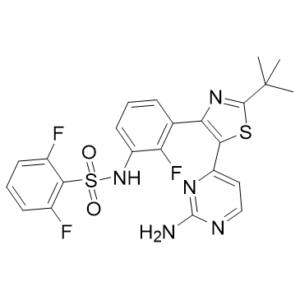
C23H20F3N5O2S2
|
|---|---|
| 分子量 |
519.56
|
| 精确质量 |
519.101
|
| 元素分析 |
C, 53.17; H, 3.88; F, 10.97; N, 13.48; O, 6.16; S, 12.34
|
| CAS号 |
1195765-45-7
|
| 相关CAS号 |
Dabrafenib Mesylate;1195768-06-9;Dabrafenib-d9;1423119-98-5
|
| PubChem CID |
44462760
|
| 外观&性状 |
White to off-white solid powder
|
| 密度 |
1.4±0.1 g/cm3
|
| 沸点 |
653.7±65.0 °C at 760 mmHg
|
| 闪点 |
349.2±34.3 °C
|
| 蒸汽压 |
0.0±2.0 mmHg at 25°C
|
| 折射率 |
1.626
|
| LogP |
3.54
|
| tPSA |
148.21
|
| 氢键供体(HBD)数目 |
2
|
| 氢键受体(HBA)数目 |
11
|
| 可旋转键数目(RBC) |
6
|
| 重原子数目 |
35
|
| 分子复杂度/Complexity |
817
|
| 定义原子立体中心数目 |
0
|
| SMILES |
S1C(C2C([H])=C([H])N=C(N([H])[H])N=2)=C(C2C([H])=C([H])C([H])=C(C=2F)N([H])S(C2C(=C([H])C([H])=C([H])C=2F)F)(=O)=O)N=C1C(C([H])([H])[H])(C([H])([H])[H])C([H])([H])[H]
|
| InChi Key |
BFSMGDJOXZAERB-UHFFFAOYSA-N
|
| InChi Code |
InChI=1S/C23H20F3N5O2S2/c1-23(2,3)21-30-18(19(34-21)16-10-11-28-22(27)29-16)12-6-4-9-15(17(12)26)31-35(32,33)20-13(24)7-5-8-14(20)25/h4-11,31H,1-3H3,(H2,27,28,29)
|
| 化学名 |
N-[3-[5-(2-aminopyrimidin-4-yl)-2-tert-butyl-1,3-thiazol-4-yl]-2-fluorophenyl]-2,6-difluorobenzenesulfonamide
|
| 别名 |
GSK2118436A; GSK-2118436B; GSK 2118436A; Dabrafenib; 1195765-45-7; GSK2118436-A; UNII-QGP4HA4G1B; QGP4HA4G1B; GSK-2118436-A; CHEBI:75045; Benzenesulfonamide, N-[3-[5-(2-amino-4-pyrimidinyl)-2-(1,1-dimethylethyl)-4-thiazolyl]-2-fluorophenyl]-2,6-difluoro-; GSK2118436B (Dabrafenib Mesylate ); GSK-2118436A; GSK 2118436B. Trade name: Tafinlar
|
| HS Tariff Code |
2934.99.9001
|
| 存储方式 |
Powder -20°C 3 years 4°C 2 years In solvent -80°C 6 months -20°C 1 month |
| 运输条件 |
Room temperature (This product is stable at ambient temperature for a few days during ordinary shipping and time spent in Customs)
|
| 溶解度 (体外实验) |
|
|||
|---|---|---|---|---|
| 溶解度 (体内实验) |
配方 1 中的溶解度: 5 mg/mL (9.62 mM) in 30% PEG400 0.5% Tween80 + 5% Propanediol 64.5%H2O (这些助溶剂从左到右依次添加,逐一添加), 悬浮液;超声助溶。
配方 2 中的溶解度: 2.5 mg/mL (4.81 mM) in 0.5%HPMC (这些助溶剂从左到右依次添加,逐一添加), 悬浊液; 超声助溶。 View More
配方 3 中的溶解度: ≥ 2.5 mg/mL (4.81 mM) (饱和度未知) in 10% DMSO + 40% PEG300 + 5% Tween80 + 45% Saline (这些助溶剂从左到右依次添加,逐一添加), 澄清溶液。 配方 4 中的溶解度: ≥ 2.5 mg/mL (4.81 mM) (饱和度未知) in 10% DMSO + 90% (20% SBE-β-CD in Saline) (这些助溶剂从左到右依次添加,逐一添加), 澄清溶液。 例如,若需制备1 mL的工作液,可将100μL 25.0mg/mL澄清的DMSO储备液加入到900μL 20%SBE-β-CD生理盐水中,混匀。 *20% SBE-β-CD 生理盐水溶液的制备(4°C,1 周):将 2 g SBE-β-CD 溶解于 10 mL 生理盐水中,得到澄清溶液。 配方 5 中的溶解度: ≥ 2.5 mg/mL (4.81 mM) (饱和度未知) in 10% DMSO + 90% Corn Oil (这些助溶剂从左到右依次添加,逐一添加), 澄清溶液。 例如,若需制备1 mL的工作液,可将100 μL 25.0 mg/mL 澄清 DMSO 储备液加入到 900 μL 玉米油中并混合均匀。 配方 6 中的溶解度: 2.5 mg/mL (4.81 mM) in 5% DMSO + 40% PEG300 + 5% Tween80 + 50% Saline (这些助溶剂从左到右依次添加,逐一添加), 悬浊液; 超声助溶。 *生理盐水的制备:将 0.9 g 氯化钠溶解在 100 mL ddH₂O中,得到澄清溶液。 配方 7 中的溶解度: ≥ 2.5 mg/mL (4.81 mM)(饱和度未知) in 5% DMSO + 95% (20% SBE-β-CD in Saline) (这些助溶剂从左到右依次添加,逐一添加),澄清溶液。 *20% SBE-β-CD 生理盐水溶液的制备(4°C,1 周):将 2 g SBE-β-CD 溶解于 10 mL 生理盐水中,得到澄清溶液。 1、请先配制澄清的储备液(如:用DMSO配置50 或 100 mg/mL母液(储备液)); 2、取适量母液,按从左到右的顺序依次添加助溶剂,澄清后再加入下一助溶剂。以 下列配方为例说明 (注意此配方只用于说明,并不一定代表此产品 的实际溶解配方): 10% DMSO → 40% PEG300 → 5% Tween-80 → 45% ddH2O (或 saline); 假设最终工作液的体积为 1 mL, 浓度为5 mg/mL: 取 100 μL 50 mg/mL 的澄清 DMSO 储备液加到 400 μL PEG300 中,混合均匀/澄清;向上述体系中加入50 μL Tween-80,混合均匀/澄清;然后继续加入450 μL ddH2O (或 saline)定容至 1 mL; 3、溶剂前显示的百分比是指该溶剂在最终溶液/工作液中的体积所占比例; 4、 如产品在配制过程中出现沉淀/析出,可通过加热(≤50℃)或超声的方式助溶; 5、为保证最佳实验结果,工作液请现配现用! 6、如不确定怎么将母液配置成体内动物实验的工作液,请查看说明书或联系我们; 7、 以上所有助溶剂都可在 Invivochem.cn网站购买。 |
| 制备储备液 | 1 mg | 5 mg | 10 mg | |
| 1 mM | 1.9247 mL | 9.6235 mL | 19.2471 mL | |
| 5 mM | 0.3849 mL | 1.9247 mL | 3.8494 mL | |
| 10 mM | 0.1925 mL | 0.9624 mL | 1.9247 mL |
1、根据实验需要选择合适的溶剂配制储备液 (母液):对于大多数产品,InvivoChem推荐用DMSO配置母液 (比如:5、10、20mM或者10、20、50 mg/mL浓度),个别水溶性高的产品可直接溶于水。产品在DMSO 、水或其他溶剂中的具体溶解度详见上”溶解度 (体外)”部分;
2、如果您找不到您想要的溶解度信息,或者很难将产品溶解在溶液中,请联系我们;
3、建议使用下列计算器进行相关计算(摩尔浓度计算器、稀释计算器、分子量计算器、重组计算器等);
4、母液配好之后,将其分装到常规用量,并储存在-20°C或-80°C,尽量减少反复冻融循环。
计算结果:
工作液浓度: mg/mL;
DMSO母液配制方法: mg 药物溶于 μL DMSO溶液(母液浓度 mg/mL)。如该浓度超过该批次药物DMSO溶解度,请首先与我们联系。
体内配方配制方法:取 μL DMSO母液,加入 μL PEG300,混匀澄清后加入μL Tween 80,混匀澄清后加入 μL ddH2O,混匀澄清。
(1) 请确保溶液澄清之后,再加入下一种溶剂 (助溶剂) 。可利用涡旋、超声或水浴加热等方法助溶;
(2) 一定要按顺序加入溶剂 (助溶剂) 。
Pediatric Long-Term Follow-up and Rollover Study
CTID: NCT03975829
Phase: Phase 4 Status: Active, not recruiting
Date: 2024-11-14
Dabrafenib inhibits MAPK signalling in BRAFV600E cells and is abrogated by ARAF or CRAF depletion. PLoS One. 2013; 8(7): e67583. |
Modulation of pharmacodynamic markers by dabrafenib in BRAFV600E tumors. |
Inhibition of BRAFV600E tumor xenograft growth by dabrafenib. |
InvivoChem的所有产品仅用于作科学研究,不面向患者销售
Copyright 2020 InvivoChem LLC | All Rights Reserved 粤ICP备20063088号-1


 COA
COA


 粤公网安备 44011102003439号
 463611831
