| 规格 | 价格 | 库存 | 数量 |
|---|---|---|---|
| 50mg |
|
||
| 100mg |
|
||
| 250mg |
|
||
| 500mg |
|
||
| 1g |
|
||
| 2g |
|
||
| 5g |
|
||
| Other Sizes |
|
| 靶点 |
Human Immunodeficiency Virus Type 1 (HIV-1) Reverse Transcriptase (RT) (IC₅₀ = 0.26 μM for recombinant HIV-1 RT)
DNA polymerase α (IC₅₀ > 440 μM) DNA polymerase δ (IC₅₀ > 550 μM) |
|---|---|
| 体外研究 (In Vitro) |
当剂量大于 100 μM 时,地拉韦啶对 H9 和 PBMC 细胞具有 50% 的细胞毒性。 100 μM 时,地拉韦啶导致外周血淋巴细胞活力下降不到 8%,表明其细胞毒性适中 [1]。地拉韦啶的 IC50 值为 0.26 μM,可抑制野生型形式的 HIV-1 逆转录酶 (RT)。它还抑制用 Y181C 和 K103N 替代的 RT,IC50 值分别为 8.32 uM 和 7.7 uM [1]。
U-90152 抑制重组HIV-1逆转录酶,IC₅₀为0.26 μM,对细胞DNA聚合酶α和δ的选择性很高(IC₅₀分别 > 440 μM和 > 550 μM)。 它在外周血淋巴细胞中抑制了25株原发性HIV-1分离株的复制,平均ED₅₀为0.066 ± 0.137 μM,包括对AZT或ddI具有高度耐药性的变异株。 在100 μM浓度下,它导致外周血淋巴细胞存活率降低小于8%。 在MT-2细胞中,它抑制HIV-1诱导的合胞体形成,ED₅₀约为10 nM。 在感染单核细胞嗜性HIV-1JR-FL的原代单核-巨噬细胞培养物中,其ED₅₀约为20 nM。 在3 μM浓度下,它能完全阻止HIV-1IIIB在MT-4细胞共培养体系中的传播;与0.5 μM AZT联用时,也能完全阻止病毒传播。 它对HIV-1 RT突变体Y181C(IC₅₀ = 8.32 μM)和K103N(IC₅₀ = 7.70 μM)仍保持抑制活性。 [1] |
| 体内研究 (In Vivo) |
甲磺酸地拉韦啶 (U 90152) 是一种小循环成分,可快速吸收和消化。它以 10 mg/kg、200 mg/kg 或 250 mg/kg 的单剂量口服给药。在 CD-1 小鼠中,其代谢为脱烷基阿维啶的能力受到限制或阻碍(PK 研究),并且其代谢动力学是非线性的 [1]。
|
| 酶活实验 |
使用高纯度的酶,通过先前描述的方法测定了U-90152对源自HIV-1IIIB的重组异源二聚体HIV-1 RT的抑制。使用poly(dA)-oligod(dT)作为模板-引物,并在聚合酶δ测定中包含增殖细胞核抗原,测定了对DNA聚合酶α和δ的抑制。通过定点诱变制备了耐药突变RT(Y181C、K103N),克隆到表达质粒中,通过金属亲和层析纯化为p66同源二聚体,并在抑制剂存在下测定了它们的RNA依赖性DNA聚合酶活性。 [1]
|
| 细胞实验 |
在MT-2细胞和外周血淋巴细胞中测定了对HIV-1IIIB的抗病毒活性。MT-2细胞感染HIV-1IIIB,洗涤后与药物共培养4天;通过计数合胞体确定ED₅₀。PBL以类似方式感染并与药物共培养6天;通过测量上清液p24抗原水平评估病毒复制。
使用标准化方案测试了对25株临床分离株的敏感性:感染PBL并与药物共培养,测量p24水平。 通过将植物血凝素刺激的正常PBL与0至100 μM U-90152共培养7天,然后进行细胞计数并通过台盼蓝排斥法测定活力,来评估细胞毒性。 在原代单核-巨噬细胞培养物中确定了对单核细胞嗜性HIV-1JR-FL的活性。 通过在药物存在下,将HIV-1IIIB感染的MT-4细胞与1000倍过量的未感染MT-4细胞共培养,来评估对病毒传播的抑制。定期用含新鲜药物的培养基稀释培养物。通过合胞体形成、p24抗原水平和细胞活力监测病毒传播。 [1] |
| 药代性质 (ADME/PK) |
吸收、分布和排泄
排泄:粪便排泄:健康志愿者每日三次,每次 330 mg 后,44% 的药物经粪便排出。肾脏排泄:健康志愿者每日三次,每次 330 mg 后,51% 的药物经肾脏排出。不到 5% 的药物以原形经尿液排出。 地拉韦啶主要分布于血浆中。 地拉韦啶吸收良好,尤其是在 pH 值低于 2.0 时。 口服地拉韦啶甲磺酸盐后吸收迅速,给药后约 1 小时达到血浆药物浓度峰值。 HIV感染成人每日三次口服400毫克甲磺酸地拉韦啶后,药物的平均稳态血浆峰浓度为15.98微克/毫升(范围:0.91-45.66微克/毫升),平均血浆谷浓度为6.85微克/毫升(范围:0.05-20.55微克/毫升),平均AUC为82.19微克小时/毫升。 有关甲磺酸地拉韦啶(共8项)的更多吸收、分布和排泄(完整)数据,请访问HSDB记录页面。 代谢/代谢物 地拉韦啶与血浆蛋白广泛结合,主要通过CYP3A4代谢。主要代谢途径为N-去烷基化。血浆地拉韦啶浓度存在显著的个体间差异,这与CYP3A活性的差异有关。脑脊液与血浆的浓度比为0.02。 地拉韦啶在小鼠体内的代谢广泛,包括酰胺键断裂、N-去烷基化、吡啶环C-6'位羟基化以及吡啶环断裂,这些代谢途径通过质谱和/或1H和13C核磁共振波谱法测定。在低剂量药物时,N-去烷基化和酰胺键断裂是主要的代谢途径;随着地拉韦啶生物转化为去烷基地拉韦啶的转化达到饱和或受到抑制,酰胺键断裂在高剂量和多次给药后成为主要的代谢途径。 生物半衰期 地拉韦啶的表观血浆半衰期随剂量增加而延长。成人每日三次服用400毫克地拉韦啶后,其平均血浆半衰期为5.8小时(范围:2-11小时)。 血浆清除:每日三次服用400毫克后,平均清除时间为5.8小时(范围:2-11小时)。表观半衰期随剂量增加而延长。 |
| 毒性/毒理 (Toxicokinetics/TK) |
妊娠期和哺乳期影响
◉ 哺乳期用药概述 地拉韦啶已停止在美国销售。目前尚无关于哺乳期使用地拉韦啶的公开信息。不建议哺乳期使用地拉韦啶。通过抗逆转录病毒疗法实现并维持病毒抑制可将母乳喂养传播风险降低至1%以下,但并非为零。对于接受抗逆转录病毒疗法且病毒载量持续低于检测限的HIV感染者,如果她们选择母乳喂养,应予以支持。如果病毒载量未得到抑制,建议使用巴氏杀菌的捐赠母乳或配方奶。 ◉ 对母乳喂养婴儿的影响 截至修订日期,未找到相关的已发表信息。 ◉ 对泌乳和母乳的影响 截至修订日期,未找到相关的已发表信息。 U-90152 显示出较低的细胞毒性。在 100 μM 的浓度下,它导致培养 7 天的植物血凝素刺激的外周血淋巴细胞的活力降低不到 8%。[1] |
| 参考文献 | |
| 其他信息 |
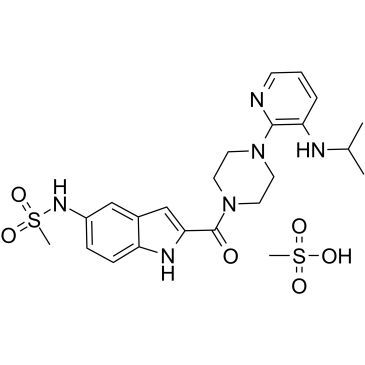
地拉韦啶甲磺酸盐是地拉韦啶的单甲磺酸盐,地拉韦啶是一种非核苷类逆转录酶抑制剂,对HIV-1具有特异性活性。单独使用地拉韦啶时,病毒耐药性会迅速出现,因此,它(以甲磺酸盐的形式)通常与其他抗逆转录病毒药物联合使用,用于HIV感染的联合治疗。它既是一种抗病毒药物,也是一种HIV-1逆转录酶抑制剂。它含有地拉韦啶。
地拉韦啶甲磺酸盐是地拉韦啶的甲磺酸盐形式,地拉韦啶是一种合成的非核苷类逆转录酶抑制剂。研究表明,与其他抗逆转录病毒药物联合使用时,该药物可以降低HIV病毒载量并提高患者的CD4白细胞计数。作为细胞色素P450系统的抑制剂,地拉韦啶可能导致同时服用的、经细胞色素P450系统代谢的蛋白酶抑制剂的血清浓度升高。 一种强效的非核苷类逆转录酶抑制剂,具有针对HIV-1的特异性活性。 作用机制 地拉韦啶进入细胞后,与逆转录酶p66亚基的疏水性口袋结合。这会导致酶构象发生变化,形成稳定的非活性形式。地拉韦啶-逆转录酶复合物通过赖氨酸103残基的氢键以及与脯氨酸236残基的强疏水相互作用而稳定。抑制细胞聚合酶所需的地拉韦啶浓度远高于抑制逆转录酶所需的浓度。 虽然地拉韦啶的抗病毒活性机制尚未完全阐明,但该药物通过干扰逆转录酶的病毒RNA和DNA聚合酶活性来抑制1型人类免疫缺陷病毒(HIV-1)的复制。HIV逆转录酶对病毒复制至关重要,其活性发生在病毒颗粒穿透细胞膜并释放病毒核心之后,但在病毒进入细胞核并整合到染色体之前,位于宿主细胞的细胞质中。该酶具有多功能性,主要有三种活性(即RNA指导的DNA聚合酶、RNase H和DNA指导的DNA聚合酶功能)。逆转录酶以病毒RNA为模板,形成病毒DNA的负链,从而产生双链RNA:DNA杂交体(即RNA指导的DNA聚合酶功能)。逆转录酶的RNase H功能通过在RNA复制后降解RNA:DNA杂交体中的RNA成分来促进病毒RNA的复制,从而留下单链病毒DNA。逆转录酶以新形成的病毒DNA负链为模板,合成病毒DNA正链,将单链病毒DNA转化为双链前病毒DNA形式(即DNA指导的DNA聚合酶功能)。BHAP衍生物,包括地拉韦啶,抑制逆转录酶的聚合酶功能,但不抑制其RNase H功能。这些药物直接与异二聚体 HIV-1 逆转录酶结合,通过作为特异性、非竞争性 HIV-1 逆转录酶抑制剂发挥抗病毒作用。 非核苷类逆转录酶抑制剂作用于逆转录酶的不同位点,与核苷类逆转录酶抑制剂(例如,阿巴卡韦、地达诺辛、拉米夫定、司他夫定、扎西他滨、齐多夫定)的作用位点不同,且这些药物的作用机制也不同。与目前可用的非核苷类逆转录酶抑制剂不同,双脱氧核苷类抗逆转录病毒药物需要在细胞内转化为三磷酸代谢物,这些代谢物随后与天然存在的脱氧核苷三磷酸竞争逆转录酶掺入病毒DNA,并通过阻止进一步的5'→3'磷酸二酯键形成而导致病毒DNA链过早终止。 U-90152是一种新型双杂芳基哌嗪(BHAP)类非核苷类逆转录酶抑制剂(NNRTI)。 它的结构与U-87201E相似,但具有更高的抗病毒活性。 它与HIV-1逆转录酶结合的位点与其他BHAP类药物和NNRTI类药物(如奈韦拉平)相同,且具有较高的表观亲和力(~80 nM)。 其抑制机制是针对模板-引物和底物的非竞争性抑制。 它对HIV-1复制表现出协同抑制作用。与 AZT 联用时。 尽管携带 RT 突变(例如 Y181C、K103N)的 HIV-1 变异株可能表现出较低的敏感性,但与其他非核苷类逆转录酶抑制剂 (NNRTI) 相比,U-90152 对这些突变株仍保持显著的活性。 已启动 U-90152 甲磺酸盐的临床试验。[1] |
| 分子式 |
C22H28N6O3S.CH4O3S
|
|---|---|
| 分子量 |
552.66678
|
| 精确质量 |
552.182
|
| CAS号 |
147221-93-0
|
| 相关CAS号 |
Delavirdine;136817-59-9
|
| PubChem CID |
441386
|
| 外观&性状 |
White to yellow solid powder
|
| 沸点 |
732ºC at 760mmHg
|
| 熔点 |
118-120ºC
|
| 闪点 |
396.5ºC
|
| 蒸汽压 |
2.74E-21mmHg at 25°C
|
| LogP |
4.531
|
| tPSA |
181.56
|
| 氢键供体(HBD)数目 |
4
|
| 氢键受体(HBA)数目 |
10
|
| 可旋转键数目(RBC) |
6
|
| 重原子数目 |
37
|
| 分子复杂度/Complexity |
842
|
| 定义原子立体中心数目 |
0
|
| InChi Key |
MEPNHSOMXMALDZ-UHFFFAOYSA-N
|
| InChi Code |
InChI=1S/C22H28N6O3S.CH4O3S/c1-15(2)24-19-5-4-8-23-21(19)27-9-11-28(12-10-27)22(29)20-14-16-13-17(26-32(3,30)31)6-7-18(16)25-20;1-5(2,3)4/h4-8,13-15,24-26H,9-12H2,1-3H3;1H3,(H,2,3,4)
|
| 化学名 |
methanesulfonic acid;N-[2-[4-[3-(propan-2-ylamino)pyridin-2-yl]piperazine-1-carbonyl]-1H-indol-5-yl]methanesulfonamide
|
| 别名 |
Rescriptor; BHAP-U 90152; U-90152; BHAP U 90152; U90152; BHAP-U-90152; U 90152; DLV
|
| HS Tariff Code |
2934.99.9001
|
| 存储方式 |
Powder -20°C 3 years 4°C 2 years In solvent -80°C 6 months -20°C 1 month 注意: 请将本产品存放在密封且受保护的环境中,避免吸湿/受潮。 |
| 运输条件 |
Room temperature (This product is stable at ambient temperature for a few days during ordinary shipping and time spent in Customs)
|
| 溶解度 (体外实验) |
DMSO : ≥ 40.3 mg/mL (~72.92 mM)
|
|---|---|
| 溶解度 (体内实验) |
配方 1 中的溶解度: ≥ 2.5 mg/mL (4.52 mM) (饱和度未知) in 10% DMSO + 40% PEG300 + 5% Tween80 + 45% Saline (这些助溶剂从左到右依次添加,逐一添加), 澄清溶液。
例如,若需制备1 mL的工作液,可将100 μL 25.0 mg/mL澄清DMSO储备液加入到400 μL PEG300中,混匀;然后向上述溶液中加入50 μL Tween-80,混匀;加入450 μL生理盐水定容至1 mL。 *生理盐水的制备:将 0.9 g 氯化钠溶解在 100 mL ddH₂O中,得到澄清溶液。 配方 2 中的溶解度: ≥ 2.5 mg/mL (4.52 mM) (饱和度未知) in 10% DMSO + 90% (20% SBE-β-CD in Saline) (这些助溶剂从左到右依次添加,逐一添加), 澄清溶液。 例如,若需制备1 mL的工作液,可将 100 μL 25.0 mg/mL澄清DMSO储备液加入900 μL 20% SBE-β-CD生理盐水溶液中,混匀。 *20% SBE-β-CD 生理盐水溶液的制备(4°C,1 周):将 2 g SBE-β-CD 溶解于 10 mL 生理盐水中,得到澄清溶液。 View More
配方 3 中的溶解度: ≥ 2.5 mg/mL (4.52 mM) (饱和度未知) in 10% DMSO + 90% Corn Oil (这些助溶剂从左到右依次添加,逐一添加), 澄清溶液。 1、请先配制澄清的储备液(如:用DMSO配置50 或 100 mg/mL母液(储备液)); 2、取适量母液,按从左到右的顺序依次添加助溶剂,澄清后再加入下一助溶剂。以 下列配方为例说明 (注意此配方只用于说明,并不一定代表此产品 的实际溶解配方): 10% DMSO → 40% PEG300 → 5% Tween-80 → 45% ddH2O (或 saline); 假设最终工作液的体积为 1 mL, 浓度为5 mg/mL: 取 100 μL 50 mg/mL 的澄清 DMSO 储备液加到 400 μL PEG300 中,混合均匀/澄清;向上述体系中加入50 μL Tween-80,混合均匀/澄清;然后继续加入450 μL ddH2O (或 saline)定容至 1 mL; 3、溶剂前显示的百分比是指该溶剂在最终溶液/工作液中的体积所占比例; 4、 如产品在配制过程中出现沉淀/析出,可通过加热(≤50℃)或超声的方式助溶; 5、为保证最佳实验结果,工作液请现配现用! 6、如不确定怎么将母液配置成体内动物实验的工作液,请查看说明书或联系我们; 7、 以上所有助溶剂都可在 Invivochem.cn网站购买。 |
| 制备储备液 | 1 mg | 5 mg | 10 mg | |
| 1 mM | 1.8094 mL | 9.0470 mL | 18.0940 mL | |
| 5 mM | 0.3619 mL | 1.8094 mL | 3.6188 mL | |
| 10 mM | 0.1809 mL | 0.9047 mL | 1.8094 mL |
1、根据实验需要选择合适的溶剂配制储备液 (母液):对于大多数产品,InvivoChem推荐用DMSO配置母液 (比如:5、10、20mM或者10、20、50 mg/mL浓度),个别水溶性高的产品可直接溶于水。产品在DMSO 、水或其他溶剂中的具体溶解度详见上”溶解度 (体外)”部分;
2、如果您找不到您想要的溶解度信息,或者很难将产品溶解在溶液中,请联系我们;
3、建议使用下列计算器进行相关计算(摩尔浓度计算器、稀释计算器、分子量计算器、重组计算器等);
4、母液配好之后,将其分装到常规用量,并储存在-20°C或-80°C,尽量减少反复冻融循环。
计算结果:
工作液浓度: mg/mL;
DMSO母液配制方法: mg 药物溶于 μL DMSO溶液(母液浓度 mg/mL)。如该浓度超过该批次药物DMSO溶解度,请首先与我们联系。
体内配方配制方法:取 μL DMSO母液,加入 μL PEG300,混匀澄清后加入μL Tween 80,混匀澄清后加入 μL ddH2O,混匀澄清。
(1) 请确保溶液澄清之后,再加入下一种溶剂 (助溶剂) 。可利用涡旋、超声或水浴加热等方法助溶;
(2) 一定要按顺序加入溶剂 (助溶剂) 。
InvivoChem的所有产品仅用于作科学研究,不面向患者销售
Copyright 2020 InvivoChem LLC | All Rights Reserved 粤ICP备20063088号-1


 COA
COA
 粤公网安备 44011102003439号
 463611831
