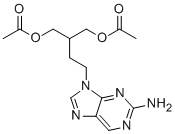
Famciclovir (BRL 42810)

别名: Famvir, BRL-42810; BRL42810; BRL 42810 泛昔洛韦; 2-[2-(2-氨基-9H-嘌呤-9-基)乙基]-1,3-丙二醇二乙酸酯; 法昔洛韦 ; 2',3'-二脱氧鸟苷; Famciclovir 泛昔洛韦;法昔洛韦 泛昔洛韦;泛昔洛韦 USP标准品;泛昔洛韦杂质;法昔洛为;2-[2-(2-氨基-9H-嘌呤-9-基)乙基]-1,3-丙二醇-二乙酯;泛昔洛韦(标准品);泛昔洛韦, 鸟嘌呤类似物抗病毒药物; [2-(乙酰氧基甲基)-4-(2-氨基嘌呤-9-基)丁基]乙酸酯
目录号: V5188 纯度: ≥98%
泛昔洛韦(也称为 BRL 42810)是一种鸟嘌呤类抗病毒药物,用于治疗各种疱疹病毒感染,例如带状疱疹(带状疱疹)。
Famciclovir (BRL 42810) CAS号: 104227-87-4
产品类别: HSV
产品仅用于科学研究,不针对患者销售
规格 价格 库存 数量
100mg
250mg
500mg
1g
2g
5g
10g
Other Sizes

Other Forms of Famciclovir (BRL 42810):

  • Famciclovir-d4 (BRL 42810-d4)
点击了解更多
InvivoChem产品被CNS等顶刊论文引用
纯度/质量控制文件

纯度: ≥98%

产品描述
泛昔洛韦(也称为 BRL 42810)是一种鸟嘌呤类抗病毒药物,用于治疗各种疱疹病毒感染,例如带状疱疹(带状疱疹)。它还适用于治疗艾滋病毒患者的单纯疱疹复发。它是喷昔洛韦的前药形式,具有改善的口服生物利用度。
生物活性&实验参考方法
靶点
Herpes Simplex Virus Type 1 (HSV-1). [1]
体外研究 (In Vitro)
通过脱乙酰化,泛昔洛韦代谢为 BRL 42359,后者氧化为喷昔洛韦[3]。
前药泛昔洛韦在体内转化为活性形式喷昔洛韦 (PCV)。通过空斑减少试验评估了PCV对临床HSV-1毒株 (HSV-1-511)的抗病毒活性。PCV在兔睾丸细胞 (RTP) 中的平均EC50(减少50%空斑的有效浓度)为 0.07 ± 0.02 μg/mL,在BALB/c 3T6小鼠细胞中为 0.08 ± 0.02 μg/mL,表明对该毒株具有相当的体外效力。[1]
体内研究 (In Vivo)
泛昔洛韦(50~400mg/kg,口服,每日3次,共10剂)可有效治愈坏死性肝炎小鼠[1]。
在幼鼠弥散性HSV-1感染模型(通过静脉接种高毒力临床分离株诱导)中,于感染后第2天(此时已出现微观肝脏病变)开始口服泛昔洛韦治疗显示出显著的保护作用。以每日50 mg/kg的剂量(分3次,每8小时一次,连续3天)治疗,与未治疗对照组相比,FCV能显著降低感染后第6天宏观坏死性肝炎的发生率 (p<0.001)。[1]
在相同的每日50 mg/kg剂量下,泛昔洛韦还能在21天观察期内显著降低死亡率 (p<0.001)。这种对死亡的保护作用显著优于 (p<0.05) 伐昔洛韦在相同50 mg/kg/日剂量下达到的效果。使用更高剂量的FCV (100, 200, 400 mg/kg/日) 进一步降低了肝炎发生率和死亡率,其中200和400 mg/kg/日的剂量在治疗组中完全防止了宏观肝脏病变和死亡。[1]
在用FCV 100 mg/kg/日治疗的存活小鼠中,感染后第21天仍可在部分动物(8只中的3只)的脑干中通过PCR检测到HSV DNA,提示可能建立了潜伏感染或存在残留病毒基因组。[1]
酶活实验
Penciclovir 在疱疹病毒感染细胞中被病毒胸苷激酶选择性磷酸化为 penciclovir 单磷酸盐,继而转化为二磷酸盐和三磷酸盐。Penciclovir 三磷酸盐抑制病毒 DNA 聚合酶,从而抑制病毒 DNA 合成。该磷酸化过程在病毒感染细胞中比在未感染宿主细胞中更高效。Penciclovir 三磷酸盐的细胞内半衰期长于阿昔洛韦三磷酸盐,有助于延长抗病毒活性。[4]
细胞实验
空斑抑制试验: 测定了HSV-1-511毒株对喷昔洛韦(泛昔洛韦的活性代谢物)的体外敏感性。简述如下:将培养于培养瓶中的细胞(BALB/c 3T6或兔睾丸细胞)接种病毒悬液,使每个培养瓶形成约50个空斑。经过1小时的病毒吸附期后,移除接种物,用含有不同浓度抗病毒药物的营养培养基覆盖细胞。随后将培养物在37°C下孵育72小时。孵育结束后,固定细胞并用结晶紫染色,在显微镜下计数空斑数量。根据剂量反应曲线确定使空斑数减少50%所需的药物浓度 (EC50)。[1]
动物实验
Animal Model: Four- to five-week-old Balb/c mice with HSV-1 infection[1]
Dosage: 50, 100, 200 and 400 mg/kg
Administration: Oral gavage; 50-400 mg/kg per day divided into three doses given every 8 h; for total 10 doses
Result: significantly decreased the daily incidence of hepatitis when administered at a dose of 50 mg/kg; however, the treatment group receiving doses of 50 and 100 mg/kg was unable to isolate the infectious virus.
Mouse Model of Disseminated HSV-1 Infection and Treatment: Four- to five-week-old Balb/c mice weighing 18-22 g were infected intravenously on day 0 with a lethal dose of HSV-1-511. Treatment with Famciclovir was initiated on day 2 post-infection (a time point when microscopic liver lesions are already present, simulating clinical diagnosis) and continued for 3 days, for a total of 10 doses. The drug was administered orally by gavage. It was dissolved in phosphate-buffered saline (PBS), and a volume of 0.2 mL of the solution was given per mouse per dose. The daily dose was divided into three equal parts administered every 8 hours. Doses tested included 50, 100, 200, and 400 mg/kg/day. Mice were monitored twice daily for 21 days for signs of encephalitis and death. To assess effects on hepatitis, half of the animals from each group were sacrificed on day 6 post-infection (one day after treatment ended) to examine the liver surface for macroscopic necrotic lesions. The remaining mice were observed for mortality until day 21. [1]
药代性质 (ADME/PK)
Absorption, Distribution and Excretion
77 %
Active tubular secretion contributes to the renal elimination of penciclovir.
1.08±0.17 L/kg [healthy male subjects following a single intravenous dose of penciclovir at 400 mg administered as a 1-hour intravenous infusion]
36.6 +/- 6.3 L/hr [healthy male]
0.48 +/- 0.09 L/hr/kg [healthy male]
Following oral administration of famciclovir to lactating rats, penciclovir was distributed into breast milk at concentrations higher than those observed in plasma.
Not known whether penciclovir crosses the placenta or is distributed into human milk.
Following oral single-dose administration of 500 mg famciclovir to seven patients with herpes zoster, the AUC (mean + or - SD), Cmax, and tmax were 12.1+ or - 1.7 ug hr/mL, 4.0 + or - 0.7 ug/mL, and 0.7 + or - 0.2 hours, respectively. The AUC of penciclovir was approximately 35% greater in patients with herpes zoster as compared to healthy volunteers. Some of this difference may be due to differences in renal function between the two groups.
Renal clearance of penciclovir following the oral administration of a single 500 mg dose of famciclovir to 109 healthy male volunteers was 27.7+ or - 7.6 L/hr. Active tubular secretion contributes to the renal elimination of penciclovir.
For more Absorption, Distribution and Excretion (Complete) data for Famciclovir (11 total), please visit the HSDB record page.
Metabolism / Metabolites
Hepatic
Famciclovir is deacetylated and oxidized to penciclovir. Penciclovir is phosphorylated to penciclovir triphosphate (the active metabolite) in cells infected with HSV-1, HSV-2, or VZV. The inactive metabolite 6-deoxy penciclovir is converted to penciclovir by aldehyde oxidase. Famciclovir not metabolized by CYP enzymes.
Following oral administration, famciclovir is deacetylated and oxidized to form penciclovir. Metabolites that are inactive include 6-deoxy penciclovir, monoacetylated penciclovir, and 6-deoxy monoacetylated penciclovir (5%, <0.5% and <0.5% of the dose in the urine, respectively). Little or no famciclovir is detected in plasma or urine. An in vitro study using human liver microsomes demonstrated that cytochrome P450 does not play an important role in famciclovir metabolism. The conversion of 6-deoxy penciclovir to penciclovir is catalyzed by aldehyde oxidase.
Biological Half-Life
10 hours
Elimination half-life of penciclovir after oral administration of famciclovir 1.6-3 hours. Intracellular half-life of penciclovir triphosphate in cells infected with herpes simplex virus (HSV)-1 or HSV-2 is 10 and 20 hours, respectively; intracellular half-life in varicella zoster virus (VZV)-infected cells is 7-14 hours.
The plasma elimination half-life of penciclovir was 2.0 + or - 0.3 hours after intravenous administration of penciclovir to 48 healthy male volunteers and 2.3 + or - 0.4 hours after oral administration of 500 mg famciclovir to 124 healthy male volunteers. The half-life in 17 patients with herpes zoster was 2.8 + or - 1.0 hours and 2.7 + or - 1.0 hours after single and repeated doses, respectively.
The literature mentions that Famciclovir is readily absorbed following oral administration and is efficiently converted to its active form, penciclovir (PCV), with a bioavailability of 77%. [1]
A key feature of penciclovir triphosphate (the intracellular active form) is its prolonged persistence inside HSV-infected cells compared to acyclovir triphosphate, potentially allowing for less frequent dosing. [1]
毒性/毒理 (Toxicokinetics/TK)
Hepatotoxicity
Famciclovir has been associated with a low rate of serum aminotransferase elevations during oral therapy. In pooled analyses of patients on long term suppressive therapy, 3.2% of famciclovir vs 1.5% of placebo recipients had ALT elevations above twice normal. The elevations were transient and asymptomatic and resolved even without dose modification. Since approval, cases of cholestatic jaundice have been reported to the sponsor, but there have been no published cases. Thus, clinically apparent liver disease due to famciclovir must be rare if it occurs at all.
Likelihood score: E (unlikely cause of clinically apparent liver injury).
Effects During Pregnancy and Lactation
◉ Summary of Use during Lactation
Because there is no published experience with famciclovir during breastfeeding, other agents may be preferred, especially while nursing a newborn or preterm infant.
◉ Effects in Breastfed Infants
Relevant published information was not found as of the revision date.
◉ Effects on Lactation and Breastmilk
Relevant published information was not found as of the revision date.
Protein Binding
20-25%
Interactions
The conversion of 6-deoxy penciclovir to penciclovir is catalyzed by aldehyde oxidase. Interactions with other drugs metabolized by this enzyme and/or inhibiting this enzyme could potentially occur. Clinical interaction studies of famciclovir with cimetidine and promethazine, in vitro inhibitors of aldehyde oxidase, did not show relevant effects on the formation of penciclovir. Raloxifene, a potent aldehyde oxidase inhibitor in vitro, could decrease the formation of penciclovir. However, a clinical drug-drug interaction study to determine the magnitude of interaction between penciclovir and raloxifene has not been conducted.
Potential pharmacokinetic interaction with other drugs metabolized by aldehyde oxidase.
Potential increased plasma penciclovir concentrations when used concomitantly with other drugs eliminated by active renal tubular secretion (e.g., probenecid).
Famciclovir is well tolerated with an adverse event profile similar to placebo and acyclovir. The most common adverse events are headache, nausea, and diarrhea. No clinically significant pharmacokinetic interactions were observed with allopurinol, digoxin, cimetidine, theophylline, or zidovudine. In preclinical studies, high doses of famciclovir caused reversible, dose-dependent testicular toxicity in dogs and rats, but a clinical study in men showed no significant effects on sperm parameters.[4]
参考文献

[1]. Wutzler P, Ulbricht A, Färber I. Antiviral efficacies of famciclovir, valaciclovir, and brivudin in disseminated herpes simplex virus type 1 infection in mice. Intervirology. 1997;40(1):15-21.

[2]. administration are replication defective. Hepatology. 1998 Feb;27(2):628-33.

[3]. Evidence that famciclovir (BRL 42810) and its associated metabolites do not inhibit the 6 beta-hydroxylation of testosterone in human liver microsomes. Drug Metab Dispos. 1993 Jan-Feb;21(1):18-23.

[4]. Drugs. 1995 Aug;50(2):396-415.

其他信息
Therapeutic Uses
Antiviral Agents
Oral famciclovir is used for the treatment of acute, localized herpes zoster (shingles, zoster). /Included in US product label/
Oral famciclovir is used for the treatment of recurrent mucocutaneous herpes simplex virus (HSV) infections (HSV-1 and HSV-2) in HIV-infected adults. /Included in US product label/
Famciclovir has been used for the management of chronic hepatitis B virus (HBV) infection in a limited number of patients. /NOT included in US product label/
For more Therapeutic Uses (Complete) data for Famciclovir (12 total), please visit the HSDB record page.
Drug Warnings
/These/ adverse events have been reported during post-approval use of Famvir. Because these events are reported voluntarily from a population of uncertain size, it is not always possible to reliably estimate their frequency or establish a causal relationship to drug exposure: Blood and lymphatic system disorders: Thrombocytopenia. Hepatobiliary disorders: Abnormal liver function tests, cholestatic jaundice. Nervous system disorders: Dizziness, somnolence. Psychiatric disorders: Confusion (including delirium, disorientation, and confusional state occurring predominantly in the elderly), hallucinations. Skin and subcutaneous tissue disorders: Urticaria, erythema multiforme, Stevens-Johnson syndrome, toxic epidermal necrolysis, angioedema (e.g. face, eyelid, periorbital, and pharyngeal edema).
The manufacturer recommends that the dosage interval of famciclovir be adjusted carefully in patients with impaired renal function to prevent drug accumulation while maintaining adequate plasma concentrations of penciclovir, the active metabolite of famciclovir.
Increased serum concentrations of ALT (SGPT) occurred in 1.4-2.4% of patients receiving famciclovir in clinical trials for herpes zoster or genital herpes. Increased serum concentrations of alkaline phosphatase, total bilirubin, and albumin each occurred rarely in patients receiving the drug in clinical trials for herpes zoster or genital herpes.
The most frequent adverse GI effect of famciclovir is nausea which occurred in approximately 13% of patients receiving the drug (versus in 11.6% in placebo recipients) in a large, controlled clinical trial for herpes zoster. Nausea resulted in discontinuance of famciclovir in less than 1% of patients in clinical trials for herpes zoster or genital herpes. Diarrhea was reported in approximately 8% of patients (5% of placebo recipients) and vomiting in approximately 5% of patients (3.4% of placebo recipients) in a large, controlled clinical trial for herpes zoster. Vomiting only rarely resulted in discontinuance of famciclovir in clinical trials for herpes zoster or genital herpes. Constipation, anorexia, abdominal pain, flatulence, and dyspepsia have occurred in patients receiving famciclovir in clinical trials for herpes zoster. Acute necroticohemorrhagic pancreatitis resulting in death has been reported following famciclovir administration for severe hepatitis B virus infection in a kidney graft recipient who was receiving cyclosporine concomitantly; a causal relationship to famciclovir was not established. Nausea, diarrhea, vomiting, or abdominal pain has been reported in 11, 7, 5, or 3%, respectively, of HIV-infected patients receiving famciclovir in clinical studies.
For more Drug Warnings (Complete) data for Famciclovir (12 total), please visit the HSDB record page.
Pharmacodynamics
Famciclovir is a prodrug that undergoes rapid biotransformation to the active antiviral compound penciclovir. Penciclovir is an anti-viral drug which has inhibitory activity against herpes simplex virus types 1 (HSV-1) and 2 (HSV-2) and varicella zoster virus (VZV). Therefore, herpes viral DNA synthesis and replication are selectively inhibited.
Famciclovir is the oral prodrug of penciclovir (PCV), a novel antiviral agent with marked activity against HSV and VZV. [1]
In the discussed mouse model, the progression of established liver tissue damage (visible as macroscopic necrosis) was significantly halted by oral treatment with Famciclovir at doses of 50 mg/kg/day and above. [1]
Treatment with Famciclovir also led to the complete clearance of infectious virus from the liver within the 3-day treatment period at effective doses (50 and 100 mg/kg/day). [1]
The study suggests that the better therapeutic effect of Famciclovir compared to valaciclovir in this model might be related to the prolonged suppression of viral replication by penciclovir triphosphate after cessation of therapy. [1]
*注: 文献方法仅供参考, InvivoChem并未独立验证这些方法的准确性
化学信息 & 存储运输条件
分子式
C14H19N5O4
分子量
321.33176
精确质量
321.143
元素分析
C, 52.33; H, 5.96; N, 21.79; O, 19.92
CAS号
104227-87-4
相关CAS号
Famciclovir-d4;1020719-42-9
PubChem CID
3324
外观&性状
White to off-white solid powder
密度
1.4±0.1 g/cm3
沸点
550.2±60.0 °C at 760 mmHg
熔点
102-104°C
闪点
286.6±32.9 °C
蒸汽压
0.0±1.5 mmHg at 25°C
折射率
1.628
LogP
-0.67
tPSA
122.22
氢键供体(HBD)数目
1
氢键受体(HBA)数目
8
可旋转键数目(RBC)
9
重原子数目
23
分子复杂度/Complexity
404
定义原子立体中心数目
0
SMILES
NC1=NC=C2N=CN(CCC(COC(C)=O)COC(C)=O)C2=N1
InChi Key
GGXKWVWZWMLJEH-UHFFFAOYSA-N
InChi Code
InChI=1S/C14H19N5O4/c1-9(20)22-6-11(7-23-10(2)21)3-4-19-8-17-12-5-16-14(15)18-13(12)19/h5,8,11H,3-4,6-7H2,1-2H3,(H2,15,16,18)
化学名
[2-(acetyloxymethyl)-4-(2-aminopurin-9-yl)butyl] acetate
别名
Famvir, BRL-42810; BRL42810; BRL 42810
HS Tariff Code
2934.99.9001
存储方式

Powder      -20°C    3 years

                     4°C     2 years

In solvent   -80°C    6 months

                  -20°C    1 month

运输条件
Room temperature (This product is stable at ambient temperature for a few days during ordinary shipping and time spent in Customs)
溶解度数据
溶解度 (体外实验)
DMSO : 64~100 mg/mL ( 199.16~311.21 mM )
Water : 64 mg/mL
Ethanol : ~48 mg/mL
溶解度 (体内实验)
配方 1 中的溶解度: ≥ 2.5 mg/mL (7.78 mM) (饱和度未知) in 10% DMSO + 40% PEG300 + 5% Tween80 + 45% Saline (这些助溶剂从左到右依次添加,逐一添加), 澄清溶液。
例如,若需制备1 mL的工作液,可将100 μL 25.0 mg/mL澄清DMSO储备液加入到400 μL PEG300中,混匀;然后向上述溶液中加入50 μL Tween-80,混匀;加入450 μL生理盐水定容至1 mL。
*生理盐水的制备:将 0.9 g 氯化钠溶解在 100 mL ddH₂O中,得到澄清溶液。

配方 2 中的溶解度: ≥ 2.5 mg/mL (7.78 mM) (饱和度未知) in 10% DMSO + 90% (20% SBE-β-CD in Saline) (这些助溶剂从左到右依次添加,逐一添加), 澄清溶液。
例如,若需制备1 mL的工作液,可将 100 μL 25.0 mg/mL澄清DMSO储备液加入900 μL 20% SBE-β-CD生理盐水溶液中,混匀。
*20% SBE-β-CD 生理盐水溶液的制备(4°C,1 周):将 2 g SBE-β-CD 溶解于 10 mL 生理盐水中,得到澄清溶液。

View More

配方 3 中的溶解度: ≥ 2.5 mg/mL (7.78 mM) (饱和度未知) in 10% DMSO + 90% Corn Oil (这些助溶剂从左到右依次添加,逐一添加), 澄清溶液。
例如,若需制备1 mL的工作液,可将 100 μL 25.0 mg/mL 澄清 DMSO 储备液加入到 900 μL 玉米油中并混合均匀。


配方 4 中的溶解度: 120 mg/mL (373.45 mM) in PBS (这些助溶剂从左到右依次添加,逐一添加), 澄清溶液; 超声助溶.

请根据您的实验动物和给药方式选择适当的溶解配方/方案:
1、请先配制澄清的储备液(如:用DMSO配置50 或 100 mg/mL母液(储备液));
2、取适量母液,按从左到右的顺序依次添加助溶剂,澄清后再加入下一助溶剂。以 下列配方为例说明 (注意此配方只用于说明,并不一定代表此产品 的实际溶解配方):
10% DMSO → 40% PEG300 → 5% Tween-80 → 45% ddH2O (或 saline);
假设最终工作液的体积为 1 mL, 浓度为5 mg/mL: 取 100 μL 50 mg/mL 的澄清 DMSO 储备液加到 400 μL PEG300 中,混合均匀/澄清;向上述体系中加入50 μL Tween-80,混合均匀/澄清;然后继续加入450 μL ddH2O (或 saline)定容至 1 mL;

3、溶剂前显示的百分比是指该溶剂在最终溶液/工作液中的体积所占比例;
4、 如产品在配制过程中出现沉淀/析出,可通过加热(≤50℃)或超声的方式助溶;
5、为保证最佳实验结果,工作液请现配现用!
6、如不确定怎么将母液配置成体内动物实验的工作液,请查看说明书或联系我们;
7、 以上所有助溶剂都可在 Invivochem.cn网站购买。
制备储备液 1 mg 5 mg 10 mg
1 mM 3.1121 mL 15.5603 mL 31.1207 mL
5 mM 0.6224 mL 3.1121 mL 6.2241 mL
10 mM 0.3112 mL 1.5560 mL 3.1121 mL

1、根据实验需要选择合适的溶剂配制储备液 (母液):对于大多数产品,InvivoChem推荐用DMSO配置母液 (比如:5、10、20mM或者10、20、50 mg/mL浓度),个别水溶性高的产品可直接溶于水。产品在DMSO 、水或其他溶剂中的具体溶解度详见上”溶解度 (体外)”部分;

2、如果您找不到您想要的溶解度信息,或者很难将产品溶解在溶液中,请联系我们;

3、建议使用下列计算器进行相关计算(摩尔浓度计算器、稀释计算器、分子量计算器、重组计算器等);

4、母液配好之后,将其分装到常规用量,并储存在-20°C或-80°C,尽量减少反复冻融循环。

计算器

摩尔浓度计算器可计算特定溶液所需的质量、体积/浓度,具体如下:

  • 计算制备已知体积和浓度的溶液所需的化合物的质量
  • 计算将已知质量的化合物溶解到所需浓度所需的溶液体积
  • 计算特定体积中已知质量的化合物产生的溶液的浓度
使用摩尔浓度计算器计算摩尔浓度的示例如下所示:
假如化合物的分子量为350.26 g/mol,在5mL DMSO中制备10mM储备液所需的化合物的质量是多少?
  • 在分子量(MW)框中输入350.26
  • 在“浓度”框中输入10,然后选择正确的单位(mM)
  • 在“体积”框中输入5,然后选择正确的单位(mL)
  • 单击“计算”按钮
  • 答案17.513 mg出现在“质量”框中。以类似的方式,您可以计算体积和浓度。

稀释计算器可计算如何稀释已知浓度的储备液。例如,可以输入C1、C2和V2来计算V1,具体如下:

制备25毫升25μM溶液需要多少体积的10 mM储备溶液?
使用方程式C1V1=C2V2,其中C1=10mM,C2=25μM,V2=25 ml,V1未知:
  • 在C1框中输入10,然后选择正确的单位(mM)
  • 在C2框中输入25,然后选择正确的单位(μM)
  • 在V2框中输入25,然后选择正确的单位(mL)
  • 单击“计算”按钮
  • 答案62.5μL(0.1 ml)出现在V1框中
g/mol

分子量计算器可计算化合物的分子量 (摩尔质量)和元素组成,具体如下:

注:化学分子式大小写敏感:C12H18N3O4  c12h18n3o4
计算化合物摩尔质量(分子量)的说明:
  • 要计算化合物的分子量 (摩尔质量),请输入化学/分子式,然后单击“计算”按钮。
分子质量、分子量、摩尔质量和摩尔量的定义:
  • 分子质量(或分子量)是一种物质的一个分子的质量,用统一的原子质量单位(u)表示。(1u等于碳-12中一个原子质量的1/12)
  • 摩尔质量(摩尔重量)是一摩尔物质的质量,以g/mol表示。
/

配液计算器可计算将特定质量的产品配成特定浓度所需的溶剂体积 (配液体积)

  • 输入试剂的质量、所需的配液浓度以及正确的单位
  • 单击“计算”按钮
  • 答案显示在体积框中
动物体内实验配方计算器(澄清溶液)
第一步:请输入基本实验信息(考虑到实验过程中的损耗,建议多配一只动物的药量)
第二步:请输入动物体内配方组成(配方适用于不溶/难溶于水的化合物),不同的产品和批次配方组成不同,如对配方有疑问,可先联系我们提供正确的体内实验配方。此外,请注意这只是一个配方计算器,而不是特定产品的确切配方。
+
+
+

计算结果:

工作液浓度 mg/mL;

DMSO母液配制方法 mg 药物溶于 μL DMSO溶液(母液浓度 mg/mL)。如该浓度超过该批次药物DMSO溶解度,请首先与我们联系。

体内配方配制方法μL DMSO母液,加入 μL PEG300,混匀澄清后加入μL Tween 80,混匀澄清后加入 μL ddH2O,混匀澄清。

(1) 请确保溶液澄清之后,再加入下一种溶剂 (助溶剂) 。可利用涡旋、超声或水浴加热等方法助溶;
            (2) 一定要按顺序加入溶剂 (助溶剂) 。

相关产品
联系我们