| 规格 | 价格 | 库存 | 数量 |
|---|---|---|---|
| 25mg |
|
||
| 50mg |
|
||
| 100mg |
|
||
| 250mg |
|
||
| 500mg |
|
||
| 1g |
|
||
| 2g |
|
||
| Other Sizes |
|

| 靶点 |
L-type calcium channel; T-type calcium channel
Voltage-gated calcium channels (VGCC) [1][4] P-glycoprotein (P-gp) [2] |
|---|---|
| 体外研究 (In Vitro) |
Lomerizine(0.1 μM 和 1 μM)可显着降低大鼠培养的视网膜神经元中谷氨酸诱导的神经毒性。 Lomerizine (1 μM) 还对大鼠培养的视网膜神经元中 N-甲基-D-天冬氨酸和红藻氨酸诱导的神经毒性表现出保护作用。
在表达突变SOD1(G93A)的原代小鼠运动神经元中,1 μM Lomerizine HCl (KB-2796) 处理可显著减少细胞凋亡,凋亡率较对照组降低42%,同时抑制胞内钙超载,维持线粒体膜电位稳定[1] 该浓度下未对表达野生型SOD1或突变TDP-43的运动神经元产生明显保护作用,显示突变SOD1特异性神经保护活性[1] 在K562/ADM多药耐药细胞中,Lomerizine HCl (KB-2796) 可浓度依赖性逆转阿霉素耐药,当药物浓度为10 μM时,阿霉素对K562/ADM细胞的IC50从12.8 μg/mL降至3.1 μg/mL,逆转倍数达4.1倍[2] 10 μM Lomerizine HCl (KB-2796) 可下调K562/ADM细胞中P-gp的mRNA和蛋白表达水平,分别降低38%和45%[2] 大鼠皮质神经元体外培养中,10 μM Lomerizine HCl (KB-2796) 可抑制皮质扩散性抑制(CSD)诱导的c-Fos样免疫反应性增强,阳性细胞数较模型组减少53%[4] |
| 体内研究 (In Vivo) |
洛美利嗪(0.1 mg/kg 和 1 mg/kg,静脉注射)在缺血前和再灌注后立即剂量依赖性地减少大鼠视网膜的视网膜损伤。 Lomerizine(30 mg/kg,口服)可减少成年 Piebald-Virol-Glaxo (PVG) 大鼠 2 周时的继发性坏死和 3 周时的继发性 caspase-3 表达。 Lomerizine(30 mg/kg,口服)可减少雌性 PVG Hooded 大鼠的形态破坏、氧化应激和磷酸聚糖表达,并限制巨噬细胞数量的早期增加。 Lomerizine(30 mg/kg,口服)可保护 RGC 免于 4 周时继发性死亡,但不能完全恢复雌性 PVG Hooded 大鼠的行为功能(视动眼球震颤)。 Lomerizine (0.1 mg/kg 或 0.3 mg/kg) 显着增加兔视网膜和视神经乳头 (ONH) 的血流量,但脉络膜或虹膜-睫状体的血流量变化不大。洛美利嗪(0.1 和 0.3 mg/kg,静脉注射)显着增加视神经乳头的组织血流量和睫状后长动脉的推定血流量,血压降低幅度较小(0.3 mg/kg,静脉注射),且不改变兔子的心率。 Lomerizine (0.1 和 0.3 mg/kg, iv) 抑制兔视神经乳头的灌注不足。
在SOD1(G93A)转基因小鼠(肌萎缩侧索硬化症模型)中,每日口服30 mg/kg Lomerizine HCl (KB-2796),从发病前期(出生后8周)持续至终点,可显著延缓运动功能衰退,小鼠后肢抓握力较对照组提升35%,生存时间延长12%[1] 脊髓前角运动神经元数量较对照组增加28%,且减少突变SOD1聚集和星形胶质细胞活化[1] 大鼠CSD模型中,静脉注射1 mg/kg Lomerizine HCl (KB-2796) 可改善CSD诱导的皮质低灌注,皮质血流量较模型组提升40%,且该效应持续至少2小时[4] 相同剂量下,可抑制CSD诱导的大脑皮质c-Fos蛋白表达上调,免疫组化染色显示阳性神经元密度降低47%[4] |
| 酶活实验 |
钙通道活性检测:将表达VGCC的皮质神经元接种于荧光探针负载的培养板,加入梯度浓度Lomerizine HCl (KB-2796) 孵育后,通过电刺激诱导钙内流,检测细胞内荧光强度变化,评估药物对钙通道的阻断效率[4]
P-gp功能检测:采用罗丹明123作为P-gp底物,与K562/ADM细胞共同孵育,同时加入Lomerizine HCl (KB-2796),培养后通过流式细胞仪检测细胞内罗丹明123的荧光强度,反映P-gp外排功能受抑制程度[2] |
| 细胞实验 |
使用 MTT 测定法测量阿霉素 (ADM) 细胞毒性,以确定甲替利嗪的作用。通过流式细胞术,确定了甲替利嗪(3、10 和 30 μM)对长春新碱 (VCR) 和 ADM 在 K562/ADM 细胞中引发的细胞凋亡的影响。荧光分光光度法用于量化 ADM 的细胞内积聚。在 K562/ADM 细胞中,使用流式细胞术检查罗丹明 123 (Rh123) 流出和 P-糖蛋白 (P-gp) 表达[2]。
原代运动神经元培养:从SOD1(G93A)转基因小鼠胚胎脊髓分离运动神经元,接种于包被基质的培养皿,培养7天后加入0.1-10 μM Lomerizine HCl (KB-2796) 处理,继续培养48小时后,采用TUNEL染色检测凋亡细胞,Western blot检测caspase-3剪切体和细胞色素c释放水平[1] K562/ADM细胞增殖实验:将K562/ADM细胞接种于96孔板,加入不同浓度Lomerizine HCl (KB-2796) 与阿霉素联合处理,培养48小时后,加入显色试剂检测细胞活力,计算阿霉素的IC50值和耐药逆转倍数[2] P-gp表达检测:K562/ADM细胞经1-20 μM Lomerizine HCl (KB-2796) 处理24小时后,提取细胞总RNA和蛋白,通过RT-PCR检测P-gp mRNA表达,Western blot检测P-gp蛋白水平[2] 皮质神经元c-Fos检测:大鼠皮质神经元接种后培养10天,诱导CSD模型,随后加入1-20 μM Lomerizine HCl (KB-2796) 处理6小时,固定细胞后进行c-Fos免疫细胞化学染色,计数阳性神经元数量[4] |
| 动物实验 |
小鼠:在p50缺陷小鼠和野生型小鼠中,于注射NMDA前一周,每天腹腔注射美金刚(10 mg/kg)、MK-801(0.5 mg/kg)、美利美利嗪(1 mg/kg)或他克莫司(2、0.5和0.2 mg/kg)进行预处理。然后,向这些小鼠玻璃体内注射5 ng NMDA,该剂量相对较低,不会引起神经毒性[3]。
大鼠:体重250-350 g的雄性Wistar大鼠饲养于温度为25±0°C、湿度为55±5%的空调房内,并按需提供食物和水。静脉注射(IV)剂量为每公斤体重1毫升。在麻醉大鼠中,采用激光多普勒血流仪(CBFLDF)测量脑皮层血流量,评估美美利嗪(0.3 mg/kg,静脉注射或 1 mg/kg,静脉注射)的作用[4]。 SOD1(G93A)转基因小鼠实验:将8周龄雄性SOD1(G93A)小鼠随机分组。实验组每日口服30 mg/kg盐酸洛美利嗪(KB-2796),药物溶于含5% DMSO的玉米油中,给药体积为10 mL/kg。对照组给予等体积的溶剂。持续给药直至小鼠出现严重运动功能障碍或死亡。每2周检测一次后肢握力和运动评分。实验终点处死后,收集脊髓组织进行组织学分析[1] 大鼠皮层扩散性抑制(CSD)模型实验:雄性Wistar大鼠麻醉后,通过开颅手术对大脑皮层进行电刺激诱导CSD。造模前30分钟,静脉注射1 mg/kg盐酸洛美利嗪(KB-2796),药物溶于生理盐水,给药体积为5 mL/kg。对照组注射等体积的生理盐水。给药1小时后检测皮层血流,2小时后处死大鼠。收集大脑皮层进行c-Fos免疫组织化学检测[4] |
| 毒性/毒理 (Toxicokinetics/TK) |
在对SOD1(G93A)转基因小鼠进行为期12周的口服给药实验中,每日口服30 mg/kg的盐酸洛美利嗪(KB-2796),未观察到明显的体重减轻、行为异常或肝肾功能指标异常[1]。在对大鼠进行静脉注射1 mg/kg盐酸洛美利嗪(KB-2796)后,未观察到明显的心血管系统不良反应,血压和心率保持稳定[4]。
|
| 参考文献 |
|
| 其他信息 |
另见:洛美利嗪(注释已移至)。
盐酸洛美利嗪 (KB-2796) 是一种亲脂性电压门控钙通道阻滞剂,主要阻断神经元细胞膜上的电压门控钙通道 (VGCC),抑制病理性钙内流,减少细胞凋亡和神经炎症,发挥神经保护作用[1][4] 其逆转多药耐药性的机制与下调 P-gp 表达和抑制药物外排泵功能有关,为逆转肿瘤化疗耐药性提供了一种潜在策略[2] 在神经系统疾病中,该药对突变型 SOD1 相关的运动神经元损伤具有特异性保护作用,但对 TDP-43 突变相关的神经病变无明显作用[1] |
| 分子式 |
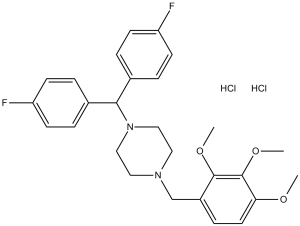
C27H32CL2F2N2O3
|
|
|---|---|---|
| 分子量 |
541.46
|
|
| 精确质量 |
540.175
|
|
| 元素分析 |
C, 59.89; H, 5.96; Cl, 13.09; F, 7.02; N, 5.17; O, 8.86
|
|
| CAS号 |
101477-54-7
|
|
| 相关CAS号 |
|
|
| PubChem CID |
122125
|
|
| 外观&性状 |
White to off-white solid powder
|
|
| 沸点 |
527.3ºC at760mmHg
|
|
| 熔点 |
214-218ºC
|
|
| 闪点 |
272.7ºC
|
|
| LogP |
6.377
|
|
| tPSA |
34.17
|
|
| 氢键供体(HBD)数目 |
2
|
|
| 氢键受体(HBA)数目 |
7
|
|
| 可旋转键数目(RBC) |
8
|
|
| 重原子数目 |
36
|
|
| 分子复杂度/Complexity |
568
|
|
| 定义原子立体中心数目 |
0
|
|
| SMILES |
Cl[H].Cl[H].FC1C([H])=C([H])C(=C([H])C=1[H])C([H])(C1C([H])=C([H])C(=C([H])C=1[H])F)N1C([H])([H])C([H])([H])N(C([H])([H])C2C([H])=C([H])C(=C(C=2OC([H])([H])[H])OC([H])([H])[H])OC([H])([H])[H])C([H])([H])C1([H])[H]
|
|
| InChi Key |
LOGVKVSFYBBUAJ-UHFFFAOYSA-N
|
|
| InChi Code |
InChI=1S/C27H30F2N2O3.2ClH/c1-32-24-13-8-21(26(33-2)27(24)34-3)18-30-14-16-31(17-15-30)25(19-4-9-22(28)10-5-19)20-6-11-23(29)12-7-20;;/h4-13,25H,14-18H2,1-3H3;2*1H
|
|
| 化学名 |
1-[bis(4-fluorophenyl)methyl]-4-[(2,3,4-trimethoxyphenyl)methyl]piperazine;dihydrochloride
|
|
| 别名 |
|
|
| HS Tariff Code |
2934.99.9001
|
|
| 存储方式 |
Powder -20°C 3 years 4°C 2 years In solvent -80°C 6 months -20°C 1 month 注意: 请将本产品存放在密封且受保护的环境中,避免吸湿/受潮。 |
|
| 运输条件 |
Room temperature (This product is stable at ambient temperature for a few days during ordinary shipping and time spent in Customs)
|
| 溶解度 (体外实验) |
|
|||
|---|---|---|---|---|
| 溶解度 (体内实验) |
配方 1 中的溶解度: ≥ 2.08 mg/mL (3.84 mM) (饱和度未知) in 10% DMSO + 40% PEG300 + 5% Tween80 + 45% Saline (这些助溶剂从左到右依次添加,逐一添加), 澄清溶液。
例如,若需制备1 mL的工作液,可将100 μL 20.8 mg/mL澄清DMSO储备液加入400 μL PEG300中,混匀;然后向上述溶液中加入50 μL Tween-80,混匀;加入450 μL生理盐水定容至1 mL。 *生理盐水的制备:将 0.9 g 氯化钠溶解在 100 mL ddH₂O中,得到澄清溶液。 配方 2 中的溶解度: ≥ 2.08 mg/mL (3.84 mM) (饱和度未知) in 10% DMSO + 90% (20% SBE-β-CD in Saline) (这些助溶剂从左到右依次添加,逐一添加), 澄清溶液。 例如,若需制备1 mL的工作液,可将 100 μL 20.8 mg/mL澄清DMSO储备液加入900 μL 20% SBE-β-CD生理盐水溶液中,混匀。 *20% SBE-β-CD 生理盐水溶液的制备(4°C,1 周):将 2 g SBE-β-CD 溶解于 10 mL 生理盐水中,得到澄清溶液。 View More
配方 3 中的溶解度: ≥ 2.08 mg/mL (3.84 mM) (饱和度未知) in 10% DMSO + 90% Corn Oil (这些助溶剂从左到右依次添加,逐一添加), 澄清溶液。 配方 4 中的溶解度: 2% DMSO +ddH2O: 5mg/mL 1、请先配制澄清的储备液(如:用DMSO配置50 或 100 mg/mL母液(储备液)); 2、取适量母液,按从左到右的顺序依次添加助溶剂,澄清后再加入下一助溶剂。以 下列配方为例说明 (注意此配方只用于说明,并不一定代表此产品 的实际溶解配方): 10% DMSO → 40% PEG300 → 5% Tween-80 → 45% ddH2O (或 saline); 假设最终工作液的体积为 1 mL, 浓度为5 mg/mL: 取 100 μL 50 mg/mL 的澄清 DMSO 储备液加到 400 μL PEG300 中,混合均匀/澄清;向上述体系中加入50 μL Tween-80,混合均匀/澄清;然后继续加入450 μL ddH2O (或 saline)定容至 1 mL; 3、溶剂前显示的百分比是指该溶剂在最终溶液/工作液中的体积所占比例; 4、 如产品在配制过程中出现沉淀/析出,可通过加热(≤50℃)或超声的方式助溶; 5、为保证最佳实验结果,工作液请现配现用! 6、如不确定怎么将母液配置成体内动物实验的工作液,请查看说明书或联系我们; 7、 以上所有助溶剂都可在 Invivochem.cn网站购买。 |
| 制备储备液 | 1 mg | 5 mg | 10 mg | |
| 1 mM | 1.8469 mL | 9.2343 mL | 18.4686 mL | |
| 5 mM | 0.3694 mL | 1.8469 mL | 3.6937 mL | |
| 10 mM | 0.1847 mL | 0.9234 mL | 1.8469 mL |
1、根据实验需要选择合适的溶剂配制储备液 (母液):对于大多数产品,InvivoChem推荐用DMSO配置母液 (比如:5、10、20mM或者10、20、50 mg/mL浓度),个别水溶性高的产品可直接溶于水。产品在DMSO 、水或其他溶剂中的具体溶解度详见上”溶解度 (体外)”部分;
2、如果您找不到您想要的溶解度信息,或者很难将产品溶解在溶液中,请联系我们;
3、建议使用下列计算器进行相关计算(摩尔浓度计算器、稀释计算器、分子量计算器、重组计算器等);
4、母液配好之后,将其分装到常规用量,并储存在-20°C或-80°C,尽量减少反复冻融循环。
计算结果:
工作液浓度: mg/mL;
DMSO母液配制方法: mg 药物溶于 μL DMSO溶液(母液浓度 mg/mL)。如该浓度超过该批次药物DMSO溶解度,请首先与我们联系。
体内配方配制方法:取 μL DMSO母液,加入 μL PEG300,混匀澄清后加入μL Tween 80,混匀澄清后加入 μL ddH2O,混匀澄清。
(1) 请确保溶液澄清之后,再加入下一种溶剂 (助溶剂) 。可利用涡旋、超声或水浴加热等方法助溶;
(2) 一定要按顺序加入溶剂 (助溶剂) 。
|
InvivoChem的所有产品仅用于作科学研究,不面向患者销售
Copyright 2020 InvivoChem LLC | All Rights Reserved 粤ICP备20063088号-1


 COA
COA

 粤公网安备 44011102003439号
 463611831
