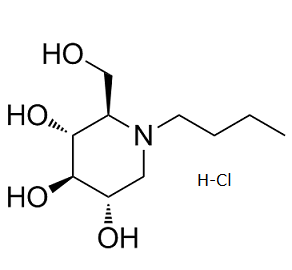
Miglustat HCl (OGT-918; NB-DNJ; Zavesca)

别名: OGT918; OGT 918; OGT-918; N-butyldeoxynojirimycin; (2R,3R,4R,5S)-1-butyl-2-(hydroxymethyl)piperidine-3,4,5-triol;hydrochloride; 874-729-5; RefChem:397514; 210110-90-0; Miglustat hydrochloride; Miglustat (hydrochloride); N-Butyldeoxynojirimycin hydrochloride; N-Butyldeoxynojirimycin.HCl; NB-DNJ; Miglustat hydrochloride; Zavesca. N-丁基脱氧野艽霉素盐酸盐; 盐酸美格鲁特
目录号: V25528 纯度: ≥98%
Miglustat HCl (OGT-918;NB-DNJ;Zavesca) 是 FDA 批准的用于治疗 I 型戈谢病 (GD1) 的药物。
Miglustat HCl (OGT-918; NB-DNJ; Zavesca) CAS号: 210110-90-0
产品类别: Glucosylceramide Synthase
产品仅用于科学研究,不针对患者销售
规格 价格 库存 数量
10mg
25mg
50mg
100mg
250mg
Other Sizes

Other Forms of Miglustat HCl (OGT-918; NB-DNJ; Zavesca):

  • Miglustat-d9 hydrochloride (N-Butyldeoxynojirimycin-d9 (hydrochloride); NB-DNJ-d9 (hydrochloride); OGT 918-d9 (hydrochloride))
  • Miglustat-d9
  • 米格鲁他
点击了解更多
InvivoChem产品被CNS等顶刊论文引用
产品描述
Miglustat HCl(OGT-918;NB-DNJ;Zavesca)是 FDA 批准的用于治疗 I 型戈谢病(GD1)的药物。它抑制葡萄糖神经酰胺合酶,这是合成大多数鞘糖脂的必需酶。它仅用于无法用伊米苷酶替代疗法治疗的患者。 Miglustat 是一种亚氨基糖,是 D-葡萄糖的合成类似物,是一种白色至灰白色结晶固体,有苦味。 miglustat 的主要药理活性是抑制葡萄糖神经酰胺合酶,催化鞘糖脂 (GSL) 生物合成的第一步,即葡萄糖神经酰胺 (GlcCer) 的形成。 GlcCer 形成的减少将导致更复杂的 GSL 生物合成的减少。这种称为底物减少疗法 (SRT) 的治疗原理可能有助于治疗由于 GSL 分解缺陷或细胞内转运/贩运而导致的细胞内(主要是溶酶体)积聚疾病。 Miglustat 具有较大的分布体积,并且能够进入大脑、骨骼和肺等深层器官。
生物活性&实验参考方法
靶点
Miglustat acts as a reversible inhibitor of glucosylceramide synthase (GCS), the enzyme that catalyzes the first committed step in glycosphingolipid biosynthesis.
体外研究 (In Vitro)
在人支气管上皮细胞(IB3-1和CUFI-1细胞,均为CFTR F508del纯合型,囊性纤维化模型细胞)中: - 抗炎活性: - 当细胞感染铜绿假单胞菌(囊性纤维化常见致病菌)时,用米格司他(10 μM,处理24小时)可使促炎细胞因子IL-8的分泌量降低约50%(通过酶联免疫吸附试验ELISA检测)[1]
- 在经TNF-α或IL-1β(促炎细胞因子)刺激的细胞中,米格司他(5–10 μM)可抑制IL-8 mRNA的表达,抑制率约40%(通过实时定量聚合酶链反应qPCR检测)[1]
- CFTR功能恢复: - 米格司他(10 μM,处理48小时)可部分恢复突变型F508del-CFTR蛋白的功能,表现为福司柯林/染料木黄酮诱导的氯离子(Cl⁻)电流增加(通过全细胞膜片钳电生理技术检测)[1]
在从NPC1⁻/⁻小鼠(尼曼-皮克病C型,NPC病模型)分离的海马脑片中: - 突触可塑性恢复: - 用米格司他(10 μM,孵育2小时)处理可逆转长时程增强(LTP,突触可塑性的关键指标)的损伤,LTP幅度恢复至野生型小鼠海马脑片水平的约80%(通过记录场兴奋性突触后电位fEPSP检测)[2]
- 信号通路调控: - 米格司他(10 μM)可使NPC1⁻/⁻小鼠海马脑片中细胞外信号调节激酶(ERK)的磷酸化水平升高约60%(通过蛋白质印迹法Western blot检测)[2]
在囊性纤维化 (CF) 折叠上皮 IB3-1 和 CuFi-1 细胞中,F508del-CFTR(囊性纤维化跨膜电导调节剂)的功能可通过盐酸伊米鲁司他(200 μM;2、4 和 24 小时)恢复。盐酸米格司他可减少 CF 和非 CF 细胞对铜绿假单胞菌的关键反应 [1]。
体内研究 (In Vivo)
在CFTR F508del/F508del小鼠(囊性纤维化小鼠模型)中: - 口服米格司他(200 mg/kg/天,溶解于0.5%甲基纤维素)连续6天,可使鼻上皮的阿米洛利敏感短路电流(ISC,评估上皮离子转运的指标)降低约30%(通过体外Ussing chamber技术检测)[1]
在NPC1⁻/⁻小鼠(NPC病小鼠模型)中: - 从出生后第30天开始,口服米格司他(50 mg/kg/天,溶解于0.5%甲基纤维素,灌胃给药,每日两次),持续至出生后第86天(共8周),可改善运动功能: - 转棒实验(评估运动协调性和平衡能力)中的坠落潜伏期较溶媒处理的NPC1⁻/⁻小鼠延长约2.5倍[2]
- 神经元凋亡减少: - 米格司他(50 mg/kg/天,处理8周)可使NPC1⁻/⁻小鼠海马区的凋亡神经元数量减少约40%(通过TUNEL染色法检测,该方法用于标记凋亡细胞)[2]
口服药物米格司他盐酸盐(0.2 mg/kg;一次)可纠正突触可塑性缺陷,恢复 ERK 激活,并对过度兴奋做出反应 [2]。
酶活实验
GCS抑制实验: 1. 大鼠睾丸微粒体与UDP-葡萄糖和C16-神经酰胺在不同浓度米格司他(0.1–100 μM)存在下,37°C孵育30分钟; 2. 反应产物经薄层层析分离,放射自显影定量; 3. 计算GCS抑制的IC₅₀值为32 μM
细胞实验
人支气管上皮细胞(IB3-1/CUFI-1)IL-8分泌实验: 1. 将细胞以5×10⁵个/孔的密度接种于24孔板,在完全培养基中培养过夜; 2. 更换为含米格司他(0.1–10 μM)或溶媒的无血清培养基,预孵育2小时; 3. 向每孔加入铜绿假单胞菌(感染复数=10),继续孵育22小时; 4. 收集培养上清液,使用ELISA试剂盒按标准流程检测IL-8浓度[1]
海马脑片LTP记录实验: 1. 从8周龄NPC1⁻/⁻小鼠和野生型小鼠中分离海马体,用振动切片机制备400 μm厚的横向脑片; 2. 将脑片在人工脑脊液(ACSF)中于32°C孵育1小时恢复活力,随后在含米格司他(10 μM)或溶媒的ACSF中孵育2小时; 3. 通过对Schaffer侧支通路施加高频刺激(100 Hz,持续1秒)诱导LTP; 4. 刺激后记录CA1区的fEPSP,持续60分钟,将fEPSP幅度相对于基线(刺激前平均幅度)进行标准化分析[2]
动物实验
Animal/Disease Models: NPC1−/− mice[1]
Doses: 0.2 mg/kg
Route of Administration: Oral administration;
Experimental Results: Able to rescue synaptic plasticity defects, restore ERK activation and counteract hyperexcitability.
CFTR F508del/F508del mouse treatment and nasal epithelium ISC assay: 1. Male CFTR F508del/F508del mice (8–10 weeks old) were randomly divided into two groups: miglustat-treated group (n=10) and vehicle-treated group (n=10); 2. miglustat was dissolved in 0.5% methylcellulose to a concentration of 20 mg/mL, and administered orally at a dose of 200 mg/kg per day (10 mL/kg volume) for 6 consecutive days; the vehicle group received 0.5% methylcellulose alone; 3. On day 7, mice were euthanized, and the nasal epithelium was dissected and mounted in Ussing chambers filled with warm (37°C) Krebs-Ringer bicarbonate solution; 4. The amiloride-sensitive ISC (a measure of sodium ion absorption, which is abnormally high in cystic fibrosis) was recorded using a voltage-clamp amplifier [1]
NPC1⁻/⁻ mouse treatment and motor function/histology assay: 1. Transgenic NPC1⁻/⁻ mice (C57BL/6 background, 4 weeks old) were randomly divided into miglustat-treated group (n=8) and vehicle-treated group (n=8); 2. miglustat was dissolved in 0.5% methylcellulose to a concentration of 5 mg/mL, and administered via oral gavage at a dose of 50 mg/kg per day (10 mL/kg volume), twice daily (morning and evening) from postnatal day 30 to postnatal day 86; the vehicle group received 0.5% methylcellulose alone; 3. Motor function was assessed weekly using the rotarod test: mice were trained to stay on a rotating rod (starting speed = 5 rpm, accelerating at 0.1 rpm/s), and the latency to fall (maximum 300 seconds) was recorded; 4. At the end of treatment (postnatal day 86), mice were euthanized, and brains were harvested, fixed in 4% paraformaldehyde, embedded in paraffin, and sectioned (5 μm thick); hippocampal sections were stained with TUNEL reagent to count apoptotic neurons [2]
药代性质 (ADME/PK)
Absorption, Distribution and Excretion
Mean oral bioavailability is 97%.
Metabolism / Metabolites
There is no evidence that miglustat is metabolized in humans.
Biological Half-Life
The effective half-life of miglustat is approximately 6 to 7 hours.
毒性/毒理 (Toxicokinetics/TK)
In the CFTR F508del/F508del mouse study: - No mortality, weight loss, or obvious signs of toxicity (e.g., abnormal behavior, reduced activity) were observed in mice treated with miglustat (200 mg/kg per day for 6 days) compared to vehicle-treated mice [1]
In the NPC1⁻/⁻ mouse study: - miglustat treatment (50 mg/kg per day for 8 weeks) did not cause significant changes in liver function markers (alanine transaminase, ALT; aspartate transaminase, AST) or renal function markers (blood urea nitrogen, BUN; creatinine) compared to vehicle-treated NPC1⁻/⁻ mice (measured via clinical chemistry analysis of serum samples) [2]
No data on plasma protein binding, drug-drug interactions, or median lethal dose (LD₅₀) were reported in the specified literatures [1][2]
参考文献

[1]. Anti-inflammatory effect of miglustat in bronchial epithelial cells. J Cyst Fibros. 2008 Nov;7(6):555-65.

[2]. Miglustat Reverts the Impairment of Synaptic Plasticity in a Mouse Model of NPC Disease. Neural Plast. 2016:2016:3830424.

其他信息
Miglustat exerts its biological effects primarily by inhibiting glucosylceramide synthase, which reduces the biosynthesis of glycosphingolipids—lipids that are abnormally accumulated in diseases like cystic fibrosis and Niemann-Pick type C (NPC) disease [1][2]
In cystic fibrosis, the anti-inflammatory activity of miglustat (reducing IL-8 secretion) may help alleviate airway inflammation, a key pathological feature of the disease, while its ability to restore F508del-CFTR function addresses the underlying defect in ion transport [1]
In NPC disease, miglustat’s restoration of synaptic plasticity (LTP) and reduction of neuronal apoptosis suggest it may have neuroprotective effects, which could help slow the progression of neurological symptoms in NPC disease [2]
*注: 文献方法仅供参考, InvivoChem并未独立验证这些方法的准确性
化学信息 & 存储运输条件
分子式
C10H21NO4
分子量
255.7390
精确质量
255.123
元素分析
C, 46.96; H, 8.67; Cl, 13.86; N, 5.48; O, 25.02
CAS号
210110-90-0
相关CAS号
Miglustat;72599-27-0;Miglustat-d9 hydrochloride;1883545-57-0
PubChem CID
6603107
外观&性状
White to light brown solid powder
沸点
421.2ºC at 760 mmHg
熔点
169-172ºC
闪点
208.5ºC
蒸汽压
7.37E-09mmHg at 25°C
tPSA
84.16
氢键供体(HBD)数目
5
氢键受体(HBA)数目
5
可旋转键数目(RBC)
4
重原子数目
16
分子复杂度/Complexity
190
定义原子立体中心数目
4
SMILES
CCCCN1C[C@@H]([C@H]([C@@H]([C@H]1CO)O)O)O.Cl
InChi Key
QPAFAUYWVZMWPR-ZSOUGHPYSA-N
InChi Code
InChI=1S/C10H21NO4.ClH/c1-2-3-4-11-5-8(13)10(15)9(14)7(11)6-12/h7-10,12-15H,2-6H2,1H31H/t7-,8+,9-,10-/m1./s1
化学名
(2R,3R,4R,5S)-1-butyl-2-(hydroxymethyl)piperidine-3,4,5-triol hydrochloride
别名
OGT918; OGT 918; OGT-918; N-butyldeoxynojirimycin; (2R,3R,4R,5S)-1-butyl-2-(hydroxymethyl)piperidine-3,4,5-triol;hydrochloride; 874-729-5; RefChem:397514; 210110-90-0; Miglustat hydrochloride; Miglustat (hydrochloride); N-Butyldeoxynojirimycin hydrochloride; N-Butyldeoxynojirimycin.HCl; NB-DNJ; Miglustat hydrochloride; Zavesca.
HS Tariff Code
2934.99.9001
存储方式

Powder      -20°C    3 years

                     4°C     2 years

In solvent   -80°C    6 months

                  -20°C    1 month

注意: 请将本产品存放在密封且受保护的环境中(例如氮气保护),避免吸湿/受潮。
运输条件
Room temperature (This product is stable at ambient temperature for a few days during ordinary shipping and time spent in Customs)
溶解度数据
溶解度 (体外实验)
DMSO : ~65 mg/mL (~254.16 mM)
H2O : ≥ 34 mg/mL (~132.95 mM)
溶解度 (体内实验)
配方 1 中的溶解度: ≥ 3.25 mg/mL (12.71 mM) (饱和度未知) in 10% DMSO + 40% PEG300 + 5% Tween80 + 45% Saline (这些助溶剂从左到右依次添加,逐一添加), 澄清溶液。
例如,若需制备1 mL的工作液,可将100 μL 32.5 mg/mL澄清DMSO储备液加入到400 μL PEG300中,混匀;然后向上述溶液中加入50 μL Tween-80,混匀;加入450 μL生理盐水定容至1 mL。
*生理盐水的制备:将 0.9 g 氯化钠溶解在 100 mL ddH₂O中,得到澄清溶液。

配方 2 中的溶解度: ≥ 3.25 mg/mL (12.71 mM) (饱和度未知) in 10% DMSO + 90% (20% SBE-β-CD in Saline) (这些助溶剂从左到右依次添加,逐一添加), 澄清溶液。
例如,若需制备1 mL的工作液,可将 100 μL 32.5 mg/mL 澄清 DMSO 储备液加入 900 μL 20% SBE-β-CD 生理盐水溶液中,混匀。
*20% SBE-β-CD 生理盐水溶液的制备(4°C,1 周):将 2 g SBE-β-CD 溶解于 10 mL 生理盐水中,得到澄清溶液。

View More

配方 3 中的溶解度: ≥ 3.25 mg/mL (12.71 mM) (饱和度未知) in 10% DMSO + 90% Corn Oil (这些助溶剂从左到右依次添加,逐一添加), 澄清溶液。
例如,若需制备1 mL的工作液,可将 100 μL 32.5 mg/mL 澄清 DMSO 储备液加入900 μL 玉米油中,混合均匀。


配方 4 中的溶解度: 100 mg/mL (391.02 mM) in PBS (这些助溶剂从左到右依次添加,逐一添加), 澄清溶液; 超声助溶.

请根据您的实验动物和给药方式选择适当的溶解配方/方案:
1、请先配制澄清的储备液(如:用DMSO配置50 或 100 mg/mL母液(储备液));
2、取适量母液,按从左到右的顺序依次添加助溶剂,澄清后再加入下一助溶剂。以 下列配方为例说明 (注意此配方只用于说明,并不一定代表此产品 的实际溶解配方):
10% DMSO → 40% PEG300 → 5% Tween-80 → 45% ddH2O (或 saline);
假设最终工作液的体积为 1 mL, 浓度为5 mg/mL: 取 100 μL 50 mg/mL 的澄清 DMSO 储备液加到 400 μL PEG300 中,混合均匀/澄清;向上述体系中加入50 μL Tween-80,混合均匀/澄清;然后继续加入450 μL ddH2O (或 saline)定容至 1 mL;

3、溶剂前显示的百分比是指该溶剂在最终溶液/工作液中的体积所占比例;
4、 如产品在配制过程中出现沉淀/析出,可通过加热(≤50℃)或超声的方式助溶;
5、为保证最佳实验结果,工作液请现配现用!
6、如不确定怎么将母液配置成体内动物实验的工作液,请查看说明书或联系我们;
7、 以上所有助溶剂都可在 Invivochem.cn网站购买。
制备储备液 1 mg 5 mg 10 mg
1 mM 3.9102 mL 19.5511 mL 39.1022 mL
5 mM 0.7820 mL 3.9102 mL 7.8204 mL
10 mM 0.3910 mL 1.9551 mL 3.9102 mL

1、根据实验需要选择合适的溶剂配制储备液 (母液):对于大多数产品,InvivoChem推荐用DMSO配置母液 (比如:5、10、20mM或者10、20、50 mg/mL浓度),个别水溶性高的产品可直接溶于水。产品在DMSO 、水或其他溶剂中的具体溶解度详见上”溶解度 (体外)”部分;

2、如果您找不到您想要的溶解度信息,或者很难将产品溶解在溶液中,请联系我们;

3、建议使用下列计算器进行相关计算(摩尔浓度计算器、稀释计算器、分子量计算器、重组计算器等);

4、母液配好之后,将其分装到常规用量,并储存在-20°C或-80°C,尽量减少反复冻融循环。

计算器

摩尔浓度计算器可计算特定溶液所需的质量、体积/浓度,具体如下:

  • 计算制备已知体积和浓度的溶液所需的化合物的质量
  • 计算将已知质量的化合物溶解到所需浓度所需的溶液体积
  • 计算特定体积中已知质量的化合物产生的溶液的浓度
使用摩尔浓度计算器计算摩尔浓度的示例如下所示:
假如化合物的分子量为350.26 g/mol,在5mL DMSO中制备10mM储备液所需的化合物的质量是多少?
  • 在分子量(MW)框中输入350.26
  • 在“浓度”框中输入10,然后选择正确的单位(mM)
  • 在“体积”框中输入5,然后选择正确的单位(mL)
  • 单击“计算”按钮
  • 答案17.513 mg出现在“质量”框中。以类似的方式,您可以计算体积和浓度。

稀释计算器可计算如何稀释已知浓度的储备液。例如,可以输入C1、C2和V2来计算V1,具体如下:

制备25毫升25μM溶液需要多少体积的10 mM储备溶液?
使用方程式C1V1=C2V2,其中C1=10mM,C2=25μM,V2=25 ml,V1未知:
  • 在C1框中输入10,然后选择正确的单位(mM)
  • 在C2框中输入25,然后选择正确的单位(μM)
  • 在V2框中输入25,然后选择正确的单位(mL)
  • 单击“计算”按钮
  • 答案62.5μL(0.1 ml)出现在V1框中
g/mol

分子量计算器可计算化合物的分子量 (摩尔质量)和元素组成,具体如下:

注:化学分子式大小写敏感:C12H18N3O4  c12h18n3o4
计算化合物摩尔质量(分子量)的说明:
  • 要计算化合物的分子量 (摩尔质量),请输入化学/分子式,然后单击“计算”按钮。
分子质量、分子量、摩尔质量和摩尔量的定义:
  • 分子质量(或分子量)是一种物质的一个分子的质量,用统一的原子质量单位(u)表示。(1u等于碳-12中一个原子质量的1/12)
  • 摩尔质量(摩尔重量)是一摩尔物质的质量,以g/mol表示。
/

配液计算器可计算将特定质量的产品配成特定浓度所需的溶剂体积 (配液体积)

  • 输入试剂的质量、所需的配液浓度以及正确的单位
  • 单击“计算”按钮
  • 答案显示在体积框中
动物体内实验配方计算器(澄清溶液)
第一步:请输入基本实验信息(考虑到实验过程中的损耗,建议多配一只动物的药量)
第二步:请输入动物体内配方组成(配方适用于不溶/难溶于水的化合物),不同的产品和批次配方组成不同,如对配方有疑问,可先联系我们提供正确的体内实验配方。此外,请注意这只是一个配方计算器,而不是特定产品的确切配方。
+
+
+

计算结果:

工作液浓度 mg/mL;

DMSO母液配制方法 mg 药物溶于 μL DMSO溶液(母液浓度 mg/mL)。如该浓度超过该批次药物DMSO溶解度,请首先与我们联系。

体内配方配制方法μL DMSO母液,加入 μL PEG300,混匀澄清后加入μL Tween 80,混匀澄清后加入 μL ddH2O,混匀澄清。

(1) 请确保溶液澄清之后,再加入下一种溶剂 (助溶剂) 。可利用涡旋、超声或水浴加热等方法助溶;
            (2) 一定要按顺序加入溶剂 (助溶剂) 。

临床试验信息
A Study to Evaluate the Safety, Efficacy, PK, PD and Immunogenicity of Cipaglucosidase Alfa/Miglustat in IOPD Subjects Aged 0 to <18
CTID: NCT04808505
Phase: Phase 3    Status: Recruiting
Date: 2024-11-06
A Global Prospective Observational Registry of Patients With Pompe Disease
CTID: NCT06121011
Phase:    Status: Recruiting
Date: 2024-10-30
ZIP Study-OL Study of Safety, PK, Efficacy, PD, Immunogenicity of ATB200/AT2221 in Pediatrics Aged 0 to < 18 y.o. w/LOPD
CTID: NCT03911505
Phase: Phase 3    Status: Recruiting
Date: 2024-09-19
An Open-label Safety, Pharmacokinetic, and Efficacy Study of Miglustat for the Treatment of CLN3 Disease
CTID: NCT05174039
Phase: Phase 1/Phase 2    Status: Active, not recruiting
Date: 2024-04-26
Effects of Miglustat Therapy on Infantile Type of Sandhoff and Taysachs Diseases (EMTISTD)
CTID: NCT03822013
Phase: Phase 3    Status: Recruiting
Date: 2024-04-16
View More

A Study Comparing ATB200/AT2221 With Alglucosidase Alfa/Placebo in Adult Subjects With Late-onset Pompe Disease
CTID: NCT03729362
Phase: Phase 3    Status: Completed
Date: 2023-09-11


Safety and Efficacy of Miglustat in Chinese NPC Patients
CTID: NCT03910621
Phase: Phase 4    Status: Completed
Date: 2022-05-25
Testing Miglustat Administration in Subjects With Spastic Paraplegia 11
CTID: NCT04768166
Phase: Phase 2    Status: Completed
Date: 2022-04-11
Synergistic Enteral Regimen for Treatment of the Gangliosidoses
CTID: NCT02030015
Phase: Phase 4    Status: Terminated
Date: 2021-04-14
Miglustat on Gaucher Disease Type IIIB
CTID: NCT02520934
Phase: N/A    Status: Unknown status
Date: 2019-03-29
Clinical Study to Evaluate the Long Term Efficacy, Safety and Tolerability of Miglustat in Patients With Stable Type 1 Gaucher Disease
CTID: NCT00319046
Phase: Phase 3    Status: Completed
Date: 2018-11-21
Observational Study for Subjects With Pompe Disease Undergoing Immune Modulation Therapies
CTID: NCT01451879
Phase:    Status: Completed
Date: 2017-12-08
OGT 918-006: A Phase I/II Randomized, Controlled Study of OGT 918 in Patients With Neuronopathic Gaucher Disease
CTID: NCT00041535
Phase: Phase 2    Status: Completed
Date: 2017-07-02
-----------------
Combined enzyme enhancement therapy (EET) and enzyme replacement therapy (ERT) in patients with Pompe disease
CTID: null
Phase: Phase 2    Status: Ongoing
Date: 2011-03-18
Determination of ( 11 C) miglustat uptake in bone tissue and brain using Positron Emission Tomography (PET).
CTID: null
Phase: Phase 4    Status: Completed
Date: 2009-07-15
Multicenter randomized study to assess the efficacy and the safety of two therapeutic regimens(high dose of imiglucerase versus co-administration of imiglucerase and miglustat) in type I Gaucher disease patients who have not responded to previous treatment with low dose imiglucerase
CTID: null
Phase: Phase 4    Status: Completed
Date: 2009-02-06
Single center, double-blind, randomized, placebo-controlled, two-period/two-treatment crossover study investigating the effect of miglustat on the nasal potential difference in patients with cystic fibrosis homozygous for the F508del mutation
CTID: null
Phase: Phase 2    Status: Completed
Date: 2008-08-11
Uso racional de los tratamientos por inhibición de sustrato y enzimático sustitutivo en pacientes con Enfermedad de Gaucher tipo 1
CTID: null
Phase: Phase 3    Status: Completed
Date: 2008-05-20
'Estudio unicéntrico, a doble ciego, aleatorizado y controlado con placebo, cruzado de 2 brazos, para investigar el efecto de miglustat sobre la diferencia de potencial nasal en pacientes con fibrosis quística homocigotos para la mutación ΔF508'
CTID: null
Phase: Phase 2    Status: Completed
Date: 2007-07-22
Evaluation d’un traitement par miglustat (Zavesca®) chez les patients atteints de mucopolysaccharidose de type III (maladie de Sanfilippo).
CTID: null
Phase: Phase 2    Status: Ongoing
Date: 2006-12-08
Efficacy and safety of treatment with N-butyl-deoxynojirimycin (NB-DNJ-miglustat) in patients with Niemann-Pick disease type C.
CTID: null
Phase: Phase 3    Status: Ongoing
Date: 2006-11-22
A phase IV, open-label, non comparative, multi-center study to evaluate the long term efficacy and safety and tolerability of oral miglustat as a maintenance after a switch from Enzyme Replacement Therapy (ERT) in adult patients with stable Type 1 Gaucher Disease
CTID: null
Phase: Phase 4    Status: Completed
Date: 2005-10-27

相关产品
联系我们