| 规格 | 价格 | 库存 | 数量 |
|---|---|---|---|
| 5mg |
|
||
| 10mg |
|
||
| 25mg |
|
||
| 50mg |
|
||
| 100mg |
|
||
| 250mg |
|
||
| Other Sizes |
|
| 靶点 |
human BRS3 ( IC50 = 28 nM ); mouse BRS3 ( IC50 = 5.4 nM ); rat BRS3 ( IC50 = 1.2 nM ); dog BRS3 ( IC50 = 6.5 nM ); rhesus BRS3 ( IC50 = 50 nM )
The IC50 values of MK-5046 against human, mouse, mouse, dog and macaque BRS3 are 28, 5.4, 1.2, 6.5 and 50 nM respectively [2]. The Ki values of MK-5046 for human, mouse, rat, dog and macaque BRS3 are 3.4, 1.6, 0.6, 9.9 and 2.4 nM respectively[2]. The EC50 values of MK-5046 against human, mouse, monkey, dog and macaque BRS3 are 14, 21, 2.2, 1.6 and 6.9 respectively. MK-5046 inhibits the rabbit calcium channel diltiazem (DLZ) site with an IC50 value of 1.9 μM[2]. |
|---|---|
| 体外研究 (In Vitro) |
MK-5046 对人、老鼠、老鼠、狗和猕猴 BRS3 的 IC50 值分别为 28、5.4、1.2、6.5 和 50 nM[2]。 MK-5046 对人、老鼠、老鼠、狗和猕猴BRS3 的 Ki 值分别为 3.4、1.6、0.6、9.9 和 2.4 nM[2]。 MK-5046 对人、老鼠、猴子、狗和猕猴 BRS3 的 EC50 值分别为 14、21、2.2、1.6 和 6.9。 MK-5046抑制兔钙离子通道地尔硫卓(DLZ)位点,IC50值为1.9 μM[2]。
MK-5046 对人BRS-3受体表现出强效的结合和功能激动活性,IC₅₀为27 ± 13 nM,Kᵢ为3.7 ± 0.5 nM,EC₅₀为25 ± 3 nM(相对于参考肽的最大激活效能为102 ± 6%)。它对相关的铃蟾肽家族受体NMBR和GRPR具有高度选择性(IC₅₀ >10,000 nM)。[2] 在广泛的脱靶筛选(>100个受体、离子通道、酶)中,发现了八个脱靶活性,IC₅₀值在0.5–10 μM之间,但均被认为不足以阻碍开发。具体数据包括:与人ether-à-go-go相关基因(hERG)钾通道结合(Kᵢ > 8 μM),抑制兔钙离子通道的地尔硫卓(DLZ)位点(IC₅₀ = 1.9 μM),以及激活人孕烷X受体(hPXR)(EC₅₀ > 25 μM)。[2] 该化合物在P-糖蛋白(P-gp)敏感性和渗透性测定中进行了评估,但正文中未提供MK-5046的具体定量结果。该系列中先导化合物被指出具有高被动渗透性。[2] |
| 体内研究 (In Vivo) |
MK-5046 (3, 10 和 30 mg/kg;通路,一次) 抑制通道开启,并提高饮食诱导反应 (DIO) 的静息代谢率 (MR) 和饮食[1]。 5,25 和 50 mg/kg;皮下注射,每天一次,连续 14 天) 显着降低 DIO 小鼠的体重和食物摄入量[1]。 动物模型:雄性 C57BL/6N 小鼠,高脂饮食为饮食诱导肥胖(DIO)模型[1] 剂量:3、10和30 mg/kg 给药方法:口服; 3、10 和 30 mg/kg,一次 结果:DIO 小鼠在 2 小时和过夜时剂量依赖性地抑制食物摄入。但对Brs3基因敲除小鼠没有效果。
在野生型小鼠中,急性给予MK-5046可显著减少食物摄入并增加空腹代谢率。这些效应在BRS-3敲除小鼠中消失,证实了其基于机制的作用。[2] 在已形成的饮食诱导肥胖小鼠的亚慢性疗效研究中,以25 mg/kg/天的剂量连续皮下输注MK-5046 14天,导致与载体对照组相比体重持续降低8-9%,且未出现快速耐受现象。[2] |
| 细胞实验 |
MK-5046 的功能激动剂活性(EC₅₀)是通过使用aequorin生物发光法测定的,该方法测量了在过表达BRS-3受体的HEK293AEQ细胞中激动剂诱导的细胞内钙动员。[2]
受体结合实验(IC₅₀, Kᵢ)是使用过表达指定受体(人、小鼠、大鼠、狗、恒河猴BRS-3)的CHO或HEK293细胞膜进行的。结合力通过与参考放射性配体竞争来测定。[2] |
| 动物实验 |
雄性C57BL/6N小鼠,喂食高脂饮食,用于建立饮食诱导肥胖(DIO)模型。
3、10和30 mg/kg 口服给药;3、10和30 mg/kg,单次给药 在野生型和BRS-3基因敲除小鼠中评估了药物对食物摄入量和代谢率的急性药理作用。这些急性研究的具体剂量、制剂和给药途径未详细说明。[2] 在已建立的饮食诱导肥胖(eDIO)小鼠中进行了亚慢性降低体重疗效研究。MK-5046以25 mg/kg/天的剂量,通过持续皮下输注给药,持续14天。[2] 在小鼠、大鼠、犬和恒河猴中进行了静脉(iv)和口服(po)给药后的药代动力学研究。具体剂量包括:静脉注射剂量为 0.5 或 1 mg/kg,口服剂量为 1 或 2 mg/kg。未提供制剂详情。[2] |
| 药代性质 (ADME/PK) |
评估了血浆蛋白结合率,结果显示大鼠血浆中游离分数 (Fᵤ) 为 1.0%。[2]
大鼠静脉注射 1 mg/kg 后体内药代动力学参数:血浆清除率 (Clₚ) = 5.6 mL/min/kg,稳态分布容积 (Vdₛₛ) = 0.45 L/kg,半衰期 (T₁/₂) = 1.4 h。口服 1 mg/kg 后:标准化游离口服暴露量 (po AUCᵤ) = 3.7 µM·h/(mg/kg),口服生物利用度 (Fᵣᵣₐₗ) = 52%。 [2] 其他物种的药代动力学参数也已提供:小鼠(Clₚ=20 mL/min/kg,T₁/₂=0.7 h,Fᵣᵣₐₗ=64%),犬(Clₚ=8.8 mL/min/kg,T₁/₂=1.0 h,Fᵣᵣₐₗ=18%),恒河猴(Clₚ=32 mL/min/kg,T₁/₂=1.1 h,Fᵣᵣₐₗ=9.6%)。[2] 早期先导化合物的代谢稳定性在大鼠肝微粒体孵育中进行了评估,结果表明吡啶环和咪唑取代基的氧化代谢是主要的清除途径,后续的修饰(如MK-5046中的修饰)旨在降低这种代谢。未提供 MK-5046 的具体微粒体稳定性数据。[2] |
| 参考文献 |
|
| 其他信息 |
MK-5046 是一种小分子激动剂,可激动孤儿 G 蛋白偶联受体 BRS-3,被开发为潜在的肥胖症治疗药物。[2] 其减肥作用机制被认为是激活中枢表达的 BRS-3,从而减少食物摄入并增加能量消耗。[2] 与之前的先导化合物相比,MK-5046 因其体外效力、选择性和在临床前动物模型中的口服暴露量均有所提高,而被选中进行进一步的药理学研究和临床试验。[2]
|
| 分子式 |
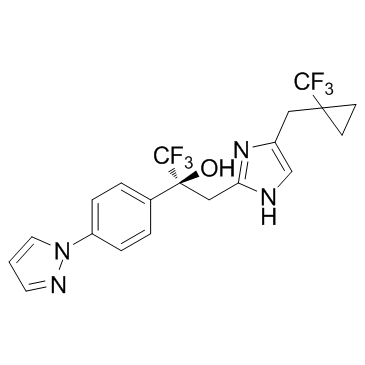
C20H18F6N4O
|
|---|---|
| 分子量 |
444.37
|
| 精确质量 |
444.138
|
| 元素分析 |
C, 54.06; H, 4.08; F, 25.65; N, 12.61; O, 3.60
|
| CAS号 |
1022152-70-0
|
| 相关CAS号 |
(R)-MK-5046; 1021736-25-3
|
| PubChem CID |
49871766
|
| 外观&性状 |
White to light yellow solid powder
|
| LogP |
4.473
|
| tPSA |
66.73
|
| 氢键供体(HBD)数目 |
2
|
| 氢键受体(HBA)数目 |
9
|
| 可旋转键数目(RBC) |
6
|
| 重原子数目 |
31
|
| 分子复杂度/Complexity |
632
|
| 定义原子立体中心数目 |
1
|
| SMILES |
O[C@](CC1=NC(CC2(C(F)(F)F)CC2)=CN1)(C(F)(F)F)C3=CC=C(N4C=CC=N4)C=C3
|
| InChi Key |
UJINBEQCDMOAHM-SFHVURJKSA-N
|
| InChi Code |
InChI=1S/C20H18F6N4O/c21-19(22,23)17(6-7-17)10-14-12-27-16(29-14)11-18(31,20(24,25)26)13-2-4-15(5-3-13)30-9-1-8-28-30/h1-5,8-9,12,31H,6-7,10-11H2,(H,27,29)/t18-/m0/s1
|
| 化学名 |
(2S)-1,1,1-trifluoro-2-(4-pyrazol-1-ylphenyl)-3-[5-[[1-(trifluoromethyl)cyclopropyl]methyl]-1H-imidazol-2-yl]propan-2-ol
|
| 别名 |
MK-5046; MK5046; MK 5046
|
| HS Tariff Code |
2934.99.9001
|
| 存储方式 |
Powder -20°C 3 years 4°C 2 years In solvent -80°C 6 months -20°C 1 month |
| 运输条件 |
Room temperature (This product is stable at ambient temperature for a few days during ordinary shipping and time spent in Customs)
|
| 溶解度 (体外实验) |
DMSO: ~14.3 mg/mL (~32.2 mM)
|
|---|---|
| 溶解度 (体内实验) |
配方 1 中的溶解度: ≥ 1.43 mg/mL (3.22 mM) (饱和度未知) in 10% DMSO + 40% PEG300 + 5% Tween80 + 45% Saline (这些助溶剂从左到右依次添加,逐一添加), 澄清溶液。
例如,若需制备1 mL的工作液,可将100 μL 14.3 mg/mL澄清DMSO储备液加入400 μL PEG300中,混匀;然后向上述溶液中加入50 μL Tween-80,混匀;加入450 μL生理盐水定容至1 mL。 *生理盐水的制备:将 0.9 g 氯化钠溶解在 100 mL ddH₂O中,得到澄清溶液。 配方 2 中的溶解度: ≥ 1.43 mg/mL (3.22 mM) (饱和度未知) in 10% DMSO + 90% (20% SBE-β-CD in Saline) (这些助溶剂从左到右依次添加,逐一添加), 澄清溶液。 例如,若需制备1 mL的工作液,可将 100 μL 14.3mg/mL澄清的DMSO储备液加入到900μL 20%SBE-β-CD生理盐水中,混匀。 *20% SBE-β-CD 生理盐水溶液的制备(4°C,1 周):将 2 g SBE-β-CD 溶解于 10 mL 生理盐水中,得到澄清溶液。 View More
配方 3 中的溶解度: ≥ 1.43 mg/mL (3.22 mM) (饱和度未知) in 10% DMSO + 90% Corn Oil (这些助溶剂从左到右依次添加,逐一添加), 澄清溶液。 1、请先配制澄清的储备液(如:用DMSO配置50 或 100 mg/mL母液(储备液)); 2、取适量母液,按从左到右的顺序依次添加助溶剂,澄清后再加入下一助溶剂。以 下列配方为例说明 (注意此配方只用于说明,并不一定代表此产品 的实际溶解配方): 10% DMSO → 40% PEG300 → 5% Tween-80 → 45% ddH2O (或 saline); 假设最终工作液的体积为 1 mL, 浓度为5 mg/mL: 取 100 μL 50 mg/mL 的澄清 DMSO 储备液加到 400 μL PEG300 中,混合均匀/澄清;向上述体系中加入50 μL Tween-80,混合均匀/澄清;然后继续加入450 μL ddH2O (或 saline)定容至 1 mL; 3、溶剂前显示的百分比是指该溶剂在最终溶液/工作液中的体积所占比例; 4、 如产品在配制过程中出现沉淀/析出,可通过加热(≤50℃)或超声的方式助溶; 5、为保证最佳实验结果,工作液请现配现用! 6、如不确定怎么将母液配置成体内动物实验的工作液,请查看说明书或联系我们; 7、 以上所有助溶剂都可在 Invivochem.cn网站购买。 |
| 制备储备液 | 1 mg | 5 mg | 10 mg | |
| 1 mM | 2.2504 mL | 11.2519 mL | 22.5038 mL | |
| 5 mM | 0.4501 mL | 2.2504 mL | 4.5008 mL | |
| 10 mM | 0.2250 mL | 1.1252 mL | 2.2504 mL |
1、根据实验需要选择合适的溶剂配制储备液 (母液):对于大多数产品,InvivoChem推荐用DMSO配置母液 (比如:5、10、20mM或者10、20、50 mg/mL浓度),个别水溶性高的产品可直接溶于水。产品在DMSO 、水或其他溶剂中的具体溶解度详见上”溶解度 (体外)”部分;
2、如果您找不到您想要的溶解度信息,或者很难将产品溶解在溶液中,请联系我们;
3、建议使用下列计算器进行相关计算(摩尔浓度计算器、稀释计算器、分子量计算器、重组计算器等);
4、母液配好之后,将其分装到常规用量,并储存在-20°C或-80°C,尽量减少反复冻融循环。
计算结果:
工作液浓度: mg/mL;
DMSO母液配制方法: mg 药物溶于 μL DMSO溶液(母液浓度 mg/mL)。如该浓度超过该批次药物DMSO溶解度,请首先与我们联系。
体内配方配制方法:取 μL DMSO母液,加入 μL PEG300,混匀澄清后加入μL Tween 80,混匀澄清后加入 μL ddH2O,混匀澄清。
(1) 请确保溶液澄清之后,再加入下一种溶剂 (助溶剂) 。可利用涡旋、超声或水浴加热等方法助溶;
(2) 一定要按顺序加入溶剂 (助溶剂) 。
|
|
InvivoChem的所有产品仅用于作科学研究,不面向患者销售
Copyright 2020 InvivoChem LLC | All Rights Reserved 粤ICP备20063088号-1


 COA
COA


 粤公网安备 44011102003439号
 463611831
