| 规格 | 价格 | 库存 | 数量 |
|---|---|---|---|
| 10 mM * 1 mL in DMSO |
|
||
| 1mg |
|
||
| 5mg |
|
||
| 10mg |
|
||
| 25mg |
|
||
| 50mg |
|
||
| 100mg |
|
||
| 250mg |
|
||
| Other Sizes |
|

| 靶点 |
125I-CXCL8-CXCR2 ( IC50 = 0.97 nM ); Cynomolgus CXCR2 ( Kd = 0.08 nM ); Mouse CXCR2 ( Kd = 0.2 nM ); Rat CXCR2 ( Kd = 0.2 nM ); 125I-CXCL8-CXCR1 ( IC50 = 43 nM ); Cynomolgus CXCR1 ( Kd = 41 nM )
C-X-C chemokine receptor type 1 (CXCR1) (Ki = 0.8 nM for human CXCR1; IC₅₀ = 1.2 nM for inhibiting CXCL8 binding to human CXCR1); C-X-C chemokine receptor type 2 (CXCR2) (Ki = 1.7 nM for human CXCR2; IC₅₀ = 2.1 nM for inhibiting CXCL8 binding to human CXCR2); >1000-fold selectivity over CXCR3, CXCR4, CCR1, CCR2, CCR5, CCR7 (Ki > 1000 nM for all) [1] |
|---|---|
| 体外研究 (In Vitro) |
体外活性:Navarixin(以前称为 MK-7123、SCH527123 或 PS291822)是一种新型强效、特异性的 CXCR1 和 CXCR2 变构拮抗剂,具有抗肿瘤活性,能够在临床前结肠癌模型中使细胞对奥沙利铂敏感。对于食蟹猴 CXCR1 的 Kd 值为 41 nM,对于小鼠、大鼠和食蟹猴 CXCR2 的 Kd 值分别为 0.20 nM、0.20 nM、0.08 nM。 Navarixin 与 CXCR1 和 CXCR2 的结合是可饱和且可逆的。尽管 Navarixin 以良好的亲和力 (K(d) = 3.9 +/- 0.3 nM) 与 CXCR1 结合,但该化合物具有 CXCR2 选择性 (K(d) = 0.049 +/- 0.004 nM)。综上所述,数据表明 Navarixin 是一种新型、强效且特异性的 CXCR2 拮抗剂,在多种炎症性疾病中具有潜在的治疗效用。激酶测定:Navarixin(以前称为 MK-7123、SCH527123 或 PS291822)是一种新型强效、特异性的 CXCR1 和 CXCR2 变构拮抗剂,具有抗肿瘤活性,能够在临床前结肠癌模型中使细胞对奥沙利铂敏感。对于食蟹猴 CXCR1 的 Kd 值为 41 nM,对于小鼠、大鼠和食蟹猴 CXCR2 的 Kd 值分别为 0.20 nM、0.20 nM、0.08 nM。 Navarixin 与 CXCR1 和 CXCR2 的结合是可饱和且可逆的。细胞测定:将重组细胞以 1×10⁶/mL 重悬于测定缓冲液(不含酚红的 RPMI 1640,补充有 2% FBS)中。将人中性粒细胞以 2 × 10⁶/mL 重悬于含有 5% FBS 的相同测定缓冲液中。 CXCL1 仅以高亲和力结合 CXCR2,而 CXCL8 以高亲和力结合 CXCR1 和 CXCR2。将在测定缓冲液中稀释的趋化剂(30 μL)分配到一次性微趋化板的底孔中,然后用过滤器覆盖。将细胞与 Navarixin (1-300 nM) 在 CO2 培养箱中预孵育 90 分钟。将细胞等分试样 (25 μL) 添加到过滤器上的每个点上。孵育后(在 CO2 培养箱中,BaF/3 细胞为 90 分钟,PMN 为 30 分钟),除去过滤器。将底部孔中迁移的细胞转移至 Microlite 光度计板,并向每孔添加 25 μL ATPlite 一步法。室温孵育 10 分钟后,使用光度计测量发光强度。
CXCR1/CXCR2结合及功能抑制:放射性配体置换实验显示,Navarixin(Sch527123)对人CXCR1(Ki=0.8 nM)和CXCR2(Ki=1.7 nM)具有高结合亲和力;以剂量依赖性方式竞争性抑制CXCL8与人CXCR1(IC₅₀=1.2 nM)和CXCR2(IC₅₀=2.1 nM)的结合。在表达CXCR1的CHO细胞中,抑制CXCL8诱导的钙流(IC₅₀=1.5 nM);在表达CXCR2的CHO细胞中,钙流抑制IC₅₀=2.3 nM;并抑制人中性粒细胞向CXCL8的趋化,10 nM浓度下抑制率85%,100 nM浓度下达93%[1] - 结肠癌细胞抗增殖活性:Navarixin以剂量依赖性方式抑制人结肠癌细胞系(HT-29、HCT116、SW620)增殖,孵育72小时后的IC₅₀值分别为7.8 μM、9.2 μM和10.5 μM。与CXCR4拮抗剂NSC 266046联合使用时具有协同抗增殖效应,使IC₅₀值降低40–50%。蛋白质印迹分析显示,切割型caspase-3和切割型PARP水平升高,表明诱导细胞凋亡[3] - 无脱靶功能效应:浓度高达10 μM时,Navarixin不影响其他趋化因子受体、G蛋白偶联受体或离子通道,证实其高靶点选择性[1] |
| 体内研究 (In Vivo) |
Navarixin(0.1-10 mg/kg,口服)可阻断小鼠鼻内脂多糖(LPS)给药后的肺中性粒细胞增多症(ED50=1.2 mg/kg)和杯状细胞增生(1-3 mg/kg 时抑制 32-38%) 。在大鼠中,Navarixin (0.1-3 mg/kg po) 抑制气管内 (it) LPS 诱导的肺中性粒细胞增多 (ED=1.8 mg/kg) 并增加支气管肺泡灌洗 (BAL) 粘蛋白含量 (ED50=0.1 mg/kg) 。
小鼠肺部炎症模型(OVA诱导过敏性炎症和LPS诱导急性炎症):口服给予Navarixin(3、10、30 mg/kg,每日一次,持续7天),剂量依赖性减少支气管肺泡灌洗液(BALF)中中性粒细胞计数(OVA模型中分别减少45%、68%、82%;LPS模型中分别减少42%、65%、80%)和黏液分泌(OVA模型中分别减少50%、70%、85%);30 mg/kg剂量下可减少气道上皮杯状细胞增生60%[2] - 人结肠癌细胞异种移植模型(HT-29细胞裸鼠移植):口服给予Navarixin(10、30 mg/kg,每日一次,持续21天),与溶媒对照组相比,肿瘤体积分别缩小35%和58%;30 mg/kg剂量下,肿瘤内中性粒细胞浸润减少52%,微血管密度减少48%,且不影响小鼠体重[3] |
| 酶活实验 |
Navarixin,以前称为 MK-7123、SCH527123 或 PS291822,是一种新型、有效、特异性的 CXCR1 和 CXCR2 变构拮抗剂,具有抗肿瘤活性。在结肠癌的临床前模型中,它能够使细胞对奥沙利铂敏感。食蟹猴 CXCR1 的 Kd 值为 41 nM,食蟹猴 CXCR2、小鼠和大鼠的 Kd 值分别为 0.20 nM、0.20 nM 和 0.08 nM。 Navarixin 与 CXCR1 和 CXCR2 表现出可逆且可饱和的结合。
CXCR1/CXCR2放射性配体结合实验:将表达人CXCR1或CXCR2的CHO细胞制备细胞膜并悬浮于结合缓冲液(三羟甲基氨基甲烷-盐酸、氯化镁、牛血清白蛋白)中。将系列稀释(0.001–1000 nM)的Navarixin与细胞膜及氚标记的CXCL8混合,25°C孵育90分钟后,通过玻璃纤维滤膜过滤分离结合态与游离态配体。闪烁计数器测量放射性强度,采用非线性回归分析置换曲线计算Ki/IC₅₀值[1] - CXCR受体选择性实验:按上述方法制备表达其他趋化因子受体(CXCR3、CXCR4、CCR1等)的细胞膜,Navarixin测试浓度最高达10 μM,测定结合亲和力(Ki)以评估选择性[1] |
| 细胞实验 |
测定缓冲液(不含酚红-RPMI 1640,补充有 2% FBS)用于以 1×10⁶/mL 的密度重悬重组细胞。使用含有 5% FBS 的相同测定缓冲液以 2 × 10⁶/mL 的密度重新悬浮人中性粒细胞。仅CXCL1和CXCR2表现出高亲和力;然而,CXCL8 对 CXCR1 和 CXCR2 均表现出高亲和力。将在测定缓冲液中稀释的 30 μL 趋化剂倒入其中后,将过滤器放置在一次性微趋化板的底孔上。 Navarixin (1–300 nM) 在 CO2 培养箱中与细胞预孵育 90 分钟。在过滤器上的每个点上,应用细胞等分试样 (25 μL)。孵育后,取出过滤器(BaF/3 细胞在 CO2 培养箱中孵育 90 分钟,PMN 细胞在 CO2 培养箱中孵育 30 分钟)。 Microlite 光度计板用于观察底部孔中迁移的细胞。然后将 25 μL ATPlite 一次性填充到每个孔中。在室温下孵育 10 分钟后,用发光计测量发光强度。
CXCL8诱导的钙流检测实验:表达CXCR1或CXCR2的CHO细胞用钙敏感荧光染料负载30分钟(37°C)。Navarixin(0.001–100 nM)与细胞预孵育15分钟后,加入CXCL8(10 nM)刺激。实时测量荧光强度评估钙流,从剂量-反应曲线推导IC₅₀值[1] - 中性粒细胞趋化实验:从外周血中分离人中性粒细胞并悬浮于趋化缓冲液中。Navarixin(0.1–100 nM)与中性粒细胞混合后加入Transwell上室,下室加入CXCL8(10 nM),37°C孵育2小时。血细胞计数板计数下室中的迁移中性粒细胞,计算相对于溶媒对照组的抑制率[1] - 结肠癌细胞增殖及凋亡实验:将HT-29、HCT116、SW620细胞以5×10³个细胞/孔接种到96孔板,孵育过夜。加入Navarixin(1–40 μM)单独或与NSC 266046(5 μM)联合处理,孵育72小时。采用四唑盐比色法评估细胞活力并计算IC₅₀值。凋亡分析中,HT-29细胞经Navarixin(10 μM)处理48小时后,用含抑制剂的RIPA缓冲液裂解,蛋白质印迹法检测切割型caspase-3、切割型PARP及GAPDH(内参)的表达[3] |
| 动物实验 |
小鼠:实验采用体重20-25克的雄性BALB/c小鼠。对照组小鼠腹腔注射50 μL等渗(0.9%)生理盐水。在每次鼻内给予脂多糖(LPS)前2小时和后4小时,灌胃给予萘普生(0.1-10 mg/kg),萘普生悬浮于0.4%甲基纤维素溶液中。对照组小鼠给予0.4%甲基纤维素溶液(10 mL/kg)。总共给予四次萘普生或溶剂[1]。
大鼠:实验采用体重200克的雄性Sprague-Dawley大鼠。对照组小鼠给予100 μL等渗生理盐水。在LPS刺激前2小时,灌胃给予萘普生(0.1-3 mg/kg),萘普生悬浮于0.4%甲基纤维素溶液中。对照组大鼠口服10 mL/kg甲基纤维素。在这些实验中,载体或纳伐辛单次给药[1]。 小鼠肺部炎症研究:BALB/c小鼠(6-8周龄,每组n=8)分为卵清蛋白(OVA)诱导模型和脂多糖(LPS)诱导模型。OVA模型:小鼠于第0天和第7天用OVA致敏,然后在第14-20天用OVA气溶胶激发。纳伐辛溶于0.5%甲基纤维素中,从第14天到第20天,每日一次口服3、10、30 mg/kg的剂量。LPS模型:小鼠于第0天经鼻内给予LPS(50 μg/kg),并在LPS激发前1小时口服相同剂量的纳伐辛。在第 21 天(OVA 组)或第 1 天(LPS 组),收集支气管肺泡灌洗液 (BALF) 进行中性粒细胞计数,并对肺组织进行组织病理学处理(黏液生成、杯状细胞计数)[2] - 结肠癌异种移植研究:将 2×10⁶ 个 HT-29 细胞皮下接种到 6-8 周龄的雌性裸鼠(每组 n=7)体内。当肿瘤体积达到 100-150 mm³ 时,小鼠每天口服一次 Navarixin(10、30 mg/kg)或载体(0.5% 甲基纤维素),持续 21 天。每 3 天测量一次肿瘤体积(V = 长 × 宽² / 2)。治疗结束后,切除肿瘤,分析中性粒细胞浸润(免疫组织化学)和微血管密度(CD31 染色)[3] |
| 药代性质 (ADME/PK) |
在小鼠中:口服给予Navarixin(10 mg/kg)后,血浆峰浓度(Cₘₐₓ)为1.1 μg/mL,达峰时间(Tₘₐₓ)为1.2小时,末端半衰期(t₁/₂)为4.8小时,口服生物利用度为45%[1]
- 组织分布:口服给药(10 mg/kg)后,给药后2小时,Navarixin分布于肺(组织与血浆比=2.5)、肝(2.1)、脾(1.8)和肾(1.6);脑组织浓度较低(组织/血浆比值 = 0.3)[1] - 体外代谢稳定性:在人肝微粒体中,Navarixin的代谢半衰期为72分钟,固有清除率(CLint)为18 μL/min/mg蛋白;在小鼠肝微粒体中,半衰期为85分钟[1] |
| 毒性/毒理 (Toxicokinetics/TK) |
血浆蛋白结合率:通过超滤法测定,Navarixin在人血浆中的血浆蛋白结合率为92%,在小鼠血浆中的血浆蛋白结合率为90%[1]
- 急性毒性:在小鼠中,Navarixin的口服LD₅₀ >200 mg/kg,在剂量高达100 mg/kg时未观察到明显的毒性(体重减轻、惊厥、死亡)[1] - 亚慢性毒性:在一项为期21天的裸鼠重复口服给药研究(30 mg/kg/天)中,Navarixin未引起体重、血液学参数或肝肾功能的显著变化。主要器官(肝脏、肾脏、肺脏、脾脏)未发现组织病理学异常[3] - 无药物相互作用:体外研究表明,浓度高达 10 μM 时,未观察到对细胞色素 P450 酶(CYP1A2、CYP2C9、CYP2D6、CYP3A4)的抑制作用[1] |
| 参考文献 |
|
| 其他信息 |
另见:Navarixin(注释已移至)。
Navarixin(原名 Sch527123)是一种强效的口服活性变构拮抗剂,可拮抗 CXCR1 和 CXCR2,对其他趋化因子受体具有高度选择性 [1] - 其核心作用机制是变构阻断促炎趋化因子(例如 CXCL8)与 CXCR1/CXCR2 的结合,从而抑制下游信号传导(钙动员、趋化作用)和炎症细胞(中性粒细胞)的募集 [1] - 临床前数据支持其在炎症性疾病(肺部炎症、哮喘)和癌症(结肠癌)中的潜在治疗用途,其作用机制是通过减少炎症驱动的组织损伤和肿瘤血管生成/免疫抑制 [2][3] - 作为一种变构拮抗剂,Navarixin 可持续抑制 CXCR1/CXCR2,且不伴随其他效应。诱导受体内化,这使其区别于正位拮抗剂[1] - 纳伐辛具有良好的口服生物利用度、组织分布(尤其是肺部分布)和低毒性,使其适用于炎症和肿瘤适应症的长期口服给药[1][2][3] |
| 分子式 |
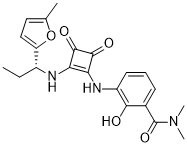
C21H23N3O5
|
|
|---|---|---|
| 分子量 |
397.43
|
|
| 精确质量 |
397.164
|
|
| 元素分析 |
C, 63.47; H, 5.83; N, 10.57; O, 20.13
|
|
| CAS号 |
473727-83-2
|
|
| 相关CAS号 |
862464-58-2 (hydrate); 473727-83-2
|
|
| PubChem CID |
9865554
|
|
| 外观&性状 |
White to off-white solid powder
|
|
| LogP |
2.975
|
|
| tPSA |
111.88
|
|
| 氢键供体(HBD)数目 |
3
|
|
| 氢键受体(HBA)数目 |
7
|
|
| 可旋转键数目(RBC) |
7
|
|
| 重原子数目 |
29
|
|
| 分子复杂度/Complexity |
704
|
|
| 定义原子立体中心数目 |
1
|
|
| SMILES |
O=C1C(C(NC2=CC=CC(C(N(C)C)=O)=C2O)=C1N[C@H](CC)C3=CC=C(O3)C)=O
|
|
| InChi Key |
RXIUEIPPLAFSDF-CYBMUJFWSA-N
|
|
| InChi Code |
InChI=1S/C21H23N3O5/c1-5-13(15-10-9-11(2)29-15)22-16-17(20(27)19(16)26)23-14-8-6-7-12(18(14)25)21(28)24(3)4/h6-10,13,22-23,25H,5H2,1-4H3/t13-/m1/s1
|
|
| 化学名 |
2-hydroxy-N,N-dimethyl-3-[[2-[[(1R)-1-(5-methylfuran-2-yl)propyl]amino]-3,4-dioxocyclobuten-1-yl]amino]benzamide
|
|
| 别名 |
|
|
| HS Tariff Code |
2934.99.9001
|
|
| 存储方式 |
Powder -20°C 3 years 4°C 2 years In solvent -80°C 6 months -20°C 1 month |
|
| 运输条件 |
Room temperature (This product is stable at ambient temperature for a few days during ordinary shipping and time spent in Customs)
|
| 溶解度 (体外实验) |
|
|||
|---|---|---|---|---|
| 溶解度 (体内实验) |
配方 1 中的溶解度: ≥ 2.5 mg/mL (6.29 mM) (饱和度未知) in 10% DMSO + 40% PEG300 + 5% Tween80 + 45% Saline (这些助溶剂从左到右依次添加,逐一添加), 澄清溶液。
例如,若需制备1 mL的工作液,可将100 μL 25.0 mg/mL澄清DMSO储备液加入到400 μL PEG300中,混匀;然后向上述溶液中加入50 μL Tween-80,混匀;加入450 μL生理盐水定容至1 mL。 *生理盐水的制备:将 0.9 g 氯化钠溶解在 100 mL ddH₂O中,得到澄清溶液。 配方 2 中的溶解度: 2.5 mg/mL (6.29 mM) in 10% DMSO + 90% (20% SBE-β-CD in Saline) (这些助溶剂从左到右依次添加,逐一添加), 悬浊液; 超声助溶。 例如,若需制备1 mL的工作液,可将 100 μL 25.0 mg/mL澄清DMSO储备液加入900 μL 20% SBE-β-CD生理盐水溶液中,混匀。 *20% SBE-β-CD 生理盐水溶液的制备(4°C,1 周):将 2 g SBE-β-CD 溶解于 10 mL 生理盐水中,得到澄清溶液。 View More
配方 3 中的溶解度: ≥ 2.5 mg/mL (6.29 mM) (饱和度未知) in 10% DMSO + 90% Corn Oil (这些助溶剂从左到右依次添加,逐一添加), 澄清溶液。 配方 4 中的溶解度: ≥ 2.5 mg/mL (6.29 mM) (饱和度未知) in 5% DMSO + 40% PEG300 + 5% Tween80 + 50% Saline (这些助溶剂从左到右依次添加,逐一添加), 澄清溶液。 *生理盐水的制备:将 0.9 g 氯化钠溶解在 100 mL ddH₂O中,得到澄清溶液。 配方 5 中的溶解度: ≥ 2.5 mg/mL (6.29 mM) (饱和度未知) in 5% DMSO + 95% (20% SBE-β-CD in Saline) (这些助溶剂从左到右依次添加,逐一添加), 澄清溶液。*20% SBE-β-CD 生理盐水溶液的制备(4°C,1 周):将 2 g SBE-β-CD 溶解于 10 mL 生理盐水中,得到澄清溶液。 1、请先配制澄清的储备液(如:用DMSO配置50 或 100 mg/mL母液(储备液)); 2、取适量母液,按从左到右的顺序依次添加助溶剂,澄清后再加入下一助溶剂。以 下列配方为例说明 (注意此配方只用于说明,并不一定代表此产品 的实际溶解配方): 10% DMSO → 40% PEG300 → 5% Tween-80 → 45% ddH2O (或 saline); 假设最终工作液的体积为 1 mL, 浓度为5 mg/mL: 取 100 μL 50 mg/mL 的澄清 DMSO 储备液加到 400 μL PEG300 中,混合均匀/澄清;向上述体系中加入50 μL Tween-80,混合均匀/澄清;然后继续加入450 μL ddH2O (或 saline)定容至 1 mL; 3、溶剂前显示的百分比是指该溶剂在最终溶液/工作液中的体积所占比例; 4、 如产品在配制过程中出现沉淀/析出,可通过加热(≤50℃)或超声的方式助溶; 5、为保证最佳实验结果,工作液请现配现用! 6、如不确定怎么将母液配置成体内动物实验的工作液,请查看说明书或联系我们; 7、 以上所有助溶剂都可在 Invivochem.cn网站购买。 |
| 制备储备液 | 1 mg | 5 mg | 10 mg | |
| 1 mM | 2.5162 mL | 12.5808 mL | 25.1617 mL | |
| 5 mM | 0.5032 mL | 2.5162 mL | 5.0323 mL | |
| 10 mM | 0.2516 mL | 1.2581 mL | 2.5162 mL |
1、根据实验需要选择合适的溶剂配制储备液 (母液):对于大多数产品,InvivoChem推荐用DMSO配置母液 (比如:5、10、20mM或者10、20、50 mg/mL浓度),个别水溶性高的产品可直接溶于水。产品在DMSO 、水或其他溶剂中的具体溶解度详见上”溶解度 (体外)”部分;
2、如果您找不到您想要的溶解度信息,或者很难将产品溶解在溶液中,请联系我们;
3、建议使用下列计算器进行相关计算(摩尔浓度计算器、稀释计算器、分子量计算器、重组计算器等);
4、母液配好之后,将其分装到常规用量,并储存在-20°C或-80°C,尽量减少反复冻融循环。
计算结果:
工作液浓度: mg/mL;
DMSO母液配制方法: mg 药物溶于 μL DMSO溶液(母液浓度 mg/mL)。如该浓度超过该批次药物DMSO溶解度,请首先与我们联系。
体内配方配制方法:取 μL DMSO母液,加入 μL PEG300,混匀澄清后加入μL Tween 80,混匀澄清后加入 μL ddH2O,混匀澄清。
(1) 请确保溶液澄清之后,再加入下一种溶剂 (助溶剂) 。可利用涡旋、超声或水浴加热等方法助溶;
(2) 一定要按顺序加入溶剂 (助溶剂) 。
| NCT Number | Recruitment | interventions | Conditions | Sponsor/Collaborators | Start Date | Phases |
| NCT00684593 | Completed | Drug: Navarixin 10 mg Other: Placebo |
Psoriasis | Merck Sharp & Dohme LLC | June 1, 2007 | Phase 2 |
| NCT00688467 | Completed | Drug: Navarixin Drug: Placebo |
Asthma | Merck Sharp & Dohme LLC | June 1, 2008 | Phase 2 |
| NCT01006616 | Completed | Drug: Navarixin Drug: Placebo Drug: Rescue medication |
COPD | Merck Sharp & Dohme LLC | October 1, 2009 | Phase 2 |
| NCT00632502 | Completed | Drug: Navarixin Drug: Placebo Drug: Rescue medication |
Neutrophilic Asthma | Merck Sharp & Dohme LLC | May 1, 2008 | Phase 2 |
| NCT03473925 | Completed | Drug: Navarixin Biological: Pembrolizumab |
Solid Tumors Non-small Cell Lung Cancer |
Merck Sharp & Dohme LLC | April 10, 2018 | Phase 2 |
 CXCR2 mRNA expression in colorectal cancer HCT116 and E2 xenografts and the influence of CXCR2 knockdown in colorectal cancer on growth of cells treated with oxaliplatin.Mol Cancer Ther.2012 Jun;11(6):1353-64. |
|---|
 SCH-527123 decreases cell proliferation, migration, and invasion and increases apoptosis in colorectal cancer cells.Mol Cancer Ther.2012 Jun;11(6):1353-64. |
 SCH-527123 combined with oxaliplatin synergistically suppresses colorectal cancer cell proliferation and survival.Mol Cancer Ther.2012 Jun;11(6):1353-64. |
 SCH-527123 in combination with oxaliplatin modulates protein expression of IL-8, PARP, BCL-2/BAX, and decreased NF-κB/Akt/MAPK signaling activity in colorectal cancer cells.Mol Cancer Ther.2012 Jun;11(6):1353-64. |
|---|
 Antitumor activity of SCH-527123 combined with oxaliplatin in HCT116 and E2 xenografts.Mol Cancer Ther.2012 Jun;11(6):1353-64. |
 SCH-527123 in combination with oxaliplatin significantly suppressed NF-κB/Akt/MAPK downstream signaling and angiogenic activity in HCT116 and E2 xenografts.Mol Cancer Ther.2012 Jun;11(6):1353-64. |
InvivoChem的所有产品仅用于作科学研究,不面向患者销售
Copyright 2020 InvivoChem LLC | All Rights Reserved 粤ICP备20063088号-1


 COA
COA
 粤公网安备 44011102003439号
 463611831
