| 规格 | 价格 | 库存 | 数量 |
|---|---|---|---|
| 2mg |
|
||
| 5mg |
|
||
| 10mg |
|
||
| 25mg |
|
||
| 50mg |
|
||
| 100mg |
|
||
| 250mg |
|
||
| 500mg |
|
||
| Other Sizes |
|
| 靶点 |
HER2 (IC50 = 59 nM); EGFR (IC50 = 92 nM)
Neratinib shows no action against tyrosine kinase c-Met[1], Akt, cyclin D1/cdk4, cyclin E/cdk2, cyclin B1/cdk1, IKK-2, MK-2, PDK1, c-Raf, and Tpl-2, among other serine-threonine kinases[1]. Neratinib is much less active in cell lines that express neither EGFR nor HER-2 (3T3, MDA-MB-435, and SW620), and it inhibits the proliferation of cell lines that exhibit high levels of HER-2 (3T3/neu, SK-Br-3, and BT474)[1]. Neratinib (0-2 nM, 12-16 h) arrests BT474 cell cycle at G1-S phase[1]. Neratinib causes cyclin D1 levels to be down-regulated, Akt and MAPK phosphorylation to be inhibited, and p27 to be induced[1]. |
|---|---|
| 体外研究 (In Vitro) |
体外活性:Neratinib 弱抑制酪氨酸激酶 KDR 和 Src,IC50 分别为 0.8 μM 和 1.4 μM,与 HER2 相比活性低 14 倍和 24 倍。 Neratinib 对其他丝氨酸-苏氨酸激酶没有活性,例如 Akt、细胞周期蛋白 D1/cdk4、细胞周期蛋白 E/cdk2、细胞周期蛋白 B1/cdk1、IKK-2、MK-2、PDK1、c-Raf 和 Tpl-2。如酪氨酸激酶 c-Met。 Neratinib 选择性抑制转染 HER2 (3T3/neu) 的 3T3 细胞以及另外两种 HER-2 过表达 SK-Br-3 和 BT474 细胞的增殖,IC50 值为 2-3 nM,显示 >230 倍与未转染的 3T3 细胞以及 EGFR 和 HER2 阴性的 MDA-MB-435 和 SW620 细胞相比,其效力较高。 Neratinib 还抑制 EGFR 依赖性 A431 细胞的增殖,IC50 为 81 nM。 Neratinib 可减少 BT474 细胞中 HER2 受体的自身磷酸化,IC50 为 5 nM,并减少 A431 细胞中 EGFR 的 EGF 依赖性磷酸化,IC50 为 3 nM。 Neratinib 阻断 HER-2 导致下游 MAPK 和 Akt 通路的抑制,IC50 为 2 nM,比曲妥珠单抗更有效。 Neratinib 抑制 BT474 细胞中细胞周期蛋白 D1 的表达和 Rb 易感基因产生的磷酸化,IC50 为 9 nM,导致 G1-S 停滞并最终降低细胞增殖。激酶测定:Neratinib 在 DMSO 中制备为 10 mg/mL 库存,并在 25 mM HEPES(pH 7.5;0.002 ng/mL-20 μg/mL)中稀释。将 HER2(氨基酸 676-1255)或表皮生长因子受体 (EGFR)(氨基酸 645-1186)的纯化重组 COOH 末端片段 [用 100 mM HEPES (pH 7.5) 和 50% 甘油稀释] 进行浓度递增的培养将 Neratinib 溶解在 4 mM HEPES (pH 7.5)、0.4 mM MnCl2、20 μM 钒酸钠和 0.2 mM DTT 中,在 96 孔 ELISA 板中室温反应 15 分钟。通过添加 40 μM ATP 和 20 mM MgCl2 启动激酶反应,并在室温下进行 1 小时。洗涤板,并使用铕标记的抗磷酸酪氨酸抗体(15 ng/孔)检测磷酸化。洗涤和增强步骤后,使用 Victor2 荧光读数器(激发波长 340 nm,发射波长 615 nm)检测信号。根据抑制曲线计算抑制受体磷酸化 50% 的 Neratinib 浓度 (IC50)。细胞测定:将细胞(3T3、3T3/neu、A431、BT474、SK-Br-3、MDA-MB-435 和 SW480)暴露于不同浓度的 Neratinib 中 2 或 6 天。使用磺基罗丹明 B(一种蛋白质结合染料)测定细胞增殖。简而言之,用 10% 三氯乙酸固定细胞并用水充分洗涤。然后用 0.1% 磺基罗丹明 B 染色细胞并用 5% 乙酸洗涤。蛋白质相关染料溶解在 10 mM Tris 中,并在 450 nM 处测量吸光度。根据抑制曲线确定抑制细胞增殖 50% 的 Neratinib 浓度 (IC50)。
Neratinib Maleate (HKI-272) 能有效抑制过表达HER-2的人乳腺癌细胞系BT474和SK-Br-3的增殖,IC50值为2 nM。它也能抑制HER-2转染的小鼠成纤维细胞3T3/neu的增殖 (IC50 = 3 nM),相较于亲本3T3细胞 (IC50 = 700 nM) 显示出超过200倍的选择性。该化合物抑制过表达EGFR的A431细胞增殖的IC50为81 nM,但对缺乏HER-2和EGFR表达的MDA-MB-435和SW620细胞活性低得多 (IC50 ~690-960 nM)。 Neratinib Maleate (HKI-272) 抑制BT474细胞中配体非依赖性的HER-2自磷酸化以及A431细胞中EGF刺激的EGFR磷酸化,IC50值分别为5 nM和3 nM。 用 Neratinib Maleate (HKI-272) 处理BT474细胞导致下游信号通路被抑制,包括MAPK和Akt的磷酸化 (两者IC50均为2 nM)、细胞周期蛋白D1水平下调 (IC50 = 9 nM)、视网膜母细胞瘤蛋白磷酸化减少以及p27诱导。这导致细胞周期停滞在G1-S期 (减少S期细胞的IC50 = 2 nM),并在更高浓度下出现指示细胞凋亡的亚G1期细胞群增加。 Neratinib Maleate (HKI-272) 作为不可逆抑制剂发挥作用。去除化合物后,对受体磷酸化的抑制仍然持续。使用[14C]HKI-272证明了其与HER-2激酶结构域的直接共价结合。 相比之下,曲妥珠单抗 (高达30 µg/ml) 在BT474细胞中仅部分抑制HER-2磷酸化和下游信号传导。 [1] |
| 体内研究 (In Vivo) |
口服 Neratinib 可显着抑制 3T3/neu 异种移植物的生长,剂量为 10、20、40 和 80 mg/kg/天时,抑制率分别为 34%、53%、98% 和 98%。与 40 mg/kg/天给药 1 小时内 HER-2 磷酸化抑制 84% 一致,Neratinib 在 5、10 剂量时抑制 BT474 异种移植物的生长 70-82%、67% 和 93%和 40 毫克/公斤/天,分别。 Neratinib 对 SK-OV-3 异种移植物也有效,5 mg/kg/天和 60 mg/kg/天的抑制率分别为 31% 和 85%。 Neratinib 对 EGFR 依赖性 A431 异种移植物的效力低于 HER-2 依赖性肿瘤,在 5 和 20 mg/kg/天时分别具有 32% 和 44% 的抑制作用。 Neratinib 对表达低水平 HER-2 和 EGFR 的 MCF-7 和 MX-1 异种移植物几乎没有活性,在 80 mg/kg/天时仅抑制 28%,表明 Neratinib 对表达 HER-2 或 EGFR 的细胞具有选择性活性。
在裸鼠中,每日一次口服给予 Neratinib Maleate (HKI-272) 可抑制HER-2依赖性肿瘤异种移植物的生长。在3T3/neu模型中,20-80 mg/kg/天的剂量可产生53-98%的肿瘤生长抑制。 在BT474乳腺癌异种移植模型中,5-40 mg/kg/天的剂量可产生70-93%的肿瘤生长抑制。单次口服40 mg/kg的剂量,在给药后1小时和6小时分别抑制BT474肿瘤中HER-2磷酸化达84%和97%,24小时后抑制率仍维持在43%。 在SK-OV-3卵巢癌异种移植模型中,5-60 mg/kg/天的剂量可产生31-85%的抑制。 在EGFR依赖的A431异种移植模型中,Neratinib Maleate (HKI-272) 效力较低,40 mg/kg/天产生76%的抑制,效果弱于在HER-2模型中所见。 该化合物在HER-2/EGFR低表达的乳腺癌细胞系MCF-7的异种移植模型中活性极微 (80 mg/kg/天时抑制率为28%)。 [1] |
| 酶活实验 |
将来那替尼在 DMSO 中制备成 10 mg/mL 储备液,在 25 mM HEPES(pH 7.5;0.002 ng/mL–20 μg/mL)中稀释。在 96 孔 ELISA 板中,将 HER2(氨基酸 676-1255)或表皮生长因子受体(EGFR)(氨基酸 645-1186)的纯化重组 COOH 末端片段稀释在 100 mM HEPES(pH 7.5)和 50% 中。甘油。然后将混合物与浓度递增的 Neratinib 在 4 mM HEPES (pH 7.5)、0.4 mM MnCl2、20 μM 钒酸钠和 0.2 mM DTT 中在室温下孵育 15 分钟。添加 40 μM ATP 和 20 mM MgCl2 以启动激酶反应,然后在室温下运行一小时。清洗板,然后使用铕标记的抗磷酸酪氨酸抗体(15 ng/孔)检测磷酸化。使用 Victor2 荧光读数器(激发波长为 340 nm,发射波长为 615 nm),在洗涤和增强阶段后检测信号。抑制曲线用于确定受体磷酸化被抑制 50% 时 Neratinib 的浓度 (IC50)。
HER-2和EGFR细胞质结构域的活性通过时间分辨荧光法的自磷酸化测定来测量。化合物在DMSO中制备为10mg/ml储备,并在25mm HEPES(pH 7.5;0.002ng/ml–20μg/ml)中稀释。酶[在100 mm HEPES(pH 7.5)和50%甘油中稀释]在96孔ELISA板中与4 mm HEPES中的抑制剂、0.4 mm MnCl2、20μm钒酸钠和0.2 mm DTT在室温下孵育15分钟。通过加入40μm ATP和20mm MgCl2引发激酶反应,并在室温下进行1小时。洗涤板,使用铕标记的抗磷酸酪氨酸抗体(15ng/孔;Wallac)检测磷酸化。根据制造商的建议进行洗涤和增强步骤后,使用Victor2荧光阅读器(激发波长340nm,发射波长615nm)检测信号。根据抑制曲线计算抑制受体磷酸化50%的化合物浓度(IC50)。[1] 使用在细菌、昆虫或人类细胞系中表达的重组酶进行其他激酶的检测。除c-Met、KDR、src(酪氨酸激酶)和MEK1(双特异性)外,所有使用的酶都是丝氨酸-苏氨酸激酶。使用的底物是肽(Akt、IKK-2、MK2、PDK1、src和Tpl2)、蛋白质(细胞周期蛋白D1/CDK4、细胞周期蛋白E/CDK2、细胞周期素B1/CDK1和c-Raf)、聚谷氨酸4酪氨酸(KDR)或激酶本身(自磷酸化;c-met)。使用TMB过氧化物酶底物测量细胞周期蛋白/细胞周期蛋白依赖性激酶(cdk)的磷酸化,使用LabChip测量MK-2,或使用DELPHIA/LANCE 测量所有其他激酶的磷酸化。 HER-2和EGFR的胞质结构域,以重组His标签蛋白的形式在昆虫细胞中表达,并通过镍亲和层析进行纯化。经SDS-PAGE评估,纯度>80%。 激酶活性测定中,酶与抑制剂在含有HEPES、MnCl2、钒酸钠和DTT的缓冲液中于室温孵育15分钟。通过加入ATP和MgCl2启动激酶反应,并在室温下进行1小时。使用铕标记的抗磷酸酪氨酸抗体,通过时间分辨荧光法 (DELFIA) 检测受体自磷酸化。根据抑制曲线计算IC50值。 [1] |
| 细胞实验 |
将不同浓度的 Neratinib 应用于细胞(3T3、3T3/neu、A431、BT474、SK-Br-3、MDA-MB-435 和 SW480),持续两天或六天。一种称为磺基罗丹明 B 的蛋白质结合染料用于测量细胞增殖。总之,细胞用10%三氯乙酸固定后用水彻底清洗。用 0.1% 磺基罗丹明 B 染色细胞后,用 5% 乙酸冲洗。将蛋白质相关染料溶解在 10 mM Tris 中后,在 450 nM 处计算吸光度。抑制曲线用于计算neratinib抑制50%细胞增殖的浓度(IC50)。
细胞增殖实验中,细胞接种于96孔板。次日,加入化合物的系列稀释液。培养2天 (BT474细胞为6天) 后,使用磺基罗丹明B (SRB) 蛋白结合染料评估细胞增殖。细胞用三氯乙酸固定,SRB染色,溶解后的染料通过分光光度法测定。根据抑制曲线确定IC50值。 用于分析受体及信号蛋白磷酸化或表达时,细胞用化合物处理指定时间 (例如,检测受体磷酸化处理3小时,检测下游标志物处理过夜)。随后裂解细胞,蛋白质经SDS-PAGE分离,转印至硝酸纤维素膜,通过特定抗体和增强化学发光法进行免疫印迹检测。 结合研究中,将重组的HER-2胞质结构域或完整的BT474细胞与[14C]HKI-272在存在或不存在过量未标记化合物的情况下孵育。样品变性后,经SDS-PAGE分离,并通过荧光自显影分析。 细胞周期分析中,用化合物处理过夜的BT474细胞用溴脱氧尿苷 (BrdUrd) 进行脉冲标记。细胞固定、变性后,用抗BrdUrd-FITC抗体和碘化丙啶染色,通过流式细胞术分析以确定处于不同细胞周期阶段的细胞百分比。 [1] |
| 动物实验 |
雌性无胸腺(裸鼠)肿瘤异种移植[1]
10、20、40、60 或 80 mg/kg/天 灌胃,42 天 肿瘤异种移植研究[1] 将肿瘤细胞(在组织培养中维持)或肿瘤碎片皮下植入雌性无胸腺(裸鼠)侧腹。对于雌激素依赖性细胞系(BT474、MCF-7 和 SK-OV-3),在肿瘤植入前 1 周,将激素缓释片(0.72 mg 17-β 雌二醇,60 天释放)植入动物体内。此外,将 SK-OV-3 细胞悬浮于 Matrigel 基底膜基质中进行植入。在肿瘤大小达到 90–200 mg 后开始治疗,并将动物随机分配到不同的治疗组(分期,第 0 天)。对于 3T3/neu 异种移植瘤,治疗于肿瘤植入后第二天(第 0 天)开始。HKI-272 配制于 0.5% 甲基纤维素-0.4% 聚山梨醇酯-80(吐温 80)溶液中,每日通过灌胃法口服给药。每 7 天测定一次肿瘤质量 [(长 × 宽²)/2]。除 3T3/neu 外,所有异种移植瘤研究中的肿瘤生长均以相对肿瘤生长表示:即平均肿瘤质量与第 0 天平均肿瘤质量的比值。肿瘤生长抑制率以载体对照组为参照进行计算。对数据进行对数转换后,采用单尾 Student's t 检验(方差相等)来验证抑制作用的统计学意义。[1] 异种移植瘤中 HER-2 磷酸化。[1] 将 BT474 肿瘤碎片(约 30 mm³)皮下植入无胸腺雌性裸鼠(每组 5 只)。当肿瘤体积达到 200–300 mg 时,给予动物单次口服剂量(40 mg/kg)的 HKI-272(溶于 pH 2.0 的水中)。分别于 1、3、6 和 24 小时切除对照组和治疗组动物的肿瘤并切碎。将肿瘤组织块悬浮于含有 10 mM Tris(pH 7.5)、5 mM EDTA、150 mM NaCl、1% Triton X-100、1% 脱氧胆酸钠、0.1% SDS、1 mM PMSF、10 μg/ml 胃蛋白酶抑制剂、10 μg/ml 亮抑蛋白酶肽、10 μg/ml 抑蛋白酶、2 mM 钒酸钠和 100 mM 氟化钠的溶液中,并在冰上用匀浆器进行匀浆裂解。离心澄清后,使用 Bio-Rad DC 蛋白测定试剂盒测定裂解液中的蛋白浓度。将每组 60 μg 裂解液混合,进行 SDS-PAGE 电泳和磷酸酪氨酸特异性抗体的免疫印迹分析。同时,将混合提取物与 4 μg 抗 HER-2 抗体在 4°C 下孵育 1 小时进行免疫沉淀。免疫复合物收集于蛋白A琼脂糖上,洗涤后,使用磷酸酪氨酸特异性抗体进行免疫印迹分析。分析单个肿瘤的提取物以确定动物间的差异。 将肿瘤细胞或肿瘤碎片皮下植入雌性无胸腺(裸鼠)体内。对于雌激素依赖性细胞系(BT474、MCF-7、SK-OV-3),在肿瘤植入前一周,将雌二醇缓释片植入动物体内。除快速生长的3T3/neu肿瘤外,当肿瘤达到预定大小(90-200 mg)时开始治疗;对于快速生长的3T3/neu肿瘤,治疗在植入后第二天开始。 马来酸奈拉替尼(HKI-272)配制于含0.5%甲基纤维素和0.4%吐温80的水溶液中,根据研究需要,每日灌胃一次,持续10-20天。定期测量肿瘤大小并计算肿瘤质量。肿瘤生长抑制率是相对于载体对照组计算的。 为了评估异种移植瘤中HER-2的磷酸化水平,给携带BT474肿瘤的小鼠单次口服该化合物。在不同时间点切除肿瘤,匀浆,并通过免疫印迹分析裂解液中磷酸酪氨酸和HER-2的表达。[1] |
| 药代性质 (ADME/PK) |
裸鼠单次口服马来酸奈拉替尼(HKI-272,20 mg/kg)后,其终末半衰期约为4小时。[1]
|
| 毒性/毒理 (Toxicokinetics/TK) |
妊娠期和哺乳期影响
◉ 哺乳期用药概述 目前尚无关于奈拉替尼在哺乳期临床应用的信息。由于奈拉替尼及其代谢物与血浆蛋白的结合率超过99%,因此其在乳汁中的含量可能很低。生产商建议在奈拉替尼治疗期间停止母乳喂养。 ◉ 对母乳喂养婴儿的影响 截至修订日期,未找到相关的已发表信息。 ◉ 对哺乳和母乳的影响 截至修订日期,未找到相关的已发表信息。 在已进行的异种移植研究中,马来酸奈拉替尼 (HKI-272)在测试剂量(最高达80 mg/kg/天)下耐受性良好。未观察到体重减轻或其他与药物相关的毒性。[1] |
| 参考文献 | |
| 其他信息 |
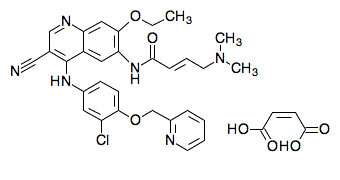
马来酸奈拉替尼是奈拉替尼的马来酸盐形式,奈拉替尼是一种口服的喹唑啉类不可逆受体酪氨酸激酶(RTK)抑制剂,可抑制人表皮生长因子受体2(HER2;ERBB2)和人表皮生长因子受体(EGFR),具有潜在的抗肿瘤活性。给药后,奈拉替尼靶向并共价结合HER2和EGFR的ATP结合口袋中的半胱氨酸残基。这抑制了它们的活性,导致下游信号转导事件的抑制,诱导细胞周期阻滞和凋亡,最终降低表达HER2和EGFR的肿瘤细胞的增殖。 EGFR 和 HER2 是 RTK,在多种肿瘤细胞类型中发生突变或过度激活,它们在肿瘤细胞增殖和肿瘤血管生成中发挥关键作用。
另见:奈拉替尼(含有活性成分)。 药物适应症 奈拉替尼适用于早期激素受体阳性、HER2 过表达/扩增的乳腺癌成年患者的延长辅助治疗,这些患者既往接受过曲妥珠单抗辅助治疗,但距完成治疗不足一年。 马来酸奈拉替尼 (HKI-272) 是一种口服有效的 HER-2 酪氨酸激酶不可逆抑制剂,其设计基于 EGFR 抑制剂 EKB-569 的化学骨架,但经过修饰以提高 HER-2 活性。它含有一个迈克尔受体基团,该基团与HER-2 ATP结合口袋中保守的半胱氨酸残基(Cys-805)共价结合,从而实现持续抑制。 其作用机制包括直接抑制HER-2和EGFR激酶活性,进而阻断下游MAPK和Akt信号通路,下调细胞周期调节因子(细胞周期蛋白D1、磷酸化Rb),诱导p27表达,使细胞周期停滞于G1-S期,最终导致细胞增殖减少和细胞凋亡。 该研究表明,马来酸奈拉替尼(HKI-272)有望成为治疗HER-2依赖性癌症(如乳腺癌和卵巢癌)的候选药物,并可能用于治疗HER-2和EGFR双过表达的肿瘤。[1] |
| 分子式 |
C34H33CLN6O7
|
|---|---|
| 分子量 |
673.11
|
| 精确质量 |
672.209
|
| 元素分析 |
C, 60.67; H, 4.94; Cl, 5.27; N, 12.49; O, 16.64
|
| CAS号 |
915942-22-2
|
| 相关CAS号 |
Neratinib;698387-09-6
|
| PubChem CID |
67307512
|
| 外观&性状 |
White to off-white solid powder
|
| tPSA |
187
|
| 氢键供体(HBD)数目 |
4
|
| 氢键受体(HBA)数目 |
12
|
| 可旋转键数目(RBC) |
13
|
| 重原子数目 |
48
|
| 分子复杂度/Complexity |
1000
|
| 定义原子立体中心数目 |
0
|
| SMILES |
C(/C(=O)O)=C/C(=O)O.N(C1C=CC(OCC2N=CC=CC=2)=C(Cl)C=1)C1=C(C#N)C=NC2=CC(=C(C=C12)NC(=O)/C=C/CN(C)C)OCC
|
| InChi Key |
VXZCUHNJXSIJIM-MEBGWEOYSA-N
|
| InChi Code |
InChI=1S/C30H29ClN6O3.C4H4O4/c1-4-39-28-16-25-23(15-26(28)36-29(38)9-7-13-37(2)3)30(20(17-32)18-34-25)35-21-10-11-27(24(31)14-21)40-19-22-8-5-6-12-33-22;5-3(6)1-2-4(7)8/h5-12,14-16,18H,4,13,19H2,1-3H3,(H,34,35)(H,36,38);1-2H,(H,5,6)(H,7,8)/b9-7+;2-1-
|
| 化学名 |
(Z)-but-2-enedioic acid;(E)-N-[4-[3-chloro-4-(pyridin-2-ylmethoxy)anilino]-3-cyano-7-ethoxyquinolin-6-yl]-4-(dimethylamino)but-2-enamide
|
| 别名 |
HKI-272 maleate or PB272; HKI272; 915942-22-2; hki-272 maleate; Nerlynx; Neratinib maleate [MI]; UNII-9RM7XY23ZS; 9RM7XY23ZS; Neratinib (maleate); HKI 272; PB 272; PB-272 maleate
|
| HS Tariff Code |
2934.99.9001
|
| 存储方式 |
Powder -20°C 3 years 4°C 2 years In solvent -80°C 6 months -20°C 1 month 注意: 请将本产品存放在密封且受保护的环境中,避免吸湿/受潮。 |
| 运输条件 |
Room temperature (This product is stable at ambient temperature for a few days during ordinary shipping and time spent in Customs)
|
| 溶解度 (体外实验) |
|
|---|
| 制备储备液 | 1 mg | 5 mg | 10 mg | |
| 1 mM | 1.4856 mL | 7.4282 mL | 14.8564 mL | |
| 5 mM | 0.2971 mL | 1.4856 mL | 2.9713 mL | |
| 10 mM | 0.1486 mL | 0.7428 mL | 1.4856 mL |
1、根据实验需要选择合适的溶剂配制储备液 (母液):对于大多数产品,InvivoChem推荐用DMSO配置母液 (比如:5、10、20mM或者10、20、50 mg/mL浓度),个别水溶性高的产品可直接溶于水。产品在DMSO 、水或其他溶剂中的具体溶解度详见上”溶解度 (体外)”部分;
2、如果您找不到您想要的溶解度信息,或者很难将产品溶解在溶液中,请联系我们;
3、建议使用下列计算器进行相关计算(摩尔浓度计算器、稀释计算器、分子量计算器、重组计算器等);
4、母液配好之后,将其分装到常规用量,并储存在-20°C或-80°C,尽量减少反复冻融循环。
计算结果:
工作液浓度: mg/mL;
DMSO母液配制方法: mg 药物溶于 μL DMSO溶液(母液浓度 mg/mL)。如该浓度超过该批次药物DMSO溶解度,请首先与我们联系。
体内配方配制方法:取 μL DMSO母液,加入 μL PEG300,混匀澄清后加入μL Tween 80,混匀澄清后加入 μL ddH2O,混匀澄清。
(1) 请确保溶液澄清之后,再加入下一种溶剂 (助溶剂) 。可利用涡旋、超声或水浴加热等方法助溶;
(2) 一定要按顺序加入溶剂 (助溶剂) 。
| NCT Number | Recruitment | interventions | Conditions | Sponsor/Collaborators | Start Date | Phases |
| NCT06083662 | Active Recruiting |
Drug: Neratinib Maleate | Metastatic Cancer HER2 Gene Mutation |
Korea University Guro Hospital | June 15, 2021 | Phase 2 |
|
|---|
|
|
InvivoChem的所有产品仅用于作科学研究,不面向患者销售
Copyright 2020 InvivoChem LLC | All Rights Reserved 粤ICP备20063088号-1


 COA
COA


 粤公网安备 44011102003439号
 463611831
