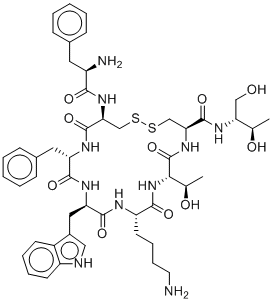
Octreotide

别名: SMS-201-995; Octreotide; Octreotide-LAR; Longastatin; Octreotide acetate; 83150-76-9; Sandostatin; SMS 201-995; Octreotidum; Octreotida; Octreotide-LAR; . 醋酸奥曲肽; [R-(R^<*>^,R^<*>^)]-D-苯丙酰-L-半胱氨酰-L-苯丙酰-D-色胺酰-L-赖氨酰-1-苏氨酰-N-[2-羟基-1-(羟基甲基)丙基]-L-苏氨酰胺环(2→7)二硫化物;醋酸奥曲肽 OCTREOTIDEACETATE; 醋酸奥曲肽;奥曲肽;奥曲肽标准品;醋酸奥曲肽 Octreotide Acetate;[R-(R^^,R^^)]-D-苯丙酰-L-半胱氨酰-L-苯丙酰-D-色胺酰-L-赖氨酰-1-苏氨酰-N-[2-羟基-1-(羟基甲基)丙基]-L-苏氨酰胺环(2→7)二硫化物;[R-(R^<*>^,R^<*>^)]-D-苯丙酰-L-半胱氨酰-L-苯丙 酰-D-色胺酰-L-赖氨酰-1-苏氨酰-N-[2-羟基-1-(羟基甲基)丙基]-L-苏氨酰胺环(2 →7)二硫化
目录号: V7435 纯度: ≥98%
奥曲肽(SMS-201-995;奥曲肽-LAR;商品名Sandostatin、Longastatin等)是一种八肽和生长抑素类似物,在生物学上模仿天然存在的生长抑素,但它是一种比生长激素、胰高血糖素和胰岛素更有效的抑制剂,可抑制生长激素、胰高血糖素和胰岛素的分泌。天然激素。
Octreotide CAS号: 83150-76-9
产品类别: New1
产品仅用于科学研究,不针对患者销售
规格 价格 库存 数量
1mg
5mg
10mg
50mg
100mg
Other Sizes

Other Forms of Octreotide:

  • 奥曲肽
  • Octreotide pamoate
点击了解更多
InvivoChem产品被CNS等顶刊论文引用
产品描述

描述:奥曲肽(SMS-201-995;奥曲肽-LAR;商品名善得定、长效生长抑素等)是一种八肽类生长抑素类似物,其生物学特性与天然生长抑素相似,但其抑制生长激素、胰高血糖素和胰岛素分泌的能力比天然生长抑素更强。它用于治疗激素分泌肿瘤、高胃泌素血症、糖尿病、高血压和小肠瘘。


生物活性&实验参考方法
靶点
SSTR2/3/5
Akt/GSK3β signaling pathway - Octreotide improves hepatic glycogen synthesis by increasing the phosphorylation of Akt (Ser473) and GSK3β (Ser9), which leads to activation of glycogen synthase (GS) [1]
.
- Glycogen synthase (GS) - Octreotide increases GS mRNA expression levels, promoting hepatic glycogen synthesis [1]
.
- Insulin resistance - Octreotide improves insulin sensitivity as evidenced by reduced HOMA index values [1]
.
体外研究 (In Vitro)
在HepG2细胞中,奥曲肽可逆转棕榈酸(PA)诱导的Akt和GSK3β磷酸化以及GS mRNA表达的改变[1]。奥曲肽(10 mM,6小时)可导致糖原和磷酸化糖原合成酶转换3β(GSK3β)水平升高。
细胞模型:采用人肝母细胞瘤HepG2细胞建立体外脂肪肝模型。将细胞用棕榈酸(PA,125 μM)加0.5% BSA处理24小时,以诱导脂质积累和胰岛素抵抗。加入奥曲肽(10⁻⁸ mmol/L)处理6小时后,再用胰岛素(100 μM)刺激20分钟,然后收集细胞[1]。
- 脂质积累:油红O染色显示,奥曲肽处理显著减轻了PA诱导的HepG2细胞中脂滴的积累。与仅PA组相比,奥曲肽处理组的IOD值显著降低(P<0.01)[1]。
- Akt/GSK3β信号通路:Western blot分析显示,与对照组相比,PA处理显著降低了Akt(降低74.2%)和GSK3β(降低18.7%)的磷酸化水平。奥曲肽治疗显著逆转了这些降低,与PA组相比,p-Akt增加了140.8%,p-GSK3β增加了12.2%(P<0.05)[1]。
- 糖原合成酶mRNA:RT-qPCR分析显示,PA治疗显著降低了GS mRNA水平。与PA组相比,奥曲肽治疗显著提高了GS mRNA的表达(0.940±0.07 vs. 0.60±0.08,P<0.05)[1]。
体内研究 (In Vivo)
在高脂饮食(HFD)动态组中,奥曲肽显著降低了胰岛素浓度。研究发现,奥曲肽显著降低了胰岛素浓度,但对血清甘油三酯(TG)、总胆固醇(TC)、游离脂肪酸(FFA)、丙氨酸氨基转移酶(ALT)或天冬氨酸氨基转移酶(AST)水平无影响。奥曲肽显著抑制了稳态模型评估胰岛素抵抗指数(HOMA-IR)。奥曲肽使腹腔葡萄糖耐量试验(ipGTT)和腹腔胰岛素耐量试验(ipITT)的曲线下面积(AUC)略有降低。在棕榈酸(PA)处理的HepG2细胞中,奥曲肽减少了HFD细胞引起的脂肪变性及脂滴积累。在HFD脂肪沉积中,奥曲肽刺激Akt和GSK3β的磷酸化以及谷氨酰胺合成酶(GS)mRNA的表达[1]。与对照组(CONT)相比,奥曲肽还降低了体重和湿肾重量。棕榈酸(PAS)和奥曲肽/棕榈酸联合治疗降低了环磷酸腺苷(cAMP)水平,但奥曲肽单独使用并未降低磷脂酰胆碱(PCK)水平。与单独使用PAS组相比,奥曲肽/PAS组中pS6阳性细胞的数量显著降低[2]。动物模型:雄性Sprague-Dawley大鼠(3周龄,40-60 g)喂食高脂饮食(HFD,500 kcal/100 g,60%热量来自脂肪)24周以诱导肥胖。选择体重≥对照组1.4倍的大鼠。将肥胖大鼠分为HFD对照组(n=12)和奥曲肽治疗组(n=12)。在继续高脂饮食喂养期间,每 12 小时皮下注射一次奥曲肽,剂量为 40 μg/kg 体重,持续 8 天 [1]。
- 体重和肥胖参数:奥曲肽治疗显著降低了体重(高脂饮食组为 606.58±57.11 g,奥曲肽组为 534.42±49.15 g,P<0.01)、肝脏重量(14.88±1.41 g vs. 12.46±1.05 g,P<0.01)、腹部脂肪(28.87±8.76 g vs. 20.02±4.83 g,P<0.01)和腹部脂肪指数(4.72±1.23% vs. 3.75±0.81%,P<0.05)。 Lee 指数显示无显著性下降[1]

- 血糖和胰岛素:奥曲肽显著降低了空腹血糖(HFD 组为 6.26±1.55 mmol/L,奥曲肽 组为 4.75±1.60 mmol/L,P<0.01)和血清胰岛素水平(157.68±43.55 mmol/L vs. 108.85±66.36 mmol/L,P<0.05)[1]

- 胰岛素敏感性:胰岛素抵抗指标 HOMA 指数经奥曲肽治疗后显著降低(HFD 组为 39.57±13.48,奥曲肽 组为 23.40±16.71,P<0.05)[1] P<0.01),表明胰岛素敏感性改善[1]

- 葡萄糖和胰岛素耐量试验:ipGTT 和 ipITT 显示,与 HFD 组相比,奥曲肽 治疗分别使曲线下面积 (AUC) 降低了 5.2% 和 10.5%,但这些变化未达到统计学意义[1]

- 血脂和肝酶:与 HFD 组相比,奥曲肽 治疗降低了血清甘油三酯 (TG)、总胆固醇 (TC)、游离脂肪酸 (FFA)、丙氨酸氨基转移酶 (ALT) 和天冬氨酸氨基转移酶 (AST) 水平,但这些变化未达到统计学意义[1]

- 肝脏脂质含量:奥曲肽 显著降低了肝脏甘油三酯 (TG) 水平(HFD 组为 29.94±14.63 mg/g 肝脏,而 18.11±7.08 mg/g 肝脏) 奥曲肽组,P<0.01)和肝脏游离脂肪酸(FFA)水平(61.22±16.04 mmol/g 蛋白 vs. 40.86±5.09 mmol/g 蛋白,P<0.01)[1]

- 肝糖原含量:奥曲肽显著增加肝糖原含量(HFD 组为 3.66±0.84 mg/g 蛋白,奥曲肽组为 4.77±0.78 mg/g 蛋白,P<0.05)[1]

- 肝脂肪变性:肝组织 H&E 染色和油红 O 染色显示,奥曲肽 治疗显著改善了 HFD 诱导的肝脂肪变性,减少了脂肪沉积和脂质浸润。与高脂饮食组(HFD组)相比,奥曲肽组的油红O染色积分光密度(IOD)值显著降低(P<0.01)[1]。
-肝脏中的Akt/GSK3β信号通路:Western blot分析显示,与高脂饮食组相比,奥曲肽治疗显著增加了肝组织中Akt(Ser473)和GSK3β(Ser9)的磷酸化水平(P<0.05)。奥曲肽治疗也显著提高了GS mRNA水平(P<0.05)[1]。
酶活实验
cAMP放射免疫测定:采用cAMP放射免疫测定试剂盒测定肾组织cAMP含量。将肾脏用HCl匀浆,提取cAMP,分析其含量,并根据蛋白质浓度进行校正[2]
细胞实验
Western Blot 分析 [3]
细胞类型: 人肝母细胞瘤 HepG2 细胞系
测试浓度: 10-8mM
孵育时间: 6 小时
实验结果: 磷酸化 Akt 和 GSK3β 的蛋白表达水平分别增加了 140.8% 和 12.2%,GS 的 mRNA 水平也增加了。
细胞培养:HepG2 细胞在含 10% FBS、100 U/mL 青霉素和 100 μg/mL 链霉素的 RPMI-1640 培养基中,于 37°C、5% CO₂ 条件下培养。当细胞汇合度达到 80% 时,在无血清或低血清(0.5% FBS)培养基中饥饿过夜[1]

- 实验组:对照组(0.5% BSA 处理 24 小时)、PA 处理组(125 μM PA + 0.5% BSA 处理 24 小时)和 PA + 奥曲肽组(125 μM PA + 0.5% BSA 处理 24 小时,然后用 10⁻⁸ mmol/L 奥曲肽处理 6 小时)。所有组在收集细胞前均接受 100 μM 胰岛素处理 20 分钟 [1]

- 油红 O 染色:细胞用 PBS 洗涤,用 4% 甲醛固定 30 分钟,用 60% 异丙醇洗涤,用 0.3% 油红 O 工作液在 37°C 染色 30 分钟,最后用 0.2% 苏木精复染。采集图像并分析 IOD 值 [1]

- RT-qPCR:使用 TRIzol 试剂提取总 RNA。将 2 μg RNA 反转录为 cDNA。使用 SYBR Green Master Mix 和 GS 和 β-actin 的特异性引物进行 qPCR。使用 2⁻ΔΔCq 法计算相对表达量 [1]

- Western 印迹:使用全细胞蛋白测定试剂盒分离总蛋白。使用 BCA 法测定蛋白浓度。将蛋白质(40 μg)经 10% SDS-PAGE 电泳分离后,转移至 PVDF 膜上,用 5% 脱脂牛奶封闭,并与针对 p-Akt (Ser473)、p-GSK3β (Ser9)、Akt、GSK3β 和 β-actin 的一抗于 4°C 孵育过夜,随后与 HRP 标记的二抗孵育。使用 ECL 试剂检测条带,并用 Quantity One 软件进行分析 [1]
动物实验
从高脂饮食(HFD)组中随机选取24只符合条件的实验大鼠,分为HFD对照组(n=12)和奥曲肽(OCT)治疗组(n=12)。两组大鼠均连续喂食HFD 8天,奥曲肽治疗组大鼠每12小时皮下注射一次奥曲肽,剂量为40 µg/kg体重,持续8天。在奥曲肽给药期间,每日监测大鼠的体重和食物摄入量。实验结束后,所有大鼠禁食12小时,然后腹腔注射2%戊巴比妥钠(45 mg/kg体重)处死。处死后,采集血样,在4℃下以860 × g离心15分钟,取上清液于-80℃保存,以备后续分析。分离肝组织,取一份样本迅速置于液氮中冷冻,然后储存于−80°C,用于提取总RNA和蛋白质或进行油红O染色。另一份样本用4%多聚甲醛在室温下固定48小时,用于组织学检查。同时收集并称量腹部脂肪。[1]
雄性PCK大鼠(n = 24)随机分为4组(每组n = 6):每4周皮下注射一次,分别给予8 mg/kg奥曲肽(OCT)-LAR、8 mg/kg PAS-LAR、8 mg/kg OCT和8 mg/kg PAS联合用药,或给予赋形剂(微粒液体;CONT),给药时间为4至16周龄。赋形剂为诺华公司提供的聚乳酸-羟基乙酸共聚物(PLGA)微粒。在4周龄和15周龄的清醒大鼠中,使用尾套式血压计测定心率(HR)、舒张压(DBP)和收缩压(SBP)。在15.5周龄后,使用代谢笼测量24小时尿量和食物消耗量。在测量体重后,于16周龄时用戊巴比妥钠麻醉动物,并迅速取出肾脏和肝脏,导致动物因失血过多而死亡。测量肾脏湿重和肝脏湿重,并采集血液样本,用于测量血清尿素氮(SUN)、天冬氨酸氨基转移酶(AST)、丙氨酸氨基转移酶(ALT)、胰岛素样生长因子-1(IGF-1)、葡萄糖、胰岛素、胰高血糖素和皮质醇。[2]
动物和饮食:**雄性Sprague-Dawley大鼠(3周龄,40-60克)在标准条件下饲养。大鼠在标准饮食下适应7天后,被分为正常饮食组(320 kcal/100 g,4.65%脂肪,n=12)和高脂饮食组(500 kcal/100 g,60%脂肪,n=28),持续24周[1]。
- **给药:** 肥胖大鼠(体重≥对照组的1.4倍)每12小时皮下注射奥曲肽40 μg/kg体重,持续8天。高脂饮食对照组未接受任何治疗[1]。
- **监测:** 每周测量体重、体长和尾长。在奥曲肽给药期间,每日监测食物摄入量[1]。
- **葡萄糖和胰岛素耐量试验:**大鼠禁食12小时后,腹腔注射葡萄糖(2.0 g/kg)或胰岛素(7.5 U/kg)。分别于注射后0、15、30、60和120分钟从尾静脉采集血样。使用血糖仪测量葡萄糖水平。使用GraphPad Prism软件计算曲线下面积(AUC)[1]。
- **样本采集:**实验结束时,大鼠禁食12小时,并用2%戊巴比妥钠(45 mg/kg,腹腔注射)处死。采集血样,在4℃下以860×g离心15分钟,并将血清储存于-80℃。分离肝组织用于组织学分析、RNA/蛋白质提取,或冷冻用于油红O染色[1]。
- **Lee指数计算:** Lee指数 = [体重 (g)¹ᐟ³ × 1000] / 体长 (cm) [1]。
- **HOMA指数计算:** HOMA指数 = [空腹血糖 (mmol/L) × 空腹血清胰岛素 (μU/mL)] / 22.5 [1]。
- **肝脏组织学:** 石蜡包埋的肝组织切片经苏木精-伊红染色进行形态学评估。冷冻肝组织切片经油红O染色进行脂质评估。使用 Image Pro Plus 软件 [1] 分析 IOD 值。
- **肝脏甘油三酯 (TG) 测定:** 将 50 mg 肝组织在氯仿-甲醇 (2:1) 混合液中匀浆,混匀,离心,收集上清液。加入 0.9% NaCl 溶液,离心,并在氮气下干燥上清液。将残渣溶解于 3% Triton X-100 溶液中,并使用 TG 测定试剂盒 [1] 测定 TG 含量。
- **肝脏游离脂肪酸 (FFA) 测定:** 将 50 mg 肝组织在 PBS 缓冲液中匀浆,于 4°C 下以 860×g 离心 20 分钟。采用 BCA 法测定上清液蛋白浓度,并使用非酯化游离脂肪酸测定试剂盒测定游离脂肪酸浓度[1]。
- **肝糖原测定:** 将 50 mg 肝组织在冰冷的 PBS 中匀浆,于 4°C 下以 14,000×g 离心 10 分钟。使用 EnzyChrom 糖原测定试剂盒测定上清液中的糖原浓度,并以蛋白浓度进行标准化[1]。
动物和饮食:雄性 Sprague-Dawley 大鼠(3 周龄,40-60 g)饲养于标准条件下。大鼠在标准饮食下适应7天后,被分为正常饮食组(320 kcal/100 g,4.65%脂肪,n=12)和高脂饮食组(500 kcal/100 g,60%脂肪,n=28),持续24周[1]。
- 给药:对肥胖大鼠(体重≥对照组的1.4倍)皮下注射奥曲肽,剂量为40 μg/kg体重,每12小时一次,持续8天。高脂饮食对照组未接受任何治疗[1]。
- 监测:每周测量体重、体长和尾长。在奥曲肽给药期间,每日监测食物摄入量[1]。
- 葡萄糖和胰岛素耐量试验:大鼠禁食12小时后,腹腔注射葡萄糖(2.0 g/kg)或胰岛素(7.5 U/kg)。分别于注射后0、15、30、60和120分钟从尾静脉采集血样。使用血糖仪测量葡萄糖水平。使用GraphPad Prism软件计算曲线下面积(AUC)[1]。
- 样本采集:实验结束时,大鼠禁食12小时,并用2%戊巴比妥钠(45 mg/kg,腹腔注射)处死。采集血样,在4℃下以860×g离心15分钟,并将血清储存于-80℃。分离肝组织用于组织学分析、RNA/蛋白质提取,或冷冻用于油红O染色[1]。
- Lee指数计算:Lee指数 = [体重 (g)¹ᐟ³ × 1000] / 体长 (cm) [1]。
- HOMA指数计算:HOMA指数 = [空腹血糖 (mmol/L) × 空腹血清胰岛素 (μU/mL)] / 22.5 [1]。
- 肝组织学:石蜡包埋的肝组织切片经苏木精-伊红染色进行形态学评估。冷冻肝组织切片经油红O染色进行脂质评估。IOD值使用Image Pro Plus软件进行分析[1]。
- 肝脏甘油三酯测定:取50 mg肝组织,在氯仿-甲醇 (2:1) 混合液中匀浆,混匀,离心,收集上清液。加入0.9%氯化钠溶液,离心,上清液在氮气下干燥。残渣溶于3% Triton X-100溶液中,使用甘油三酯(TG)测定试剂盒测定TG含量[1]。
- 肝脏游离脂肪酸(FFA)测定:取50 mg肝组织,在PBS缓冲液中匀浆,于4℃下以860×g离心20 min。采用BCA法测定上清液蛋白浓度,并使用非酯化游离脂肪酸测定试剂盒测定FFA浓度[1]。
- 肝脏糖原测定:取50 mg肝组织,在冰冷的PBS缓冲液中匀浆,于4℃下以14,000×g离心10 min。使用EnzyChrom糖原测定试剂盒测定上清液中糖原浓度,并以蛋白浓度进行标准化[1]。
药代性质 (ADME/PK)
吸收、分布和排泄
奥曲肽皮下注射后可完全吸收。口服缓释胶囊后,峰浓度比皮下注射后低33%。口服给药后的Cmax为1.67-2.5小时,而皮下注射后仅为30分钟。肢端肥大症患者每日两次,每次20 mg时,峰浓度为2.5 mg/nL;每日两次,每次40 mg时,峰浓度为5.30 ng/mL。无论给药途径如何,AUC均随剂量成比例增加。口服奥曲肽后,约32%经尿液排泄,30-40%经肝脏经粪便排泄。约11%的原形药物残留在尿液中,2%从粪便中排出。一项药代动力学研究显示,健康志愿者体内分布容积为 13.6 L。另一项药代动力学研究显示,健康志愿者静脉给药后的分布容积范围为 18.1 至 30.4 L。奥曲肽的全身清除率为 7–10 L/h。一项药代动力学研究显示,奥曲肽的总清除率为 11.4 L/h。代谢/代谢物:据报道,奥曲肽主要在肝脏代谢。生物半衰期:皮下注射后的血浆半衰期估计为 0.2 小时。皮下给药和口服给药的平均消除半衰期为 2.3 至 2.7 小时,无统计学差异。一项药代动力学研究显示,血浆半衰期为 72 至 113 分钟。
毒性/毒理 (Toxicokinetics/TK)
肝毒性
少数接受奥曲肽治疗的患者可能会出现轻度、短暂且无症状的血清转氨酶水平升高;部分患者的转氨酶水平会持续升高并随时间推移而加重,可能需要停药。此外,已有数例由奥曲肽引起的急性、具有临床意义的肝损伤病例报道。肝损伤通常发生在开始治疗后的1至6个月内,且剂量越高,发生率可能越高。大多数与奥曲肽治疗相关的肝损伤病例无症状且无黄疸,其特征是血清ALT和AST显著升高,而血清碱性磷酸酶、GGT和胆红素水平正常或接近正常。然而,在某些情况下,尤其是在再次给药后,可能会出现黄疸。目前尚无与奥曲肽相关的急性肝衰竭或胆管消失综合征的报道;这种损伤的特点是停用注射或输注后病情迅速好转。已有数例先天性高胰岛素血症新生儿和婴儿接受高剂量奥曲肽持续输注后出现转氨酶水平显著升高的病例报道,停药后转氨酶水平迅速恢复正常。奥曲肽抑制胆囊收缩并减少胆汁分泌,长期治疗与高胆固醇胆结石发生率增加相关。前瞻性研究表明,25%至65%接受奥曲肽维持治疗的肢端肥大症患者会出现胆结石(超声检查发现),其中一些患者会出现症状性胆结石,需要住院治疗和胆囊切除术。即使在胆囊切除术后,胆固醇结石仍可能在胆总管和肝内胆管内形成,引起症状、败血症,甚至需要部分肝切除术。熊去氧胆酸治疗似乎并不能预防奥曲肽治疗期间的胆结石形成,尽管它可能有所帮助。奥曲肽还与急性胰腺炎相关,这可能是由于其对胃肠道激素释放的抑制作用,尽管其他病例可能是由于胆结石排出和胰管阻塞所致。概率评分:C(可能是具有临床意义的肝损伤原因)。
妊娠和哺乳期影响
◉ 哺乳期用药概述
尚未研究奥曲肽是否会分泌到母乳中。然而,由于其分子量高达10¹⁹道尔顿,因此分泌到母乳中的量可能极少。口服吸收不良,但已安全地通过注射直接给药于婴儿,因此不太可能对母乳喂养的婴儿产生不良影响。至少有三名婴儿成功接受母乳喂养,且未报告任何不良反应。在获得更多数据之前,哺乳期妇女应在密切监测婴儿的情况下使用奥曲肽,尤其是在婴儿未满 2 个月的情况下。
◉ 对母乳喂养婴儿的影响
一位母亲在孕期和产后接受了奥曲肽治疗肢端肥大症(剂量未说明)。她母乳喂养婴儿 4 个月(喂养持续时间未说明),未出现任何明显问题。
一位患有肢端肥大症的妇女在产后哺乳期间每 6 周接受一次长效奥曲肽(Zanderidin LAR;剂量未说明)。产后 6 个月,注射频率增加至每 4 周一次。她母乳喂养婴儿 12 个月(喂养持续时间未说明)。该儿童 5 岁时发育正常。
◉ 对母乳喂养和泌乳的影响
一位患有肢端肥大症的孕妇在妊娠 12 周时开始每月注射 10 mg 长效奥曲肽。分娩后,她继续母乳喂养至产后6周,之后奥曲肽LAR的剂量需要增加至每月20毫克。服用奥曲肽期间,她继续成功进行母乳喂养。
蛋白结合
约65%的剂量与血浆中的脂蛋白和白蛋白结合。
观察到的副作用:在8天的治疗期间,奥曲肽治疗的大鼠表现出正常的活动和进食行为。未观察到明显的不适、腹泻或脂肪泻症状[1]

- 潜在副作用(文献):讨论中提到,奥曲肽的潜在副作用包括胃肠道反应,例如厌食、痉挛、脂肪泻、稀便和腹泻。然而,本研究并未观察到这些现象[1]
参考文献

[1]. Effects of octreotide on hepatic glycogenesis in rats with high fat diet?induced obesity. Mol Med Rep. 2017 Jul;16(1):109-118.

[2]. Beneficial effect of combined treatment with octreotide and pasireotide in PCK rats, an orthologous model of human autosomal recessive polycystic kidney disease. PLoS One. 2017 May 18;12(5):e0177934.

[3]. Effects of octreotide on hepatic glycogenesis in rats with high fat diet‑induced obesity. Mol Med Rep. 2017 Jul;16(1):109-118.

其他信息
药效学
奥曲肽模拟天然激素生长抑素的作用。与生长抑素类似,它能抑制生长激素和胰高血糖素,可用于治疗肢端肥大症患者的组织生长障碍和胰岛素调节紊乱。此外,奥曲肽可通过减少内脏血流量和与腹泻相关的多种胃肠道激素,缓解胃肠道肿瘤引起的潮红和腹泻。产品标签警告称,奥曲肽可能会降低健康志愿者的胆囊收缩力、胆汁分泌和促甲状腺激素 (TSH) 释放。此外,已有接受奥曲肽治疗的患者出现维生素 B12 水平下降的报道。服用奥曲肽的患者应密切监测维生素B12水平。
背景和化学特性:奥曲肽是一种生长抑素类似物,其半衰期比天然生长抑素更长,作用更强。生长抑素是一种神经激素,具有广泛的生物活性,包括减少胰岛素和胰高血糖素的分泌、抑制胃排空和胃酸分泌以及减少肠道对营养物质的吸收[1]

-既往研究:既往研究表明,奥曲肽可促进体重减轻,减少胰岛素过度分泌,并改善高脂饮食诱导肥胖小鼠的代谢异常。它还能改善代谢和氧化应激紊乱[1]。
- 临床应用:在临床医学中,奥曲肽广泛用于治疗急性胰腺炎和胃肠道出血[1]。
- 肝糖原合成的作用机制:奥曲肽通过激活Akt/GSK3β信号通路,改善高脂饮食诱导的肥胖大鼠的肝糖原合成。它增加Akt(Ser473)和GSK3β(Ser9)的磷酸化,导致GSK3β(通常抑制GS)失活,并增加GS mRNA的表达。这导致糖原合成增强、血糖水平降低和胰岛素敏感性提高[1]

- 对肥胖和代谢的双重作用:该研究表明,奥曲肽不仅能降低体重和脂肪含量,还能改善高脂饮食诱导的肥胖大鼠的肝脂肪变性、糖原合成和胰岛素抵抗,提示其在肥胖症及肥胖相关代谢紊乱(包括非酒精性脂肪性肝病)的治疗中具有潜在的应用价值[1]

- 临床意义:作者认为,基于奥曲肽对糖原合成、葡萄糖稳态和肝脂肪变性的有益作用,可将其视为治疗高脂饮食诱导的肥胖症及肥胖相关代谢紊乱的一种新型策略[1]

- 给药信息:奥曲肽以40 μg/kg体重每12小时皮下注射一次。 8 天。体外研究中,浓度为 10⁻⁸ mmol/L [1]

- 来源:本研究中使用的奥曲肽购自成都天台山药业有限公司(中国成都)[1]
*注: 文献方法仅供参考, InvivoChem并未独立验证这些方法的准确性
化学信息 & 存储运输条件
分子式
C49H66N10O10S2
分子量
1019.24
精确质量
1018.44
元素分析
C, 57.74; H, 6.53; N, 13.74; O, 15.70; S, 6.29
CAS号
83150-76-9
相关CAS号
Octreotide acetate;79517-01-4;Octreotide pamoate;135467-16-2
PubChem CID
448601
外观&性状
White to off-white solid powder
密度
1.4±0.1 g/cm3
沸点
1447.2±65.0 °C at 760 mmHg
熔点
153-156
闪点
829.1±34.3 °C
蒸汽压
0.0±0.3 mmHg at 25°C
折射率
1.673
LogP
0.77
tPSA
382.82
氢键供体(HBD)数目
13
氢键受体(HBA)数目
14
可旋转键数目(RBC)
17
重原子数目
71
分子复杂度/Complexity
1740
定义原子立体中心数目
10
SMILES
C[C@H]([C@H]1C(=O)N[C@@H](CSSC[C@@H](C(=O)N[C@H](C(=O)N[C@@H](C(=O)N[C@H](C(=O)N1)CCCCN)CC2=CNC3=CC=CC=C32)CC4=CC=CC=C4)NC(=O)[C@@H](CC5=CC=CC=C5)N)C(=O)N[C@H](CO)[C@@H](C)O)O
InChi Key
DEQANNDTNATYII-OULOTJBUSA-N
InChi Code
InChI=1S/C49H66N10O10S2/c1-28(61)39(25-60)56-48(68)41-27-71-70-26-40(57-43(63)34(51)21-30-13-5-3-6-14-30)47(67)54-37(22-31-15-7-4-8-16-31)45(65)55-38(23-32-24-52-35-18-10-9-17-33(32)35)46(66)53-36(19-11-12-20-50)44(64)59-42(29(2)62)49(69)58-41/h3-10,13-18,24,28-29,34,36-42,52,60-62H,11-12,19-23,25-27,50-51H2,1-2H3,(H,53,66)(H,54,67)(H,55,65)(H,56,68)(H,57,63)(H,58,69)(H,59,64)/t28-,29-,34-,36+,37+,38-,39-,40+,41+,42+/m1/s1
化学名
(4R,7S,10S,13R,16S,19R)-10-(4-aminobutyl)-19-[[(2R)-2-amino-3-phenylpropanoyl]amino]-16-benzyl-N-[(2R,3R)-1,3-dihydroxybutan-2-yl]-7-[(1R)-1-hydroxyethyl]-13-(1H-indol-3-ylmethyl)-6,9,12,15,18-pentaoxo-1,2-dithia-5,8,11,14,17-pentazacycloicosane-4-carboxamide
别名
SMS-201-995; Octreotide; Octreotide-LAR; Longastatin; Octreotide acetate; 83150-76-9; Sandostatin; SMS 201-995; Octreotidum; Octreotida; Octreotide-LAR; .
HS Tariff Code
2934.99.9001
存储方式

Powder      -20°C    3 years

                     4°C     2 years

In solvent   -80°C    6 months

                  -20°C    1 month

注意: (1). 请将本产品存放在密封且受保护的环境中(例如氮气保护),避免吸湿/受潮和光照。  (2). 该产品在溶液状态不稳定,请现配现用。
运输条件
Room temperature (This product is stable at ambient temperature for a few days during ordinary shipping and time spent in Customs)
溶解度数据
溶解度 (体外实验)
H2O : ~100 mg/mL (~98.11 mM)
溶解度 (体内实验)
配方 1 中的溶解度: 100 mg/mL (98.11 mM) in PBS (这些助溶剂从左到右依次添加,逐一添加), 澄清溶液; 超声助溶。

请根据您的实验动物和给药方式选择适当的溶解配方/方案:
1、请先配制澄清的储备液(如:用DMSO配置50 或 100 mg/mL母液(储备液));
2、取适量母液,按从左到右的顺序依次添加助溶剂,澄清后再加入下一助溶剂。以 下列配方为例说明 (注意此配方只用于说明,并不一定代表此产品 的实际溶解配方):
10% DMSO → 40% PEG300 → 5% Tween-80 → 45% ddH2O (或 saline);
假设最终工作液的体积为 1 mL, 浓度为5 mg/mL: 取 100 μL 50 mg/mL 的澄清 DMSO 储备液加到 400 μL PEG300 中,混合均匀/澄清;向上述体系中加入50 μL Tween-80,混合均匀/澄清;然后继续加入450 μL ddH2O (或 saline)定容至 1 mL;

3、溶剂前显示的百分比是指该溶剂在最终溶液/工作液中的体积所占比例;
4、 如产品在配制过程中出现沉淀/析出,可通过加热(≤50℃)或超声的方式助溶;
5、为保证最佳实验结果,工作液请现配现用!
6、如不确定怎么将母液配置成体内动物实验的工作液,请查看说明书或联系我们;
7、 以上所有助溶剂都可在 Invivochem.cn网站购买。
制备储备液 1 mg 5 mg 10 mg
1 mM 0.9811 mL 4.9056 mL 9.8112 mL
5 mM 0.1962 mL 0.9811 mL 1.9622 mL
10 mM 0.0981 mL 0.4906 mL 0.9811 mL

1、根据实验需要选择合适的溶剂配制储备液 (母液):对于大多数产品,InvivoChem推荐用DMSO配置母液 (比如:5、10、20mM或者10、20、50 mg/mL浓度),个别水溶性高的产品可直接溶于水。产品在DMSO 、水或其他溶剂中的具体溶解度详见上”溶解度 (体外)”部分;

2、如果您找不到您想要的溶解度信息,或者很难将产品溶解在溶液中,请联系我们;

3、建议使用下列计算器进行相关计算(摩尔浓度计算器、稀释计算器、分子量计算器、重组计算器等);

4、母液配好之后,将其分装到常规用量,并储存在-20°C或-80°C,尽量减少反复冻融循环。

计算器

摩尔浓度计算器可计算特定溶液所需的质量、体积/浓度,具体如下:

  • 计算制备已知体积和浓度的溶液所需的化合物的质量
  • 计算将已知质量的化合物溶解到所需浓度所需的溶液体积
  • 计算特定体积中已知质量的化合物产生的溶液的浓度
使用摩尔浓度计算器计算摩尔浓度的示例如下所示:
假如化合物的分子量为350.26 g/mol,在5mL DMSO中制备10mM储备液所需的化合物的质量是多少?
  • 在分子量(MW)框中输入350.26
  • 在“浓度”框中输入10,然后选择正确的单位(mM)
  • 在“体积”框中输入5,然后选择正确的单位(mL)
  • 单击“计算”按钮
  • 答案17.513 mg出现在“质量”框中。以类似的方式,您可以计算体积和浓度。

稀释计算器可计算如何稀释已知浓度的储备液。例如,可以输入C1、C2和V2来计算V1,具体如下:

制备25毫升25μM溶液需要多少体积的10 mM储备溶液?
使用方程式C1V1=C2V2,其中C1=10mM,C2=25μM,V2=25 ml,V1未知:
  • 在C1框中输入10,然后选择正确的单位(mM)
  • 在C2框中输入25,然后选择正确的单位(μM)
  • 在V2框中输入25,然后选择正确的单位(mL)
  • 单击“计算”按钮
  • 答案62.5μL(0.1 ml)出现在V1框中
g/mol

分子量计算器可计算化合物的分子量 (摩尔质量)和元素组成,具体如下:

注:化学分子式大小写敏感:C12H18N3O4  c12h18n3o4
计算化合物摩尔质量(分子量)的说明:
  • 要计算化合物的分子量 (摩尔质量),请输入化学/分子式,然后单击“计算”按钮。
分子质量、分子量、摩尔质量和摩尔量的定义:
  • 分子质量(或分子量)是一种物质的一个分子的质量,用统一的原子质量单位(u)表示。(1u等于碳-12中一个原子质量的1/12)
  • 摩尔质量(摩尔重量)是一摩尔物质的质量,以g/mol表示。
/

配液计算器可计算将特定质量的产品配成特定浓度所需的溶剂体积 (配液体积)

  • 输入试剂的质量、所需的配液浓度以及正确的单位
  • 单击“计算”按钮
  • 答案显示在体积框中
动物体内实验配方计算器(澄清溶液)
第一步:请输入基本实验信息(考虑到实验过程中的损耗,建议多配一只动物的药量)
第二步:请输入动物体内配方组成(配方适用于不溶/难溶于水的化合物),不同的产品和批次配方组成不同,如对配方有疑问,可先联系我们提供正确的体内实验配方。此外,请注意这只是一个配方计算器,而不是特定产品的确切配方。
+
+
+

计算结果:

工作液浓度 mg/mL;

DMSO母液配制方法 mg 药物溶于 μL DMSO溶液(母液浓度 mg/mL)。如该浓度超过该批次药物DMSO溶解度,请首先与我们联系。

体内配方配制方法μL DMSO母液,加入 μL PEG300,混匀澄清后加入μL Tween 80,混匀澄清后加入 μL ddH2O,混匀澄清。

(1) 请确保溶液澄清之后,再加入下一种溶剂 (助溶剂) 。可利用涡旋、超声或水浴加热等方法助溶;
            (2) 一定要按顺序加入溶剂 (助溶剂) 。

临床试验信息
Study of RYZ101 Compared with SOC in Pts W Inoperable SSTR+ Well-differentiated GEP-NET That Has Progressed Following 177Lu-SSA Therapy
CTID: NCT05477576
Phase: Phase 3    Status: Recruiting
Date: 2024-11-13
Octreotide Acetate and Recombinant Interferon Alfa-2b or Bevacizumab in Treating Patients With Metastatic or Locally Advanced, High-Risk Neuroendocrine Tumor
CTID: NCT00569127
Phase: Phase 3    Status: Active, not recruiting
Date: 2024-11-13
Octreotide Treatment to Improve Nutritional Recovery After Surgery for Patients with Esophageal or Gastric Cancer
CTID: NCT04871204
Phase: Phase 2    Status: Completed
Date: 2024-10-31
Treatment of Orthostatic Intolerance
CTID: NCT00262470
Phase: Phase 1/Phase 2    Status: Active, not recruiting
Date: 2024-10-02
Human Models of Selective Insulin Resistance: Pancreatic Clamp
CTID: NCT06558422
Phase: Phase 1    Status: Not yet recruiting
Date: 2024-09-20
View More

Pancreatic Clamp in NAFLD
CTID: NCT05724134
Phase: Phase 1    Status: Recruiting
Date: 2024-09-19


Dexamethasone/Pancreatic Clamp P&F
CTID: NCT06126354
Phase: Phase 1    Status: Withdrawn
Date: 2024-07-10
Outcome of ADPKD With Octreotide LAR
CTID: NCT06193616
Phase:    Status: Recruiting
Date: 2024-03-15
Angiotensin 2 for Hepatorenal Syndrome
CTID: NCT04048707
Phase: Phase 2    Status: Withdrawn
Date: 2024-03-06
Trial Using Octreotide to Enhance Liver Recovery After Hepatectomy
CTID: NCT03179995
Phase: Phase 2    Status: Terminated
Date: 2024-02-14
Comparison of 24-hours Versus 72-hours of Octreotide Infusion in Preventing Early Rebleed From Esophageal Varices
CTID: NCT03624517
Phase: Phase 4    Status: Recruiting
Date: 2024-01-08
Survivin Long Peptide Vaccine in Treating Patients With Metastatic Neuroendocrine Tumors
CTID: NCT03879694
Phase: Phase 1    Status: Recruiting
Date: 2023-12-29
The Effect of Satiety Gut Hormone Modulation on Appetitive Drive After Upper Gastrointestinal Surgery
CTID: NCT02381249
Phase: N/A    Status: Completed
Date: 2023-11-27
Food Intake and Gut Hormones in Patients Who Have Undergone Upper Gastrointestinal Surgery for Cancer
CTID: NCT02385617
Phase: N/A    Status: Completed
Date: 2023-11-27
A Study to Evaluate Patient Experience in the Therapy of Neuroendocrine Tumors Treated With Octreotide Long Acting Release Versus Lanreotide
CTID: NCT03289741
Phase: Phase 4    Status: Completed
Date: 2023-11-07
Efficacy and Safety of Octreotide in Laparoscopic Hepatectomy Surgery: Effect on Blood Loss, Need for Vasoactive Drugs, Transfusion Requirements.
CTID: NCT06085976
Phase: Phase 2    Status: Recruiting
Date: 2023-10-17
AMG 706 and Octreotide in Treating Patients With Low-Grade Neuroendocrine Tumors
CTID: NCT00427349
Phase: Phase 2    Status: Completed
Date: 2023-07-05
Octreotide Compared With Loperamide Hydrochloride for Chemotherapy-Related Diarrhea in Patients With Colorectal Cancer
CTID: NCT00003057
Phase: Phase 3    Status: Completed
Date: 2023-06-18
Octreotide With or Without Prednisone in Treating Patients With Metastatic or Recurrent Thymoma
CTID: NCT00003283
Phase: Phase 2    Status: Completed
Date: 2023-06-15
Combination of Everolimus and Octreotide LAR in Aggressive Recurrent Meningiomas
CTID: NCT02333565
Phase: Phase 2    Status: Completed
Date: 2023-05-25
Efficacy of Octreotide on Blood and Iron Requirements in Patients With Anemia Due to Angiodysplasias
CTID: NCT02384122
Phase: Phase 3    Status: Completed
Date: 2023-05-24
A Feasibility Study of Octreotide Infusion During Liver Transplant.
CTID: NCT04941911
Phase: Phase 2    Status: Active, not recruiting
Date: 2023-05-03
Macro and Microcirculatory Effects of the Combination of Norepinephrine and Octreotide for the Treatment of Cirrhotic Patients With Hemorrhagic Shock
CTID: NCT03891849
Phase: N/A    Status: Withdrawn
Date: 2023-02-09
The Effect of Octreotide on Wound Drainage After Mastectomy
CTID: NCT05682209
Phase: Phase 4    Status: Completed
Date: 2023-01-18
Ghrelin Suppression by Octreotide in Prader-Willi
CTID: NCT01613495
Phase: N/A    Status: Unknown status
Date: 2022-12-16
Palliative Management of Inoperable Malignant Bowel Obstruction
CTID: NCT04027348
Phase: Phase 2    Status: Terminated
Date: 2022-11-29
Everolimus and Octreotide Acetate With or Without Bevacizumab in Treating Patients With Locally Advanced or Metastatic Pancreatic Neuroendocrine Tumors That Cannot Be Removed by Surgery
CTID: NCT01229943
Phase: Phase 2    Status: Completed
Date: 2022-08-04
Investigation of the Effects of Obesity Surgery on Appetitive Behaviour
CTID: NCT02010385
Phase: N/A    Status: Completed
Date: 2022-05-23
Comparison of 2 Days Versus 5 Days of Octreotide After Endoscopic Therapy in Preventing Early Esophageal Varices Rebleed : A Randomized Controlled Study
CTID: NCT05199038
Phase: Phase 4    Status: Unknown status
Date: 2022-05-18
Effect of Hyperglycemia on Microvascular Perfusion in Healthy Adults
CTID: NCT03520569
PhaseEarly Phase 1    Status: Completed
Date: 2022-05-13
Effect of Octreotide on Saliva
CTID: NCT05340192
Phase: Phase 1    Status: Completed
Date: 2022-04-22
Comparison of Oral Octreotide Capsules to Injectable Somatostatin Analogs in Acromegaly
CTID: NCT02685709
Phase: Phase 3    Status: Completed
Date: 2022-04-22
The Longitudinal Approach to Acromegaly: A Pattern of Treatment and Comparative Effectiveness Research
CTID: NCT03158090
Phase:    Status: Recruiting
Date: 2022-03-16
Efficacy and Safety Evaluation of Octreotide in the Treatment of Congenital Hyperinsulinemia
CTID: NCT05171751
Phase:    Status: Completed
Date: 2021-12-29
Cattell-Warren Versus Blumgart Techniques of Pancreatico-jejunostomy Following Pancreato-duodenectomy
CTID: NCT02457156
Phase: Phase 3    Status: Unknown status
Date: 2021-12-10
Functional MRI-based Assessment of Terlipressin vs. Octreotide on Renal Function in Cirrhotic Patients With Acute Variceal Bleeding (CHESS1903)
CTID: NCT04028323
Phase: Phase 4    Status: Unknown status
Date: 2021-08-17
Gastrointestinal Nutrient Transit and Enteroendocrine Function After Upper Gastrointestinal Surgery
CTID: NCT03734627
Phase:    Status: Completed
Date: 2021-08-16
Prevention of Postoperative Pancreatic Fistula by Somatostatin
CTID: NCT03000946
Phase: Phase 3    Status: Completed
Date: 2021-05-03
Efficacy and Safety of Octreotide Capsules (MYCAPSSA) in Acromegaly
CTID: NCT03252353
Phase: Phase 3    Status: Unknown status
Date: 2020-11-23
Octreotide for Management of Bronchorrhea in Mechanically Ventilated Patients
CTID: NCT02916433
Phase: Phase 2    Status: Completed
Date: 2020-10-08
Octreotide LAR in the Induction of Immunologic Response in NENs Patients
CTID: NCT04129255
Phase: Phase 2    Status: Completed
Date: 2020-09-10
Prophylactic Octreotide to Prevent Post Duodenal EMR and Ampullectomy Bleeding
CTID: NCT02032784
Phase: Phase 4    Status: Terminated
Date: 2020-07-16
Hemodynamic Profile of Terlipressin and Octreotide in Patients With Cirrhosis and Portal Hypertension. A Randomised, Single Blinded Clinical Trial.
CTID: NCT04353193
Phase: Phase 4    Status: Unknown status
Date: 2020-04-20
Tamoxifen With or Without Octreotide in Treating Postmenopausal Women With Stage I, Stage II, or Stage III Breast Cancer
CTID: NCT00002864
Phase: Phase 3    Status: Completed
Date: 2020-04-01
Stress, Diurnal Cortisol, and Breast Cancer Survival
CTID: NCT00226967
Phase:    Status: Completed
Date: 2020-01-27
Etiology, Assessment and Treatment of Post-gastric Bypass Severe Hypoglycemia
CTID: NCT01865760
Phase: N/A    Status: Completed
Date: 2019-10-28
Sandostatin (Octreotide LAR) May Lead to Clinical Improvement Through Receptor Occupation Optimisation
CTID: NCT04140409
Phase: Phase 4    Status: Terminated
Date: 2019-10-25
Octreotide VS Placebo in Prevention of Salivary Fistulae After Post Radiation Salvage Surgery
CTID: NCT02437825
Phase: Phase 2    Status: Unknown status
Date: 2019-09-12
Study of Prophylactic Octreotide to Prevent or Reduce the Frequency and Severity of Diarrhoea in Subjects Receiving Lapatinib With Capecitabine for the Treatment of Metastatic Breast Cancer
CTID: NCT02294786
Phase: Phase 2    Status: Terminated
Date: 2019-07-15
Terlipressin on Effect of Renal Function in Cirrhotic Patients With Acute Gastrointestinal Hemorrhage
CTID: NCT03846180
Phase:    Status: Completed
Date: 2019-07-05
A Four-Part Study to Assess the Safety, Tolerability, PK and PD of ONO-5788 in Healthy Adult Volunteers
CTID: NCT03571594
Phase: Phase 1    Status: Terminated
Date: 2019-06-05
Midodrine, Octreotide and Albumin: Impact on Renal Function of Patients With Liver Cirrhosis and Renal Failure
CTID: NCT01587222
Phase: Phase 2    Status: Withdrawn
Date: 2019-02-15
Recurrence Rates of Type I Gastric Neuroendocrine Tumors Treated With Long-acting Somatostatin Analogs
CTID: NCT03812939
Phase:    Status: Unknown status
Date: 2019-01-23
Effects of Glucagon Administration on Energy Expenditure
CTID: NCT02237053
Phase: Phase 1    Status: Completed
Date: 2018-04-26
Comparison of Terlipressin, Somatostatin, and Octreotide for Control of Variceal Bleeding
CTID: NCT00966355
Phase: Phase 4    Status: Completed
Date: 2018-03-19
The Effect of Subcutaneous Infusions of 3 Doses of DG3173 on Growth Hormone Levels in Untreated Acromegalics
CTID: NCT02217800
Phase: Phase 2    Status: Completed
Date: 2018-02-15
Single Dose Pharmacology Study of DG3173 and Octreotide in Acromegalic Patients.
CTID: NCT02235987
Phase: Phase 2    Status: Completed
Date: 2018-02-15
Somatostatin In Patients With Autosomal Dominant Polycystic Kidney Disease And Moderate To Severe Renal Insufficiency
CTID: NCT01377246
Phase: Phase 3    Status: Completed
Date: 2018-01-10
RCT to Determine the Efficacy of Combining Hemospray With Medical Treatment in Acute Variceal Bleeding
CTID: NCT03061604
Phase: N/A    Status: Completed
Date: 2017-11-14
Octreotide in the Prevention of Postoperative Complications After Pancreaticoduodenectomy
CTID: NCT02474914
Phase: N/A    Status: Completed
Date: 2017-08-22
Efficacy and Safety of Octreotide (MYCAPSSA™ [Formerly Octreolin™]) for Acromegaly
CTID: NCT01412424
Phase: Phase 3    Status: Completed
Date: 2017-08-17
Safety and Efficacy of Pasireotide Long Acting Release (LAR) vs. Octreotide LAR in Patients With Active Acromegaly
CTID: NCT00600886
Phase: Phase 3    Status: Completed
Date: 2017-07-02
Octreotide in Treating Patients With Cancer-Related Malignant Ascites
CTID: NCT00182754
Phase: Phase 3    Status: Completed
Date: 2017-04-11
Efficacy of Octreotide Treatment in Patients With Primary Inoperable Thymoma
CTID: NCT00332969
Phase: Phase 2    Status: Completed
Date: 2017-03-31
Octreotide Efficacy and Safety in First-line Acromegalic Patients
CTID: NCT00171886
Phase: Phase 4    Status: Completed
Date: 2017-02-24
Treatment of Orthostatic Hypotension in Autonomic Failure
CTID: NCT00223691
Phase: Phase 1    Status: Completed
Date: 2017-01-18
Fludarabine Plus Octreotide in Treating Patients With Relapsed Low-Grade Non-Hodgkin's Lymphoma
CTID: NCT00002779
Phase: Phase 2    Status: Completed
Date: 2016-12-15
Fecal Calprotectin Levels in Mycophenolate Mofetil Induced Diarrhea and Treatment With Octreotide
CTID: NCT02977897
Phase:    Status: Unknown status
Date: 2016-11-30
Impact of Prophylactic Octreotide to Pancreatic Exocrine Secretion
CTID: NCT02920567
Phase: N/A    Status: Unknown status
Date: 2016-09-30
Phase 1, Open-label, Drug-drug Interaction Study With Octreotide Acetate Injection and Telotristat Etiprate in Healthy Subjects
CTID: NCT02195635
Phase: Phase 1    Status: Completed
Date: 2016-09-07
Cixutumumab, Everolimus, and Octreotide Acetate in Treating Patients With Advanced Low to Intermediate Grade Neuroendocrine Carcinoma
CTID: NCT01204476
Phase: Phase 1    Status: Completed
Date: 2016-07-15
Octreotide in Preventing Diarrhea in Patients Who Are Undergoing Radiation Therapy to the Pelvis
CTID: NCT00033605
Phase: Phase 3    Status: Completed
Date: 2016-07-13
Phase II Study With ITF2984 in Acromegalic Patients
CTID: NCT02111044
Phase: Phase 2    Status: Completed
Date: 2016-06-16
Hemodynamic Effects of Terlipressin and High Dose Octreotide
CTID: NCT02119884
Phase: Phase 4    Status: Completed
Date: 2016-06-13
Evaluation of the Efficacy of Long-acting Release Octreotide in Patients With Advanced Hepatocellular Carcinoma
CTID: NCT00241020
Phase: Phase 3    Status: Completed
Date: 2016-04-12
Effect of Octreotide on the Colonic Motility in Pediatric Patients
CTID: NCT01917773
Phase: Phase 4    Status: Completed
Date: 2015-12-21
Octreotide in Preventing or Reducing Diarrhea in Patients Receiving Chemoradiotherapy for Anal or Rectal Cancer
CTID: NCT00075868
Phase: Phase 3    Status: Completed
Date: 2015-11-17
Vatalanib and Octreotide in Treating Patients With Progressive Neuroendocrine Tumors
CTID: NCT00227773
Phase: Phase 2    Status: Withdrawn
Date: 2015-10-08
Hormonal Outcomes in Acromegalic Patients With Treated Surgery With or Without Long Acting Somatostatin Analogues
CTID: NCT02427295
Phase: Phase 4    Status: Unknown status
Date: 2015-04-28
Effect of Obesity-derived Cytokines on Protein Turnover and Carbohydrate Metabolism in Human Skeletal Muscle
CTID: NCT02305069
Phase: N/A    Status: Completed
Date: 2014-12-02
Cabazitaxel Plus Prednisone With Octreotide For Castration-Resistant Prostate Cancer (CRPC) Previously Treated With Docetaxel
CTID: NCT01469338
Phase: Phase 2    Status: Terminated
Date: 2014-11-24
Everolimus and Octreotide in Patients With Advanced Carcinoid Tumor
CTID: NCT00412061
Phase: Phase 3    Status: Completed
Date: 2014-11-21
Single Dose Pharmacodynamic and Pharmacokinetic Study of DG3173
CTID: NCT02217826
Phase: Phase 1    Status: Completed
Date: 2014-08-19
Multiple Ascending Dose Tolerability, Pharmacokinetic and Pharmacodynamic Study of DG3173
CTID: NCT02217839
Phase: Phase 1    Status: Completed
Date: 2014-08-15
Octreotide Therapy in Children and Young Adults With Prader-Willi Syndrome (PWS)
CTID: NCT00399893
Phase: N/A    Status: Terminated
Date: 2014-07-24
Preoperative Octreotide Treatment of Acromegaly
CTID: NCT00521300
Phase: Phase 4    Status: Completed
Date: 2014-06-02
Octreotide and Doxorubicin in Treating Patients With Advanced Cancer
CTID: NCT00008073
Phase: Phase 1    Status: Completed
Date: 2013-12-19
Sandostatin for Patients With Androgen Independent Prostate Cancer
CTID: NCT00510224
Phase: Phase 2    Status: Terminated
Date: 2013-12-11
Long-term Safety and Efficacy Study of Octreotide Implant in Patients With Acromegaly
CTID: NCT01295060
Phase: Phase 3    Status: Terminated
Date: 2013-09-20
Pharmacokinetics, Efficacy and Safety of an Octreotide Implant in Patients With Carcinoid Syndrome
CTID: NCT0088
Hemodynamic profile of terlipressin and octreotide in patients with cirrhosis and portal hypertension. A randomised, single blinded clinical trial.
CTID: null
Phase: Phase 4    Status: Ongoing
Date: 2020-04-13
A Phase 3, randomized, double-blind, placebo-controlled, multi-center trial to assess efficacy and safety of octreotide subcutaneous depot (CAM2029) in patients with acromegaly
CTID: null
Phase: Phase 3    Status: Ongoing, GB - no longer in EU/EEA, Completed
Date: 2020-02-13
This is a multicenter, stratified, randomized, open-label comparator-controlled, Phase III study in patients with somatostatin receptor positive, well-differentiated G2 and G3, advanced GEP NETs, diagnosed within 6 months prior to screening, comparing treatment with Lutathera (7.4GBq/200 mCi x 4 administrations every 8± 1 weeks; cumulative dose: 29.6 GBq/800mCi) plus octreotide long-acting (30 mg every 8 weeks during Lutathera treatment and every 4 weeks after last Lutathera treatment) and high dose octreotide long-acting (60 mg every 4 weeks).
CTID: null
Phase: Phase 3    Status: Trial now transitioned, GB - no longer in EU/EEA, Ongoing
Date: 2019-11-15
A Phase 3, open-label, single-arm, multi-center trial to assess the long term safety of octreotide subcutaneous depot (CAM2029) in patients with acromegaly
CTID: null
Phase: Phase 3    Status: Trial now transitioned, Ongoing, GB - no longer in EU/EEA
Date: 2019-07-12
Effectiveness of Somatostatin Analogues in Patients with hereditary hemorrhagic telangiectasia and symptomatic gastrointestinal bleeding, the SAIPAN-trial: a multicenter, randomized, open-label, parallelgroup, superiority trial.
CTID: null
Phase: Phase 3    Status: Ongoing
Date: 2019-06-03
A phase 3, randomized, double-blind, placebo-controlled, multicenter study to evaluate efficacy and safety of octreotide capsules in patients who previously tolerated and demonstrated biochemical control on injectable somatostatin receptor ligands (SRL) treatment
CTID: null
Phase: Phase 3    Status: GB - no longer in EU/EEA, Completed
Date: 2017-10-27
Octreotide LAR in the induction of immunologic response in patient with neuroendocrine tumors: an interventional pharmacological study
CTID: null
Phase: Phase 2    Status: Completed
Date: 2017-07-11
Evaluation of the impact of a Sandostatin injection before axillary node dissection on lymphorrhea in patients operated for breast cancer
CTID: null
Phase: Phase 2    Status: Completed
Date: 2016-05-09
A PHASE 3, RANDOMIZED, OPEN-LABEL, ACTIVE CONTROLLED, MULTICENTER STUDY TO EVALUATE MAINTENANCE OF RESPONSE, SAFETY AND PATIENT REPORTED OUTCOMES IN ACROMEGALY PATIENTS TREATED WITH OCTREOTIDE CAPSULES, AND IN PATIENTS TREATED WITH STANDARD OF CARE PARENTERAL SOMATOSTATIN RECEPTOR LIGANDS WHO PREVIOUSLY TOLERATED AND DEMONSTRATED A BIOCHEMICAL CONTROL ON BOTH TREATMENTS
CTID: null
Phase: Phase 3    Status: Prematurely Ended, Completed
Date: 2016-04-18
The Effect of Satiety Gut Hormone Modulation on Appetitive Drive After Upper Gastrointestinal Surgery
CTID: null
Phase: Phase 2    Status: Ongoing
Date: 2015-12-11
A randomised, open-label clinical trial assessing the efficacy of octreotide to decrease iron infusion and blood transfusion requirements in patients with refractory anaemia due to gastrointestinal bleeding from angiodysplasias.
CTID: null
Phase: Phase 3    Status: Completed
Date: 2015-09-09
Follow-Up Study in Patients with Acromegaly Previously Participating in Chiasma Study CH-ACM-01
CTID: null
Phase: Phase 3    Status: Completed
Date: 2015-06-30
A Randomised, Multicentre, Open Label, Phase II study of Prophylactic Octreotide to Prevent or Reduce the Frequency and Severity of Diarrhoea in Subjects Receiving Lapatinib with Capecitabine for the Treatment of Metastatic Breast Cancer.
CTID: null
Phase: Phase 2    Status: Completed
Date: 2014-08-21
Evaluation of a standardized treatment regimen for acromegaly: A multi centre intervention study
CTID: null
Phase: Phase 4    Status: Ongoing
Date: 2014-08-05
A Phase II, Open-label, Multicentre, Randomised Study of the Pharmacokinetics, Pharmacodynamics, Efficacy, and Safety of CAM2029 in Two Patient Groups with Acromegaly and Neuroendocrine Tumours (NET) Previously Treated with Sandostatin® LAR®
CTID: null
Phase: Phase 2    Status: Completed
Date: 2014-07-02
Sandostatin therapy in sarcoidosis
CTID: null
Phase: Phase 2    Status: Prematurely Ended
Date: 2014-06-20
Activity and safety of Everolimus in combination with octreotide LAR and Metformin in patients with advanced pancreatic well-differentiated Neuroendocrine Tumors (pWDNETs): a Phase II, open, monocentric, prospective study.
CTID: null
Phase: Phase 2    Status: Completed
Date: 2014-06-05
A Randomized, Multicenter, Phase II study to Investigate Efficacy and Safety of ITF2984 in Acromegalic patients.
CTID: null
Phase: Phase 2    Status: Completed
Date: 2014-02-25
Impact of 68Ga-DOTAOTC PET for diagnosis of newly diagnosed or recurrent meningiomas
CTID: null
Phase: Phase 2    Status: Ongoing
Date: 2014-02-12
AN OPEN, MONOCENTRIC, NOT CONTROLLED CLINICAL TRIAL TO DEVELOP AND EVALUATE THE CLINICAL APPLICATION OF A NEW BETA PROBE FOR RADIOGUIDED SURGERY IN MENINGIOMA TUMOR
CTID: null
Phase: Phase 2    Status: Prematurely Ended
Date: 2013-12-13
Imaging with 111In-Octreotide SPECT-CT compared to 68Ga-DOTATATE PET-CT in patients admitted for evaluation of GastroEnteroPancreatic NeuroEndocrine Tumours, GEP-NETs
CTID: null
Phase: Phase 4    Status: Prematurely Ended
Date: 2013-08-22
68Ga-DOTATOC-PET/CT for diagnosis of neuroendocrina tumours
CTID: null
Phase: Phase 2    Status: Ongoing
Date: 2012-10-29
A Randomized, Double-Blind, Double Dummy, Placebo-Controlled, Parallel Group Study to Evaluate the Efficacy of LF-PB 10 mg, 20 mg, and 30 mg to Treat Lymphorrhea Post Axillary Dissection in Breast Cancer
CTID: null
Phase: Phase 2    Status: Completed
Date: 2012-10-09
A multi-centre, stratified, open, randomized, comparator-controlled, parallel-group phase III study comparing treatment with 177Lu-DOTA0-Tyr3-Octreotate to Octreotide LAR in patients with inoperable, progressive, somatostatin receptor positive, midgut carcinoid tumours.
CTID: null
Phase: Phase 3    Status: GB - no longer in EU/EEA, Completed
Date: 2012-04-25
Midrodrine, octeotride and albumin for cirrhotic patients with functional renal impairment
CTID: null
Phase: Phase 4    Status: Completed
Date: 2012-04-03
A prospective trial with ketoconazole and octreotide combination therapy for treatment of Cushing’s disease.
CTID: null
Phase: Phase 2    Status: Ongoing
Date: 2011-10-31
Efficacy and safety of oral Octreolin™ in patients with acromegaly who are currently receiving parenteral somatostatin analogs
CTID: null
Phase: Phase 3    Status: Completed
Date: 2011-08-31
Estudio de prueba de concepto diseñado para evaluar los efectos de Octreolin sobre el gradiente de presión venosa hepática en sujetos con cirrosis e hipertensión portal
CTID: null
Phase: Phase 2    Status: Ongoing
Date: 2011-04-15
A prospective, randomized, double-blind, placebo controlled clinical trial to assess the effects of long-acting somatostatin (Octreotide LAR)therapy on disease progression in patients with Autosomal Dominant Polycystic Kidney Disease and moderate to severe renal insufficiency
CTID: null
Phase: Phase 3    Status: Completed
Date: 2011-04-04
A phase III, multicenter, randomized, parallel-group study to assess the efficacy and safety of double-blind pasireotide LAR 40 mg and pasireotide LAR 60 mg versus open-label octreotide LAR or lanreotide ATG in patients with inadequately controlled acromegaly
CTID: null
Phase: Phase 3    Status: Completed
Date: 2010-06-10
EFFECTS OF LONG-ACTING SOMATOSTATIN ON DISEASE PROGRESSION IN PATIENTS WITH AUTOSOMAL DOMINANT POLYCYSTIC KIDNEY DISEASE AND MODERATE/SEVERE RENAL INSUFFICIENCY(ALADIN II STUDY)
CTID: null
Phase: Phase 3    Status: Prematurely Ended
Date: 2009-11-16
An open label, single arm, phase II study of combination RAD001 and octreotide LAR in patients with advanced neuroendocrine tumors as first line treatment
CTID: null
Phase: Phase 2    Status: Completed
Date: 2009-03-12
PHASE III, OPEN-LABEL, MULTICENTER INTERNATIONAL STUDY TO EVALUATE THE EFFICACY AND SAFETY OF AN OCTREOTIDE IMPLANT VERSUS SANDOSTATIN LAR® DEPOT IN PATIENTS WITH ACROMEGALY
CTID: null
Phase: Phase 3    Status: Completed
Date: 2008-10-29
Traitement par Sandostatine LP remplaçant le traitement par Sandostatine SC chez les enfants présentant un hyperinsulinisme congénital résistant au diazoxide.
CTID: null
Phase: Phase 2    Status: Ongoing
Date: 2008-09-10
A multi-center, randomized, double-blind, placebo-controlled, crossover study in women with irritable bowel syndrome to evaluate feasibility and reproducibility of barostat assessments of colorectal sensation during colorectal distention and its pharmacological modulation using octreotide
CTID: null
Phase: Phase 2    Status: Completed
Date: 2008-02-04
Co-treatment with pegvisomant and a somatostatin analogue (SA) in SA-responsive acromegalic patients: impact on insulin sensitivity, glucose tolerance, and pharmacoeconomics
CTID: null
Phase: Phase 4    Status: Completed
Date: 2008-01-31
A multicenter, randomized, blinded efficacy and safety study of pasireotide LAR vs octreotide LAR in patients with metastatic carcinoid tumors whose disease-related symptoms are inadequately controlled by somatostatin analogues
CTID: null
Phase: Phase 3    Status: Completed, Prematurely Ended
Date: 2008-01-14
Receptor radionuclide therapy with [177Lu-
CTID: null
Phase: Phase 2    Status: Ongoing
Date: 2008-01-10
Prospektive, offene Studie zur Prüfung der Wirksamkeit der zusätzlichen Gabe des Somatostatinanalogon Octreotid (Sandostatin) bzw. des Dopaminagonisten Cabergolin (Dostinex) bei Patientin mit Akromegalie unter laufender Therapie mit Pegvisomant (Somavert);
CTID: null
Phase: Phase 4    Status: Completed
Date: 2007-12-20
A multicenter, randomized, blinded study to assess the safety and efficacy of pasireotide LAR vs. octreotide LAR in patients with active acromegaly.
CTID: null
Phase: Phase 3    Status: Prematurely Ended, Completed
Date: 2007-11-15
OPEN LABEL EXTENSION STUDY EVALUATING THE SAFETY AND BIOLOGICAL ACTIVITY OF A NEW PROLONGED RELEASE FORMULATION OF OCTREOTIDE ACETATE, C2L-OCT-01 PR, ADMINISTERED INTRA MUSCULARLY EVERY 6 WEEKS IN ACROMEGALIC PATIENTS
CTID: null
Phase: Phase 3    Status: Completed, Prematurely Ended
Date: 2007-10-29
SAFETY AND BIOLOGICAL ACTIVITY OF A NEW PROLONGED RELEASE FORMULATION OF OCTREOTIDE ACETATE, C2L-OCT-01 PR, ADMINISTERED INTRA MUSCULARLY EVERY 6 WEEKS IN ACROMEGALIC PATIENTS
CTID: null
Phase: Phase 3    Status: Prematurely Ended
Date: 2007-10-25
An open-label, two-step, multicenter European study to evaluate the efficacy and safety of Sandostatin LAR at High Dose or in combination either with GH-receptor antagonist or dopamine-agonist in acromegalic patients not adequately controlled by conventional regimen
CTID: null
Phase: Phase 3    Status: Completed
Date: 2007-04-20
Phase I study of Somatostatin-Analogues as Second Line Treatment in Adult Patients with Recurrent Medulloblastoma (WHO IV)
CTID: null
Phase: Phase 1, Phase 2    Status: Prematurely Ended
Date: 2007-04-17
Sandostatin® in the treatment of diarrhea in patients with ileal pouch anal anastomosis.
CTID: null
Phase: Phase 4    Status: Completed
Date: 2007-04-10
OPEN LABEL, RANDOMIZED STUDY COMPARING THE BIOLOGICAL EFFICACY AND SAFETY OF A NEW PROLONGED RELEASE FORMULATION OF OCTREOTIDE ACETATE, C2L-OCT-01 PR, 30 MG ADMINISTERED INTRA MUSCULARLY EVERY 42 DAYS FOR 84 DAYS WITH SANDOSTATIN LAR® 30 MG ADMINISTERED INTRA MUSCULARLY EVERY 28 DAYS FOR 84 DAYS TO ACROMEGALIC PATIENTS
CTID: null
Phase: Phase 3    Status: Completed
Date: 2007-02-22
A randomized, double-blind, placebo-controlled, multicenter phase III study in patients with advanced carcinoid tumor receiving Sandostatin LAR® and RAD001 10 mg/d or Sandostatin LAR® and placebo
CTID: null
Phase: Phase 3    Status: Prematurely Ended, Completed
Date: 2007-01-22
phase II study of the combination of bevacizumab plus somatostatin analogue and metronomic capecitabine as first-line therapy in patients with advanced inoperable well-differentiated neuroendrocrine tumors
CTID: null
PhasePha e.querySelector("font strong").in

生物数据图片
  • Effect of octreotide on insulin resistance in rats with HFD-induced obesity. (A) The glycemic curve during the ipGTT and (B) the AUC of ipGTT. (C) The glycemic curve during the ipITT and (D) the AUC of ipGTT. Data are presented as the mean ± standard deviation of three independent experiments. *P<0.05 vs. control group. HFD, high fat diet; ipGTT, intraperitoneal glucose tolerance test; ipITT, intraperitoneal insulin tolerance test; AUC, area under the curve.[1].Wang XX, et al. Effects of octreotide on hepatic glycogenesis in rats with high fat diet?induced obesity. Mol Med Rep. 2017 Jul;16(1):109-118
  • Octreotide promotes the phosphorylation of Akt and GSK3β and the expression of GS mRNA in rats with HFD-induced obesity. (A) Western blotting images of p-Akt (Ser473) and (B) quantification of band intensities. (C) Western blotting images of p-GSK3β (Ser9) and (D) quantification of band intensities. (E) The level of GS mRNA. Data presented as the mean ± standard deviation of three independent experiments. *P<0.05 vs. control group; #P<0.05 vs. HFD group. p-Akt, phosphorylated-Akt; p-GSK3β, phosphorylated-glycogen synthase kinase 3β; GS, glycogen synthase; HFD, high fat diet; IOD, integrated optical density.[1].Wang XX, et al. Effects of octreotide on hepatic glycogenesis in rats with high fat diet?induced obesity. Mol Med Rep. 2017 Jul;16(1):109-118
  • Expression of p-Akt and p-GSK3β protein, and GS mRNA levels in PA-treated HepG2 cells. (A) Western blotting images of p-Akt (Ser473) expression, and (B) quantification of band intensities. The PA group exhibited the lowest protein expression levels of p-Akt among the three groups. (C) Western blotting images of p-GSK3β (Ser9) expression, and (D) quantification of band intensities. The level of p-GSK3β expression in the PA group was lower when compared with the control group. However, octreotide administration inhibited the reduction by promoting GSK3β phosphorylation. (E) The downregulation of GS mRNA in the PA group was ameliorated by octreotide intervention. Data are presented as the mean ± standard deviation of three independent experiments. *P<0.05 vs. the control group; #P<0.05 vs. the PA group. p-Akt, phosphorylated-Akt; p-GSK3β, phosphorylated-glycogen synthase kinase 3β; GS, glycogen synthase; PA, palmitate; HFD, high fat diet; IOD, integrated optical density.[1].Wang XX, et al. Effects of octreotide on hepatic glycogenesis in rats with high fat diet?induced obesity. Mol Med Rep. 2017 Jul;16(1):109-118
相关产品
联系我们