| 规格 | 价格 | 库存 | 数量 |
|---|---|---|---|
| 10 mM * 1 mL in DMSO |
|
||
| 2mg |
|
||
| 5mg |
|
||
| 10mg |
|
||
| 25mg |
|
||
| 50mg |
|
||
| 100mg |
|
||
| 250mg |
|
||
| 500mg |
|
||
| Other Sizes |
|

| 靶点 |
Pinometostat (EPZ-5676) is a selective inhibitor of histone H3 lysine 79 (H3K79) methyltransferase DOT1L (Disruptor of telomeric silencing 1-like). It exhibits high inhibitory activity against recombinant human DOT1L with an IC50 of 0.12 μM. It shows minimal inhibition (IC50 >50 μM) against other histone methyltransferases (e.g., EZH2, SUV39H1, SET7/9) and DNA methyltransferases (DNMT1), confirming its specificity for DOT1L [1]
|
|---|---|
| 体外研究 (In Vitro) |
对于 MV4-11 和 HL60 细胞,pinometostat (EPZ-5676) 抑制 H3K79me2 的 IC50 值分别为 3 nM 和 5 nM。 Pinometostat,也称为 EPZ-5676,IC50 值为 3.5 nM,使其成为 MV4-11 增殖的强抑制剂(1)。在 MLL-r 细胞中,pinometostat (EPZ-5676) 与 AML 治疗药物联合使用时表现出协同效益。它还具有协同且持久的抗增殖作用,上调分化标志物的表达和自身凋亡[2]。
对MLL重排白血病细胞的抗增殖活性:Pinometostat (EPZ-5676)(0.1-50 μM)浓度依赖性抑制MLL融合阳性白血病细胞系增殖,IC50值分别为1.8 μM(MV4-11)、2.2 μM(MOLM-13)和2.5 μM(THP-1);对MLL融合阴性白血病细胞(K562)抗增殖活性弱(IC50 >20 μM),体现对MLL重排细胞的选择性[1] - 降低H3K79me2水平:MV4-11细胞经Pinometostat (EPZ-5676)(0.1-10 μM)处理48小时后,Western blot显示H3K79me2(DOT1L的主要催化产物)呈浓度依赖性降低;1 μM浓度下,H3K79me2水平较溶剂对照组降低85±6%,而总组蛋白H3水平无变化[1] - 下调MLL靶基因表达:MV4-11细胞经Pinometostat (EPZ-5676)(1 μM)处理72小时后,实时定量PCR(qPCR)显示白血病驱动基因HOXA9 mRNA降低70±5%、MEIS1 mRNA降低65±4%—二者均为MLL融合蛋白的关键靶基因[1] - 与标准化疗药物的协同活性:Pinometostat (EPZ-5676)(0.25-4 μM)与阿糖胞苷(Ara-C,0.1-2 μM)在MV4-11细胞中具有协同作用,协同指数(CI)为0.32±0.04(CI <1表示协同);与柔红霉素(DNR,0.05-1 μM,CI=0.45±0.05)及去甲基化药物阿扎胞苷(AZA,0.1-2 μM,CI=0.28±0.03)也存在协同作用[2] - 抑制克隆形成:在MV4-11细胞克隆形成实验中,Pinometostat (EPZ-5676)(1 μM)单药处理使克隆数较溶剂组减少45±5%;Pinometostat(1 μM)+Ara-C(0.5 μM)联合处理使克隆数减少92±7%,Pinometostat(1 μM)+AZA(0.5 μM)联合处理使克隆数减少88±6%[2] |
| 体内研究 (In Vivo) |
在 MLL 重排白血病的大鼠异种移植模型中,pinometostat (EPZ-5676)(70 mg/kg,腹腔注射)可实现全面且持续的消退。 pinometostat (EPZ-5676)(70、35 mg/kg,静脉注射)可降低从 HOXA9 和 MEIS1 mRNA 水平生长的大鼠肿瘤,这也会降低体内 MLL 融合靶基因的表达 [1]。
MLL重排白血病异种移植模型的抗肿瘤疗效:6-8周龄雌性裸鼠接种MV4-11(MLL重排)皮下异种移植瘤后,随机分为3组(n=6/组):溶剂组(10% DMSO/PBS)、Pinometostat (EPZ-5676) 25 mg/kg组、Pinometostat 50 mg/kg组。每日口服给药一次,连续21天。50 mg/kg剂量组的肿瘤生长抑制率(TGI)达82±6%,肿瘤体积从溶剂组的1200±150 mm³降至220±30 mm³;中位生存期从溶剂组的22±3天延长至50 mg/kg组的45±5天[1] - 肿瘤组织中的靶点抑制验证:Pinometostat (EPZ-5676)(50 mg/kg)处理的MV4-11异种移植瘤组织免疫组化(IHC)显示,H3K79me2阳性细胞较溶剂组减少75±8%,证实药物在体内可有效抑制DOT1L[1] |
| 酶活实验 |
DOT1L活性测定(HTRF法):将重组人源DOT1L与含50 mM Tris-HCl(pH 7.5)、1 mM S-腺苷甲硫氨酸(SAM,甲基供体)和10 μM生物素化H3K79肽段(组蛋白H3的71-85位氨基酸)的反应缓冲液混合。加入浓度范围为0.01-50 μM的Pinometostat (EPZ-5676),37°C孵育60分钟。加入抗体混合物(抗H3K79me2 Eu标记抗体+链霉亲和素APC偶联抗体)终止反应,测定均相时间分辨荧光(HTRF,激发光320 nm,发射光665 nm)。相对于溶剂组计算抑制率,通过非线性回归法求得IC50[1]
- 对其他甲基转移酶的选择性测定:采用上述HTRF法,测试20 μM Pinometostat (EPZ-5676) 对一组甲基转移酶的活性,包括EZH2(H3K27me3)、SUV39H1(H3K9me3)和DNMT1(DNA甲基化)。所有测试酶的抑制率均<5%,证实DOT1L特异性[1] |
| 细胞实验 |
抗增殖实验(MTT法):将MLL融合阳性(MV4-11、MOLM-13、THP-1)和阴性(K562)白血病细胞以5×10³个/孔接种于96孔板,培养24小时后加入Pinometostat (EPZ-5676)(0.1-50 μM),继续培养72小时。加入MTT试剂(5 mg/mL),37°C孵育4小时,DMSO溶解甲瓒结晶后测定570 nm处吸光度。采用四参数逻辑模型计算IC50[1]
- H3K79me2 Western blot检测:MV4-11细胞以2×10⁵个/孔接种于6孔板,经Pinometostat (EPZ-5676)(0.1-10 μM)处理48小时后,用含蛋白酶抑制剂的RIPA缓冲液裂解,取30 μg蛋白进行12% SDS-PAGE电泳。蛋白转印至PVDF膜后,用5%脱脂牛奶封闭,加入抗H3K79me2一抗(1:1000稀释)和HRP偶联二抗(1:5000稀释)孵育。ECL化学发光显影,ImageJ软件定量条带强度[1] - 协同作用实验(Chou-Talalay法):MV4-11细胞以5×10³个/孔接种于96孔板,用Pinometostat (EPZ-5676)(0.25-4 μM)与Ara-C/DNR/AZA的浓度矩阵处理。72小时后,MTT法测定细胞活力,采用Chou-Talalay方程计算协同指数(CI <1=协同,CI=1=相加,CI>1=拮抗)[2] - 克隆形成实验:MV4-11细胞以1×10³个/孔接种于6孔板,用Pinometostat (EPZ-5676)(0.25-4 μM)单药或与Ara-C/AZA联合处理。每3天换液一次,培养14天后,4%甲醛固定细胞,0.1%结晶紫染色,计数含>50个细胞的克隆。克隆形成率计算公式为:(药物组克隆数/溶剂组克隆数)×100%[2] |
| 动物实验 |
35、67 或 70 mg/kg/天;静脉注射 携带 MV4-11 异种移植瘤的裸鼠
MV4-11 MLL 重排白血病异种移植瘤模型:雌性裸鼠(6-8 周龄)在实验前适应环境 1 周。将 MV4-11 细胞(5×10⁶ 个细胞)悬浮于 50% Matrigel 中,并皮下注射到每只小鼠的右侧腹部。当肿瘤体积达到 100-150 mm³ 时,将小鼠随机分为 3 组(每组 n=6):1. 载体组:每日一次灌胃 0.2 mL 10% DMSO PBS 溶液,持续 21 天; 2. Pinometostat (EPZ-5676) 25 mg/kg 组:每日一次灌胃给药(药物溶于 10% DMSO 的 PBS 溶液中),持续 21 天;3. Pinometostat (EPZ-5676) 50 mg/kg 组:给药方案与 25 mg/kg 组相同。每 3 天测量一次肿瘤体积,计算公式为 V = L×W²/2(L = 最长径,W = 最短径)。监测生存期 60 天。治疗结束后,处死小鼠,收集肿瘤组织进行 H3K79me2 免疫组化分析 [1] |
| 药代性质 (ADME/PK) |
口服吸收:在CD-1小鼠中,口服给予Pinometostat(EPZ-5676)(50 mg/kg)后,血浆峰浓度(Cmax)为45±8 ng/mL,达峰时间(Tmax)为1.5±0.5小时。血浆浓度-时间曲线下面积(AUC0-24h)为180±30 ng·h/mL。口服生物利用度为35±5%,与静脉给药(5 mg/kg,AUC0-24h = 510±60 ng·h/mL)[1] 相比计算得出。
- 组织分布:在MV4-11异种移植小鼠中,口服Pinometostat (EPZ-5676) (50 mg/kg) 4小时后,肿瘤/血浆浓度比为3.2±0.4,表明药物在肿瘤组织中有效蓄积[1]。 - 代谢:在人肝微粒体中,Pinometostat (EPZ-5676) 的代谢半衰期 (t1/2) 为4.2±0.6小时。与选择性CYP抑制剂孵育显示,CYP3A4介导60%的代谢,CYP2C19介导25%的代谢。主要代谢产物为羟基化衍生物,不具有DOT1L抑制活性(IC50 > 50 μM)[1] - 消除半衰期:在小鼠中,Pinometostat (EPZ-5676) 的消除半衰期为5.5±0.8小时(口服)和2.8±0.4小时(静脉注射)[1] |
| 毒性/毒理 (Toxicokinetics/TK) |
体外对正常细胞的细胞毒性:Pinometostat (EPZ-5676) (0.1-50 μM) 对正常人 CD34+ 造血祖细胞的毒性较低,CC50(导致 50% 细胞死亡的浓度)为 32±4 μM,相对于 MLL 重排白血病细胞 (IC50=1.8-2.5 μM),其治疗指数 (>10) 较高 [1]
- 体内急性毒性:口服 Pinometostat (EPZ-5676) (50 mg/kg/天,持续 7 天) 治疗的 BALB/c 小鼠未出现死亡或严重毒性(例如,嗜睡、共济失调)。体重变化为 +2±1%(载体组为 +3±1%),血清丙氨酸转氨酶 (ALT)、天冬氨酸转氨酶 (AST)、血尿素氮 (BUN) 和肌酐水平均在正常范围内 [1] - 体内慢性毒性:在用 Pinometostat (EPZ-5676) (50 mg/kg/天,持续 21 天) 治疗的 MV4-11 异种移植小鼠中,肝脏、肾脏和脾脏组织的组织病理学分析显示没有坏死、炎症或纤维化。外周血白细胞计数正常,证实无骨髓抑制[1] - 血浆蛋白结合:平衡透析实验表明,Pinometostat (EPZ-5676) 的血浆蛋白结合率分别为 92±2%(人)、90±3%(小鼠)和 91±2%(大鼠),主要与白蛋白 (80%) 和 α1-酸性糖蛋白 (15%) 结合[1] |
| 参考文献 |
|
| 其他信息 |
Pinometostat (EPZ-5676) 是一种强效的 DOT1L 组蛋白甲基转移酶抑制剂。
Pinometostat 已用于多种疾病的治疗临床试验,包括白血病、急性白血病、急性髓系白血病、骨髓增生异常综合征和急性淋巴细胞白血病等。 Pinometostat 是一种小分子组蛋白甲基转移酶抑制剂,具有潜在的抗肿瘤活性。静脉注射后,pinometostat 可特异性阻断组蛋白赖氨酸甲基转移酶 DOT1L 的活性,从而抑制核小体组蛋白 H3 第 79 位赖氨酸 (H3K79) 的甲基化。H3K79 与混合谱系白血病 (MLL) 融合蛋白结合,该融合蛋白靶向基因并阻断致白血病基因的表达。这最终导致携带 MLL 基因易位的白血病细胞发生凋亡。DOT1L 是一种不含 SET 结构域的组蛋白甲基转移酶,特异性地甲基化 H3K79,在正常细胞分化以及 11 号染色体上 MLL 基因重排的白血病发展中发挥关键作用,并促进白血病致病基因的表达。作用机制:Pinometostat (EPZ-5676) 通过选择性抑制 DOT1L(目前已知的唯一组蛋白 H3K79 甲基转移酶)发挥抗肿瘤作用。在 MLL 重排的白血病中,MLL 融合蛋白将 DOT1L 募集到靶基因启动子(例如 HOXA9、MEIS1),导致 H3K79 异常甲基化和这些癌基因的持续过表达。 Pinometostat 通过抑制 DOT1L 来降低 H3K79me2 水平,下调 HOXA9/MEIS1 表达,并抑制白血病细胞的增殖和存活 [1] - MLL 重排白血病靶向治疗的理论依据:MLL 重排(KMT2A 重排)的急性髓系白血病 (AML) 和急性淋巴细胞白血病 (ALL) 采用标准化疗预后不良。DOT1L 是 MLL 驱动的肿瘤发生过程中的关键表观遗传调控因子,因此是这种高危白血病亚型的有效治疗靶点 [1] - 临床应用潜力:Pinometostat (EPZ-5676) 在 MLL 重排白血病中显示出单药治疗的临床前疗效,并与标准化疗药物(阿糖胞苷、柔红霉素)和去甲基化药物(硫唑嘌呤)具有协同作用。其口服生物利用度高且对正常造血细胞毒性低,支持其作为复发/难治性MLL重排白血病靶向治疗药物的开发[1,2] - 局限性:文献中未提供临床数据(例如,人体疗效、患者药代动力学)。此外,Pinometostat (EPZ-5676) 对MLL融合阴性白血病无效,限制了其在血液系统恶性肿瘤中的更广泛应用[1] |
| 分子式 |
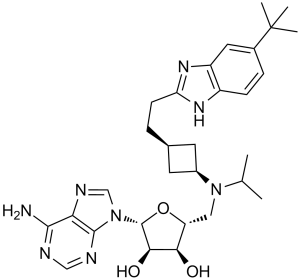
C30H42N8O3
|
|
|---|---|---|
| 分子量 |
562.71
|
|
| 精确质量 |
562.338
|
|
| CAS号 |
1380288-87-8
|
|
| 相关CAS号 |
|
|
| PubChem CID |
57345410
|
|
| 外观&性状 |
White to light yellow solid powder
|
|
| 密度 |
1.5±0.1 g/cm3
|
|
| 沸点 |
835.3±75.0 °C at 760 mmHg
|
|
| 闪点 |
459.0±37.1 °C
|
|
| 蒸汽压 |
0.0±3.2 mmHg at 25°C
|
|
| 折射率 |
1.722
|
|
| LogP |
4.8
|
|
| tPSA |
151.23
|
|
| 氢键供体(HBD)数目 |
4
|
|
| 氢键受体(HBA)数目 |
9
|
|
| 可旋转键数目(RBC) |
9
|
|
| 重原子数目 |
41
|
|
| 分子复杂度/Complexity |
884
|
|
| 定义原子立体中心数目 |
4
|
|
| SMILES |
CC(C)N(C[C@@H]1[C@H]([C@H]([C@@H](O1)N2C=NC3=C(N=CN=C32)N)O)O)C4CC(C4)CCC5=NC6=C(N5)C=C(C=C6)C(C)(C)C
|
|
| InChi Key |
LXFOLMYKSYSZQS-LURJZOHASA-N
|
|
| InChi Code |
InChI=1S/C30H42N8O3/c1-16(2)37(13-22-25(39)26(40)29(41-22)38-15-34-24-27(31)32-14-33-28(24)38)19-10-17(11-19)6-9-23-35-20-8-7-18(30(3,4)5)12-21(20)36-23/h7-8,12,14-17,19,22,25-26,29,39-40H,6,9-11,13H2,1-5H3,(H,35,36)(H2,31,32,33)/t17-,19+,22-,25-,26-,29-/m1/s1
|
|
| 化学名 |
(2R,3R,4S,5R)-2-(6-amino-9H-purin-9-yl)-5-((((1r,3S)-3-(2-(5-(tert-butyl)-1H-benzo[d]imidazol-2-yl)ethyl)cyclobutyl)(isopropyl)amino)methyl)tetrahydrofuran-3,4-diol
|
|
| 别名 |
EPZ 5676; Pinometostat; EPZ-5676; EPZ5676
|
|
| HS Tariff Code |
2934.99.9001
|
|
| 存储方式 |
Powder -20°C 3 years 4°C 2 years In solvent -80°C 6 months -20°C 1 month |
|
| 运输条件 |
Room temperature (This product is stable at ambient temperature for a few days during ordinary shipping and time spent in Customs)
|
| 溶解度 (体外实验) |
|
|||
|---|---|---|---|---|
| 溶解度 (体内实验) |
配方 1 中的溶解度: ≥ 2.5 mg/mL (4.44 mM) (饱和度未知) in 10% DMSO + 40% PEG300 + 5% Tween80 + 45% Saline (这些助溶剂从左到右依次添加,逐一添加), 澄清溶液。
例如,若需制备1 mL的工作液,可将100 μL 25.0 mg/mL澄清DMSO储备液加入到400 μL PEG300中,混匀;然后向上述溶液中加入50 μL Tween-80,混匀;加入450 μL生理盐水定容至1 mL。 *生理盐水的制备:将 0.9 g 氯化钠溶解在 100 mL ddH₂O中,得到澄清溶液。 配方 2 中的溶解度: ≥ 2.5 mg/mL (4.44 mM) (饱和度未知) in 10% DMSO + 90% (20% SBE-β-CD in Saline) (这些助溶剂从左到右依次添加,逐一添加), 澄清溶液。 例如,若需制备1 mL的工作液,可将 100 μL 25.0 mg/mL澄清DMSO储备液加入900 μL 20% SBE-β-CD生理盐水溶液中,混匀。 *20% SBE-β-CD 生理盐水溶液的制备(4°C,1 周):将 2 g SBE-β-CD 溶解于 10 mL 生理盐水中,得到澄清溶液。 View More
配方 3 中的溶解度: ≥ 2.5 mg/mL (4.44 mM) (饱和度未知) in 10% DMSO + 90% Corn Oil (这些助溶剂从左到右依次添加,逐一添加), 澄清溶液。 配方 4 中的溶解度: ≥ 2.5 mg/mL (4.44 mM) (饱和度未知) in 10% EtOH + 40% PEG300 + 5% Tween80 + 45% Saline (这些助溶剂从左到右依次添加,逐一添加), 澄清溶液。 例如,若需制备1 mL的工作液,可将100 μL 25.0 mg/mL 澄清 EtOH 储备液加入400 μL PEG300 中,混匀;再向上述溶液中加入50 μL Tween-80,混匀;然后加入450 μL 生理盐水定容至1 mL。 *生理盐水的制备:将 0.9 g 氯化钠溶解在 100 mL ddH₂O中,得到澄清溶液。 配方 5 中的溶解度: ≥ 2.5 mg/mL (4.44 mM) (饱和度未知) in 10% EtOH + 90% (20% SBE-β-CD in Saline) (这些助溶剂从左到右依次添加,逐一添加), 澄清溶液。 例如,若需制备1 mL的工作液,可将100μL 25.0mg/mL澄清EtOH储备液加入到900μL 20%SBE-β-CD生理盐水中,混匀。 *20% SBE-β-CD 生理盐水溶液的制备(4°C,1 周):将 2 g SBE-β-CD 溶解于 10 mL 生理盐水中,得到澄清溶液。 配方 6 中的溶解度: ≥ 2.5 mg/mL (4.44 mM) (饱和度未知) in 10% EtOH + 90% Corn Oil (这些助溶剂从左到右依次添加,逐一添加), 澄清溶液。 例如,若需制备1 mL的工作液,可将 100 μL 25.0 mg/mL 澄清乙醇储备液加入到 900 μL 玉米油中并混合均匀。 配方 7 中的溶解度: 2% DMSO+30% PEG 300+5% Tween 80+ddH2O:5mg/mL 1、请先配制澄清的储备液(如:用DMSO配置50 或 100 mg/mL母液(储备液)); 2、取适量母液,按从左到右的顺序依次添加助溶剂,澄清后再加入下一助溶剂。以 下列配方为例说明 (注意此配方只用于说明,并不一定代表此产品 的实际溶解配方): 10% DMSO → 40% PEG300 → 5% Tween-80 → 45% ddH2O (或 saline); 假设最终工作液的体积为 1 mL, 浓度为5 mg/mL: 取 100 μL 50 mg/mL 的澄清 DMSO 储备液加到 400 μL PEG300 中,混合均匀/澄清;向上述体系中加入50 μL Tween-80,混合均匀/澄清;然后继续加入450 μL ddH2O (或 saline)定容至 1 mL; 3、溶剂前显示的百分比是指该溶剂在最终溶液/工作液中的体积所占比例; 4、 如产品在配制过程中出现沉淀/析出,可通过加热(≤50℃)或超声的方式助溶; 5、为保证最佳实验结果,工作液请现配现用! 6、如不确定怎么将母液配置成体内动物实验的工作液,请查看说明书或联系我们; 7、 以上所有助溶剂都可在 Invivochem.cn网站购买。 |
| 制备储备液 | 1 mg | 5 mg | 10 mg | |
| 1 mM | 1.7771 mL | 8.8856 mL | 17.7711 mL | |
| 5 mM | 0.3554 mL | 1.7771 mL | 3.5542 mL | |
| 10 mM | 0.1777 mL | 0.8886 mL | 1.7771 mL |
1、根据实验需要选择合适的溶剂配制储备液 (母液):对于大多数产品,InvivoChem推荐用DMSO配置母液 (比如:5、10、20mM或者10、20、50 mg/mL浓度),个别水溶性高的产品可直接溶于水。产品在DMSO 、水或其他溶剂中的具体溶解度详见上”溶解度 (体外)”部分;
2、如果您找不到您想要的溶解度信息,或者很难将产品溶解在溶液中,请联系我们;
3、建议使用下列计算器进行相关计算(摩尔浓度计算器、稀释计算器、分子量计算器、重组计算器等);
4、母液配好之后,将其分装到常规用量,并储存在-20°C或-80°C,尽量减少反复冻融循环。
计算结果:
工作液浓度: mg/mL;
DMSO母液配制方法: mg 药物溶于 μL DMSO溶液(母液浓度 mg/mL)。如该浓度超过该批次药物DMSO溶解度,请首先与我们联系。
体内配方配制方法:取 μL DMSO母液,加入 μL PEG300,混匀澄清后加入μL Tween 80,混匀澄清后加入 μL ddH2O,混匀澄清。
(1) 请确保溶液澄清之后,再加入下一种溶剂 (助溶剂) 。可利用涡旋、超声或水浴加热等方法助溶;
(2) 一定要按顺序加入溶剂 (助溶剂) 。
| NCT Number | Recruitment | interventions | Conditions | Sponsor/Collaborators | Start Date | Phases |
| NCT03701295 | Completed Has Results | Drug: Azacitidine Drug: Pinometostat |
Recurrent Acute Myeloid Leukemia Refractory Acute Myeloid Leukemia |
National Cancer Institute (NCI) | March 6, 2020 | Phase 1 Phase 2 |
| NCT03724084 | Terminated | Drug: Daunorubicin Hydrochloride Drug: Pinometostat |
Acute Myeloid Leukemia | National Cancer Institute (NCI) | January 25, 2019 | Phase 1 Phase 2 |
 |
|---|
InvivoChem的所有产品仅用于作科学研究,不面向患者销售
Copyright 2020 InvivoChem LLC | All Rights Reserved 粤ICP备20063088号-1


 NMR
NMR
 粤公网安备 44011102003439号
 463611831
