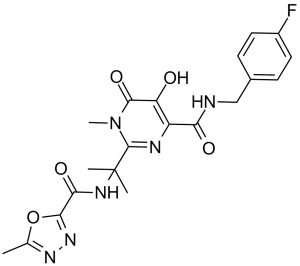
Raltegravir (MK-0518)

别名: MK-0518; MK0518; MK 0518; MK-0518; Raltegravir; trade name: Isentress 雷特格韦; N-(2-(4-(4-氟苄基氨基甲酰基)-5-羟基-1-甲基-6-氧代-1,6-二氢嘧啶-2-基)丙-2-基)-5-甲基-1,3,4-恶二唑-2-甲酰胺; 雷特格韦 雷特格韦;雷特格韦标准品;雷特拉韦;拉替拉韦; 拉替拉韦碱基;雷特格韦/拉替拉韦;雷特拉韦及其中间体; 雷特格韦/雷特格韦钾盐;雷特格韦(游离)
目录号: V1830 纯度: ≥98%
Raltegravir(以前也称为 MK-0518;商品名:Isentress)是一种新型、有效的整合酶 (IN) 抑制剂,适用于 WT 和 S217Q PFV IN,在无细胞测定中 IC50 分别为 90 nM 和 40 nM。
Raltegravir (MK-0518) CAS号: 518048-05-0
产品类别: Reverse Transcriptase
产品仅用于科学研究,不针对患者销售
规格 价格 库存 数量
25mg
50mg
100mg
250mg
500mg
1g
Other Sizes

Other Forms of Raltegravir (MK-0518):

  • 雷特格韦钾盐
  • 雷特格韦钠
  • Raltegravir-d4
点击了解更多
InvivoChem产品被CNS等顶刊论文引用
纯度/质量控制文件

纯度: ≥98%

产品描述
Raltegravir(以前也称为 MK-0518;商品名:Isentress)是一种新型、有效的整合酶 (IN) 抑制剂,适用于 WT 和 S217Q PFV IN,在无细胞测定中 IC50 分别为 90 nM 和 40 nM。拉替拉韦是一种用于治疗艾滋病毒感染的抗逆转录病毒药物。 Raltegravir 与整合酶结合并抑制整合酶,整合酶是一种 HIV 酶,可将病毒遗传物质插入受感染人体细胞的遗传物质中。抑制整合酶可防止 HIV DNA 插入人类 DNA 基因组,从而阻止 HIV 复制。它是第一个获得 FDA 批准用于 HIV 治疗的整合酶抑制剂。
生物活性&实验参考方法
靶点
Raltegravir (MK-0518) targets HIV-1 integrase (Ki = 0.53 nM for strand transfer reaction; IC50 = 3.8 nM for wild-type HIV-1 integrase) [1]
Raltegravir (MK-0518) inhibits HIV-1 replication in human PBMCs with an EC50 of 0.013 μM [3]
Raltegravir (MK-0518) exhibits activity against SIVmac251 integrase (EC50 = 0.015 μM in CEMx174 cells) [6]
体外研究 (In Vitro)
具有 S217H 改变的 PFV IN 的 IC50 为 900 nM,使其对拉替拉韦的敏感性降低十倍。 PFV IN 表现出 WT 10% 的活性,并被 Raltegravir 抑制,IC50 为 200 nM,表明 PFV IN 对 IN 链转移抑制剂 (INSTI) 的敏感性低于 WT IN。与 WT 酶类似,S217Q PFV IN 也对拉替拉韦敏感 [1]。拉替拉韦的代谢机制是葡萄糖醛酸化,而不是肝脏。拉替拉韦在人类 T 细胞培养物中的 95% 抑制浓度为 31±20 nM,在体外表现出强大的抗 HIV-1 作用。 Raltegravir 在 CEMx174 细胞中也表现出抗 HIV-2 活性,IC95 为 6 nM。葡萄糖醛酸化是拉替拉韦代谢的主要机制。不应使用强葡萄糖醛酸酶 UGT1A1 诱导剂,因为它们会大大降低拉替拉韦浓度。拉替拉韦仅轻微抑制肝细胞色素 P450 活性。拉替拉韦既不诱导 CYP3A4 依赖性睾酮 6-β-羟化酶活性,也不诱导 CYP3A4 RNA 表达 [2]。镁和钙已被证明可以降低拉替拉韦的细胞通透性[3]。拉替拉韦和相关的 HIV-1 整合酶 (IN) 链转移抑制剂 (INSTI) 可以有效防止病毒复制 [4]。 Latisavue 成功抑制了急性感染的人淋巴 CD4+ T 细胞系 MT-4 和 CEMx174 中的 SIVmac251 复制,表明 EC90 在低纳摩尔范围内 [5]。
拉替拉韦(Raltegravir, MK-0518) 强效抑制HIV-1整合酶介导的链转移反应,10 nM浓度下阻断病毒DNA整合到宿主基因组的抑制率达95% [1]
拉替拉韦(Raltegravir, MK-0518) 与富马酸替诺福韦二吡呋酯和恩曲他滨联合使用时,1 μM浓度下使小鼠神经前体细胞(NPCs)增殖减少30%,且无显著细胞毒性(CC50 > 50 μM)[2]
拉替拉韦(Raltegravir, MK-0518) 在pH < 6.0或缺乏Mg²+(IC50升高8倍)和Mn²+(IC50升高5倍)的体外环境中,抑制活性降低 [4]
拉替拉韦(Raltegravir, MK-0518) 抑制CEMx174细胞中SIVmac251的复制,0.015 μM浓度下达到50%抑制率 [6]
拉替拉韦(Raltegravir, MK-0518) 结合HIV-1整合酶催化核心结构域,稳定酶-DNA复合物,阻止链转移反应 [5]
体内研究 (In Vivo)
随着感染的进展,Ratetelevi 可改善感染 SIVmac251 的非人灵长类动物的病毒免疫状态。拉替拉韦单一疗法导致一种非人类灵长类动物的病毒载量检测不到[5]。
拉替拉韦(Raltegravir, MK-0518) 与富马酸替诺福韦二吡呋酯和恩曲他滨联合,以10 mg/kg/天的剂量口服给药孕鼠(妊娠第12天至出生后第7天),使出生后第8天小鼠脑室下区的神经前体细胞增殖减少25% [2]
拉替拉韦(Raltegravir, MK-0518) 以30 mg/kg/天的剂量口服给药SIVmac251感染的恒河猴21天后,病毒载量下降3.2 log10拷贝/mL,存活率较未治疗对照组提高40% [6]
拉替拉韦(Raltegravir, MK-0518) 以30 mg/kg/天剂量给药时,减少感染猕猴淋巴组织中SIVmac251储存库形成,前病毒DNA水平降低55% [6]
酶活实验
HIV-1整合酶链转移抑制实验:制备包含重组HIV-1整合酶催化核心、预处理病毒DNA底物和靶DNA的反应体系。加入系列稀释浓度的拉替拉韦(Raltegravir, MK-0518)(0.1–100 nM),在37°C下孵育60分钟。通过聚丙烯酰胺凝胶电泳分离反应产物,染色可视化DNA条带,定量链转移反应的抑制率 [1]
整合酶结合亲和力实验:将纯化的HIV-1整合酶固定在传感器芯片上。在25°C、Mg²+(10 mM)存在的条件下,注入系列浓度的拉替拉韦(Raltegravir, MK-0518)。通过表面等离子体共振(SPR)监测折射率变化,确定解离常数(Ki)[5]
细胞实验
HIV-1抗病毒细胞实验:在96孔板中以2×10⁵个细胞/孔接种人PBMCs,用HIV-1感染(MOI = 0.01)。加入浓度范围为0.001–1 μM的拉替拉韦(Raltegravir, MK-0518),孵育7天。通过ELISA测定病毒p24抗原水平计算EC50;MTT法评估细胞活力以确定CC50 [3]
神经前体细胞增殖实验:从胚胎小鼠大脑中分离神经前体细胞,在96孔板中以1×10⁴个细胞/孔接种。用拉替拉韦(Raltegravir, MK-0518)单独(0.1–5 μM)或与富马酸替诺福韦二吡呋酯(0.5 μM)和恩曲他滨(0.5 μM)联合处理48小时。加入BrdU标记增殖细胞,检测吸光度以定量增殖率 [2]
SIV抗病毒细胞实验:在96孔板中以3×10⁴个细胞/孔培养CEMx174细胞,用SIVmac251感染(MOI = 0.05)。用拉替拉韦(Raltegravir, MK-0518)(0.005–0.5 μM)处理5天。通过RT-PCR测定病毒载量,计算EC50 [6]
动物实验
Neural progenitor cell mouse assay: Pregnant C57BL/6 mice are administered Raltegravir (MK-0518) via oral gavage at 10 mg/kg/day from gestational day 12 to postnatal day 7, either alone or in combination with tenofovir disoproxil fumarate (10 mg/kg/day) and emtricitabine (10 mg/kg/day). The drug is formulated in 0.5% methylcellulose. At postnatal day 8, pups are euthanized, brains are harvested, and subventricular zone tissues are analyzed for BrdU-positive cells [2]
SIVmac251-infected macaque assay: Rhesus macaques are intravenously infected with SIVmac251 (1×10⁵ TCID50/kg). Two weeks post-infection, macaques receive Raltegravir (MK-0518) via oral gavage at 15 or 30 mg/kg/day for 21 days. Drug is dissolved in 0.9% saline. Blood samples are collected weekly to measure viral load by RT-PCR; lymphoid tissues are harvested at study end to quantify proviral DNA [6]
药代性质 (ADME/PK)
Absorption, Distribution and Excretion
Absorbed from the gastrointestinal tract.
Feces and urine
Approximately 83% bound to human plasma protein and is minimally distributed into red blood cells (blood-to-plasma partitioning ratio of 0.6).
The major mechanism of clearance of raltegravir in humans is glucuronidation mediated by UGT1A1, the renal clearance of unchanged drug is a minor pathway of elimination of raltegravir (9% of total dose).
Raltegravir (film-coated tablet) is absorbed with a Tmax of approximately 3 hours postdose in the fasted state. Raltegravir AUC and Cmax increase dose proportionally over the dose range 100 mg to 1600 mg. Raltegravir C12hr increases dose proportionally over the dose range of 100 to 800 mg and increases slightly less than dose proportionally over the dose range 100 mg to 1600 mg.
With twice-daily dosing, pharmacokinetic steady state is achieved within approximately the first 2 days of dosing. There is little to no accumulation in AUC and Cmax. The average accumulation ratio for C12hr ranged from approximately 1.2 to 1.6.
The absolute bioavailability of raltegravir has not been established. Based on a formulation comparison study in healthy adult volunteers, the chewable tablet has higher oral bioavailability compared to the 400 mg film-coated tablet.
In subjects who received 400 mg twice daily alone, raltegravir drug exposures were characterized by a geometric mean AUC0-12hr of 14.3 uM.hr and C12hr of 142 nM.
For more Absorption, Distribution and Excretion (Complete) data for Raltegravir (13 total), please visit the HSDB record page.
Metabolism / Metabolites
Hepatic (UGT1A1)
In feces, only raltegravir was present, most of which is likely derived from hydrolysis of raltegravir-glucuronide secreted in bile as observed in preclinical species. Two components, namely raltegravir and raltegravir-glucuronide, were detected in urine and accounted for approximately 9 and 23% of the dose, respectively. The major circulating entity was raltegravir and represented approximately 70% of the total radioactivity; the remaining radioactivity in plasma was accounted for by raltegravir-glucuronide.
Studies using isoform-selective chemical inhibitors and cDNA-expressed UDP-glucuronosyltransferases (UGT) show that UGT1A1 is the main enzyme responsible for the formation of raltegravir-glucuronide. Thus, the data indicate that the major mechanism of clearance of raltegravir in humans is UGT1A1-mediated glucuronidation.
Biological Half-Life
9 hours
The apparent terminal half-life of raltegravir is approximately 9 hours, with a shorter alpha-phase half-life (approximetly1 hour) accounting for much of the AUC.
Raltegravir (MK-0518) has an oral bioavailability of 31% in humans when administered with food [3]
Raltegravir (MK-0518) reaches peak plasma concentrations (Cmax) of 1.5 μg/mL at a Tmax of 1 h after oral administration of 400 mg with food [3]
The area under the plasma concentration-time curve (AUC0–24h) of Raltegravir (MK-0518) in humans is 3.3 μg·h/mL at 400 mg twice daily [3]
Raltegravir (MK-0518) has a volume of distribution (Vd) of 11.8 L in humans [3]
The plasma elimination half-life (t1/2) of Raltegravir (MK-0518) in humans is 9 hours [3]
Raltegravir (MK-0518) is metabolized primarily by uridine diphosphate glucuronosyltransferase (UGT1A1) in the liver [3]
Renal excretion accounts for < 7% of the administered dose of Raltegravir (MK-0518) in humans [3]
毒性/毒理 (Toxicokinetics/TK)
Hepatotoxicity
In large clinical trials, therapy with raltegravir was associated with alanine aminotransferase (ALT) elevations in up to 10% and elevations of greater than 5 times the upper limit of normal (ULN) in 3% to 4% of patients, but these rates were similar to those in comparator groups receiving matched background optimized antiretroviral therapy without raltegravir. These elevations were not associated with clinical symptoms and generally did not require dose modification. There have been no published reports of clinically apparent cases of liver injury attributed to raltegravir. Nevertheless, the product label for raltegravir mentions hepatitis and hepatic failure as a potential adverse reactions, but without specific details. Raltegravir has also been linked to instances of Stevens Johnson syndrome and drug hypersensitivity reactions, which can be accompanied by hepatic involvement. Finally, initiation of antiretroviral therapy with raltegravir can result in the immune reconstitution syndrome which may cause a worsening or flare of an accompanying chronic hepatitis B or C in coinfected individuals.
Likelihood score: E (unproven but suspected cause of clinically apparent liver injury).
Effects During Pregnancy and Lactation
◉ Summary of Use during Lactation
Limited information indicates that maternal doses of up to 1200 mg daily of raltegravir produce low levels in milk and would not be expected to cause any adverse effects in breastfed infants. Achieving and maintaining viral suppression with antiretroviral therapy decreases breastfeeding transmission risk to less than 1%, but not zero. Individuals with HIV who are on antiretroviral therapy with a sustained undetectable viral load and who choose to breastfeed should be supported in this decision. If a viral load is not suppressed, banked pasteurized donor milk or formula is recommended.
◉ Effects in Breastfed Infants
Relevant published information was not found as of the revision date.
◉ Effects on Lactation and Breastmilk
Relevant published information was not found as of the revision date.
Protein Binding
83%
Interactions
Pharmacokinetic interaction with omeprazole (substantially increased raltegravir peak plasma concentrations and area under the concentration-time curve (AUC)).
Pharmacokinetic interaction with rifabutin (increased raltegravir peak plasma concentrations and AUC).
Pharmacokinetic interaction with rifampin (decreased raltegravir plasma concentrations and AUC); rifampin is a strong inducer of UGT 1A1. If raltegravir is used in adults receiving rifampin, dosage of raltegravir film-coated tablets should be increased ... twice daily and patients monitored closely for virologic response.
Concomitant use of raltegravir and rifapentine is not recommended. HIV-infected tuberculosis patients treated with rifapentine have a higher rate of tuberculosis relapse than those treated with other rifamycin-based tuberculosis regimens; an alternative antimycobacterial agent is recommended in HIV-infected patients.
For more Interactions (Complete) data for Raltegravir (17 total), please visit the HSDB record page.
Raltegravir (MK-0518) shows low cytotoxicity in human PBMCs and CEMx174 cells, with CC50 values > 50 μM [3][6]
In humans, the most common adverse events of Raltegravir (MK-0518) (400 mg twice daily) are diarrhea (16%), nausea (13%), and headache (12%); grade 3–4 toxicities occur in < 3% of patients [3]
Raltegravir (MK-0518) has a plasma protein binding rate of 83% in humans [3]
Raltegravir (MK-0518) does not inhibit cytochrome P450 enzymes, resulting in minimal drug-drug interactions [3]
The oral LD50 of Raltegravir (MK-0518) in mice is > 2000 mg/kg [3]
参考文献

[1]. Molecular mechanisms of retroviral integrase inhibition and the evolution of viral resistance. Proc Natl Acad Sci U S A, 2010. 107(46): p. 20057-62.

[2]. Combined Medication of Antiretroviral Drugs Tenofovir Disoproxil Fumarate, Emtricitabine, and Raltegravir Reduces Neural Progenitor Cell Proliferation In Vivo and In Vitro. J Neuroimmune Pharmacol. 2017 Dec;12(4):682-692.

[3]. Raltegravir: the first HIV type 1 integrase inhibitor. Clin Infect Dis. 2009 Apr 1;48(7):931-9.

[4]. Divalent metals and pH alter raltegravir disposition in vitro. Antimicrob Agents Chemother. 2012 Jun;56(6):3020-6.

[5]. Structural and functional analyses of the second-generation integrase strand transfer inhibitor dolutegravir (S/GSK1349572). Mol Pharmacol. 2011 Oct;80(4):565-72.

[6]. Response of a simian immunodeficiency virus (SIVmac251) to raltegravir: a basis for a new treatment for simian AIDS and an animal model for studying lentiviral persistence during antiretroviral therapy. Retrovirology, 2010. 7: p. 21.

其他信息
Raltegravir is a pyrimidone that is pyrimidin-4(3H)-one in which the hydrogens at positions 2, 3, 5 and 6 are replaced by 2-[(5-methyl-1,3,4-oxadiazole-2-carbonyl)amino]propan-2-yl, methyl, hydroxy, and N-[(4-fluorophenyl)methyl]aminoacyl groups, respectively. It is an antiretroviral drug used for treatment of HIV infection. It has a role as an antiviral drug and a HIV-1 integrase inhibitor. It is a 1,2,4-oxadiazole, a dicarboxylic acid amide, a member of monofluorobenzenes, a pyrimidone, a hydroxypyrimidine and a secondary carboxamide.
Raltegravir is an antiretroviral drug produced by Merck & Co., used to treat HIV infection. It received approval by the U.S. Food and Drug Administration (FDA) on 12 October 2007, the first of a new class of HIV drugs, the integrase inhibitors, to receive such approval.
Raltegravir is a Human Immunodeficiency Virus Integrase Strand Transfer Inhibitor. The mechanism of action of raltegravir is as a HIV Integrase Inhibitor.
Raltegravir is an integrase inhibitor, the first of the class of antiviral agents active against the human immunodeficiency virus (HIV) that targets the viral integrase. Raltegravir is used in combination with other antiretroviral agents in the treatment of HIV infection. Raltegravir has not been linked convincingly to serum aminotransferase elevations during therapy or to episodes of acute, clinically apparent liver injury.
Raltegravir has been reported in Stachybotrys chartarum with data available.
Raltegravir is a small molecule with activity against human immunodeficiency virus (HIV). Raltegravir is an integrase inhibitor that blocks the integration of the viral genome into the host DNA, a critical step in the pathogenesis of HIV.
A pyrrolidinone derivative and HIV INTEGRASE INHIBITOR that is used in combination with other ANTI-HIV AGENTS for the treatment of HIV INFECTION.
See also: Raltegravir Potassium (has salt form).
Drug Indication
For the treatment of HIV-1 infection in conjunction with other antiretrovirals.
FDA Label
Isentress is indicated in combination with other anti-retroviral medicinal products for the treatment of human immunodeficiency virus (HIV 1) infection.
Treatment of human immunodeficiency virus (HIV-1) infection
Mechanism of Action
Raltegravir inhibits HIV integrase to prevent the viral genome being incorporated into the human genome. Raltegravir is primarily metabolized by glucuronidation.
Raltegravir inhibits the catalytic activity of HIV-1 integrase, an HIV-1 encoded enzyme that is required for viral replication. Inhibition of integrase prevents the covalent insertion, or integration, of unintegrated linear HIV-1 DNA into the host cell genome preventing the formation of the HIV-1 provirus. The provirus is required to direct the production of progeny virus, so inhibiting integration prevents propagation of the viral infection. Raltegravir did not significantly inhibit human phosphoryltransferases including DNA polymerases alpha, beta, and gamma.
Therapeutic Uses
Pyrrolidinones
ISENTRESS (raltegravir) is indicated in combination with other antiretroviral agents for the treatment of human immunodeficiency virus (HIV-1) infection. /Included in US product label/
ISENTRESS (raltegravir) is indicated in combination with other antiretroviral agents for the treatment of HIV-1 infection in children and adolescents 2 years of age and older and weighing at least 10 kg. /Included in US product label/
/EXPERIMENTAL THER/ /Investigators/ describe five patients with HIV-2 infection (four antiretroviral-experienced and one antiretroviral-naive) treated with a regimen containing raltegravir. All responded to treatment as demonstrated by viral load and CD4(+) T-cell count monitoring. /This/ series confirms the clinical effectiveness of raltegravir in HIV-2-infected patients when given with other antiretrovirals to which the virus is susceptible.
/EXPERIMENTALTHER VET/ Feline leukemia virus (FeLV) is a gammaretrovirus that is a significant cause of neoplastic-related disorders affecting cats worldwide. Treatment options for FeLV are limited, associated with serious side effects, and can be cost-prohibitive. The development of drugs used to treat a related retrovirus, human immunodeficiency virus type 1 (HIV-1), has been rapid, leading to the approval of five drug classes. Although structural differences affect the susceptibility of gammaretroviruses to anti-HIV drugs, the similarities in mechanism of replication suggest that some anti-HIV-1 drugs may also inhibit FeLV. This study demonstrates the anti-FeLV activity of four drugs approved by the US FDA (Food and Drug Administration) at non-toxic concentrations. Of these, tenofovir and raltegravir are anti-HIV-1 drugs, while decitabine and gemcitabine are approved to treat myelodysplastic syndromes and pancreatic cancer, respectively, but also have anti-HIV-1 activity in cell culture. Our results indicate that these drugs may be useful for FeLV treatment and should be investigated for mechanism of action and suitability for veterinary use.
Drug Warnings
Severe, potentially life-threatening skin reactions have been reported, including some fatalities. Stevens-Johnson syndrome, toxic epidermal necrolysis, and hypersensitivity reactions characterized by rash, constitutional findings, and organ dysfunction (including hepatic failure) have occurred.
Raltegravir and any other suspect agents should be discontinued immediately if signs or symptoms of severe skin or hypersensitivity reactions occur, including (but not limited to) severe rash or rash accompanied by fever, general malaise, fatigue, muscle or joint aches, blisters, oral lesions, conjunctivitis, facial edema, hepatitis, eosinophilia, or angioedema. Clinical status, including liver aminotransferases, should be monitored and appropriate therapy initiated. A life-threatening reaction could occur if there is a delay in discontinuing raltegravir or other suspect agents after the onset of severe rash.
During initial treatment, patients who respond to antiretroviral therapy may develop an inflammatory response to indolent or residual opportunistic infections (e.g., Mycobacterium avium, M. tuberculosis, cytomegalovirus (CMV), Pneumocystis jiroveci (formerly P. carinii), varicella-zoster virus (VZV)); this may necessitate further evaluation and treatment. Autoimmune disorders (e.g., Graves' disease, polymyositis, Guillain-Barre syndrome) have been reported to occur in the setting of immune reconstitution; the time to onset is more variable and can occur many months after initiation of antiretroviral therapy.
Individuals with phenylketonuria (i.e., homozygous genetic deficiency of phenylalanine hydroxylase) and other individuals who must restrict their intake of phenylalanine should be advised that raltegravir chewable tablets contain aspartame (NutraSweet), which is metabolized in the GI tract to phenylalanine. Each 25-mg chewable tablet provides approximately 0.05 mg of phenylalanine and each 100-mg chewable tablet provides approximately 0.1 mg of phenylalanine.
For more Drug Warnings (Complete) data for Raltegravir (12 total), please visit the HSDB record page.
Raltegravir (MK-0518) is the first approved HIV-1 integrase strand transfer inhibitor (INSTI) for the treatment of HIV-1 infection [3]
Raltegravir (MK-0518) exerts its antiviral effect by binding to the HIV-1 integrase catalytic core, blocking the strand transfer step of viral DNA integration into the host cell genome [1]
Raltegravir (MK-0518) is indicated for the treatment of HIV-1 infection in adults and children aged ≥ 2 years, both as initial therapy and in treatment-experienced patients with resistance to other antiretroviral classes [3]
Raltegravir (MK-0518) demonstrates efficacy in simian AIDS models, providing a basis for studying lentiviral persistence during antiretroviral therapy [6]
Raltegravir (MK-0518) was approved by the FDA in 2007 [3]
*注: 文献方法仅供参考, InvivoChem并未独立验证这些方法的准确性
化学信息 & 存储运输条件
分子式
C20H21FN6O5
分子量
444.42
精确质量
444.155
CAS号
518048-05-0
相关CAS号
Raltegravir potassium;871038-72-1;Raltegravir sodium;1292804-07-9;Raltegravir-d4;2712343-38-7
PubChem CID
54671008
外观&性状
White to off-white solid powder
密度
1.5±0.1 g/cm3
折射率
1.651
LogP
-0.68
tPSA
152.24
氢键供体(HBD)数目
3
氢键受体(HBA)数目
9
可旋转键数目(RBC)
6
重原子数目
32
分子复杂度/Complexity
836
定义原子立体中心数目
0
InChi Key
CZFFBEXEKNGXKS-UHFFFAOYSA-N
InChi Code
InChI=1S/C20H21FN6O5/c1-10-25-26-17(32-10)16(30)24-20(2,3)19-23-13(14(28)18(31)27(19)4)15(29)22-9-11-5-7-12(21)8-6-11/h5-8,28H,9H2,1-4H3,(H,22,29)(H,24,30)
化学名
N-[2-[4-[(4-fluorophenyl)methylcarbamoyl]-5-hydroxy-1-methyl-6-oxopyrimidin-2-yl]propan-2-yl]-5-methyl-1,3,4-oxadiazole-2-carboxamide
别名
MK-0518; MK0518; MK 0518; MK-0518; Raltegravir; trade name: Isentress
HS Tariff Code
2934.99.9001
存储方式

Powder      -20°C    3 years

                     4°C     2 years

In solvent   -80°C    6 months

                  -20°C    1 month

注意: 本产品在运输和储存过程中需避光。
运输条件
Room temperature (This product is stable at ambient temperature for a few days during ordinary shipping and time spent in Customs)
溶解度数据
溶解度 (体外实验)
DMSO: 88 mg/mL (198.0 mM)
Water:<1 mg/mL
Ethanol:<1 mg/mL
溶解度 (体内实验)
配方 1 中的溶解度: ≥ 2.5 mg/mL (5.63 mM) (饱和度未知) in 10% DMSO + 40% PEG300 + 5% Tween80 + 45% Saline (这些助溶剂从左到右依次添加,逐一添加), 澄清溶液。
例如,若需制备1 mL的工作液,可将100 μL 25.0 mg/mL澄清DMSO储备液加入到400 μL PEG300中,混匀;然后向上述溶液中加入50 μL Tween-80,混匀;加入450 μL生理盐水定容至1 mL。
*生理盐水的制备:将 0.9 g 氯化钠溶解在 100 mL ddH₂O中,得到澄清溶液。

配方 2 中的溶解度: ≥ 2.5 mg/mL (5.63 mM) (饱和度未知) in 10% DMSO + 90% (20% SBE-β-CD in Saline) (这些助溶剂从左到右依次添加,逐一添加), 澄清溶液。
例如,若需制备1 mL的工作液,可将 100 μL 25.0 mg/mL澄清DMSO储备液加入900 μL 20% SBE-β-CD生理盐水溶液中,混匀。
*20% SBE-β-CD 生理盐水溶液的制备(4°C,1 周):将 2 g SBE-β-CD 溶解于 10 mL 生理盐水中,得到澄清溶液。

View More

配方 3 中的溶解度: ≥ 2.5 mg/mL (5.63 mM) (饱和度未知) in 10% DMSO + 90% Corn Oil (这些助溶剂从左到右依次添加,逐一添加), 澄清溶液。
例如,若需制备1 mL的工作液,可将 100 μL 25.0 mg/mL 澄清 DMSO 储备液添加到 900 μL 玉米油中并混合均匀。


配方 4 中的溶解度: 30% PEG400+0.5% Tween80+5% Propylene glycol : 30 mg/mL

请根据您的实验动物和给药方式选择适当的溶解配方/方案:
1、请先配制澄清的储备液(如:用DMSO配置50 或 100 mg/mL母液(储备液));
2、取适量母液,按从左到右的顺序依次添加助溶剂,澄清后再加入下一助溶剂。以 下列配方为例说明 (注意此配方只用于说明,并不一定代表此产品 的实际溶解配方):
10% DMSO → 40% PEG300 → 5% Tween-80 → 45% ddH2O (或 saline);
假设最终工作液的体积为 1 mL, 浓度为5 mg/mL: 取 100 μL 50 mg/mL 的澄清 DMSO 储备液加到 400 μL PEG300 中,混合均匀/澄清;向上述体系中加入50 μL Tween-80,混合均匀/澄清;然后继续加入450 μL ddH2O (或 saline)定容至 1 mL;

3、溶剂前显示的百分比是指该溶剂在最终溶液/工作液中的体积所占比例;
4、 如产品在配制过程中出现沉淀/析出,可通过加热(≤50℃)或超声的方式助溶;
5、为保证最佳实验结果,工作液请现配现用!
6、如不确定怎么将母液配置成体内动物实验的工作液,请查看说明书或联系我们;
7、 以上所有助溶剂都可在 Invivochem.cn网站购买。
制备储备液 1 mg 5 mg 10 mg
1 mM 2.2501 mL 11.2506 mL 22.5012 mL
5 mM 0.4500 mL 2.2501 mL 4.5002 mL
10 mM 0.2250 mL 1.1251 mL 2.2501 mL

1、根据实验需要选择合适的溶剂配制储备液 (母液):对于大多数产品,InvivoChem推荐用DMSO配置母液 (比如:5、10、20mM或者10、20、50 mg/mL浓度),个别水溶性高的产品可直接溶于水。产品在DMSO 、水或其他溶剂中的具体溶解度详见上”溶解度 (体外)”部分;

2、如果您找不到您想要的溶解度信息,或者很难将产品溶解在溶液中,请联系我们;

3、建议使用下列计算器进行相关计算(摩尔浓度计算器、稀释计算器、分子量计算器、重组计算器等);

4、母液配好之后,将其分装到常规用量,并储存在-20°C或-80°C,尽量减少反复冻融循环。

计算器

摩尔浓度计算器可计算特定溶液所需的质量、体积/浓度,具体如下:

  • 计算制备已知体积和浓度的溶液所需的化合物的质量
  • 计算将已知质量的化合物溶解到所需浓度所需的溶液体积
  • 计算特定体积中已知质量的化合物产生的溶液的浓度
使用摩尔浓度计算器计算摩尔浓度的示例如下所示:
假如化合物的分子量为350.26 g/mol,在5mL DMSO中制备10mM储备液所需的化合物的质量是多少?
  • 在分子量(MW)框中输入350.26
  • 在“浓度”框中输入10,然后选择正确的单位(mM)
  • 在“体积”框中输入5,然后选择正确的单位(mL)
  • 单击“计算”按钮
  • 答案17.513 mg出现在“质量”框中。以类似的方式,您可以计算体积和浓度。

稀释计算器可计算如何稀释已知浓度的储备液。例如,可以输入C1、C2和V2来计算V1,具体如下:

制备25毫升25μM溶液需要多少体积的10 mM储备溶液?
使用方程式C1V1=C2V2,其中C1=10mM,C2=25μM,V2=25 ml,V1未知:
  • 在C1框中输入10,然后选择正确的单位(mM)
  • 在C2框中输入25,然后选择正确的单位(μM)
  • 在V2框中输入25,然后选择正确的单位(mL)
  • 单击“计算”按钮
  • 答案62.5μL(0.1 ml)出现在V1框中
g/mol

分子量计算器可计算化合物的分子量 (摩尔质量)和元素组成,具体如下:

注:化学分子式大小写敏感:C12H18N3O4  c12h18n3o4
计算化合物摩尔质量(分子量)的说明:
  • 要计算化合物的分子量 (摩尔质量),请输入化学/分子式,然后单击“计算”按钮。
分子质量、分子量、摩尔质量和摩尔量的定义:
  • 分子质量(或分子量)是一种物质的一个分子的质量,用统一的原子质量单位(u)表示。(1u等于碳-12中一个原子质量的1/12)
  • 摩尔质量(摩尔重量)是一摩尔物质的质量,以g/mol表示。
/

配液计算器可计算将特定质量的产品配成特定浓度所需的溶剂体积 (配液体积)

  • 输入试剂的质量、所需的配液浓度以及正确的单位
  • 单击“计算”按钮
  • 答案显示在体积框中
动物体内实验配方计算器(澄清溶液)
第一步:请输入基本实验信息(考虑到实验过程中的损耗,建议多配一只动物的药量)
第二步:请输入动物体内配方组成(配方适用于不溶/难溶于水的化合物),不同的产品和批次配方组成不同,如对配方有疑问,可先联系我们提供正确的体内实验配方。此外,请注意这只是一个配方计算器,而不是特定产品的确切配方。
+
+
+

计算结果:

工作液浓度 mg/mL;

DMSO母液配制方法 mg 药物溶于 μL DMSO溶液(母液浓度 mg/mL)。如该浓度超过该批次药物DMSO溶解度,请首先与我们联系。

体内配方配制方法μL DMSO母液,加入 μL PEG300,混匀澄清后加入μL Tween 80,混匀澄清后加入 μL ddH2O,混匀澄清。

(1) 请确保溶液澄清之后,再加入下一种溶剂 (助溶剂) 。可利用涡旋、超声或水浴加热等方法助溶;
            (2) 一定要按顺序加入溶剂 (助溶剂) 。

临床试验信息
Antiretroviral Regimens Containing Raltegravir for Prophylaxis of Mother-to-child-transmission of HIV Infection
CTID: NCT01854762
Phase: Phase 2/Phase 3    Status: Terminated
Date: 2024-10-15
Very Early Intensive Treatment of Infants Living With HIV to Achieve HIV Remission
CTID: NCT02140255
Phase: Phase 1/Phase 2    Status: Recruiting
Date: 2024-08-09
Combination Antiretroviral Therapy (cART) for PBC
CTID: NCT03954327
Phase: Phase 2    Status: Completed
Date: 2024-02-16
Research In Viral Eradication of HIV Reservoirs
CTID: NCT02336074
Phase: Phase 2    Status: Completed
Date: 2023-10-23
Study on PhArmacokinetics of First liNe Antiretrovirals in Healthy Breastfeeding Volunteers
CTID: NCT05648201
Phase: Phase 4    Status: Recruiting
Date: 2023-04-10
View More

Raltegravir for HAM/TSP
CTID: NCT01867320
PhaseEarly Phase 1    Status: Completed
Date: 2023-03-30


Pregnancy and Neonatal Outcomes Following Antenatal Exposure to Raltegravir: a Pooled Analysis From the European Pregnancy and Paediatric Infections Cohort Collaboration (EPPICC)
CTID: NCT05751031
Phase:    Status: Recruiting
Date: 2023-03-02
Population Pharmacokinetics of Antiretroviral in Children
CTID: NCT03194165
Phase:    Status: Completed
Date: 2023-02-21
HIV Non Occupational Post-Exposure Prophylaxis (PEP)
CTID: NCT00594646
Phase: Phase 4    Status: Completed
Date: 2022-10-25
Pharmacokinetic Study of Antiretroviral Drugs and Related Drugs During and After Pregnancy
CTID: NCT00042289
Phase:    Status: Completed
Date: 2022-07-22
A Study of GSK1349572 Versus Raltegravir (RAL) With Investigator Selected Background Regimen in Antiretroviral-Experienced, Integrase Inhibitor-Naive Adults
CTID: NCT01231516
Phase: Phase 3    Status: Completed
Date: 2022-03-15
Evaluating the Safety and Pharmacokinetics of Raltegravir in Infants
CTID: NCT01828073
Phase:    Status: Completed
Date: 2021-11-08
Safety and Pharmacokinetics of Raltegravir in HIV-1-Exposed Newborn Infants at Risk of Acquiring HIV-1 Infection
CTID: NCT01780831
Phase: Phase 1    Status: Completed
Date: 2021-11-05
Safety, Tolerance and Pharmacokinetics of Raltegravir-Containing Antiretroviral Therapy in Infants, Children Infected With HIV and TB
CTID: NCT01751568
Phase: Phase 1/Phase 2    Status: Completed
Date: 2021-11-05
Optimizing Treatment for Treatment-Experienced, HIV-Infected People
CTID: NCT00537394
Phase: Phase 3    Status: Completed
Date: 2021-11-04
Effect of Addition of Raltegravir (MK-0518) to PI- or NNRTI-Based ART Regimens in HIV Infected Subjects With Undetectable Viral Load
CTID: NCT00515827
Phase: Phase 2    Status: Completed
Date: 2021-11-04
Study of Viral Load Decay Rates in HIV Infected Participants Starting Treatment With Raltegravir (RAL) and Emtricitabine/Tenofovir Disoproxil Fumarate (TDF)
CTID: NCT00660972
Phase: Phase 1    Status: Completed
Date: 2021-11-01
Effect on Liver Fat and Metabolic Parameters When Switching a Protease Inhibitor or Efavirenz to Raltegravir
CTID: NCT03374358
Phase: Phase 4    Status: Completed
Date: 2021-09-05
Hepatic Safety of Raltegravir Versus Efavirenz as HIV Therapy for Patients With HIV and HCV Coinfection
CTID: NCT01147107
Phase: Phase 4    Status: Completed
Date: 2021-08-13
Study of Options for Second-Line Effective Combination Therapy (SELECT)
CTID: NCT01352715
Phase: Phase 3    Status: Completed
Date: 2021-08-05
Time to Protection and Adherence Requirements of Raltegravir With or Without Lamivudine in Protection From HIV Infection
CTID: NCT03205566
Phase: Phase 4    Status: Completed
Date: 2021-03-16
Assess the Downregulation of HIV-1 When Raltegravir is Added to a Virologically Suppressed HAART Regimen
CTID: NCT00738569
Phase: N/A    Status: Completed
Date: 2021-01-19
Pharmacokinetic Study of the HCV Protease Inhibitor Boceprevir and the HIV Integrase Inhibitor Raltegravir
CTID: NCT01288417
Phase: Phase 1    Status: Completed
Date: 2020-12-01
The Influence of GINkGo Biloba on the Pharmacokinetics of the UGT Substrate raltEgraviR (GINGER)
CTID: NCT01246804
Phase: Phase 1    Status: Completed
Date: 2020-11-30
Study of the Effect of Atorvastatin for Reducing Aging-related Complication in HIV-infected Patients Older Than 45 Years Receiving a Protease Inhibitor-based Regimen Versus a Raltegravir-based Regimen
CTID: NCT02577042
Phase: Phase 4    Status: Completed
Date: 2020-10-29
Pharmacokinetic Drug Interaction Study Between Raltegravir and Atorvastatin.
CTID: NCT01779687
Phase: Phase 1    Status: Completed
Date: 2020-10-20
Pharmacokinetic Drug-drug Interaction Study Between RaltEgravir and CITALopram in Healthy Subjects (RECITAL).
CTID: NCT01978782
Phase: Phase 1    Status: Completed
Date: 2020-10-19
The Influence of Raltegravir on Pravastatin Pharmacokinetics(GRAPPA)
CTID: NCT00665717
Phase: Phase 1    Status: Completed
Date: 2020-10-19
Pharmacokinetic Study on Raltegravir and Lamotrigine
CTID: NCT00618241
Phase: Phase 1    Status: Completed
Date: 2020-10-19
Raltegravir Intensification in HIV-infected Patients
CTID: NCT00631449
Phase: Phase 4    Status: Completed
Date: 2020-08-17
Clinical Trial to Evaluate the Effect of Raltegravir Intensification (1.200 mg QD) on the Gut Microbiota of Chronically HIV-1 Infected Subject Over Time: THE RAGTIME STUDY
CTID: NCT03029689
Phase: Phase 3    Status: Completed
Date: 2020-07-27
Raltegravir + Lopinavir/Ritonavir Versus Efavirenz + Tenofovir + Emtricitabine in Treatment Naive Patients
CTID: NCT00752856
Phase: Phase 2    Status: Completed
Date: 2020-07-22
Pharmacokinetics of Low Dose Raltegravir
CTID: NCT01159132
Phase: Phase 2    Status: Completed
Date: 2020-07-17
Efficacy of Treatment Intensification With Maraviroc on HIV-1 Viral Latency in Recently Infected Hiv-1 naïve Patients Starting Raltegravir Plus Tenofovir/Emtricitabine
CTID: NCT00808002
Phase: Phase 3    Status: Completed
Date: 2020-01-31
Evaluating the Response to Two Antiretroviral Medication Regimens in HIV-Infected Pregnant Women, Who Begin Antiretroviral Therapy Between 20 and 36 Weeks of Pregnancy, for the Prevention of Mother-to-Child Transmission
CTID: NCT01618305
Phase: Phase 4    Status: Completed
Date: 2020-01-30
Pilot Study to Compare the Pharmacokinetics Parameters in Plasma and Intracellular of Raltegravir Administered Once a Day in Adult Patients Infected With HIV
CTID: NCT00995241
Phase: Phase 4    Status: Completed
Date: 2019-12-05
The Safety, Pharmacokinetic Profile and Efficacy of Raltegravir in HIV-infected Patients at Least 60 Years of Age
CTID: NCT01335620
Phase: Phase 4    Status: Completed
Date: 2019-11-20
Raltegravir Cerebrospinal Fluid Pharmacodynamic Study in HIV-Infected Individuals
CTID: NCT01293123
Phase: N/A    Status: Terminated
Date: 2019-10-31
The Raltegravir and Ribavirin Pharmacokinetics (PK) Study
CTID: NCT00982553
Phase: Phase 1    Status: Completed
Date: 2019-10-11
Safety, Tolerability, and Pharmacokinetics of Raltegravir (MK-0518) in Healthy Japanese Male Participants (MK-0518-851)
CTID: NCT03667547
Phase: Phase 4    Status: Completed
Date: 2019-10-02
Dual Therapy With Raltegravir and Darunavir/Ritonavir in HIV Infected Patients.
CTID: NCT01258374
Phase:    Status: Completed
Date: 2019-09-27
Bone and Body Comp: A Sub Study of the SECOND-LINE Study
CTID: NCT01513122
Phase: Phase 4    Status: Completed
Date: 2019-09-04
A Trial of 2 Options for Second Line Combination Antiretroviral Therapy Following Virological Failure of a Standard Non-nucleoside Reverse Transcriptase Inhibitor (NNRTI)+2N(t)RTI First Line Regimen
CTID: NCT00931463
Phase: Phase 4    Status: Completed
Date: 2019-09-04
Effects of Losartan and Antiretroviral Regimen Containing Raltegravir in Fibrosis Inflammation Mediators, Cardiovascular Risk and Neurocognitive Disorders in HIV Infected Patients Previously Effectively Treated
CTID: NCT01529749
Phase: Phase 4    Status: Completed
Date: 2019-08-02
First-Line Treatment for HIV-2
CTID: NCT02150993
Phase: Phase 2/Phase 3    Status: Completed
Date: 2019-07-22
A Prospective, Open-label Trial of Two ABC/3TC Based Regimens in Late Presenter naïve Patients (CD4 <200 Cells/µL)
CTID: NCT01900106
Phase: Phase 3    Status: Completed
Date: 2019-04-23
Evaluation of Renal Function, Efficacy, and Safety When Switching From Tenofovir/Emtricitabine Plus a Protease Inhibitor/Ritonavir, to a Combination of Raltegravir (MK-0518) Plus Nevirapine Plus Lamivudine in HIV-1 Participants With Suppressed Viremia and Impaired Renal Function (MK-0518-284)
CTID: NCT02116660
Phase: Phase 2    Status: Terminated
Date: 2019-04-08
A5288/MULTI-OCTAVE: Management Using Latest Technologies to Optimize Combination Therapy After Viral Failure
CTID: NCT01641367
Phase: Phase 4    Status: Completed
Date: 2019-03-15
Compare the Efficacy and Safety of Raltegravir Versus Efavirenz Combination Therapy in Treatment-naïve HIV-1 Patients
CTID: NCT01989910
Phase: Phase 4    Status: Completed
Date: 2019-02-25
A Drug Interaction Study to Assess the Pharmacokinetics of Narlaprevir and Antiretroviral Drugs
CTID: NCT03537404
Phase: Phase 1    Status: Completed
Date: 2019-02-19
Neuropsyquiatric Evolution After Introduction of Raltegravir QD in Substitution of Dolutegravir: NEAR QD Study
CTID: NCT03732625
Phase: Phase 4    Status: Unknown status
Date: 2019-02-15
Evaluation of the Safety and Efficacy of Reformulated Raltegravir (MK-0518) 1200 mg Once Daily in Combination With TRUVADA™ in Human Immunodeficiency Virus (HIV)-1 Infected, Treatment-Naive Participants (MK-0518-292)
CTID: NCT02131233
Phase: Phase 3    Status: Completed
Date: 2019-01-30
Effects of Raltegravir Based Regimen on Platelet Reactivity, Platelet-monocyte Aggregation and Immune Activation
CTID: NCT02383355
Phase: Phase 4    Status: Completed
Date: 2019-01-10
Raltegravir Versus Efavirenz in Naive HIV-1-infected Patients Receiving Rifampin for Active Tuberculosis
CTID: NCT02273765
Phase: Phase 3    Status: Completed
Date: 2018-12-31
Comparison of Virologic and Immunologic Responses to Raltegravir and Dolutegravir in the Gastrointestinal Tract of HIV-Positive Adults
CTID: NCT02218320
Phase:    Status: Completed
Date: 2018-12-26
Effect of Raltegravir on Endothelial Function in HIV-Infected Patients
CTID: NCT00843713
Phase: Phase 4    Status: Completed
Date: 2018-12-12
HIV Attachment Inhibitor to Treat Human Immunodeficiency Virus 1 (HIV-1) Infections
CTID: NCT01384734
Phase: Phase 2    Status: Completed
Date: 2018-11-14
Safety and Effectiveness of Raltegravir Plus Darunavir/Ritonavir in Treatment-Naive HIV-Infected Adults
CTID: NCT00830804
Phase: Phase 2    Status: Completed
Date: 2018-11-08
A Trial Comparing GSK1349572 50mg Once Daily to Raltegravir 400mg Twice Daily
CTID: NCT01227824
Phase: Phase 3    Status: Completed
Date: 2018-10-09
Study in Healthy Volunteers to Investigate the Safety, Tolerability and Pharmacokinetics of VM-1500
CTID: NCT02489487
Phase: Phase 1    Status: Completed
Date: 2018-10-04
Raltegravir vs. Lopinavir/Ritonavir, Both in Combination With Truvada, in HIV+ Treatment Naive Individuals
CTID: NCT00632970
Phase: Phase 4    Status: Terminated
Date: 2018-08-29
The Effect of Antacids on the Pharmacokinetics (PK) of Raltegravir in Human Immunodeficiency Virus (HIV)-Infected Participants (MK-0518-824)
CTID: NCT02473367
Phase: Phase 1    Status: Completed
Date: 2018-08-27
A Pharmacokinetic Study to Evaluate the Effect of MAALOX on Raltegravir (MK-0518) in Human Immunodeficiency Virus (HIV)-Infected Participants (MK-0518-295)
CTID: NCT01930045
Phase: Phase 1    Status: Completed
Date: 2018-08-24
A Study of the Safety, Tolerability, and Antiretroviral Activity of Raltegravir (MK-0518) in Combination With Other Antiretroviral Therapies in Russian Children and Adolescents Infected With Human Immunodeficiency Virus (HIV-1) (MK-0518-248)
CTID: NCT01717287
Phase: Phase 2    Status: Completed
Date: 2018-08-21
Evaluating the Effect of CHanging EnfuvirtidE to Raltegravir in HIV Infected Subjects
CTID: NCT00529243
Phase: Phase 3    Status: Completed
Date: 2018-08-07
Study With Dual Therapy Including Lamivudine (300 mg QD) Plus Raltegravir (1200 mg QD) in Virologically Suppressed HIV-1 Infected Patients Experiencing Inconvenience, Toxicity, Negative Impact on Co-morbidities or Risk of Drug-drug Interactions With Their Current Regimen
CTID: NCT03333083
Phase: Phase 3    Status: Unknown status
Date: 2018-07-31
Simplification Study of HIV-1 Infected Patients With Virological Suppression Under the Combination of Lamivudine (150 mg BID) Plus Raltegravir (400 mg BID) Switching to Lamivudine (300 mg QD) Plus Raltegravir (1200 mg QD) : Roll-over Study of the RALAM
CTID: NCT03311945
Phase: Phase 3    Status: Unknown status
Date: 2018-07-31
Raltegravir in the Swiss HIV Cohort Study
CTID: NCT00904644
Phase:    Status: Completed
Date: 2018-06-06
A Key Link for Transmission Prevention
CTID: NCT01450189
Phase: N/A    Status: Completed
Date: 2018-04-19
Rifampin-Based Tuberculosis Treatment Versus Rifabutin-Based Tuberculosis Treatment in Persons With HIV
CTID: NCT01601626
Phase: Phase 2    Status: Terminated
Date: 2018-02-13
Trial to Assess Effect of Raltegravir on HTLV-1 Proviral Load
CTID: NCT01620736
Phase: Phase 2    Status: Withdrawn
Date: 2018-01-24
Characterization of Acute and Recent HIV-1 Infections in Zurich: a Long-term Observational Study
CTID: NCT00537966
Phase: N/A    Status: Recruiting
Date: 2017-11-08
A Drug Interaction Study Evaluating GSK2248761 and Raltegravir Pharmacokinetics in Healthy Adult Subjects
CTID: NCT01101893
Phase: Phase 1    Status: Completed
Date: 2017-09-11
Measurement of Plasma and Intracellular Concentrations of Raltegravir
CTID: NCT01214486
Phase: N/A    Status: Completed
Date: 2017-08-21
Advanced Neuroimaging Evaluation of CNS Changes Associated With Efavirenz Therapy Switch to an Raltegravir-based Regimen
CTID: NCT01978743
Phase: N/A    Status: Completed
Date: 2017-07-26
Changes in Liver Steatosis After Switching to Raltegravir in HIV/HCV Coinfection
CTID: NCT01900015
Phase: Phase 4    Status: Completed
Date: 2017-07-25
BRAVO: Background Regimen of Raltegravir on Virologic Outcome
CTID: NCT00751530
Phase:    Status: Completed
Date: 2017-07-02
Effect of Antacids on the Pharmacokinetics of Raltegravir
CTID: NCT00944307
Phase: Phase 1    Status: Completed
Date: 2017-06-28
Raltegravir (Isentress) Pilot Study in Relapsing Multiple Sclerosis
CTID: NCT01767701
Phase: Phase 2    Status: Completed
Date: 2017-05-30
Pilot Project of Virologic and Immunologic Correlates of GALT Immune Reconstitution Following Raltegravir Therapy
CTID: NCT00661960
Phase: N/A    Status: Completed
Date: 2017-05-30
A Retrospective Analysis of Raltegravir Use in Minority HIV Infected Women in Houston, Texas
CTID: NCT02302950
Phase:    Status: Unknown status
Date: 2017-05-22
EPOCH Chemotherapy and Bortezomib for Associated T-Cell Leukemia Lymphoma
CTID: NCT01000285
Phase: Phase 1/Phase 2    Status: Completed
Date: 2017-03-28
A Pharmacokinetic Study to Evaluate the Effect of Antacids on Raltegravir (MK-0518) in HIV-Infected Participants (MK-0518-247)
CTID: NCT01622673
Phase: Phase 1    Status: Completed
Date: 2017-03-21
A Study to Evaluate the Safety and Antiretroviral Activity of MK-0518 Versus Efavirenz in Treatment Naive HIV-Infected Patients, Each in Combination With TRUVADA (0518-021 EXT)
CTID: NCT00369941
Phase: Phase 3    Status: Completed
Date: 2017-03-21
A Study to Evaluate the Effect of Famotidine and Omeprazole on MK0518 (Raltegravir) Pharmacokinetics in Human Immunodeficiency Virus (HIV)-Infected Patients (0518-054)
CTID: NCT01000818
Phase: Phase 1    Status: Completed
Date: 2017-03-21
MK0518 in the Treatment of HIV-Infected Patients Switched From a Protease Inhibitor Regimen (0518-032)(TERMINATED)
CTID: NCT00443703
Phase: Phase 3    Status: Terminated
Date: 2017-03-21
Raltegravir as Early Therapy in African-Americans Living With HIV Study
CTID: NCT00667433
Phase: Phase 1    Status: Completed
Date: 2017-03-03
Safety Study of Isentress® + Truvada® in Post-exposure Treatment of HIV Infection
CTID: NCT01114425
Phase: Phase 3    Status: Completed
Date: 2017-02-23
Third Line Antiretroviral Treatment Optimization in Sub-Saharan Africa
CTID: NCT02025868
Phase: Phase 2    Status: Unknown status
Date: 2017-02-17
Pilot Study of Adding Raltegravir (MK-0518) to Antiretroviral Therapy in Patients With Low Level Viremia
CTID: NCT00618371
Phase: N/A    Status: Completed
Date: 2017-02-01
RAL+ATV/r in Comparison With TDF/FTC (or 3TC) +ATV/r in HIV Infected Patients
CTID: NCT01829802
Phase: Phase 4    Status: Unknown status
Date: 2017-01-24
Addition of Raltegravir to Established Antiretroviral Suppressive Therapy
CTID: NCT01245101
Phase: Phase 4    Status: Terminated
Date: 2016-12-23
Interferon Alfa Sensitivity in HIV/HCV Persons Before and After HIV Meds
CTID: NCT01285050
Phase: Phase 4    Status: Completed
Date: 2016-11-29
A Study of Drug-Drug Interaction Between Danoprevir/Low-Dose Ritonavir and Raltegravir in Healthy Volunteers
CTID: NCT01531647
Phase: Phase 1    Status: Completed
Date: 2016-11-02
Raltegravir Switch Study to Reduce Liver Fibrosis Progression in HIV-Hepatitis C Co-infection
CTID: NCT01231685
Phase: Phase 2    Status: Completed
Date: 2016-09-21
Changes in Lipids and Lipoproteins in HIV Infected Women After Switch From Protease Inhibitor to Raltegravir
CTID: NCT02097108
Phase: Phase 2    Status: Completed
Date: 2016-09-13
Renal Transplantation and Raltegravir in HIV-Infected Patients
CTID: NCT01453192
Phase: Phase 3    Status: Completed
Date: 2016-07-12
A Study of the Neurological Effects of Adding Raltegravir to HAART Regimen in Patients With HIV
CTID: NCT01448486
Phase: Phase 4    Status: Terminated
Date: 2016-06-27
Pilot Study of Raltegravir/Truvada Versus Efavirenz/Truvada for Adults With Acute IV-1 Infection
CTID: NCT00734344
Phase: N/A    Status: Completed
Date: 2016-05-30
Multicenter, Randomized, Double-Blind, Double-Dummy, Phase 3 Study of the Safety and Efficacy of Elvitegravir Versus Raltegravir
CTID: NCT00708162
Phase: Phase 3    Status: Completed
Date: 2016-05-30
A Study to Assess the Efficacy of Raltegravir (Isentress®), Administered in Combination With Other Antiretroviral Drugs as Treatment for Adults and Older Adults Infected With the Human Immunodeficiency Virus 1 (HIV-1)(MK-0518-145) (Wirksamkeit Von Isentress® Unter Praxisbedingungen)
CTID: NCT01213316
Phase:    Status: Completed
Date: 2016-05-23
Early Access of MK0518 in Combination With an Optimized Background Antiretroviral Therapy (0518-023)
CTID: NCT00377065
Phase:    Status: Approved for marketing
Date: 2016-04-22
Reduction of EArly mortaLITY in HIV-infected Adults and Children Starting Antiretroviral Therapy
CTID: NCT01825031
Phase: Phase 3    Status: Completed
Date: 2016-04-20
Effects of Intensive cART During Acute/Early HIV Infection
CTID: NCT01154673
Phase: Phase 2/Phase 3    Status: Completed
Date: 2016-04-05
The Effect of Antacids and Multivitamins on Raltegravir
CTID: NCT01784302
Phase: Phase 1    Status: Completed
Date: 2016-02-25
Truvada Plus Raltegravir for Nonoccupational Post-exposure Prophylaxis (nPEP)
CTID: NCT01214759
PhasePh
EFFICACY AND SAFETY OF A SIMPLIFICATION STRATEGY BASED ON DOLUTEGRAVIR AND DARUNAVIR / COBICISTAT VS OPTIMIZED TREATMENT IN SUPPRESSED HIV-1-INFECTED PATIENTS CARRYING ARCHIVED MULTIDRUG RESISTANCE MUTATIONS
CTID: null
Phase: Phase 4    Status: Ongoing
Date: 2018-09-04
A randomized, open, parallel design study to evaluate the effect on liver fat, adipose tissue and metabolic parameters when switching a protease inhibitor or efavirenz to once daily raltegravir in HIV-infected patients with body mass index over 25 kg/m2 and with at least one metabolic syndrome component.
CTID: null
Phase: Phase 4    Status: Completed
Date: 2017-11-29
Phase 3b, single arm, single site simplification study of HIV-1 infected patients with virological suppression under the combination of 3TC (150 mg BID) plus Raltegravir (400 mg BID) switching to 3TC (300 mg QD) plus Raltegravir (1200 mg QD) : Roll-over study of the RALAM clinical trial (NCT02284035)
CTID: null
Phase: Phase 3    Status: Ongoing
Date: 2017-10-11
Phase 3b, single arm, single site simplification study with dual therapy including 3TC (300 mg QD) plus Raltegravir (1200 mg QD) in virologically suppressed HIV-1 infected atients experiencing inconvenience, toxicity, negative impact on co-morbidities or risk of drug-drug interactions with their current regimen. RALAM-II study
CTID: null
Phase: Phase 3    Status: Ongoing
Date: 2017-10-04
Randomized, open-label and multicentric trial evaluating the non-inferiority of antiretroviral treatment taken 4 consecutive days per week versus continuous therapy 7/7 days per week in HIV-1 infected patients with controlled viral load under antiretroviral therapy
CTID: null
Phase: Phase 3    Status: Completed
Date: 2017-07-02
The time to protection and adherence requirements of Raltegravir with or without lamivudine in protection from HIV infection
CTID: null
Phase: Phase 4    Status: Completed
Date: 2017-04-28
Randomized, double-blind, placebo-controlled clinical trial to evaluate the effect of Raltegravir intensification (1.200 mg QD) on the gut microbiota of chronically HIV-1 infected subject over time: THE RAGTIME STUDY
CTID: null
Phase: Phase 3    Status: Ongoing
Date: 2017-03-29
Raltegravir-based regimen versus raltegravir-based regimen plus atorvastatin for reducing ?inflamaging? (aging-related complication) in HIV-infected patients older than 60 years.
CTID: null
Phase: Phase 4    Status: Completed
Date: 2015-09-30
A non-comparative phase II trial evaluating the capacity of the dual combination raltegravir/etravirine to maintain virological success in HIV-1 infected patients of at least 45 years of age with an HIV-RNA plasma viremia below 50 copies/mL
CTID: null
Phase: Phase 2    Status: Completed
Date: 2015-05-31
An open-label, randomized, controlled clinical trial to assess the safety, tolerability and efficacy of two dolutegravir-based simplification strategies in HIV-infected patients with prolonged virological suppression
CTID: null
Phase: Phase 4    Status: Completed
Date: 2015-04-23
A phase IV, open-label three-arm study investigating the impact of a combination of tenofovir disoproxil fumarate/emtricitabine with raltegravir or dolutegravir or elvitegravir/cobicistat on renal tubular function and renal transporters in HIV-1 antiretroviral naïve patients
CTID: null
Phase: Phase 4    Status: Completed
Date: 2015-01-26
RIVER - Research In Viral Eradication of HIV Reservoirs, A two-arm (proof of concept) randomised phase II trial
CTID: null
Phase: Phase 2    Status: GB - no longer in EU/EEA
Date: 2015-01-13
The Central Nervous System Effects of Two Different HIV-Integrase Inhibitor Containing Antiretroviral Regimens.
CTID: null
Phase: Phase 4    Status: Completed
Date: 2014-11-27
A Phase III Multicenter, Double-Blind, Randomized, Active Comparator-Controlled Clinical Trial to Evaluate the Safety and Efficacy of Reformulated Raltegravir 1200 mg Once Daily Versus Raltegravir 400 mg Twice Daily, Each in Combination With TRUVADA™, in Treatment-Naïve HIV-1 Infected Subjects
CTID: null
Phase: Phase 3    Status: Completed
Date: 2014-05-16
Switching from regimens consisting of a RTV -boosted protease inhibitor plus TDF/ FTC to a combination of RAltegravir pluis NevIrapine and IAmivudine in HIV patients with suppressed viremia and and impaired renal function (RANIA study)
CTID: null
Phase: Phase 2    Status: Prematurely Ended
Date: 2014-05-16
Evaluation of the pharmacokinetic properties and the tolerance of raltegravir during the third trimester of pregnancy
CTID: null
Phase: Phase 2    Status: Completed
Date: 2014-02-06
One arm, Open label, Interventional, non-comparative Study to assess Changes in Lipids and Lipoproteins in HIV infected Women with Hyperlipidemia after Switch from boosted Protease Inhibitors to Raltegravir
CTID: null
Phase: Phase 2    Status: Prematurely Ended
Date: 2013-12-02
Cambios esteatosis hepática debido a cambiar efavirens por RALTEGRAVIR conjunta de dos análogos de nucleósidos en pacientes coinfectados por VIH / VHC,: Estudio Steral
CTID: null
Phase: Phase 4    Status: Completed
Date: 2013-09-09
“Switching HIV-positive Women With Undetectable Viremia on Tenofovir/Emtricitabine plus Boosted Atazanavir to RALtegravir (400 mg twice-daily) plus Boosted ATazanavir (300/100 mg once-daily): A Pilot Randomized Clinical Trial Investigating 48-weeks Changes in Bone Mineral Density”
CTID: null
Phase: Phase 4    Status: Ongoing
Date: 2013-08-17
Randomized,multicenter,open-label, study of monoterapy with darunavir/ritonavir or lopinavir/ritonavir vs standard of care in virologically suppressed HIV-infected patients.
CTID: null
Phase: Phase 3    Status: Completed
Date: 2013-06-20
A phase II baseline versus treatment study to determine the efficacy of raltegravir (ISENTRESS) in preventing progression of relapsing remitting multiple sclerosis as determined by gadolinium-enhanced MRI
CTID: null
Phase: Phase 2    Status: Completed
Date: 2013-01-16
Effects of losartan and antiretroviral regimen containing raltegravir in fibrosis inflammation mediators, cardiovascular risk and neurocognitive disorders in HIV infected patients previously effectively treated.
CTID: null
Phase: Phase 4    Status: Completed
Date: 2012-01-16
Comparison of two antiretroviral regimens in HIV Post-exposure Prophylaxis: TDF-FTC (Truvada®) + Lopinavir/ritonavir (kaletra®) versus TDF-FTC (Truvada®) + raltegravir (Isentress®). A prospective, randomized, open clinical trial.
CTID: null
Phase: Phase 4    Status: Ongoing
Date: 2012-01-05
A phase IV, randomized, open label, cross-over, intervention trial to investigate the effect of the switch of lopinavir-ritonavir to raltegravir on endothelial function, chronic inflammation, immune activation and HIV replication below 50 copies/ml
CTID: null
Phase: Phase 4    Status: Ongoing
Date: 2011-11-29
Impact of Raltegravir Intensification on HIV-1-infected Subjects with Complete Viral Suppression under Monotherapy with Protease Inhibitors. A 24-week controlled, open-label, proof-of-concept pilot clinical trial.
CTID: null
Phase: Phase 3    Status: Ongoing
Date: 2011-11-22
Studio PKCT - Pharmacokinetics of chemotherapy when given concurrently with antiretroviral (Protocol no. CSL01).
CTID: null
Phase: Phase 4    Status: Completed
Date: 2011-10-20
An Open-Label, Randomized Study Evaluating a Switch from a Regimen of Two Nucleoside Reverse Transcriptase Inhibitors plus any Third Agent to either a Regimen of Atazanavir/Ritonavir Once Daily and Raltegravir Twice Daily or to a Regimen of Atazanavir/Ritonavir Once Daily and Tenofovir/Emtricitabine Once Daily in Virologically Suppressed HIV-1 Infected Subjects With Safety and/or Tolerability Issues on their Present Treatment Regimen (the HARNESS study).
CTID: null
Phase: Phase 4    Status: Completed
Date: 2011-08-01
Studio degli effetti immuno-virologici dell’interruzione di Maraviroc nei pazienti che stanno fallendo un regime contenente Maraviroc
CTID: null
Phase: Phase 2    Status: Prematurely Ended
Date: 2011-03-22
A e.quer

生物数据图片
  • Raltegravir (MK-0518)

    SIVmac251 susceptibility to raltegravir in tissue culture. Retrovirology. 2010 Mar 16;7:21.
  • Raltegravir (MK-0518)

    Effect of raltegravir (RAL), alone and in combination with PMPA and FTC, on viral load (panel A) and CD4 counts (panel B) in SIVmac251-infected macaques (Group 1). Retrovirology. 2010 Mar 16;7:21.
相关产品
联系我们