| 规格 | 价格 | 库存 | 数量 |
|---|---|---|---|
| 5mg |
|
||
| 10mg |
|
||
| 25mg |
|
||
| 50mg |
|
||
| 100mg |
|
||
| 250mg |
|
||
| Other Sizes |
|

| 靶点 |
NEP
Sacubitrilat (LBQ657) has a distinct stereocenter and is a single diastereomer. Sacubitrilat exhibits a high inhibitory efficacy of 5 nM upon binding to the active site of NEP via a complicated response network including all of the compound's functional groups [1]. |
|---|---|
| 体外研究 (In Vitro) |
Sacubitrilat (LBQ657) 具有独特的立体中心,是单一非对映异构体。 Sacubitrilat 通过复杂的反应网络(包括该化合物的所有官能团)与 NEP 活性位点结合后,表现出 5 nM 的高抑制功效 [1]。
|
| 体内研究 (In Vivo) |
本研究总结了空腹期间单次侧剂量 400 或 1200 mg LCZ696 后 sacubitrilat、sacubitrilat la (LBQ657) 和杀虫剂沙坦的药代动力学。 400 mg 剂量的中位 Tmax 为 0.52 小时,1200 mg 剂量的中位 Tmax 为 1.05 小时,沙库巴曲的平均腹膜内浓度迅速上升。其次是沙库巴曲,相应的 Tmax 值分别为 2.07 小时和 3.05 小时。 LCZ696 400 mg 和 1200 mg 剂量的中位 Brasartan Tmax 为 2.07 小时。 Sacubitril 的 Cmax 显示出与剂量成比例的增加,而 Sacubitril 和 Sacubitril 的 Cmax 则显示出与剂量不成比例的增加。算术工具 AUC0-24 h 和 AUClast 显示沙坦的剂量比例增加较小,但 Sacubitril 和 Sacubitrilat 的剂量比例增加[2]。
|
| 酶活实验 |
沙库比曲是活性奈普赖氨酸(NEP)抑制剂LBQ657的乙酯前药,也是LCZ696(沙库比曲利/缬沙坦)的一种成分。我们在此报道了LBQ657在2Å分辨率下与人类NEP复合物的三维结构。晶体结构揭示了占据活性位点的S1、S1’和S2’亚口袋的化合物的结合模式,与竞争抑制模式一致。抑制剂的P1’-联苯部分结合后诱导的拟合构象变化表明了其对结构同源的锌金属肽酶的选择性的解释[1]。
|
| 动物实验 |
目的:沙库巴曲/缬沙坦 (LCZ696) 是一种首创的血管紧张素受体脑啡肽酶抑制剂 (ARNI),适用于降低慢性心力衰竭(NYHA II-IV 级)且射血分数降低患者的心血管死亡和心力衰竭住院风险。本研究旨在评估单次口服治疗剂量 (400 mg) 和超治疗剂量 (1200 mg) LCZ696 对心脏复极化的影响。[2]
方法:这项随机、双盲、交叉研究纳入健康男性受试者,比较了治疗剂量和超治疗剂量 LCZ696 与安慰剂和莫西沙星 400 mg(开放标签治疗)作为阳性对照的效果。主要评估指标为平均基线校正和安慰剂校正后的 QTcF 间期 (∆∆QTcF;Fridericia 校正)。其他评估指标包括∆∆QTcB(Bazett校正)、PR间期、QRS波时限、心率(HR)、LCZ696药代动力学、药代动力学/药效学关系以及安全性。[2] 结果:84名入组受试者中,81名完成了研究。LCZ696 400 mg和1200 mg组∆∆QTcF双侧90%置信区间的上限均小于10 ms,且莫西沙星证实了该检测方法的灵敏度。LCZ696组和安慰剂组均未观察到任何心电图衍生参数出现相关的治疗相关变化,且各治疗组的不良事件发生率相当。[2] |
| 药代性质 (ADME/PK) |
本研究提供了健康男性受试者在空腹状态下单次口服 400 mg(治疗剂量)和 1200 mg(超治疗剂量)LCZ696 后,LBQ657 的药代动力学 (PK) 参数。[2]
LCZ696 400 mg 剂量后 (N=81-82):算术平均 AUC₀₋₂₄ 为 122,000 h·ng/mL(SD 19,700,CV% 16.2);算术平均 AUCₗₐₛₜ 为 121,000 h·ng/mL(SD 22,200,CV% 18.3);算术平均 Cₘₐₓ 为 13,700 ng/mL(SD 2,490,CV% 18.2)。中位 Tₘₐₓ 为 2.07 小时(范围 1.05-5.07)。[2] LCZ696 1200 mg 剂量后 (N=82):算术平均 AUC₀₋₂₄ 为 364,000 h·ng/mL(SD 62,300,CV% 17.1);算术平均 AUCₗₐₛₜ 为 364,000 h·ng/mL(SD 62,400,CV% 17.1);算术平均 Cₘₐₓ 为 40,700 ng/mL(SD 6,990,CV% 17.2);中位 Tₘₐₓ 为 3.05 小时(范围 2.05-5.07)。 [2] LBQ657 的 Cₘₐₓ 在 LCZ696 的 400 mg 剂量和 1200 mg 剂量之间呈剂量比例增加。AUC 也大致呈剂量比例增加。半衰期被提及较短,但未提供具体的 t₁/₂ 值。该文件还指出,所有 LCZ696 分析物(包括 LBQ657)均具有较高的血浆蛋白结合率,但未给出具体的百分比。[2] |
| 毒性/毒理 (Toxicokinetics/TK) |
安全性评估主要针对复方药物LCZ696。在这项针对健康受试者的研究中,单次服用400 mg和1200 mg LCZ696(可释放LBQ657)总体安全且耐受性良好。不良事件(AE)的总体发生率与安慰剂组相当(LCZ696组为14.6%,安慰剂组为12.2%)。常见不良事件包括头痛、鼻咽炎、体位性眩晕和恶心。大多数不良事件为轻度,无需治疗即可缓解。未报告死亡、严重不良事件或导致停药的不良事件。除主要QTc间期评估外,未观察到实验室参数、生命体征或安全性心电图的临床显著变化。该研究得出结论,LCZ696 不影响心脏复极化(QTc 间期),表明其成分(包括 LBQ657)引起药物性心律失常的风险较低。[2]
|
| 参考文献 | |
| 其他信息 |
LCZ696 的一种代谢产物,具有脑啡肽酶抑制活性。
沙库巴曲拉是一种脑啡肽酶抑制剂。沙库巴曲拉的作用机制是作为脑啡肽酶抑制剂。 沙库巴曲拉 (LBQ657) 是口服 LCZ696(沙库巴曲/缬沙坦)后,由前药沙库巴曲生成的活性脑啡肽酶 (NEP) 抑制剂代谢产物。LCZ696 是一种血管紧张素受体脑啡肽酶抑制剂 (ARNI),已获批准用于降低射血分数降低的慢性心力衰竭患者的心血管死亡和住院风险。这项专门的QT间期(TQT)研究表明,单次口服治疗剂量(400 mg)和超治疗剂量(1200 mg)的LCZ696不会延长健康受试者的QTc间期,符合ICH E14指南规定的标准。两种剂量LCZ696的平均基线校正和安慰剂校正QTcF(ΔΔQTcF)均低于5 ms,且90%置信区间的上限在所有时间点均低于10 ms。使用莫西沙星(阳性对照)验证了检测灵敏度。该研究支持LCZ696的心脏复极安全性,并进一步表明其成分(包括NEP抑制剂LBQ657)不具有显著的QT间期延长风险。[2] |
| 分子式 |
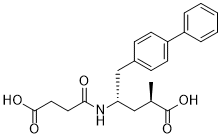
C22H25NO5
|
|---|---|
| 分子量 |
383.4376
|
| 精确质量 |
383.173
|
| 元素分析 |
C, 68.91; H, 6.57; N, 3.65; O, 20.86
|
| CAS号 |
149709-44-4
|
| 相关CAS号 |
Sacubitrilat-d4
|
| PubChem CID |
10430040
|
| 外观&性状 |
White to off-white solid powder
|
| LogP |
4.196
|
| tPSA |
107.19
|
| 氢键供体(HBD)数目 |
3
|
| 氢键受体(HBA)数目 |
5
|
| 可旋转键数目(RBC) |
10
|
| 重原子数目 |
28
|
| 分子复杂度/Complexity |
521
|
| 定义原子立体中心数目 |
2
|
| SMILES |
C[C@H](C[C@@H](CC1=CC=C(C=C1)C2=CC=CC=C2)NC(=O)CCC(=O)O)C(=O)O
|
| InChi Key |
DOBNVUFHFMVMDB-BEFAXECRSA-N
|
| InChi Code |
InChI=1S/C22H25NO5/c1-15(22(27)28)13-19(23-20(24)11-12-21(25)26)14-16-7-9-18(10-8-16)17-5-3-2-4-6-17/h2-10,15,19H,11-14H2,1H3,(H,23,24)(H,25,26)(H,27,28)/t15-,19+/m1/s1
|
| 化学名 |
(2R,4S)-4-(3-carboxypropanoylamino)-2-methyl-5-(4-phenylphenyl)pentanoic acid
|
| 别名 |
Sacubitrilat; LBQ657; LBQ-657; LBQ 657
|
| HS Tariff Code |
2934.99.9001
|
| 存储方式 |
Powder -20°C 3 years 4°C 2 years In solvent -80°C 6 months -20°C 1 month |
| 运输条件 |
Room temperature (This product is stable at ambient temperature for a few days during ordinary shipping and time spent in Customs)
|
| 溶解度 (体外实验) |
DMSO: ~77 mg/mL (~200.8 mM)
Ethanol: ~77 mg/mL (~200.8 mM) |
|---|---|
| 溶解度 (体内实验) |
配方 1 中的溶解度: ≥ 2.5 mg/mL (6.52 mM) (饱和度未知) in 10% DMSO + 40% PEG300 + 5% Tween80 + 45% Saline (这些助溶剂从左到右依次添加,逐一添加), 澄清溶液。
例如,若需制备1 mL的工作液,可将100 μL 25.0 mg/mL澄清DMSO储备液加入到400 μL PEG300中,混匀;然后向上述溶液中加入50 μL Tween-80,混匀;加入450 μL生理盐水定容至1 mL。 *生理盐水的制备:将 0.9 g 氯化钠溶解在 100 mL ddH₂O中,得到澄清溶液。 配方 2 中的溶解度: ≥ 2.5 mg/mL (6.52 mM) (饱和度未知) in 10% DMSO + 90% (20% SBE-β-CD in Saline) (这些助溶剂从左到右依次添加,逐一添加), 澄清溶液。 例如,若需制备1 mL的工作液,可将 100 μL 25.0 mg/mL澄清DMSO储备液加入900 μL 20% SBE-β-CD生理盐水溶液中,混匀。 *20% SBE-β-CD 生理盐水溶液的制备(4°C,1 周):将 2 g SBE-β-CD 溶解于 10 mL 生理盐水中,得到澄清溶液。 View More
配方 3 中的溶解度: ≥ 2.5 mg/mL (6.52 mM) (饱和度未知) in 10% DMSO + 90% Corn Oil (这些助溶剂从左到右依次添加,逐一添加), 澄清溶液。 1、请先配制澄清的储备液(如:用DMSO配置50 或 100 mg/mL母液(储备液)); 2、取适量母液,按从左到右的顺序依次添加助溶剂,澄清后再加入下一助溶剂。以 下列配方为例说明 (注意此配方只用于说明,并不一定代表此产品 的实际溶解配方): 10% DMSO → 40% PEG300 → 5% Tween-80 → 45% ddH2O (或 saline); 假设最终工作液的体积为 1 mL, 浓度为5 mg/mL: 取 100 μL 50 mg/mL 的澄清 DMSO 储备液加到 400 μL PEG300 中,混合均匀/澄清;向上述体系中加入50 μL Tween-80,混合均匀/澄清;然后继续加入450 μL ddH2O (或 saline)定容至 1 mL; 3、溶剂前显示的百分比是指该溶剂在最终溶液/工作液中的体积所占比例; 4、 如产品在配制过程中出现沉淀/析出,可通过加热(≤50℃)或超声的方式助溶; 5、为保证最佳实验结果,工作液请现配现用! 6、如不确定怎么将母液配置成体内动物实验的工作液,请查看说明书或联系我们; 7、 以上所有助溶剂都可在 Invivochem.cn网站购买。 |
| 制备储备液 | 1 mg | 5 mg | 10 mg | |
| 1 mM | 2.6080 mL | 13.0398 mL | 26.0797 mL | |
| 5 mM | 0.5216 mL | 2.6080 mL | 5.2159 mL | |
| 10 mM | 0.2608 mL | 1.3040 mL | 2.6080 mL |
1、根据实验需要选择合适的溶剂配制储备液 (母液):对于大多数产品,InvivoChem推荐用DMSO配置母液 (比如:5、10、20mM或者10、20、50 mg/mL浓度),个别水溶性高的产品可直接溶于水。产品在DMSO 、水或其他溶剂中的具体溶解度详见上”溶解度 (体外)”部分;
2、如果您找不到您想要的溶解度信息,或者很难将产品溶解在溶液中,请联系我们;
3、建议使用下列计算器进行相关计算(摩尔浓度计算器、稀释计算器、分子量计算器、重组计算器等);
4、母液配好之后,将其分装到常规用量,并储存在-20°C或-80°C,尽量减少反复冻融循环。
计算结果:
工作液浓度: mg/mL;
DMSO母液配制方法: mg 药物溶于 μL DMSO溶液(母液浓度 mg/mL)。如该浓度超过该批次药物DMSO溶解度,请首先与我们联系。
体内配方配制方法:取 μL DMSO母液,加入 μL PEG300,混匀澄清后加入μL Tween 80,混匀澄清后加入 μL ddH2O,混匀澄清。
(1) 请确保溶液澄清之后,再加入下一种溶剂 (助溶剂) 。可利用涡旋、超声或水浴加热等方法助溶;
(2) 一定要按顺序加入溶剂 (助溶剂) 。
InvivoChem的所有产品仅用于作科学研究,不面向患者销售
Copyright 2020 InvivoChem LLC | All Rights Reserved 粤ICP备20063088号-1


 COA
COA
 粤公网安备 44011102003439号
 463611831
