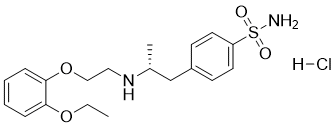
Tamsulosin HCl

别名: Tamsulosina hydrochloride; Tamsulosinum hydrochloride; Tamsulosin HCl; Pradif; Flomax; Omnic 盐酸坦索罗辛 ;坦索罗辛盐酸盐; 盐酸坦索罗辛(左旋); 盐酸坦洛辛 ;盐酸坦索罗辛 (盐酸坦洛新); 盐酸坦索罗新; 盐酸坦洛新(标准品);Tamsulosin Hydrochloride 盐酸坦索罗辛;坦索罗辛;消旋坦洛新;盐酸坦洛新; 盐酸坦索罗辛 EP标准品;盐酸坦索罗辛 USP标准品;盐酸坦索罗辛 标准品;盐酸坦索罗辛原药; (-)-(R)-5-[2-[2-(2-乙氧基苯氧基)乙基氨基]丙基]-2-甲氧基苯磺酰胺盐酸盐;(R)-5-[2-[[2-(2-乙氧基苯氧基)乙基]氨基]丙基]-2-甲氧基-苯磺酰胺盐酸盐;(R)-坦洛新;坦洛新
目录号: V2704 纯度: ≥98%
盐酸坦索罗辛是一种已上市的药物,是一种有效的选择性α1a肾上腺素受体拮抗剂,用于治疗良性前列腺增生(BPH)。
Tamsulosin HCl CAS号: 106463-17-6
产品类别: Adrenergic Receptor
产品仅用于科学研究,不针对患者销售
规格 价格 库存 数量
25mg
50mg
100mg
250mg
500mg
1g
Other Sizes

Other Forms of Tamsulosin HCl:

  • (Rac)-Tamsulosin-d3 hydrochloride
  • Tamsulosin-d5 hydrochloride
  • Tamsulosin-d4
  • Tamsulosin impurity 1
  • Tamsulosin-d4 HCl-(-)-YM12617-d4
  • 坦索洛新
点击了解更多
InvivoChem产品被CNS等顶刊论文引用
纯度/质量控制文件

纯度: ≥98%

产品描述
盐酸坦索罗辛是一种已上市药物,是一种有效的选择性α1a肾上腺素受体拮抗剂,用于治疗良性前列腺增生(BPH)。与血管中的 α1B 受体相比,它对前列腺中的 α1A 受体具有优先选择性。与对照患者相比,接受坦索罗辛治疗的患者发生急性尿潴留的风险降低了 0.30 倍。坦索罗辛可推荐用于治疗 AUR 插管后的男性,并且可以减少需要重新插管的可能性。
生物活性&实验参考方法
靶点
α1-adrenergic receptor
α1-adrenergic receptor (α1-AR) subtypes, with highest affinity for α1A-AR (Ki = 0.034 nM) and α1D-AR (Ki = 0.23 nM), lower affinity for α1B-AR (Ki = 4.5 nM) [1]
- α1A- and α1D-adrenergic receptors, which mediate smooth muscle contraction in the prostate and vasculature [2]
体外研究 (In Vitro)
体外活性:坦索罗辛是一种选择性 α1 受体拮抗剂,相对于血管中的 α1B 受体,它对前列腺中的 α1A 受体具有优先选择性。与对照患者相比,接受坦索罗辛治疗的患者发生急性尿潴留的风险降低了 0.30 倍。国际节制协会男性问卷各领域得分均未显示各组之间存在显着变化。坦索罗辛可推荐用于治疗 AUR 插管后的男性,并且可以减少需要重新插管的可能性。激酶测定: 细胞测定:
Tamsulosin HCl 在人前列腺膜制剂中竞争性抑制[3H]-哌唑嗪与α1-AR亚型的结合,对α1A-AR和α1D-AR的拮抗作用具有亚型选择性,优于对α1B-AR的作用[1]
- Tamsulosin HCl 通过抑制PI3K/Akt/mTOR信号通路,抑制血管紧张素II诱导的小鼠主动脉平滑肌细胞(ASMCs)增殖和迁移;同时降低ASMCs中I型胶原蛋白和基质金属蛋白酶-9(MMP-9)的表达[2]
体内研究 (In Vivo)
坦索罗辛表现出高血浆蛋白结合,主要与 α1-酸性糖蛋白结合。它主要通过细胞色素 P450 (CYP) 3A4 和 CYP2D6 代谢为低丰度化合物,口服剂量的 8.7-15% 作为母体化合物经肾脏排泄。坦索罗辛的药代动力学在很大程度上不受年龄的影响,肾功能不全患者的药代动力学变化很大程度上与α1-酸性糖蛋白浓度的增加有关。肝功能损害引起的药代动力学改变也仅为中度,因此肾功能损害和轻至中度肝功能损害都不需要调整剂量。对大鼠和狗等实验动物进行坦索罗辛速释的早期研究表明,口服给药后(30-90 分钟内)坦索罗辛吸收迅速,但大鼠的绝对生物利用度仅为 7-23%,狗的绝对生物利用度仅为 30-42%。坦索罗辛 MR 在禁食人体中的绝对生物利用度约为 100%。在禁食状态下,tmax 通常为约 5 小时(报告的平均值范围为 2.9-5.6 小时),在进食状态下为约 6 小时(范围为 5.2-7.0 小时)。静脉注射放射性标记坦索罗辛并在10分钟后测量各组织中放射性标记的动物研究表明,该药物存在于各组织中,排列顺序如下:肾>肺≈心脏>颌下腺>肝≈脾≈主动脉≈输精管>前列腺>>大脑皮层,后者接近检测限。坦索罗辛可能无法通过血脑屏障。坦索罗辛在大鼠和狗体内进行广泛的肝脏代谢,分别仅以母体化合物的形式在尿液中排泄 1.2% 和 2.8%。在人类中,坦索罗辛也经历广泛的肝脏代谢,但显然比大鼠或狗的代谢程度稍小,因为口服剂量的 8.7-15% 以非代谢形式从尿液中排出。坦索罗辛从体内消除的速度因物种而异,例如坦索罗辛在大鼠和狗中的消除速度比在人类中更快。
在良性前列腺增生(BPH)模型大鼠中,Tamsulosin HCl(0.01-0.1 mg/kg,口服)通过松弛前列腺和膀胱颈平滑肌,降低尿道内压力并改善尿流率[1]
- 在血管紧张素II诱导的腹主动脉瘤(AAA)ApoE-/-小鼠模型中,Tamsulosin HCl(0.1 mg/kg/天,灌胃给药28天)可抑制AAA生长(最大主动脉直径减少31.2%),并减轻主动脉壁炎症、弹性蛋白降解和平滑肌细胞丢失[2]
酶活实验
取人前列腺组织制备膜制剂,与[3H]-哌唑嗪(放射性配体)和不同浓度的Tamsulosin HCl在25°C下孵育60分钟。通过过滤分离结合态和游离态配体,测定放射性强度以确定对α1-AR亚型的结合亲和力(Ki值)[1]
- 采用重组人α1A-、α1B-和α1D-AR表达细胞的膜制剂进行亚型特异性放射性配体结合实验,绘制竞争曲线以计算IC50值和亚型选择性比率[1]
细胞实验
从主动脉组织中分离小鼠ASMCs,在添加胎牛血清的DMEM培养基中培养。细胞先用Tamsulosin HCl(1-10 μM)预处理1小时,再用血管紧张素II(100 nM)刺激24-48小时。通过CCK-8法检测细胞增殖,Transwell法检测细胞迁移,Western blot检测蛋白表达(PI3K、Akt、mTOR、MMP-9)[2]
- 经Tamsulosin HCl和血管紧张素II处理48小时后,采用酶联免疫吸附试验(ELISA)测定ASMCs分泌的I型胶原蛋白水平[2]
动物实验
Dissolved in saline; 0.1 and 1 μg/kg; s.c. injection
Female Wistar rats
BPH model rats (induced by testosterone propionate injection) were randomly divided into control and treatment groups. Tamsulosin HCl was administered orally at doses of 0.01, 0.03, and 0.1 mg/kg once daily for 2 weeks. Urinary flow parameters and intraurethral pressure were measured under anesthesia [1]
- ApoE-/- mice (8-10 weeks old) were implanted with osmotic minipumps delivering angiotensin II (1000 ng/kg/min) to induce AAA. Tamsulosin HCl was dissolved in normal saline and administered via oral gavage at 0.1 mg/kg/day for 28 days. Mice were euthanized, and aortic tissues were collected for histopathological and molecular analysis [2]
药代性质 (ADME/PK)
Tamsulosin hydrochloride has an oral bioavailability of approximately 90% in humans (food has no significant effect on absorption). Peak plasma concentration (Cmax) is reached 0.5–1 hour after oral administration [1]
- Plasma protein binding is 99%, mainly bound to albumin and α1-acid glycoprotein [1]
- Tamsulosin hydrochloride is metabolized in the liver by cytochrome P450 (CYP) enzymes, mainly by CYP3A4 and CYP2D6 to inactive metabolites [1]
- The elimination half-life (t1/2) in humans is 10–14 hours; approximately 70% of the dose is excreted in the urine (10% of which is the original drug), and 20% is excreted in the feces [1]
毒性/毒理 (Toxicokinetics/TK)
Common adverse reactions in humans include dizziness (6.3%), orthostatic hypotension (3.2%), rhinitis (2.8%), and ejaculatory abnormalities (2.1%); these adverse reactions are dose-related and are generally mild to moderate [1]
- No significant hepatotoxicity or nephrotoxicity was observed in clinical trials; repeated daily administration did not lead to plasma concentration accumulation [1]
- In animal toxicity studies, high doses (100 times the therapeutic dose) caused hypotension and bradycardia, but no fatal toxicity was reported [1]
参考文献

[1]. Tamsulosin: an overview. World J Urol. 2002 Apr;19(6):397-404.

[2]. Tamsulosin Attenuates Abdominal Aortic Aneurysm Growth. Surgery. 2018 Nov; 164(5): 1087-1092.

其他信息
Tamsulosin hydrochloride is the hydrochloride salt formed by the reaction of equimolar amounts of tamsulosin with hydrogen chloride. It is an alpha-adrenergic antagonist and antitumor drug. It contains the tamsulosin (1+) molecule. It is the enantiomer of ent-tamsulosin hydrochloride. Tamsulosin hydrochloride is the hydrochloride salt of tamsulosin, a sulfonamide derivative with adrenergic antagonistic activity. Tamsulosin selectively binds to and blocks the activity of alpha-1 adrenergic receptors in the human prostate and bladder neck; blocking these adrenergic receptors relaxes the smooth muscle of the prostate and bladder neck, thereby improving urinary flow rate. Tamsulosin hydrochloride is a sulfonamide derivative and alpha-1 adrenergic receptor antagonist used to relieve urinary tract obstruction symptoms caused by benign prostatic hyperplasia. See also: Tamsulosin (note moved to). Tamsulosin hydrochloride is a selective α1A/α1D adrenergic receptor antagonist approved for the treatment of lower urinary tract symptoms (LUTS) associated with benign prostatic hyperplasia (BPH)[1]. Its therapeutic effect is achieved by relaxing the smooth muscle of the prostatic interstitium and bladder neck, reducing urethral resistance and improving urinary flow rate[1]. Tamsulosin hydrochloride slows the growth of abdominal aortic aneurysms (AAA) by inhibiting smooth muscle cell proliferation/migration and reducing inflammation. It also protects the extracellular matrix of the aortic wall[2].
*注: 文献方法仅供参考, InvivoChem并未独立验证这些方法的准确性
化学信息 & 存储运输条件
分子式
C20H28N2O5S.HCL
分子量
444.97
精确质量
444.148
元素分析
C, 55.00; H, 6.56; Cl, 8.54; N, 6.75; O, 15.42; S, 7.73
CAS号
106463-17-6
相关CAS号
Tamsulosin;106133-20-4; Tamsulosin-d5 hydrochloride; Tamsulosin-d4 hydrochloride; 2518100-55-3
PubChem CID
5362376
外观&性状
White to off-white solid powder
沸点
595.5ºC at 760 mmHg
熔点
228-230ºC
闪点
313.9ºC
蒸汽压
3.79E-14mmHg at 25°C
LogP
4.512
tPSA
108.26
氢键供体(HBD)数目
3
氢键受体(HBA)数目
7
可旋转键数目(RBC)
11
重原子数目
29
分子复杂度/Complexity
539
定义原子立体中心数目
1
SMILES
Cl[H].S(C1=C(C([H])=C([H])C(=C1[H])C([H])([H])[C@@]([H])(C([H])([H])[H])N([H])C([H])([H])C([H])([H])OC1=C([H])C([H])=C([H])C([H])=C1OC([H])([H])C([H])([H])[H])OC([H])([H])[H])(N([H])[H])(=O)=O
InChi Key
ZZIZZTHXZRDOFM-XFULWGLBSA-N
InChi Code
InChI=1S/C20H28N2O5S.ClH/c1-4-26-17-7-5-6-8-18(17)27-12-11-22-15(2)13-16-9-10-19(25-3)20(14-16)28(21,23)24;/h5-10,14-15,22H,4,11-13H2,1-3H3,(H2,21,23,24);1H/t15-;/m1./s1
化学名
5-[(2R)-2-[2-(2-ethoxyphenoxy)ethylamino]propyl]-2-methoxybenzenesulfonamide;hydrochloride
别名
Tamsulosina hydrochloride; Tamsulosinum hydrochloride; Tamsulosin HCl; Pradif; Flomax; Omnic
HS Tariff Code
2934.99.9001
存储方式

Powder      -20°C    3 years

                     4°C     2 years

In solvent   -80°C    6 months

                  -20°C    1 month

运输条件
Room temperature (This product is stable at ambient temperature for a few days during ordinary shipping and time spent in Customs)
溶解度数据
溶解度 (体外实验)
DMSO: ~88 mg/mL (~197.8 mM)
Water: ~17 mg/mL (~38.2 mM)
Ethanol: ~8 mg/mL (~18 mM)
制备储备液 1 mg 5 mg 10 mg
1 mM 2.2473 mL 11.2367 mL 22.4734 mL
5 mM 0.4495 mL 2.2473 mL 4.4947 mL
10 mM 0.2247 mL 1.1237 mL 2.2473 mL

1、根据实验需要选择合适的溶剂配制储备液 (母液):对于大多数产品,InvivoChem推荐用DMSO配置母液 (比如:5、10、20mM或者10、20、50 mg/mL浓度),个别水溶性高的产品可直接溶于水。产品在DMSO 、水或其他溶剂中的具体溶解度详见上”溶解度 (体外)”部分;

2、如果您找不到您想要的溶解度信息,或者很难将产品溶解在溶液中,请联系我们;

3、建议使用下列计算器进行相关计算(摩尔浓度计算器、稀释计算器、分子量计算器、重组计算器等);

4、母液配好之后,将其分装到常规用量,并储存在-20°C或-80°C,尽量减少反复冻融循环。

计算器

摩尔浓度计算器可计算特定溶液所需的质量、体积/浓度,具体如下:

  • 计算制备已知体积和浓度的溶液所需的化合物的质量
  • 计算将已知质量的化合物溶解到所需浓度所需的溶液体积
  • 计算特定体积中已知质量的化合物产生的溶液的浓度
使用摩尔浓度计算器计算摩尔浓度的示例如下所示:
假如化合物的分子量为350.26 g/mol,在5mL DMSO中制备10mM储备液所需的化合物的质量是多少?
  • 在分子量(MW)框中输入350.26
  • 在“浓度”框中输入10,然后选择正确的单位(mM)
  • 在“体积”框中输入5,然后选择正确的单位(mL)
  • 单击“计算”按钮
  • 答案17.513 mg出现在“质量”框中。以类似的方式,您可以计算体积和浓度。

稀释计算器可计算如何稀释已知浓度的储备液。例如,可以输入C1、C2和V2来计算V1,具体如下:

制备25毫升25μM溶液需要多少体积的10 mM储备溶液?
使用方程式C1V1=C2V2,其中C1=10mM,C2=25μM,V2=25 ml,V1未知:
  • 在C1框中输入10,然后选择正确的单位(mM)
  • 在C2框中输入25,然后选择正确的单位(μM)
  • 在V2框中输入25,然后选择正确的单位(mL)
  • 单击“计算”按钮
  • 答案62.5μL(0.1 ml)出现在V1框中
g/mol

分子量计算器可计算化合物的分子量 (摩尔质量)和元素组成,具体如下:

注:化学分子式大小写敏感:C12H18N3O4  c12h18n3o4
计算化合物摩尔质量(分子量)的说明:
  • 要计算化合物的分子量 (摩尔质量),请输入化学/分子式,然后单击“计算”按钮。
分子质量、分子量、摩尔质量和摩尔量的定义:
  • 分子质量(或分子量)是一种物质的一个分子的质量,用统一的原子质量单位(u)表示。(1u等于碳-12中一个原子质量的1/12)
  • 摩尔质量(摩尔重量)是一摩尔物质的质量,以g/mol表示。
/

配液计算器可计算将特定质量的产品配成特定浓度所需的溶剂体积 (配液体积)

  • 输入试剂的质量、所需的配液浓度以及正确的单位
  • 单击“计算”按钮
  • 答案显示在体积框中
动物体内实验配方计算器(澄清溶液)
第一步:请输入基本实验信息(考虑到实验过程中的损耗,建议多配一只动物的药量)
第二步:请输入动物体内配方组成(配方适用于不溶/难溶于水的化合物),不同的产品和批次配方组成不同,如对配方有疑问,可先联系我们提供正确的体内实验配方。此外,请注意这只是一个配方计算器,而不是特定产品的确切配方。
+
+
+

计算结果:

工作液浓度 mg/mL;

DMSO母液配制方法 mg 药物溶于 μL DMSO溶液(母液浓度 mg/mL)。如该浓度超过该批次药物DMSO溶解度,请首先与我们联系。

体内配方配制方法μL DMSO母液,加入 μL PEG300,混匀澄清后加入μL Tween 80,混匀澄清后加入 μL ddH2O,混匀澄清。

(1) 请确保溶液澄清之后,再加入下一种溶剂 (助溶剂) 。可利用涡旋、超声或水浴加热等方法助溶;
            (2) 一定要按顺序加入溶剂 (助溶剂) 。

临床试验信息
A Study to Evaluate the Efficacy, Safety, and Tolerability of Mirabegron in Men With OAB Symptoms While Taking Tamsulosin Hydrochloride for Lower Urinary Tract Symptoms (LUTS) Due to Benign Prostatic Hyperplasia (BPH)
CTID: NCT02757768
Phase: Phase 4    Status: Completed
Date: 2024-11-12
Post-Operative Urinary Retention (POUR) in Thoracic Surgery Patients Receiving Prophylactic Tamsulosin
CTID: NCT04994431
Phase: Phase 4    Status: Terminated
Date: 2024-11-07
Prevention of Post Operative Urinary Retention After Thoracic Surgery Trial
CTID: NCT06262048
Phase: Phase 2    Status: Recruiting
Date: 2024-10-28
Use of Tamsulosin to Reduce the Incidence and Duration of Postoperative Urinary Retention Following Spine Surgery
CTID: NCT01568918
Phase: Phase 3    Status: Terminated
Date: 2024-05-30
Efficacy and Safety of Ningmitai Capsule in Patients With Chronic Prostatitis/Chronic Pelvic Pain Syndrome
CTID: NCT05890235
Phase: Phase 4    Status: Completed
Date: 2023-06-06
View More

Investigating Medication vs. Prostatic Urethral Lift: Assessment and Comparison of Therapies for BPH
CTID: NCT04987892
Phase: Phase 4    Status: Recruiting
Date: 2023-04-25


Composite Steep-pulseTreatment Device Used in Patients With Benign Prostatic Hyperplasia
CTID: NCT05531344
Phase: Phase 2/Phase 3    Status: Completed
Date: 2022-09-07
Efficacy of Tadalafil/Solifenacin VS Tamsulosin/Solifenacin Combination Therapy for BPH/OAB
CTID: NCT05494567
Phase: Phase 4    Status: Unknown status
Date: 2022-08-10
Prophylactic Tamsulosin in Prevention of Post-operative Urinary Retention in Men After Transanal Endoscopic Microsurgery
CTID: NCT03314025
Phase: Phase 2    Status: Unknown status
Date: 2021-05-19
Trial of Tadalafil, Tamsulosin and Combination for Access Sheath Deployment
CTID: NCT03229889
Phase: Phase 4    Status: Unknown status
Date: 2021-04-19
REduction of Post-Operative Urinary Retention With Tamsulosin Versus Placebo (REPOURT- P) Trial
CTID: NCT04159077
Phase: Phase 3    Status: Unknown status
Date: 2021-02-25
Chronic Prostatitis Collaborative Research Network Clinical Trial- Ciprofloxacin and Tamsulosin
CTID: NCT04552431
Phase: Phase 2    Status: Completed
Date: 2020-09-18
Determine the Bioequivalence of Two Formulations of Tamsulosin HCl Capsules in Fasted Male.
CTID: NCT02417831
Phase: Phase 1    Status: Completed
Date: 2020-04-27
Determine the Bioequivalence of Two Formulations of Tamsulosin HCl Capsules in Fed Male.
CTID: NCT02417844
Phase: Phase 1    Status: Completed
Date: 2020-04-17
Actual Use Study of Tamsulosin in Men
CTID: NCT02573311
Phase: Phase 3    Status: Completed
Date: 2020-04-08
Treatment of Supine Hypertension in Autonomic Failure
CTID: NCT00223717
Phase: Phase 1    Status: Completed
Date: 2017-10-13
The Effects of α-adrenergic Receptor Antagonists on Choroid and Pupil
CTID: NCT03144596
Phase: Phase 4    Status: Completed
Date: 2017-05-09
Study to Investigate the Efficacy and Safety of GL2702 GLARS-NF1tablet and Harnal-D - Tablet in BPH Patients With LUTS
CTID: NCT02303769
Phase: Phase 3    Status: Completed
Date: 2016-02-25
PK/PD, Long-term Safety and Efficacy of Tamsulosin Treatment in Children With Neurogenic Bladder
CTID: NCT00340704
Phase: Phase 2    Status: Completed
Date: 2016-02-17
EC905 Pharmacokinetic Profile Study
CTID: NCT02634489
PhasePhas
Etude de l’efficacité et de la tolérance, de l’injection intra prostatique de toxine botulique A, chez l’homme, dans le traitement de l’hyperplasie bénigne de prostate symptomatique.
CTID: null
Phase: Phase 2    Status: Completed
Date: 2010-09-29
A Phase 3, Randomized, Double-Blind, Placebo-Controlled, Parallel-Design, Global Multicenter Study to Evaluate the Efficacy and Safety of Tadalafil Once Daily Dosing for 12 Weeks in Men with Signs and Symptoms of Benign Prostatic Hyperplasia.
CTID: null
Phase: Phase 3    Status: Completed
Date: 2009-10-01
A randomized, double-blind, parallel group, placebo controlled, multi-center study of fixed dose combinations of solifenacin succinate (6 mg and 9 mg) with tamsulosin hydrochloride OCAS 0.4 mg and tamsulosin hydrochloride OCAS 0.4 mg monotherapy, in male subjects with lower urinary tract symptoms (LUTS) associated with benign prostatic hyperplasia (BPH) with a substantial storage component
CTID: null
Phase: Phase 3    Status: Completed
Date: 2009-07-16
An open-label, long term multi-center study to assess the safety and efficacy of fixed dose combinations of solifenacin succinate (6 mg and 9 mg) with tamsulosin hydrochloride OCAS 0.4 mg, in male subjects with lower urinary tract symptoms (LUTS) associated with benign prostatic hyperplasia (BPH) with a substantial storage component
CTID: null
Phase: Phase 3    Status: Completed
Date: 2009-07-16
A Phase IIb/III, multi-centre, double-blind, randomised, placebo-controlled, dose ranging study of tamsulosin hydrochloride (low, medium and high dose) as treatment in children with neuropathic bladder for three months
CTID: null
Phase: Phase 3    Status: Completed
Date: 2007-10-29
A Phase 2, Randomized, Double-Blind, Parallel Group, Placebo Controlled, Multi-Center Study to Evaluate the Safety of the Co-administration of Solifenacin Succinate with 0.4 mg Tamsulosin Hydrochloride OCAS (TOCAS) Using Urodynamics in Male Subjects with Lower Urinary Tract Symptoms (LUTS) and Bladder Outlet Obstruction (BOO)
CTID: null
Phase: Phase 2    Status: Completed
Date: 2007-09-12
An uncontrolled, open-label, titration, long-term safety (up to 12 months) and efficacy study of tamsulosin hydrochloride in children with neuropathic bladder, with a randomized pharmacokinetic sub-study investigating low, medium and high dose ranges
CTID: null
Phase: Phase 2    Status: Prematurely Ended, Completed
Date: 2007-01-22
A randomized, double-blind, parallel group, placebo controlled, multi center dose ranging study of solifenacin succinate (3 mg, 6 mg and 9 mg) in combination with tamsulosin OCAS 0.4 mg compared with solifenacin succinate monotherapy (3 mg, 6 mg and 9 mg) and tamsulosin OCAS 0.4 mg monotherapy in males with lower urinary tract symptoms
CTID: null
Phase: Phase 2    Status: Completed
Date: 2006-12-13
Evaluation Of The Efficacy And Safety Of Silodosin Vs. Tamsulosin And Placebo In The Treatment Of The Signs And Symptoms Of Benign Prostatic Hyperplasia. Multicentre, Randomised, Double-Blind, Controlled Trial With An Optional Long-Term Open-Label Extension Phase
CTID: null
Phase: Phase 3    Status: Completed
Date: 2006-03-23
Tamsulosiinin ja sildenafiilin sydän- ja verenkiertoelinvaikutukset BPH-potilailla
CTID: null
Phase: Phase 4    Status: Ongoing
Date: 2005-03-02
Intraprostatic injection of Botulinumtoxin type A in patients with chronic prostatitis / chronic pelvic pain syndrome (CP/CPPS)
CTID: null
Phase: Phase 3    Status: Completed
Date:

生物数据图片
  • Blood pressure measurement, topical elastase and tamsulosin treatment experiment design. Surgery . 2018 Nov;164(5):1087-1092.
  • Tamsulosin treatment decreases the percent change in aortic diameter of treated mice and preserves elastin integrity. Surgery . 2018 Nov;164(5):1087-1092.
  • Pro-inflammatory cytokines IL-1β, INF-γ, TNFα, IL-17, IL-7, CXCL1, CXCL2, IL-1α are down-regulated in tamsulosin treated aortic tissue. Surgery . 2018 Nov;164(5):1087-1092.
相关产品
联系我们