| 规格 | 价格 | 库存 | 数量 |
|---|---|---|---|
| 5mg |
|
||
| 10mg |
|
||
| 25mg |
|
||
| 50mg |
|
||
| 100mg |
|
||
| 250mg |
|
||
| 500mg |
|
||
| Other Sizes |
|
| 靶点 |
One hour after an intravenous injection of a dose of 10 mg/kg, tinostamustine reduced HDAC activity in rat peripheral blood mononuclear cells (PBMCs) by around 90% in cell tests; greater doses, up to 50 mg/kg, had no effect on HDAC activity in PBMCs. suppression of HDAC. Tinostustine exhibits strong anticancer activity and causes apoptosis in HL60 and Daudi cells. Initial in vitro tests using HL60 cells revealed that cleaving caspases 3, 9, and PARP triggered the intrinsic mechanism of apoptosis and markedly decreased the levels of the anti-apoptotic proteins XIAP and Mcl-1 [1].
|
|---|---|
| 体外研究 (In Vitro) |
在细胞测试中,静脉注射 10 mg/kg 剂量后 1 小时,替诺莫司汀使大鼠外周血单核细胞 (PBMC) 的 HDAC 活性降低约 90%;更大剂量(高达 50 mg/kg)对 PBMC 中的 HDAC 活性没有影响。 HDAC 的抑制。 Tinostustine 表现出强大的抗癌活性,并导致 HL60 和 Daudi 细胞凋亡。使用 HL60 细胞的初步体外测试表明,裂解 caspase 3、9 和 PARP 会触发细胞凋亡的内在机制,并显着降低抗细胞凋亡蛋白 XIAP 和 Mcl-1 的水平 [1]。
Tinostamustine 表现出与 vorinostat 相似的 HDAC 抑制活性,涵盖多种重组 HDAC 酶(I 类和 II 类)。 在 MM1S 和 HL60 细胞中,它诱导组蛋白 H3 在赖氨酸残基 K9、K14、K23 和 K56 的全局超乙酰化。 彗星实验显示,Tinostamustine 在较低浓度下(4 µM 时 57.51% 交联)即可引起 HL60 细胞的 DNA 交联和双链断裂,效果优于 bendamustine 和美法仑。 它在 HL60 细胞中触发凋亡,表现为 caspase 3、9、PARP 的剪切以及抗凋亡蛋白 XIAP 和 Mcl-1 的减少。 在 MM1S 细胞中,它下调 DNA 修复蛋白 p-ATR、p-ATM 和 p-CHK2。[1] |
| 体内研究 (In Vivo) |
替诺莫司汀具有细胞内 HDAC 抑制作用,在分娩后迅速生效,峰值为 10 mg/kg,持续约 12 至 16 小时。皮下患有人类伯基特淋巴瘤的小鼠的肿瘤中 p53 和 pH2AX 的激活证明,暴露于黄嘌呤会引发有效的 DNA 修复反应。静脉注射替诺莫司汀可使 BL 肿瘤迅速缩小或完全消失 [1]。
在 Daudi Burkitt 淋巴瘤异种移植模型中,静脉注射 Tinostamustine(78 mg/kg 或 39 mg/kg)可显著抑制肿瘤生长或完全消除肿瘤。 它诱导肿瘤中 DNA 损伤反应,表现为 pH2AX 和 p53 染色增加。 在大鼠 PBMCs 中,HDAC 抑制在给药后 1 小时可达 90%(10 mg/kg i.v.),24 小时内恢复至正常水平。[1] |
| 酶活实验 |
使用重组人 HDACs(1、2、3、6、8、10)进行 HDAC 酶活性测定。化合物溶于 DMSO 后加入含 Fluor de Lys 底物的测定缓冲液中,37°C 孵育 30 分钟,随后加入 HDAC 显影剂并测量荧光强度。[1]
|
| 细胞实验 |
为测定细胞毒性和 IC50,将细胞(如 Daudi、HL60)接种于 96 孔板中,用 Tinostamustine 处理 72 小时,使用 CellTiter-Glo 试剂和发光法检测细胞活力。
通过 Western blot 分析细胞裂解物中的凋亡标志物(caspases、PARP、XIAP、Mcl-1)和组蛋白乙酰化状态。 彗星实验用于评估 HL60 细胞在暴露于 Tinostamustine 后的 DNA 交联和双链断裂情况。[1] |
| 动物实验 |
将Daudi肿瘤细胞皮下接种到NOD/SCID雌性小鼠体内。当肿瘤体积达到约468 mm³时,将小鼠随机分为对照组和治疗组。
替诺司汀配制成6 mg/mL的注射液,其中包含15%的HPRCD、1.5%的乙酸和1.25%的NaHCO₃。 在指定日期(例如,第1、8、15天)以39 mg/kg或78 mg/kg的剂量静脉注射给药。定期使用游标卡尺测量肿瘤体积。[1] |
| 参考文献 | |
| 其他信息 |
替诺司汀正在临床试验NCT03452930(替诺司汀联合或不联合放射治疗治疗新诊断的MGMT未甲基化胶质母细胞瘤患者)中进行研究。
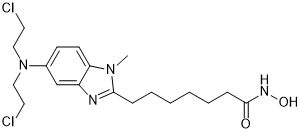
替诺司汀是一种烷化组蛋白去乙酰化酶抑制剂(HDACi)融合分子,由烷化剂苯达莫司汀与泛HDACi伏立诺他融合而成,具有潜在的双功能抗肿瘤活性。替诺司汀给药后,伏立诺他部分靶向并结合HDAC。这导致高度乙酰化的组蛋白积累,进而诱导染色质重塑、调节基因表达、抑制肿瘤细胞分裂并诱导肿瘤细胞凋亡。苯达莫司汀部分能够结合、烷基化并交联大分子,从而抑制DNA、RNA和蛋白质的合成,最终导致肿瘤细胞凋亡。因此,与单独使用苯达莫司汀或替诺司汀相比,替诺司汀显示出更优的疗效。此外,替诺司汀对HDAC6活性的抑制作用可诱导肌醇需求酶1 (IRE-1) 的激活,IRE-1是未折叠蛋白反应 (UPR) 的关键调控蛋白。UPR的诱导可提高某些癌细胞类型对某些化疗药物(例如蛋白酶体抑制剂)的敏感性。因此,替诺司汀可能与蛋白酶体抑制剂产生协同作用。组蛋白去乙酰化酶(HDAC)是能够使染色质组蛋白去乙酰化的酶,在多种癌症中过度表达,并在肿瘤细胞的增殖和耐药性中发挥关键作用。 替诺司汀是一种首创的融合分子,结合了烷化剂苯达莫司汀和HDAC抑制剂伏立诺他。 它的设计旨在使单个分子同时发挥烷化和HDAC抑制活性,从而可能提高疗效并克服耐药性。 临床前研究表明,它对血液系统恶性肿瘤和实体瘤(包括多发性骨髓瘤、淋巴瘤、胶质母细胞瘤和乳腺癌)具有活性。 研究认为,其协同作用是通过染色质松弛(HDAC抑制)增强DNA烷基化并损害DNA修复来实现的。[1] |
| 分子式 |
C19H28CL2N4O2
|
|---|---|
| 分子量 |
415.3572
|
| 精确质量 |
414.159
|
| CAS号 |
1236199-60-2
|
| 相关CAS号 |
1793059-58-1 (HCl);1236199-60-2;
|
| PubChem CID |
46836227
|
| 外观&性状 |
White to off-white solid powder
|
| LogP |
4.246
|
| tPSA |
70.39
|
| 氢键供体(HBD)数目 |
2
|
| 氢键受体(HBA)数目 |
4
|
| 可旋转键数目(RBC) |
12
|
| 重原子数目 |
27
|
| 分子复杂度/Complexity |
438
|
| 定义原子立体中心数目 |
0
|
| InChi Key |
GISXTRIGVCKQBX-UHFFFAOYSA-N
|
| InChi Code |
InChI=1S/C19H28Cl2N4O2/c1-24-17-9-8-15(25(12-10-20)13-11-21)14-16(17)22-18(24)6-4-2-3-5-7-19(26)23-27/h8-9,14,27H,2-7,10-13H2,1H3,(H,23,26)
|
| 化学名 |
7-(5-(bis(2-chloroethyl)amino)-1-methyl-1H-benzo[d]imidazol-2-yl)-N-hydroxyheptanamide
|
| 别名 |
EDO-S101; Minomustine; EDO-S-101; EDO-S 101; EDO S-101;
|
| HS Tariff Code |
2934.99.9001
|
| 存储方式 |
Powder -20°C 3 years 4°C 2 years In solvent -80°C 6 months -20°C 1 month |
| 运输条件 |
Room temperature (This product is stable at ambient temperature for a few days during ordinary shipping and time spent in Customs)
|
| 溶解度 (体外实验) |
DMSO : ~100 mg/mL (~240.76 mM)
|
|---|---|
| 溶解度 (体内实验) |
配方 1 中的溶解度: 2.5 mg/mL (6.02 mM) in 10% DMSO + 40% PEG300 +5% Tween-80 + 45% Saline (这些助溶剂从左到右依次添加,逐一添加), 悬浮液;超声助溶。
例如,若需制备1 mL的工作液,可将100 μL 25.0 mg/mL澄清DMSO储备液加入到400 μL PEG300中,混匀;然后向上述溶液中加入50 μL Tween-80+,混匀;加入450 μL生理盐水定容至1 mL。 *生理盐水的制备:将 0.9 g 氯化钠溶解在 100 mL ddH₂O中,得到澄清溶液。 请根据您的实验动物和给药方式选择适当的溶解配方/方案: 1、请先配制澄清的储备液(如:用DMSO配置50 或 100 mg/mL母液(储备液)); 2、取适量母液,按从左到右的顺序依次添加助溶剂,澄清后再加入下一助溶剂。以 下列配方为例说明 (注意此配方只用于说明,并不一定代表此产品 的实际溶解配方): 10% DMSO → 40% PEG300 → 5% Tween-80 → 45% ddH2O (或 saline); 假设最终工作液的体积为 1 mL, 浓度为5 mg/mL: 取 100 μL 50 mg/mL 的澄清 DMSO 储备液加到 400 μL PEG300 中,混合均匀/澄清;向上述体系中加入50 μL Tween-80,混合均匀/澄清;然后继续加入450 μL ddH2O (或 saline)定容至 1 mL; 3、溶剂前显示的百分比是指该溶剂在最终溶液/工作液中的体积所占比例; 4、 如产品在配制过程中出现沉淀/析出,可通过加热(≤50℃)或超声的方式助溶; 5、为保证最佳实验结果,工作液请现配现用! 6、如不确定怎么将母液配置成体内动物实验的工作液,请查看说明书或联系我们; 7、 以上所有助溶剂都可在 Invivochem.cn网站购买。 |
| 制备储备液 | 1 mg | 5 mg | 10 mg | |
| 1 mM | 2.4076 mL | 12.0378 mL | 24.0755 mL | |
| 5 mM | 0.4815 mL | 2.4076 mL | 4.8151 mL | |
| 10 mM | 0.2408 mL | 1.2038 mL | 2.4076 mL |
1、根据实验需要选择合适的溶剂配制储备液 (母液):对于大多数产品,InvivoChem推荐用DMSO配置母液 (比如:5、10、20mM或者10、20、50 mg/mL浓度),个别水溶性高的产品可直接溶于水。产品在DMSO 、水或其他溶剂中的具体溶解度详见上”溶解度 (体外)”部分;
2、如果您找不到您想要的溶解度信息,或者很难将产品溶解在溶液中,请联系我们;
3、建议使用下列计算器进行相关计算(摩尔浓度计算器、稀释计算器、分子量计算器、重组计算器等);
4、母液配好之后,将其分装到常规用量,并储存在-20°C或-80°C,尽量减少反复冻融循环。
计算结果:
工作液浓度: mg/mL;
DMSO母液配制方法: mg 药物溶于 μL DMSO溶液(母液浓度 mg/mL)。如该浓度超过该批次药物DMSO溶解度,请首先与我们联系。
体内配方配制方法:取 μL DMSO母液,加入 μL PEG300,混匀澄清后加入μL Tween 80,混匀澄清后加入 μL ddH2O,混匀澄清。
(1) 请确保溶液澄清之后,再加入下一种溶剂 (助溶剂) 。可利用涡旋、超声或水浴加热等方法助溶;
(2) 一定要按顺序加入溶剂 (助溶剂) 。
InvivoChem的所有产品仅用于作科学研究,不面向患者销售
Copyright 2020 InvivoChem LLC | All Rights Reserved 粤ICP备20063088号-1


 COA
COA
 粤公网安备 44011102003439号
 463611831
