| 规格 | 价格 | 库存 | 数量 |
|---|---|---|---|
| 50mg |
|
||
| 100mg |
|
||
| 500mg |
|
||
| Other Sizes |
|
| 靶点 |
The primary target is the orphan nuclear receptor Nurr1 (NR4A2), specifically its ligand‑binding domain (LBD). Amodiaquine binds to Nurr1‑LBD with a Kᵢ of 246 nM (competition against [³H]‑chloroquine). The dissociation constant (Kd) for chloroquine binding to Nurr1‑LBD was 0.27 µM, and AQ competed for this binding with a Kᵢ of 246 nM. EC₅₀ for Nurr1 LBD‑dependent transcriptional activation was approximately 20 µM. No IC₅₀ values were reported. [1]
Amodiaquine hydrochloride targets the heme polymerase enzyme in the malaria parasite Plasmodium falciparum. Similar to chloroquine, amodiaquine accumulates in the parasite's food vacuole and inhibits the detoxification of heme by preventing its polymerization into hemozoin. This leads to the accumulation of toxic heme, which damages the parasite's membranes and kills the parasite. The compound also targets the Ebola virus protein VP35, inhibiting viral replication. Its anti-inflammatory properties may involve inhibition of pro-inflammatory mediators. |
|---|---|
| 体外研究 (In Vitro) |
阿莫地喹二盐酸盐(10–20 μM;4 小时)以剂量调节的方式抑制 LPS 诱导的促炎细胞因子(IL-1β、白细胞介素 6、TNF-α 和 iNOS)的表达[1]。μM;24 小时)显著降低了导致原代多巴胺细胞死亡的神经毒性物质(6-OHDA)的量,这可以从 TH+ 神经元和多巴胺饲料的数量中看出。利用RT-PCR方法发现,阿莫地喹在茶树PC12细胞中具有神经保护作用。
阿莫地喹以剂量依赖的方式激活Nurr1依赖性转录活性,使全长Nurr1报告基因的激活倍数约为3倍,而基于Nurr1 LBD的报告基因的激活倍数高达15倍,EC₅₀约为20 µM。 共免疫沉淀实验表明,阿莫地喹增强了Nurr1与转录共激活因子SRC-1和SRC-3之间的相互作用。 阿莫地喹促进了大鼠神经干细胞在体外分化过程中生成TH⁺神经元,并增加了包括TH、DAT、VMAT和AADC在内的mDA特异性基因的mRNA表达。 阿莫地喹对6-OHDA诱导的大鼠原代中脑DA神经元细胞死亡具有神经保护作用(增加……在TH⁺神经元存活和DA摄取方面,以及在PC12细胞(MTT法)中,均观察到了阿莫地喹的作用。 在原代大鼠小胶质细胞中,阿莫地喹(10-20 µM)以剂量依赖的方式抑制了LPS诱导的促炎细胞因子IL-1β、IL-6、TNF-α和iNOS的表达。 Nurr1特异性siRNA敲低了Nurr1的表达,并将阿莫地喹诱导的荧光素酶活性降低了80%以上,证实了该作用依赖于Nurr1。 ChIP实验表明,阿莫地喹增强了Nurr1在NL1和NL3位点向TH启动子的募集。[1] 体外实验表明,盐酸阿莫地喹对恶性疟原虫(包括氯喹耐药株)具有强效的抗疟活性。该化合物的活性是通过抑制血红素聚合实现的。在细胞实验中,阿莫地喹能以低纳摩尔浓度抑制寄生虫生长。该化合物在细胞培养中也表现出抗埃博拉病毒活性,其作用机制是通过抑制VP35介导的功能。此外,免疫细胞实验也证实了其抗炎活性。 |
| 体内研究 (In Vivo) |
阿莫地喹(40 mg/kg;腹腔注射;每日一次;持续3天;稳定的ICR肿瘤)治疗降低了肿瘤周围星状细胞和微小星状细胞/巨噬细胞的活化。阿莫地喹还能改善小鼠的运动障碍,并抑制脑出血诱导的IL-1β、CCL2和CXCL2的mRNA表达[2]。在6-OHDA损伤的帕金森病大鼠模型中,阿莫地喹(10 mg/kg,腹腔注射,每日一次,持续4周)显著改善了行为缺陷。在安非他明诱导的旋转测试中,损伤后4周,AQ治疗组大鼠的旋转频率约为3.5次/分钟,而生理盐水对照组约为10次/分钟。
在踏步测试中,AQ治疗组大鼠的踏步能力约为正常水平的70%,而生理盐水对照组约为30%。 损伤后6周,AQ治疗显著增加了受损侧黑质中TH⁺神经元的数量,达到健侧的约60%,而生理盐水对照组则低于20%。 TH⁺细胞共表达FoxA2和AADC。 阿莫地喹抑制了同侧黑质和纹状体中小胶质细胞的活化,表现为Iba-1⁺小胶质细胞计数减少。 与左旋多巴治疗的对照组(表现出显著的异常不自主运动)相比,阿莫地喹治疗的大鼠未观察到类似运动障碍的异常不自主运动。[1] 在体内,盐酸阿莫地喹已作为抗疟药用于人类数十年。该化合物可有效治疗非复杂性疟疾,通常与其他抗疟药(如青蒿琥酯)联合使用。它也被评估用于治疗贾第虫病和肝阿米巴病。在临床前研究中,阿莫地喹已显示出对动物模型中埃博拉病毒感染的活性。其抗炎特性已在多种炎症模型中得到证实。 |
| 酶活实验 |
使用 Biacore S51 进行表面等离子共振 (SPR) 分析表明,阿莫地喹以剂量依赖的方式特异性地与 Nurr1-LBD 结合,但不与 RXR-LBD 结合。实验中使用的是纯化的 Nurr1-LBD 多肽(氨基酸 328-598)。
荧光猝灭分析:Nurr1-LBD 在 336 nm 处显示最大荧光强度。随着阿莫地喹浓度的增加,荧光强度逐渐降低,表明其与 Nurr1-LBD 结合。RXR-LBD 未被阿莫地喹猝灭。 放射性配体结合实验(使用 [³H]-氯喹):[³H]-氯喹与 Nurr1-LBD 的结合呈饱和性,Kd 为 0.27 µM,Bmax 为 13.9 µM。竞争性结合实验表明,未标记的阿莫地喹与[³H]‐CQ竞争结合,Ki值为246 nM。 利用均匀¹⁵N标记的Nurr1‐LBD的²D ¹H‐¹⁵N TROSY‐HSQC谱进行NMR滴定实验:添加阿莫地喹导致主要位于α2螺旋(H402、I403、Q404、Q405、D408、L409)和α11螺旋(V468、Y575、D580)的残基发生浓度依赖性的化学位移扰动。[1] 体外酶/受体结合实验中,盐酸阿莫地喹通常涉及评估其对血红素聚合的抑制作用。该化合物抑制血红素生成血红素晶体的能力通过分光光度法测定。此外,还可以利用表面等离子共振或其他生物物理技术来评估该化合物与埃博拉病毒VP35蛋白的结合情况。该化合物对寄生虫酶和免疫靶点的影响也值得研究。 |
| 细胞实验 |
RT-PCR[1]
细胞类型: 原代小胶质细胞 测试浓度: 10μM、15μM、20μM 孵育时间: 4 小时 实验结果: 以剂量依赖的方式抑制 LPS 诱导的促炎细胞因子(IL-1β、白细胞介素-6、TNF-1α 和 iNOS)。 基于细胞的报告基因检测:将人神经母细胞瘤 SK-N-BE(2)C 细胞转染 p4xNL3-Luc(四个 NBRE 样基序拷贝)和 pCMV-Nurr1(全长 Nurr1),或 pGAL-Nurr(LBD) 和 pGAL-Nurr(DBD) 构建体,并用化合物处理24 小时后,测定荧光素酶活性。 siRNA 敲低:用 Nurr1 特异性 siRNA 或对照 RNA 处理细胞,并评估 Nurr1 蛋白表达和 AQ 诱导的荧光素酶激活。Nurr1 siRNA 使 AQ 诱导的激活降低了 80% 以上。 共免疫沉淀:在有或无阿莫地喹处理的情况下,检测 SK-N-BE(2)C 细胞中 Nurr1 与 SRC-1 和 SRC-3 的相互作用; AQ增强了这些相互作用。 神经干细胞分化:从E14.5大鼠皮层提取神经祖细胞,通过bFGF撤除诱导分化,在分化过程中用AQ处理2小时,并在第3天和第9天进行TH免疫细胞化学染色和mDA基因(TH、DAT、VMAT、AADC)的qRT-PCR检测。 神经保护试验:将原代大鼠中脑DA神经元和PC12细胞用6-OHDA(20 µM,24小时)处理,同时加入或不加入阿莫地喹(原代神经元5 µM;PC12细胞使用不同浓度)。采用 TH⁺ 神经元计数、[³H]DA 摄取和 MTT 还原法测定细胞存活率。 小胶质细胞实验:将 P1 大鼠脑组织中的原代小胶质细胞用 LPS (10 ng/mL, 4-8 h) 处理,并加入或不加入阿莫地喹 (10-20 µM),然后通过 qRT-PCR 检测 IL-1β、IL-6、TNF-α 和 iNOS 的 mRNA 水平。 ChIP 实验:用阿莫地喹 (20 µM) 或氯喹 (70 µM) 处理大鼠 PC12 细胞,然后用抗 Nurr1 抗体进行染色质免疫沉淀,以评估 Nurr1 募集到 TH 启动子 NL1 和 NL3 位点的情况。[1] 体外细胞实验利用恶性疟原虫培养物来评估盐酸阿莫地喹的抗疟活性。将寄生虫培养于人红细胞中,并用不同浓度的阿莫地喹处理。通过显微镜观察或测量放射性标记的次黄嘌呤掺入量来评估寄生虫的生长情况。使用细胞活力测定法评估其对哺乳动物细胞的细胞毒性。在埃博拉病毒感染的细胞培养物中评估其抗病毒活性。通过测量细胞因子的产生来评估其在免疫细胞培养物中的抗炎作用。 |
| 动物实验 |
动物/疾病模型:雄性ICR小鼠(8-10周龄)诱导脑出血(ICH)[2]
剂量:40 mg/kg 给药途径:腹腔注射(ip);每日一次;持续3天 实验结果:血肿周围的小胶质细胞增多/巨噬细胞和星形胶质细胞活化减弱。 动物实验均按照机构指南进行。使用成年Sprague-Dawley大鼠。6-OHDA损伤模型:大鼠接受单侧立体定位注射,将6-OHDA(8 µg溶于4 µL含0.02%抗坏血酸的生理盐水中)注射到内侧前脑束。两周后,选择苯丙胺诱导旋转试验中旋转次数>6次/分钟的大鼠。 阿莫地喹以10 mg/kg/天的剂量腹腔注射,持续4周。左旋多巴(6 mg/kg加15 mg/kg苄丝肼)用作疗效和运动障碍评估的阳性对照。生理盐水用作溶剂对照。 行为学测试:在损伤后2、4和6周进行苯丙胺诱导旋转试验(2.5 mg/kg苯丙胺,腹腔注射)。在损伤后4周进行踏步试验。给药后3小时内,每30分钟记录一次异常不自主运动(AIMs)。 组织学分析:在损伤后6周,对脑组织进行免疫组织化学染色。采用盲法立体定量计数黑质中的TH⁺神经元。通过Iba-1免疫组化检测黑质和纹状体中的小胶质细胞活化情况。[1] 盐酸阿莫地喹的体内动物实验通常采用疟疾小鼠模型。感染伯氏疟原虫或其他啮齿类疟原虫的小鼠经口服或腹腔注射阿莫地喹治疗,并通过血涂片监测寄生虫水平。记录小鼠的存活率和临床症状。在埃博拉病毒模型中,小鼠感染埃博拉病毒后接受阿莫地喹治疗,并评估其存活率和病毒滴度。抗炎作用则在炎症模型中进行评估。 |
| 药代性质 (ADME/PK) |
盐酸阿莫地喹具有良好的口服生物利用度,已在临床应用数十年。口服后,该化合物经胃肠道吸收并分布至全身各组织。它主要在肝脏中通过细胞色素P450酶代谢为活性代谢物去乙基阿莫地喹。该化合物及其代谢物主要经肾脏排泄。其药代动力学特征支持每日一次或两次给药方案用于疟疾治疗。
|
| 毒性/毒理 (Toxicokinetics/TK) |
盐酸阿莫地喹(CAS# 69-44-3)是一种抗疟疾药物,同时也是组胺N-甲基转移酶(HNMT)的强效抑制剂,HNMT是负责细胞内组胺失活的酶。本研究揭示,阿莫地喹以独特的双位点方式与HNMT结合:一个分子占据活性位点(竞争性抑制),另一个分子结合于外表面口袋(非竞争性抑制),从而产生混合抑制模式。这种双重结合可能是其Ki值极低(本研究中为18.6 nM,文献报道为7.5 nM)的原因,与其他HNMT抑制剂相比,其Ki值显著降低。结构分析表明,喹啉环位于芳香族残基之间,烷基氨基尾部与Glu246和Cys196相互作用。利用外表面口袋结合,通过阿莫地喹-琼脂糖柱对HNMT进行亲和纯化。研究表明,阿莫地喹与Gln94(通常参与AdoMet/AdoHcy结合的残基)之间的相互作用可能影响辅因子结合。本研究未提供体内、ADME或毒性数据。该化合物已获FDA批准用于抗疟疾;其对HNMT的抑制作用属于脱靶活性。[5]
盐酸阿莫地喹在治疗剂量下通常耐受性良好,但不良反应可能包括胃肠道不适、头痛和瘙痒。部分患者曾报告出现严重不良反应,包括肝毒性和粒细胞缺乏症,这限制了其在某些人群中的使用。肝病患者或葡萄糖-6-磷酸脱氢酶缺乏症患者应谨慎使用该化合物。数十年的临床应用已证实其安全性良好。 |
| 参考文献 |
[1]. Chun-Hyung Kim, et al. Nuclear receptor Nurr1 agonists enhance its dual functions and improve behavioral deficits in an animal model of Parkinson's disease. Proc Natl Acad Sci U S A. 2015 Jul 14;112(28):8756-61.
[2]. Keita Kinoshita, et al. A Nurr1 agonist amodiaquine attenuates inflammatory events and neurological deficits in a mouse model of intracerebral hemorrhage. J Neuroimmunol. 2019 May 15;330:48-54. [3]. Akira Yokoyama, et al. Effect of amodiaquine, a histamine N-methyltransferase inhibitor, on, Propionibacterium acnes and lipopolysaccharide-induced hepatitis in mice. Eur J Pharmacol. 2007 Mar 8;558(1-3):179-84. [4]. M T HOEKENGA. The treatment of acute malaria with single oral doses of amodiaquin, chloroquine, hydroxychloroquine and pyrimethamine. Am J Trop Med Hyg. 1954 Sep;3(5):833-8. [5]. John R Horton, et al. Structural basis for inhibition of histamine N-methyltransferase by diverse drugs. J Mol Biol. 2005 Oct 21;353(2):334-344. |
| 其他信息 |
盐酸阿莫地喹是阿莫地喹的盐酸盐,阿莫地喹是一种口服有效的4-氨基喹啉衍生物,具有抗疟和抗炎特性。阿莫地喹的结构和活性与氯喹相似,对某些氯喹耐药株有效,尤其对恶性疟原虫(最致命的疟原虫)有效。尽管其抗疟原虫的作用机制尚未完全阐明,但与其他喹啉衍生物一样,阿莫地喹可能在体内抑制血红素聚合酶的活性。这会导致游离血红素的积累,而游离血红素对寄生虫具有毒性。
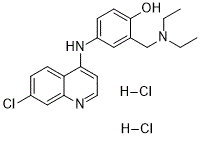
盐酸阿莫地喹(CAS# 69-44-3)是本研究中鉴定的一种Nurr1激动剂抗疟药物。它与氯喹和格拉芬宁具有相同的4-氨基-7-氯喹啉骨架。该化合物被发现可直接与Nurr1-LBD结合,Nurr1-LBD是一种核受体,此前由于缺乏经典的配体结合口袋而被认为不依赖于配体。 其机制涉及与Nurr1-LBD的物理结合,增强SRC-1/SRC-3共激活因子的募集,从而导致mDA神经元基因转录激活增强以及小胶质细胞中促炎基因的转录抑制。 在6-OHDA诱导的帕金森病大鼠模型中,阿莫地喹改善了运动障碍,保护了DA神经元,并抑制了神经炎症,且未出现运动障碍副作用。该研究提供了Nurr1是帕金森病潜在药物靶点的概念验证。 该化合物已获得FDA批准用于抗疟疾,但其用于帕金森病的用途仍处于研究阶段。FDA未提及针对此适应症的特定警告。该研究由NIH拨款和迈克尔·J·福克斯基金会资助。 [1] 盐酸阿莫地喹是一种口服有效的4-氨基喹啉类抗疟药,对氯喹耐药的恶性疟原虫也有效。它已被用于治疗和预防疟疾超过50年。该化合物还具有抗埃博拉病毒的活性和抗炎特性。其分子式为C20H24Cl3N3O,分子量为428.78 g/mol。阿莫地喹常与青蒿琥酯联合用于疟疾治疗。 |
| 分子式 |
C20H24CL3N3O
|
|---|---|
| 分子量 |
428.7831
|
| 精确质量 |
391.121
|
| CAS号 |
69-44-3
|
| 相关CAS号 |
Amodiaquine dihydrochloride dihydrate;6398-98-7;Amodiaquine;86-42-0
|
| PubChem CID |
6246
|
| 外观&性状 |
Light yellow to yellow solid powder
|
| 沸点 |
478ºC at 760 mmHg
|
| LogP |
6.054
|
| tPSA |
48.39
|
| 氢键供体(HBD)数目 |
4
|
| 氢键受体(HBA)数目 |
4
|
| 可旋转键数目(RBC) |
6
|
| 重原子数目 |
27
|
| 分子复杂度/Complexity |
406
|
| 定义原子立体中心数目 |
0
|
| SMILES |
CCN(CC)CC1=C(C=CC(=C1)NC2=C3C=CC(=CC3=NC=C2)Cl)O.O.O.Cl.Cl
|
| InChi Key |
ROEBJVHPINPMKL-UHFFFAOYSA-N
|
| InChi Code |
InChI=1S/C20H22ClN3O.2ClH/c1-3-24(4-2)13-14-11-16(6-8-20(14)25)23-18-9-10-22-19-12-15(21)5-7-17(18)19/h5-12,25H,3-4,13H2,1-2H3,(H,22,23)2*1H
|
| 化学名 |
4-[(7-chloroquinolin-4-yl)amino]-2-(diethylaminomethyl)phenol
|
| 别名 |
Amodiaquin dihydrochloride dihydrate
Amodiaquin dihydrochloride Amodiaquine hydrochloride dihydrate
|
| HS Tariff Code |
2934.99.9001
|
| 存储方式 |
Powder -20°C 3 years 4°C 2 years In solvent -80°C 6 months -20°C 1 month 注意: 请将本产品存放在密封且受保护的环境中(例如氮气保护),避免吸湿/受潮和光照。 |
| 运输条件 |
Room temperature (This product is stable at ambient temperature for a few days during ordinary shipping and time spent in Customs)
|
| 溶解度 (体外实验) |
DMSO : ~125 mg/mL (~291.52 mM)
H2O : ~50 mg/mL (~116.61 mM) |
|---|---|
| 溶解度 (体内实验) |
配方 1 中的溶解度: ≥ 2.08 mg/mL (4.85 mM) (饱和度未知) in 10% DMSO + 40% PEG300 + 5% Tween80 + 45% Saline (这些助溶剂从左到右依次添加,逐一添加), 澄清溶液。
例如,若需制备1 mL的工作液,可将100 μL 20.8 mg/mL澄清DMSO储备液加入400 μL PEG300中,混匀;然后向上述溶液中加入50 μL Tween-80,混匀;加入450 μL生理盐水定容至1 mL。 *生理盐水的制备:将 0.9 g 氯化钠溶解在 100 mL ddH₂O中,得到澄清溶液。 配方 2 中的溶解度: ≥ 2.08 mg/mL (4.85 mM) (饱和度未知) in 10% DMSO + 90% (20% SBE-β-CD in Saline) (这些助溶剂从左到右依次添加,逐一添加), 澄清溶液。 例如,若需制备1 mL的工作液,可将 100 μL 20.8 mg/mL澄清DMSO储备液加入900 μL 20% SBE-β-CD生理盐水溶液中,混匀。 *20% SBE-β-CD 生理盐水溶液的制备(4°C,1 周):将 2 g SBE-β-CD 溶解于 10 mL 生理盐水中,得到澄清溶液。 请根据您的实验动物和给药方式选择适当的溶解配方/方案: 1、请先配制澄清的储备液(如:用DMSO配置50 或 100 mg/mL母液(储备液)); 2、取适量母液,按从左到右的顺序依次添加助溶剂,澄清后再加入下一助溶剂。以 下列配方为例说明 (注意此配方只用于说明,并不一定代表此产品 的实际溶解配方): 10% DMSO → 40% PEG300 → 5% Tween-80 → 45% ddH2O (或 saline); 假设最终工作液的体积为 1 mL, 浓度为5 mg/mL: 取 100 μL 50 mg/mL 的澄清 DMSO 储备液加到 400 μL PEG300 中,混合均匀/澄清;向上述体系中加入50 μL Tween-80,混合均匀/澄清;然后继续加入450 μL ddH2O (或 saline)定容至 1 mL; 3、溶剂前显示的百分比是指该溶剂在最终溶液/工作液中的体积所占比例; 4、 如产品在配制过程中出现沉淀/析出,可通过加热(≤50℃)或超声的方式助溶; 5、为保证最佳实验结果,工作液请现配现用! 6、如不确定怎么将母液配置成体内动物实验的工作液,请查看说明书或联系我们; 7、 以上所有助溶剂都可在 Invivochem.cn网站购买。 |
| 制备储备液 | 1 mg | 5 mg | 10 mg | |
| 1 mM | 2.3322 mL | 11.6610 mL | 23.3220 mL | |
| 5 mM | 0.4664 mL | 2.3322 mL | 4.6644 mL | |
| 10 mM | 0.2332 mL | 1.1661 mL | 2.3322 mL |
1、根据实验需要选择合适的溶剂配制储备液 (母液):对于大多数产品,InvivoChem推荐用DMSO配置母液 (比如:5、10、20mM或者10、20、50 mg/mL浓度),个别水溶性高的产品可直接溶于水。产品在DMSO 、水或其他溶剂中的具体溶解度详见上”溶解度 (体外)”部分;
2、如果您找不到您想要的溶解度信息,或者很难将产品溶解在溶液中,请联系我们;
3、建议使用下列计算器进行相关计算(摩尔浓度计算器、稀释计算器、分子量计算器、重组计算器等);
4、母液配好之后,将其分装到常规用量,并储存在-20°C或-80°C,尽量减少反复冻融循环。
计算结果:
工作液浓度: mg/mL;
DMSO母液配制方法: mg 药物溶于 μL DMSO溶液(母液浓度 mg/mL)。如该浓度超过该批次药物DMSO溶解度,请首先与我们联系。
体内配方配制方法:取 μL DMSO母液,加入 μL PEG300,混匀澄清后加入μL Tween 80,混匀澄清后加入 μL ddH2O,混匀澄清。
(1) 请确保溶液澄清之后,再加入下一种溶剂 (助溶剂) 。可利用涡旋、超声或水浴加热等方法助溶;
(2) 一定要按顺序加入溶剂 (助溶剂) 。
| NCT Number | Recruitment | interventions | Conditions | Sponsor/Collaborators | Start Date | Phases |
| NCT00894660 | COMPLETED | Drug: Amodiaquine (Test) Drug: Amodiaquine (Comparator) |
Falciparum Malaria | Pfizer | 2009-06 | Phase 1 |
| NCT00238017 | UNKNOWN STATUS | Drug: amodiaquine-artesunate versus amodiaquine | Malaria | Charite University, Berlin, Germany | 2005-10 | Phase 4 |
| NCT00859807 | COMPLETED | Drug: Flavoquine®, Camoquin® Suspension | Falciparum Malaria | Pfizer | 2009-05 | Phase 4 |
| NCT01023399 | COMPLETED | Drug: Artesunate + Amodiaquine | Malaria | Sanofi | 2009-11 | Phase 4 |
| NCT04080895 | RECRUITING | Drug: Artemether-lumefantrine Drug: Amodiaquine Drug: Artemether-lumefantrine Drug: Artemether-lumefantrine + Amodiaquine |
Drug Combination Healthy Pharmacokinetic |
University of Oxford | 2022-11-01 | Phase 1 |
|
|
InvivoChem的所有产品仅用于作科学研究,不面向患者销售
Copyright 2020 InvivoChem LLC | All Rights Reserved 粤ICP备20063088号-1


 COA
COA


 粤公网安备 44011102003439号
 463611831
