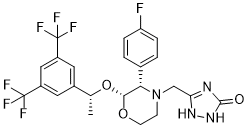
APREPITANT

别名: L754030; L-754030; L 754030; MK0869; MK 0869; MK-0869; ONO7436; ONO-7436; ONO 7436; Emend; Aponvie; Cinvanti; L-754030; Aprepitant; trade name: Emend 阿瑞吡坦;阿瑞匹坦;阿瑞比坦;阿瑞吡坦杂质;5-[2(R)-[1(R)-[3,5-二(三氟甲基)苯基]乙氧基]-3(S)-(4-氟苯基)吗啉-4-基甲基]-3,4-二氢;阿瑞匹坦 (API);阿瑞匹坦 5-[2(R)-[1(R)-[3,5-二(三氟甲基)苯基]乙氧基]-3(S)-(4-氟苯基)吗啉-4-基甲基]-3,4-二氢-2H-1,2,4-三唑-3-酮
目录号: V4330 纯度: ≥98%
阿瑞匹坦(原名 MK-0869;MK-869;L-754030;商品名:Emend)是一种新型、选择性、高亲和力的神经激肽 1 受体小分子拮抗剂,kdof 86 pM。
APREPITANT CAS号: 170729-80-3
产品类别: Neurokinin Receptor
产品仅用于科学研究,不针对患者销售
规格 价格 库存 数量
10mg
25mg
50mg
100mg
250mg
500mg
Other Sizes
点击了解更多
  • 与全球5000+客户建立关系
  • 覆盖全球主要大学、医院、科研院所、生物/制药公司等
  • 产品被大量CNS顶刊文章引用
InvivoChem产品被CNS等顶刊论文引用
纯度/质量控制文件

纯度: ≥98%

产品描述
阿瑞匹坦(原名 MK-0869;MK-869;L-754030;商品名:Emenend)是一种新型、选择性、高亲和力的神经激肽 1 受体小分子拮抗剂,Kd 为 86 pM。通过穿过血脑屏障,阿瑞吡坦能够选择性地与中枢神经系统(CNS)中的人P物质/神经激肽1受体结合,从而抑制内源性P物质的受体结合以及P物质引起的呕吐。阿瑞匹坦对 3 型血清素 (5-HT3)、多巴胺和皮质类固醇受体几乎没有亲和力或没有亲和力。
生物活性&实验参考方法
靶点
G-CSF; IL-6; IL-8; TNFα; Neurokinin-1 receptor( IC50 = 0.1 nM)
Aprepitant decreases metabolic activity with an estimated IC50 value of 20 µM. Aprepitant causes G1 cell cycle arrest and inhibition of cell growth. In Nalm-6 cells, apropitant strongly induces apoptosis, which is mediated by activating caspase-3. Pro-apoptotic p53 target gene expression and p53 accumulation are induced by aprepitant (20 µM)[2]. In a dose-dependent manner, aprepitant (1, 5, 10 µM) inhibits HIV infection in MDM from HIV-negative individuals who are depressed and those who are not. Apreciant's IC50 value is approximately 5 μM, while its IC90 value is 10 μM[4].
体外研究 (In Vitro)
阿瑞吡坦会降低代谢活性,估计 IC50 值为 20 µM。阿瑞吡坦可诱导细胞生长抑制和 G1 细胞周期停滞。阿瑞匹坦显着诱导 Nalm-6 细胞凋亡,该凋亡是通过 caspase-3 激活介导的。阿瑞吡坦 (20 µM) 诱导 p53 积累和促凋亡 p53 靶基因的表达[2]。阿瑞匹坦 (1, 5, 10 µM) 以剂量依赖性方式在体外抑制抑郁和非抑郁 HIV 阴性个体的 MDM 中的 HIV 感染。阿瑞吡坦的IC90值相当于10μM,IC50值约为5μM[4]。
Aprepitant 在体外以剂量依赖的方式抑制HIV-1 Bal对人单核细胞源性巨噬细胞(MDM)的感染,ED50约为5 µM。10 µM的浓度大约相当于IC90。抑郁状态、性别、年龄或种族对这种抑制作用没有影响。在为期一周的感染性实验过程中,培养基中aprepitant浓度的测定显示其几乎没有降解。
用P物质(SP)刺激健康供体的外周血单核细胞(PBMC)可上调促炎细胞因子和趋化因子(G-CSF、IL-6、IL-8、TNFα、MIP-1α和MCP-1)的产生。 Aprepitant(10 µM)阻断了这种SP诱导的上调作用。DMSO溶剂没有效果。
用SP刺激PBMC还会导致CD4+ T细胞上PD-1表达增加,该效应可被与aprepitant共孵育所阻断。
人单核细胞暴露于SP会导致可溶性CD163(sCD163)快速、时间和剂量依赖性的释放,该释放可被aprepitant预孵育所抑制。
体内研究 (In Vivo)
阿瑞匹坦可防止由伯氏疏螺旋体体内 NHP 感染诱导的 NK-1R 表达增加。阿瑞吡坦治疗可防止伯氏疏螺旋体诱导的 NHP 脑脊液中 CCL2 蛋白水平增加。阿瑞吡坦治疗可防止伯氏疏螺旋体诱导的 NHP 背根神经节中 CCL2 和 CXCL13 mRNA 表达增加,防止伯氏疏螺旋体诱导的 NHP 脊髓中 CCL2、CXCL13、IL-17A 和 IL-6 mRNA 表达增加NHP。阿瑞吡坦治疗可减轻伯氏疏螺旋体感染引起的星形胶质细胞活性/数量减少[1]。阿瑞吡坦(10 mg/kg,腹腔注射)显着减弱小鼠中 AMPH 和可卡因产生的 CPP 表达和运动激活。阿瑞吡坦不会诱导显着的 CPP 或条件性位置厌恶或运动激活或抑制[3]。与未治疗的对照相比,阿瑞匹坦(125 毫克/天,口服)导致血浆病毒 RNA 水平降低 1 个对数级[4]。
在猕猴莱姆神经疏螺旋体病模型中,口服 阿瑞匹坦(平均剂量 28 ± 6 mg/kg/天)显著减轻了伯氏疏螺旋体感染诱导的神经炎症反应。
阿瑞匹坦 治疗阻止了感染后2周大脑皮层中NK-1R mRNA和蛋白表达的增加。
在一个实验系列中,阿瑞匹坦 治疗显著减轻了感染后2周脑脊液中CCL2蛋白水平的升高。
阿瑞匹坦 治疗显著减轻了中枢神经系统特定组织中炎症介质mRNA表达的增加:在背根神经节中,降低了感染后2周和4周的CXCL13和CCL2 mRNA表达;在颈段脊髓和硬脑膜中,降低了感染后2周的CXCL13、CCL2和IL-17A mRNA表达;在颈段脊髓中,降低了感染后4周的IL-6 mRNA表达。
通过免疫荧光检测,阿瑞匹坦 治疗减轻了感染后2周和4周额叶皮层中星形胶质细胞标志物胶质纤维酸性蛋白表达的减少。
在研究期间,未记录到任何动物出现可归因于 阿瑞匹坦 治疗的不良事件。[1]
细胞实验
Appetitant 对 Nalm-6 细胞代谢活性的抑制作用通过活细胞对噻唑蓝四唑溴化物 (MTT) 的摄取来测量。以每孔 5000 个细胞的密度,将细胞接种到 96 孔板上。以 5、10、15、20 和 30 µM 阿瑞吡坦处理 24-36-48 小时后,将细胞与 100 µL MTT (0.5 mg/mL) 一起在 37°C 下孵育 3 小时。对照组由未经处理的细胞组成。用 100 μL DMSO 溶解沉淀的甲臜后,使用 ELISA 读数器在 578 nm 波长处测量光密度。
MDM中的HIV感染性实验: 从人血样本中分离单核细胞,并通过培养7天将其分化为巨噬细胞(MDM)。在感染HIV-1 Bal前,MDM用aprepitant(1、5、10 µM)或溶剂(0.001% DMSO)预孵育2小时。过夜孵育后,洗去未结合的病毒。含有aprepitant的培养基每周更换两次。感染后第7天,提取细胞RNA,并使用实时RT-PCR定量HIV gag mRNA的表达。
PBMC中细胞因子产生实验: 新鲜分离的人PBMC培养过夜。然后用P物质(10 µM)、aprepitant(10 µM)、两者或溶剂(DMSO)处理培养物。24小时后收集上清液,使用多重磁珠panel检测法测量细胞因子浓度。
PBMC中PD-1表达实验: PBMC用P物质(10 µM)和/或aprepitant(10 µM)处理。使用流式细胞术每天监测CD3+CD4+细胞上PD-1的表达,持续长达8天。
单核细胞释放sCD163实验: 新鲜分离的人单核细胞用不同剂量的P物质(经或不经aprepitant预孵育)处理。在不同时间点收集上清液,并通过ELISA测量可溶性CD163水平。
动物实验
十五只恒河猴接受麻醉后,经脊髓大池鞘内注射1×10⁸个活螺旋体。其余五只恒河猴未感染,抽取相应量的脑脊液后,给予1 mL RPMI 1640培养基。至少一份尸检组织样本的培养结果呈阳性,表明体内已建立伯氏疏螺旋体感染。第一组动物分为两组对照组(一组接受阿瑞匹坦治疗)、两组感染组(未接受治疗)和两组感染组(接受阿瑞匹坦治疗),所有动物均接受为期两周的研究。第二组动物包括五只感染但未治疗的动物、四只感染后接受阿瑞匹坦治疗的动物和三只对照组动物(其中一只接受阿瑞匹坦治疗),所有动物均接受为期四周的研究。每天两次口服阿匹坦,平均剂量为 28 ± 6 mg/kg,药物治疗在接种前两天开始。这些剂量与所选药物在非人灵长类动物中的典型兽医治疗方案一致,4 周的研究周期避免了神经病理的发生,而神经病理通常在伯氏疏螺旋体感染后 8 周出现。
本研究采用恒河猴(Macaca mulatta)莱姆病神经系统疾病模型。
将 2.5 至 5.5 岁的动物麻醉后,通过鞘内注射将 1 × 10^8 个活的伯氏疏螺旋体(溶于 RPMI 1640 培养基)接种到枕大池。
每日口服(po)阿瑞匹坦,平均剂量为 28 ± 6 mg/kg/天。
药物治疗在细菌接种前 2 天开始,持续 2 周或 4 周直至安乐死。
对照组包括未感染的动物(部分动物接受治疗)。 阿瑞匹坦)、感染但未治疗的动物,以及用阿瑞匹坦治疗的感染动物。
尸检时,采集包括脑皮层、背根神经节、脊髓和脑脊液在内的组织,用于后续分析(RT-PCR、免疫印迹、多重ELISA、免疫荧光)。[1]
药代性质 (ADME/PK)
吸收、分布和排泄
阿瑞吡坦的平均绝对口服生物利用度约为 60% 至 65%。
阿瑞吡坦主要通过代谢消除;不经肾脏排泄。阿瑞吡坦可分泌至大鼠乳汁中。尚不清楚该药物是否会分泌至人乳中。
70 L
表观血浆清除率=62-90 mL/min
代谢/代谢物
阿瑞吡坦主要通过 CYP3A4 介导的代谢,少量通过 CYP1A2 和 CYP2C19 介导的代谢。在人血浆中已鉴定出约七种阿瑞匹坦代谢物,它们均保留了较弱的药理活性。
阿瑞匹坦已知的人体代谢物包括5-氧代-1,4-二氢-1,2,4-三唑-3-甲醛、1-[3,5-双(三氟甲基)苯基]乙酮、5-{[(2S,3S)-3-(4-氟苯基)-2-羟基吗啉-4-基]甲基}-2,4-二氢-1,2,4-三唑-3-酮和(2R,3S)-2-((R)-1-(3,5-双(三氟甲基)苯基)乙氧基)-3-(4-氟苯基)吗啉。
生物半衰期
9-13小时
阿瑞匹坦是一种中枢性NK-1受体拮抗剂,可穿过血脑屏障。口服给药后可穿过血脑屏障。人体正电子发射断层扫描研究支持了这一观点,该研究表明其能够以口服剂量和血浆浓度依赖的方式占据脑NK-1受体。[1]
毒性/毒理 (Toxicokinetics/TK)
肝毒性
在阿瑞匹坦的预注册临床试验中,接受治疗的患者中有6%出现血清转氨酶升高,而接受癌症化疗的对照组患者中这一比例为4.3%。这些转氨酶升高是短暂的,程度为轻度至中度,且不伴有症状或黄疸。文献中尚未发表任何令人信服的、由阿瑞匹坦或福沙匹坦引起的临床明显肝损伤病例,因此,即使确实存在,使用这两种药物导致的严重肝损伤也极其罕见。
可能性评分:E(不太可能是临床明显肝损伤的原因)。
蛋白质结合
据报道,蛋白质结合率>95%。
在这项涉及恒河猴的特定研究中,接受阿瑞匹坦治疗的动物均未记录到任何可归因于该治疗的不良事件。
该研究引用了其他研究(在人和小鼠中),这些研究均未发现使用阿瑞匹坦存在安全问题。[1]
参考文献

[1]. Aprepitant limits in vivo neuroinflammatory responses in a rhesus model of Lyme neuroborreliosis. J Neuroinflammation. 2017 Feb 15;14(1):37.

[2]. Inhibition of tachykinin NK1 receptor using aprepitant induces apoptotic cell death and G1 arrest through Akt/p53 axis in pre-B acute lymphoblastic leukemia cells. Eur J Pharmacol. 2016 Nov 15;791:274-283.

[3]. Differential effects of aprepitant, a clinically used neurokinin-1 receptor antagonist on the expression of conditioned psychostimulant versus opioid reward. Psychopharmacology (Berl). 2017 Feb;234(4):695-705.

[4]. Pharmacologic rationale for the NK1R antagonist, aprepitant as adjunctive therapy in HIV. J Transl Med. 2016 May 26;14(1):148.

其他信息
药效学
阿瑞匹坦是一种止吐药,属于P物质/神经激肽1 (NK1) 受体拮抗剂,与其他止吐药联合使用,适用于预防高致吐性癌症化疗初始疗程和重复疗程引起的急性及迟发性恶心呕吐。阿瑞匹坦是人P物质/神经激肽1 (NK1) 受体的选择性高亲和力拮抗剂。阿瑞匹坦对血清素 (5-HT3)、多巴胺和皮质类固醇受体几乎没有亲和力,而这些受体正是现有化疗引起的恶心呕吐 (CI NV) 疗法的靶点。
阿瑞匹坦是一种特异性的非肽类神经激肽-1受体 (NK-1R) 拮抗剂。
它是一种获得美国食品药品监督管理局 (FDA) 批准的药物,目前(与其前药福沙匹坦一起)在临床上用作化疗后止吐药。
本研究探索了阿瑞匹坦作为辅助疗法,用于限制细菌性中枢神经系统感染(特别是莱姆病)相关的神经炎症损伤的潜在用途。
其作用机制涉及拮抗P物质 (SP)/NK-1R相互作用,这种相互作用与感染期间中枢神经系统炎症反应的加剧有关。
在非人灵长类动物模型中,阿瑞匹坦(apprepitant)能减轻伯氏疏螺旋体(B. burgdorferi)引起的神经炎症,这支持对其治疗神经炎症性疾病的潜力进行进一步研究。[1]
*注: 文献方法仅供参考, InvivoChem并未独立验证这些方法的准确性
化学信息 & 存储运输条件
分子式
C23H21F7N4O3
分子量
534.426669836044
精确质量
534.15
元素分析
C, 51.69; H, 3.96; F, 24.88; N, 10.48; O, 8.98
CAS号
170729-80-3
PubChem CID
135413536
外观&性状
White solid powder
密度
1.5±0.1 g/cm3
熔点
75-76 °C(lit.)
折射率
1.564
LogP
4.23
tPSA
83.24
氢键供体(HBD)数目
2
氢键受体(HBA)数目
12
可旋转键数目(RBC)
6
重原子数目
37
分子复杂度/Complexity
810
定义原子立体中心数目
3
SMILES
O=C1NC(CN2[C@H]([C@@H](O[C@@H](C3=CC(C(F)(F)F)=CC(C(F)(F)F)=C3)C)OCC2)C4=CC=C(F)C=C4)=NN1
InChi Key
ATALOFNDEOCMKK-OITMNORJSA-N
InChi Code
InChI=1S/C23H21F7N4O3/c1-12(14-8-15(22(25,26)27)10-16(9-14)23(28,29)30)37-20-19(13-2-4-17(24)5-3-13)34(6-7-36-20)11-18-31-21(35)33-32-18/h2-5,8-10,12,19-20H,6-7,11H2,1H3,(H2,31,32,33,35)/t12-,19+,20-/m1/s1
化学名
3-[[(2R,3S)-2-[(1R)-1-[3,5-bis(trifluoromethyl)phenyl]ethoxy]-3-(4-fluorophenyl)morpholin-4-yl]methyl]-1,4-dihydro-1,2,4-triazol-5-one
别名
L754030; L-754030; L 754030; MK0869; MK 0869; MK-0869; ONO7436; ONO-7436; ONO 7436; Emend; Aponvie; Cinvanti; L-754030; Aprepitant; trade name: Emend
HS Tariff Code
2934.99.9001
存储方式

Powder      -20°C    3 years

                     4°C     2 years

In solvent   -80°C    6 months

                  -20°C    1 month

注意: 本产品在运输和储存过程中需避光。
运输条件
Room temperature (This product is stable at ambient temperature for a few days during ordinary shipping and time spent in Customs)
溶解度数据
溶解度 (体外实验)
DMSO: ~107 mg/mL (~200.2 mM)
Ethanol: ~15 mg/mL
溶解度 (体内实验)
配方 1 中的溶解度: ≥ 2.5 mg/mL (4.68 mM) (饱和度未知) in 10% DMSO + 40% PEG300 + 5% Tween80 + 45% Saline (这些助溶剂从左到右依次添加,逐一添加), 澄清溶液。
例如,若需制备1 mL的工作液,可将100 μL 25.0 mg/mL澄清DMSO储备液加入到400 μL PEG300中,混匀;然后向上述溶液中加入50 μL Tween-80,混匀;加入450 μL生理盐水定容至1 mL。
*生理盐水的制备:将 0.9 g 氯化钠溶解在 100 mL ddH₂O中,得到澄清溶液。

配方 2 中的溶解度: ≥ 2.5 mg/mL (4.68 mM) (饱和度未知) in 10% DMSO + 90% Corn Oil (这些助溶剂从左到右依次添加,逐一添加), 澄清溶液。
例如,若需制备1 mL的工作液,可将 100 μL 25.0 mg/mL 澄清 DMSO 储备液加入到 900 μL 玉米油中并混合均匀。

请根据您的实验动物和给药方式选择适当的溶解配方/方案:
1、请先配制澄清的储备液(如:用DMSO配置50 或 100 mg/mL母液(储备液));
2、取适量母液,按从左到右的顺序依次添加助溶剂,澄清后再加入下一助溶剂。以 下列配方为例说明 (注意此配方只用于说明,并不一定代表此产品 的实际溶解配方):
10% DMSO → 40% PEG300 → 5% Tween-80 → 45% ddH2O (或 saline);
假设最终工作液的体积为 1 mL, 浓度为5 mg/mL: 取 100 μL 50 mg/mL 的澄清 DMSO 储备液加到 400 μL PEG300 中,混合均匀/澄清;向上述体系中加入50 μL Tween-80,混合均匀/澄清;然后继续加入450 μL ddH2O (或 saline)定容至 1 mL;

3、溶剂前显示的百分比是指该溶剂在最终溶液/工作液中的体积所占比例;
4、 如产品在配制过程中出现沉淀/析出,可通过加热(≤50℃)或超声的方式助溶;
5、为保证最佳实验结果,工作液请现配现用!
6、如不确定怎么将母液配置成体内动物实验的工作液,请查看说明书或联系我们;
7、 以上所有助溶剂都可在 Invivochem.cn网站购买。
制备储备液 1 mg 5 mg 10 mg
1 mM 1.8712 mL 9.3558 mL 18.7115 mL
5 mM 0.3742 mL 1.8712 mL 3.7423 mL
10 mM 0.1871 mL 0.9356 mL 1.8712 mL

1、根据实验需要选择合适的溶剂配制储备液 (母液):对于大多数产品,InvivoChem推荐用DMSO配置母液 (比如:5、10、20mM或者10、20、50 mg/mL浓度),个别水溶性高的产品可直接溶于水。产品在DMSO 、水或其他溶剂中的具体溶解度详见上”溶解度 (体外)”部分;

2、如果您找不到您想要的溶解度信息,或者很难将产品溶解在溶液中,请联系我们;

3、建议使用下列计算器进行相关计算(摩尔浓度计算器、稀释计算器、分子量计算器、重组计算器等);

4、母液配好之后,将其分装到常规用量,并储存在-20°C或-80°C,尽量减少反复冻融循环。

计算器

摩尔浓度计算器可计算特定溶液所需的质量、体积/浓度,具体如下:

  • 计算制备已知体积和浓度的溶液所需的化合物的质量
  • 计算将已知质量的化合物溶解到所需浓度所需的溶液体积
  • 计算特定体积中已知质量的化合物产生的溶液的浓度
使用摩尔浓度计算器计算摩尔浓度的示例如下所示:
假如化合物的分子量为350.26 g/mol,在5mL DMSO中制备10mM储备液所需的化合物的质量是多少?
  • 在分子量(MW)框中输入350.26
  • 在“浓度”框中输入10,然后选择正确的单位(mM)
  • 在“体积”框中输入5,然后选择正确的单位(mL)
  • 单击“计算”按钮
  • 答案17.513 mg出现在“质量”框中。以类似的方式,您可以计算体积和浓度。

稀释计算器可计算如何稀释已知浓度的储备液。例如,可以输入C1、C2和V2来计算V1,具体如下:

制备25毫升25μM溶液需要多少体积的10 mM储备溶液?
使用方程式C1V1=C2V2,其中C1=10mM,C2=25μM,V2=25 ml,V1未知:
  • 在C1框中输入10,然后选择正确的单位(mM)
  • 在C2框中输入25,然后选择正确的单位(μM)
  • 在V2框中输入25,然后选择正确的单位(mL)
  • 单击“计算”按钮
  • 答案62.5μL(0.1 ml)出现在V1框中
g/mol

分子量计算器可计算化合物的分子量 (摩尔质量)和元素组成,具体如下:

注:化学分子式大小写敏感:C12H18N3O4  c12h18n3o4
计算化合物摩尔质量(分子量)的说明:
  • 要计算化合物的分子量 (摩尔质量),请输入化学/分子式,然后单击“计算”按钮。
分子质量、分子量、摩尔质量和摩尔量的定义:
  • 分子质量(或分子量)是一种物质的一个分子的质量,用统一的原子质量单位(u)表示。(1u等于碳-12中一个原子质量的1/12)
  • 摩尔质量(摩尔重量)是一摩尔物质的质量,以g/mol表示。
/

配液计算器可计算将特定质量的产品配成特定浓度所需的溶剂体积 (配液体积)

  • 输入试剂的质量、所需的配液浓度以及正确的单位
  • 单击“计算”按钮
  • 答案显示在体积框中
动物体内实验配方计算器(澄清溶液)
第一步:请输入基本实验信息(考虑到实验过程中的损耗,建议多配一只动物的药量)
第二步:请输入动物体内配方组成(配方适用于不溶/难溶于水的化合物),不同的产品和批次配方组成不同,如对配方有疑问,可先联系我们提供正确的体内实验配方。此外,请注意这只是一个配方计算器,而不是特定产品的确切配方。
+
+
+

计算结果:

工作液浓度 mg/mL;

DMSO母液配制方法 mg 药物溶于 μL DMSO溶液(母液浓度 mg/mL)。如该浓度超过该批次药物DMSO溶解度,请首先与我们联系。

体内配方配制方法μL DMSO母液,加入 μL PEG300,混匀澄清后加入μL Tween 80,混匀澄清后加入 μL ddH2O,混匀澄清。

(1) 请确保溶液澄清之后,再加入下一种溶剂 (助溶剂) 。可利用涡旋、超声或水浴加热等方法助溶;
            (2) 一定要按顺序加入溶剂 (助溶剂) 。

临床试验信息
Aprepitant and Ondansetron Monotherapy or Combination for Postoperative Nausea and Vomiting in Thyroid Cancer
CTID: NCT06697782
Phase: N/A    Status: Not yet recruiting
Date: 2024-11-20
Effect of Aprepitant on Cyclophosphamide Pharmacokinetics in Patients With Breast Cancer
CTID: NCT00719173
Phase: Phase 1    Status: Completed
Date: 2024-11-04
Dual-dose Aprepitant to Reduce Postoperative Nausea and Vomiting After Laparoscopic Bariatric Surgery.
CTID: NCT05189756
Phase: Phase 4    Status: Recruiting
Date: 2024-10-28
Recommendations of Enhanced Recovery Interventions for Patient's Clinical Team and Collection of Associated Data
CTID: NCT04606264
Phase: Phase 3    Status: Recruiting
Date: 2024-10-08
Mechanisms Underlying Hypotensive Response to ARB/NEP Inhibition - Aim 3
CTID: NCT04649229
Phase: Phase 4    Status: Recruiting
Date: 2024-09-19
View More

Comparison of Adding EMEND to PONV/PDNV Treatment Regimen
CTID: NCT01186029
Phase: N/A    Status: Withdrawn
Date: 2024-08-30


Efficacy and Safety Study of Aprepitant Injection for Prevention of Post-operative Nausea and Vomiting
CTID: NCT06543966
Phase: Phase 3    Status: Not yet recruiting
Date: 2024-08-09
Prevention and Treatment of CINV Caused by TC Regimen in Gynecological Malignant Tumor Patients
CTID: NCT06007586
Phase: Phase 4    Status: Recruiting
Date: 2024-06-18
Aprepitant Treatment to Prevent Postoperative Nausea and Vomiting in Children Undergoing Scoliosis Surgery
CTID: NCT06357234
Phase: Phase 2    Status: Not yet recruiting
Date: 2024-04-10
Ondanstron Weekly vs Every 3 Weeks for Prevention of Nausea and Vomiting Induced by Chemotherapy Combined With PD-1 Blockade
CTID: NCT06080880
Phase: N/A    Status: Recruiting
Date: 2024-02-29
Designing Optimal Prevention and Management of Postoperative Nausea and Emesis for Patients Undergoing Laparoscopic Sleeve Gastrectomy
CTID: NCT03435003
Phase: Phase 4    Status: Completed
Date: 2024-02-14
Low Dose Aprepitant for Patients Receiving Carboplatin
CTID: NCT03237611
Phase: Phase 2    Status: Terminated
Date: 2023-11-13
Phase 2 Bunionectomy HTX-011 Administration Study
CTID: NCT03718039
Phase: Phase 2    Status: Completed
Date: 2023-06-26
Efficacy and Safety of Intravenous Versus Oral 5-HT3 Antagonists Combined With NK-1 Receptor Antagonists for the Prevention of CINV in Breast Cancer
CTID: NCT05841849
Phase: Phase 4    Status: Not yet recruiting
Date: 2023-05-03
The Effect of Aprepitant Reducing Postoperative Nausea and Vomiting
CTID: NCT05772676
Phase: Phase 4    Status: Active, not recruiting
Date: 2023-03-16
Incidence of Chemotherapy-Induced Nausea and Vomiting Associated With Docetaxel-Cyclophosphamide in Early Breast Cancer.
CTID: NCT01298193
Phase: Phase 4    Status: Completed
Date: 2023-03-07
Aprepitant Triple Therapy for the Prevention of CINV in Nondrinking and Young Women Who Received Moderately Emetogenic Chemotherapy
CTID: NCT03674294
Phase: Phase 3    Status: Completed
Date: 2023-02-08
Postoperative Nausea and Vomiting in Laparoscopic Abdominal Surgery
CTID: NCT05632224
Phase: Phase 4    Status: Unknown status
Date: 2022-11-30
Low Dose Olanzapine to the Prophylaxis of Nausea and Vomiting Induced by Chemotherapy in Children and Adolescents
CTID: NCT05346731
Phase: Phase 3    Status: Unknown status
Date: 2022-07-28
Adding Mirtazapine to Dexamethasone and Aprepitant for Delayed Emesis
CTID: NCT02336750
Phase: Phase 3    Status: Completed
Date: 2022-04-20
Relative Bioavailability of an Extemporaneous Oral Suspension of Aprepitant in Healthy Adult Volunteers
CTID: NCT03245918
Phase: Phase 1    Status: Completed
Date: 2022-04-11
Effect of Chronic ACE and DPP4 Inhibition on Blood Pressure
CTID: NCT02130687
Phase: N/A    Status: Completed
Date: 2022-03-02
Aprepitant as Antiemetic Prophylaxis in Patients With Acute Myeloid Leukemia Undergoing Induction Chemotherapy
CTID: NCT01334086
Phase: Phase 2    Status: Completed
Date: 2021-11-22
A Proof-of-concept Clinical Trial Assessing the Safety of the Coordinated Undermining of Survival Paths by 9 Repurposed Drugs Combined With Metronomic Temozolomide (CUSP9v3 Treatment Protocol) for Recurrent Glioblastoma
CTID: NCT02770378
Phase: Phase 1/Phase 2    Status: Completed
Date: 2021-10-05
Aprepitant Effects in Intravenous Heroin Dependence
CTID: NCT01527994
Phase: Phase 1    Status: Completed
Date: 2021-08-23
Aprepitant Without Steroid in Preventing Chemotherapy-induced Nausea and Vomiting in Patients With Colorectal Cancer
CTID: NCT02909478
Phase: Phase 3    Status: Completed
Date: 2021-07-29
Topical Aprepitant in Prurigo Patients
CTID: NCT01963793
Phase: Phase 2    Status: Completed
Date: 2021-07-16
Aprepitant Versus Hydroxyzine in Persistent Aquagenic Pruritus for Patients With Myeloproliferative Neoplasms
CTID: NCT03808805
Phase: Phase 3    Status: Unknown status
Date: 2021-06-11
Granisetron Transdermal Patch for Prophylaxis of Delayed CINV
CTID: NCT04912271
Phase: Phase 3    Status: Unknown status
Date: 2021-06-03
Aprepitant vs. Desloratadine in EGFR-TKIs Related Pruritus Treatment
CTID: NCT02646020
Phase: Phase 2    Status: Completed
Date: 2021-05-18
Comparative Study of Fosaprepitant and Aprepitant for the Prevention of Chemotherapy-induced Nausea and Vomiting in Pediatric Caner Patients
CTID: NCT04873284
Phase: N/A    Status: Unknown status
Date: 2021-05-10
A Study of Aprepitant (MK-0869) in Pediatric Participants Undergoing Surgery (MK-0869-148)
CTID: NCT00819039
Phase: Phase 1    Status: Completed
Date: 2021-01-26
Pharmacokinetic Study on the Addition of Aprepitant to Cisplatin - Etoposide Treatment in Lung Cancer Patients
CTID: NCT00588835
Phase: Phase 4    Status: Terminated
Date: 2020-11-30
A Study to Evaluate the Efficacy of Anti-emetic Drug Upon the Combination Chemotherapy for Non-small Cell Lung Cancer
CTID: NCT02364804
Phase:    Status: Completed
Date: 2020-09-01
Aprepitant for Nause and Vomiting Induced by Chemoradiotherapy in HNSCC
CTID: NCT03572829
Phase: Phase 2    Status: Completed
Date: 2020-07-15
Influence of Antipruritics on the Dermal Blood Flow Response to Histamine, Cinnamaldehyde and Capsaicin.
CTID: NCT04399148
Phase: N/A    Status: Completed
Date: 2020-05-27
Aprepitant for Chemotherapy Induced Nausea and Vomiting in Chinese Advanced Non-small Cell Lung Cancers
CTID: NCT02161991
Phase: Phase 3    Status: Completed
Date: 2020-03-26
Relative Bioavailability of NXP001 Compared to Emend® in Healthy Volunteers
CTID: NCT03889366
Phase: Phase 1    Status: Completed
Date: 2020-02-25
Aprepitant and Granisetron for the Prophylaxis of Radiation Induced Nausea and Vomiting - A Pilot Study
CTID: NCT01183481
Phase: Phase 2    Status: Terminated
Date: 2019-10-09
'Olanzapine for Prevention of Chemotherapy Induced Nausea and Vomiting in Children and Adolescents Receiving Highly Emetogenic Chemotherapy (HEC)'
CTID: NCT03219710
Phase: Phase 3    Status: Completed
Date: 2019-08-20
Aprepitant for the Relief of Nausea in Patients With Chronic Nausea and Vomiting of Presumed Gastric Origin Trial
CTID: NCT01149369
Phase: Phase 2    Status: Completed
Date: 2019-05-08
Olanzapine Versus Aprepitant Based Antiemetic Regimen for High Emetic Chemotherapy
CTID: NCT03876938
Phase: Phase 3    Status: Unknown status
Date: 2019-03-15
Real-time Decision Support for Postoperative Nausea and Vomiting (PONV) Prophylaxis
CTID: NCT02625181
Phase: N/A    Status: Completed
Date: 2019-03-07
Effects of Aprepitant on Satiation, Gastric Volume, Gastric Accommodation and Gastric Emptying
CTID: NCT02989467
Phase: Phase 1    Status: Completed
Date: 2018-12-12
Differentiating th
The gastrointestinal behavior of aprepitant in healthy volunteers
CTID: null
Phase: Phase 4    Status: Completed
Date: 2016-07-19
Pilot study of aprepitant effect on aldosterone secretion in diabetic patient (diabetes mellitus) with hypertension associated with low renin
CTID: null
Phase: Phase 3    Status: Completed
Date: 2016-02-26
Aprepitant in histamine-refractory chronic pruritus:
CTID: null
Phase: Phase 2    Status: Completed
Date: 2014-02-14
Effects of aprepitant (Emend ®) on the pharmacokinetics of fentanyl
CTID: null
Phase: Phase 4    Status: Ongoing
Date: 2013-12-13
Topical Aprepitant in Prurigo Patients (iTAPP)
CTID: null
Phase: Phase 2    Status: Completed
Date: 2013-10-25
Release of substance P during peritoneal dialysis: effects of intervention. Controlled cross-over study of the neurokinin-1 receptor antagonist Aprepitant
CTID: null
Phase: Phase 2    Status: Completed
Date: 2013-10-02
Aprepitant – effect and safety in treatment of atopic dermatitis
CTID: null
Phase: Phase 3    Status: Completed
Date: 2013-08-23
A single arm double-blind placebo controlled cross-over trial of Aprepitant for the treatment of cough in lung cancer: “CALC” Trial
CTID: null
Phase: Phase 4    Status: Completed
Date: 2013-03-22
A Phase IIb, Partially-Blinded, Randomized, Active Comparator-Controlled Study to Evaluate the Pharmacokinetics/Pharmacodynamics, Safety, and Tolerability of Aprepitant in Pediatric Patients for the Prevention of Post Operative Nausea and Vomiting
CTID: null
Phase: Phase 2    Status: Completed
Date: 2012-11-05
Phase II randomized multicenter study of multiple doses of palonosetron plus aprepitant versus multiple doses of palonosetron alone in preventing chemotherapy-induced nausea and vomiting in patients with newly diagnosed acute myeloid leukaemia or high-risk myelodysplastic syndrome receiving multiple days chemotherapy
CTID: null
Phase: Phase 2    Status: Ongoing
Date: 2011-11-08
A Phase III, Randomized, Double-Blind, Active Comparator-Controlled Clinical Trial, Conducted Under In-House Blinding Conditions, to Examine the Efficacy and Safety of Aprepitant for the Prevention of Chemotherapy-Induced Nausea and Vomiting (CINV) in Pediatric Patients
CTID: null
Phase: Phase 3    Status: Not Authorised, Completed
Date: 2011-07-20
A phase III, multicenter, randomized, double-blind, unbalanced (3:1) active control study to assess the safety and describe the efficacy of netupitant and palonosetron for the prevention of chemotherapy-induced nausea and vomiting in repeated chemotherapy cycles
CTID: null
Phase: Phase 3    Status: Completed
Date: 2011-05-27
Aprepitant for prevention of acute and delayed nausea and vomiting: a phase III, double-blind, randomized, palcebo-controlled trial in patients receiving a high-emetogenic dose of cyclophosphamide for peripheral blood stem cells harvesting
CTID: null
Phase: Phase 3    Status: Ongoing
Date: 2010-02-03
A randomized phase II trial of irinotecan drug-eluting beads administered by hepatic chemoembolization with intravenous cetuximab (DEBIRITUX) versus systemic treatment with intravenous cetuximab and irinotecan in patients with refractory metastatic colorectal cancer and k-ras wild-type tumours
CTID: null
Phase: Phase 2    Status: Temporarily Halted
Date: 2010-01-13
Pilot study of the effect of a substance P antagonist, aprepitant, on aldosterone and cortisol secretions in healthy volunteers
CTID: null
Phase: Phase 4    Status: Completed
Date: 2009-03-03
'Estudio multicéntrico, abierto, de 5 partes para evaluar la farmacocinética, seguridad y tolerabilidad del aprepitant y de la dimeglumina de fosaprepitant en pacientes pediátricos que reciben quimioterapia emetógena'
CTID: null
Phase: Phase 1    Status: Prematurely Ended, Completed
Date: 2009-01-22
Estudio multicéntrico de 2 partes para evaluar la farmacocinética, la seguridad y la tolerabilidad del aprepitant en pacientes pediátricos sometidos a una intervención quirúrgica.
CTID: null
Phase: Phase 1    Status: Completed
Date: 2009-01-19
Modulation of opiate reward by NK1 antagonism:
CTID: null
Phase: Phase 2    Status: Prematurely Ended
Date: 2008-07-31
Aprepitant in the prevention of cisplatin-induced delayed emesis: a double-blind randomized study
CTID: null
Phase: Phase 3    Status: Ongoing
Date: 2008-04-10
Aprepitant in the prevention of delayed emesis induced by moderately emetogenic chemotherapy (cyclophosphamide + anthracycline) in breast cancer patients: a double-blind randomized study
CTID: null
Phase: Phase 3    Status: Ongoing
Date: 2008-04-10
A Phase III, Randomized, Double-Blind, Active-Controlled,
CTID: null
Phase: Phase 3    Status: Completed
Date: 2008-01-08
A pharmacokinetic evaluation of the addition of Aprepitant to the Cisplatin - Etoposide (CE) treatment of patients with metastatic lung carcinoma (ACE).
CTID: null
Phase: Phase 4    Status: Completed
Date: 2007-12-04
A Randomized, Double-Blind, Parallel-Group Study Conducted Under In-House Blinding Conditions to Determine the Efficacy and Tolerability of Aprepitant for the Prevention of Chemotherapy-Induced Nausea and Vomiting Associated With Moderately Emetogenic Chemotherapy (Study #2)
CTID: null
Phase: Phase 3    Status: Completed
Date: 2006-11-23
Open-Label Pilot Study to Evaluate the Efficacy of Palonosetron Associated with Aprepitant (Emend) and Dexamethasone in Preventing Nausea and Vomiting Induced by Highly Emetogenic Chemotherapy (HEC)
CTID: null
Phase: Phase 4    Status: Completed
Date: 2006-10-17
Estudio Fase IV, Nacional, Multicéntrico, competitivo, aleatorizado, doble ciego, controlado de grupos paralelos, para determinar la seguridad, tolerabilidad, y eficacia de aprepitant, más palonosetrón frente a granisetrón en la prevención de las náuseas y la emesis inducidas por quimioterapia en pacientes tratados con trasplante de progenitores hematopoyéticos.
CTID: null
Phase: Phase 4    Status: Ongoing
Date: 2006-06-26
A Randomized, Double-Blind, Active Comparator-Controlled, Parallel-Group Study
CTID: null
Phase: Phase 3    Status: Prematurely Ended
Date: 2006-06-12
A double-blind placebo-controlled two period crossover study of pregabalin and aprepitant in the electrical hyperalgesia model of central sensitisation in healthy volunteers
CTID: null
Phase: Phase 4    Status: Completed
Date: 2005-07-20
Randomised, placebo controlled, single-center, double-blind clinical trial to investigate efficacy and safety of Aprepitant combined with Kevatril and Dexamethasone versus Placebo combined with Kevatril and Dexamethasone in prevention of acute and delayed high-dose chemotherapy-induced nausea and vomiting in subjects with multiple myeloma receiving an autologous peripheral blood stemcell transplantation.
CTID: null
Phase: Phase 3    Status: Completed
Date: 2005-06-06
Application of Aprepitant as salvage prophylaxis after failure of a conventional antiemetic therapy during moderately emetogenic chemotherapy in gastrointestinal cancer
CTID: null
Phase: Phase 2    Status: Prematurely Ended
Date: 2005-04-27
A Phase II Multicentre, Randomised, Double-Blind, Placebo and Active-Controlled, Dose-Ranging, Parallel Group Study of the Safety and Efficacy of The Oral Neurokinin-1 Receptor Antagonist, GW679769 When Administered at daily doses of 50 mg, 100 mg, and 150 mg Oral Tablets in Combination with Ondansetron Hydrochloride and Dexamethasone for the Prevention of Chemotherapy-Induced Nausea and Vomiting in Cancer Subjects Receiving Highly Emetogenic Cisplatin-based Chemotherapy.
CTID: null
Phase: Phase 2    Status: Completed
Date: 2005-01-25
Ensayo prospectivo, abierto, no comparativo para determinar la incidencia de náuseas y vómitos inducidos por la quimioterapia (NVIQT) asociada al régimen docetaxel-ciclofosfamida en pacientes con cáncer de mama temprano.
CTID: null
Phase: Phase 4    Status: Ongoing
Date:
Evaluation study of the need for the diuretics and an antiemetic, in cisplatin containing regimen.
CTID: UMIN000014878
Phase: Phase II    Status: Complete: follow-up complete
Date: 2014-08-18
A double-blind randomized phase II study of olanzapine 10mg versus 5mg for highly emetogenic chemotherapy-induced nausea and vomiting.
CTID: UMIN000014214
Phase: Phase II    Status: Complete: follow-up complete
Date: 2014-06-16
Effects of aprepitant on cognitive functions in heavy drinkers using fMRI
CTID: UMIN000012945
Phase:    Status: Suspended
Date: 2014-02-24
A phase II trial of palonosetron and 1-day dexamethasone and 3-day aprepitant to prevent nausea and vomiting in patients receiving paclitaxel and carboplatin
CTID: UMIN000013082
Phase:    Status: Complete: follow-up complete
Date: 2014-02-05
Effect of aprepitant for nausea and vomiting during Paclitaxel + Carboplatin (TC) therapy
CTID: UMIN000012500
Phase:    Status: Recruiting
Date: 2013-12-10
Effect of aprepitant for nausea and vomiting during Paclitaxel + Carboplatin (TC) therapy
CTID: UMIN000012500
Phase:    Status: Recruiting
Date: 2013-12-10
A phase II trial of aprepitant, palonosetron, dexamethasone and olanzapine for the prevention of cisplatin-based chemotherapy-induced nausea and vomiting for gynecological cancer.
CTID: UMIN000011857
Phase: Phase II    Status: Complete: follow-up complete
Date: 2013-09-26
A phase II trial of aprepitant, palonosetron, dexamethasone and olanzapine for the prevention of cisplatin-based chemotherapy-induced nausea and vomiting for gynecological cancer.
CTID: UMIN000011857
Phase: Phase II    Status: Complete: follow-up complete
Date: 2013-09-26
Efficacy of palonosetron plus aprepitant in preventing chemoradiotherapy-induced nausea and emesis in patients receiving daily low-dose cisplatin-based concurrent chemoradiotherapy for uterine cervical cancer: a phase II study
CTID: UMIN000011616
Phase:    Status: Complete: follow-up complete
Date: 2013-09-02
Efficacy of palonosetron plus aprepitant in preventing chemoradiotherapy-induced nausea and emesis in patients receiving daily low-dose cisplatin-based concurrent chemoradiotherapy for uterine cervical cancer: a phase II study
CTID: UMIN000011616
Phase:    Status: Complete: follow-up complete
Date: 2013-09-02
Efficacy of Rikkunshito on Nausea, Vomiting and Anorexia in Patients with Uterus Cancer Treated with Cisplatin plus Paclitaxel - Randomized Phase II Study
CTID: UMIN000011227
Phase: Phase II    Status: Complete: follow-up complete
Date: 2013-07-18
A phase II trial of combination therapy with palonosetron / dexamethasone or palonosetron / aprepitant / dexamethasone for the prevention of chemotherapy-induced nausea and vomiting in patients with urothelial cancer.
CTID: UMIN000010460
Phase: Phase II    Status: Recruiting
Date: 2013-04-10
Prospective, open-label, comparative study on the efficacy of triple (aprepitant + granisetron 3 mg + dexamethasone) versus double (palonosetron 0.75 mg + dexamethasone) combination therapy for nausea and vomiting during moderately emetogenic chemotherapy containing carboplatin: CAP Study
CTID: UMIN000010186
PhaseNot applicable    Status: Complete: follow-up complete
Date: 2013-03-07
Phase III study to clarify the efficacy and safety of aprepitant or palonosetron on chemotherapy with paclitaxel and carboplatin for gynecologic cancer
CTID: UMIN000009585
Phase: Phase III    Status: Pending
Date: 2013-03-01
Antiemetic effectiveness and safety of aprepitant in patients with lung cancer receiving combination therapy with carboplatin.
CTID: UMIN000010018
Phase:    Status: Complete: follow-up complete
Date: 2013-02-13
CINV by MEC in clinical practice and rescue of it by NK1RA
CTID: UMIN000008430
PhaseNot applicable    Status: Complete: follow-up complete
Date: 2012-07-14
Evaluation of combinational effect of Aprepitant on nausea and vomiting induced by chemotherapy (moderate risk) in patients with Gastric Cancer or Colorectal Cancer
CTID: UMIN000008041
PhaseNot applicable    Status: Complete: follow-up complete
Date: 2012-05-28
Multicenter double-blind randomized comparative parallel study with concomitant therapy of 3 drugs, aprepitant + dexamethasone+palonosetron or aprepitant + dexamethasone+ granisetron, for prevention of nausea/vomiting in breast cancer patients receiving AC therapy
CTID: UMIN000007882
Phase: Phase III    Status: Recruiting
Date: 2012-05-02
Efficacy of NK1 receptor antagonist (aprepitant) in the cancer chemotherapies for hematologic malignancies.
CTID: UMIN000006690
Phase: Phase II    Status: Recruiting
Date: 2011-11-09
Study of antiemetic therapy for chemotherapy-induced nausea and vomiting in patients with hematologic malignancy receiving highly emetogenic chemotherapy.
CTID: UMIN000006375
Phase:    Status: Recruiting
Date: 2011-09-21
A multicenter randomized trial to evaluate the antiemetic efficacy of aprepitant for nausea and vomiting associated with chemotherapies for hematopoietic malignancies.
CTID: UMIN000005738
Phase: Phase II    Status: Complete: follow-up complete
Date: 2011-06-08
Efficacy of preventive treatment of nausea and vomiting induced by chemotherapy of Colorectal Cancer
CTID: UMIN000005710
Phase:    Status: Complete: follow-up complete
Date: 2011-06-02
Preventive effect of combination therapy with aprepitant, palonosetron and dexamethasone on chemotherapy-induced nausea and vomiting (CINV) in esophageal cancer patients receiving 5-FU plus cisplatin: a prospective phase II study
CTID: UMIN000005551
Phase: Phase II    Status: Complete: follow-up complete
Date: 2011-06-01
Efficacy and safety of Aprepitant for the prevention of chemotherapy-induced nausea and vomiting in patients with hematological malignancies after highly emetogenic chemotherapy
CTID: UMIN000005624
Phase:    Status: Recruiting
Date: 2011-05-22
Randomized study comparing the efficacy of aprepitant with palonosetron as antiemetic drug during chemotherapy including cisplatin
CTID: UMIN000005623
Phase:    Status: Complete: follow-up complete
Date: 2011-05-20
Efficacy and safety of a triple antiemetic combination with palonosetron, dexamethasone and aprepitant in patients receiving multiple-day cisplatin-containing chemotherapy.
CTID: UMIN000005506
Phase: Phase II    Status: Complete: follow-up complete
Date: 2011-04-25
Aprepitant for nausea, vomiting with the TC therapy of the gynecology cancer patient or the DC therapy, fosaprepitant, granisetron, protective efficacy of the dexamethasone combination therapy.
CTID: UMIN000005494
Phase:    Status: Recruiting
Date: 2011-04-25
Multicenter Randomized Controlled Trial of Combination Antiemetic Therapy with Aprepitant/Fosaprepitant in Patients with Colorectal Cancer Receiving Oxaliplatin-based chemotherapy
CTID: UMIN000005431
Phase:    Status: Complete: follow-up complete
Date: 2011-04-14
Effect of oral neurokinin-1 antagonist, aprepitant for chemotherapy-induced nausea and vomiting in patients with gynecologic cancer receiving carboplatin/paclitaxel chemotherapy.
CTID: UMIN000005317
Phase:    Status: Recruiting
Date: 2011-03-31
Study of efficacy and safety of oral neurokinin-1 antagonist, aprepitant for prevention of chemotherapy-induced nausea and vomiting associated with 5-FU/cisplatin chemotherapy in patients with head and neck cancer.
CTID: UMIN000005071
Phase:    Status: Complete: follow-up continuing
Date: 2011-02-15
A phase II study of Palonosetron combined with Dexamethasone and Aprepitant to prevent nausea and vomiting in patients receiving highly emetogenic chemotherapy for esophageal cancer
CTID: UMIN000005017
Phase: Phase II    Status: Recruiting
Date: 2011-02-03
A multicenter, double-blind, placebo-controlled phase II study of apreipitant for prevention of chemotherapy-induced nausea and vomiting (CINV) following moderately emetogenic chemotherapy (MEC) in women younger than 70 years without alcohol drinking habit
CTID: UMIN000004998
Phase: Phase II    Status: Complete: follow-up complete
Date: 2011-02-01
Randomized crossover trial of Granisetron/Dexamethasone/Aprepitant versus Palonosetron/Dexamethasone/Aprepitant for the prevention of nausea and vomiting in patients receiving receiving Cisplatin containing chemotherapy for head and neck cancer
CTID: UMIN000004826
Phase: Phase II    Status: Complete: follow-up complete
Date: 2011-01-06
Investigation of the efficacy of an antiemetic, aprepitant and its drug interaction with prednisolone in CHOP or R-CHOP therapy
CTID: UMIN000004495
Phase: Phase IV    Status: Complete: follow-up complete
Date: 2010-11-03
fMRI study on effect of NK1 antagonist (Aprepitant) on cognitive function in normal subjects
CTID: UMIN000004381
PhaseNot applicable    Status: Complete: follow-up complete
Date: 2010-10-14
Preventing postoperative pain: Effect of Neurokinin-1 receptor antagonist
CTID: UMIN000004232
PhaseNot applicable    Status: Pending
Date: 2010-09-18
Efficacy of aprepitant on postoperative nausea and vomiting: Assesement with patient-controlled prevention of nause and vomiting (PCPNV).
CTID: UMIN000004167
Phase:    Status: Complete: follow-up complete
Date: 2010-09-07
Study of efficacy and tolerability of combination therapy with palonosetron, aprepitant, and dexamethasone for the prevention of chemotherapy-induced nausea and vomiting in patients with germ cell tumors undergoing multiple-day cisplatin-based chemotherapy regimen.
CTID: UMIN000004202
Phase: Phase II    Status: Complete: follow-up complete
Date: 2010-09-05
Study of Aprepitant / Palonosetron / Dexamethasone for nausea and vomiting induced chemotherapy for breast cancer.
CTID: UMIN000004025
Phase: Phase II    Status: Complete: follow-up complete
Date: 2010-08-10
A pilot study of efficacy and safety of aprepitant with chemoradiotherapy involving weekly cisplatin in patients with cervical cancer.
CTID: UMIN000003979
PhaseNot applicable    Status: Recruiting
Date: 2010-08-06
Preventing postoperative nausea and vomiting: Effect of Neurokinin-1 receptor antagonist
CTID: UMIN000003850
PhaseNot applicable    Status: Complete: follow-up complete
Date: 2010-07-02
Efficacy and tolerability of combination therapy with aprepitant,palonosetron,and dexamethasone for the prevention of chemotherapy-induced nausea and vomiting in patients receiving cisplatin-based chemotherapy for gynecological cancer(Phase II Study)
CTID: UMIN000003820
Phase: Phase II    Status: Complete: follow-up complete
Date: 2010-06-24
Effect of Aprepitant on Pharmacokinecics of Controlled-Release Oxycodone
CTID: UMIN000003580
PhaseNot applicable    Status: Complete: follow-up complete
Date: 2010-06-01
ONO-7436 Phase 3 Study
CTID: jRCT2080220825
Phase:    Status:
Date: 2009-08-20

生物数据图片
  • APREPITANT

    Aprepitant treatment preventsB. burgdorferi-induced increases in CCL2, CXCL13, IL-17A, and IL-6 mRNA expression in the spinal cord of NHPs.2017 Feb 15;14(1):37.

  • APREPITANT

    Aprepitant treatment preventsB. burgdorferi-induced increases in CCL2 and CXCL13 mRNA expression in the dorsal root ganglia of NHPs. Rhesus macaques were uninfected (n = 5 animals) or infected intrathecally withB. burgdorferi(Bb, 1 × 108bacteria;n = 15), and were untreated (n = 7) or treated with aprepitant (Ap,n = 8) for 2 (a) or 4 (b,c) weeks.The level of expression of mRNA encoding CXCL13 (a,b) and CCL2 (c) in the dorsal root ganglia was determined by qPCR. Data is expressed as the mean ± SD and asterisks indicate statistically significant differences between the untreated and treated groups (p J Neuroinflammation.2017 Feb 15;14(1):37.

  • APREPITANT

    Aprepitant treatment preventsB. burgdorferi-induced increases in CCL2 protein levels in the CSF of NHPs.Rhesus macaques were uninfected (n = 5 animals) or infected intrathecally withB. burgdorferi(Bb, 1 × 108bacteria;n = 15) and were untreated (n = 7) or treated with aprepitant (Ap,n = 8) for 2 (a) or 4 (b) weeks.

    APREPITANT

    Aprepitant treatment attenuatesB. burgdorferiinfection-induced reductions in astrocyte activity/numbers. Rhesus macaques were uninfected orx infected intrathecally withB. burgdorferi(Bb, 1 × 108bacteria) and were untreated or treated with aprepitant (Ap) for 2 or 4weeks prior to euthanasia.2017 Feb 15;14(1):37.

相关产品
联系我们