| 规格 | 价格 | 库存 | 数量 |
|---|---|---|---|
| 500mg |
|
||
| 1g |
|
||
| 5g |
|
||
| Other Sizes |
|

| 靶点 |
Microbial Metabolite; Endogenous Metabolite
This study uses Arginine HCl to induce acute pancreatitis in a mouse model. It is not being studied as a therapeutic agent but as a tool to induce pancreatic injury. The paper does not provide IC₅₀, Ki, or EC₅₀ values for specific molecular targets of arginine. Its mechanism of action in this model is to trigger a cascade of pathological events including oxidative stress, inflammation, and apoptosis. [5] |
|---|---|
| 体外研究 (In Vitro) |
α-氨基酸包括精氨酸。在二十种最常见的天然氨基酸中,L-精氨酸是其中之一。从分子遗传学角度来看,CGU、CGC、CGA、CGG、AGA 和 AGG 三联体是核苷酸碱基或密码子,在蛋白质合成过程中编码精氨酸。这些碱基存在于信使核糖核酸 (mRNA) 的结构中。根据个体的发育阶段和整体健康状况,精氨酸在哺乳动物中被分为条件必需氨基酸和半必需氨基酸。在重症脓毒症患者中,L-精氨酸与较低的心脏指数相关,但与中风指数无关。L-精氨酸组 40% 的患者和安慰剂组 24% 的患者在 72 小时内休克消退。接受辛伐他汀慢性治疗(每日皮下注射 2 mg/kg,持续 14 天)后,L-精氨酸(15 分钟内注射 450 mg/kg)可显著提高脑内 eNOS 的表达水平,并增强和维持脑内充血(38%)。SV-129 小鼠的血流量。
|
| 体内研究 (In Vivo) |
L-精氨酸可用于动物模型构建胰腺炎模型。L-精氨酸是内皮型一氧化氮合酶 (eNOS) 的底物,可代谢为一氧化氮 (NO)、多胺或 L-脯氨酸,从而刺激炎症反应。L-精氨酸还能选择性地破坏胰腺腺泡细胞,导致急性坏死性胰腺炎。雄性大鼠单次腹腔注射 500 mg/100 g 体重的 L-精氨酸后,胰腺腺泡细胞被选择性破坏,而胰岛未发生形态学改变。注射后 24 小时即可观察到嗜碱性消失、酶原脱颗粒以及腺泡细胞的空泡化和坏死。3 天后,可见成纤维细胞增生和胰腺小叶萎缩。早期电镜观察结果显示内质网发生改变,例如池状结构部分扩张或出现空泡,通常伴有附着于膜上的核糖体丢失。精氨酸过量的影响可能归因于氨基酸失衡,进而导致腺泡细胞蛋白质合成减少。本研究过程中,在胰周、附睾、大网膜和腹膜后区域的脂肪组织中观察到脂肪坏死伴有大量白细胞浸润。这种改变与胰腺的显著坏死密切相关。研究还证实了血液中脂肪酶水平的升高。[4]
盐酸精氨酸用于诱导小鼠急性胰腺炎(AP),其特征是显著的生化、组织病理学和分子变化。 1. 急性胰腺炎的诱导:两次腹腔注射盐酸精氨酸(总剂量为450 mg/100 g体重,间隔1小时)成功诱导雄性ICR小鼠发生AP。注射后72小时,血清淀粉酶水平显著升高(8438.50 ± 2371.55 U/L),而对照组为5880 ± 1561.98 U/L,证实了这一点。 [5] 2. 对体重的影响:与对照组(ΔBW 2.23 ± 1.52 g)相比,经盐酸精氨酸处理的小鼠体重显著下降(ΔBW -0.69 ± 0.68 g),表明其具有严重的全身性影响。[5] 3. 组织病理学变化:根据组织病理学评分系统(平均分 7.67 ± 0.82 分,满分 9 分),经盐酸精氨酸处理的小鼠的胰腺组织表现出严重的胰腺炎,伴有明显的嗜中性粒细胞浸润、间质水肿和脂肪坏死。 [5] 4. 诱导细胞凋亡:TUNEL 检测显示,盐酸精氨酸组的凋亡腺泡细胞百分比(2.72 ± 2.72%)显著高于对照组(0.50 ± 0.33%)。[5] 5. 诱导炎症和氧化应激:盐酸精氨酸处理导致胰腺组织中髓过氧化物酶 (MPO) 阳性细胞数量(29.57 ± 3.18 个细胞/高倍视野)和 NF-κB 阳性细胞百分比(47.95 ± 12.98%)显著增加。与对照组(1.38 ± 0.70)相比,该组氧化应激标志物4-羟基壬烯醛(4-HNE)的表达也显著升高(相对比值为2.59 ± 0.46)。[5] |
| 动物实验 |
一氧化氮是氧化氮合酶活性的产物,可舒张血管平滑肌并增加脑血流量。我们评估了eNOS在L-精氨酸输注后脑血流量增加中的作用,以及在SV-129小鼠中eNOS上调后脑血流量的增加情况。在L-精氨酸输注前后(450 mg/kg,15分钟内输注),我们采用激光多普勒血流仪测量脑血流量;此外,我们还采用14C-碘苯丙胺指示剂分级法或14C-碘安替比林组织平衡法测量脑血流量。L-精氨酸输注后,rCBF(激光多普勒血流仪测量)增加了26%,但在eNOS表达缺陷的突变小鼠中未观察到变化。经辛伐他汀慢性治疗(2 mg/kg 皮下注射,每日一次,持续 14 天)上调 eNOS 后,L-精氨酸可增强并维持充血(38%),并将绝对脑血流量从 86 ± 7 mL/100 g/min 增加至 119 ± 10 mL/100 g/min。此外,辛伐他汀预处理可增强大脑中动脉闭塞后缺血脑组织内的血流量。综上所述,这些发现表明 eNOS 活性对于急性 L-精氨酸输注期间血流量的增加至关重要,而慢性 eNOS 上调联合 L-精氨酸给药为提高正常和缺血性脑组织的血流量提供了一种新的策略。[3]
采用详细的体内方案,用盐酸精氨酸诱导急性胰腺炎。 1. **动物:** 本实验采用4周龄、体重25-30克的雄性ICR小鼠。小鼠饲养于温度控制在25-30℃、12小时光照/12小时黑暗循环的环境中,并可自由摄取食物和水。实验前,小鼠适应环境一周。[5] 2. **药物配制:** 将L-精氨酸粉末溶解于0.9%生理盐水中,配制成盐酸精氨酸溶液。用5 N盐酸将溶液pH值调节至7。[5] 3. **AP诱导给药方案:** 小鼠腹腔注射(ip)两次盐酸精氨酸,总剂量为450 mg/100 g体重。两次注射间隔1小时。 [5] 4. **实验时间表:** 小鼠注射盐酸精氨酸后,观察72小时。72小时后,用过量硫喷妥钠(50 mg/kg,腹腔注射)处死小鼠。采集胰腺组织和血液样本进行后续分析。[5] 采用详细的体内实验方案,用盐酸精氨酸诱导急性胰腺炎。 1. 动物:使用4周龄、体重25-30克的雄性ICR小鼠。小鼠饲养于温度控制在25-30℃、12小时光照/12小时黑暗循环的环境中,并可自由获取食物和水。实验前,小鼠适应环境一周。 [5] 2. 药物制备:将L-精氨酸粉末溶解于0.9%生理盐水中,制备盐酸精氨酸溶液。用5 N盐酸将溶液pH值调节至7。[5] 3. 急性胰腺炎诱导给药方案:小鼠腹腔注射两次盐酸精氨酸,总剂量为450 mg/100 g体重。两次注射间隔1小时。[5] 4. 实验流程:给予盐酸精氨酸后,观察小鼠72小时。72小时后,用过量硫喷妥钠(50 mg/kg,腹腔注射)处死小鼠。采集胰腺组织和血液样本进行后续分析。[5] |
| 药代性质 (ADME/PK) |
吸收
L-精氨酸从小肠被肠细胞吸收。吸收效率很高,是通过主动转运机制实现的。 代谢/代谢物 L-精氨酸在肠细胞内发生部分代谢。未在肠细胞内代谢的L-精氨酸进入门静脉循环,然后被运送到肝脏,在那里一些氨基酸再次被代谢。 |
| 毒性/毒理 (Toxicokinetics/TK) |
大鼠口服LD50为12 g/kg:行为:睡眠时间改变(包括翻正反射);行为:共济失调;肺、胸膜或呼吸系统:呼吸困难。《药物科学杂志》,62(49),1973 [PMID:4734197]
大鼠腹腔注射LD50为3793 mg/kg:行为:昏迷;肺、胸膜或呼吸系统:呼吸困难。《生物化学与生物物理学档案》,58(253),1955 [PMID:13259702] 30个月龄儿童静脉注射LD50为3900 mg/kg:脑和脑膜:其他退行性改变;心脏:其他改变。 《毒理学杂志》,临床毒理学,35(621),1997 [PMID:9365430] 本研究利用高剂量盐酸精氨酸的毒性作用建立疾病模型。 - 胰腺毒性的诱导:使用高剂量盐酸精氨酸(450 mg/100 g 体重)专门诱导重症急性胰腺炎。其特征为显著的体重减轻、血清淀粉酶升高、严重的胰腺组织病理学改变(炎症、水肿、坏死)、细胞凋亡增加以及炎症标志物(MPO、NF-κB)和氧化应激标志物(4-HNE)升高。这些是构建疾病模型的预期毒性作用。 [5] - 未进行正式毒性评估:该论文未提供诸如LD₅₀、胰腺外器官毒性或其他标准毒理学终点等参数的数据,因为其目的是诱发胰腺炎,而非评估精氨酸本身的安全性。[5] |
| 参考文献 | |
| 其他信息 |
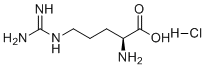
盐酸精氨酸是一种L-α-氨基酸。盐酸精氨酸是精氨酸的盐酸盐形式,精氨酸是青少年必需氨基酸。精氨酸是一种复杂的氨基酸,由于其氨基侧链,常存在于蛋白质和酶的活性位点。精氨酸可能有助于预防或治疗心血管系统疾病,对抗疲劳,并刺激免疫系统。它还能促进一氧化氮的生成,从而放松血管,治疗心绞痛和其他心血管疾病。精氨酸也是尿素循环和含氮废物解毒过程中的重要中间体。(NCI04) 生理活性形式为L-精氨酸的必需氨基酸。作用机制:补充L-精氨酸的许多作用,包括其潜在的抗动脉粥样硬化作用,可能与其作为一氧化氮(NO)前体的作用有关。一氧化氮(NO)由全身所有组织产生,并在心血管系统、免疫系统和神经系统中发挥着至关重要的作用。一氧化氮(NO)由一氧化氮合酶(NOS)催化L-精氨酸生成,其作用主要由3,5'-环磷酸鸟苷(cGMP)介导。NO激活鸟苷酸环化酶,后者催化鸟苷三磷酸(GTP)合成cGMP。cGMP随后被cGMP磷酸二酯酶转化为鸟苷酸核苷酸。NOS是一种含血红素的酶,其部分序列与细胞色素P-450还原酶相似。NOS存在多种同工酶,其中两种是组成型NOS,一种由免疫刺激诱导产生。存在于血管内皮细胞中的组成型NOS称为eNOS,存在于脑、脊髓和周围神经系统中的组成型NOS称为nNOS。由免疫或炎症刺激诱导产生的NOS称为iNOS。 iNOS 可在某些组织(例如肺上皮细胞)中组成型表达。所有一氧化氮合酶均以 NADPH(还原型烟酰胺腺嘌呤二核苷酸磷酸)和氧气 (O₂) 为辅底物,辅因子包括 FAD(黄素腺嘌呤二核苷酸)、FMN(黄素单核苷酸)、四氢生物蝶呤和血红素。有趣的是,抗坏血酸似乎可通过提高细胞内四氢生物蝶呤水平来增强 NOS 活性。eNOS 和 nNOS 在钙离子浓度升高时或在某些情况下,在非钙依赖性刺激(例如剪切应力)下合成 NO。NOS 的体外研究表明,该酶对 L-精氨酸的 Km 值在微摩尔范围内。内皮细胞、其他细胞和血浆中 L-精氨酸的浓度在毫摩尔范围内。这意味着在生理条件下,NOS 的底物 L-精氨酸已达到饱和。换句话说,L-精氨酸预计并非该酶的限速步骤,口服补充这种氨基酸可能导致 L-精氨酸浓度超过生理水平,但这似乎对 NO 的产生没有影响。该反应似乎已达到其最大水平。然而,体内研究表明,在某些情况下,例如高胆固醇血症,补充 L-精氨酸可以增强内皮依赖性血管舒张和 NO 的产生。药效学研究表明,L-精氨酸可以改善对细菌、病毒和肿瘤细胞的免疫反应;促进伤口愈合和肝脏再生;促进生长激素的释放;并且被认为是最佳肌肉生长和组织修复所必需的。
盐酸精氨酸(L-精氨酸盐酸盐)是一种氨基酸。本研究中,L-精氨酸并非用作治疗药物,而是作为一种成熟的工具,用于在啮齿动物中诱导急性胰腺炎。已知高剂量L-精氨酸可选择性地损伤胰腺腺泡细胞。本研究采用的模型包括间隔一小时的两次腹腔注射。这会导致严重的坏死性胰腺炎,其特征为体重减轻、血清淀粉酶升高、炎症、水肿、脂肪坏死、腺泡细胞凋亡以及关键炎症(NF-κB、MPO)和氧化应激(4-HNE)通路的激活。该模型被认为适用于研究急性胰腺炎的发病机制以及测试潜在的治疗药物,例如本文中使用的姜黄素。[5] |
| 分子式 |
C6H15CLN4O2
|
|---|---|
| 分子量 |
210.66
|
| 精确质量 |
210.088
|
| 元素分析 |
C, 34.21; H, 7.18; Cl, 16.83; N, 26.60; O, 15.19
|
| CAS号 |
1119-34-2
|
| 相关CAS号 |
DL-Arginine;7200-25-1;L-Arginine-15N2 hydrochloride;204633-92-1;L-Arginine-15N4 hydrochloride;204633-95-4;L-Arginine-d7 hydrochloride;204244-77-9;L-Arginine-13C6 hydrochloride;201740-91-2;L-Arginine-13C6,15N4 hydrochloride;202468-25-5;L-Arginine butanoate;80407-72-3;L-Arginine-1-13C hydrochloride;2483735-41-5;L-Arginine-13C6,15N4,d7 hydrochloride;2483829-29-2;L-Arginine-1,2-13C2 hydrochloride;201740-75-2;L-Arginine-13C hydrochloride;94740-43-9;L-Arginine-15N4,d7 hydrochloride
|
| PubChem CID |
66250
|
| 外观&性状 |
White to off-white solid powder
|
| 密度 |
1.42
|
| 沸点 |
409.1ºC at 760 mmHg
|
| 熔点 |
226-230 °C(lit.)
|
| 闪点 |
201.2ºC
|
| LogP |
1.354
|
| tPSA |
125.22
|
| 氢键供体(HBD)数目 |
5
|
| 氢键受体(HBA)数目 |
4
|
| 可旋转键数目(RBC) |
5
|
| 重原子数目 |
13
|
| 分子复杂度/Complexity |
176
|
| 定义原子立体中心数目 |
1
|
| SMILES |
C(C[C@@H](C(=O)O)N)CN=C(N)N.Cl
|
| InChi Key |
KWTQSFXGGICVPE-WCCKRBBISA-N
|
| InChi Code |
InChI=1S/C6H14N4O2.ClH/c7-4(5(11)12)2-1-3-10-6(8)9;/h4H,1-3,7H2,(H,11,12)(H4,8,9,10);1H/t4-;/m0./s1
|
| 化学名 |
(2S)-2-amino-5-(diaminomethylideneamino)pentanoic acid;hydrochloride
|
| 别名 |
NSC-203450; NSC203450; L-Arginine hydrochloride; 1119-34-2; Arginine Hydrochloride; L-ARGININE HCL; L-Arginine monohydrochloride; Arginine HCl; H-Arg-OH.HCl; R-Gene;NSC 203450; Arginine HCl; Detoxargin; Levargin; Arginine Hydrochloride
|
| HS Tariff Code |
2934.99.9001
|
| 存储方式 |
Powder -20°C 3 years 4°C 2 years In solvent -80°C 6 months -20°C 1 month 注意: 请将本产品存放在密封且受保护的环境中,避免吸湿/受潮。 |
| 运输条件 |
Room temperature (This product is stable at ambient temperature for a few days during ordinary shipping and time spent in Customs)
|
| 溶解度 (体外实验) |
H2O : ~100 mg/mL (~474.70 mM)
DMSO :< 1 mg/mL |
|---|---|
| 溶解度 (体内实验) |
配方 1 中的溶解度: 100 mg/mL (474.70 mM) in PBS (这些助溶剂从左到右依次添加,逐一添加), 澄清溶液; 超声助溶。
请根据您的实验动物和给药方式选择适当的溶解配方/方案: 1、请先配制澄清的储备液(如:用DMSO配置50 或 100 mg/mL母液(储备液)); 2、取适量母液,按从左到右的顺序依次添加助溶剂,澄清后再加入下一助溶剂。以 下列配方为例说明 (注意此配方只用于说明,并不一定代表此产品 的实际溶解配方): 10% DMSO → 40% PEG300 → 5% Tween-80 → 45% ddH2O (或 saline); 假设最终工作液的体积为 1 mL, 浓度为5 mg/mL: 取 100 μL 50 mg/mL 的澄清 DMSO 储备液加到 400 μL PEG300 中,混合均匀/澄清;向上述体系中加入50 μL Tween-80,混合均匀/澄清;然后继续加入450 μL ddH2O (或 saline)定容至 1 mL; 3、溶剂前显示的百分比是指该溶剂在最终溶液/工作液中的体积所占比例; 4、 如产品在配制过程中出现沉淀/析出,可通过加热(≤50℃)或超声的方式助溶; 5、为保证最佳实验结果,工作液请现配现用! 6、如不确定怎么将母液配置成体内动物实验的工作液,请查看说明书或联系我们; 7、 以上所有助溶剂都可在 Invivochem.cn网站购买。 |
| 制备储备液 | 1 mg | 5 mg | 10 mg | |
| 1 mM | 4.7470 mL | 23.7349 mL | 47.4699 mL | |
| 5 mM | 0.9494 mL | 4.7470 mL | 9.4940 mL | |
| 10 mM | 0.4747 mL | 2.3735 mL | 4.7470 mL |
1、根据实验需要选择合适的溶剂配制储备液 (母液):对于大多数产品,InvivoChem推荐用DMSO配置母液 (比如:5、10、20mM或者10、20、50 mg/mL浓度),个别水溶性高的产品可直接溶于水。产品在DMSO 、水或其他溶剂中的具体溶解度详见上”溶解度 (体外)”部分;
2、如果您找不到您想要的溶解度信息,或者很难将产品溶解在溶液中,请联系我们;
3、建议使用下列计算器进行相关计算(摩尔浓度计算器、稀释计算器、分子量计算器、重组计算器等);
4、母液配好之后,将其分装到常规用量,并储存在-20°C或-80°C,尽量减少反复冻融循环。
计算结果:
工作液浓度: mg/mL;
DMSO母液配制方法: mg 药物溶于 μL DMSO溶液(母液浓度 mg/mL)。如该浓度超过该批次药物DMSO溶解度,请首先与我们联系。
体内配方配制方法:取 μL DMSO母液,加入 μL PEG300,混匀澄清后加入μL Tween 80,混匀澄清后加入 μL ddH2O,混匀澄清。
(1) 请确保溶液澄清之后,再加入下一种溶剂 (助溶剂) 。可利用涡旋、超声或水浴加热等方法助溶;
(2) 一定要按顺序加入溶剂 (助溶剂) 。
Sickle Cell Disease Treatment With Arginine Therapy (STArT) Trial
CTID: NCT04839354
Phase: Phase 3 Status: Active, not recruiting
Date: 2024-07-03
InvivoChem的所有产品仅用于作科学研究,不面向患者销售
Copyright 2020 InvivoChem LLC | All Rights Reserved 粤ICP备20063088号-1


 粤公网安备 44011102003439号
 463611831
