| 规格 | 价格 | 库存 | 数量 |
|---|---|---|---|
| 50mg |
|
||
| 100mg |
|
||
| 250mg |
|
||
| 500mg |
|
||
| 1g |
|
||
| 5g |
|
||
| Other Sizes |
|

| 靶点 |
AMP-activated protein kinase (AMPK) / peroxisome proliferator-activated receptor-γ coactivator-1β (PGC-1β) / nuclear respiratory factor-1 (NRF-1) axis in mitochondria of hepatocytes in fish (Megalobrama amblycephala). [1]
|
|---|---|
| 体内研究 (In Vivo) |
在饲喂高碳水化合物(HC,43%碳水化合物)饲料的团头鲂幼鱼中,日粮中添加 1.425 mg/kg 的 benfotiamine 饲喂12周,与单独饲喂 HC 饲料的鱼相比,改善了生长性能(增加了终末体重、增重率、特定生长率)。
日粮中添加 1.425 mg/kg 的 benfotiamine 改善了 HC 饲料诱导的代谢紊乱。它显著提高了血浆胰岛素水平以及组织(肝脏、肌肉、脂肪)糖原和脂质含量,同时显著降低了鱼体内的血浆葡萄糖、糖化血清蛋白(GSP)和晚期糖基化终末产物(AGEs)水平。 Benfotiamine 补充(1.425 mg/kg)提高了鱼肝脏中磷酸化 AMPKα 与总 AMPKα 蛋白的比率以及 PGC-1β 的蛋白表达。 Benfotiamine 补充(1.425 mg/kg)上调了肝脏中与线粒体生物合成和融合相关基因的 mRNA 转录,包括 AMPKα-2、PGC-1β、NRF-1、线粒体转录因子 A (TFAM)、线粒体融合蛋白1 (Mfn-1) 和视神经萎缩蛋白1 (Opa-1)。相反,它下调了与线粒体分裂相关基因的转录,如动力相关蛋白1 (Drp-1)、分裂蛋白1 (Fis-1) 和线粒体分裂因子 (Mff)。 Benfotiamine 补充(1.425 mg/kg)提高了鱼肝脏中线粒体呼吸链复合物 I、II、III、IV 和 V 的活性。 Benfotiamine 补充(1.425 mg/kg)提高了肝脏中线粒体功能相关基因的 mRNA 转录,包括细胞色素 b (CYT-b)、细胞色素 c 氧化酶-2 (COX-2) 和 ATP 合酶-6 (ATP-6)。 在此鱼模型 HC 饲料条件下,改善生长和线粒体功能的最佳日粮剂量为 1.425 mg/kg。更高剂量(2.85 和 5.7 mg/kg)未提供额外益处,且最高剂量甚至损害了生长。[1] |
| 酶活实验 |
在分离的肝脏线粒体中测量了线粒体呼吸链复合物的活性。简要步骤如下:将肝脏样本在含有 KH2PO4、蔗糖和 EDTA 的冰冷提取介质中匀浆。匀浆液低速离心,保留上清液。通过进一步离心获得线粒体部分。将沉淀物(线粒体沉淀)洗涤、重悬并保存。测定线粒体蛋白浓度。使用已建立的分光光度法或其他生化方法测量复合物 I、II、III、IV 和 V 的活性。复合物 I-III 活性根据参考文献方法测量。复合物 IV 和 V 活性使用另一参考文献方法进行分析。活性以纳摩尔/分钟/毫克蛋白表示。[1]
|
| 动物实验 |
360尾幼年钝吻鲷(平均初始体重:45.25 ± 0.34 g)被随机分配到24个水箱中(每个水箱15尾)。这些鱼被喂食六种不同的实验饲料,持续12周。这些饲料包括:对照组饲料(碳水化合物含量30%,C)、高碳水化合物组饲料(碳水化合物含量43%,HC)以及在HC组饲料中添加四种不同浓度的苯磷硫胺:0.7125 (HCB1)、1.425 (HCB2)、2.85 (HCB3) 和 5.7 (HCB4) mg/kg。苯磷硫胺在饲料配制过程中混入饲料中。每天喂食三次(07:00、12:00 和 17:00),直至鱼达到视觉饱食状态。水温维持在 27.4 ± 0.6°C,光照周期为 12 小时光照:12 小时黑暗,溶解氧高于 5.0 mg/L。12 周饲喂期结束后,鱼禁食 24 小时,麻醉后采集血液和组织(肝脏、肌肉、脂肪组织)进行分析。[1]
|
| 毒性/毒理 (Toxicokinetics/TK) |
在饲料中添加 5.7 mg/kg 的苯磷硫胺(最高测试剂量)显著降低了鱼的最终体重、增重率和特定生长率,与最佳剂量组相比,表明在实验条件下,该高剂量可能具有抑制生长的作用。在为期 12 周的试验中,所有组均未观察到死亡。该研究未提供具体的毒性数据,例如 LD50、器官组织病理学或器官损伤的血浆生化标志物。[1]
|
| 参考文献 |
|
| 其他信息 |
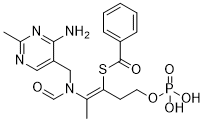
苯磷硫胺是一种硫酯,是硫胺素的合成类似物,通过噻唑环的酰化裂解和O-磷酸化得到。它具有免疫佐剂、营养保健品、抗氧化剂、维生素原B1和保护剂等作用。它是一种氨基嘧啶,属于甲酰胺类化合物、有机磷酸酯和硫酯。其功能与硫胺素(1+)相关。苯磷硫胺已被研究用于治疗和预防糖尿病肾病和2型糖尿病。另见:苯磷硫胺(注释已移至)。苯磷硫胺可用作膳食补充剂,用于治疗糖尿病并发症。它可以通过阻断与高血糖损伤相关的三个主要通路来改善葡萄糖稳态:己糖胺通路、晚期糖基化终产物 (AGEs) 形成通路和二酰甘油 (DAG)-蛋白激酶 C 通路。
苯磷硫胺 可以通过提高细胞内硫胺素二磷酸 (TPP) 水平来增强脱氢酶复合物的活性,从而增加线粒体中的葡萄糖氧化。 苯磷硫胺 可以缓解线粒体电子传递链中超氧阴离子过度产生引起的应激。 在这项鱼类研究中,苯磷硫胺 通过激活 AMPK/PGC-1β/NRF-1 轴、上调线粒体融合基因、增强线粒体呼吸链复合物活性和抑制线粒体分裂,改善了肝脏中的线粒体生物合成和功能。 [1] |
| 分子式 |
C19H23N4O6PS
|
|---|---|
| 分子量 |
466.4488
|
| 精确质量 |
466.107
|
| CAS号 |
22457-89-2
|
| 相关CAS号 |
147317-17-7 (semihydrate);22457-89-2 (free acid);
|
| PubChem CID |
3032771
|
| 外观&性状 |
White to off-white solid powder
|
| 密度 |
1.4±0.1 g/cm3
|
| 沸点 |
745.1±70.0 °C at 760 mmHg
|
| 熔点 |
165ºC
|
| 闪点 |
404.4±35.7 °C
|
| 蒸汽压 |
0.0±2.6 mmHg at 25°C
|
| 折射率 |
1.645
|
| LogP |
1.81
|
| tPSA |
191.05
|
| 氢键供体(HBD)数目 |
3
|
| 氢键受体(HBA)数目 |
10
|
| 可旋转键数目(RBC) |
10
|
| 重原子数目 |
31
|
| 分子复杂度/Complexity |
697
|
| 定义原子立体中心数目 |
0
|
| SMILES |
CC1=NC=C(C(=N1)N)CN(C=O)/C(=C(/CCOP(=O)(O)O)\SC(=O)C2=CC=CC=C2)/C
|
| InChi Key |
BTNNPSLJPBRMLZ-LGMDPLHJSA-N
|
| InChi Code |
InChI=1S/C19H23N4O6PS/c1-13(23(12-24)11-16-10-21-14(2)22-18(16)20)17(8-9-29-30(26,27)28)31-19(25)15-6-4-3-5-7-15/h3-7,10,12H,8-9,11H2,1-2H3,(H2,20,21,22)(H2,26,27,28)/b17-13-
|
| 化学名 |
S-[(Z)-2-[(4-amino-2-methylpyrimidin-5-yl)methyl-formylamino]-5-phosphonooxypent-2-en-3-yl] benzenecarbothioate
|
| 别名 |
CB 8088 Berdi Betivina BiotaminBRN-0771326 BTMP CB-8088 CB8088 Benfotiamine S-benzoylthiamine O-monophosphate
|
| HS Tariff Code |
2934.99.9001
|
| 存储方式 |
Powder -20°C 3 years 4°C 2 years In solvent -80°C 6 months -20°C 1 month |
| 运输条件 |
Room temperature (This product is stable at ambient temperature for a few days during ordinary shipping and time spent in Customs)
|
| 溶解度 (体外实验) |
DMSO : ≥ 50 mg/mL (~107.19 mM)
H2O : ~0.67 mg/mL (~1.44 mM) |
|---|---|
| 溶解度 (体内实验) |
配方 1 中的溶解度: ≥ 3 mg/mL (6.43 mM) (饱和度未知) in 10% DMSO + 40% PEG300 + 5% Tween80 + 45% Saline (这些助溶剂从左到右依次添加,逐一添加), 澄清溶液。
例如,若需制备1 mL的工作液,可将100 μL 30.0 mg/mL 澄清的 DMSO 储备液加入到400 μL PEG300中,混匀;再向上述溶液中加入50 μL Tween-80,混匀;然后加入450 μL 生理盐水定容至1 mL。 *生理盐水的制备:将 0.9 g 氯化钠溶解在 100 mL ddH₂O中,得到澄清溶液。 配方 2 中的溶解度: ≥ 3 mg/mL (6.43 mM) (饱和度未知) in 10% DMSO + 90% (20% SBE-β-CD in Saline) (这些助溶剂从左到右依次添加,逐一添加), 澄清溶液。 例如,若需制备1 mL的工作液,可将 100 μL 30.0 mg/mL澄清DMSO储备液加入900 μL 20% SBE-β-CD生理盐水溶液中,混匀。 *20% SBE-β-CD 生理盐水溶液的制备(4°C,1 周):将 2 g SBE-β-CD 溶解于 10 mL 生理盐水中,得到澄清溶液。 View More
配方 3 中的溶解度: ≥ 3 mg/mL (6.43 mM) (饱和度未知) in 10% DMSO + 90% Corn Oil (这些助溶剂从左到右依次添加,逐一添加), 澄清溶液。 配方 4 中的溶解度: 3.12 mg/mL (6.69 mM) in PBS (这些助溶剂从左到右依次添加,逐一添加), 澄清溶液; 超声助溶 (<60°C). 1、请先配制澄清的储备液(如:用DMSO配置50 或 100 mg/mL母液(储备液)); 2、取适量母液,按从左到右的顺序依次添加助溶剂,澄清后再加入下一助溶剂。以 下列配方为例说明 (注意此配方只用于说明,并不一定代表此产品 的实际溶解配方): 10% DMSO → 40% PEG300 → 5% Tween-80 → 45% ddH2O (或 saline); 假设最终工作液的体积为 1 mL, 浓度为5 mg/mL: 取 100 μL 50 mg/mL 的澄清 DMSO 储备液加到 400 μL PEG300 中,混合均匀/澄清;向上述体系中加入50 μL Tween-80,混合均匀/澄清;然后继续加入450 μL ddH2O (或 saline)定容至 1 mL; 3、溶剂前显示的百分比是指该溶剂在最终溶液/工作液中的体积所占比例; 4、 如产品在配制过程中出现沉淀/析出,可通过加热(≤50℃)或超声的方式助溶; 5、为保证最佳实验结果,工作液请现配现用! 6、如不确定怎么将母液配置成体内动物实验的工作液,请查看说明书或联系我们; 7、 以上所有助溶剂都可在 Invivochem.cn网站购买。 |
| 制备储备液 | 1 mg | 5 mg | 10 mg | |
| 1 mM | 2.1439 mL | 10.7193 mL | 21.4385 mL | |
| 5 mM | 0.4288 mL | 2.1439 mL | 4.2877 mL | |
| 10 mM | 0.2144 mL | 1.0719 mL | 2.1439 mL |
1、根据实验需要选择合适的溶剂配制储备液 (母液):对于大多数产品,InvivoChem推荐用DMSO配置母液 (比如:5、10、20mM或者10、20、50 mg/mL浓度),个别水溶性高的产品可直接溶于水。产品在DMSO 、水或其他溶剂中的具体溶解度详见上”溶解度 (体外)”部分;
2、如果您找不到您想要的溶解度信息,或者很难将产品溶解在溶液中,请联系我们;
3、建议使用下列计算器进行相关计算(摩尔浓度计算器、稀释计算器、分子量计算器、重组计算器等);
4、母液配好之后,将其分装到常规用量,并储存在-20°C或-80°C,尽量减少反复冻融循环。
计算结果:
工作液浓度: mg/mL;
DMSO母液配制方法: mg 药物溶于 μL DMSO溶液(母液浓度 mg/mL)。如该浓度超过该批次药物DMSO溶解度,请首先与我们联系。
体内配方配制方法:取 μL DMSO母液,加入 μL PEG300,混匀澄清后加入μL Tween 80,混匀澄清后加入 μL ddH2O,混匀澄清。
(1) 请确保溶液澄清之后,再加入下一种溶剂 (助溶剂) 。可利用涡旋、超声或水浴加热等方法助溶;
(2) 一定要按顺序加入溶剂 (助溶剂) 。
| NCT Number | Recruitment | interventions | Conditions | Sponsor/Collaborators | Start Date | Phases |
| NCT02292238 | COMPLETEDWITH RESULTS | Drug: Benfotiamine | Alzheimer's Disease | Burke Medical Research Institute | 2015-02-15 | Phase 2 |
| NCT01868191 | UNKNOWN STATUS | Drug: Benfotiamine Drug: Placebo for benfotiamine |
Diabetic Neuropathies | Diabetes Schwerpunktpraxis | 2013-07 | Phase 3 |
| NCT00565318 | COMPLETED | Drug: Benfotiamine Drug: Placebo |
Diabetic Nephropathy | University Medical Center Groningen | 2007-12 | Phase 4 |
| NCT00785460 | COMPLETED | Drug: Benfotiamine | Healthy Subjects | Ruhr University of Bochum | 2008-01 | Phase 3 |
| NCT03892707 | COMPLETEDWITH RESULTS | Drug: Exposure of interest (within routine clinical practice): Vitamin B complexes Milgamma® and Milgamma® compositum |
Acute Non-specific Low Back Pain | Woerwag Pharma LLC | 2018-12-15 |
|
|
|
InvivoChem的所有产品仅用于作科学研究,不面向患者销售
Copyright 2020 InvivoChem LLC | All Rights Reserved 粤ICP备20063088号-1


 粤公网安备 44011102003439号
 463611831
