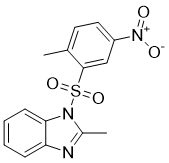
BI6015

别名: BI6015 BI-6015 BI 6015
目录号: V7204 纯度: ≥98%
BI-6015 是一种肝细胞核因子 4α (HNF4α) 拮抗剂,可以抑制已知 HNF4α 靶基因的表达。
BI6015 CAS号: 93987-29-2
产品类别: New12
产品仅用于科学研究,不针对患者销售
规格 价格 库存 数量
5mg
10mg
25mg
50mg
100mg
250mg
500mg
Other Sizes
点击了解更多
  • 与全球5000+客户建立关系
  • 覆盖全球主要大学、医院、科研院所、生物/制药公司等
  • 产品被大量CNS顶刊文章引用
InvivoChem产品被CNS等顶刊论文引用
产品描述
BI-6015 是一种肝细胞核因子 4α (HNF4α) 拮抗剂,可以抑制已知 HNF4α 靶基因的表达。 BI6015 通过 HNF4α 拮抗作用抑制胰岛素启动子活性。 BI-6015 可用于癌症和糖尿病研究。
生物活性&实验参考方法
体外研究 (In Vitro)
人肝细胞癌 (HCC) 对 BI-6015 (1.25–20 μM;24-72 h) 具有细胞毒性 [1]。在 HepG2 细胞中,BI-6015(2.5-10 μM;5-48 小时)抑制 HNF4α 基因。原代小鼠肝细胞暴露于 BI-6015(5 μM;3 d),会导致肝脂肪变性 [1]。
体内研究 (In Vivo)
BI-6015 Senses 研究 HNF4α 表达和肝脂肪变性;每天一次腹腔注射,连续五天,剂量为 10-30 mg/kg [1]。在人肝细胞癌模型中,BI-6015(10-30 mg/kg;每天腹膜内注射或每天一次,持续 20-57 天)可进行细胞灭菌[1]。
细胞实验
细胞活力测定 [1]
细胞类型: Hep3B-Luc 细胞和原代肝细胞
测试浓度: 1.25,表达 [1]。 2.5、5、10、20 μM
孵育时间:24、48、72 hrs(小时)
实验结果:对 Hep3B 有明显毒性细胞,但不影响原代肝细胞。
参考文献
[1]. Kiselyuk A, et, al. HNF4α antagonists discovered by a high-throughput screen for modulators of the human insulin promoter. Chem Biol. 2012 Jul 27;19(7):806-18.
*注: 文献方法仅供参考, InvivoChem并未独立验证这些方法的准确性
化学信息 & 存储运输条件
分子式
C15H13N3O4S
分子量
331.35
精确质量
331.062
元素分析
C, 54.37; H, 3.95; N, 12.68; O, 19.31; S, 9.68
CAS号
93987-29-2
PubChem CID
3269393
外观&性状
Solid powder
密度
1.5±0.1 g/cm3
沸点
570.6±60.0 °C at 760 mmHg
闪点
298.9±32.9 °C
蒸汽压
0.0±1.6 mmHg at 25°C
折射率
1.679
LogP
3.53
tPSA
106.16
氢键供体(HBD)数目
0
氢键受体(HBA)数目
5
可旋转键数目(RBC)
2
重原子数目
23
分子复杂度/Complexity
556
定义原子立体中心数目
0
SMILES
[O-][N+](C1C=C(S(N2C(C)=NC3C2=CC=CC=3)(=O)=O)C(C)=CC=1)=O
InChi Key
ILVCPQPMRPHZSG-UHFFFAOYSA-N
InChi Code
InChI=1S/C15H13N3O4S/c1-10-7-8-12(18(19)20)9-15(10)23(21,22)17-11(2)16-13-5-3-4-6-14(13)17/h3-9H,1-2H3
化学名
2-methyl-1-(2-methyl-5-nitrophenyl)sulfonylbenzimidazole
别名
BI6015 BI-6015 BI 6015
HS Tariff Code
2934.99.9001
存储方式

Powder      -20°C    3 years

                     4°C     2 years

In solvent   -80°C    6 months

                  -20°C    1 month

运输条件
Room temperature (This product is stable at ambient temperature for a few days during ordinary shipping and time spent in Customs)
溶解度数据
溶解度 (体外实验)
DMSO : ~50 mg/mL (~150.90 mM)
溶解度 (体内实验)
配方 1 中的溶解度: ≥ 2.5 mg/mL (7.54 mM) (饱和度未知) in 10% DMSO + 90% Corn Oil (这些助溶剂从左到右依次添加,逐一添加), 澄清溶液。
例如,若需制备1 mL的工作液,可将100 μL 25.0 mg/mL 澄清 DMSO 储备液加入900 μL 玉米油中,混合均匀。

请根据您的实验动物和给药方式选择适当的溶解配方/方案:
1、请先配制澄清的储备液(如:用DMSO配置50 或 100 mg/mL母液(储备液));
2、取适量母液,按从左到右的顺序依次添加助溶剂,澄清后再加入下一助溶剂。以 下列配方为例说明 (注意此配方只用于说明,并不一定代表此产品 的实际溶解配方):
10% DMSO → 40% PEG300 → 5% Tween-80 → 45% ddH2O (或 saline);
假设最终工作液的体积为 1 mL, 浓度为5 mg/mL: 取 100 μL 50 mg/mL 的澄清 DMSO 储备液加到 400 μL PEG300 中,混合均匀/澄清;向上述体系中加入50 μL Tween-80,混合均匀/澄清;然后继续加入450 μL ddH2O (或 saline)定容至 1 mL;

3、溶剂前显示的百分比是指该溶剂在最终溶液/工作液中的体积所占比例;
4、 如产品在配制过程中出现沉淀/析出,可通过加热(≤50℃)或超声的方式助溶;
5、为保证最佳实验结果,工作液请现配现用!
6、如不确定怎么将母液配置成体内动物实验的工作液,请查看说明书或联系我们;
7、 以上所有助溶剂都可在 Invivochem.cn网站购买。
制备储备液 1 mg 5 mg 10 mg
1 mM 3.0180 mL 15.0898 mL 30.1796 mL
5 mM 0.6036 mL 3.0180 mL 6.0359 mL
10 mM 0.3018 mL 1.5090 mL 3.0180 mL

1、根据实验需要选择合适的溶剂配制储备液 (母液):对于大多数产品,InvivoChem推荐用DMSO配置母液 (比如:5、10、20mM或者10、20、50 mg/mL浓度),个别水溶性高的产品可直接溶于水。产品在DMSO 、水或其他溶剂中的具体溶解度详见上”溶解度 (体外)”部分;

2、如果您找不到您想要的溶解度信息,或者很难将产品溶解在溶液中,请联系我们;

3、建议使用下列计算器进行相关计算(摩尔浓度计算器、稀释计算器、分子量计算器、重组计算器等);

4、母液配好之后,将其分装到常规用量,并储存在-20°C或-80°C,尽量减少反复冻融循环。

计算器

摩尔浓度计算器可计算特定溶液所需的质量、体积/浓度,具体如下:

  • 计算制备已知体积和浓度的溶液所需的化合物的质量
  • 计算将已知质量的化合物溶解到所需浓度所需的溶液体积
  • 计算特定体积中已知质量的化合物产生的溶液的浓度
使用摩尔浓度计算器计算摩尔浓度的示例如下所示:
假如化合物的分子量为350.26 g/mol,在5mL DMSO中制备10mM储备液所需的化合物的质量是多少?
  • 在分子量(MW)框中输入350.26
  • 在“浓度”框中输入10,然后选择正确的单位(mM)
  • 在“体积”框中输入5,然后选择正确的单位(mL)
  • 单击“计算”按钮
  • 答案17.513 mg出现在“质量”框中。以类似的方式,您可以计算体积和浓度。

稀释计算器可计算如何稀释已知浓度的储备液。例如,可以输入C1、C2和V2来计算V1,具体如下:

制备25毫升25μM溶液需要多少体积的10 mM储备溶液?
使用方程式C1V1=C2V2,其中C1=10mM,C2=25μM,V2=25 ml,V1未知:
  • 在C1框中输入10,然后选择正确的单位(mM)
  • 在C2框中输入25,然后选择正确的单位(μM)
  • 在V2框中输入25,然后选择正确的单位(mL)
  • 单击“计算”按钮
  • 答案62.5μL(0.1 ml)出现在V1框中
g/mol

分子量计算器可计算化合物的分子量 (摩尔质量)和元素组成,具体如下:

注:化学分子式大小写敏感:C12H18N3O4  c12h18n3o4
计算化合物摩尔质量(分子量)的说明:
  • 要计算化合物的分子量 (摩尔质量),请输入化学/分子式,然后单击“计算”按钮。
分子质量、分子量、摩尔质量和摩尔量的定义:
  • 分子质量(或分子量)是一种物质的一个分子的质量,用统一的原子质量单位(u)表示。(1u等于碳-12中一个原子质量的1/12)
  • 摩尔质量(摩尔重量)是一摩尔物质的质量,以g/mol表示。
/

配液计算器可计算将特定质量的产品配成特定浓度所需的溶剂体积 (配液体积)

  • 输入试剂的质量、所需的配液浓度以及正确的单位
  • 单击“计算”按钮
  • 答案显示在体积框中
动物体内实验配方计算器(澄清溶液)
第一步:请输入基本实验信息(考虑到实验过程中的损耗,建议多配一只动物的药量)
第二步:请输入动物体内配方组成(配方适用于不溶/难溶于水的化合物),不同的产品和批次配方组成不同,如对配方有疑问,可先联系我们提供正确的体内实验配方。此外,请注意这只是一个配方计算器,而不是特定产品的确切配方。
+
+
+

计算结果:

工作液浓度 mg/mL;

DMSO母液配制方法 mg 药物溶于 μL DMSO溶液(母液浓度 mg/mL)。如该浓度超过该批次药物DMSO溶解度,请首先与我们联系。

体内配方配制方法μL DMSO母液,加入 μL PEG300,混匀澄清后加入μL Tween 80,混匀澄清后加入 μL ddH2O,混匀澄清。

(1) 请确保溶液澄清之后,再加入下一种溶剂 (助溶剂) 。可利用涡旋、超声或水浴加热等方法助溶;
            (2) 一定要按顺序加入溶剂 (助溶剂) 。

生物数据图片
  • BIM5078 and BI6015 repress insulin promoter activity through HNF4α antagonism (a, b) Direct binding based on quenching of HNF4α aromatic amino acid fluorescence emission. Full-length HNF4α protein (100nM) in 2mL PBS was titrated with increasing concentrations of BIM5078 (a) or FK614 (b). The data are presented as the change in fluorescence intensity (Fo – F) plotted as a function of ligand concentration. Values represent the mean ± SE, n=3. Insets, linear plot of the binding curve from each panel. (c) DARTS assay. HepG2 cells were treated with DMSO (lane 1), BI6018 (lane 2), FK614 (lane 3), BIM5078 (lane 4) or BI6015 (lane 5) at a concentration of 20μM for 24hr. Total cell protein was extracted and each sample was split into three aliquots for proteolysis without (−) or with (+) subtilisin (left panels) or for Coomassie (InstantBlue) staining (middle panels) as a control to ensure that the compounds did not induce nonspecific proteolysis. Lane M-MW markers. Western blots were quantified using ImageJ software, demonstrating a statistically significant effect of BI6015 on subtilisin sensitivity. Values represent the mean ± SE of 3 biological replicates. *p<0.05.[1]. Kiselyuk A, et, al. HNF4α antagonists discovered by a high-throughput screen for modulators of the human insulin promoter. Chem Biol. 2012 Jul 27;19(7):806-18.
  • BIM5078 and BI6015 affect the expression of known HNF4α target genes (a, b and c) HNF4α antagonists BIM5078 and BI6015, repress HNF4α gene expression. T6PNE (a), MIN6 (b) and HepG2 (c) cells were cultured for 5 (b) or 48 (a, c) hours in the presence of BIM5078 or BI6015. HNF4α mRNA levels were normalized to 18S rRNA (a, c) or GAPDH (b) to control for nonspecific compound effects. Differences in expression were measured by Student’s t-test (*p<0.05, **p<0.002). (d) Effect of BI6015 on the OTC promoter. pGL3/mOTC-235, a plasmid containing the HNF4α-responsive OTC promoter driving the firefly luciferase gene, was co-transfected into HepG2 and CV-1 cells with a plasmid encoding full length human HNF4α. Cells were treated with DMSO or 1μM BI6015 for 48 hours. HepG2 cells had greater baseline stimulation of the OTC-luciferase transgene than CV-1 cells and BI6015 potently reduced this baseline activity in both cell lines. Values represent the mean ± SE, n=3. Differences in activity were measured by Student’s t-test (*p<0.05, **p<0.001). [1]. Kiselyuk A, et, al. HNF4α antagonists discovered by a high-throughput screen for modulators of the human insulin promoter. Chem Biol. 2012 Jul 27;19(7):806-18.
  • BIM5078 and BI6015 affect the expression and binding of E47-responsive genes (a) Microarray data was analyzed using GeneSpring GX11. Of 214 genes whose expression changed with BIM5078 treatment, 67 (p<0.001) were also altered by induction of E47 in T6PNE cells. (b) Analysis in (a) was restricted to genes with promoter regions [−2kb, 2kb] around transcription start sites containing E-boxes (CANNTG). (c) HNF4α antagonists, BIM5078 and BI6015, reduced Kip2 mRNA in T6PNE cells. FK614 had no effect on Kip2 expression. Kip2 mRNA values are reported as normalized to 18s rRNA to control for nonspecific compound effects. Differences in expression between vehicle (DMSO) and BIM5078 or BI6015 were measured by Student’s t-test (*p<0.05, **p<0.01, NS = no significance). (d and e) BIM5078 decreases association of E47 and PDX-1 to the human insulin promoter. T6PNE cells were treated with 1μM tamoxifen and DMSO or 5μM BIM5078 for 48 hours followed by ChIP with anti-E47 antibody and anti-PDX-1 antibody. Q-PCR was performed with primers targeting E-box and A-box elements in the insulin promoter. [1]. Kiselyuk A, et, al. HNF4α antagonists discovered by a high-throughput screen for modulators of the human insulin promoter. Chem Biol. 2012 Jul 27;19(7):806-18.
相关产品
联系我们