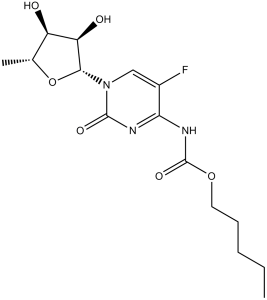
Capecitabine (Xeloda)

别名: Capecitabine; RO09-1978; Ro-091978000; Ro 091978000; Ro091978000; RO-09-1978; RO 09-1978; Abbreviation: CAPE. Trade name: Xeloda 卡培他滨; 5'-脱氧-5-氟-N-[(戊氧基)羰基]胞啶; 卡培他滨;卡培西他滨;卡培他宾;卡陪他宾;5'-脱氧-5-氟-N-[(戊氧基)羰基]-胞苷; 5-脱氧-5-氟-N-[(戊氧基)羰基]-胞嘧啶核甙;5-脱氧-5-氟-N-[(戊氧基)羰基]-胞嘧啶核苷;卡培西他滨;卡培他宾;Capecitabine; 卡培他滨; 卡倍他滨杂质对照品 ;卡陪他宾;卡陪他滨;卡培他滨 EP标准品;卡培他滨 USP标准品;卡培他滨 标准品;卡培他滨(希罗达)
目录号: V1454 纯度: =99.46%
卡培他滨(原RO 09-1978;RO-09-1978;RO09-1978;CAPE;商品名:Xeloda)是一种批准用于治疗乳腺癌、胃癌和结直肠癌的抗癌化疗药物。
Capecitabine (Xeloda) CAS号: 154361-50-9
产品类别: DNA(RNA) Synthesis
产品仅用于科学研究,不针对患者销售
规格 价格 库存 数量
10mg
50mg
100mg
500mg
1g
2g
5g
10g
50g
Other Sizes
点击了解更多
  • 与全球5000+客户建立关系
  • 覆盖全球主要大学、医院、科研院所、生物/制药公司等
  • 产品被大量CNS顶刊文章引用
InvivoChem产品被CNS等顶刊论文引用
纯度/质量控制文件

纯度: =99.46%

产品描述
卡培他滨(原 RO 09-1978;RO-09-1978;RO09-1978;CAPE;商品名:希罗达)是一种被批准用于治疗乳腺癌、胃癌和结直肠癌的抗癌化疗药物。它是一种氟嘧啶氨基甲酸酯前药,必须在体内转化为活性形式/代谢物,即 5-氟尿嘧啶 (5-FU)。
生物活性&实验参考方法
靶点
DNA/RNA Synthesis
Thymidylate synthase (TS; IC50=0.1 μM, inhibited by active metabolite 5-fluorouracil [5-FU]) [2]
- DNA synthesis (inhibition via incorporation of 5-FU into DNA; EC50 for human tumor cell lines: 5-50 μM, varies by cell type) [1]
- RNA synthesis (interference via 5-FU incorporation into RNA; ) [2]
体外研究 (In Vitro)
当在与 HepG2 肝癌相同的平板中培养时,LS174T WT 和 LS174T-c2 细胞对卡培他滨表现出显着更高的敏感性,单独 LS174T WT 和与 HepG2 一起培养的 IC50 值分别为 890 和 630 μM。此外,对于 LS174T-C2 亚系,当与肝癌细胞在同一平板中培养时,IC50 从 330 ± 4 降至 89 ± 6 μm。此外,卡培他滨以 Fas 依赖性方式诱导细胞凋亡,在胸苷磷酸化酶 (TP) 转染的 LS174T-c2 细胞中显示出高 7 倍的细胞毒性和明显更强的凋亡潜力。细胞测定:将 HepG2 和 LS174T WT 或 LS174T-c2 细胞分别接种到 96 孔板中 8 孔条形膜的顶部和底部室中。呈指数增长的细胞暴露于浓度不断增加的卡培他滨。当实验中使用后者时,培养基中补充有 750 ng/mL ZB4 MoAB 或 100 ng/mL BR17 MoAB。连续暴露 72 小时后,使用经典的比色 MTT 测试评估 LS174T 的活力。
72小时暴露后,对人结直肠癌细胞系(HT-29、HCT-116)具有抗增殖活性,IC50分别为12 μM和18 μM;诱导S期细胞周期阻滞和凋亡,表现为膜联蛋白V阳性率升高和caspase-3活性增强[1]
- 72小时处理对人乳腺癌细胞系MCF-7的生长具有抑制作用,IC50为25 μM;50 μM浓度下克隆形成效率较未处理对照组降低70%[3]
- 与亚叶酸联合使用时增强HT-29细胞中TS的抑制作用;10 μM 卡培他滨(Xeloda)联合5 μM亚叶酸,TS抑制率从45%提升至75%[2]
- 对5-FU耐药的人胃癌细胞系SGC-7901具有细胞毒性,IC50为42 μM;活性通过耐药细胞中胸苷磷酸化酶(TP)表达升高介导[3]
体内研究 (In Vivo)
在研究的人类癌症异种移植模型中,卡培他滨比5-FU、UFT或其中间代谢物5-DFUR在更宽的剂量范围内更有效,并且具有更广谱的抗肿瘤活性,这可以与肿瘤dThdPase水平相关。卡培他滨在高转移性裸鼠模型中抑制人肝细胞癌(HCC)切除后的肿瘤生长和转移复发,这归因于肿瘤中血小板源性内皮细胞生长因子的高表达。
抑制裸鼠HT-29结直肠癌异种移植瘤生长;每日两次口服100 mg/kg,持续14天,肿瘤生长抑制率(TGI)达75%(相较于溶媒对照组)[1]
- 抑制裸鼠MCF-7乳腺癌异种移植瘤进展;每日口服150 mg/kg,持续3周,肿瘤体积缩小68%,中位生存期延长10天[3]
- 在大鼠结直肠癌腹膜转移模型中展现疗效;每日口服80 mg/kg,持续21天,腹膜肿瘤结节减少60%,腹水生成量降低[1]
酶活实验
采用纯化的人TS测定胸苷酸合成酶活性;将酶与0.05-5 μM 5-FU(卡培他滨(Xeloda)的活性代谢产物)、5,10-亚甲基四氢叶酸(辅因子)和脱氧尿苷一磷酸(dUMP,底物)在37°C下孵育45分钟;通过HPLC测定胸苷一磷酸(dTMP)的生成量,以确定抑制效率并计算IC50[2]
- 评估胸苷磷酸化酶(TP)介导的卡培他滨(Xeloda)激活;将10-100 μM 卡培他滨(Xeloda)与纯化的人TP和磷酸盐缓冲液(pH 7.4)在37°C下孵育60分钟;通过HPLC定量5-FU的生成量以评估激活速率[2]
细胞实验
在 96 孔板中,将 HepG2 和 LS174T WT 或 LS174T-c2 细胞分别接种在 8 孔条形膜的上室和下室中。呈指数扩张的细胞受到卡培他滨水平不断升高的影响。当实验中使用 BR17 MoAB 时,除了 750 ng/mL 的 ZB4 MoAB 之外,还向培养基中添加 100 ng/mL 的 moab。传统的比色 MTT 测试用于评估 LS174T 在连续暴露 72 小时后的活力。
在96孔板中接种HT-29结直肠癌细胞,每孔3×10³个;贴壁24小时后,用1-100 μM 卡培他滨(Xeloda)处理72小时;采用MTT法测定细胞活力,碘化丙啶染色后流式细胞术分析细胞周期分布,膜联蛋白V-FITC/PI双染色检测凋亡[1]
- 在6孔板中培养MCF-7乳腺癌细胞,每孔5×10³个;贴壁24小时后,暴露于5-50 μM 卡培他滨(Xeloda)48小时;洗涤细胞后在无药培养基中培养14天;甲醇固定并结晶紫染色;计数细胞数>50的克隆以确定克隆形成抑制率[3]
- 在24孔板中接种SGC-7901胃癌细胞;用卡培他滨(Xeloda)(10-80 μM)单独或与TP抑制剂(1 μM)联合处理72小时;通过caspase-8活性测定和PARP裂解免疫印迹检测凋亡细胞;RT-PCR定量TP mRNA表达[3]
动物实验
小鼠:采用6周龄C57/Bl6 Nu/Nu小鼠。实验方法为:每侧皮下注射10⁷个细胞,以建立双侧HCT 116异种移植瘤。对携带HCT 116异种移植瘤的小鼠进行治疗,连续5天(第0-4天、第7-11天、第14-18天)每日灌胃一次,分别给予赋形剂或卡培他滨0.52或2.1 mmol/kg(分别为563和2250 mg/m²)。在第0天15、30分钟、1、2、4、8和24小时,以及第7天和第14天(在预定治疗疗程开始前),处死小鼠。每个时间点检查3只小鼠。在肝素抗凝状态下采集血液,分离血浆并保存于-80℃。取出肝脏后立即置于RNAlater溶液中保存。去除纤维化组织和血管后,对肿瘤进行肉眼解剖,并用液氮冷冻。将2×10⁶个HT-29结直肠癌细胞皮下植入6-7周龄的裸鼠体内;当肿瘤体积达到100 mm³时,将卡培他滨(希罗达)悬浮于0.5%羧甲基纤维素钠溶液中,以100 mg/kg的剂量每日两次口服给药,持续14天;对照组小鼠仅给予载体;每2天测量一次肿瘤体积,并计算肿瘤生长指数(TGI)。处死小鼠以称量肿瘤[1]
- 携带MCF-7乳腺癌异种移植瘤的裸鼠接受卡培他滨(希罗达)(溶于含0.1% DMSO的生理盐水中)灌胃治疗,剂量为150 mg/kg,每日一次,持续3周;监测小鼠的存活情况,并在处死时切除肿瘤,以评估组织病理学变化和Ki-67增殖指数[3]
- 将5×10⁵个结直肠癌细胞腹腔接种到Wistar大鼠体内以诱导腹膜转移;接种7天后,大鼠接受卡培他滨(希罗达)灌胃治疗,剂量为80 mg/kg,每日一次,持续21天;对照组大鼠接受溶剂;处死时计数腹膜肿瘤结节并测量腹水量[1]
药代性质 (ADME/PK)
吸收、分布和排泄
卡培他滨及其代谢物5'-DFCR的AUC在500 mg/m2/天至3,500 mg/m2/天的剂量范围内(相当于批准推荐剂量的0.2至1.4倍)呈比例增加。卡培他滨代谢物5'-DFUR和氟尿嘧啶的AUC增加幅度大于剂量比例。氟尿嘧啶的Cmax和AUC的患者间变异性大于85%。口服卡培他滨 1255 mg/m²,每日两次(单药治疗时的推荐剂量)后,卡培他滨及其代谢物氟尿嘧啶的中位达峰时间 (Tmax) 分别约为 1.5 小时和 2 小时。
给予放射性标记的卡培他滨后,96% 的给药剂量经尿液排出(3% 为原药,57% 为代谢物 FBAL),2.6% 经粪便排出。
在平均年龄为 58 ± 9.5 岁、ECOG 体能状态评分为 0-1 的结直肠癌患者中,卡培他滨的分布容积计算为 186 ± 28 L。
在平均年龄为 58 ± 9.5 岁、ECOG 体能状态评分为 0-1 的结直肠癌患者中,卡培他滨的清除率计算为 775 ± 213 mL/min。
卡培他滨很容易从胃肠道吸收;平均而言,口服剂量的药物至少有 70% 被吸收。尽管体外研究表明卡培他滨在强酸性条件下不稳定,但该药物似乎在溶解后能立即被完整吸收,不会因胃的酸性pH值而降解。
据生产商称,卡培他滨的血浆峰浓度出现在约1.5小时,其活性成分氟尿嘧啶的血浆峰浓度则稍晚一些,出现在2小时左右。
在接受卡培他滨治疗的成年癌症患者中,每日剂量为2510 mg/m²,分两次服用,两次服药间隔约12小时,在餐后30分钟内服用。在治疗周期的第一天采集的血样显示,卡培他滨和氟尿嘧啶的血浆峰浓度分别在约2小时内达到3.93 μg/mL和0.66 μg/mL。
血浆峰浓度和浓度-时间曲线下面积(AUC)存在显著的个体间差异(即超过85%)。据报道,口服卡培他滨后会出现不良反应。
有关卡培他滨(共12项)的更多吸收、分布和排泄(完整)数据,请访问HSDB记录页面。
代谢/代谢物
卡培他滨经羧酸酯酶代谢,水解为5'-二氟卡培他滨(5'-DFCR)。5'-DFCR随后经胞苷脱氨酶转化为5'-二氟尿嘧啶(5'-DFUR)。5'-DFUR随后经胸苷磷酸化酶(dThdPase)水解为活性代谢物氟尿嘧啶。氟尿嘧啶随后经二氢嘧啶脱氢酶代谢为5-氟-5,6-二氢氟尿嘧啶(FUH2)。 FUH2 的嘧啶环经二氢嘧啶酶裂解生成 5-氟脲基丙酸 (FUPA)。FUPA 最终经 β-脲基丙酸酶裂解生成 α-氟-β-丙氨酸 (FBAL)。
卡培他滨是一种抗癌前药,据信可通过三种酶生物转化为活性药物 5-氟尿嘧啶 (5-FU)。口服后,卡培他滨首先经羧酸酯酶 (CES) 代谢为 5'-脱氧-5-氟胞苷 (5'-DFCR),然后 5'-DFCR 经胞苷脱氨酶转化为 5'-脱氧-5-氟尿苷 (5'-DFUR)。5'-DFUR 经胸苷磷酸化酶活化为 5-FU。尽管人肝脏中药物代谢酶活性很高,但肝脏参与卡培他滨代谢的机制尚未完全阐明。本研究在体外研究了卡培他滨在人肝脏中的代谢。在二氢嘧啶脱氢酶抑制剂5-氯-2,4-二羟基吡啶存在的情况下,分别在人肝S9细胞、微粒体和胞质溶胶中检测了卡培他滨生成5'-DFCR、5'-DFUR和5-FU的情况。结果表明,在胞质溶胶以及微粒体与胞质溶胶的混合培养基中,卡培他滨均可生成5'-DFCR、5'-DFUR和5-FU。而在微粒体中,仅检测到5'-DFCR的生成。胞质溶胶单独催化以及与微粒体联合催化5-FU生成的表观Km和Vmax值分别为8.1 mM和106.5 pmol/min/mg蛋白,以及4.0 mM和64.0 pmol/min/mg蛋白。14例人肝样本中,微粒体和胞质溶胶中5'-DFCR生成的个体间差异分别为8.3倍和12.3倍。卡培他滨似乎在人肝中代谢为5-FU。尽管CES位于人肝微粒体中,但胞质溶胶中5'-DFCR的生成存在较大的个体间差异。本研究阐明了胞质酶在5'-DFCR的形成中发挥重要作用,CES亦是如此。
卡培他滨(希罗达;CAP)是一种新近研发的口服抗肿瘤药物,是5-氟尿嘧啶(5-FU)的前药,具有更高的肿瘤选择性。既往研究表明,CAP的激活途径包含三个酶促步骤和两种中间代谢产物:5'-脱氧-5-氟胞苷(5'-DFCR)和5'-脱氧-5-氟尿苷(5'-DFUR),最终在肿瘤组织中优先生成5-FU。本研究检测了离体灌注大鼠肝脏(IPRL)的肝脏、胆汁和灌注液中以及健康大鼠的肝脏、血浆、肾脏、胆汁和尿液中所有含氟化合物的含量。此外,还将大鼠尿液数据与小鼠和人尿液数据进行了比较。由于大鼠胞苷脱氨酶活性较低,5'-DFCR 是 IPRL 灌注液以及大鼠血浆和尿液中的主要产物。肝脏和循环灌注液及血浆中的 5'-DFCR 在 25 至 400 μM 的范围内达到平衡,浓度值相同,这支持了肝脏中 es 型核苷转运蛋白的参与。5'-DFUR 和 α-氟-β-脲基丙酸 (FUPA) + α-氟-β-丙氨酸 (FBAL) 是小鼠尿液中的主要产物,占给药剂量的 23% 至 30%,而大鼠中仅占 3% 至 4%。在人尿液中,FUPA + FBAL 占给药剂量的 50%,5'-DFCR 占 10%,5'-DFUR 占 7%。由于氟-19核磁共振波谱法可以全面分析样品中存在的所有氟化化合物,我们观察到了以下几种未报道的CAP代谢物:1)5-氟胞嘧啶及其羟基化代谢物5-氟-6-羟基胞嘧啶;2)氟离子;3)2-氟-3-羟基丙酸和氟乙酸;以及4)5'-DFCR的葡萄糖醛酸结合物。
氟尿嘧啶经二氢嘧啶脱氢酶代谢为毒性低得多的代谢物二氢氟尿嘧啶(FUH2)。二氢嘧啶酶裂解二氢氟尿嘧啶的嘧啶环,生成5-氟脲基丙酸(FUPA),后者再经β-脲基丙酸酶裂解生成α-氟-β-丙氨酸(FBAL)。
经胸苷磷酸化酶代谢为氟尿嘧啶。
排泄途径:卡培他滨及其代谢物主要经尿液排泄;95.5%的给药剂量经尿液回收。粪便排泄量极少(2.6%)。尿液中排泄的主要代谢物是 FBAL,占给药剂量的 57%。约 3% 的给药剂量以原药形式经尿液排泄。
卡培他滨及其代谢物的半衰期:45-60 分钟。
生物半衰期
卡培他滨和氟尿嘧啶的消除半衰期约为 0.75 小时。
卡培他滨及其代谢物(包括活性药物氟尿嘧啶)的血浆消除半衰期约为 45-60 分钟,但氟尿嘧啶的分解代谢物 α-氟-β-丙氨酸 (FBAL) 除外,其初始半衰期约为 3 小时。
人体口服生物利用度为 70-80%;口服1250 mg/m²剂量的卡培他滨(希罗达)可使血浆峰浓度(Cmax)达到3.5 μg/mL [2]
- 卡培他滨依次经肝脏胞苷脱氨酶(CDA)、组织尿苷磷酸化酶(UP)和肿瘤细胞胸苷磷酸化酶(TP)代谢,生成活性代谢物5-氟尿嘧啶(5-FU)[2]
- 卡培他滨(希罗达)在人体内的血浆半衰期(t1/2)为1.5小时;5-氟尿嘧啶的t1/2为10-20分钟[2]
- 卡培他滨(希罗达)在人体内的血浆蛋白结合率<50%; 5-氟尿嘧啶与血浆蛋白的结合率为10-15%[3]
- 24小时内,80%的剂量经尿液排出,其中<2%为原药,10%为5-氟尿嘧啶[2]
毒性/毒理 (Toxicokinetics/TK)
毒性概述
卡培他滨是一种前药,在胸苷磷酸化酶的作用下,选择性地被肿瘤细胞激活为具有细胞毒性的分子——氟尿嘧啶。氟尿嘧啶在正常细胞和肿瘤细胞内进一步代谢为两种活性代谢物:5-氟-2-脱氧尿苷单磷酸(FdUMP)和5-氟尿苷三磷酸(FUTP)。FdUMP通过减少正常胸苷的生成来抑制DNA合成,而FUTP则通过与尿苷三磷酸竞争来抑制RNA和蛋白质合成。3 卡培他滨的活性分子——氟尿嘧啶,具有细胞周期特异性(S期)。正常细胞和肿瘤细胞均可将5-氟尿嘧啶代谢为5-氟-2-脱氧尿苷单磷酸(FdUMP)和5-氟尿苷三磷酸(FUTP)。这些代谢物通过两种不同的机制造成细胞损伤。首先,FdUMP 和叶酸辅因子 N5,10-亚甲基四氢叶酸与胸苷酸合成酶 (TS) 结合,形成共价结合的三元复合物。这种结合抑制了 2'-脱氧尿苷酸生成胸苷酸的过程。胸苷酸是胸苷三磷酸的必要前体,而胸苷三磷酸是 DNA 合成所必需的,因此该化合物的缺乏会抑制细胞分裂。其次,在 RNA 合成过程中,核转录酶可能会错误地将 FUTP 掺入到尿苷三磷酸 (UTP) 的位置。这种代谢异常会干扰RNA加工和蛋白质合成。
肝毒性
部分接受常规剂量卡培他滨治疗的患者会出现血清转氨酶升高,但升高超过正常值上限5倍的情况并不常见,
可能性评分:E(未经证实但怀疑是临床上明显的肝损伤的原因)。
妊娠和哺乳期影响
◉ 哺乳期用药概述
大多数资料认为,母亲在接受抗肿瘤药物治疗期间应避免哺乳。间歇性治疗期间,如果哺乳期适当延长,或许可以安全地进行母乳喂养。一些研究建议在恢复哺乳前暂停哺乳24小时,但生产商建议暂停哺乳2周。卡培他滨代谢为氟尿嘧啶。有限的信息表明,母亲每日以 200 mg/m² 的剂量持续静脉输注氟尿嘧啶,乳汁中药物浓度无法检测。如果使用卡培他滨,建议监测婴儿的血常规和血细胞分类计数。化疗可能会对母乳的正常微生物群和化学成分产生不利影响。妊娠期间接受化疗的女性更有可能出现哺乳困难。
◉ 对母乳喂养婴儿的影响
截至修订日期,未找到相关的已发表信息。
◉ 对泌乳和母乳的影响
截至修订日期,未找到相关的已发表信息。
蛋白结合
卡培他滨及其代谢物的血浆蛋白结合率低于 60%,且与浓度无关。卡培他滨主要与人血白蛋白结合(约35%)。
相互作用
同时服用叶酸可能会影响卡培他滨的代谢。
4例患者长期接受卡培他滨1250 mg/m²每日两次给药,并同时服用单次20 mg华法林,结果显示S-华法林的平均浓度-时间曲线下面积(AUC)增加57%,清除率降低37%。这些患者的INR基线校正AUC增加2.8倍,观察到的最大平均INR增加91%。这种相互作用的机制可能涉及卡培他滨和/或其代谢物对细胞色素P-450(CYP)2C9同工酶的抑制。由于抗凝血药物代谢速率降低可能增加患者对香豆素和茚满二酮衍生物的反应,因此卡培他滨与这些药物合用时应格外谨慎。
亚叶酸钙可增强氟尿嘧啶(卡培他滨的活性药物)的抗肿瘤活性,但也可能增加其毒性。接受亚叶酸钙和氟尿嘧啶每周联合治疗的老年患者曾有因严重肠炎、腹泻和脱水而死亡的报道。
苯妥英钠与卡培他滨合用可能导致血清苯妥英钠浓度升高,从而引起毒性。其相互作用机制被认为是卡培他滨和/或其代谢物通过抑制细胞色素P-450 (CYP) 2C9同工酶来抑制苯妥英钠的代谢。接受卡培他滨治疗的患者必须密切监测苯妥英的血清浓度,必要时需减少苯妥英的剂量。
有关卡培他滨(共6项)的更多相互作用(完整)数据,请访问HSDB记录页面。
在人体中,口服剂量≥1250 mg/m²,每日两次时观察到剂量依赖性手足综合征(掌跖红斑感觉异常);其特征为皮肤红斑和疼痛[3]
- 在裸鼠中,口服剂量≥200 mg/kg,每日一次时出现骨髓抑制(白细胞减少症、血小板减少症);白细胞计数最低点出现在治疗后7天[1]
- 在大鼠中,口服剂量为150 mg/kg,每日一次,持续3周,观察到胃肠道毒性(腹泻、恶心);未检测到明显的肝毒性或肾毒性[1]
- 药物相互作用:与华法林合用会因抑制维生素K依赖性凝血因子而导致国际标准化比值(INR)升高[3]
- 对正常人肠上皮细胞(HIEC)的体外细胞毒性较低,CC50 >100 μM[2]
参考文献

[1]. Mol Cancer Ther . 2002 Sep;1(11):923-7.

[2]. Biochem Pharmacol . 1998 Apr 1;55(7):1091-7.

[3]. Clin Cancer Res . 2003 Dec 1;9(16 Pt 1):6030-7.

其他信息
治疗用途
抗代谢药,抗肿瘤药
卡培他滨适用于Dukes C期结肠癌患者的辅助治疗,这些患者已接受原发肿瘤完全切除术,且首选单独使用氟尿嘧啶类药物治疗。卡培他滨在无病生存期(DFS)方面不劣于5-氟尿嘧啶和亚叶酸钙(5-FU/LV)。虽然卡培他滨或联合化疗均不能延长总生存期(OS),但联合化疗已被证实比5-FU/LV更能改善无病生存期。医生在为Dukes C期结肠癌患者进行辅助治疗时,应考虑这些结果,尤其是在处方单药卡培他滨时。/美国产品标签包含/
卡培他滨适用于转移性结直肠癌患者的一线治疗,尤其适用于首选单独使用氟尿嘧啶类药物治疗的情况。与单独使用 5-FU/LV 相比,联合化疗已显示出生存获益。卡培他滨单药治疗尚未证实其生存获益优于 5-FU/LV。卡培他滨替代 5-FU/LV 进行联合治疗的研究尚不充分,无法确保其安全性或维持生存优势。(美国产品标签内容)
卡培他滨联合多西他赛适用于既往蒽环类药物化疗失败的转移性乳腺癌患者。(美国产品标签内容)
卡培他滨单药治疗也适用于对紫杉醇和蒽环类药物化疗方案均耐药,或对紫杉醇耐药且不宜继续接受蒽环类药物治疗的转移性乳腺癌患者,例如,已接受累积剂量达 400 mg/m² 多柔比星或等效剂量多柔比星的患者。耐药性定义为在治疗期间出现疾病进展,无论初始治疗是否有效,或在完成含蒽环类药物的辅助治疗方案后 6 个月内复发。/美国产品标签包含/
药物警告
腹泻是卡培他滨的剂量限制性常见不良反应,在接受卡培他滨治疗转移性乳腺癌或转移性结直肠癌的患者中发生率为 55-67%,其中 15% 的患者腹泻症状严重或危及生命。恶心和呕吐分别在接受卡培他滨治疗转移性乳腺癌或转移性结直肠癌的患者中发生率为 43-53% 和 27-37%。在接受卡培他滨单药治疗的转移性乳腺癌患者中,若出现严重的恶心和/或呕吐,这些胃肠道不良反应通常发生较早,一般在治疗的第一个月内出现。
在接受卡培他滨单药作为III期结肠癌辅助治疗的患者中,47%出现腹泻,其中12%为严重或危及生命(3级或4级);34%出现恶心,15%出现呕吐。
老年患者可能更易发生与卡培他滨相关的严重胃肠道不良反应。在临床试验中,21名80岁及以上接受卡培他滨单药治疗转移性乳腺癌或转移性结直肠癌的患者中,分别有29%、14%和10%的患者出现严重或危及生命(3级或4级)的腹泻、恶心或呕吐。在10名年龄在70-80岁之间、接受卡培他滨联合多西他赛治疗转移性乳腺癌的患者中,30%的患者出现3级或4级腹泻和口腔炎。
卡培他滨引起的腹泻可能对标准止泻药(例如洛哌丁胺)有效。严重腹泻的患者应密切监测,并根据情况补充液体和电解质以纠正脱水。
有关卡培他滨(共38条)的更多药物警告(完整)数据,请访问HSDB记录页面。
药效学
卡培他滨是一种氟嘧啶氨基甲酸酯类抗肿瘤药物,属于抗代谢药物,其通过干扰DNA合成杀死癌细胞。卡培他滨是一种口服的全身性前药,在被许多肿瘤中高浓度表达的酶转化为5-氟尿嘧啶(5-FU)之前,几乎没有药理活性。卡培他滨的设计初衷正是为了克服5-FU的缺点,并模拟5-FU的输注药代动力学,同时避免中心静脉通路和输注泵带来的复杂性和并发症。特别是,由于将5-FU转化为活性代谢物的酶存在于胃肠道中,输注5-FU可能会产生胃肠道毒性,并降低疗效。由于卡培他滨可以完整地穿过肠黏膜,因此可以通过酶促转化,优先在肿瘤细胞内将5-FU选择性地递送至肿瘤组织。 5-FU 通过抑制和干扰胸苷酸合成酶、DNA 和 RNA 这 3 个主要靶点发挥药理作用,从而导致蛋白质合成破坏和细胞凋亡。基于人群的暴露-效应分析表明,5-氟尿嘧啶 (5-FU) 的 AUC 与 3-4 级高胆红素血症呈正相关。
卡培他滨(希罗达) 是一种口服的 5-氟尿嘧啶 (5-FU) 前药,旨在实现肿瘤选择性激活 [2]
- 其抗肿瘤作用由 5-FU 介导,5-FU 可抑制胸苷酸合成酶 (TS) 以阻断 DNA 合成,并掺入 RNA 以干扰蛋白质合成 [2]
- 已获 FDA 批准用于治疗转移性结直肠癌、乳腺癌(转移性或难治性)和胃癌 [3]
- 肿瘤选择性是通过肿瘤组织中 TP 表达高于正常组织来实现的,从而限制了 5-FU 的全身毒性 [1]
- 在局部晚期结直肠癌的治疗中,与放射疗法显示出协同作用 [3]
*注: 文献方法仅供参考, InvivoChem并未独立验证这些方法的准确性
化学信息 & 存储运输条件
分子式
C15H22FN3O6
分子量
359.35
精确质量
359.149
元素分析
C, 50.14; H, 6.17; F, 5.29; N, 11.69; O, 26.71
CAS号
154361-50-9
相关CAS号
154361-50-9
PubChem CID
60953
外观&性状
White to off-white solid powder
密度
1.5±0.1 g/cm3
沸点
517.6±60.0 °C at 760 mmHg
熔点
110-121°C
闪点
266.8±32.9 °C
蒸汽压
0.0±3.1 mmHg at 25°C
折射率
1.600
LogP
0.97
tPSA
122.91
氢键供体(HBD)数目
3
氢键受体(HBA)数目
7
可旋转键数目(RBC)
7
重原子数目
25
分子复杂度/Complexity
582
定义原子立体中心数目
4
SMILES
FC1C(N([H])C(=O)OC([H])([H])C([H])([H])C([H])([H])C([H])([H])C([H])([H])[H])=NC(N(C=1[H])[C@@]1([H])[C@@]([H])([C@@]([H])([C@@]([H])(C([H])([H])[H])O1)O[H])O[H])=O
InChi Key
GAGWJHPBXLXJQN-UORFTKCHSA-N
InChi Code
InChI=1S/C15H22FN3O6/c1-3-4-5-6-24-15(23)18-12-9(16)7-19(14(22)17-12)13-11(21)10(20)8(2)25-13/h7-8,10-11,13,20-21H,3-6H2,1-2H3,(H,17,18,22,23)/t8-,10-,11-,13-/m1/s1
化学名
pentyl N-[1-[(2R,3R,4S,5R)-3,4-dihydroxy-5-methyloxolan-2-yl]-5-fluoro-2-oxopyrimidin-4-yl]carbamate
别名
Capecitabine; RO09-1978; Ro-091978000; Ro 091978000; Ro091978000; RO-09-1978; RO 09-1978; Abbreviation: CAPE. Trade name: Xeloda
HS Tariff Code
2934.99.9001
存储方式

Powder      -20°C    3 years

                     4°C     2 years

In solvent   -80°C    6 months

                  -20°C    1 month

运输条件
Room temperature (This product is stable at ambient temperature for a few days during ordinary shipping and time spent in Customs)
溶解度数据
溶解度 (体外实验)
DMSO: 72~250 mg/mL (200.4~695.7 mM)
Water: ~6 mg/mL (~16.7 mM)
Ethanol: ~72 mg/mL (~200.4 mM)
溶解度 (体内实验)
配方 1 中的溶解度: ≥ 2.08 mg/mL (5.79 mM) (饱和度未知) in 10% DMSO + 40% PEG300 + 5% Tween80 + 45% Saline (这些助溶剂从左到右依次添加,逐一添加), 澄清溶液。
例如,若需制备1 mL的工作液,可将100 μL 20.8 mg/mL澄清DMSO储备液加入400 μL PEG300中,混匀;然后向上述溶液中加入50 μL Tween-80,混匀;加入450 μL生理盐水定容至1 mL。
*生理盐水的制备:将 0.9 g 氯化钠溶解在 100 mL ddH₂O中,得到澄清溶液。

配方 2 中的溶解度: ≥ 2.08 mg/mL (5.79 mM) (饱和度未知) in 10% DMSO + 90% (20% SBE-β-CD in Saline) (这些助溶剂从左到右依次添加,逐一添加), 澄清溶液。
例如,若需制备1 mL的工作液,可将 100 μL 20.8 mg/mL澄清DMSO储备液加入900 μL 20% SBE-β-CD生理盐水溶液中,混匀。
*20% SBE-β-CD 生理盐水溶液的制备(4°C,1 周):将 2 g SBE-β-CD 溶解于 10 mL 生理盐水中,得到澄清溶液。

View More

配方 3 中的溶解度: ≥ 2.08 mg/mL (5.79 mM) (饱和度未知) in 10% DMSO + 90% Corn Oil (这些助溶剂从左到右依次添加,逐一添加), 澄清溶液。
例如,若需制备1 mL的工作液,可将 100 μL 20.8 mg/mL 澄清 DMSO 储备液加入到 900 μL 玉米油中并混合均匀。


配方 4 中的溶解度: 25 mg/mL (69.57 mM) in PBS (这些助溶剂从左到右依次添加,逐一添加), 澄清溶液; 超声助溶.

配方 5 中的溶解度: 20 mg/mL (55.66 mM) in 50% PEG300 50% Saline (这些助溶剂从左到右依次添加,逐一添加), 澄清溶液; 超声助溶.
*生理盐水的制备:将 0.9 g 氯化钠溶解在 100 mL ddH₂O中,得到澄清溶液。

请根据您的实验动物和给药方式选择适当的溶解配方/方案:
1、请先配制澄清的储备液(如:用DMSO配置50 或 100 mg/mL母液(储备液));
2、取适量母液,按从左到右的顺序依次添加助溶剂,澄清后再加入下一助溶剂。以 下列配方为例说明 (注意此配方只用于说明,并不一定代表此产品 的实际溶解配方):
10% DMSO → 40% PEG300 → 5% Tween-80 → 45% ddH2O (或 saline);
假设最终工作液的体积为 1 mL, 浓度为5 mg/mL: 取 100 μL 50 mg/mL 的澄清 DMSO 储备液加到 400 μL PEG300 中,混合均匀/澄清;向上述体系中加入50 μL Tween-80,混合均匀/澄清;然后继续加入450 μL ddH2O (或 saline)定容至 1 mL;

3、溶剂前显示的百分比是指该溶剂在最终溶液/工作液中的体积所占比例;
4、 如产品在配制过程中出现沉淀/析出,可通过加热(≤50℃)或超声的方式助溶;
5、为保证最佳实验结果,工作液请现配现用!
6、如不确定怎么将母液配置成体内动物实验的工作液,请查看说明书或联系我们;
7、 以上所有助溶剂都可在 Invivochem.cn网站购买。
制备储备液 1 mg 5 mg 10 mg
1 mM 2.7828 mL 13.9140 mL 27.8280 mL
5 mM 0.5566 mL 2.7828 mL 5.5656 mL
10 mM 0.2783 mL 1.3914 mL 2.7828 mL

1、根据实验需要选择合适的溶剂配制储备液 (母液):对于大多数产品,InvivoChem推荐用DMSO配置母液 (比如:5、10、20mM或者10、20、50 mg/mL浓度),个别水溶性高的产品可直接溶于水。产品在DMSO 、水或其他溶剂中的具体溶解度详见上”溶解度 (体外)”部分;

2、如果您找不到您想要的溶解度信息,或者很难将产品溶解在溶液中,请联系我们;

3、建议使用下列计算器进行相关计算(摩尔浓度计算器、稀释计算器、分子量计算器、重组计算器等);

4、母液配好之后,将其分装到常规用量,并储存在-20°C或-80°C,尽量减少反复冻融循环。

计算器

摩尔浓度计算器可计算特定溶液所需的质量、体积/浓度,具体如下:

  • 计算制备已知体积和浓度的溶液所需的化合物的质量
  • 计算将已知质量的化合物溶解到所需浓度所需的溶液体积
  • 计算特定体积中已知质量的化合物产生的溶液的浓度
使用摩尔浓度计算器计算摩尔浓度的示例如下所示:
假如化合物的分子量为350.26 g/mol,在5mL DMSO中制备10mM储备液所需的化合物的质量是多少?
  • 在分子量(MW)框中输入350.26
  • 在“浓度”框中输入10,然后选择正确的单位(mM)
  • 在“体积”框中输入5,然后选择正确的单位(mL)
  • 单击“计算”按钮
  • 答案17.513 mg出现在“质量”框中。以类似的方式,您可以计算体积和浓度。

稀释计算器可计算如何稀释已知浓度的储备液。例如,可以输入C1、C2和V2来计算V1,具体如下:

制备25毫升25μM溶液需要多少体积的10 mM储备溶液?
使用方程式C1V1=C2V2,其中C1=10mM,C2=25μM,V2=25 ml,V1未知:
  • 在C1框中输入10,然后选择正确的单位(mM)
  • 在C2框中输入25,然后选择正确的单位(μM)
  • 在V2框中输入25,然后选择正确的单位(mL)
  • 单击“计算”按钮
  • 答案62.5μL(0.1 ml)出现在V1框中
g/mol

分子量计算器可计算化合物的分子量 (摩尔质量)和元素组成,具体如下:

注:化学分子式大小写敏感:C12H18N3O4  c12h18n3o4
计算化合物摩尔质量(分子量)的说明:
  • 要计算化合物的分子量 (摩尔质量),请输入化学/分子式,然后单击“计算”按钮。
分子质量、分子量、摩尔质量和摩尔量的定义:
  • 分子质量(或分子量)是一种物质的一个分子的质量,用统一的原子质量单位(u)表示。(1u等于碳-12中一个原子质量的1/12)
  • 摩尔质量(摩尔重量)是一摩尔物质的质量,以g/mol表示。
/

配液计算器可计算将特定质量的产品配成特定浓度所需的溶剂体积 (配液体积)

  • 输入试剂的质量、所需的配液浓度以及正确的单位
  • 单击“计算”按钮
  • 答案显示在体积框中
动物体内实验配方计算器(澄清溶液)
第一步:请输入基本实验信息(考虑到实验过程中的损耗,建议多配一只动物的药量)
第二步:请输入动物体内配方组成(配方适用于不溶/难溶于水的化合物),不同的产品和批次配方组成不同,如对配方有疑问,可先联系我们提供正确的体内实验配方。此外,请注意这只是一个配方计算器,而不是特定产品的确切配方。
+
+
+

计算结果:

工作液浓度 mg/mL;

DMSO母液配制方法 mg 药物溶于 μL DMSO溶液(母液浓度 mg/mL)。如该浓度超过该批次药物DMSO溶解度,请首先与我们联系。

体内配方配制方法μL DMSO母液,加入 μL PEG300,混匀澄清后加入μL Tween 80,混匀澄清后加入 μL ddH2O,混匀澄清。

(1) 请确保溶液澄清之后,再加入下一种溶剂 (助溶剂) 。可利用涡旋、超声或水浴加热等方法助溶;
            (2) 一定要按顺序加入溶剂 (助溶剂) 。

临床试验信息
Substudy 06C: A Study of Sacituzumab Tirumotecan (MK-2870) With Pembrolizumab (MK-3475) and Chemotherapy in Participants With First-Line Locally Advanced Unresectable/Metastatic Gastroesophageal Adenocarcinoma (MK-3475-06C/KEYMAKER-U06)
CTID: NCT06469944
Phase: Phase 1/Phase 2    Status: Recruiting
Date: 2024-12-02
A Study to Evaluate the Safety, Pharmacokinetics, and Activity of RO7496353 in Combination With a Checkpoint Inhibitor With or Without Standard-of-Care Chemotherapy in Participants With Locally Advanced or Metastatic Solid Tumors
CTID: NCT05867121
Phase: Phase 1    Status: Active, not recruiting
Date: 2024-12-02
A Study of Sacituzumab Tirumotecan (MK-2870) as a Single Agent and in Combination With Pembrolizumab (MK-3475) Versus Treatment of Physician's Choice in Participants With HR+/HER2- Unresectable Locally Advanced or Metastatic Breast Cancer (MK-2870-010)
CTID: NCT06312176
Phase: Phase 3    Status: Recruiting
Date: 2024-12-02
Sacituzumab Tirumotecan (MK-2870) Plus Pembrolizumab Versus TPC in TNBC Who Did Not Achieve pCR (MK-2870-012)
CTID: NCT06393374
Phase: Phase 3    Status: Recruiting
Date: 2024-12-02
Pembrolizumab (MK-3475) Plus Chemotherapy Versus Placebo Plus Chemotherapy in Participants Gastric or Gastroesophageal Junction (GEJ) Adenocarcinoma (MK-3475-859/KEYNOTE-859)
CTID: NCT03675737
Phase: Phase 3    Status: Active, not recruiting
Date: 2024-12-02
View More

Testing the Addition of an Anti-Cancer Drug, ZEN003694, to the Usual Chemotherapy Treatment (Capecitabine) for Metastatic or Unresectable Cancers
CTID: NCT05803382
Phase: Phase 1    Status: Recruiting
Date: 2024-11-29


Anti-HER2 Bispecific Antibody Zanidatamab (ZW25) Activity in Combination With Chemotherapy With/Without Tislelizumab
CTID: NCT04276493
Phase: Phase 1/Phase 2    Status: Completed
Date: 2024-11-29
Efficacy and Safety of Paclitaxel Polymeric Micelles for Injection in the Treatment of Metastatic Breast Cancer
CTID: NCT06143553
Phase: Phase 3    Status: Recruiting
Date: 2024-11-29
Study of Ociperlimab (BGB-A1217) in Combination With Tislelizumab in Advanced Solid Tumors
CTID: NCT04047862
Phase: Phase 1    Status: Completed
Date: 2024-11-29
Study of Sacituzumab Govitecan-hziy and Pembrolizumab Versus Treatment of Physician's Choice in Patients With Triple Negative Breast Cancer Who Have Residual Invasive Disease After Surgery and Neoadjuvant Therapy (ASCENT-05/AFT-65 OptimICE-RD/NSABP B-63)
CTID: NCT05633654
Phase: Phase 3    Status: Recruiting
Date: 2024-11-27
Trial of ZW25 (Zanidatamab) in Patients With Advanced HER2-expressing Cancers
CTID: NCT02892123
Phase: Phase 1    Status: Completed
Date: 2024-11-27
A Study of Tetrathiomolybdate (TM) Plus Capecitabine
CTID: NCT06134375
Phase: Phase 1/Phase 2    Status: Recruiting
Date: 2024-11-27
A Study of Dato-DXd With or Without Durvalumab Versus Investigator's Choice of Therapy in Patients With Stage I-III Triple-negative Breast Cancer Without Pathological Complete Response Following Neoadjuvant Therapy (TROPION-Breast03)
CTID: NCT05629585
Phase: Phase 3    Status: Recruiting
Date: 2024-11-27
Non-OpeRative MANagement of Rectal Cancer Patients
CTID: NCT04696757
PhaseEarly Phase 1    Status: Active, not recruiting
Date: 2024-11-26
A Study of DB-1303/BNT323 vs Investigator's Choice Chemotherapy in HER2-Low, Hormone Receptor Positive Metastatic Breast Cancer (DYNASTY-Breast02)
CTID: NCT06018337
Phase: Phase 3    Status: Recruiting
Date: 2024-11-26
Study of Dato-Dxd as Monotherapy and in Combination With Anti-cancer Agents in Patients With Advanced Solid Tumours (TROPION-PanTumor03)
CTID: NCT05489211
Phase: Phase 2    Status: Recruiting
Date: 2024-11-26
A Phase I/II, Dose Finding and Optimization Study of [177Lu]Lu-NeoB in Combination With Capecitabine in Patients With GRPR+, ER+, HER2- Metastatic Breast Cancer After Progression on Previous Endocrine Therapy in Combination With a CDK4/6 Inhibitor.
CTID: NCT06247995
Phase: Phase 1/Phase 2    Status: Recruiting
Date: 2024-11-25
A Phase 1b Study of T-DXd Combinations in HER2-low Advanced or Metastatic Breast Cancer
CTID: NCT04556773
Phase: Phase 1    Status: Active, not recruiting
Date: 2024-11-25
Different Methods of Capecitabine in Patients With Non-PCR After Neoadjuvant Therapy for TNBC
CTID: NCT06700382
Phase:    Status: Recruiting
Date: 2024-11-25
Study of IMM 101 in Combination With Standard of Care in Patients With Metastatic or Unresectable Cancer
CTID: NCT03009058
Phase: Phase 1/Phase 2    Status: Terminated
Date: 2024-11-25
A Study of CDX-1140, a CD40 Agonist, in Combination With Capecitabine and Oxaliplatin (CAPOX) and Keytruda in Subjects With Biliary Tract Carcinoma (BTC)
CTID: NCT05849480
Phase: Phase 1/Phase 2    Status: Recruiting
Date: 2024-11-25
Organoid-based Functional Precision Therapy for Advanced Breast Cancer
CTID: NCT06102824
Phase: Phase 2    Status: Recruiting
Date: 2024-11-25
Lenvatinib (E7080/MK-7902) in Combination With Pembrolizumab (MK-3475) vs. Standard Chemotherapy and Lenvatinib Monotherapy in Participants With Recurrent/Metastatic Head and Neck Squamous Cell Carcinoma That Progressed After Platinum Therapy and Immunotherapy (MK-7902-009/E7080-G000-228/LEAP-009)
CTID: NCT04428151
Phase: Phase 2    Status: Active, not recruiting
Date: 2024-11-25
PT886 for Treatment of Patients with Metastatic/Advanced Gastric, Gastroesophageal Junction and Pancreatic Adenocarcinoma (the TWINPEAK Study)
CTID: NCT05482893
Phase: Phase 1/Phase 2    Status: Recruiting
Date: 2024-11-22
Sacituzumab Govitecan in Primary HER2-negative Breast Cancer
CTID: NCT04595565
Phase: Phase 3    Status: Active, not recruiting
Date: 2024-11-22
Capecitabine + Bevacizumab in Patients With Recurrent Glioblastoma
CTID: NCT02669173
Phase: Phase 1    Status: Active, not recruiting
Date: 2024-11-21
A Phase-3, Open-Label, Randomized Study of Dato-DXd Versus Investigator's Choice of Chemotherapy (ICC) in Participants With Inoperable or Metastatic HR-Positive, HER2-Negative Breast Cancer Who Have Been Treated With One or Two Prior Lines of Systemic Chemotherapy (TROPION-Breast01)
CTID: NCT05104866
Phase: Phase 3    Status: Active, not recruiting
Date: 2024-11-21
Irinotecan Liposomes +5-FU/LV Versus Capecitabine in Patients of Recurrence After Resection of Resectable BTC
CTID: NCT06699459
Phase: Phase 2    Status: Not yet recruiting
Date: 2024-11-21
Donafenib Combined With Capecitabine for Postoperative Adjuvant Therapy of Biliary Malignant Tumors With High-risk Recurrence Risk
CTID: NCT06685289
Phase: Phase 4    Status: Not yet recruiting
Date: 2024-11-20
Testing Immunotherapy (Atezolizumab) With or Without Chemotherapy in Locoregional MSI-H/dMMR Gastric and Gastroesophageal Junction (GEJ) Cancer
CTID: NCT05836584
Phase: Phase 2    Status: Recruiting
Date: 2024-11-19
Pan Tumor Rollover Study
CTID: NCT03899155
Phase: Phase 2    Status: Recruiting
Date: 2024-11-19
A Phase II Study of Chiauranib in Combine With Capecitabine in TNBC
CTID: NCT05336721
Phase: Phase 2    Status: Terminated
Date: 2024-11-19
Pembrolizumab/Placebo Plus Trastuzumab Plus Chemotherapy in Human Epidermal Growth Factor Receptor 2 Positive (HER2+) Advanced Gastric or Gastroesophageal Junction (GEJ) Adenocarcinoma (MK-3475-811/KEYNOTE-811)
CTID: NCT03615326
Phase: Phase 3    Status: Active, not recruiting
Date: 2024-11-19
Zunsemetinib in Combination With Capecitabine in Patients With Hormone Receptor-Positive and HER2-Negative Metastatic Breast Cancer With Bone Metastasis
CTID: NCT06374459
Phase: Phase 1/Phase 2    Status: Not yet recruiting
Date: 2024-11-19
Efficacy and Safety of Lenvatinib (E7080/MK-7902) Plus Pembrolizumab (MK-3475) Plus Chemotherapy in Participants With Advanced/Metastatic Gastroesophageal Adenocarcinoma (MK-7902-015/E7080-G000-321/LEAP-015)
CTID: NCT04662710
Phase: Phase 3    Status: Active, not recruiting
Date: 2024-11-18
A Study of Zanidatamab in Combination With Chemotherapy Plus or Minus Tislelizumab in Patients With HER2-positive Advanced or Metastatic Gastric and Esophageal Cancers
CTID: NCT05152147
Phase: Phase 3    Status: Recruiting
Date: 2024-11-18
Biweekly Intraperitoneal Oxaliplatin With Systemic Capecitabine and Bevacizumab for Patients With Peritoneal Carcinomatosis From Appendiceal or Colorectal Cancer
CTID: NCT01061515
Phase: Phase 1    Status: Active, not recruiting
Date: 2024-11-18
A Clinical Trial of a New Combination Treatment, Domvanalimab and Zimberelimab, Plus Chemotherapy, for People With an Upper Gastrointestinal Tract Cancer That Cannot be Removed With Surgery That Has Spread to Other Parts of the Body
CTID: NCT05568095
Phase: Phase 3    Status: Active, not recruiting
Date: 2024-11-15
A Phase 1 Study of Pegilodecakin (LY3500518) in Participants With Advanced Solid Tumors
CTID: NCT02009449
Phase: Phase 1    Status: Completed
Date: 2024-11-15
A Study of Atezolizumab With or Without Tiragolumab Following Neoadjuvant Chemoradiotherapy in Participants With Locally Advanced Rectal Cancer
CTID: NCT05009069
Phase: Phase 2    Status: Active, not recruiting
Date: 2024-11-15
Effect of Tumor Treating Fields (TTFields, 150 KHz) Concomitant with Chemotherapy As First Line Treatment of Unresectable Gastroesophageal Junction or Gastric Adenocarcinoma
CTID: NCT04281576
Phase: N/A    Status: Completed
Date: 2024-11-14
A Study to Explore the Efficacy and Safety of Atezolizumab Plus Tiragolumab and Chemotherapy in 1st Line HER2 Negative Unresectable, Recurrent or Metastatic Gastric Cancer or Adenocarcinoma of Gastroesophageal Junction (GEJ)
CTID: NCT04933227
Phase: Phase 2    Status: Terminated
Date: 2024-11-14
Tocotrienol and Bevacizumab in Metastatic Colorectal Cancer
CTID: NCT04245865
Phase: Phase 2    Status: Active, not recruiting
Date: 2024-11-14
Carboplatin and Paclitaxel or Oxaliplatin and Capecitabine With or Without Bevacizumab as First-Line Therapy in Treating Patients With Newly Diagnosed Stage II-IV or Recurrent Stage I Epithelial Ovarian or Fallopian Tube Cancer
CTID: NCT01081262
Phase: Phase 3    Status: Active, not recruiting
Date: 2024-11-13
Neoadjuvant Chemotherapy, Excision And Observation vs Chemoradiotherapy For Rectal Cancer
CTID: NCT06205485
Phase: Phase 3    Status: Recruiting
Date: 2024-11-13
Therapy Adapted for High Risk and Low Risk HIV-Associated Anal Cancer
CTID: NCT04929028
Phase: Phase 2    Status: Recruiting
Date: 2024-11-13
Efficacy and Safety of IMAB362 in Combination With the EOX Regimen for CLDN18.2-positive Gastric Cancer
CTID: NCT01630083
Phase: Phase 2    Status: Completed
Date: 2024-11-13
A Study Evaluating the Efficacy and Safety of Multiple Treatment Combinations in Patients With Metastatic or Locally Advanced Breast Cancer
CTID: NCT03424005
Phase: Phase 1/Phase 2    Status: Recruiting
Date: 2024-11-13
Study of Pembrolizumab (MK-3475) Plus Chemotherapy Versus Placebo Plus Chemotherapy for HR+/HER2- Locally Recurrent Inoperable or Metastatic Breast Cancer (MK-3475-B49/KEYNOTE-B49)
CTID: NCT04895358
Phase: Phase 3    Status: Active, not recruiting
Date: 2024-11-13
A Study of Encorafenib Plus Cetuximab With or Without Chemotherapy in People With Previously Untreated Metastatic Colorectal Cancer
CTID: NCT04607421
Phase: Phase 3    Status: Active, not recruiting
Date: 2024-11-12
NBTXR3, Chemotherapy, and Radiation Therapy for the Treatment of Esophageal Cancer
CTID: NCT04615013
Phase: Phase 1    Status: Recruiting
Date: 2024-11-12
The Sagittarius Trial
CTID: NCT06490536
Phase: Phase 3    Status: Recruiting
Date: 2024-11-12
A Study to Evaluate SHR-1210 in Combination With Capecitabine + Oxaliplatin Sequenced by SHR-1210 + Apatinib as First-line Therapy in Treatment of Advanced Gastric Cancer
CTID: NCT03813784
Phase: Phase 3    Status: Completed
Date: 2024-11-08
ELVN-002 with Trastuzumab +/- Chemotherapy in HER2+ Solid Tumors, Colorectal and Breast Cancer
CTID: NCT06328738
Phase: Phase 1    Status: Recruiting
Date: 2024-11-08
A Study of the Efficacy and Safety of Atezolizumab Plus Chemotherapy for Patients With Early Relapsing Recurrent Triple-Negative Breast Cancer
CTID: NCT03371017
Phase: Phase 3    Status: Completed
Date: 2024-11-08
Gene Signatures to Guide HR+MBC Therapy in a Diverse Cohort
CTID: NCT05693766
Phase: Phase 2    Status: Recruiting
Date: 2024-11-07
Study of Durvalumab Versus Placebo in Combination With Definitive Chemoradiation Therapy in Patient With ESCC
CTID: NCT04550260
Phase: Phase 3    Status: Active, not recruiting
Date: 2024-11-07
Perioperative Chemotherapy in Gastric Cancer
CTID: NCT04937738
Phase: Phase 2    Status: Terminated
Date: 2024-11-06
NeoOPTIMIZE: Early Switching of mFOLFIRINOX or Gemcitabine/Nab-Paclitaxel Before Surgery for the Treatment of Resectable, Borderline Resectable, or Locally-Advanced Unresectable Pancreatic Cancer
CTID: NCT04539808
Phase: Phase 2    Status: Recruiting
Date: 2024-11-06
A Study of Atezolizumab and Trastuzumab in Combination With Capecitabine and Oxaliplatin in Patients With HER2 Positive Locally Advanced Resectable Gastric Cancer of Adenocarcinoma of Gastroesophageal Junction
CTID: NCT04661150
Phase: Phase 2    Status: Active, not recruiting
Date: 2024-11-06
An Open-Label Study to Enable Continued Treatment Access for Subjects Previously Enrolled in Studies of Ruxolitinib
CTID: NCT02955940
Phase: Phase 2    Status: Active, not recruiting
Date: 2024-11-06
Testing the Addition of Radiotherapy to the Usual Treatment (Chemotherapy) for Patients With Esophageal and Gastric Cancer That Has Spread to a Limited Number of Other Places in the Body
CTID: NCT04248452
Phase: Phase 3    Status: Recruiting
Date: 2024-11-05
DS-8201a in Pre-treated HER2 Breast Cancer That Cannot be Surgically Removed or Has Spread [DESTINY-Breast02]
CTID: NCT03523585
Phase: Phase 3    Status: Active, not recruiting
Date: 2024-11-05
A Study to Describe the Diagnosis, Anti-Cancer Treatment and Clinical Outcome in Patients With Newly Diagnosed Breast Cancer in Latin America
CTID: NCT04158258
Phase:    Status: Active, not recruiting
Date: 2024-11-05
Circulating Tumor DNA Testing in Predicting Treatment for Patients With Stage IIA Colon Cancer After Surgery
CTID: NCT04068103
Phase: Phase 2/Phase 3    Status: Active, not recruiting
Date: 2024-11-04
CtDNA-Directed Post-Hepatectomy Chemotherapy for Patients with Resectable Colorectal Liver Metastases
CTID: NCT05062317
Phase: Phase 2    Status: Recruiting
Date: 2024-11-04
Anti-CEACAM5 ADC M9140 in Advanced Solid Tumors (PROCEADE-CRC-01)
CTID: NCT05464030
Phase: Phase 1    Status: Recruiting
Date: 2024-11-04
Adjuvant Metronomic Capecitabine Plus Endocrine Therapy for HR+/HER2- Primary Breast Cancer
CTID: NCT05063136
Phase: Phase 3    Status: Recruiting
Date: 2024-11-04
LOGiC - Lapatinib Optimization Study in ErbB2 (HER2) Positive Gastric Cancer: A Phase III Global, Blinded Study Designed to Evaluate Clinical Endpoints and Safety of Chemotherapy Plus Lapatinib
CTID: NCT00680901
Phase: Phase 3    Status: Completed
Date: 2024-10-30
Ph1b/2 Study of the Safety and Efficacy of T-DXd Combinations in Advanced HER2-expressing Gastric Cancer (DESTINY-Gastric03)
CTID: NCT04379596
Phase: Phase 2    Status: Recruiting
Date: 2024-10-30
Efficacy and Safety of Olaparib (MK-7339) With or Without Bevacizumab Compared to Bevacizumab With a Fluoropyrimidine in Unresectable or Metastatic Colorectal Cancer (CRC) (MK-7339-003/LYNK-003)
CTID: NCT04456699
Phase: Phase 3    Status: Completed
Date: 2024-10-29
A Study Investigating the Efficacy and Safety of LBL-007 Plus Tislelizumab in Combination With Bevacizumab Plus Fluoropyrimidine Versus Bevacizumab Plus Fluoropyrimidine in Participants With Unresectable or Metastatic Colorectal Cancer
CTID: NCT05609370
Phase: Phase 1/Phase 2    Status: Recruiting
Date: 2024-10-28
Tislelizumab in Combination With Chemotherapy as First-Line Treatment in Adults With Inoperable, Locally Advanced or Metastatic Gastric, or Gastroesophageal Junction Carcinoma
CTID: NCT03777657
Phase: Phase 3    Status: Completed
Date: 2024-10-26
Testing the Addition of an Anti-Cancer Drug, Irinotecan, to the Standard Chemotherapy Treatment (FOLFOX) After Long-Course Radiation Therapy for Advanced-Stage Rectal Cancers to Improve the Rate of Complete Response and Long-Term Rates of Organ Preservation
CTID: NCT05610163
Phase: Phase 2    Status: Recruiting
Date: 2024-10-26
A Study of Tislelizumab (BGB-A317) in Combination With Chemotherapy as First Line Treatment in Participants With Advanced Esophageal Squamous Cell Carcinoma
CTID: NCT03783442
Phase: Phase 3    Status: Completed
Date: 2024-10-26
Comparing Capecitabine and Temozolomide in Combination to Lutetium Lu 177 Dotatate in Patients With Advanced Pancreatic Neuroendocrine Tumors
CTID: NCT05247905
Phase: Phase 2    Status: Recruiting
Date: 2024-10-26
Short-Course Chemoradiotherapy Followed by Chemotherapy for the Treatment of Resectable Gastric Adenocarcinoma
CTID: NCT04523818
Phase: Phase 1    Status: Active, not recruiting
Date: 2024-10-24
Gemcitabine Hydrochloride With or Without Erlotinib Hydrochloride Followed by the Same Chemotherapy Regimen With or Without Radiation Therapy and Capecitabine or Fluorouracil in Treating Patients With Pancreatic Cancer That Has Been Removed by Surgery
CTID: NCT01013649
Phase: Phase 3    Status: Active, not recruiting
Date: 2024-10-24
A Study of Pembrolizumab With Trastuzumab and Chemotherapy in People With Esophagogastric Cancer
CTID: NCT06123338
Phase: Phase 2    Status: Recruiting
Date: 2024-10-23
BGB A317 in Combination With Chemotherapy as First-Line Treatment in Adults With Inoperable, Locally Advanced or Metastatic Esophageal, Gastric, or Gastroesophageal Junction Carcinoma
CTID: NCT03469557
Phase: Phase 2    Status: Completed
Date: 2024-10-23
Study of Sacituzumab Govitecan-hziy Versus Treatment of Physician's Choice in Participants With HR+/HER2- Metastatic Breast Cancer
CTID: NCT03901339
Phase: Phase 3    Status: Completed
Date: 2024-10-21
A Trial to Evaluate Safety, Tolerability, Pharmacokinetics and Preliminary Efficacy of TST001 in Advanced or Metastatic Solid Tumors
CTID: NCT04495296
Phase: Phase 1/Phase 2    Status: Recruiting
Date: 2024-10-21
MK-7684A With or Without Other Anticancer Therapies in Participants With Selected Solid Tumors (MK-7684A-005) (KEYVIBE-005)
CTID: NCT05007106
Phase: Phase 2    Status: Active, not recruiting
Date: 2024-10-21
Study of Pembrolizumab (MK-3475) Plus Chemotherapy Versus Placebo Plus Chemotherapy in Participants With Gastric or Gastroesophageal Junction (GEJ) Adenocarcinoma (MK-3475-585/KEYNOTE-585)
CTID: NCT03221426
Phase: Phase 3    Status: Active, not recruiting
Date: 2024-10-18
Intraperitoneal and Intravenous Paclitaxel Chemotherapy With Oral Capecitabine for Gastric Adenocarcinoma With Peritoneal Carcinomatosis
CTID: NCT04034251
Phase: Phase 2    Status: Completed
Date: 2024-10-18
A Safety and Efficacy Study of ZW25 (Zanidatamab) Plus Combination Chemotherapy in HER2-expressing Gastrointestinal Cancers, Including Gastroesophageal Adenocarcinoma, Biliary Tract Cancer, and Colorectal Cancer
CTID: NCT03929666
Phase: Phase 2    Status: Active, not recruiting
Date: 2024-10-18
Study of Trastuzumab Deruxtecan (T-DXd) vs Investigator's Choice Chemotherapy in HER2-low, Hormone Receptor Positive, Metastatic Breast Cancer
CTID: NCT04494425
Phase: Phase 3    Status: Active, not recruiting
Date: 2024-10-17
CAPOX, Bevacizumab and Trastuzumab for Patients With HER2-Positive Metastatic Esophagogastric Cancer
CTID: NCT01191697
Phase: Phase 2    Status: Active, not recruiting
Date: 2024-10-17
Total Neoadjuvant Therapy Versus Standard Therapy of Locally Advanced Rectal Cancer With High Risk Factors for Failure
CTID: NCT04679597
Phase:    Status: Completed
Date: 2024-10-17
Capecitabine In Combination With Cemiplimab In Patient With Metastatic Breast Cancer
CTID: NCT05064085
Phase: Phase 1    Status: Active, not recruiting
Date: 2024-10-16
Perioperative Therapies in Locally Advanced Unresectable Gastric Cancer
CTID: NCT06630130
Phase: Phase 2    Status: Not yet recruiting
Date: 2024-10-16
A Phase III Randomised Study to Evaluate Dato-DXd and Durvalumab for Neoadjuvant/Adjuvant Treatment of Triple-Negative or Hormone Receptor-low/HER2-negative Breast Cancer
CTID: NCT06112379
Phase: Phase 3    Status: Recruiting
Date: 2024-10-15
Tucatinib Plus Trastuzumab and Oxaliplatin-based Chemotherapy or Pembrolizumab-containing Combinations for HER2+ Gastrointestinal Cancers
CTID: NCT04430738
Phase: Phase 1/Phase 2    Status: Active, not recruiting
Date: 2024-10-15
A Phase 2 Study of PCS6422 with Capecitabine in Patients with Advanced or Metastatic Breast Cancer
CTID: NCT06568692
Phase: Phase 2    Status: Recruiting
Date: 2024-10-10
Novel Combinations in Participants With Locally Advanced Unresectable or Metastatic Gastric or Gastroesophageal Junction Adenocarcinoma
CTID: NCT05702229
Phase: Phase 2    Status: Recruiting
Date: 2024-10-09
Chemotherapy with or Without Radiation or Surgery in Treating Participants with Oligometastatic Esophageal or Gastric Cancer
CTID: NCT03161522
Phase: Phase 2    Status: Recruiting
Date: 2024-10-08
A Phase III Study of YL201 in Recurrent or Metastatic Nasopharyngeal Carcinoma
CTID: NCT06629597
Phase: Phase 3    Status: Not yet recruiting
Date: 2024-10-08
Study of Pembrolizumab (MK-3475) Plus Chemotherapy Versus Placebo Plus Chemotherapy in Participants With Gastric or Gastroesophageal Junction (GEJ) Adenocarcinoma (MK-3475-585/KEYNOTE-585)-China Extension
CTID: NCT04882241
Phase: Phase 3    Status: Active, not recruiting
Date: 2024-10-04
A Study of Zolbetuximab (IMAB362) Plus CAPOX Compared With Placebo Plus CAPOX as First-line Treatment of Subjects With Claudin (CLDN) 18.2-Positive, HER2-Negative, Locally Advanced Unresectable or Metastatic Gastric or Gastroesophageal Junction (GEJ) Adenocarcinoma
CTID: NCT03653507
Phase: Phase 3    Status: Active, not recruiting
Date: 2024-10-03
Rilvegostomig + Chemotherapy as Adjuvant Therapy for Biliary Tract Cancer After Resection (ARTEMIDE-Biliary01)
CTID: NCT06109779
Phase: Phase 3    Status: Recruiting
Date: 2024-10-02
Atorvastatin in Treating Patients With Stage IIb-III Triple Negative Breast Cancer Who Did Not Achieve a Pathologic Complete Response After Receiving Neoadjuvant Chemotherapy
CTID: NCT03872388
Phase: Phase 2    Status: Terminated
Date: 2024-10-02
Efficacy of Neoadjuvant Folfirinox Regimen in Patients With Resectable Locally Advanced Rectal Cancer
CTID: NCT01804790
Phase: Phase 3    Status: Active, not recruiting
Date: 2024-10-01
An Umbrella Study Evaluating the Efficacy and Safety of Multiple Treatment Combinations in Patients With Gastric or Gastroesophageal Junction Carcinoma
CTID: NCT05251948
Phase: Phase 1/Phase 2    Status: Active, not recruiting
Date: 2024-10-01
Sequential Therapies Modeled on Evolutionary Dynamics for Breast Cancer
CTID: NCT06409390
PhaseEarly Phase 1    Status: Recruiting
Date: 2024-10-01
The Combination of Hypofractionated Radiotherapy and Immunotherapy in Locally Recurrent Rectal Cancer
CTID: NCT05628038
Phase: Phase 2    Status: Recruiting
Date: 2024-10-01
D07001 Softgel-Capsules and Capecitabine Combination Therapy in Patients With Advanced Biliary Tract Cancer
CTID: NCT06622057
Phase: Phase 3    Status: Not yet recruiting
Date: 2024-10-01
Circulating Tumor DNA Enriched, Genomically Directed Post-neoadjuvant Trial for Patients With Residual Triple Negative Breast Cancer
CTID: NCT04849364
Phase: Phase 2    Status: Active, not recruiting
Date: 2024-09-26
FDA018-ADC Vs Investigator's Choice Chemotherapy to Treat Locally Advanced, Recurrent or Metastatic Triple-negative Breast Cancer
CTID: NCT06519370
Phase: Phase 3    Status: Recruiting
Date: 2024-09-26
A Study Comparing BL-B01D1 With Chemotherapy of Physician's Choice in Patients With Unresectable Locally Advanced or Metastatic Triple-Negative Breast Cancer
CTID: NCT06382142
Phase: Phase 3    Status: Recruiting
Date: 2024-09-26
Phase III Palbociclib With Endocrine Therapy vs. Capecitabine in HR+/HER2- MBC With Resistance to Aromatase Inhibitors
CTID: NCT02028507
Phase: Phase 3    Status: Completed
Date: 2024-09-25
Adebrelimab Combined With Capecitabine for Adjuvant Therapy in Cholangiocarcinoma With High-risk Recurrence Post-surgery
CTID: NCT06607276
Phase: Phase 2    Status: Not yet recruiting
Date: 2024-09-23
Imatinib Mesylate, Gemcitabine, and Capecitabine in Treating Patients With Advanced Solid Tumors
CTID: NCT00483366
Phase: Phase 1    Status: Completed
Date: 2024-09-23
Immunoscore As Decision Guidance for Adjuvant Chemotherapy in Colon Cancer
CTID: NCT04488159
Phase: Phase 3    Status: Withdrawn
Date: 2024-09-20
Phase IB Study to Evaluate the Safety of Selinexor (KPT-330) in Combination with Multiple Standard Chemotherapy or Immunotherapy Agents in Patients with Advanced Malignancies
CTID: NCT02419495
Phase: Phase 1    Status: Terminated
Date: 2024-09-19
PET Dynamics to Response-Adapted Neoadjuvant Therapy in TNBC
CTID: NCT06245889
Phase: Phase 2    Status: Recruiting
Date: 2024-09-19
A Phase 2 Study of SSGJ-707 in Metastatic Colorectal Cancer Patients
CTID: NCT06493760
Phase: Phase 2    Status: Recruiting
Date: 2024-09-19
SMART TNT for the Conservative Management of Locally Advanced Rectal Cancer
CTID: NCT05412082
Phase: Phase 1    Status: Recruiting
Date: 2024-09-19
The Efficacy and Safety of LM-302 in Combination With Candonilimab and Capecitabine for First-Line Treatment in Patients With Unresectable Advanced, Recurrent, or Metastatic CLDN18.2-Positive Gastric or Gastroesophageal Junction Adenocarcinoma
CTID: NCT06587425
Phase: Phase 2    Status: Recruiting
Date: 2024-09-19
Short RT Versus RCT,Followed by Chemo.and Organ Preservation for Interm and High-risk Rectal Cancer Patients
CTID: NCT04246684
Phase: Phase 3    Status: Active, not recruiting
Date: 2024-09-19
The Management of Metastatic Neck Nodes in N2/3 Hypopharyngeal Squamous Cell Carcinoma
CTID: NCT05494190
Phase: N/A    Status: Recruiting
Date: 2024-09-19
Endocrine Therapy With Abemaciclib or Chemotherapy as Initial Metastatic Treatment in ER+/HER2- Breast Cancer
CTID: NCT04158362
Phase: Phase 3    Status: Active, not recruiting
Date: 2024-09-19
Planning Treatment for Oesophago-gastric Cancer: a Maintenance Therapy Trial
CTID: NCT02678182
Phase: Phase 2    Status: Active, not recruiting
Date: 2024-09-19
A Study of BL-M07D1 Combination Therapy in Patients With Unresectable Locally Advanced or Metastatic HER2-positive Gastric or Gastroesophageal Junction Adenocarcinoma
CTID: NCT06423885
Phase: Phase 2    Status: Not yet recruiting
Date: 2024-09-19
Trifluridine/Tipiracil in Combination With Capecitabine and Bevacizumab in Metastatic Colorectal Cancer Patients.
CTID: NCT04564898
Phase: Phase 1/Phase 2    Status: Active, not recruiting
Date: 2024-09-19
Tucatinib With Brain and/or Spinal XRT in Patients With HER2+ Metastatic Breast Cancer and LMD
CTID: NCT06016387
Phase: Phase 2    Status: Recruiting
Date: 2024-09-19
A Study to Evaluate the Efficacy and Safety of ONO-4538 in Combination With Ipilimumab and Chemotherapy in Chemotherapy-naïve Participants With HER2-negative Unresectable Advanced or Recurrent Gastric Cancer (Including Esophagogastric Junction Cancer)
CTID: NCT05144854
Phase: Phase 3    Status: Active, not recruiting
Date: 2024-09-05
Capecitabine, Tucatinib, and Intrathecal Trastuzumab for Breast Cancer Patients with Leptomeningeal Disease
CTID: NCT05800275
Phase: Phase 2    Status: Recruiting
Date: 2024-09-04
--lse if(down_display === 'none' || down_display =

相关产品
联系我们