CyPPA

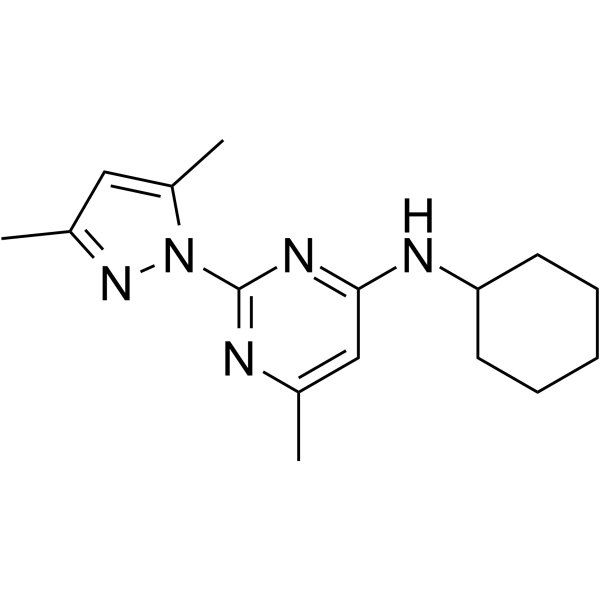
别名: N-环己基-N-[2-(3,5-二甲基吡唑-1-基)-6-甲基嘧啶-4-基]胺
目录号: V19008 纯度: ≥98%
CyPPA 是 hSK3 和 hSK2 的正调节剂,EC50 分别为 14 μM 和 5.6 μM。
CyPPA CAS号: 73029-73-9
产品类别: New1
产品仅用于科学研究,不针对患者销售
规格 价格 库存 数量
1mg
5mg
10mg
50mg
100mg
250mg
Other Sizes
点击了解更多
  • 与全球5000+客户建立关系
  • 覆盖全球主要大学、医院、科研院所、生物/制药公司等
  • 产品被大量CNS顶刊文章引用
InvivoChem产品被CNS等顶刊论文引用
产品描述
CyPPA 是 hSK3 和 hSK2 的正调节剂,EC50 分别为 14 μM 和 5.6 μM。 CyPPA 对 hSK1 和 hIK 通道无活性。
生物活性&实验参考方法
体外研究 (In Vitro)
CyPPA 浓度依赖性地增加通道激活的表观 Ca2+ 敏感性,导致 EC50 (Ca2+) 从 429 nM 变为 59 nM [1]。
体内研究 (In Vivo)
CyPPA 是小电导 Ca2+ 激活的 K+ 通道的正调节剂,可以延迟小鼠早产并减少子宫的阶段性收缩 [2]。
参考文献

[1]. Neurons, Inhibits Dopamine Release, and Counteracts Hyperdopaminergic Behaviors Induced by Methylphenidate. Br J Pharmacol. 2007 Jul;151(5):655-65.

[2]. CyPPA, a positive modulator of small-conductance Ca(2+)-activated K(+) channels, inhibits phasic uterine contractions and delays preterm birth in mice. Am J Physiol Cell Physiol. 2011 Nov;301(5):C1027-35.

*注: 文献方法仅供参考, InvivoChem并未独立验证这些方法的准确性
化学信息 & 存储运输条件
分子式
C16H23N5
分子量
285.38732
精确质量
285.195
CAS号
73029-73-9
PubChem CID
909822
外观&性状
White to off-white solid powder
密度
1.2±0.1 g/cm3
沸点
512.2±42.0 °C at 760 mmHg
闪点
263.6±27.9 °C
蒸汽压
0.0±1.3 mmHg at 25°C
折射率
1.648
LogP
2.13
tPSA
55.63
氢键供体(HBD)数目
1
氢键受体(HBA)数目
4
可旋转键数目(RBC)
3
重原子数目
21
分子复杂度/Complexity
331
定义原子立体中心数目
0
InChi Key
USEMRPYUFJNFQN-UHFFFAOYSA-N
InChi Code
InChI=1S/C16H23N5/c1-11-10-15(18-14-7-5-4-6-8-14)19-16(17-11)21-13(3)9-12(2)20-21/h9-10,14H,4-8H2,1-3H3,(H,17,18,19)
化学名
N-cyclohexyl-2-(3,5-dimethylpyrazol-1-yl)-6-methylpyrimidin-4-amine
HS Tariff Code
2934.99.9001
存储方式

Powder      -20°C    3 years

                     4°C     2 years

In solvent   -80°C    6 months

                  -20°C    1 month

运输条件
Room temperature (This product is stable at ambient temperature for a few days during ordinary shipping and time spent in Customs)
溶解度数据
溶解度 (体外实验)
DMSO : ~100 mg/mL (~350.40 mM)
溶解度 (体内实验)
配方 1 中的溶解度: ≥ 2.5 mg/mL (8.76 mM) (饱和度未知) in 10% DMSO + 90% (20% SBE-β-CD in Saline) (这些助溶剂从左到右依次添加,逐一添加), 澄清溶液。
例如,若需制备1 mL的工作液,可将100 μL 25.0 mg/mL澄清DMSO储备液加入900 μL 20% SBE-β-CD生理盐水溶液中,混匀。
*20% SBE-β-CD 生理盐水溶液的制备(4°C,1 周):将 2 g SBE-β-CD 溶解于 10 mL 生理盐水中,得到澄清溶液。

配方 2 中的溶解度: ≥ 2.5 mg/mL (8.76 mM) (饱和度未知) in 10% DMSO + 90% Corn Oil (这些助溶剂从左到右依次添加,逐一添加), 澄清溶液。
例如,若需制备1 mL的工作液,可将 100 μL 25.0 mg/mL 澄清 DMSO 储备液添加到 900 μL 玉米油中并混合均匀。

请根据您的实验动物和给药方式选择适当的溶解配方/方案:
1、请先配制澄清的储备液(如:用DMSO配置50 或 100 mg/mL母液(储备液));
2、取适量母液,按从左到右的顺序依次添加助溶剂,澄清后再加入下一助溶剂。以 下列配方为例说明 (注意此配方只用于说明,并不一定代表此产品 的实际溶解配方):
10% DMSO → 40% PEG300 → 5% Tween-80 → 45% ddH2O (或 saline);
假设最终工作液的体积为 1 mL, 浓度为5 mg/mL: 取 100 μL 50 mg/mL 的澄清 DMSO 储备液加到 400 μL PEG300 中,混合均匀/澄清;向上述体系中加入50 μL Tween-80,混合均匀/澄清;然后继续加入450 μL ddH2O (或 saline)定容至 1 mL;

3、溶剂前显示的百分比是指该溶剂在最终溶液/工作液中的体积所占比例;
4、 如产品在配制过程中出现沉淀/析出,可通过加热(≤50℃)或超声的方式助溶;
5、为保证最佳实验结果,工作液请现配现用!
6、如不确定怎么将母液配置成体内动物实验的工作液,请查看说明书或联系我们;
7、 以上所有助溶剂都可在 Invivochem.cn网站购买。
制备储备液 1 mg 5 mg 10 mg
1 mM 3.5040 mL 17.5199 mL 35.0398 mL
5 mM 0.7008 mL 3.5040 mL 7.0080 mL
10 mM 0.3504 mL 1.7520 mL 3.5040 mL

1、根据实验需要选择合适的溶剂配制储备液 (母液):对于大多数产品,InvivoChem推荐用DMSO配置母液 (比如:5、10、20mM或者10、20、50 mg/mL浓度),个别水溶性高的产品可直接溶于水。产品在DMSO 、水或其他溶剂中的具体溶解度详见上”溶解度 (体外)”部分;

2、如果您找不到您想要的溶解度信息,或者很难将产品溶解在溶液中,请联系我们;

3、建议使用下列计算器进行相关计算(摩尔浓度计算器、稀释计算器、分子量计算器、重组计算器等);

4、母液配好之后,将其分装到常规用量,并储存在-20°C或-80°C,尽量减少反复冻融循环。

计算器

摩尔浓度计算器可计算特定溶液所需的质量、体积/浓度,具体如下:

  • 计算制备已知体积和浓度的溶液所需的化合物的质量
  • 计算将已知质量的化合物溶解到所需浓度所需的溶液体积
  • 计算特定体积中已知质量的化合物产生的溶液的浓度
使用摩尔浓度计算器计算摩尔浓度的示例如下所示:
假如化合物的分子量为350.26 g/mol,在5mL DMSO中制备10mM储备液所需的化合物的质量是多少?
  • 在分子量(MW)框中输入350.26
  • 在“浓度”框中输入10,然后选择正确的单位(mM)
  • 在“体积”框中输入5,然后选择正确的单位(mL)
  • 单击“计算”按钮
  • 答案17.513 mg出现在“质量”框中。以类似的方式,您可以计算体积和浓度。

稀释计算器可计算如何稀释已知浓度的储备液。例如,可以输入C1、C2和V2来计算V1,具体如下:

制备25毫升25μM溶液需要多少体积的10 mM储备溶液?
使用方程式C1V1=C2V2,其中C1=10mM,C2=25μM,V2=25 ml,V1未知:
  • 在C1框中输入10,然后选择正确的单位(mM)
  • 在C2框中输入25,然后选择正确的单位(μM)
  • 在V2框中输入25,然后选择正确的单位(mL)
  • 单击“计算”按钮
  • 答案62.5μL(0.1 ml)出现在V1框中
g/mol

分子量计算器可计算化合物的分子量 (摩尔质量)和元素组成,具体如下:

注:化学分子式大小写敏感:C12H18N3O4  c12h18n3o4
计算化合物摩尔质量(分子量)的说明:
  • 要计算化合物的分子量 (摩尔质量),请输入化学/分子式,然后单击“计算”按钮。
分子质量、分子量、摩尔质量和摩尔量的定义:
  • 分子质量(或分子量)是一种物质的一个分子的质量,用统一的原子质量单位(u)表示。(1u等于碳-12中一个原子质量的1/12)
  • 摩尔质量(摩尔重量)是一摩尔物质的质量,以g/mol表示。
/

配液计算器可计算将特定质量的产品配成特定浓度所需的溶剂体积 (配液体积)

  • 输入试剂的质量、所需的配液浓度以及正确的单位
  • 单击“计算”按钮
  • 答案显示在体积框中
动物体内实验配方计算器(澄清溶液)
第一步:请输入基本实验信息(考虑到实验过程中的损耗,建议多配一只动物的药量)
第二步:请输入动物体内配方组成(配方适用于不溶/难溶于水的化合物),不同的产品和批次配方组成不同,如对配方有疑问,可先联系我们提供正确的体内实验配方。此外,请注意这只是一个配方计算器,而不是特定产品的确切配方。
+
+
+

计算结果:

工作液浓度 mg/mL;

DMSO母液配制方法 mg 药物溶于 μL DMSO溶液(母液浓度 mg/mL)。如该浓度超过该批次药物DMSO溶解度,请首先与我们联系。

体内配方配制方法μL DMSO母液,加入 μL PEG300,混匀澄清后加入μL Tween 80,混匀澄清后加入 μL ddH2O,混匀澄清。

(1) 请确保溶液澄清之后,再加入下一种溶剂 (助溶剂) 。可利用涡旋、超声或水浴加热等方法助溶;
            (2) 一定要按顺序加入溶剂 (助溶剂) 。

生物数据图片
  • CyPPA is a positive modulator of hSK3 but not hIK channels. (a) Chemical structures of the subtype-selective SK channel activator CyPPA and the pan-selective compound NS309. (b) The left panel shows whole-cell current–voltage (I-V) relationships from a HEK293 cell expressing hSK3. The currents were recorded upon application of 200 ms long voltage ramps (−80 to +80 mV) elicited every 5 s from a holding potential of 0 mV. The free [Ca2+] in the pipette solution was buffered at 0.3 μm and the [K+] was 154 mm in the intra- as well as extracellular solutions. The traces were obtained before (Ctrl) and during application of 40 nm NS309 or 300 nm CyPPA as indicated. The right panel shows the current at −75 mV as a function of time. The first 7 min after obtaining the whole-cell configuration are not shown. During this period the hSK3 current increased as a result of Ca2+ equilibration between the pipette solution and the cell; also 0.1% DMSO was shown to be without effect on the currents. NS309 (40 nm), BMB (30 μm) and CyPPA (300 nm) were present in the bath solution as indicated by the bars. BMB inhibited the current by 75 and 77% in the absence and presence of CyPPA, respectively. (c) Same experimental conditions as in (b) but using a hIK-expressing HEK293 cell. The hIK current was activated by 40 nm NS309 and inhibited by 30 nm ChTX. The hIK current was inhibited by 54 and 51% before and during application of 10 μm CyPPA.Br J Pharmacol. 2007 Jul;151(5):655-65.
  • SK subtype-dependent effects of CyPPA on the Ca2+ activation curves. In the left panels, currents at −75 mV are depicted as a function of time. Currents were measured from inside-out patches obtained from HEK293 cells stably expressing hSK3 (a), hSK2 (b) or hSK1 (c). The patches were exposed to a bath/intracellular [Ca2+] of 0.01, 0.2 or 10 μm as indicated, and CyPPA (10 μm) was applied at the different [Ca2+] as shown by the bars. In the right panels, the Ca2+ concentration–response relationships for hSK3, hSK2 and hSK1 are depicted in the absence or presence of 10 μm CyPPA. Currents from individual patches were normalized with respect to the effect of 10 μm Ca2+ (in the absence of CyPPA). The solid lines are the fit of the Hill equation to mean data. The following EC50(Ca2+) and Hill coefficients were estimated from separate experiments: hSK3, 0.43±0.01 μm and 6.3±0.4 (control, n=14), 0.12±0.02 μm and 3.4±0.2 (+10 μm CyPPA, n=3); hSK2, 0.42±0.02 μm and 5.2±0.1 (control, n=8), 0.20±0.01 and 3.9±0.3 (+10 μm CyPPA, efficacy: 91±4%, n=3); hSK1, 0.42±0.01 μm and 4.5±0.2 (control, n=8), 0.38±0.03 μm and 3.5±0.2 (+10 μm CyPPA, efficacy: 84±7%, n=3); ***P<0.001 compared to corresponding control values (Bonferroni post hoc comparisons).Br J Pharmacol. 2007 Jul;151(5):655-65.
  • CyPPA activates the endogenous SK channels in TE671 cells but not the endogenous IK channels in HeLa cells. Whole cell I-V relationships measured in a TE671 (a) or HeLa (b) cell upon application of 200 ms long voltage ramps (−80 to +80 mV) elicited every 5 s from a holding potential of 0 mV; [Ca2+] in the pipette solution was 0.4 μm. Whole-cell I-V relationships were measured in the absence of compound (Ctrl) and in the presence of NS309 (1 μm), or CyPPA (10 μm). BMB (100 μm) was applied as an inhibitor of SK channel activity in TE671 cells (a) and clotrimazole (clot, 1 μm) as an inhibitor of IK channels in HeLa cells (b). Membrane potential measured under current-clamp conditions in a TE671 cells (c) or a HeLa cell (d). The cells were exposed to a near-physiological K+ gradient at an intracellular [Ca2+] of 0.1 μm. NS309 (1 μm) and CyPPA (10 μm) were applied to the extracellular solution as indicated and experiments terminated by addition of BMB (100 μm, C) or clot (1 μm, D); n=3–5.Br J Pharmacol. 2007 Jul;151(5):655-65..
相关产品
联系我们