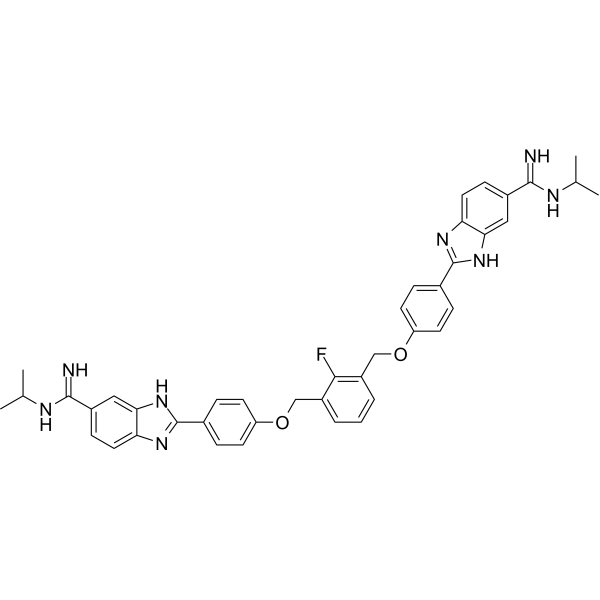
DB2313

别名: DB-2313; DB 2313; DB2313
目录号: V19210 纯度: ≥98%
DB2313 是转录因子 PU 的有效抑制剂。
DB2313 CAS号: 2170606-74-1
产品类别: New1
产品仅用于科学研究,不针对患者销售
规格 价格 库存 数量
1mg
5mg
10mg
50mg
100mg
250mg
Other Sizes
点击了解更多
  • 与全球5000+客户建立关系
  • 覆盖全球主要大学、医院、科研院所、生物/制药公司等
  • 产品被大量CNS顶刊文章引用
InvivoChem产品被CNS等顶刊论文引用
产品描述
DB2313 是转录因子 PU.1 的有效抑制剂,凋亡率为 14 nM。 DB2313 破坏 PU.1 与靶基因启动子的相互作用。 DB2313 可引起急性髓系白血病 (AML) 细胞凋亡,并具有抗癌作用。
生物活性&实验参考方法
体外研究 (In Vitro)
DB2313治疗显着抑制PU.1 URE–/–急性髓系白血病(AML)细胞的增殖(IC50为7.1 μM),但在相同浓度下,对正常造血细胞没有影响。在小鼠 PU.1 URE–/– AML 细胞中,DB2313 治疗导致凋亡细胞增加 3.5 倍。此外,在第二轮和第三轮电镀中,DB2313显着降低了克隆形成性;在第四轮及后续轮中,克隆形成被完全破坏[1]。 DB2313 可降低 AML 细胞中 E2f1、Junb 和 Csf1r 启动子上的 PU.1 占用率 [1]。
体内研究 (In Vivo)
使用 DB2313(17 mg/kg;腹腔注射;每周 3 次;持续三周)治疗的小鼠可提高生存率并延缓白血病病程 [1]。
动物实验
动物/疾病模型:接受亚致死剂量(2.0 Gy)照射的 NSG 小鼠,并注射 PU.1 URE–/– AML 细胞 [1]
剂量: 17 mg/kg
给药途径:腹腔注射;每周三次;持续 3 周
实验结果:肿瘤负荷减轻,导致生存期延长。
参考文献
[1]. Iléana Antony-Debré, et al. Pharmacological inhibition of the transcription factor PU.1 in leukemia. J Clin Invest. 2017 Dec 1;127(12):4297-4313.
[2]. Zhang S, Zhao S, Qi Y, et al. SPI1-induced downregulation of FTO promotes GBM progression by regulating pri-miR-10a processing in an m6A-dependent manner. Mol Ther Nucleic Acids. 2022;27:699-717.
*注: 文献方法仅供参考, InvivoChem并未独立验证这些方法的准确性
化学信息 & 存储运输条件
分子式
C42H41FN8O2
分子量
708.825752019882
精确质量
708.333
CAS号
2170606-74-1
PubChem CID
138556040
外观&性状
Typically exists as solid at room temperature
LogP
6.9
tPSA
153
氢键供体(HBD)数目
4
氢键受体(HBA)数目
7
可旋转键数目(RBC)
12
重原子数目
53
分子复杂度/Complexity
1130
定义原子立体中心数目
0
InChi Key
NUVPJXUYFGWDGB-UHFFFAOYSA-N
InChi Code
InChI=1S/C42H41FN8O2/c1-24(2)46-39(44)28-12-18-34-36(20-28)50-41(48-34)26-8-14-32(15-9-26)52-22-30-6-5-7-31(38(30)43)23-53-33-16-10-27(11-17-33)42-49-35-19-13-29(21-37(35)51-42)40(45)47-25(3)4/h5-21,24-25H,22-23H2,1-4H3,(H2,44,46)(H2,45,47)(H,48,50)(H,49,51)
化学名
2-[4-[[2-fluoro-3-[[4-[6-(N'-propan-2-ylcarbamimidoyl)-1H-benzimidazol-2-yl]phenoxy]methyl]phenyl]methoxy]phenyl]-N'-propan-2-yl-3H-benzimidazole-5-carboximidamide
别名
DB-2313; DB 2313; DB2313
HS Tariff Code
2934.99.9001
存储方式

Powder      -20°C    3 years

                     4°C     2 years

In solvent   -80°C    6 months

                  -20°C    1 month

运输条件
Room temperature (This product is stable at ambient temperature for a few days during ordinary shipping and time spent in Customs)
溶解度数据
溶解度 (体外实验)
DMSO : ~3.7 mg/mL (~5.22 mM ()
溶解度 (体内实验)
配方 1 中的溶解度: 5 mg/mL (7.05 mM) in 50% PEG300 +50% Saline (这些助溶剂从左到右依次添加,逐一添加), 悬浮液;超声助溶。
*生理盐水的制备:将 0.9 g 氯化钠溶解在 100 mL ddH₂O中,得到澄清溶液。

请根据您的实验动物和给药方式选择适当的溶解配方/方案:
1、请先配制澄清的储备液(如:用DMSO配置50 或 100 mg/mL母液(储备液));
2、取适量母液,按从左到右的顺序依次添加助溶剂,澄清后再加入下一助溶剂。以 下列配方为例说明 (注意此配方只用于说明,并不一定代表此产品 的实际溶解配方):
10% DMSO → 40% PEG300 → 5% Tween-80 → 45% ddH2O (或 saline);
假设最终工作液的体积为 1 mL, 浓度为5 mg/mL: 取 100 μL 50 mg/mL 的澄清 DMSO 储备液加到 400 μL PEG300 中,混合均匀/澄清;向上述体系中加入50 μL Tween-80,混合均匀/澄清;然后继续加入450 μL ddH2O (或 saline)定容至 1 mL;

3、溶剂前显示的百分比是指该溶剂在最终溶液/工作液中的体积所占比例;
4、 如产品在配制过程中出现沉淀/析出,可通过加热(≤50℃)或超声的方式助溶;
5、为保证最佳实验结果,工作液请现配现用!
6、如不确定怎么将母液配置成体内动物实验的工作液,请查看说明书或联系我们;
7、 以上所有助溶剂都可在 Invivochem.cn网站购买。
制备储备液 1 mg 5 mg 10 mg
1 mM 1.4108 mL 7.0539 mL 14.1078 mL
5 mM 0.2822 mL 1.4108 mL 2.8216 mL
10 mM 0.1411 mL 0.7054 mL 1.4108 mL

1、根据实验需要选择合适的溶剂配制储备液 (母液):对于大多数产品,InvivoChem推荐用DMSO配置母液 (比如:5、10、20mM或者10、20、50 mg/mL浓度),个别水溶性高的产品可直接溶于水。产品在DMSO 、水或其他溶剂中的具体溶解度详见上”溶解度 (体外)”部分;

2、如果您找不到您想要的溶解度信息,或者很难将产品溶解在溶液中,请联系我们;

3、建议使用下列计算器进行相关计算(摩尔浓度计算器、稀释计算器、分子量计算器、重组计算器等);

4、母液配好之后,将其分装到常规用量,并储存在-20°C或-80°C,尽量减少反复冻融循环。

计算器

摩尔浓度计算器可计算特定溶液所需的质量、体积/浓度,具体如下:

  • 计算制备已知体积和浓度的溶液所需的化合物的质量
  • 计算将已知质量的化合物溶解到所需浓度所需的溶液体积
  • 计算特定体积中已知质量的化合物产生的溶液的浓度
使用摩尔浓度计算器计算摩尔浓度的示例如下所示:
假如化合物的分子量为350.26 g/mol,在5mL DMSO中制备10mM储备液所需的化合物的质量是多少?
  • 在分子量(MW)框中输入350.26
  • 在“浓度”框中输入10,然后选择正确的单位(mM)
  • 在“体积”框中输入5,然后选择正确的单位(mL)
  • 单击“计算”按钮
  • 答案17.513 mg出现在“质量”框中。以类似的方式,您可以计算体积和浓度。

稀释计算器可计算如何稀释已知浓度的储备液。例如,可以输入C1、C2和V2来计算V1,具体如下:

制备25毫升25μM溶液需要多少体积的10 mM储备溶液?
使用方程式C1V1=C2V2,其中C1=10mM,C2=25μM,V2=25 ml,V1未知:
  • 在C1框中输入10,然后选择正确的单位(mM)
  • 在C2框中输入25,然后选择正确的单位(μM)
  • 在V2框中输入25,然后选择正确的单位(mL)
  • 单击“计算”按钮
  • 答案62.5μL(0.1 ml)出现在V1框中
g/mol

分子量计算器可计算化合物的分子量 (摩尔质量)和元素组成,具体如下:

注:化学分子式大小写敏感:C12H18N3O4  c12h18n3o4
计算化合物摩尔质量(分子量)的说明:
  • 要计算化合物的分子量 (摩尔质量),请输入化学/分子式,然后单击“计算”按钮。
分子质量、分子量、摩尔质量和摩尔量的定义:
  • 分子质量(或分子量)是一种物质的一个分子的质量,用统一的原子质量单位(u)表示。(1u等于碳-12中一个原子质量的1/12)
  • 摩尔质量(摩尔重量)是一摩尔物质的质量,以g/mol表示。
/

配液计算器可计算将特定质量的产品配成特定浓度所需的溶剂体积 (配液体积)

  • 输入试剂的质量、所需的配液浓度以及正确的单位
  • 单击“计算”按钮
  • 答案显示在体积框中
动物体内实验配方计算器(澄清溶液)
第一步:请输入基本实验信息(考虑到实验过程中的损耗,建议多配一只动物的药量)
第二步:请输入动物体内配方组成(配方适用于不溶/难溶于水的化合物),不同的产品和批次配方组成不同,如对配方有疑问,可先联系我们提供正确的体内实验配方。此外,请注意这只是一个配方计算器,而不是特定产品的确切配方。
+
+
+

计算结果:

工作液浓度 mg/mL;

DMSO母液配制方法 mg 药物溶于 μL DMSO溶液(母液浓度 mg/mL)。如该浓度超过该批次药物DMSO溶解度,请首先与我们联系。

体内配方配制方法μL DMSO母液,加入 μL PEG300,混匀澄清后加入μL Tween 80,混匀澄清后加入 μL ddH2O,混匀澄清。

(1) 请确保溶液澄清之后,再加入下一种溶剂 (助溶剂) 。可利用涡旋、超声或水浴加热等方法助溶;
            (2) 一定要按顺序加入溶剂 (助溶剂) 。

生物数据图片
  • Expanded heterocyclic diamidines target the DNA minor groove and inhibit PU.1 binding by an allosteric mechanism. (A) Chemical structures of the heterocyclic diamidines. (B) Model of DB2313 docked to the track (5′-AAATAAAA-3′) upstream of the 5′-GGAA-3′ ETS core consensus in the λB motif. (C) Representative SPR sensorgrams for the interaction of DB2313 with the 5′ AT-rich binding site of the λB promoter DNA sequence. Note the lack of binding by DB2313 to an alternative site specific to the ETS homolog ETS1 (5′-GCCGGAAGTG-3′), even at high concentrations (100 nM, asterisk). (D) Comparison of the binding affinities for the λB promoter DNA sequence with different compounds. RU values from the SPR sensorgrams, as in B, were converted to r (r = RU/RUmax, moles of compound bound/mole of promoter DNA) and are plotted against the unbound compound concentration. (E) Specificity of the λB motif for PU.1. Under identical solution conditions, ETS1 bound negligibly at concentrations that saturated the target in the case of PU.1. (F) Normalized PU.1 inhibition resulted from biosensor SPR experiments. The plots represent the amount of PU.1-DNA complex inhibition as a function of the added compound concentration. (G) Perturbations of DNA minor groove width and depth by bound DB2313 or PU.1. The base steps marked “Xi” denote the bases 5′ to the ETS consensus (G0G1AA). Dashed lines indicate the expected values of B-form DNA. Aligned structures of the DB2313-bound (gray) and PU.1-bound (orange) DNA, rendered as van der Waals surfaces, show the mutually incompatible minor groove conformations induced by the diamidine and protein. (H) DNase I footprints of compound binding to the λB motif. The subsite at which the compounds bind is marked by a bracket. Arrows indicate distinct perturbations to the drug-induced DNA structure among the compounds as detected by DNase I. As a reference, the PU.1-bound footprint is also shown (red); note the DNase I–hypersensitive band (asterisk) in the reverse strand that is diagnostic of site-specific ETS-DNA complexes. J Clin Invest . 2017 Dec 1;127(12):4297-4313.
  • Small-molecule PU.1 inhibitors decrease cell growth and increase apoptosis of AML cells. (A) Cell viability of PU.1 URE–/– AML cells and WT BM cells after treatment with increasing concentrations of vehicle or small molecules (n = 3). (B) Cell viability of human CD34+, THP1, and MOLM13 cells after treatment with increasing concentrations of vehicle or small molecules (n = 3). (C) Apoptosis induction (annexin-V+PI–) in PU.1 URE–/– AML cells after 48 hours of treatment with DB1976 (n = 6), DB2115 (n = 6), or DB2313 (n = 3). Fold change compared with vehicle is shown. (D) Clonogenic capacities of PU.1 URE–/– AML cells after treatment with DB1976 (n = 5), DB2115 (n = 3) and DB2313 (n = 4). (E) Serial replating capacity of PU.1 URE–/– AML cells after treatment with DB2313 (n = 3). (F–H) Primary human AML cells were plated in semisolid media containing DB1976, DB2115, or DB2313; colony numbers, viable cell numbers, and apoptotic cells were assessed after 14 days of culture. Error bars represent the mean ± SD, and each AML sample is represented by an individual dot. The percentage (F and G) or fold change (H) compared with vehicle (dotted line) is shown. (F) Number of viable cells (n = 10) and (G) clonogenic capacity (n = 11) after treatment. (H) Apoptotic cell (annexin-V+PI–) fraction after treatment (n = 10). *P < 0.05, **P < 0.01, ***P < 0.001, and ****P < 0.0001, by 1-way ANOVA (C, D, and F–H) or 2-tailed Student’s t test (E). J Clin Invest . 2017 Dec 1;127(12):4297-4313.
  • Inhibitors show on-target PU.1 inhibitory activity in AML cells. (A) qRT-PCR analysis of PU.1 target genes after PU.1 URE–/– AML cell treatment (n = 3–7), normalized to Gapdh. Fold change compared with vehicle is shown. (B) Mean fluorescence intensity (MFI) of BM MNCs isolated from PU.1/GFP-knockin mice (38) after treatment (n = 5). Fold change compared with vehicle is shown. (C) Quantitative ChIP assays of PU.1 occupancy after treatment of PU.1 URE+/–Msh2–/– AML cells (n = 5). Myogenin was used as a negative control. (D–I) Transcriptome analysis of PU.1 URE–/– AML cells after a 24-hour treatment with DB2313 (n = 3) versus vehicle (n = 3). (D) Differentially expressed genes upon treatment were tested for enrichment of genes directly regulated by PU.1, or regulated by the other ETS transcription factors using Ingenuity Knowledge Base (generated with the use of IPA). Dotted line represents the significance threshold (–log P value >1.3). (E and F) Comparative analysis of deregulated genes in PU.1 URE–/– AML cells after treatment and in PUER cells after PU.1 induction (GEO GSE13125). (E) Venn diagram shows significant overlap between the 2 data sets. (F) Deregulated canonical pathways between the data sets. Colored squares indicate the activation Z score. (G) GSEA enrichment plot of PU.1 positively regulated genes (regulon) in AML cells (from the MILE AML network, as determined by the ARACNe algorithm) against the global list of differentially expressed genes upon treatment, ranked by the drug response (as measured by t score of DB2313 vs. vehicle). (H) Heatmap of leading-edge genes showing row-normalized relative expression. (I) Enrichment of PU.1 binding at promoters of deregulated genes in PU.1 URE–/– AML cells upon treatment. Publicly available PU.1 ChIP-seq data from PUER cells (GSE63317) were used for this analysis. Up, upregulated; Down, downregulated. *P < 0.05, **P < 0.01, ***P < 0.001, and ****P < 0.0001, by 1-way ANOVA (A–C), hypergeometric test (E), Fisher’s exact test (I), or according to ref. 57 (G). J Clin Invest . 2017 Dec 1;127(12):4297-4313.
相关产品
联系我们