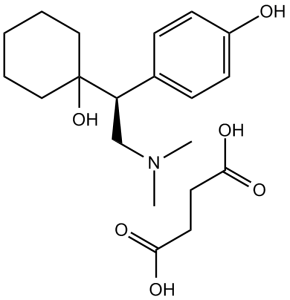
| 规格 | 价格 | 库存 | 数量 |
|---|---|---|---|
| 10mg |
|
||
| 25mg |
|
||
| 50mg |
|
||
| 100mg |
|
||
| 250mg |
|
||
| 500mg |
|
||
| 1g |
|
||
| Other Sizes |
|

| 靶点 |
hSERT ( IC50 = 47.3 nM ); hNET ( IC50 = 531.3 nM )
Human serotonin transporter (SERT): Ki = 40 nM (recombinant SERT), IC50 = 47 nM for [³H]5-HT uptake inhibition [1] - Human norepinephrine transporter (NET): Ki = 54 nM (recombinant NET), IC50 = 59 nM for [³H]NE uptake inhibition [1] - No significant binding to dopamine transporter (DAT, Ki > 1000 nM), muscarinic M1, histamine H1, or alpha1-adrenergic receptors (Ki > 500 nM) [1] |
|---|---|
| 体外研究 (In Vitro) |
去甲文拉法辛琥珀酸盐是 O-去甲文拉法辛的琥珀酸盐一水合物,是文拉法辛的活性代谢物。 Desvenlafaxine Succinate 是一种血清素-去甲肾上腺素再摄取抑制剂,是抗抑郁药文拉法辛的活性代谢物。与文拉法辛类似,琥珀酸去甲文拉法辛抑制神经元对血清素和去甲肾上腺素的摄取。琥珀酸去甲文拉法辛对人多巴胺 (DA) 转运蛋白显示出弱结合亲和力(100 μM 时抑制 62%)。 Desvenlafaxine Succinate 抑制 hSERT 或 hNET 的 [3H]5-HT 或 [3H]NE 摄取,IC50 分别为 47.3 和 531.3 nM。 Desvenlafaxine Succinate 有抑制 CYP2D6 的潜力,这可能导致通过该途径代谢的药物浓度增加。 Desvenlafaxine Succinate 也可以诱导 CYP3A4,这可能会影响通过该酶代谢的药物的代谢。
重组细胞中SERT/NET摄取抑制: - 表达人SERT的HEK293细胞:琥珀酸去甲文拉法辛(0.1~1000 nM)剂量依赖性抑制[³H]5-HT摄取,IC50为47 nM。1 μM时可使[³H]5-HT摄取较溶剂组减少约85%[1] - 表达人NET的HEK293细胞:琥珀酸去甲文拉法辛抑制[³H]NE摄取,IC50为59 nM;1 μM时诱导[³H]NE摄取减少约78%[1] - 受体选择性: - 琥珀酸去甲文拉法辛(浓度高达10 μM)对人DAT、M1、H1或α1肾上腺素能受体的结合率<10%(放射性配体结合实验),证实无脱靶活性[1] - 体外细胞活力: - 人肾近曲小管细胞:琥珀酸去甲文拉法辛(0.1 μM~100 μM)孵育24小时后,对细胞活力(MTT法)无显著影响;活力较溶剂组仍>90%[2] |
| 体内研究 (In Vivo) |
琥珀酸去甲文拉法辛迅速渗透雄性大鼠大脑和下丘脑。与基线相比,琥珀酸去甲文拉法辛显着增加了雄性大鼠下丘脑的细胞外 NE 水平,但使用微透析对 DA 水平没有影响。琥珀酸去甲文拉法辛在 100 至 600 mg/天的剂量范围内表现出线性且与剂量成比例的单剂量药代动力学特征。口服制剂的绝对生物利用度为80.5%。
啮齿动物模型中的抗抑郁活性: - 小鼠强迫游泳实验(FST):口服琥珀酸去甲文拉法辛 10 mg/kg、20 mg/kg、40 mg/kg,分别使不动时间较溶剂组减少约30%、50%、70%。40 mg/kg剂量对运动活性无影响(旷场实验)[1] - 大鼠悬尾实验(TST):腹腔注射(i.p.)琥珀酸去甲文拉法辛 5 mg/kg、10 mg/kg,分别使不动时间减少约25%、45%;疗效与同剂量文拉法辛(母药)相当[1] - 脑内神经递质调节: - 大鼠口服(20 mg/kg):琥珀酸去甲文拉法辛在给药后2小时,使前额叶皮层(PFC)细胞外5-HT水平升高约180%、NE水平升高约150%(在体微透析+HPLC)[1] - 临床抗抑郁疗效[2]: - 重度抑郁症(MDD)患者随机双盲试验(n=400):口服琥珀酸去甲文拉法辛 50 mg/天,持续8周,蒙哥马利-阿斯伯格抑郁量表(MADRS)评分降低约12分(安慰剂组降低约5分;p<0.001)。有效率(MADRS评分降低≥50%)为55%,安慰剂组为30%[2] - MDD患者临床安全性: - 琥珀酸去甲文拉法辛 50 mg/天持续12周,对体重无显著影响(平均变化:-0.5 kg vs. 安慰剂组-0.3 kg),对睡眠质量无影响(匹兹堡睡眠质量指数评分无变化)[2] |
| 酶活实验 |
人SERT/NET结合实验:
- 膜制备:表达人SERT或NET的HEK293细胞在冰浴Tris-HCl缓冲液(50 mM,pH 7.4,含120 mM NaCl、5 mM KCl)中匀浆,离心(10,000×g,15分钟),膜沉淀重悬于结合缓冲液(50 mM Tris-HCl pH 7.4、0.1% BSA)[1] - 结合反应:SERT实验中,膜与[³H]西酞普兰(1 nM)及琥珀酸去甲文拉法辛(0.1~1000 nM)混合;NET实验中,膜与[³H]尼索西汀(1 nM)及琥珀酸去甲文拉法辛(0.1~1000 nM)混合。混合物25°C孵育90分钟后,通过预浸泡于0.5%聚乙烯亚胺的玻璃纤维滤膜过滤,冰浴缓冲液洗涤3次,液体闪烁计数检测放射性,采用Cheng-Prusoff方程计算Ki值[1] - SERT/NET摄取实验: - HEK293-SERT/NET细胞接种到24孔板,24小时后用琥珀酸去甲文拉法辛(0.1~1000 nM)预处理15分钟,再加入[³H]5-HT(5 nM)或[³H]NE(5 nM)37°C孵育20分钟。冰浴缓冲液洗涤细胞3次,0.1 M NaOH裂解细胞,计数放射性以计算摄取抑制率[1] |
| 细胞实验 |
人肾近曲小管细胞活力实验:
- 细胞以5×10³个/孔接种到96孔板,在添加10% FBS、1%胰岛素-转铁蛋白-硒的DMEM/F12培养基中,于37°C、5% CO₂条件下培养24小时。加入琥珀酸去甲文拉法辛(0.1 μM~100 μM)继续孵育24小时,每孔加20 μL MTT溶液(5 mg/mL)孵育4小时,弃上清后加150 μL DMSO溶解甲瓒,检测570 nm吸光度,计算相对于溶剂组的活力[2] - 表达SERT/NET的HEK293细胞功能实验(详见“Enzyme Assay”部分)[1] |
| 动物实验 |
溶于 0.25% Tween 80 和 0.5% 甲基纤维素溶液;30 mg/kg;灌胃给药
雄性 Sprague-Dawley 大鼠 小鼠强迫游泳试验和旷场试验: - 将雄性 ICR 小鼠(20–25 g)分为 4 组(每组 n=8):溶剂组(0.5% 甲基纤维素溶液,灌胃)、琥珀酸去甲文拉法辛 10 mg/kg、20 mg/kg、40 mg/kg(灌胃)。给药于强迫游泳试验前 60 分钟进行。将小鼠放入直径 25 cm 的水箱(水温 25°C,水深 15 cm)中 6 分钟,并记录最后 4 分钟的静止不动时间。在旷场实验中,将小鼠置于 30×30 cm 的实验场地中 30 分钟,并通过视频追踪测量其总运动距离 [1] - 大鼠体内微透析: - 将雄性 Sprague-Dawley 大鼠(250–300 g)麻醉,并将微透析探针植入前额叶皮层 (PFC)。恢复 24 小时后,给予琥珀酸去甲文拉法辛(20 mg/kg,口服)或溶剂对照。每隔 20 分钟收集一次透析液,持续 4 小时,并使用高效液相色谱-电化学检测法 (HPLC-ECD) 分析 5-HT/NE 水平 [1] - 大鼠强迫游泳试验 (TST): - 将雄性 Wistar 大鼠(220–250 g)分为 3 组(每组 n=6):赋形剂组(生理盐水,腹腔注射)、琥珀酸去甲文拉法辛 5 mg/kg 组和 10 mg/kg 组(腹腔注射)。给药在 TST 前 30 分钟进行。将大鼠尾部悬吊(离地 50 cm),持续 6 分钟,并记录最后 4 分钟的静止不动时间 [1] |
| 药代性质 (ADME/PK) |
人体药代动力学:
- 口服给药(50 mg):健康志愿者(n=12)的血药浓度峰值 (Cmax) 为 320 ng/mL,达峰时间 (Tmax) 为 5.5 小时,消除半衰期 (t₁/₂) 为 11 小时,口服生物利用度 (F) 为 80%(食物对吸收无影响)[1][2] - 稳态:每日口服 50 mg,连续 7 天,达到稳态血药浓度峰值 (Cmax) 为 640 ng/mL(累积 2 倍)[2] - 大鼠药代动力学: - 口服(20 mg/kg):血药浓度峰值 (Cmax) 为 450 ng/mL,达峰时间 (Tmax) 为 2 小时,消除半衰期 (t₁/₂) 为 4.5 小时,F = 75% [1] - 静脉注射(5 mg/kg):半衰期 (t₁/₂) 为 4.2 小时,清除率 (CL) 为 14 mL/min/kg,体积分布容积 (Vd) = 4.0 L/kg [1] - 代谢: - 琥珀酸去甲文拉法辛主要在肝脏中通过葡萄糖醛酸化(约50%)和CYP3A4介导的氧化(约30%)代谢;主要代谢物无活性(例如,去甲文拉法辛O-葡萄糖醛酸苷,SERT/NET的Ki值>1000 nM)[1] - 排泄: - 约70%的剂量在48小时内经尿液排出(45%为原药,25%为代谢物);约15%经粪便排出[1] |
| 毒性/毒理 (Toxicokinetics/TK) |
急性毒性:
- 小鼠口服 LD50 = 1200 mg/kg;大鼠口服 LD50 = 1000 mg/kg。急性症状(大鼠 500 mg/kg)包括短暂镇静和活动减少,24 小时内完全恢复[1] - 亚急性毒性(28 天): - 大鼠口服琥珀酸去甲文拉法辛(10 mg/kg、30 mg/kg、100 mg/kg/天):体重、食物摄入量或血清 ALT/AST(肝脏)和肌酐/BUN(肾脏)水平无显著变化。脑、肝、肾组织病理学检查未见病变[1] - 临床不良反应: - 常见副作用(发生率 5%–15%):恶心 (10%)、头晕 (8%)、头痛 (7%) 和口干 (5%);所有副作用均为轻度至中度,并在治疗后 1–2 周内消退[2] - 血浆蛋白结合率: - 人血浆中为 30%(平衡透析),大鼠血浆中为 28%;结合率与浓度无关(10–1000 ng/mL)[1] - 药物相互作用: - 在健康志愿者中,与帕罗西汀(CYP2D6 抑制剂)或酮康唑(CYP3A4 抑制剂)未见显著相互作用;琥珀酸去甲文拉法辛血浆浓度变化 <15%[2] |
| 参考文献 | |
| 其他信息 |
去甲文拉法辛是一种环己醇和苯酚衍生物,也是文拉法辛的代谢产物,它是一种血清素和去甲肾上腺素再摄取抑制剂 (SNRI),用作抗抑郁药。
另见:琥珀酸去甲文拉法辛(注释已移至)。 琥珀酸去甲文拉法辛(WY 45233;O-去甲基文拉法辛)是文拉法辛的主要活性代谢产物,文拉法辛是一种血清素-去甲肾上腺素再摄取抑制剂 (SNRI),已获准用于治疗重度抑郁症 (MDD)、广泛性焦虑症 (GAD) 和社交焦虑症 (SAD) [1][2]。 - 作用机制:琥珀酸去甲文拉法辛抑制突触前神经元中 5-羟色胺转运蛋白 (SERT) 和去甲肾上腺素转运蛋白 (NET) 介导的 5-羟色胺 (5-HT) 和去甲肾上腺素 (NE) 的再摄取。神经元,增加脑内细胞外神经递质水平——这增强了单胺能神经传递,从而发挥其抗抑郁和抗焦虑作用[1] - 与文拉法辛相比的临床优势: - 半衰期更长(11 小时,而文拉法辛为 3-4 小时),允许每日一次给药[2] - 无显著首过代谢(F=80%,而文拉法辛为 45%),降低了血浆浓度的个体差异[2] - 文献指出,琥珀酸去甲文拉法辛被归类为“me too”药物(结构/机制与现有 SNRI 相似),但由于给药方式简化,为患者依从性提供了实际益处[2] |
| 分子式 |
C20H31NO6
|
|
|---|---|---|
| 分子量 |
381.46
|
|
| 精确质量 |
381.215
|
|
| CAS号 |
448904-47-0
|
|
| 相关CAS号 |
Desvenlafaxine; 93413-62-8; Desvenlafaxine succinate hydrate; 386750-22-7; Desvenlafaxine fumarate; 93414-04-1
|
|
| PubChem CID |
9800068
|
|
| 外观&性状 |
Typically exists as solid at room temperature
|
|
| LogP |
2.668
|
|
| tPSA |
118.3
|
|
| 氢键供体(HBD)数目 |
4
|
|
| 氢键受体(HBA)数目 |
7
|
|
| 可旋转键数目(RBC) |
7
|
|
| 重原子数目 |
27
|
|
| 分子复杂度/Complexity |
359
|
|
| 定义原子立体中心数目 |
0
|
|
| SMILES |
CN(C)CC(C1=CC=C(C=C1)O)C2(CCCCC2)O.C(CC(=O)O)C(=O)O
|
|
| InChi Key |
ORUUBRMVQCKYHB-UHFFFAOYSA-N
|
|
| InChi Code |
InChI=1S/C16H25NO2.C4H6O4/c1-17(2)12-15(13-6-8-14(18)9-7-13)16(19)10-4-3-5-11-16;5-3(6)1-2-4(7)8/h6-9,15,18-19H,3-5,10-12H2,1-2H3;1-2H2,(H,5,6)(H,7,8)
|
|
| 化学名 |
butanedioic acid;4-[2-(dimethylamino)-1-(1-hydroxycyclohexyl)ethyl]phenol
|
|
| 别名 |
|
|
| HS Tariff Code |
2934.99.9001
|
|
| 存储方式 |
Powder -20°C 3 years 4°C 2 years In solvent -80°C 6 months -20°C 1 month |
|
| 运输条件 |
Room temperature (This product is stable at ambient temperature for a few days during ordinary shipping and time spent in Customs)
|
| 溶解度 (体外实验) |
|
|---|
| 制备储备液 | 1 mg | 5 mg | 10 mg | |
| 1 mM | 2.6215 mL | 13.1075 mL | 26.2151 mL | |
| 5 mM | 0.5243 mL | 2.6215 mL | 5.2430 mL | |
| 10 mM | 0.2622 mL | 1.3108 mL | 2.6215 mL |
1、根据实验需要选择合适的溶剂配制储备液 (母液):对于大多数产品,InvivoChem推荐用DMSO配置母液 (比如:5、10、20mM或者10、20、50 mg/mL浓度),个别水溶性高的产品可直接溶于水。产品在DMSO 、水或其他溶剂中的具体溶解度详见上”溶解度 (体外)”部分;
2、如果您找不到您想要的溶解度信息,或者很难将产品溶解在溶液中,请联系我们;
3、建议使用下列计算器进行相关计算(摩尔浓度计算器、稀释计算器、分子量计算器、重组计算器等);
4、母液配好之后,将其分装到常规用量,并储存在-20°C或-80°C,尽量减少反复冻融循环。
计算结果:
工作液浓度: mg/mL;
DMSO母液配制方法: mg 药物溶于 μL DMSO溶液(母液浓度 mg/mL)。如该浓度超过该批次药物DMSO溶解度,请首先与我们联系。
体内配方配制方法:取 μL DMSO母液,加入 μL PEG300,混匀澄清后加入μL Tween 80,混匀澄清后加入 μL ddH2O,混匀澄清。
(1) 请确保溶液澄清之后,再加入下一种溶剂 (助溶剂) 。可利用涡旋、超声或水浴加热等方法助溶;
(2) 一定要按顺序加入溶剂 (助溶剂) 。
| NCT Number | Recruitment | interventions | Conditions | Sponsor/Collaborators | Start Date | Phases |
| NCT00818155 | Completed | Drug: desvenlafaxine succinate SR Other: Placebo |
Healthy | Wyeth is now a wholly owned subsidiary of Pfizer |
January 2009 | Phase 1 |
| NCT01948895 | Completed | Drug: Desvenlafaxine | Dysthymic Disorder | Centre for Addiction and Mental Health |
August 2012 | Not Applicable |
| NCT01309542 | Completed | Drug: Desvenlafaxine Succinate | Major Depressive Disorder | Pfizer | August 2003 | Phase 3 |
| NCT00887224 | Completed | Drug: Placebo Drug: Desvenlafaxine succinate sustained release 50 mg |
Major Depressive Disorder | Pfizer | June 2009 | Phase 3 |
| NCT00683800 | Completed | Drug: Placebo Drug: desvenlafaxine succinate (DVS) SR |
Vasomotor Symptoms | Pfizer | June 2008 | Phase 3 |
|
|---|
|
  |
InvivoChem的所有产品仅用于作科学研究,不面向患者销售
Copyright 2020 InvivoChem LLC | All Rights Reserved 粤ICP备20063088号-1


 COA
COA


 粤公网安备 44011102003439号
 463611831
