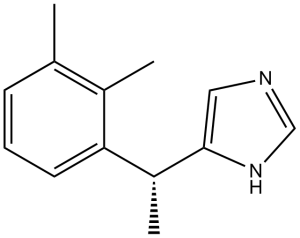
Dexmedetomidine

别名: Dexmedetomidine HCl; Dexmedetomidine Hydrochloride; Precedex 4-(1-(2,3-二甲基苯)乙基)-1H-咪唑酒石酸盐;右美托咪定;盐酸右美托咪啶;右美托咪啶;右美托嘧啶;右美托嘧啶杂质;左美托嘧啶;右旋美托咪啶;(+)-美托咪定;DEXMEDETOMIDINE 游离
目录号: V1146 纯度: ≥98%
右美托咪定(商品名 Precedex)是美托咪定的右旋异构体,是一种强效、高选择性的 α-2 肾上腺素能受体激动剂,具有镇静活性。
Dexmedetomidine CAS号: 113775-47-6
产品类别: Adrenergic Receptor
产品仅用于科学研究,不针对患者销售
规格 价格 库存 数量
25mg
50mg
100mg
250mg
500mg
1g
Other Sizes

Other Forms of Dexmedetomidine:

  • Medetomidine-d3 hydrochloride (MPV785-d3)
  • Levomedetomidine-d8
  • Medetomidine-13C,d3 hydrochloride
  • 3-Hydroxy Medetomidine
  • Levomedetomidine hydrochloride
  • 美托咪定
  • 盐酸右美托咪定
  • 盐酸美托咪啶
点击了解更多
InvivoChem产品被CNS等顶刊论文引用
纯度/质量控制文件

纯度: ≥98%

产品描述
右美托咪定(商品名 Precedex)是美托咪定的右旋异构体,是一种有效的、高选择性的 α-2 肾上腺素受体激动剂,具有镇静活性。右美托咪定通过提供显着的镇静作用来减少患者的麻醉需求。
生物活性&实验参考方法
靶点
α2-adrenergic receptor ( Ki = 1.08 nM )
α2A-adrenergic receptor (Ki = 0.08 nM) [1]
- α2B-adrenergic receptor (Ki = 0.25 nM) [1]
- α2C-adrenergic receptor (Ki = 0.17 nM) [1]
- α1-adrenergic receptor (Ki = 640 nM, 8000-fold lower affinity than α2A subtype) [1]
体外研究 (In Vitro)
右美托咪定具有相对较高的 α2/α1 活性比率(1620:1,而可乐定为 220:1),因此被认为是 α2 受体的完全激动剂。这可能会产生更有效的镇静作用,而不会因 α1 受体激活而对心血管产生不良影响。右美托咪定的 2 小时半衰期比可乐定短近 4 倍,这增加了连续输注右美托咪定用于镇静的可能性。右美托咪定还具有保留最低肺泡麻醉浓度 (MAC) 的特性,但其作为麻醉佐剂的使用因持续低血压而变得复杂,需要静脉输液和血管加压药。此外,大剂量使用会因α2受体介导的血管收缩而导致高血压变得复杂。
大鼠大脑皮层膜制备物与Dexmedetomidine(0.01-100 nM)孵育后,高亲和力结合α2-肾上腺素受体各亚型,其Ki值较α1受体低7000-8000倍,显示出极强的亚型选择性[1]
- 原代大鼠皮质神经元经Dexmedetomidine(10 nM)处理后,通过α2-肾上腺素受体激活抑制毛喉素诱导的cAMP蓄积达68%,降低神经元兴奋性[3]
- Dexmedetomidine(1-10 μM)呈剂量依赖性抑制脂多糖(LPS)诱导的小鼠腹腔巨噬细胞释放肿瘤坏死因子-α(TNF-α),10 μM时抑制率达42%,发挥抗炎作用[3]
体内研究 (In Vivo)
美托咪定(10-100 μg/kg;静脉注射,间隔 5 分钟)会导致给予戊巴比妥的大鼠出现剂量依赖性瞳孔扩张[1]。
健康志愿者静脉注射Dexmedetomidine(0.5 μg/kg)后10分钟内出现轻至中度镇静(Ramsay镇静评分=4),静息心率降低18次/分钟,平均动脉压降低12 mmHg,且无显著呼吸抑制[2]
- 大鼠肌内注射Dexmedetomidine(50 μg/kg)后,镇静持续150分钟,热痛阈值较基线提高65%(通过甩尾试验评估)[3]
- 儿童术前口服Dexmedetomidine(2 μg/kg),给药后60分钟镇静评分(1-5分制)达3.8±0.5,与口服咪达唑仑(0.5 mg/kg)疗效相当,且不良反应更少(如呕吐发生率:3% vs. 12%)[3]
- 麻醉犬静脉注射Dexmedetomidine(10 μg/kg)后15分钟给予异氟醚麻醉,异氟醚的最低肺泡有效浓度(MAC)降低30%,术中血流动力学参数稳定[1]
酶活实验
α2/α1-肾上腺素受体结合实验:从大鼠大脑皮层分离膜组分,将Dexmedetomidine(0.001-1000 nM)与细胞膜及[³H]可乐定(α2配体)或[³H]哌唑嗪(α1配体)在25°C孵育90分钟。真空过滤去除未结合配体,液体闪烁计数法定量结合放射性强度,通过竞争性结合分析计算Ki值[1]
细胞实验
神经元cAMP抑制实验:原代大鼠皮质神经元接种于24孔板,培养7天。用Dexmedetomidine(0.1-100 nM)预处理细胞30分钟后,用毛喉素(10 μM)刺激15分钟。裂解细胞后,采用竞争性ELISA试剂盒检测cAMP水平[3]
- 巨噬细胞抗炎实验:收集小鼠腹腔巨噬细胞接种于96孔板,培养24小时后用Dexmedetomidine(1-10 μM)预处理1小时,再暴露于LPS(1 μg/mL)6小时。ELISA法定量培养上清液中的TNF-α浓度[3]
动物实验
雌性Sprague-Dawley大鼠(270-350 g)
1、5、10、50、100 mg/kg
静脉注射,每5分钟一次
健康志愿者(n=12)接受静脉输注右美托咪定(0.5 μg/kg,10分钟内输注完毕),溶于0.9%生理盐水中。每5分钟监测一次镇静评分、心率、平均动脉压和呼吸频率,持续60分钟[2]
- 雄性Sprague-Dawley大鼠(10周龄)随机分为对照组和治疗组。右美托咪定(50 μg/kg)通过肌内注射给药。通过观察运动活动记录镇静持续时间,并使用甩尾试验每隔30分钟测量一次热痛阈值[3]
- 麻醉的比格犬(n=6)在异氟烷麻醉前15分钟接受静脉注射右美托咪定(10 μg/kg)。记录维持麻醉所需的异氟烷最小肺泡浓度(MAC),并在整个手术过程中监测血流动力学参数(心率、血压)[1]
- 接受择期手术的儿童(3-12岁,n=60)被随机分配到口服右美托咪定(2 μg/kg,溶于果汁)或口服咪达唑仑(0.5 mg/kg),于麻醉诱导前60分钟服用。记录镇静评分、面罩诱导的依从性以及不良事件[3]
药代性质 (ADME/PK)
吸收、分布和排泄
一项质量平衡研究表明,静脉注射放射性标记的右美托咪定后,9天后平均95%的放射性物质从尿液中回收,4%从粪便中回收。对尿液中排泄的放射性物质进行分馏分析表明,N-葡萄糖醛酸化产物约占累积尿排泄量的34%。大部分代谢物经尿液排出。
118 升
39 升/小时 [健康志愿者接受静脉输注 (0.2-0.7 微克/公斤/小时)]
代谢/代谢物
肝脏
右美托咪定已知的人体代谢物包括 (2S,3S,4S,5R)-6-[5-[(1S)-1-(2,3-二甲基苯基)乙基]-1H-咪唑-3-鎓-3-基]-3,4,5-三羟基氧杂环己烷-2-羧酸和 (2S,3S,4S,5R)-6-[5-[(1S)-1-(2,3-二甲基苯基)乙基]咪唑-1-基]-3,4,5-三羟基氧杂环己烷-2-羧酸。
生物半衰期
2小时
静脉注射右美托咪定(0.5 μg/kg)后,在输注结束时血浆峰浓度(Cmax)达到0.8 ng/mL,消除半衰期(t1/2)为2.1小时[2]
- 在大鼠中,肌注右美托咪定(50 μg/kg)20分钟时Cmax为3.2 ng/mL,口服生物利用度为35%,70%的剂量通过葡萄糖醛酸化和羟基化在肝脏代谢[1]
- 该药物广泛分布于组织中,在人体内的分布容积(Vd)为118 L,在大鼠内的分布容积为2.8 L/kg[2]
- 在儿童中,口服右美托咪定(2 μg/kg)给药后 45 分钟达到 Cmax 0.3 ng/mL,t1/2 为 1.8 小时 [3]
毒性/毒理 (Toxicokinetics/TK)
妊娠期和哺乳期影响
◉ 哺乳期用药概述
有限的数据表明,静脉输注结束后 4 至 6 小时内,极少量的右美托咪定会分泌到乳汁中。输注结束后 24 小时内,乳汁中不再含有该药物。舌下含服后乳汁中的药物含量预计低于静脉输注后的含量。由于乳汁中的药物剂量低且口服生物利用度差,预计右美托咪定不会对母乳喂养的婴儿或新生儿造成不良影响。舌下含服期间,应监测母乳喂养婴儿的烦躁情况。
◉ 对母乳喂养婴儿的影响
截至修订日期,未找到相关的已发表信息。
◉ 对泌乳和母乳的影响
一项双盲研究将 160 名接受择期剖宫产且行脊髓麻醉的女性随机分为两组,一组接受舒芬太尼进行患者自控静脉镇痛(标准治疗),另一组在标准治疗的基础上加用右美托咪定。右美托咪定的给药剂量为 5 mcg/kg,随后以 0.5 mcg/kg/小时的速度持续输注,直至手术结束。后一组患者术后接受右美托咪定联合舒芬太尼进行患者自控静脉镇痛,持续 2 天。接受右美托咪定治疗的患者首次泌乳时间更短(28 小时 vs 34 小时),更快实现纯母乳喂养(8 天 vs 11 天),并且在产后第二天乳汁量更多。
在一项对接受剖宫产的女性进行的回顾性研究中,比较了 3 种方案:麻醉前和分娩期间使用右美托咪定(n = 115)、麻醉前和分娩期间使用生理盐水,分娩后使用右美托咪定(n = 109)以及麻醉前和分娩期间使用生理盐水(n = 168)。接受右美托咪定麻醉前和分娩期间的女性在住院期间服用舒芬太尼和昂丹司琼的剂量较少,且首次泌乳时间略短于其他组的女性(25 分钟 vs 27 至 28 分钟)。
蛋白质结合
94%
在临床研究(人类和儿童)中,右美托咪定(0.2-2 μg/kg,静脉/口服)耐受性良好。轻度不良事件包括心动过缓(成人9%,儿童5%)、低血压(成人7%,儿童4%)和轻微呼吸抑制(发生率<1%)[2,3]
- 小鼠急性腹腔注射右美托咪定的LD50为135 mg/kg [1]
- 右美托咪定在人血浆中的血浆蛋白结合率为94%,在大鼠血浆中的血浆蛋白结合率为91% [2]
- 与异氟烷、丙泊酚、阿片类药物或咪达唑仑合用时,未观察到显著的药物相互作用 [3]
参考文献

[1]. Characterization of the selectivity, specificity and potency of medetomidine as an alpha 2-adrenoceptor agonist. Eur J Pharmacol. 1988 May 20;150(1-2):9-14.

[2]. Dexmedetomidine: a novel sedative-analgesic agent. Proc (Bayl Univ Med Cent). 2001 Jan;14(1):13-21.

[3]. A comparison of oral dexmedetomidine and oral midazolam as premedicants in children. J Anaesthesiol Clin Pharmacol. Jan-Mar 2019;35(1):36-40.

其他信息
右美托咪定是一种美托咪定衍生物。它是一种α-肾上腺素能激动剂,属于非麻醉性镇痛药,具有镇痛和镇静作用。它是左美托咪定的对映异构体。
右美托咪定是一种α-2肾上腺素能受体激动剂,因其镇痛和镇静作用而用于兽医学。它是右美托咪定的消旋体。
右美托咪定是一种中枢α-2肾上腺素能激动剂。右美托咪定的作用机制是作为α-肾上腺素能激动剂。右美托咪定的生理效应是通过全身麻醉实现的。
右美托咪定是咪唑衍生物,是美托咪定的活性d-异构体,具有镇痛、抗焦虑和镇静作用。右美托咪定选择性地与位于脑内的突触前α2肾上腺素受体结合,从而抑制突触小泡释放去甲肾上腺素。这导致突触后肾上腺素受体的激活受到抑制,进而抑制交感神经活性,最终产生镇静和抗焦虑作用。该药的镇痛作用是通过与脊髓中的α2肾上腺素受体结合而实现的。
一种咪唑衍生物,是肾上腺素能α2受体的激动剂。它与美托咪定密切相关,美托咪定是该化合物的外消旋体。
药物适应症
右美托咪定静脉注射用于重症监护病房中初始插管和机械通气患者的镇静,以及用于手术和其他操作前和/或手术期间非插管患者的镇静。本品亦有口腔或舌下含服的速溶膜剂型,用于急性治疗精神分裂症或双相情感障碍I型或II型引起的躁动。
适用于需要镇静的成人重症监护病房患者,镇静程度不超过对语言刺激产生觉醒反应(对应里士满躁动-镇静量表 (RASS) 0 至 -3)。
适用于需要镇静的成人重症监护病房 (ICU) 患者,镇静程度不超过对语言刺激产生觉醒反应(对应里士满躁动-镇静量表 (RASS) 0 至 -3)。用于未插管成年患者在需要镇静的诊断或手术操作前和/或操作过程中进行镇静,即操作性/清醒镇静。
用于犬猫的非侵入性、轻度至中度疼痛的检查和操作,这些操作和操作需要保定、镇静和镇痛。与布托啡诺联合使用时,可用于犬的深度镇静和镇痛,以进行内科和小型外科手术。用于犬猫在诱导和维持全身麻醉前的预用药。
用于犬猫的非侵入性、轻度至中度疼痛的检查和操作,这些操作和操作需要保定、镇静和镇痛。与布托啡诺联合使用时,可用于犬的深度镇静和镇痛,以进行内科和小型外科手术。犬猫全身麻醉诱导和维持前的预用药。
适用于犬猫进行非侵入性、轻度至中度疼痛的检查和操作,这些操作和操作需要保定、镇静和镇痛。猫咪使用氯胺酮进行全身麻醉诱导和维持前的预用药。犬咪与布托啡诺联合使用时,可进行深度镇静和镇痛,用于内科和小型外科手术。犬咪全身麻醉诱导和维持前的预用药。
缓解犬咪因噪音引起的急性焦虑和恐惧。
作用机制
右美托咪定是一种特异性选择性α2肾上腺素受体激动剂。它通过与突触前α2肾上腺素受体结合,抑制去甲肾上腺素的释放,从而终止疼痛信号的传导。突触后α-2肾上腺素受体的激活抑制交感神经活动,降低血压和心率。
药效学
右美托咪定激活α2肾上腺素受体,降低交感神经张力,减弱麻醉和手术引起的神经内分泌和血流动力学反应;减少麻醉药和阿片类药物的需求;右美托咪定可引起镇静和镇痛作用。
右美托咪定是美托咪定的活性(S)-对映体,其对α2-肾上腺素能受体的亲和力比(R)-对映体高8-10倍[1]
- 该药物通过激活蓝斑核中的中枢α2-肾上腺素能受体(主要为α2A亚型)发挥镇静、镇痛和抗焦虑作用,从而减少去甲肾上腺素的释放[2]
- 临床上,它被批准用于ICU插管/机械通气患者的镇静、非插管患者的操作镇静以及儿童和成人的术前用药[2,3]
- 右美托咪定在治疗剂量下可维持呼吸功能,因此适用于有呼吸功能受损风险的患者的镇静。 [3]
*注: 文献方法仅供参考, InvivoChem并未独立验证这些方法的准确性
化学信息 & 存储运输条件
分子式
C13H16N2
分子量
200.28
精确质量
200.131
元素分析
C, 77.96; H, 8.05; N, 13.99
CAS号
113775-47-6
相关CAS号
Medetomidine; 86347-14-0;Dexmedetomidine hydrochloride; 145108-58-3; Medetomidine hydrochloride; 86347-15-1
PubChem CID
5311068
外观&性状
White to off-white solid powder
密度
1.053g/cm3
沸点
381.9ºC at 760mmHg
熔点
146-149°C
闪点
191.3ºC
蒸汽压
1.08E-05mmHg at 25°C
折射率
1.569
LogP
3.178
tPSA
28.68
氢键供体(HBD)数目
1
氢键受体(HBA)数目
1
可旋转键数目(RBC)
2
重原子数目
15
分子复杂度/Complexity
205
定义原子立体中心数目
1
SMILES
N1([H])C([H])=NC([H])=C1[C@@]([H])(C([H])([H])[H])C1=C([H])C([H])=C([H])C(C([H])([H])[H])=C1C([H])([H])[H]
InChi Key
CUHVIMMYOGQXCV-NSHDSACASA-N
InChi Code
InChI=1S/C13H16N2/c1-9-5-4-6-12(10(9)2)11(3)13-7-14-8-15-13/h4-8,11H,1-3H3,(H,14,15)/t11-/m0/s1
化学名
5-[(1S)-1-(2,3-dimethylphenyl)ethyl]-1H-imidazole
别名
Dexmedetomidine HCl; Dexmedetomidine Hydrochloride; Precedex
HS Tariff Code
2934.99.9001
存储方式

Powder      -20°C    3 years

                     4°C     2 years

In solvent   -80°C    6 months

                  -20°C    1 month

注意: 本产品在运输和储存过程中需避光。
运输条件
Room temperature (This product is stable at ambient temperature for a few days during ordinary shipping and time spent in Customs)
溶解度数据
溶解度 (体外实验)
DMSO: 40~125 mg/mL (199.7~624.1 mM)
Water: ~40 mg/mL (~199.7 mM)
Ethanol: ~40 mg/mL (~199.7 mM)
溶解度 (体内实验)
配方 1 中的溶解度: ≥ 2.08 mg/mL (10.39 mM) (饱和度未知) in 10% DMSO + 40% PEG300 + 5% Tween80 + 45% Saline (这些助溶剂从左到右依次添加,逐一添加), 澄清溶液。
例如,若需制备1 mL的工作液,可将100 μL 20.8 mg/mL澄清DMSO储备液加入400 μL PEG300中,混匀;然后向上述溶液中加入50 μL Tween-80,混匀;加入450 μL生理盐水定容至1 mL。
*生理盐水的制备:将 0.9 g 氯化钠溶解在 100 mL ddH₂O中,得到澄清溶液。

配方 2 中的溶解度: ≥ 2.08 mg/mL (10.39 mM) (饱和度未知) in 10% DMSO + 90% (20% SBE-β-CD in Saline) (这些助溶剂从左到右依次添加,逐一添加), 澄清溶液。
例如,若需制备1 mL的工作液,可将 100 μL 20.8 mg/mL澄清DMSO储备液加入900 μL 20% SBE-β-CD生理盐水溶液中,混匀。
*20% SBE-β-CD 生理盐水溶液的制备(4°C,1 周):将 2 g SBE-β-CD 溶解于 10 mL 生理盐水中,得到澄清溶液。

View More

配方 3 中的溶解度: ≥ 2.08 mg/mL (10.39 mM) (饱和度未知) in 10% DMSO + 90% Corn Oil (这些助溶剂从左到右依次添加,逐一添加), 澄清溶液。
例如,若需制备1 mL的工作液,可将 100 μL 20.8 mg/mL 澄清 DMSO 储备液加入到 900 μL 玉米油中并混合均匀。


请根据您的实验动物和给药方式选择适当的溶解配方/方案:
1、请先配制澄清的储备液(如:用DMSO配置50 或 100 mg/mL母液(储备液));
2、取适量母液,按从左到右的顺序依次添加助溶剂,澄清后再加入下一助溶剂。以 下列配方为例说明 (注意此配方只用于说明,并不一定代表此产品 的实际溶解配方):
10% DMSO → 40% PEG300 → 5% Tween-80 → 45% ddH2O (或 saline);
假设最终工作液的体积为 1 mL, 浓度为5 mg/mL: 取 100 μL 50 mg/mL 的澄清 DMSO 储备液加到 400 μL PEG300 中,混合均匀/澄清;向上述体系中加入50 μL Tween-80,混合均匀/澄清;然后继续加入450 μL ddH2O (或 saline)定容至 1 mL;

3、溶剂前显示的百分比是指该溶剂在最终溶液/工作液中的体积所占比例;
4、 如产品在配制过程中出现沉淀/析出,可通过加热(≤50℃)或超声的方式助溶;
5、为保证最佳实验结果,工作液请现配现用!
6、如不确定怎么将母液配置成体内动物实验的工作液,请查看说明书或联系我们;
7、 以上所有助溶剂都可在 Invivochem.cn网站购买。
制备储备液 1 mg 5 mg 10 mg
1 mM 4.9930 mL 24.9650 mL 49.9301 mL
5 mM 0.9986 mL 4.9930 mL 9.9860 mL
10 mM 0.4993 mL 2.4965 mL 4.9930 mL

1、根据实验需要选择合适的溶剂配制储备液 (母液):对于大多数产品,InvivoChem推荐用DMSO配置母液 (比如:5、10、20mM或者10、20、50 mg/mL浓度),个别水溶性高的产品可直接溶于水。产品在DMSO 、水或其他溶剂中的具体溶解度详见上”溶解度 (体外)”部分;

2、如果您找不到您想要的溶解度信息,或者很难将产品溶解在溶液中,请联系我们;

3、建议使用下列计算器进行相关计算(摩尔浓度计算器、稀释计算器、分子量计算器、重组计算器等);

4、母液配好之后,将其分装到常规用量,并储存在-20°C或-80°C,尽量减少反复冻融循环。

计算器

摩尔浓度计算器可计算特定溶液所需的质量、体积/浓度,具体如下:

  • 计算制备已知体积和浓度的溶液所需的化合物的质量
  • 计算将已知质量的化合物溶解到所需浓度所需的溶液体积
  • 计算特定体积中已知质量的化合物产生的溶液的浓度
使用摩尔浓度计算器计算摩尔浓度的示例如下所示:
假如化合物的分子量为350.26 g/mol,在5mL DMSO中制备10mM储备液所需的化合物的质量是多少?
  • 在分子量(MW)框中输入350.26
  • 在“浓度”框中输入10,然后选择正确的单位(mM)
  • 在“体积”框中输入5,然后选择正确的单位(mL)
  • 单击“计算”按钮
  • 答案17.513 mg出现在“质量”框中。以类似的方式,您可以计算体积和浓度。

稀释计算器可计算如何稀释已知浓度的储备液。例如,可以输入C1、C2和V2来计算V1,具体如下:

制备25毫升25μM溶液需要多少体积的10 mM储备溶液?
使用方程式C1V1=C2V2,其中C1=10mM,C2=25μM,V2=25 ml,V1未知:
  • 在C1框中输入10,然后选择正确的单位(mM)
  • 在C2框中输入25,然后选择正确的单位(μM)
  • 在V2框中输入25,然后选择正确的单位(mL)
  • 单击“计算”按钮
  • 答案62.5μL(0.1 ml)出现在V1框中
g/mol

分子量计算器可计算化合物的分子量 (摩尔质量)和元素组成,具体如下:

注:化学分子式大小写敏感:C12H18N3O4  c12h18n3o4
计算化合物摩尔质量(分子量)的说明:
  • 要计算化合物的分子量 (摩尔质量),请输入化学/分子式,然后单击“计算”按钮。
分子质量、分子量、摩尔质量和摩尔量的定义:
  • 分子质量(或分子量)是一种物质的一个分子的质量,用统一的原子质量单位(u)表示。(1u等于碳-12中一个原子质量的1/12)
  • 摩尔质量(摩尔重量)是一摩尔物质的质量,以g/mol表示。
/

配液计算器可计算将特定质量的产品配成特定浓度所需的溶剂体积 (配液体积)

  • 输入试剂的质量、所需的配液浓度以及正确的单位
  • 单击“计算”按钮
  • 答案显示在体积框中
动物体内实验配方计算器(澄清溶液)
第一步:请输入基本实验信息(考虑到实验过程中的损耗,建议多配一只动物的药量)
第二步:请输入动物体内配方组成(配方适用于不溶/难溶于水的化合物),不同的产品和批次配方组成不同,如对配方有疑问,可先联系我们提供正确的体内实验配方。此外,请注意这只是一个配方计算器,而不是特定产品的确切配方。
+
+
+

计算结果:

工作液浓度 mg/mL;

DMSO母液配制方法 mg 药物溶于 μL DMSO溶液(母液浓度 mg/mL)。如该浓度超过该批次药物DMSO溶解度,请首先与我们联系。

体内配方配制方法μL DMSO母液,加入 μL PEG300,混匀澄清后加入μL Tween 80,混匀澄清后加入 μL ddH2O,混匀澄清。

(1) 请确保溶液澄清之后,再加入下一种溶剂 (助溶剂) 。可利用涡旋、超声或水浴加热等方法助溶;
            (2) 一定要按顺序加入溶剂 (助溶剂) 。

临床试验信息
Role of Intravenous Dexmedetomidine in Reducing Shivering After Shivering Cesarean Section Due to Spinal Anesthesia
CTID: NCT06711913
Phase: Phase 2    Status: Completed
Date: 2024-12-02
Comparison of Two Sedation Regimens for Awake Fiberoptic Intubation
CTID: NCT05736198
Phase:    Status: Recruiting
Date: 2024-11-29
Effects of Dexmedetomidine Versus Ketamine on Inflammatory Response and Hemodynamic in Patients
CTID: NCT06490731
Phase: Phase 1/Phase 2    Status: Recruiting
Date: 2024-11-27
Comparison of Perioperative Conscious Sedation During Endovascular Thrombectomy in Acute Ischemic Stroke
CTID: NCT06139692
Phase: Phase 4    Status: Recruiting
Date: 2024-11-27
Dexmedetomidine Dosage for Postoperative Delirium and Cognitive Function in Elderly TKA Patients
CTID: NCT06614881
Phase: N/A    Status: Completed
Date: 2024-11-26
View More

Dexmedetomidine and Magnesium Sulfate in the Reduction Cognitive Dysfunction in Geriatrics
CTID: NCT06702488
Phase: Phase 1    Status: Recruiting
Date: 2024-11-25


Dexmedetomidine in Reducing Postoperative Delirium Among Cardiac Surgery Patients with Preoperative Sleep Disorders
CTID: NCT06619912
Phase: Phase 2    Status: Not yet recruiting
Date: 2024-11-20
Dexmedetomidine, Ozone and Dexamethasone Local Injection in Carpal Tunnel Syndrome for Pain Relief
CTID: NCT06133712
Phase: N/A    Status: Recruiting
Date: 2024-11-19
Efficacy and Safety of Adding Dexmedetomidine to Levobupivacaine in Rectus Sheath Block Compared to Quadratus Lumborum Block in Patients Undergoing Lower Abdominal Cancer Surgery: a Randomized Clinical Trial
CTID: NCT06695468
Phase: Phase 4    Status: Not yet recruiting
Date: 2024-11-19
Association Between Anesthetic Drugs for General Anesthesia and Postoperative Intelligence/behavioral Assessment Results in Children
CTID: NCT04364945
Phase: N/A    Status: Active, not recruiting
Date: 2024-11-19
Liposomal Bupivacaine Vs Bupivacaine with Dexmedetomidine in Erector Spinae Plane Blocks for Mastectomies
CTID: NCT06252662
Phase: Phase 4    Status: Recruiting
Date: 2024-11-19
Comparing the Effect of Adding Dexmedetomidine to Bupivacaine in Classical and Modified Thoracolumbar Interfascial Plane Block on Postoperative Pain in Patients Undergoing Lumbar Disc Surgeries
CTID: NCT06690021
Phase: Phase 4    Status: Not yet recruiting
Date: 2024-11-15
Dexmedetomidine as an Adjuvant in External Oblique Intercostal Plane Block for Post Thoracotomy Pain
CTID: NCT06684535
Phase: N/A    Status: Recruiting
Date: 2024-11-15
Pharmacokinetics of Sedatives and Analgesics During Extracorporeal Membrane Oxygenation (ECMO) Support
CTID: NCT03593408
Phase:    Status: Recruiting
Date: 2024-11-14
Intranasal Dexmedetomidine vs Intranasal Midazolam as Anxiolysis Prior to Pediatric Laceration Repair
CTID: NCT02168439
Phase: Phase 4    Status: Completed
Date: 2024-11-14
Dexmedetomidine in Postoperative Analgesia
CTID: NCT05705128
Phase: Phase 2/Phase 3    Status: Enrolling by invitation
Date: 2024-11-14
Dexmedetomidine vs Propofol TIVA (Total Intravenous Anesthesia) and Interscalene Block
CTID: NCT02469961
Phase: Phase 4    Status: Completed
Date: 2024-11-13
Effect of Adding Different Concentrations of Dexmedetomidine to Bupivacaine in Caudal Block for Pediatrics
CTID: NCT06668220
Phase: Phase 1    Status: Not yet recruiting
Date: 2024-11-13
Dexmedetomidine for Improved Pain Relief and Recovery in Spine Surgery
CTID: NCT06685081
Phase: N/A    Status: Completed
Date: 2024-11-12
Effect of Dexmedetomidine on the Quality of Recovery in Parturients Undergoing Elective Caesarean Sections
CTID: NCT05991466
Phase: Phase 4    Status: Completed
Date: 2024-11-12
Premedication With Intranasal Dexmedetomidine in Sedation of Patients Undergoing Total Knee Arthroplasty
CTID: NCT04859283
Phase: Phase 4    Status: Active, not recruiting
Date: 2024-11-12
The Impact of a Dexmedetomidine Perfusion on Intraoperative Remifentanil Consumption
CTID: NCT06684197
Phase: N/A    Status: Not yet recruiting
Date: 2024-11-12
Opioid-based Versus Opioid-free Anaesthesia for Laparoscopic Cholecystectomy
CTID: NCT06476600
Phase: N/A    Status: Completed
Date: 2024-11-08
Propofol Versus Dexmedetomidine Effect on Prevention Emergence Agitation
CTID: NCT06312618
Phase: Phase 4    Status: Recruiting
Date: 2024-11-06
Comparison Between Effect of Vitamin D Versus Dexmedetomidine in Patients with Head Trauma Using Interleukin 6
CTID: NCT06565338
Phase:    Status: Completed
Date: 2024-11-04
Effect of Dexmedetomidine on Postoperative Mental Disorders and Long-term Survival in Elderly Patients
CTID: NCT06362408
Phase:    Status: Completed
Date: 2024-11-04
Dexmedetomidine and Bupivacaine Intra-articular for Postoperative Analgesia After Knee Arthroscopic Surgery
CTID: NCT06665438
Phase: Phase 3    Status: Not yet recruiting
Date: 2024-10-30
Non-invasive Ventilation and Dexmedetomidine in Critically Ill Adults
CTID: NCT06259565
Phase: Phase 3    Status: Not yet recruiting
Date: 2024-10-29
Non-invasive Ventilation and Dex in Critically Ill Adults
CTID: NCT04878510
Phase: Phase 3    Status: Completed
Date: 2024-10-28
Perioperative Pain Management for Lumbar Spine Surgery
CTID: NCT06662318
Phase: N/A    Status: Recruiting
Date: 2024-10-28
Early Sedation with Dexmedetomidine Vs. Placebo in Older Ventilated Critically Ill Patients
CTID: NCT06251375
Phase: Phase 4    Status: Not yet recruiting
Date: 2024-10-28
Effect of Intravenous or Intrathecal Dexmedetomidine on Bupivacaine Spinal Block in Lower Abdominal Surgery
CTID: NCT06654531
Phase: Phase 2/Phase 3    Status: Completed
Date: 2024-10-23
The Effects of Dexmedetomidine on Postoperative Cognitive Function in Open Heart Surgery
CTID: NCT06655025
Phase: N/A    Status: Recruiting
Date: 2024-10-23
Nerve Block Vs Sedation Infusion for Awake Fiberoptic Intubation.
CTID: NCT06651905
Phase: N/A    Status: Completed
Date: 2024-10-23
Dexmedetomidine Ropivacaine Versus Plain Ropivacaine in Bilateral Pectoralis Nerve (PECS) Block
CTID: NCT06636578
Phase: Phase 4    Status: Recruiting
Date: 2024-10-15
Intrathecal Dexmedetomidine Vs Epinephrine
CTID: NCT06418308
Phase: Phase 4    Status: Recruiting
Date: 2024-10-15
Effect of Dexmedetomidine Supplementation to General Anaesthesia in Paediatric Transcatheter Closure of Atrial Septal Defect
CTID: NCT06631534
Phase: Phase 4    Status: Recruiting
Date: 2024-10-15
Cardioprotective Effect of Dexmedetomidine in Patients With ST-segment Elevation Myocardial Infarction
CTID: NCT04912518
Phase: N/A    Status: Recruiting
Date: 2024-10-15
Intra-Articular Dexmedetomidine: A Treatment for Chronic Knee Pain
CTID: NCT06641206
Phase: N/A    Status: Recruiting
Date: 2024-10-15
Sphenopalatine Block Vs Dexmedetomidine Infusion in Trans Nasal Endoscopic Pituitary Surgery
CTID: NCT06639659
Phase: N/A    Status: Not yet recruiting
Date: 2024-10-15
Effects of an Opioid Free/Sparing Care Pathway for Patients Undergoing Obesity Surgery
CTID: NCT03756961
Phase: N/A    Status: Recruiting
Date: 2024-10-15
Effect of Dexmedetomidine on Left Ventricular Function in Coronary Artery Bypass Graft Surgery Outcome
CTID: NCT05778305
PhaseEarly Phase 1    Status: Completed
Date: 2024-10-09
The Effect of Dexmedetomidine on the Renal Functions in Septic Critically Ill Patients
CTID: NCT06570187
Phase: Phase 4    Status: Recruiting
Date: 2024-10-09
Dexmedetomidine-Esketamine Combination for Sedation and Analgesia in ICU Patients
CTID: NCT06468436
Phase: N/A    Status: Not yet recruiting
Date: 2024-10-08
Investigation of Sleep in the Intensive Care Unit
CTID: NCT03355053
Phase: Phase 2    Status: Completed
Date: 2024-10-08
Dexmedetomidine and Myocardial Protection
CTID: NCT04871308
Phase: N/A    Status: Recruiting
Date: 2024-10-03
Alpha 2 Agonists for Sedation to Produce Better Outcomes From Critical Illness (A2B Trial)
CTID: NCT03653832
Phase: Phase 3    Status: Completed
Date: 2024-10-03
Dexmedetomidine Reduces Sevoflurane MAC-BAR During Pneumoperitoneum
CTID: NCT06575179
Phase: Phase 4    Status: Recruiting
Date: 2024-10-01
Effects of Dexmedetomidine on Agitation in Critically Ill TBI Patients
CTID: NCT06620393
Phase: Phase 2/Phase 3    Status: Not yet recruiting
Date: 2024-10-01
Effect of Different Administration Routes of Dexmedetomidine Combined with Ultrasound-Guided Fascia Iliaca Block on Emergence Agitation After Hip Replacement Surgery
CTID: NCT06614010
Phase: Phase 1    Status: Recruiting
Date: 2024-09-26
Dexamethasone Vs. Dexmedetomidine for ESPB in Pain Management After Pediatric Idiopathic Scoliosis Surgery
CTID: NCT06086431
Phase: Phase 4    Status: Recruiting
Date: 2024-09-26
Pregabalin Versus Dexmedetomidine for Delirium Prevention After Cardiac Surgery
CTID: NCT05640479
Phase: Phase 4    Status: Recruiting
Date: 2024-09-23
Nebulized Dexmedetomidine or Lidocaine for Treatment of Post Dural Puncture Headache in Parturients Undergoing Elective Cesarean Section Under Spinal Anesthesia
CTID: NCT06607861
PhaseEarly Phase 1    Status: Not yet recruiting
Date: 2024-09-23
In Vitro Evaluation of Spontaneous and Oxytocin-induced Contractility of Pregnant Human Myometrium During Exposure to Dexmedetomidine
CTID: NCT05511415
Phase: N/A    Status: Recruiting
Date: 2024-09-19
Effect of Intraoperative Dexmedetomidine on Early Postoperative Cognitive Dysfunction
CTID: NCT03793751
Phase: Phase 4    Status: Completed
Date: 2024-09-19
Tranexamic Acid Versus Dexmedetomidine for Improving Surgical Field Quality During Spine Surgeries
CTID: NCT06587620
Phase: N/A    Status: Completed
Date: 2024-09-19
Dexmedetomidine for Intraoperative Shivering in Scheduled Elective Cesarean Delivery
CTID: NCT04730609
Phase: Phase 4    Status: Recruiting
Date: 2024-09-19
----------------------
Intranasal dexmedetomidine: pilot pharmacokinetics / pharmacodynamics (PK/PD) study in a preterm population undergoing percutaneous central venous catheter placement
CTID: null
Phase: Phase 2    Status: Ongoing
Date: 2021-12-10
Impact of post-ARDS COVID sedation on late neuroinflammation
CTID: null
Phase: Phase 3    Status: Trial now transitioned
Date: 2021-08-03
Combined intravenous dexamethasone and dexmedetomidine as adjuncts to popliteal and saphenous nerve blocks in patients undergoing orthopaedic surgery of the foot and ankle. A randomised, blinded, placebo-controlled, parallel clinical trial.
CTID: null
Phase: Phase 4    Status: Completed
Date: 2021-04-21
Opioid-Free Anesthesia in Cardiac Surgery
CTID: null
Phase: Phase 3    Status: Completed
Date: 2021-03-09
Neurodevelopmental outcome after standard dose sevoflurane versus low-dose sevoflurane/dexmedetomidine/remifentanil anaesthesia in young children
CTID: null
Phase: Phase 3    Status: Trial now transitioned
Date: 2020-04-03
Dexmedetomidine for analgosedation to newborn infants during neonatal
CTID: null
Phase: Phase 3    Status: Ongoing
Date: 2020-01-08
Comparison of pain and comfort in patients following cardiac surgery: opioid-morphine managed vs multimodal pain-management.
CTID: null
Phase: Phase 4    Status: Completed
Date: 2019-07-16
Effect of dexmedetomidine vs 0.9% sodium chloride on Nol-Index guided remifentanil analgesia: a double-blinded bicenter randomized controlled trial
CTID: null
Phase: Phase 4    Status: Ongoing
Date: 2019-02-18
Alpha 2 agonists for sedation to produce better outcomes from critical illness (A2B Trial): A randomised, parallel-group, allocation concealed, controlled, open, phase 3 pragmatic clinical and cost- effectiveness trial with internal pilot
CTID: null
Phase: Phase 3    Status: GB - no longer in EU/EEA
Date: 2018-12-10
Feasibility and pharmacodynamics of subcutaneously given combination of dexmedetomidine and ketamine infusion in ALS patients receiving palliative care
CTID: null
Phase: Phase 4    Status: Ongoing
Date: 2018-05-09
Effects of an Opiod Sparing Care Pathway for Patients undergoing Obesity Surgery
CTID: null
Phase: Phase 4    Status: Trial now transitioned
Date: 2018-02-19
‘Immune protective anesthesia during endoscopic colon surgery to improve long-term survival’
CTID: null
Phase: Phase 4    Status: Ongoing
Date: 2017-10-03
Pharmacodynamic interactions between remifentanil and dexmedetomidine (PIRAD)
CTID: null
Phase: Phase 4    Status: Completed
Date: 2017-05-01
Efficacy of single dose intranasal dexmedetomidine for conscious sedation in dental practice in dentophobic uncooperative patients with intellectual disability.
CTID: null
Phase: Phase 2    Status: Ongoing
Date: 2016-11-24
Intranasal dexmedetomidine sedation during intra-articular joint injections in pediatric population
CTID: null
Phase: Phase 4    Status: Completed
Date: 2016-11-07
Bioavailability and pharmacokinetics of intranasal dexmedetomidine in children
CTID: null
Phase: Phase 4    Status: Completed
Date: 2016-10-28
Effects of different concentrations of dexmedetomidine on basal ganglia neuronal activity (local field potentials) in Parkinson's disease.
CTID: null
Phase: Phase 4    Status: Completed
Date: 2016-10-20
Dexmedetomidine infusion in pain management during low back surgery
CTID: null
Phase: Phase 4    Status: Prematurely Ended
Date: 2016-09-01
Pharmacokinetics of subcutaneously given dexmedetomidine in healthy volunteers
CTID: null
Phase: Phase 4    Status: Completed
Date: 2016-01-26
Safety, tolerability and sedative properties of single dose intranasal dexmedetomidine premedication in elderly subjects.
CTID: null
Phase: Phase 2    Status: Ongoing
Date: 2016-01-08
Comparison of efficacy between dexmedetomidine (DEX) and nicardipine (NIC) in adult facial surgery
CTID: null
Phase: Phase 4    Status: Completed
Date: 2015-12-23
The Neural Mechanisms of Anesthesia and Human Consciousness (Part 6)
CTID: null
Phase: Phase 4    Status: Completed
Date: 2015-12-15
Open randomized clinical trial to compare the efficacy of hypotensive anesthesia with clonidine or dexmedetomidine during endoscopic nasal surgery
CTID: null
Phase: Phase 3    Status: Ongoing
Date: 2015-10-02
Dexmedetomidine versus propofol in awake implantation of a neuromodulative system.
CTID: null
Phase: Phase 2    Status: Completed
Date: 2015-09-17
DEXMEDETOMIDINA VERSUS PROPOFOL FOR SEDATION DURING ECOBRONCHOSCOPY
CTID: null
Phase: Phase 4    Status: Completed
Date: 2015-06-05
Does perineural dexmedetomidine prolong the duration of an adductor canal block
CTID: null
Phase: Phase 2    Status: Completed
Date: 2015-04-23
Dexmedetomidine for saphenous nerve blockade in patients undergoing anterior cruciate ligament replacement: a randomized, placebo-controlled, triple blinded study
CTID: null
Phase: Phase 2    Status: Ongoing
Date: 2014-12-05
Az optimális premedikációs stratégia kidolgozása fogyatékkal élő betegek altatásos fogászati beavatkozásaihoz;orális midazolam, valamint két különböző dózisú intranasalis dexmedetomidine hatásainak összehasonlítása
CTID: null
Phase: Phase 3    Status: Ongoing
Date: 2014-11-19
'Sedation Practices in Intensive Care Evaluation: SPICE III – A Prospective Multicentre Randomised Controlled Trial of Early Goal Direct Sedation vs. Standard Care Sedation”
CTID: null
Phase: Phase 4    Status: Ongoing
Date: 2014-11-06
Conscious sedation for procedures in Dental and Minor Maxillofacial Surgery Unit: optimization of the dexmedetomidine dose (Dexdor®).
CTID: null
Phase: Phase 4    Status: Prematurely Ended
Date: 2014-10-24
Dexmedetomidine in awake implantation of neuromodulative systems.
CTID: null
Phase: Phase 2    Status: Completed
Date: 2014-07-31
Effect of dexmedetomidine on monitoring of motor evoked potentials in patients undergoing supratentorial craniotomy or brainstem surgery
CTID: null
Phase: Phase 4    Status: Ongoing
Date: 2014-07-10
Effect of dexmedetomidine vs propofol on basal ganglia activity (local field potentials) recorded through implanted stimulators
CTID: null
Phase: Phase 4    Status: Completed
Date: 2014-06-26
Neuroprotection with Dexmedetomidine in patients undergoing elective cardiac or abdominal surgery
CTID: null
Phase: Phase 4    Status: Completed
Date: 2013-12-23
DEXMEDETOMIDINE FOR PERIPHERAL NERVE BLOCKADE: A DOSE-FINDING STUDY IN VOLUNTEERS
CTID: null
Phase: Phase 4    Status: Completed
Date: 2013-10-23
The Neural Mechanisms of Anesthesia and Human Consciousness
CTID: null
Phase: Phase 4    Status: Completed
Date: 2013-06-18
The effect of dexmedetomidine as an adjuvant to local anaesthetics for ilioinguinal blocks in paediatric patients
CTID: null
Phase: Phase 4    Status: Ongoing
Date: 2013-05-17
Postoperatiivisen deksmedetomidiinisedaation vaikutukset hemodynamiikkaan ekstubaation yhteydessä
CTID: null
Phase: Phase 4    Status: Ongoing
Date: 2013-05-17
Acute ventilatory response to hypoxia during sedation with dexmedetomidine compared to propofol in healthy volunteers.
CTID: null
Phase: Phase 4    Status: Completed
Date: 2013-05-02
Development of a pharmacokinetic/pharmacodynamic model of dexmedetomidine, and the effect of repeated auditory stimulation on pharmacodynamics of dexmedetomidine
CTID: null
Phase: Phase 3    Status: Ongoing
Date: 2013-03-05
The effects of dexmedetomidine on cerebral autoregulation and cerebral oxygenation in subarachnoid haemorrhage patients.
CTID: null
Phase: Phase 4    Status: Ongoing
Date: 2012-05-16
Comparative evaluation of the effects of dexmedetomidine and propofol on patient/ventilator interaction in difficult-to-wean mechanically ventilated patients; a prospective, open, randomised, multicentre study.
CTID: null
Phase: Phase 3    Status: Completed
Date: 2012-04-03
The effect and safety of dexmedetomidine as an additive to ropivacaine for interscalene brachial plexus blocks for shoulder surgery
CTID: null
Phase: Phase 3    Status: Completed
Date: 2011-10-12
Dexmedetomidine pharmacokinetics-pharmacodynamics
CTID: null
Phase: Phase 3    Status: Completed
Date: 2011-02-14
Dexmedetomidine pharmacokinetics-pharmacodynamics
CTID: null
Phase: Phase 3    Status: Completed
Date: 2010-01-06
A prospective, multi-centre, randomised, double-blind, placebo-controlled comparison of intravenous dexmedetomidine with haloperidol in treatment of hyperactive delirium after heart surgery.
CTID: null
Phase: Phase 3    Status: Ongoing
Date: 2009-11-30
The effect of dexmedetomidine on reactivity of a propofol-anaesthetized patient
CTID: null
Phase: Phase 4    Status: Completed
Date: 2009-10-09
Evaluation de l’effet anesthésique de la dexmédétomidine dans une population d’opérés recevant une anesthésie totale intraveineuse en « boucle » guidée par l’index bispectral (Etude monocentrique, prospective, randomisée)
CTID: null
Phase: Phase 3    Status: Ongoing
Date: 2009-02-13
Effects of the combination ketamine-dexmedetomidine in experimental pain.
CTID: null
Phase: Phase 4    Status: Ongoing
Date: 2008-03-31
A PROSPECTIVE, MULTI-CENTRE, RANDOMISED, DOUBLE-BLIND COMPARISON OF INTRAVENOUS DEXMEDETOMIDINE WITH PROPOFOL FOR CONTINUOUS SEDATION OF VENTILATED PATIENTS IN INTENSIVE CARE UNIT
CTID: null
Phase: Phase 3    Status: Completed
Date: 2007-04-24
A PROSPECTIVE, MULTI-CENTRE, RANDOMISED, DOUBLE-BLIND COMPARISON OF INTRAVENOUS DEXMEDETOMIDINE WITH MIDAZOLAM FOR CONTINUOUS SEDATION OF VENTILATED PATIENTS IN INTENSIVE CARE UNIT
CTID: null
Phase: Phase 3    Status: Completed
Date: 2007-04-24
A Prospective, Multi-Centre, Randomised, Double-Blind Comparison of intravenous Dexmedetomidine with Propofol/Midazolam for continous sedation (24 hours to 14 days) of ventilated Patients in Intensive Care Unit
CTID: null
Phase: Phase 3    Status: Completed
Date: 2005-08-24
Comparison of recovery time after intravenous sedation using dexmedetomidine in combination with propofol or midazolam
CTID: UMIN000039668
Phase:    Status: Complete: follow-up complete
Date: 2020-03-04
Examination of airway management method in intravenous anesthesia using Nasal High Flow load device AIRVO
CTID: UMIN000038126
Phase:    Status: Recruiting
Date: 2019-10-09
Development of a new sleep apnea diagnostic method using intravenous sedation
CTID: UMIN000038127
Phase:    Status: Recruiting
Date: 2019-10-01
Management of intravenous sedation for the elderly patients with progressed dementia during dental treatment- a comparison between midazolam and dexmedetomidine
CTID: UMIN000036530
PhaseNot applicable    Status: Recruiting
Date: 2019-04-16
Analgesia for total knee arthroplasty:comparing single shot adductor canal block with dexmedetomidine as an adjuvant and continuous femoral nerve block
CTID: UMIN000036466
Phase:    Status: Recruiting
Date: 2019-04-10
The usefulness of infusion of fentanyl for intravenous sedation of dexmedetomidine and midazolam
CTID: UMIN000034929
Phase:    Status: Complete: follow-up complete
Date: 2018-11-20
The efficasy of dexmedetomidine in preoperaive sleep
CTID: UMIN000032302
Phase:    Status: Complete: follow-up complete
Date: 2018-04-20
The Effects of Dexmedetomidine on Preventing Delirium in Elderly Patients with Different Anesthetic Techniques
CTID: UMIN000028566
Phase:    Status: Recruiting
Date: 2018-01-30
Evaluation of the effect of dexmedetomidine on the incidence of delirium in patients after cardiovascular surgery: A randomized placebo-controlled trial
CTID: UMIN000030920
Phase:    Status: Complete: follow-up complete
Date: 2018-01-23
Dexmedetomidine and contrast induced nephropathy in patients undergoing coronary angiography using non-ionic contrast media.
CTID: UMIN000030258
Phase:    Status: Recruiting
Date: 2017-12-04
Effect of dexmedetomidine on platelet aggregation in whole blood
CTID: UMIN000030233
Phase:    Status: Complete: follow-up complete
Date: 2017-12-03
Prospective randomized comparison of effect of dexmedetomidine and remifentanil on intubation, intraoperative hemodynamics and revocery during general anesthesia for laryngeal microsurgery
CTID: UMIN000030217
PhaseNot applicable    Status: Complete: follow-up complete
Date: 2017-12-01
Change of cerebral regional oxygen saturation using near-infrared spectroscopy at spinal anesthesia and at dexmedetomidine or propofol administration
CTID: UMIN000026225
PhaseNot applicable    Status: Complete: follow-up complete
Date: 2017-02-20
Effect of dexmedetomidine on the local anesthetic action
CTID: UMIN000025928
Phase:    Status: Complete: follow-up continuing
Date: 2017-02-01
Examination of the effect of dexmedetomidine on reperfusion injury due to isolated pulmonary ventilation
CTID: UMIN000025051
PhaseNot applicable    Status: Complete: follow-up complete
Date: 2016-11-29
A comparison of propofol vs. dexmedetomidine for sedation and contribution to perioperative analgesia for lumbar plexus block
CTID: UMIN000023218
Phase:    Status: Complete: follow-up complete
Date: 2016-08-18
Usefulness of dexmedetomidine for endoscopic submucosal dissection in colon
CTID: UMIN000021769
Phase:    Status: Complete: follow-up complete
Date: 2016-04-07
the evaluation of the appropriate dose of dexmedetomidine under Sedline which is the new monitoring for the degree of sedation
CTID: UMIN000021688
Phase:    Status: Complete: follow-up complete
Date: 2016-03-31
A prospective comparative study of the sedation between a combination of propofol and dexmedetomidine hydrochloride and propofol alone in esophageal endoscopic submucosal dissection.
CTID: UMIN000021487
Phase:    Status: Complete: follow-up complete
Date: 2016-03-20
Elderly patient outcomes associated with on-demand trunk blocks in the intensive care unit following emergency laparotomy
CTID: UMIN000021038
Phase:    Status: Recruiting
Date: 2016-02-15
Intranasal Premedication with Dexmedetomidine and midazolam in ophthalmic surgery for pediatrics, are they really equally effective?
CTID: UMIN000020446
Phase:    Status: Complete: follow-up complete
Date: 2016-02-01
Establishment of appropriate termination method of dexmedetomidine in pediatric patients
CTID: UMIN000020387
Phase:    Status: Complete: follow-up complete
Date: 2016-01-01
Low dose dexmedetomidine inhibit post operative nausea and vomitting and shivering post brain tumor resection. Double Blind Randomized Control Trial
CTID: UMIN000019139
PhaseNot applicable    Status: Complete: follow-up complete
Date: 2015-10-01
The Effects of dexmedetomidine added to Levobupivacaine for rectus sheath block.
CTID: UMIN000018025
Phase:    Status: Recruiting
Date: 2015-06-22
Evaluation of the antiarrythmic effect of dexmedetomidine
CTID: UMIN000016717
Phase:    Status: Complete: follow-up complete
Date: 2015-03-05
Effects of dexmedetomidine on preventing sleep disturbance and delirium during high flow oxygen therapy in patients with acute respiratory failure.
CTID: UMIN000015650
PhaseNot applicable    Status: Complete: follow-up complete
Date: 2015-02-01
The Respiratory effects of Dexmedetomidine Versus Propofol for sedation during Spinal Anesthesia
CTID: UMIN000014002
Phase:    Status: Complete: follow-up complete
Date: 2015-02-01
Effect of dexmedetomidine on the local anesthetic action
CTID: UMIN000016224
Phase:    Status: Complete: follow-up continuing
Date: 2015-01-15
Antitussive effect of dexmedetomidine during surgery under spinal anesthesia
CTID: UMIN000014576
PhaseNot applicable    Status: Complete: follow-up complete
Date: 2014-07-17
Effect of dexmedetomidine infusion on the intraocular pressure during Robotic Radical Prostatectomy
CTID: UMIN000014432
Phase:    Status: Complete: follow-up complete
Date: 2014-06-30
Investigation of dexmedetomidine concentration in breast milk during postpartum period
CTID: UMIN000014262
PhaseNot applicable    Status: Complete: follow-up complete
Date: 2014-06-13
Examination of sedative effects of dexmedetomidine during chronic subdural hematoma surgery under local anesthesia: prospective randomized control trial
CTID: UMIN000013904
Phase:    Status: Complete: follow-up complete
Date: 2014-05-09
Evaluation of the intravenous anesthesia using propofol plus dexmedetomidine in endoscopic submucosal dissection
CTID: UMIN000013739
Phase:    Status: Recruiting
Date: 2014-05-09
Randomized, Controlled, Trial;Effect of dexmedetomidine for inguinal hernia repair with local anesthesia
CTID: UMIN000013468
Phase:    Status: Complete: follow-up complete
Date: 2014-03-25
Comparison of dexmedetomidine and propofol for conscious sedation in dental surgery
CTID: UMIN000013448
Phase: Phase IV    Status: Complete: follow-up complete
Date: 2014-03-19
The effects of dexmedetomidine and fentanyl on emergence agitation after sevoflurane anesthesia in children undergoing adenotonsillectomy
CTID: UMIN000013394
PhaseNot applicable    Status: Complete: follow-up complete
Date: 2014-03-11
Effects of dexmedetomidine on hemodynamic changes during spinal a e.querySelector("font strong").innerText = 'View More' } else if(up_display === 'none' || up_display === '

生物数据图片
  • Dexmedetomidine
    Immunofluorescence staining of phosphorylated ERK1/2 in astrocyte cultures.Br J Pharmacol. 2008 May; 154(1): 191–203.

  • Dexmedetomidine
    Src kinase is involved in dexmedetomidine-induced, but not EGF-induced ERK1/2 phosphorylation in astrocytes.Br J Pharmacol. 2008 May; 154(1): 191–203.


  • Dexmedetomidine
    Dexmedetomidine-induced protein expression of cFos and FosB requires EGF receptor and ERK action in astrocytes.Br J Pharmacol. 2008 May; 154(1): 191–203.
相关产品
联系我们