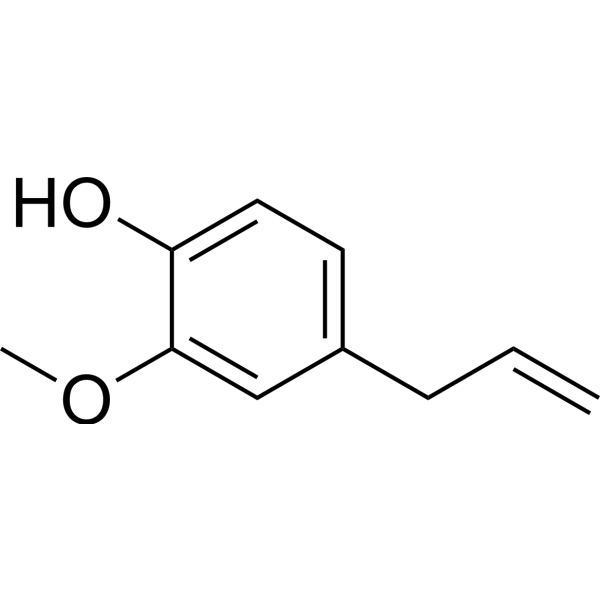
Eugenol

别名: 4-Allyl-2-methoxyphenol; 4-Allylguaiacol; Eugenic acid; Allylguaiacol; p-Eugenol; Caryophyllic acid; 丁香酚;2-甲氧基-4-(2-丙烯基)苯酚;2-甲氧基-4-丙烯基苯基苯乙醚;丁香油酚;丁子香酚;丁子香酸;烯丙基甲氧基苯酚;异丁香酚苯乙醚;Eugenol 丁香酚
目录号: V12761 纯度: ≥98%
丁子香酚是丁香中的精油,具有抗菌、驱虫和抗氧化作用。
Eugenol CAS号: 97-53-0
产品类别: New1
产品仅用于科学研究,不针对患者销售
规格 价格 库存 数量
100mg
250mg
500mg
Other Sizes

Other Forms of Eugenol:

  • Isoeugenol-d3
  • Eugenol-d3 (丁香酚 d3)
点击了解更多
InvivoChem产品被CNS等顶刊论文引用
产品描述
丁子香酚是丁香中的精油,具有抗菌、驱虫和抗氧化作用。丁子香酚还可以抑制脂质过氧化。
生物活性&实验参考方法
靶点
Antibacterial; anthelmintic; antioxidant; Pesticide active substance; Flavoring Agents
体外研究 (In Vitro)
O. 丁香酚和免费精油都可以很好地防止 H 转变为另一种物种。扭转卵,表明可能应用于治疗小反刍动物胃肠道蠕虫病。丁子香酚和精油在浓度为 0.50% 时具有最强的抑制作用 [1]。 250 μM 剂量的丁子香酚可抑制黄嘌呤-黄嘌呤氧化酶系统产生超氧阴离子的能力达 50%。此外,乙醇还能减少70%羟基自由基的合成。 OH 自由基生成的测量涉及将水杨酸盐羟基化为 2,3-二羟基苯甲酸酯,250 μM 丁子香酚可抑制 46% 的 OH 自由基形成 [2]。丁子香酚具有抗氧化特性,但它还能调节大脑的单胺能通路和 HPA 轴,这可能有助于避免类似于 RS 引起的肠易激综合征 (IBS) 的胃肠道功能障碍。与昂丹司琼一样,丁子香酚 (50 毫克/千克) 可将 RS 引起的粪便颗粒增加量降低 80%。丁子香酚影响 PFC 和杏仁核的血清素途径,并将压力引起的血浆皮质酮增加降低 80%。丁子香酚可增强整个大脑的抗氧化防御机制,并减少压力引起的去甲肾上腺素变化 [3]。
体内研究 (In Vivo)
口服丁子香酚(33 mg/kg)两天可显着减轻膝盖水肿,并且在治疗结束时这种情况持续存在。两天后,用丁香酚治疗患有分枝杆菌关节炎的大鼠的爪子肿胀明显减轻[4]。
丁香酚(50 mg/kg)减少了80%的rs诱导的粪丸增加,与昂丹西琼相似。丁香酚能降低80%的应激引起的血浆皮质酮升高,并调节PFC和杏仁核中的血清素能系统。丁香酚可以减弱应激诱导的去甲肾上腺素的变化,增强大脑各区域的抗氧化防御系统。 结论:丁香酚除具有抗氧化作用外,还通过调节hpa -轴和脑单胺能通路,保护rs诱导的ibs样胃肠道功能障碍的发生。[3]
酶活实验
香料成分姜黄素(来自姜黄)和丁香酚(来自丁香)是很好的脂质过氧化抑制剂。脂质过氧化是由活性氧引起的。研究了姜黄素和丁香酚对模型体系中活性氧生成的影响。在75 μ m和250 μ m浓度下,姜黄素和丁香酚对黄嘌呤-黄嘌呤氧化酶体系中超氧阴离子的抑制作用分别达到40%和50%。姜黄素和丁香酚也抑制羟基自由基(. oh)的产生,脱氧核糖降解程度分别为76%和70%。姜黄素和丁香酚在50 μ m和250 μ m下对水杨酸羟基化生成2,3-二羟基苯甲酸的抑制作用分别为66%和46%。这些香料原理还可以防止Fe2+在芬顿反应中氧化,从而产生。oh自由基。[2]
细胞实验
试验材料的制备[1]
将精油和丁香酚在Tween 20(0.5%)水溶液中以0.0625、0.12、0.25、0.5和1.0%的浓度稀释,用于鸡蛋孵化试验。

驱虫活性评价[1]
体外卵孵化试验评价杀卵活性的方法采用Coles et al.(1992)的方法。从山羊和绵羊实验感染的粪便中提取约250个新鲜鸡蛋,用300 μl的悬浮液与相同体积的不同浓度的精油混合。这些试验有三个对照:蒸馏水、Tween 20(0.5%水溶液)和噻苯达唑(0.5%水溶液)。在室温下孵育48小时。48 h后,加入lugol停止鸡蛋孵化。计数所有卵和一期幼虫(L1)。每个实验组和对照组重复试验5次。所得值采用方差分析和邓肯检验,显著性水平为0.05%。
动物实验
Eugenol (12.5, 25, and 50 mg/kg), ondansetron (4.0 mg/kg, p.o.), and vehicle were administered to rats for 7 consecutive days before exposure to 1 h RS. One control group was not exposed to RS-induction. The effect of eugenol (50 mg/kg) with and without RS exposure was evaluated for mechanism of action and per se effect, respectively. The hypothalamic-pituitary-adrenal cortex (HPA)-axis function was evaluated by estimating the plasma corticosterone level. The levels of brain monoamines, namely serotonin, norepinephrine, dopamine, and their metabolites were estimated in stress-responsive regions such as hippocampus, hypothalamus, pre-frontal cortex (PFC), and amygdala. Oxidative damage and antioxidant defenses were also assessed in brain regions.[3]
This study examined the effect of eugenol and ginger oil on severe chronic adjuvant arthritis in rats. Severe arthritis was induced in the right knee and right paw of male Sprague-Dawley rats by injecting 0.05 ml of a fine suspension of dead Mycobacterium tuberculosis bacilli in liquid paraffin (5 mg/ml). Eugenol (33 mg/kg) and ginger oil (33 mg/kg), given orally for 26 days, caused a significant suppression of both paw and joint swelling. These findings suggest that eugenol and ginger oil have potent antiinflammatory and/or antirheumatic properties.[4]
The ovicidal activity of the essential oil of Ocimum gratissimum Linn. (Labideae) and its main component eugenol was evaluated against Haemonchus contortus, gastrointestinal parasite of small ruminants. The oil and eugenol were diluted in Tween 20 (0.5%) at five different concentrations. In the egg hatch test, H. contortus eggs were obtained from feces of goats experimentally infected. At 0.50% concentration, the essential oil and eugenol showed a maximum eclodibility inhibition. These results suggest a possible utilization of the essential oil of O. gratissimum as an aid to the control of gastrointestinal helmintosis of small ruminants.[1]
药代性质 (ADME/PK)
Absorption, Distribution and Excretion
Intraperitoneal injection of a single 450 mg/kg dose of (14)C methoxy labelled eugenol resulted in rapid distribution to all organs. Both ether- and water soluble materials were recovered from most tissues and excretions. Only 0.2-1.0% of the dose was eliminated as expired (14)CO2. Over 70% of a lethal dose of eugenol was recovered on death, from the urine of rabbits.
No penetration of mouse skin was demonstrated after dermal application of eugenol.
Metabolism / Metabolites
Following ip injection of (14)C eugenol into rats, ... the presence of (14)CO2 in expired air indicated the demethylation of eugenol.
The metabolism and toxic effects of eugenol were studied in isolated rat hepatocytes. Incubation of hepatocytes with eugenol resulted in the formation of conjugates with sulfate, glucuronic acid and glutathione. The major metabolite formed was the glucuronic acid conjugate. Covalent binding to cellular protein was observed using (3)H eugenol. Loss of intracellular glutathione and cell death were also observed in these incubations. Concentrations of 1 mM eugenol caused a loss of over 90% of intracellular glutathione and resulted in approximately 85% cell death over a 5 hr incubation period. The loss of the majority of glutathione occurred prior to the onset of cell death (2 hr). The effects of eugenol were concentration dependent. The addition of 1 mM N-acetylcysteine to incubations containing 1 mM eugenol was able to completely prevent glutathione loss and cell death as well as inhibit the covalent binding of eugenol metabolites to protein. Conversely, pretreatment of hepatocytes with diethylmaleate to deplete intracellular glutathione increased the cytotoxic effects of eugenol. These results demonstrate that eugenol is actively metabolized in hepatocytes and suggest that the cytotoxic effects of eugenol are due to the formation of a reactive intermediate, possibly a quinone methide.
Two metabolites of eugenol, 3-piperidyl-1-(3'-methoxy-4'-hydroxyphenyl)-1-propanone and 3-pyrrolidinyl-1-(3'-methoxy-4'-hydroxyphenyl)-1-propanone, have been isolated from rat urine.
Epoxidation of eugenol by rat liver cell cultures has been reported. The dihydrodiol metabolite of eugenol has been isolated from liver homogenates and urine of rats pretreated with eugenol.
For more Metabolism/Metabolites (Complete) data for EUGENOL (9 total), please visit the HSDB record page.
Eugenol has known human metabolites that include Hydroxychavicol and (2S,3S,4S,5R)-3,4,5-Trihydroxy-6-(2-methoxy-4-prop-2-enylphenoxy)oxane-2-carboxylic acid.
毒性/毒理 (Toxicokinetics/TK)
Hepatotoxicity
The low concentrations of eugenol and clove extracts used topically and in herbal products have not been convincingly linked to instances of liver injury, either in the form of serum enzyme elevations or clinically apparent liver injury. In high doses, however, eugenol appears to be a direct cytotoxin and several instances of severe acute liver and kidney injury have been reported after accidental overdose of eugenol containing herbal products, largely in children. Overdoses have been marked by the onset of agitation, decrease in consciousness and coma arising within hours on ingestion (10-30 mL of clove oil). There is typically an accompanying acidosis, respiratory depression and severe hypoglycemia requiring ventilation and intravenous glucose. Liver injury arises 12 to 24 hours after ingestion with marked elevations in serum aminotransferase levels and early coagulation abnormalities. Signs of hepatic failure arise rapidly, and jaundice can develop and deepen. The overall clinical presentation is typical of acute hepatic necrosis and similar to that of acetaminophen, iron or copper overdose. The liver injury generally worsens for several days but then rapidly improves and ultimately resolves within 1 to 3 weeks. Renal dysfunction may also occur but rarely requires intervention or dialysis. Long term injury or effects have not been described. Cases described in the literature have been in infants who swallowed clove oil being used by parents.
Likelihood score: C[H] (probable cause of clinically apparent liver injury in overdoses).
Toxicity Data
LC50 > 2,580 mg/m3/4hr
Interactions
Mice treated with eugenol (400-600 mg/kg, orally) in combination with an inhibitor of glutathione synthesis, buthionine sulfoximine (1 hr before eugenol, 4 mmol/kg, ip) developed hepatotoxicity characterized by increases in relative liver weight and serum glutamic-pyruvic transaminase, hepatic congestion, and centrilobular necrosis of hepatocytes. Eugenol (up to 600 mg/kg) alone produced no hepatotoxicity. Drug metabolism inhibitors such as carbon disulfide, methoxsalen, and piperonyl butoxide prevented or significantly reduced the hepatotoxic effect of eugenol given in combination with buthionine sulfoximine.
The present study was undertaken to evaluate the chemopreventive potential of eugenol alone and in combination with a chemotherapeutic agent such as gemcitabine. Eugenol showed dose-dependent selective cytotoxicity toward HeLa cells in comparison to normal cells, pointing to its safe cytotoxicity profile. A combination of eugenol and gemcitabine induced growth inhibition and apoptosis at lower concentrations, compared with the individual drugs. The analysis of the data using a combination index showed combination index values of <1 indicating strong synergistic interaction. The combination thus may enhance the efficacy of gemcitabine at lower doses and minimize the toxicity on normal cells. In addition, the expression analysis of genes involved in apoptosis and inflammation revealed significant downregulation of Bcl-2, COX-2, and IL-1beta on treatment with eugenol. Thus, the results suggest that eugenol exerts its anticancer activities via apoptosis induction and anti-inflammatory properties and also provide the first evidence demonstrating synergism between eugenol and gemcitabine, which may enhance the therapeutic index of prevention and/or treatment of cervical cancer.
The biochemical mechanisms underlying the increased toxicity of several plant essential oils (thymol, eugenol, pulegone, terpineol, and citronellal) against fourth instar of Aedes aegypti L. when exposed simultaneously with piperonyl butoxide (PBO) were examined. Whole body biotransformational enzyme activities including cytochrome P450-mediated oxidation (ethoxyresorufin O-dethylase (EROD)), glutathione S-transferase (GST), and beta-esterase activity were measured in control, essential oil-exposed only (single chemical), and essential oil + PBO (10 mg/liter) exposed larvae. At high concentrations, thymol, eugenol, pulegone, and citronellal alone reduced EROD activity by 5-25% 16 h postexposure. Terpineol at 10 mg/liter increased EROD activity by 5 +/- 1.8% over controls. The essential oils alone reduced GST activity by 3-20% but PBO exposure alone did not significantly affect the activity of any of the measured enzymes. All essential oils in combination with PBO reduced EROD activity by 58-76% and reduced GST activity by 3-85% at 16 hr postexposure. This study indicates a synergistic interaction between essential oils and PBO in inhibiting the cytochrome P450 and GST detoxification enzymes in Ae. aegypti.
... Swiss albino mice were administered different doses of eugenol (75,150 and 300 mg/kg) before exposure to 1.5 Gy of gamma radiation. The micronucleus test was carried out to determine the genetic damage in bone marrow. Our results demonstrated significant reduction in the frequencies of micronucleated polychromatic erythrocytes (MnPCEs) with all three eugenol doses. Eugenol (150 mg/kg) was also tested against different doses of radiation (0.5, 1, 1.5, and 2 Gy) and was found to afford significant radioprotection. Reduction in the incidence of MnPCEs could be noticed up to 72 hr postirradiation (1.5 Gy). Moreover, the level of peroxidative damage and the specific activities of lactate dehydrogenase (LDH) and methylglyoxalase I (Gly I) were observed in the liver of mice treated with eugenol for seven days in comparison to untreated mice.
For more Interactions (Complete) data for EUGENOL (7 total), please visit the HSDB record page.
Non-Human Toxicity Values
LD50 Guinea pig oral 2130 mg/kg
LD50 Mouse ip 1109 mg/kg (7.5% eugenol in saline)
LD50 Rat oral 1930 mg/kg
LD50 Mouse intraperitoneal 500 mg/kg
For more Non-Human Toxicity Values (Complete) data for EUGENOL (6 total), please visit the HSDB record page.
参考文献

[1]. Anthelmintic activity of essential oil of Ocimum gratissimum Linn. and eugenol against Haemonchus contortus. Vet Parasitol. 2002 Oct 16;109(1-2):59-63.

[2]. Studies on the inhibitory effects of curcumin and eugenol on the formation of reactive oxygenspecies and the oxidation of ferrous iron. Mol Cell Biochem. 1994 Aug 17;137(1):1-8.

[3]. Protective effect of eugenol against restraint stress-induced gastrointestinal dysfunction: Potential use in irritable bowel syndrome. Pharm Biol. 2015 Jul;53(7):968-74.

[4]. Suppressive effects of eugenol and ginger oil on arthritic rats. Pharmacology. 1994 Nov;49(5):314-8.

其他信息
Therapeutic Uses
... Has been used as an antipyretic but it is relatively ineffective. /Eugenol/ has... been used in medicine for the study of mucous secretion /and/ gastric cytology, without gastric resection or gastroenterostomy. It has been shown to have anthelmintic properties. /SRP: Former use/
Nonprescription medicines for toothache commonly contain eugenol, and some products for canker-sore may do so also.
Eugenol is used as a component of several dental materials (e.g., dental cements, impression pastes and surgical pastes). Such products are principally combinations of zinc oxide and eugenol in varying ratios. They are reported to be widely used in dentistry as temporary filing materials, cavity liners for pulp protection, capping materials, temporary cementation of fixed protheses, impression materials and major ingredients of endodontic sealers. In addition, eugenol has been used in dentistry for disinfecting root canals.
Analgesic (dental)
*注: 文献方法仅供参考, InvivoChem并未独立验证这些方法的准确性
化学信息 & 存储运输条件
分子式
C10H12O2
分子量
164.2011
精确质量
164.083
元素分析
C, 73.15; H, 7.37; O, 19.49
CAS号
97-53-0
相关CAS号
Eugenol-d3;1335401-17-6
PubChem CID
3314
外观&性状
Colorless to light yellow liquid
密度
1.1±0.1 g/cm3
沸点
255.0±0.0 °C at 760 mmHg
熔点
−12-−10 °C(lit.)
闪点
119.8±8.1 °C
蒸汽压
0.0±0.5 mmHg at 25°C
折射率
1.536
LogP
2.2
tPSA
29.46
氢键供体(HBD)数目
1
氢键受体(HBA)数目
2
可旋转键数目(RBC)
3
重原子数目
12
分子复杂度/Complexity
145
定义原子立体中心数目
0
SMILES
OC1C(OC)=CC(CC=C)=CC=1
InChi Key
OC1=CC=C(CC=C)C=C1OC
InChi Code
InChI=1S/C10H12O2/c1-3-4-8-5-6-9(11)10(7-8)12-2/h3,5-7,11H,1,4H2,2H3
化学名
Phenol, 2-methoxy-4-(2-propen-1-yl)-; 2-methoxy-4-prop-2-enylphenol
别名
4-Allyl-2-methoxyphenol; 4-Allylguaiacol; Eugenic acid; Allylguaiacol; p-Eugenol; Caryophyllic acid;
HS Tariff Code
2934.99.9001
存储方式

Powder      -20°C    3 years

                     4°C     2 years

In solvent   -80°C    6 months

                  -20°C    1 month

运输条件
Room temperature (This product is stable at ambient temperature for a few days during ordinary shipping and time spent in Customs)
溶解度数据
溶解度 (体外实验)
DMSO : ≥ 100 mg/mL (~609.01 mM)
溶解度 (体内实验)
配方 1 中的溶解度: ≥ 3.25 mg/mL (19.79 mM) (饱和度未知) in 10% DMSO + 40% PEG300 + 5% Tween80 + 45% Saline (这些助溶剂从左到右依次添加,逐一添加), 澄清溶液。
例如,若需制备1 mL的工作液,可将100 μL 32.5 mg/mL澄清DMSO储备液加入到400 μL PEG300中,混匀;然后向上述溶液中加入50 μL Tween-80,混匀;加入450 μL生理盐水定容至1 mL。
*生理盐水的制备:将 0.9 g 氯化钠溶解在 100 mL ddH₂O中,得到澄清溶液。

配方 2 中的溶解度: ≥ 3.25 mg/mL (19.79 mM) (饱和度未知) in 10% DMSO + 90% (20% SBE-β-CD in Saline) (这些助溶剂从左到右依次添加,逐一添加), 澄清溶液。
例如,若需制备1 mL的工作液,可将 100 μL 32.5 mg/mL 澄清 DMSO 储备液加入 900 μL 20% SBE-β-CD 生理盐水溶液中,混匀。
*20% SBE-β-CD 生理盐水溶液的制备(4°C,1 周):将 2 g SBE-β-CD 溶解于 10 mL 生理盐水中,得到澄清溶液。

View More

配方 3 中的溶解度: ≥ 3.25 mg/mL (19.79 mM) (饱和度未知) in 10% DMSO + 90% Corn Oil (这些助溶剂从左到右依次添加,逐一添加), 澄清溶液。
例如,若需制备1 mL的工作液,可将 100 μL 32.5 mg/mL 澄清 DMSO 储备液加入900 μL 玉米油中,混合均匀。


请根据您的实验动物和给药方式选择适当的溶解配方/方案:
1、请先配制澄清的储备液(如:用DMSO配置50 或 100 mg/mL母液(储备液));
2、取适量母液,按从左到右的顺序依次添加助溶剂,澄清后再加入下一助溶剂。以 下列配方为例说明 (注意此配方只用于说明,并不一定代表此产品 的实际溶解配方):
10% DMSO → 40% PEG300 → 5% Tween-80 → 45% ddH2O (或 saline);
假设最终工作液的体积为 1 mL, 浓度为5 mg/mL: 取 100 μL 50 mg/mL 的澄清 DMSO 储备液加到 400 μL PEG300 中,混合均匀/澄清;向上述体系中加入50 μL Tween-80,混合均匀/澄清;然后继续加入450 μL ddH2O (或 saline)定容至 1 mL;

3、溶剂前显示的百分比是指该溶剂在最终溶液/工作液中的体积所占比例;
4、 如产品在配制过程中出现沉淀/析出,可通过加热(≤50℃)或超声的方式助溶;
5、为保证最佳实验结果,工作液请现配现用!
6、如不确定怎么将母液配置成体内动物实验的工作液,请查看说明书或联系我们;
7、 以上所有助溶剂都可在 Invivochem.cn网站购买。
制备储备液 1 mg 5 mg 10 mg
1 mM 6.0901 mL 30.4507 mL 60.9013 mL
5 mM 1.2180 mL 6.0901 mL 12.1803 mL
10 mM 0.6090 mL 3.0451 mL 6.0901 mL

1、根据实验需要选择合适的溶剂配制储备液 (母液):对于大多数产品,InvivoChem推荐用DMSO配置母液 (比如:5、10、20mM或者10、20、50 mg/mL浓度),个别水溶性高的产品可直接溶于水。产品在DMSO 、水或其他溶剂中的具体溶解度详见上”溶解度 (体外)”部分;

2、如果您找不到您想要的溶解度信息,或者很难将产品溶解在溶液中,请联系我们;

3、建议使用下列计算器进行相关计算(摩尔浓度计算器、稀释计算器、分子量计算器、重组计算器等);

4、母液配好之后,将其分装到常规用量,并储存在-20°C或-80°C,尽量减少反复冻融循环。

计算器

摩尔浓度计算器可计算特定溶液所需的质量、体积/浓度,具体如下:

  • 计算制备已知体积和浓度的溶液所需的化合物的质量
  • 计算将已知质量的化合物溶解到所需浓度所需的溶液体积
  • 计算特定体积中已知质量的化合物产生的溶液的浓度
使用摩尔浓度计算器计算摩尔浓度的示例如下所示:
假如化合物的分子量为350.26 g/mol,在5mL DMSO中制备10mM储备液所需的化合物的质量是多少?
  • 在分子量(MW)框中输入350.26
  • 在“浓度”框中输入10,然后选择正确的单位(mM)
  • 在“体积”框中输入5,然后选择正确的单位(mL)
  • 单击“计算”按钮
  • 答案17.513 mg出现在“质量”框中。以类似的方式,您可以计算体积和浓度。

稀释计算器可计算如何稀释已知浓度的储备液。例如,可以输入C1、C2和V2来计算V1,具体如下:

制备25毫升25μM溶液需要多少体积的10 mM储备溶液?
使用方程式C1V1=C2V2,其中C1=10mM,C2=25μM,V2=25 ml,V1未知:
  • 在C1框中输入10,然后选择正确的单位(mM)
  • 在C2框中输入25,然后选择正确的单位(μM)
  • 在V2框中输入25,然后选择正确的单位(mL)
  • 单击“计算”按钮
  • 答案62.5μL(0.1 ml)出现在V1框中
g/mol

分子量计算器可计算化合物的分子量 (摩尔质量)和元素组成,具体如下:

注:化学分子式大小写敏感:C12H18N3O4  c12h18n3o4
计算化合物摩尔质量(分子量)的说明:
  • 要计算化合物的分子量 (摩尔质量),请输入化学/分子式,然后单击“计算”按钮。
分子质量、分子量、摩尔质量和摩尔量的定义:
  • 分子质量(或分子量)是一种物质的一个分子的质量,用统一的原子质量单位(u)表示。(1u等于碳-12中一个原子质量的1/12)
  • 摩尔质量(摩尔重量)是一摩尔物质的质量,以g/mol表示。
/

配液计算器可计算将特定质量的产品配成特定浓度所需的溶剂体积 (配液体积)

  • 输入试剂的质量、所需的配液浓度以及正确的单位
  • 单击“计算”按钮
  • 答案显示在体积框中
动物体内实验配方计算器(澄清溶液)
第一步:请输入基本实验信息(考虑到实验过程中的损耗,建议多配一只动物的药量)
第二步:请输入动物体内配方组成(配方适用于不溶/难溶于水的化合物),不同的产品和批次配方组成不同,如对配方有疑问,可先联系我们提供正确的体内实验配方。此外,请注意这只是一个配方计算器,而不是特定产品的确切配方。
+
+
+

计算结果:

工作液浓度 mg/mL;

DMSO母液配制方法 mg 药物溶于 μL DMSO溶液(母液浓度 mg/mL)。如该浓度超过该批次药物DMSO溶解度,请首先与我们联系。

体内配方配制方法μL DMSO母液,加入 μL PEG300,混匀澄清后加入μL Tween 80,混匀澄清后加入 μL ddH2O,混匀澄清。

(1) 请确保溶液澄清之后,再加入下一种溶剂 (助溶剂) 。可利用涡旋、超声或水浴加热等方法助溶;
            (2) 一定要按顺序加入溶剂 (助溶剂) 。

临床试验信息
EUGENOL 1518 (EUGENOL) LIQUID
Drug: Eugenol
Download: PDF
Data File: XML
Ingredient (UNII): EUGENOL (UNII:3T8H1794QW)
Indication: For the temporary relief of minor skin rash or hives, abdominal pain, nausea, or occasional headache due to sensitivity to phenolic compounds found in foods or other products.*
Category: Homeopathic
Company: Professional Complementary Health Formulas
Date: 2019-08-15
相关产品
联系我们