| 规格 | 价格 | 库存 | 数量 |
|---|---|---|---|
| 5mg |
|
||
| 10mg |
|
||
| 25mg |
|
||
| 50mg |
|
||
| 100mg |
|
||
| 250mg |
|
||
| Other Sizes |
|
| 靶点 |
Orexin 1 receptor
GSK1059865 is a highly selective competitive antagonist of the orexin 1 receptor (OX1R, also known as hypocretin 1 receptor) (Ki = 0.4 nM for human recombinant OX1R in radioligand binding assays; IC50 = 1.2 nM for inhibiting orexin A-induced Ca²⁺ mobilization in OX1R-expressing CHO cells) [1][2] GSK1059865 exhibits extreme selectivity for OX1R over the orexin 2 receptor (OX2R) (Ki > 1000 nM for human OX2R) and no significant binding to other GPCRs (e.g., CRF1, adrenergic, dopaminergic receptors) (Ki > 1000 nM for all tested receptors) [2][3] |
|---|---|
| 体外研究 (In Vitro) |
1. 在稳定表达人OX1R的CHO细胞中,GSK1059865(0.1 nM–10 μM)剂量依赖性抑制食欲素A诱导的细胞内钙动员,IC50为1.2 nM;10 nM GSK1059865使钙响应降低95%,且浓度高达10 μM时无激动剂活性[1][2]
2. 在表达OX1R的HEK293细胞膜放射性配体结合实验中,GSK1059865置换[³H]食欲素A的Ki为0.4 nM,证实其与OX1R正构位点的高亲和力结合[2] 3. GSK1059865(≤10 μM)对表达OX2R的细胞中食欲素A诱导的钙动员无影响,且对CRF1受体无显著结合(Ki > 1000 nM),验证了其亚型和受体选择性[3] 4. GSK1059865(≤10 μM)在表达OX1R的CHO细胞和原代大鼠皮质神经元中无细胞毒性,MTT实验显示细胞活力>95%[1] |
| 体内研究 (In Vivo) |
GSK1059865 治疗以剂量依赖性方式显着减少 CIE 暴露小鼠的乙醇饮用量。相比之下,GSK1059865 仅在最高剂量时才减少暴露于空气的小鼠的饮酒量。 GSK1059865 对蔗糖摄入量没有影响[1]。 GSK1059865 (0.3 nM-10 nM) 产生不可克服的拮抗作用,OXA EC50 剂量依赖性右移,并伴随激动剂最大反应降低。 GSK1059865 的计算 pKB 值为 8.77±0.12。 GSK1059865 (0.1-3.3 μM) 产生经典的可克服曲线,OXA EC50 平行向右移动,而不会降低激动剂最大反应[2]。腹膜内给予 GSK1059865 对育亨宾诱导的相对脑血容量反应产生区域依赖性抑制。 GSK1059865 的施用本身会在几个大脑区域产生微弱的相对脑血容量增加。 GSK1059865 预处理的动物表现出比对照组稍高的基线平均动脉血压值[3]。
1. 在慢性乙醇依赖C57BL/6小鼠(通过间歇性给予20%乙醇4周诱导)中,腹腔注射GSK1059865(1、3、10 mg/kg)剂量依赖性减少自主饮酒行为:10 mg/kg GSK1059865使24小时乙醇摄入量降低65%,乙醇偏好度(乙醇/水体积比)从0.75降至0.22[1] 2. 乙醇依赖小鼠腹腔注射3 mg/kg GSK1059865后,由乙醇相关线索诱导的复饮样行为减少50%,且对水或蔗糖摄入无影响(排除非特异性食欲抑制)[1] 3. 在暴食行为雌性SD大鼠模型(通过14天限食+高脂美味食物诱导)中,腹腔注射GSK1059865(3、10 mg/kg)剂量依赖性减少强迫性美味食物摄入:10 mg/kg使2小时内高脂食物摄入量降低45%,暴食发作(10分钟内进食≥1 g)减少60%[2] 4. 雌性大鼠腹腔注射10 mg/kg GSK1059865后,7天内普通饲料摄入量和体重无变化,表明其选择性抑制奖赏驱动的暴食行为[2] 5. 在育亨宾(2 mg/kg腹腔注射,药理应激源)诱导的大鼠fMRI研究中,腹腔注射3 mg/kg GSK1059865可抑制育亨宾诱导的应激/奖赏脑区激活:中央杏仁核的血氧水平依赖(BOLD)信号强度较溶媒对照组降低38%,下丘脑BOLD信号降低32%[3] 6. 大鼠腹腔注射3 mg/kg GSK1059865后,育亨宾诱导的血浆皮质酮(关键的下丘脑-垂体-肾上腺轴应激激素)升高被抑制42%(育亨宾注射后30分钟检测)[3] |
| 酶活实验 |
1. 人OX1R放射性配体结合实验:制备稳定表达人OX1R的HEK293细胞膜,将膜蛋白(50 μg/孔)与[³H]食欲素A(1 nM)及系列浓度的GSK1059865(0.01 nM–10 μM)在结合缓冲液(50 mM Tris-HCl、5 mM MgCl₂、0.1% BSA,pH 7.4)中25℃孵育90分钟;通过预浸结合缓冲液的玻璃纤维滤膜快速过滤终止反应,液闪计数器检测滤膜结合的放射性;在10 μM未标记食欲素A存在下测定非特异性结合,利用Cheng-Prusoff方程计算Ki值[2]
2. OX1R功能钙动员实验:将表达人OX1R的CHO细胞负载4 μM钙敏感荧光染料,37℃孵育60分钟;加入GSK1059865(0.1 nM–10 μM)预处理30分钟后,用食欲素A(10 nM,OX1R激活的EC80)刺激;荧光仪每2秒检测一次荧光强度,持续60秒,将荧光峰值响应相对于溶媒对照组归一化,计算抑制作用的IC50[1][2] 3. CRF1受体结合实验:将表达CRF1的HEK293细胞膜与[³H]CRF(1 nM)及GSK1059865(0.1 nM–10 μM)在相同结合缓冲液中孵育90分钟;按上述方法过滤并检测放射性,评估其与CRF1受体的潜在结合能力[3] |
| 细胞实验 |
1. 表达OX1R的CHO细胞钙动员实验:将稳定转染人OX1R cDNA的CHO细胞培养于含10%胎牛血清的DMEM培养基,在5% CO₂、37℃条件下培养;以1×10⁴个细胞/孔接种于黑色壁96孔板,贴壁24小时后负载染料,经GSK1059865预处理后用食欲素A刺激,检测荧光以量化钙动员;通过非线性回归拟合剂量反应曲线,确定GSK1059865的抑制效力[1][2]
2. 细胞活力MTT实验:将表达OX1R的CHO细胞和原代大鼠皮质神经元以5×10³个细胞/孔接种于96孔板,GSK1059865(0.1 nM–10 μM)处理72小时;加入0.5 mg/mL MTT试剂37℃孵育4小时,DMSO溶解甲臜结晶后,酶标仪检测570 nm吸光度以计算细胞活力[1] |
| 动物实验 |
大鼠:将GSK1059865溶于0.5% HPMC (w/v)蒸馏水中,以10和30 mg/kg的剂量灌胃给予大鼠。给药或给予溶剂前一小时,可喂食极具吸引力的食物[2]。
小鼠:在基线期和慢性间歇性乙醇(或空气)暴露后的前五个测试周期中,小鼠在摄入乙醇前30分钟腹腔注射溶剂(生理盐水,0.01 ml/g体重)。在第6和第7个测试周期中,小鼠分别给予溶剂或GSK1059865(10、25、50 mg/kg)。之后,小鼠可在第6个测试周期中选择摄入乙醇(15% v/v),在第7个测试周期中选择摄入蔗糖(5% w/v),或饮水。以 TWEEN 80 (0.5 % v/v) 为溶剂,GSK1059865 溶解于盐水中[1]。 1. 乙醇依赖性小鼠模型方案:雄性 C57BL/6 小鼠 (20–25 g) 接受间歇性乙醇摄入(20% 乙醇 v/v,每天 2 小时,持续 4 周),以诱导乙醇依赖性。小鼠被随机分为四组(每组 n=10):(1)载体对照组(0.9% 生理盐水 + 5% DMSO,腹腔注射),(2)GSK1059865 1 mg/kg 腹腔注射,(3)GSK1059865 3 mg/kg 腹腔注射,(4)GSK1059865 10 mg/kg 腹腔注射。药物溶解于含 5% DMSO 的生理盐水中(注射体积 0.1 mL/10 g 体重),并在给予乙醇前 30 分钟给药。 2. 雌性大鼠暴食模型方案:将雌性Sprague-Dawley大鼠(200-250 g)限制食物摄入(每天6小时),持续14天,以诱导其暴食高脂食物。在摄入高脂食物前30分钟,大鼠腹腔注射GSK1059865(3、10 mg/kg)或载体。每隔30分钟测量一次食物摄入量,持续2小时,并计数暴食事件(定义为10分钟内摄入食物量>1 g)[2]。3. 大鼠功能磁共振成像(fMRI)应激回路研究方案:将雄性Sprague-Dawley大鼠(300-350 g)用异氟烷麻醉,并置于7T fMRI扫描仪中。在注射育亨宾(2 mg/kg,腹腔注射,作为应激源)前 30 分钟,分别给予 GSK1059865(3 mg/kg,腹腔注射)或载体。在注射育亨宾后 60 分钟内进行 fMRI 扫描,并在 30 分钟时采集血样,通过 ELISA 法测定血浆皮质酮水平。分析感兴趣脑区(杏仁核、下丘脑、前额叶皮层)的 BOLD 信号强度变化 [3] |
| 药代性质 (ADME/PK) |
1. 脑渗透性:在雄性 C57BL/6 小鼠中,GSK1059865(10 mg/kg 腹腔注射)表现出较高的脑渗透性,给药后 1 小时脑/血浆比为 3.2; 1 小时后脑内药物浓度为 25 nM,远高于 OX1R Ki (0.4 nM) [1]
2. 血浆药代动力学:小鼠腹腔注射 GSK1059865 (10 mg/kg) 后,血浆消除半衰期 (t₁/₂) 为 2.8 小时,血浆峰浓度 (Cmax) 为 8 nM (Tmax = 30 分钟) [1] 3. 口服生物利用度:大鼠口服 GSK1059865 (10 mg/kg) 后,口服生物利用度为 42%,Tmax 为 1 小时,Cmax 为 5 nM [2] |
| 毒性/毒理 (Toxicokinetics/TK) |
1. 体外细胞毒性:GSK1059865 (≤10 μM) 对表达 OX1R 的 CHO 细胞、原代皮层神经元或大鼠海马神经元无明显细胞毒性(MTT 检测和 LDH 释放的细胞活力 >95%)[1][2]
2. 急性体内毒性:小鼠和大鼠单次腹腔注射 GSK1059865 (100 mg/kg) 7 天内未引起死亡或行为异常(例如,共济失调、嗜睡);转棒试验未观察到运动功能障碍[1][2] 3. 血浆蛋白结合率:GSK1059865在人血浆中的血浆蛋白结合率为92%,在大鼠血浆中的血浆蛋白结合率为90%(超滤法测定)[2] 4. 慢性毒性:大鼠连续28天腹腔注射GSK1059865(10 mg/kg/天),体重增长正常,血清肝功能(ALT/AST)或肾功能(肌酐)指标无变化;脑、肝、肾组织病理学分析未见异常[3] |
| 参考文献 |
|
| 其他信息 |
1. GSK1059865 是一种强效、高选择性的食欲素 1 受体 (OX1R) 拮抗剂,由葛兰素史克公司开发,用于食欲素系统在神经精神行为中的作用的临床前研究 [1][2][3]
2. GSK1059865 通过竞争性阻断 OX1R 发挥其药理作用,OX1R 在调节奖赏(伏隔核)、压力(杏仁核)和摄食行为(下丘脑)的大脑区域中高表达;这种抑制作用会破坏食欲素A介导的这些神经回路的激活[1][2][3] 3. 在乙醇依赖性小鼠中,GSK1059865通过抑制OX1R依赖的奖赏寻求来减少乙醇摄入和复发,而对天然奖赏(例如蔗糖)没有影响,表明其对药物成瘾具有选择性作用[1] 4. 在暴食症模型中,GSK1059865靶向下丘脑和伏隔核中的OX1R,以减少强迫性美味食物的摄入,提示其具有治疗饮食障碍的潜力[2] 5. GSK1059865通过抑制OX1R介导的下丘脑-垂体-肾上腺(HPA)轴和应激相关脑回路的激活来调节应激反应,表现为杏仁核BOLD信号和皮质酮水平的降低。释放是响应育亨宾而发生的[3] |
| 分子式 |
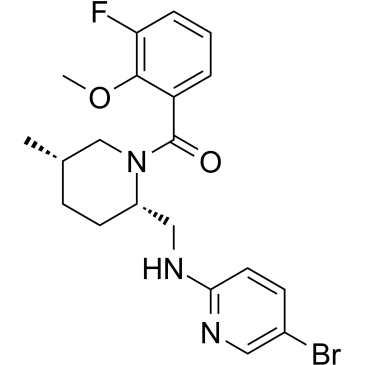
C20H23BRFN3O2
|
|
|---|---|---|
| 分子量 |
436.317927598953
|
|
| 精确质量 |
435.095
|
|
| CAS号 |
1191044-58-2
|
|
| 相关CAS号 |
|
|
| PubChem CID |
44463491
|
|
| 外观&性状 |
White to off-white solid powder
|
|
| 密度 |
1.4±0.1 g/cm3
|
|
| 沸点 |
575.8±50.0 °C at 760 mmHg
|
|
| 闪点 |
302.1±30.1 °C
|
|
| 蒸汽压 |
0.0±1.6 mmHg at 25°C
|
|
| 折射率 |
1.592
|
|
| LogP |
4.41
|
|
| tPSA |
54.5
|
|
| 氢键供体(HBD)数目 |
1
|
|
| 氢键受体(HBA)数目 |
5
|
|
| 可旋转键数目(RBC) |
5
|
|
| 重原子数目 |
27
|
|
| 分子复杂度/Complexity |
498
|
|
| 定义原子立体中心数目 |
2
|
|
| SMILES |
C[C@H]1CC[C@H](N(C1)C(=O)C2=C(C(=CC=C2)F)OC)CNC3=NC=C(C=C3)Br
|
|
| InChi Key |
TWCRHJLMMAYSTE-ZFWWWQNUSA-N
|
|
| InChi Code |
InChI=1S/C20H23BrFN3O2/c1-13-6-8-15(11-24-18-9-7-14(21)10-23-18)25(12-13)20(26)16-4-3-5-17(22)19(16)27-2/h3-5,7,9-10,13,15H,6,8,11-12H2,1-2H3,(H,23,24)/t13-,15-/m0/s1
|
|
| 化学名 |
[(2S,5S)-2-[[(5-bromopyridin-2-yl)amino]methyl]-5-methylpiperidin-1-yl]-(3-fluoro-2-methoxyphenyl)methanone
|
|
| 别名 |
|
|
| HS Tariff Code |
2934.99.9001
|
|
| 存储方式 |
Powder -20°C 3 years 4°C 2 years In solvent -80°C 6 months -20°C 1 month |
|
| 运输条件 |
Room temperature (This product is stable at ambient temperature for a few days during ordinary shipping and time spent in Customs)
|
| 溶解度 (体外实验) |
|
|||
|---|---|---|---|---|
| 溶解度 (体内实验) |
配方 1 中的溶解度: 3.33 mg/mL (7.63 mM) in 30 % SBE-β-CD (这些助溶剂从左到右依次添加,逐一添加), 澄清溶液; 超声助溶。
配方 2 中的溶解度: 5 mg/mL (11.46 mM) in 30% PEG300 70% (10% HP-β-CD in Saline) (这些助溶剂从左到右依次添加,逐一添加), 悬浊液; 超声助溶。 *生理盐水的制备:将 0.9 g 氯化钠溶解在 100 mL ddH₂O中,得到澄清溶液。 请根据您的实验动物和给药方式选择适当的溶解配方/方案: 1、请先配制澄清的储备液(如:用DMSO配置50 或 100 mg/mL母液(储备液)); 2、取适量母液,按从左到右的顺序依次添加助溶剂,澄清后再加入下一助溶剂。以 下列配方为例说明 (注意此配方只用于说明,并不一定代表此产品 的实际溶解配方): 10% DMSO → 40% PEG300 → 5% Tween-80 → 45% ddH2O (或 saline); 假设最终工作液的体积为 1 mL, 浓度为5 mg/mL: 取 100 μL 50 mg/mL 的澄清 DMSO 储备液加到 400 μL PEG300 中,混合均匀/澄清;向上述体系中加入50 μL Tween-80,混合均匀/澄清;然后继续加入450 μL ddH2O (或 saline)定容至 1 mL; 3、溶剂前显示的百分比是指该溶剂在最终溶液/工作液中的体积所占比例; 4、 如产品在配制过程中出现沉淀/析出,可通过加热(≤50℃)或超声的方式助溶; 5、为保证最佳实验结果,工作液请现配现用! 6、如不确定怎么将母液配置成体内动物实验的工作液,请查看说明书或联系我们; 7、 以上所有助溶剂都可在 Invivochem.cn网站购买。 |
| 制备储备液 | 1 mg | 5 mg | 10 mg | |
| 1 mM | 2.2919 mL | 11.4595 mL | 22.9190 mL | |
| 5 mM | 0.4584 mL | 2.2919 mL | 4.5838 mL | |
| 10 mM | 0.2292 mL | 1.1459 mL | 2.2919 mL |
1、根据实验需要选择合适的溶剂配制储备液 (母液):对于大多数产品,InvivoChem推荐用DMSO配置母液 (比如:5、10、20mM或者10、20、50 mg/mL浓度),个别水溶性高的产品可直接溶于水。产品在DMSO 、水或其他溶剂中的具体溶解度详见上”溶解度 (体外)”部分;
2、如果您找不到您想要的溶解度信息,或者很难将产品溶解在溶液中,请联系我们;
3、建议使用下列计算器进行相关计算(摩尔浓度计算器、稀释计算器、分子量计算器、重组计算器等);
4、母液配好之后,将其分装到常规用量,并储存在-20°C或-80°C,尽量减少反复冻融循环。
计算结果:
工作液浓度: mg/mL;
DMSO母液配制方法: mg 药物溶于 μL DMSO溶液(母液浓度 mg/mL)。如该浓度超过该批次药物DMSO溶解度,请首先与我们联系。
体内配方配制方法:取 μL DMSO母液,加入 μL PEG300,混匀澄清后加入μL Tween 80,混匀澄清后加入 μL ddH2O,混匀澄清。
(1) 请确保溶液澄清之后,再加入下一种溶剂 (助溶剂) 。可利用涡旋、超声或水浴加热等方法助溶;
(2) 一定要按顺序加入溶剂 (助溶剂) 。
Voluntary sucrose intake (ml) for EtOH and CTL mice that received GSK1059865 treatment before drinking sucrose.Brain Res.2016 Apr 1;1636:74-80. |
|---|
Voluntary ethanol intake (g/kg) for EtOH and CTL mice that received GSK1059865 treatment before drinking ethanol.Brain Res.2016 Apr 1;1636:74-80. |
InvivoChem的所有产品仅用于作科学研究,不面向患者销售
Copyright 2020 InvivoChem LLC | All Rights Reserved 粤ICP备20063088号-1


 COA
COA


 粤公网安备 44011102003439号
 463611831
