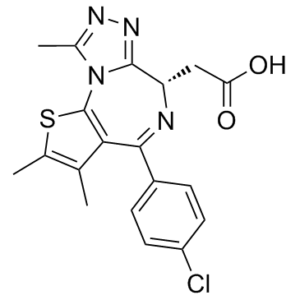
| 规格 | 价格 | 库存 | 数量 |
|---|---|---|---|
| 5mg |
|
||
| 10mg |
|
||
| 25mg |
|
||
| 50mg |
|
||
| 100mg |
|
||
| 250mg |
|
||
| 500mg |
|
||
| Other Sizes |
|
| 靶点 |
BET/bromodomain and extra terminal domain
Bromodomain and Extra-Terminal (BET) Family Proteins (BRD4 Bromodomain 1: Ki=2.3 nM for (+)-JQ1 carboxylic acid binding; BRD4 Bromodomain 2: Ki=3.1 nM) [1] |
|---|---|
| 体外研究 (In Vitro) |
在 B16F10 细胞表面,JQ-1 羧酸可降低 PD-L1 的表达 [1]。
(+)-JQ1羧酸((+)-JQ1 carboxylic acid) 是一种BET溴结构域靶向配体,作为三价PROTAC的靶向弹头用于特异性BET蛋白降解[1] - BET蛋白结合选择性:与BRD4溴结构域1(BD1)和溴结构域2(BD2)结合,Ki值分别为2.3 nM和3.1 nM;对非BET溴结构域(如BRD7、BRD9)的选择性>100倍,Ki>500 nM[1] - 支持PROTAC介导的BET降解:通过其羧基官能团与三价PROTAC偶联后,(+)-JQ1 carboxylic acid 保留BET结合亲和力,使PROTAC在MV4;11白血病细胞中诱导剂量依赖性BRD4降解(PROTAC的DC₅₀=120 nM,western blot)[1] - 无 (+)-JQ1 carboxylic acid 单独的抗增殖活性数据;含该配体的三价PROTAC在72小时MTT实验中抑制MV4;11细胞增殖,IC₅₀=350 nM[1] |
| 体内研究 (In Vivo) |
(+)-JQ1 (50 mg/kg) 抑制 NMC 797 异种移植小鼠的肿瘤生长。 (+)-JQ1 (50 mg/kg) 导致 NMC 797 异种移植小鼠中 NUT 核斑点的消失,这与与核染色质的竞争性结合一致。 (+)-JQ1 (50 mg/kg) 在 NMC 797 异种移植物中诱导强(31 级)角蛋白表达。 (+)-JQ1 (50 mg/kg) 促进 NMC 异种移植小鼠模型的分化、肿瘤消退和延长生存期。与媒介物处理的动物相比,静脉注射 MM.1S-luc+ 细胞后,(+)-JQ1 (50 mg/kg) 导致原位异种移植的 SCID 米色小鼠的总生存期显着延长。 (+)-JQ1 (50 mg/kg ip) 导致带有 Raji 异种移植物的小鼠的存活率显着增加。
|
| 酶活实验 |
BET溴结构域结合实验(AlphaScreen法):重组人BRD4 BD1/BD2结构域用实验缓冲液(50 mM HEPES pH 7.5、100 mM NaCl、0.01% Tween-20、1 mM DTT)稀释。将 (+)-JQ1 carboxylic acid 系列3倍稀释液(0.1 nM–1 μM)与BRD4结构域、生物素化乙酰化组蛋白H4肽(底物)在384孔板中混合,加入链霉亲和素偶联供体珠和抗GST受体珠(针对GST标签化BRD4),室温孵育1小时。检测AlphaScreen信号,非线性回归分析计算Ki值[1]
|
| 细胞实验 |
PROTAC介导的BRD4降解实验:MV4;11白血病细胞以2×10⁶个/孔接种到6孔板,用含 (+)-JQ1 carboxylic acid 的三价PROTAC(0.01–1 μM)处理24小时。RIPA缓冲液裂解细胞,SDS-PAGE分离蛋白,膜与抗BRD4和GAPDH(内参)一抗孵育,HRP偶联二抗检测,密度分析法量化条带强度以确定BRD4降解效率[1]
- 细胞增殖实验(MTT):MV4;11细胞以5×10³个/孔接种到96孔板,用含 (+)-JQ1 carboxylic acid 的三价PROTAC(0.01–5 μM)处理72小时。加入MTT试剂37°C孵育4小时,测定570 nm处吸光度,计算PROTAC的IC₅₀值(无 (+)-JQ1 carboxylic acid 单独数据)[1] |
| 动物实验 |
已报道的体内制剂:
1. 溶于 5% 葡萄糖溶液;50 mg/kg;腹腔注射;Nature. 2010 年 12 月 23 日;468(7327):1067-73 2. 溶于 10% DMSO 和 90% 的 10% 2-羟丙基-β-环糊精溶液;Leukemia. 2017 年 10 月;31(10):2037-2047 3. 溶于 1% DMSO + 5% 葡萄糖 + 双蒸水; Cell. 2018 年 9 月 20 日;175(1):186-199.e19 4. 溶于 20% 羟丙基-β-环糊精、5% DMSO、0.2% Tween-80 的生理盐水中;Mol Cancer Ther. 2016 年 6 月;15(6):1217-26 5. 溶于 1:1 丙二醇:水混合溶液中;J Biol Chem. 2016年11月4日;291(45):23756-23768 6. 溶于5% DMSO和10% 2-羟丙基-β-环糊精溶液中;Cancer Lett. 2017年8月28日;402:100-109 |
| 参考文献 | |
| 其他信息 |
我们设计、合成并评估了具有可控取向功能化位点的三价PROTACs。基于BRD蛋白降解剂MZ1 (1)与人VHL和BRD4BD2复合物的X射线晶体结构,我们预期MZ1 (1)中JQ-1部分附近的1,2-二取代乙基可被平面苯环取代,作为进一步功能化的平台。为了验证这一假设,我们首先设计了六种二价MZ1衍生物2a-c和3a-c,这些衍生物通过组合苯环上的三种取代模式(1,2-、1,3-和1,4-取代)和两种乙二醇单元数(2或1)的组合而获得。然后,我们测试了每种合成化合物对BRD4的降解活性。正如预期,我们发现1,2-二取代苯环上带有两个乙二醇单元的MZ1衍生物1,2D-EG2-MZ1 (2a)的活性与MZ1 (1)相似。基于2a的结构,我们合成并评估了四种异构的三价MZ1衍生物15a-15d,这些衍生物的苯环上带有叔丁酯单元,可作为进一步功能化的连接基团。在这四种异构体中,1,2,5T-EG2-MZ1 (15c)保留了与2a相似的BRD4耗竭活性,且未观察到明显的钩状效应,其BRD4耗竭动力学与MZ1 (1)相同。其他异构体也表现出BRD4耗竭活性。因此,我们合成的三价PROTACs可作为高效平台用于进一步的应用。[1]
肿瘤内环境是一种缺氧、非炎症的“冷”状态,许多药物难以在此积累并激活免疫系统。兼性厌氧沙门氏菌VNP20009本身就能靶向肿瘤缺氧区域,侵入肿瘤细胞并发挥免疫效应。我们通过用新合成的七甲川菁染料NHS-N782和JQ-1衍生物修饰细菌表面,构建了生物杂合剂NVJ,从而实现了深层肿瘤靶向光热疗法和增强免疫疗法。由于NHS-N782具有线粒体靶向能力,NVJ在到达肿瘤后对温度升高非常敏感。这种协同策略通过三个不同维度构建炎症性“热”肿瘤状态来促进全身免疫,这三个维度包括细菌固有的免疫原性、近红外激光触发的肿瘤抗原以及PD-L1表达的下调。所有这些方法都能产生有效且持久的T细胞免疫反应,从而长期抑制局部和远处肿瘤的进展。利用减毒细菌将双药递送至肿瘤组织以构建自合成疫苗,为增强细菌介导的癌症免疫疗法提供了一种新范式。[2] (+)-JQ1 羧酸 是强效 BET 溴结构域抑制剂 (+)-JQ1 的羧基功能化衍生物,被设计为 PROTAC 合成的靶向弹头。[1] - 结构特征:羧酸基团 (-COOH) 作为偶联位点,可与 PROTAC 连接子和效应分子连接,从而形成具有可控取向的三价 PROTAC。[1] - 作用机制(作为 PROTAC 弹头):与 BET 溴结构域(主要是 BRD4)的乙酰赖氨酸结合口袋结合,介导 PROTAC 诱导的 BET 蛋白泛素化和降解。[1] - 应用:专用于作为三价PROTAC开发中的中间/功能性成分,用于潜在的抗癌治疗[1] |
| 分子式 |
C19H17CLN4O2S
|
|
|---|---|---|
| 分子量 |
400.88
|
|
| 精确质量 |
400.076
|
|
| 元素分析 |
C, 56.93; H, 4.27; Cl, 8.84; N, 13.98; O, 7.98; S, 8.00
|
|
| CAS号 |
202592-23-2
|
|
| 相关CAS号 |
(+)-JQ-1;1268524-70-4;(R)-(-)-JQ1 Enantiomer; 1268524-71-5; 202592-23-2 (free); 1426257-60-4 (HCl); 2069219-37-8 (TFA); 2230314-61-9 (xTFA);
|
|
| PubChem CID |
66828107
|
|
| 外观&性状 |
Typically exists as Off-white to yellow solids
|
|
| 密度 |
1.5±0.1 g/cm3
|
|
| 沸点 |
661.6±65.0 °C at 760 mmHg
|
|
| 闪点 |
353.9±34.3 °C
|
|
| 蒸汽压 |
0.0±2.1 mmHg at 25°C
|
|
| 折射率 |
1.737
|
|
| LogP |
2.79
|
|
| tPSA |
109Ų
|
|
| 氢键供体(HBD)数目 |
1
|
|
| 氢键受体(HBA)数目 |
6
|
|
| 可旋转键数目(RBC) |
3
|
|
| 重原子数目 |
27
|
|
| 分子复杂度/Complexity |
613
|
|
| 定义原子立体中心数目 |
1
|
|
| SMILES |
ClC1C([H])=C([H])C(=C([H])C=1[H])C1C2C(C([H])([H])[H])=C(C([H])([H])[H])SC=2N2C(C([H])([H])[H])=NN=C2C([H])(C([H])([H])C(=O)O[H])N=1
|
|
| InChi Key |
LJOSBOOJFIRCSO-AWEZNQCLSA-N
|
|
| InChi Code |
InChI=1S/C19H17ClN4O2S/c1-9-10(2)27-19-16(9)17(12-4-6-13(20)7-5-12)21-14(8-15(25)26)18-23-22-11(3)24(18)19/h4-7,14H,8H2,1-3H3,(H,25,26)/t14-/m0/s1
|
|
| 化学名 |
2-[(9S)-7-(4-chlorophenyl)-4,5,13-trimethyl-3-thia-1,8,11,12-tetrazatricyclo[8.3.0.02,6]trideca-2(6),4,7,10,12-pentaen-9-yl]acetic acid
|
|
| 别名 |
|
|
| HS Tariff Code |
2934.99.9001
|
|
| 存储方式 |
Powder -20°C 3 years 4°C 2 years In solvent -80°C 6 months -20°C 1 month |
|
| 运输条件 |
Room temperature (This product is stable at ambient temperature for a few days during ordinary shipping and time spent in Customs)
|
| 溶解度 (体外实验) |
DMSO: >120 mg/mL
|
|---|---|
| 溶解度 (体内实验) |
配方 1 中的溶解度: ≥ 2.5 mg/mL (6.24 mM) (饱和度未知) in 5% DMSO + 40% PEG300 + 5% Tween80 + 50% Saline (这些助溶剂从左到右依次添加,逐一添加), 澄清溶液。
*生理盐水的制备:将 0.9 g 氯化钠溶解在 100 mL ddH₂O中,得到澄清溶液。 配方 2 中的溶解度: ≥ 2.5 mg/mL (6.24 mM) (饱和度未知) in 5% DMSO + 95% (20% SBE-β-CD in Saline) (这些助溶剂从左到右依次添加,逐一添加), 澄清溶液。 *20% SBE-β-CD 生理盐水溶液的制备(4°C,1 周):将 2 g SBE-β-CD 溶解于 10 mL 生理盐水中,得到澄清溶液。 View More
配方 3 中的溶解度: ≥ 1.39 mg/mL (3.47 mM) (饱和度未知) in 10% DMSO + 40% PEG300 + 5% Tween80 + 45% Saline (这些助溶剂从左到右依次添加,逐一添加), 澄清溶液。 配方 4 中的溶解度: ≥ 1.39 mg/mL (3.47 mM) (饱和度未知) in 10% DMSO + 90% (20% SBE-β-CD in Saline) (这些助溶剂从左到右依次添加,逐一添加), 澄清溶液。 例如,若需制备1 mL的工作液,可将100μL 13.9mg/mL澄清的DMSO储备液加入到900μL 20%SBE-β-CD生理盐水中,混匀。 *20% SBE-β-CD 生理盐水溶液的制备(4°C,1 周):将 2 g SBE-β-CD 溶解于 10 mL 生理盐水中,得到澄清溶液。 配方 5 中的溶解度: ≥ 1.39 mg/mL (3.47 mM) (饱和度未知) in 10% DMSO + 90% Corn Oil (这些助溶剂从左到右依次添加,逐一添加), 澄清溶液。 例如,若需制备1 mL的工作液,可将100 μL 13.9 mg/mL 澄清 DMSO 储备液添加到 900 μL 玉米油中并混合均匀。 1、请先配制澄清的储备液(如:用DMSO配置50 或 100 mg/mL母液(储备液)); 2、取适量母液,按从左到右的顺序依次添加助溶剂,澄清后再加入下一助溶剂。以 下列配方为例说明 (注意此配方只用于说明,并不一定代表此产品 的实际溶解配方): 10% DMSO → 40% PEG300 → 5% Tween-80 → 45% ddH2O (或 saline); 假设最终工作液的体积为 1 mL, 浓度为5 mg/mL: 取 100 μL 50 mg/mL 的澄清 DMSO 储备液加到 400 μL PEG300 中,混合均匀/澄清;向上述体系中加入50 μL Tween-80,混合均匀/澄清;然后继续加入450 μL ddH2O (或 saline)定容至 1 mL; 3、溶剂前显示的百分比是指该溶剂在最终溶液/工作液中的体积所占比例; 4、 如产品在配制过程中出现沉淀/析出,可通过加热(≤50℃)或超声的方式助溶; 5、为保证最佳实验结果,工作液请现配现用! 6、如不确定怎么将母液配置成体内动物实验的工作液,请查看说明书或联系我们; 7、 以上所有助溶剂都可在 Invivochem.cn网站购买。 |
| 制备储备液 | 1 mg | 5 mg | 10 mg | |
| 1 mM | 2.4945 mL | 12.4726 mL | 24.9451 mL | |
| 5 mM | 0.4989 mL | 2.4945 mL | 4.9890 mL | |
| 10 mM | 0.2495 mL | 1.2473 mL | 2.4945 mL |
1、根据实验需要选择合适的溶剂配制储备液 (母液):对于大多数产品,InvivoChem推荐用DMSO配置母液 (比如:5、10、20mM或者10、20、50 mg/mL浓度),个别水溶性高的产品可直接溶于水。产品在DMSO 、水或其他溶剂中的具体溶解度详见上”溶解度 (体外)”部分;
2、如果您找不到您想要的溶解度信息,或者很难将产品溶解在溶液中,请联系我们;
3、建议使用下列计算器进行相关计算(摩尔浓度计算器、稀释计算器、分子量计算器、重组计算器等);
4、母液配好之后,将其分装到常规用量,并储存在-20°C或-80°C,尽量减少反复冻融循环。
计算结果:
工作液浓度: mg/mL;
DMSO母液配制方法: mg 药物溶于 μL DMSO溶液(母液浓度 mg/mL)。如该浓度超过该批次药物DMSO溶解度,请首先与我们联系。
体内配方配制方法:取 μL DMSO母液,加入 μL PEG300,混匀澄清后加入μL Tween 80,混匀澄清后加入 μL ddH2O,混匀澄清。
(1) 请确保溶液澄清之后,再加入下一种溶剂 (助溶剂) 。可利用涡旋、超声或水浴加热等方法助溶;
(2) 一定要按顺序加入溶剂 (助溶剂) 。
 Leukemia and lymphoma cell lines are broadly sensitive to BET-bromodomain inhibition.Proc Natl Acad Sci U S A.2011 Oct 4;108(40):16669-74. |
|---|
 Gene expression profiling of LP-1 and Raji cells treated with active or inactive BET inhibitors.Proc Natl Acad Sci U S A.2011 Oct 4;108(40):16669-74. |
 Small molecule BET-bromodomain inhibition suppressesMYCtranscription.Proc Natl Acad Sci U S A.2011 Oct 4;108(40):16669-74. |
 MYC reconstitution significantly protects cells from BET-mediated effects.Proc Natl Acad Sci U S A.2011 Oct 4;108(40):16669-74. |
|---|
 BET-bromodomain inhibition decreases tumor load in vivo.Proc Natl Acad Sci U S A.2011 Oct 4;108(40):16669-74. |
 Integrated genomic rationale for BET bromodomains as therapeutic targets in MM.Cell.2011 Sep 16;146(6):904-17. |
 Inhibition of Myc-dependent transcription by theJQ1BET bromodomain inhibitor.Cell.2011 Sep 16;146(6):904-17. |
|---|
 BET inhibition suppressesMYCtranscription in MM.Cell.2011 Sep 16;146(6):904-17. |
 Regulation ofMYCtranscription by BET bromodomains.Cell.2011 Sep 16;146(6):904-17. |
 Anti-myeloma activity ofJQ1in vitro.Cell.2011 Sep 16;146(6):904-17. |
|---|
 JQ1induces cell cycle arrest and cellular senescence in MM cells.Cell.2011 Sep 16;146(6):904-17. |
 Translational implications of BET bromodomain inhibition in MM.Cell.2011 Sep 16;146(6):904-17. |
|
|---|
InvivoChem的所有产品仅用于作科学研究,不面向患者销售
Copyright 2020 InvivoChem LLC | All Rights Reserved 粤ICP备20063088号-1


 COA
COA


 粤公网安备 44011102003439号
 463611831


